 Скачать презентацию Mountains of Yahweh Horeb Sinai and Hor
5b7d11eed3b6a6f6fef07efd1c04b74f.ppt
- Количество слайдов: 30



Mountains of Yahweh Horeb, Sinai and Hor
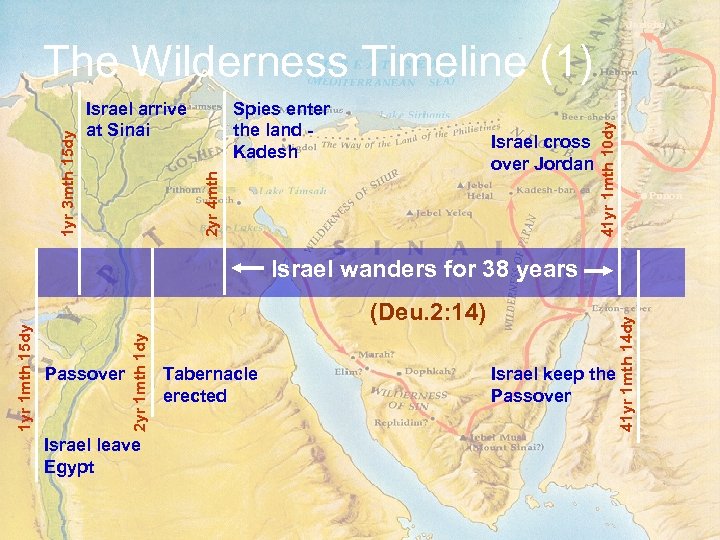
Jericho Israel cross over Jordan 41 yr 1 mth 10 dy Spies enter the land Kadesh Israel arrive at Sinai 2 yr 4 mth 1 yr 3 mth 15 dy The Wilderness Timeline (1) Punon Passover Israel leave Egypt Tabernacle erected Israel keep the Passover 41 yr 1 mth 14 dy (Deu. 2: 14) 2 yr 1 mth 1 dy 1 yr 1 mth 15 dy Israel wanders for 38 years
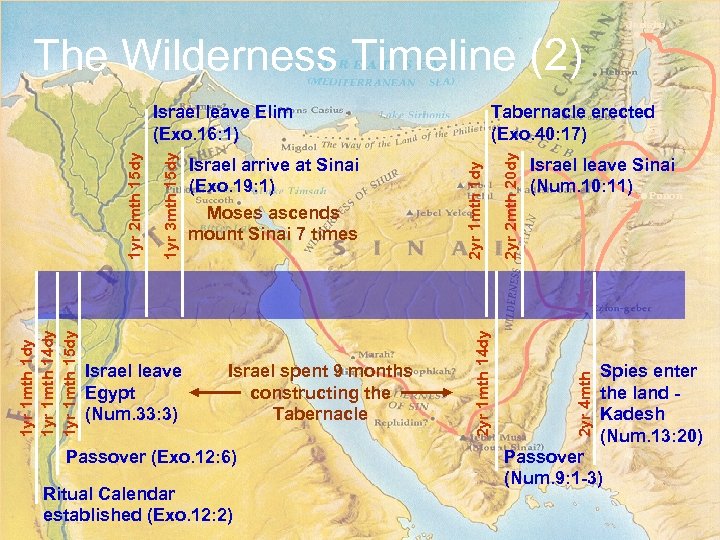
Jericho The Wilderness Timeline (2) Passover (Exo. 12: 6) Ritual Calendar established (Exo. 12: 2) 2 yr 2 mth 20 dy Israel leave Sinai (Num. 10: 11) Punon 2 yr 4 mth Israel spent 9 months constructing the Tabernacle 2 yr 1 mth 1 dy 1 yr 3 mth 15 dy Israel leave Egypt (Num. 33: 3) Israel arrive at Sinai (Exo. 19: 1) Moses ascends mount Sinai 7 times Tabernacle erected (Exo. 40: 17) 2 yr 1 mth 14 dy 1 yr 1 mth 15 dy 1 yr 2 mth 15 dy Israel leave Elim (Exo. 16: 1) Spies enter the land Kadesh (Num. 13: 20) Passover (Num. 9: 1 -3)
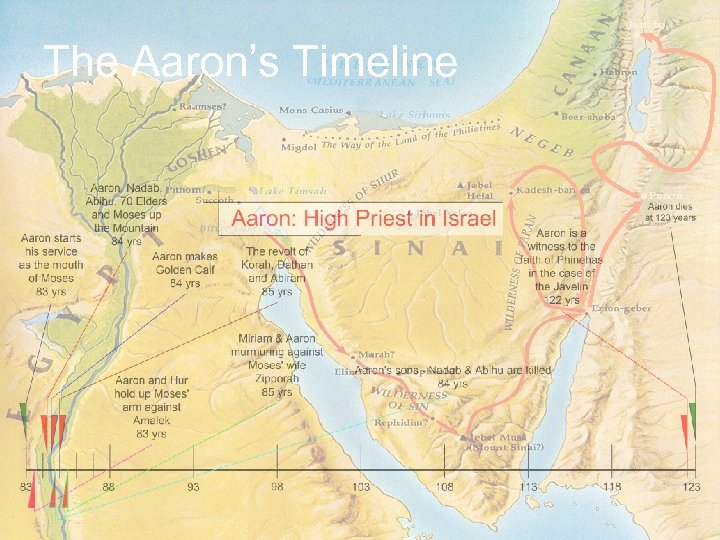
Jericho The Aaron’s Timeline Punon
Aaron and Mountains • Aaron meets Moses in the wilderness in the ‘mount of God’ or Horeb – Exo. 4: 27 • Israel prevailed over Amalek when Aaron and Hur held up Moses’ arm – ‘top of the hill’ – Exo. 17: 10 • Moses and Aaron come before Horeb and receive the 10 Commandments – Exo. 19: 24
Aaron and Mountains • Moses, Aaron, Nadab, Abihu and 70 Elders came before Horeb communed – Exo. 24: 1, 2 • Aaron makes a Golden Calf before Horeb – Exo. 32 • Aaron is taken up to mount Hor to die – Num. 20: 22
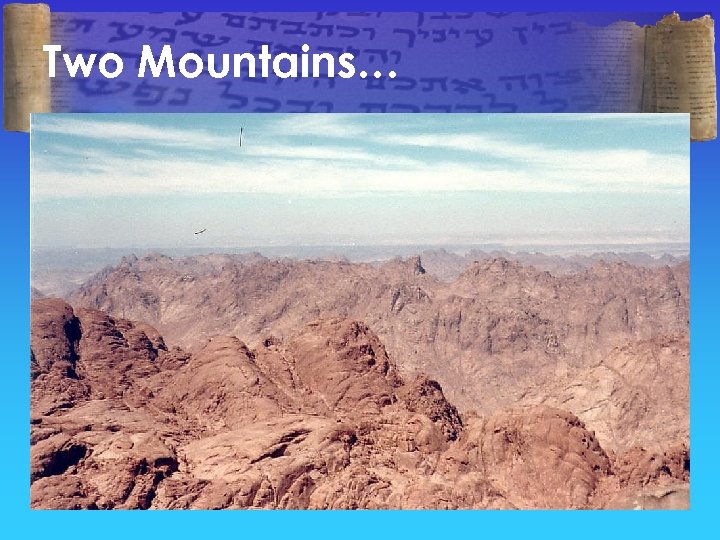
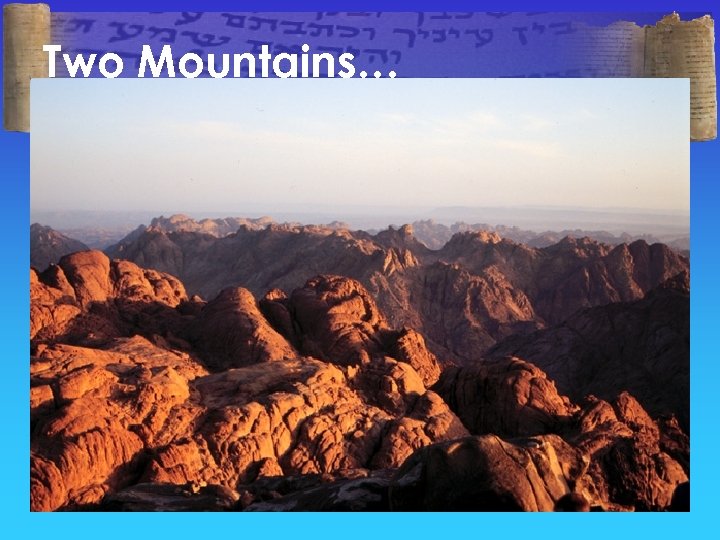
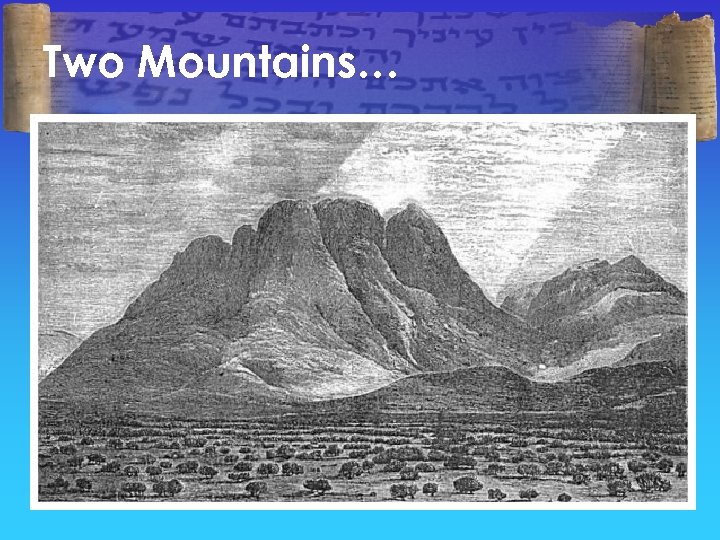
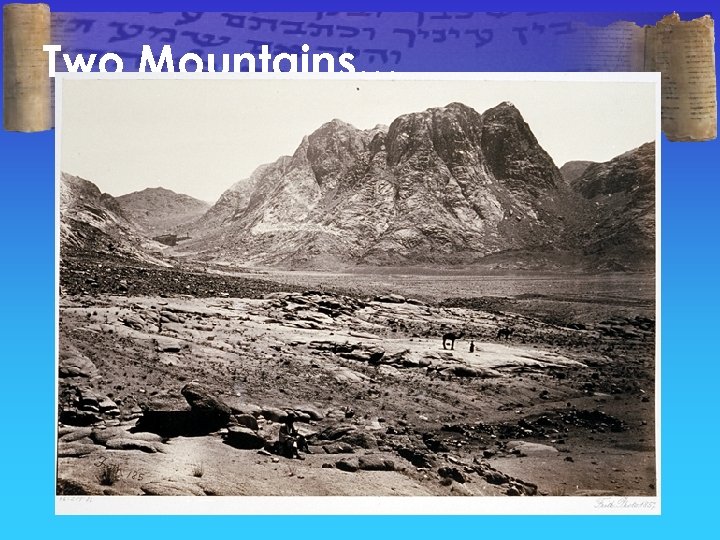
Two Mountains… • Scripture requires: – A ‘mount that might be touched’. – A height that the voice of God could be heard from. – A summit that Moses could not see or hear the Children of Israel. – A stream running down to the plain. • All of these are provided by the area of the modern name of Ras Sufsafeh and Jebel Musa
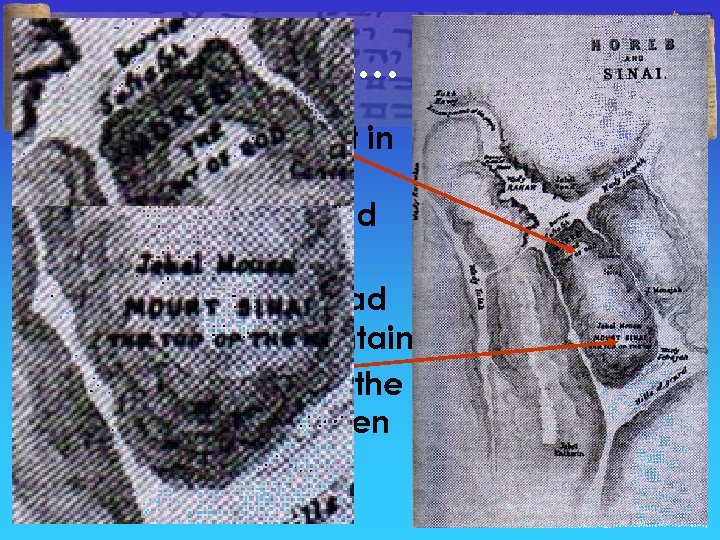
Two Mountains… • Exo. 32 is important in identifying the two peaks of Horeb and Sinai • Moses & Joshua had gone up the mountain. • Leaving Joshua in the joining part between the two mounts.
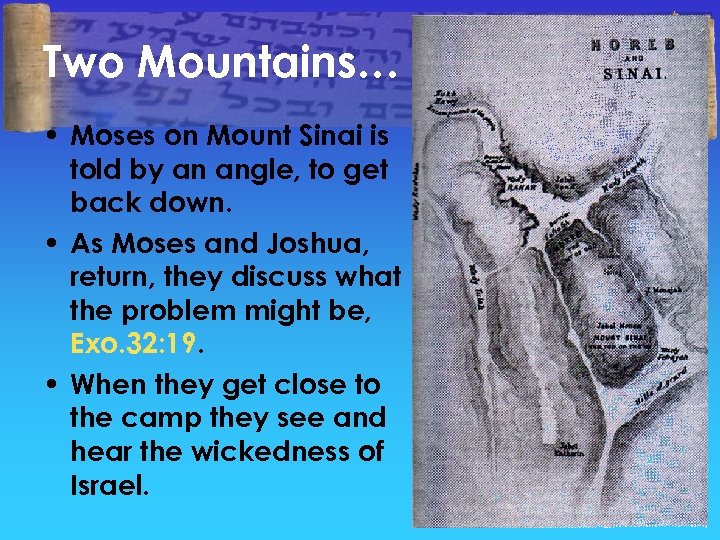
Two Mountains… • Moses on Mount Sinai is told by an angle, to get back down. • As Moses and Joshua, return, they discuss what the problem might be, Exo. 32: 19. • When they get close to the camp they see and hear the wickedness of Israel.
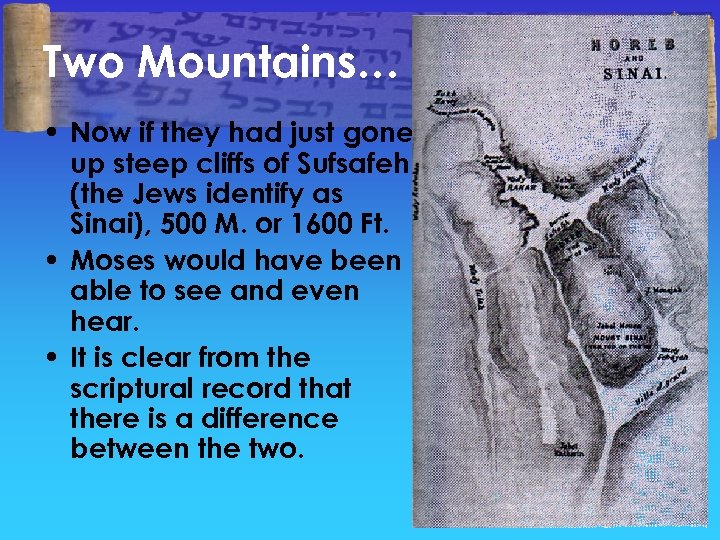
Two Mountains… • Now if they had just gone up steep cliffs of Sufsafeh (the Jews identify as Sinai), 500 M. or 1600 Ft. • Moses would have been able to see and even hear. • It is clear from the scriptural record that there is a difference between the two.
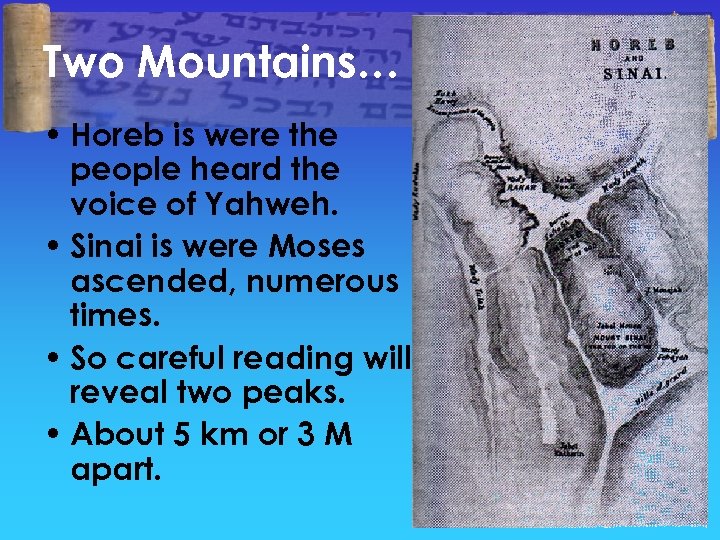
Two Mountains… • Horeb is were the people heard the voice of Yahweh. • Sinai is were Moses ascended, numerous times. • So careful reading will reveal two peaks. • About 5 km or 3 M apart.
Two Mountains…
Two Mountains…
Two Mountains…
Two Mountains…
Two Mountains…
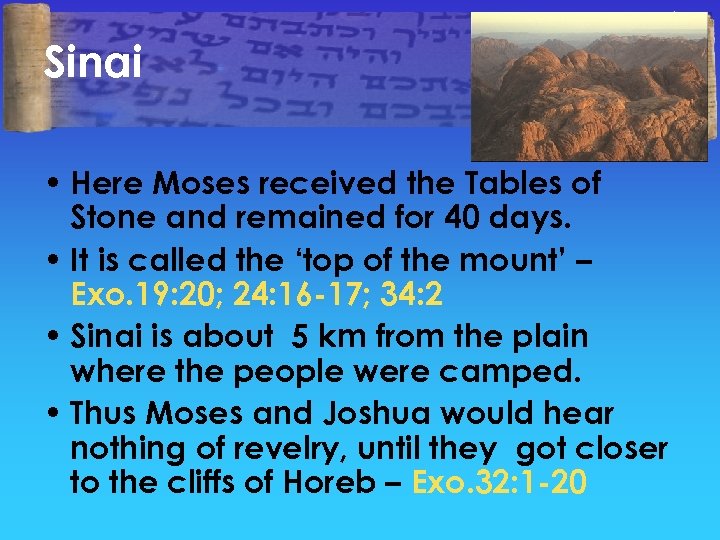
Sinai • Here Moses received the Tables of Stone and remained for 40 days. • It is called the ‘top of the mount’ – Exo. 19: 20; 24: 16 -17; 34: 2 • Sinai is about 5 km from the plain where the people were camped. • Thus Moses and Joshua would hear nothing of revelry, until they got closer to the cliffs of Horeb – Exo. 32: 1 -20
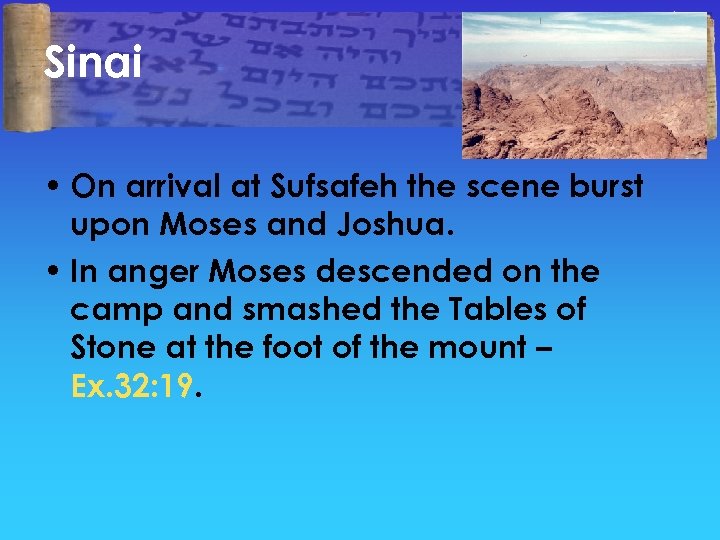
Sinai • On arrival at Sufsafeh the scene burst upon Moses and Joshua. • In anger Moses descended on the camp and smashed the Tables of Stone at the foot of the mount – Ex. 32: 19.
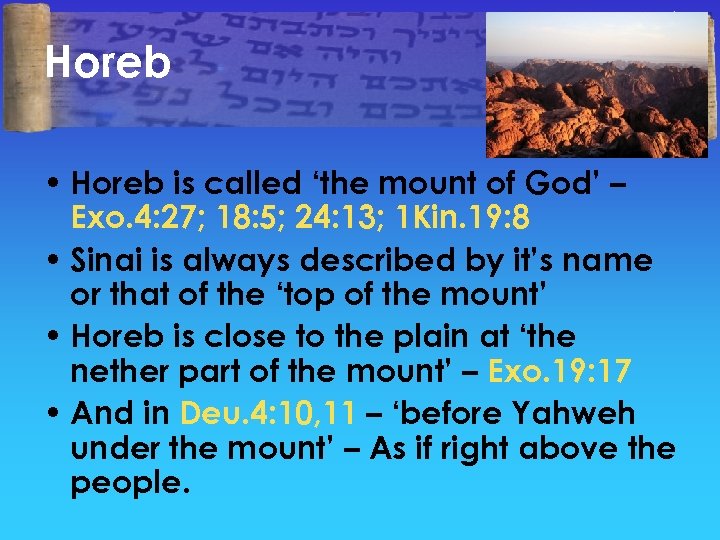
Horeb • Horeb is called ‘the mount of God’ – Exo. 4: 27; 18: 5; 24: 13; 1 Kin. 19: 8 • Sinai is always described by it’s name or that of the ‘top of the mount’ • Horeb is close to the plain at ‘the nether part of the mount’ – Exo. 19: 17 • And in Deu. 4: 10, 11 – ‘before Yahweh under the mount’ – As if right above the people.
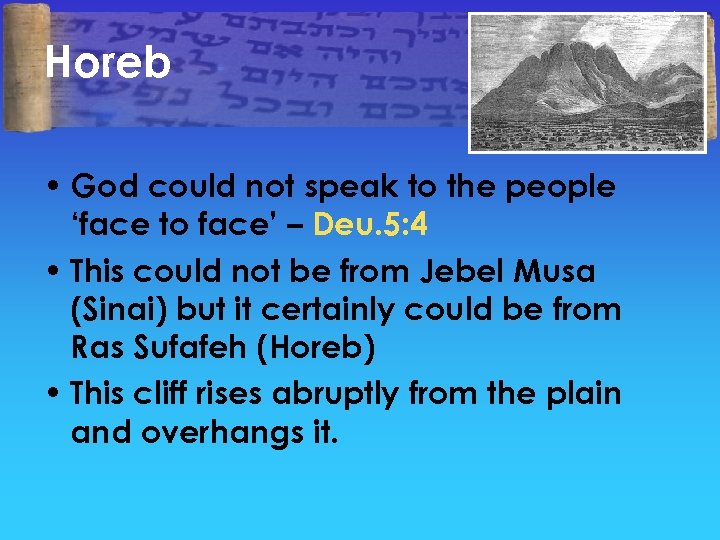
Horeb • God could not speak to the people ‘face to face’ – Deu. 5: 4 • This could not be from Jebel Musa (Sinai) but it certainly could be from Ras Sufafeh (Horeb) • This cliff rises abruptly from the plain and overhangs it.
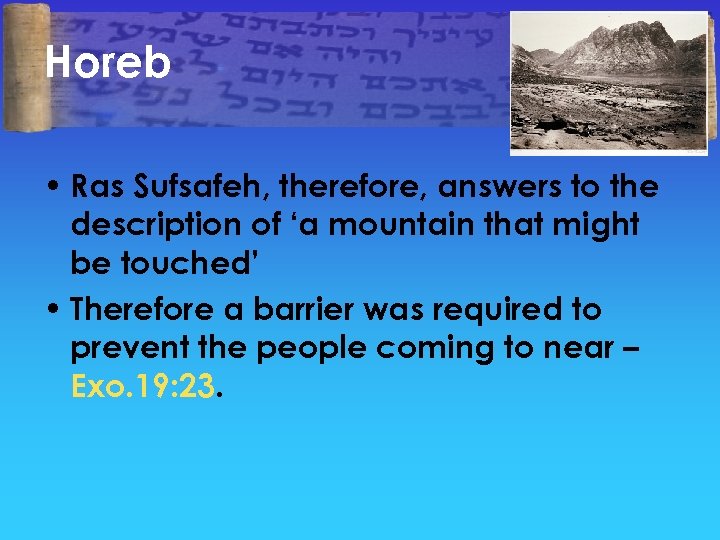
Horeb • Ras Sufsafeh, therefore, answers to the description of ‘a mountain that might be touched’ • Therefore a barrier was required to prevent the people coming to near – Exo. 19: 23.
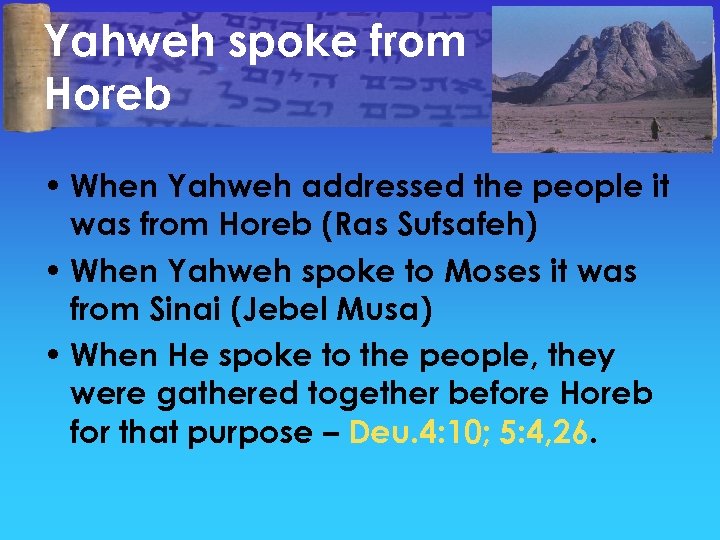
Yahweh spoke from Horeb • When Yahweh addressed the people it was from Horeb (Ras Sufsafeh) • When Yahweh spoke to Moses it was from Sinai (Jebel Musa) • When He spoke to the people, they were gathered together before Horeb for that purpose – Deu. 4: 10; 5: 4, 26.
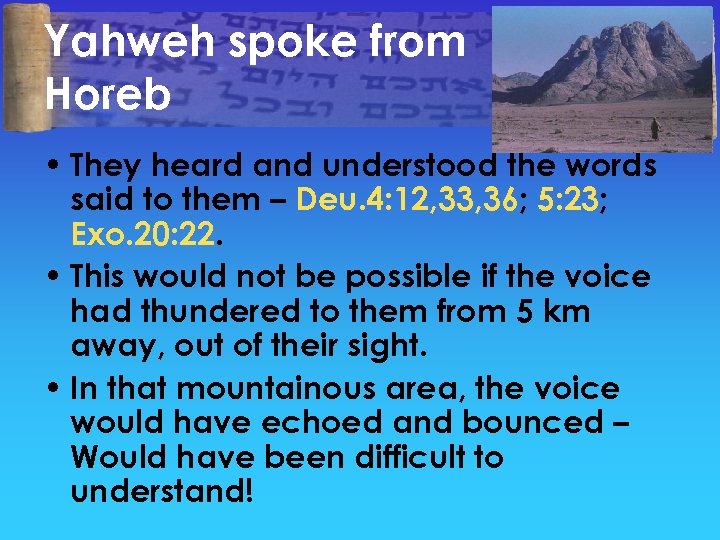
Yahweh spoke from Horeb • They heard and understood the words said to them – Deu. 4: 12, 33, 36; 5: 23; Exo. 20: 22. • This would not be possible if the voice had thundered to them from 5 km away, out of their sight. • In that mountainous area, the voice would have echoed and bounced – Would have been difficult to understand!
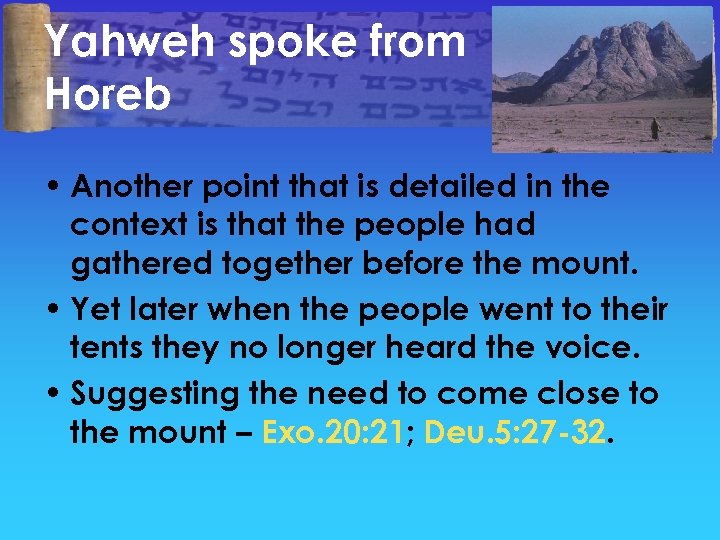
Yahweh spoke from Horeb • Another point that is detailed in the context is that the people had gathered together before the mount. • Yet later when the people went to their tents they no longer heard the voice. • Suggesting the need to come close to the mount – Exo. 20: 21; Deu. 5: 27 -32.
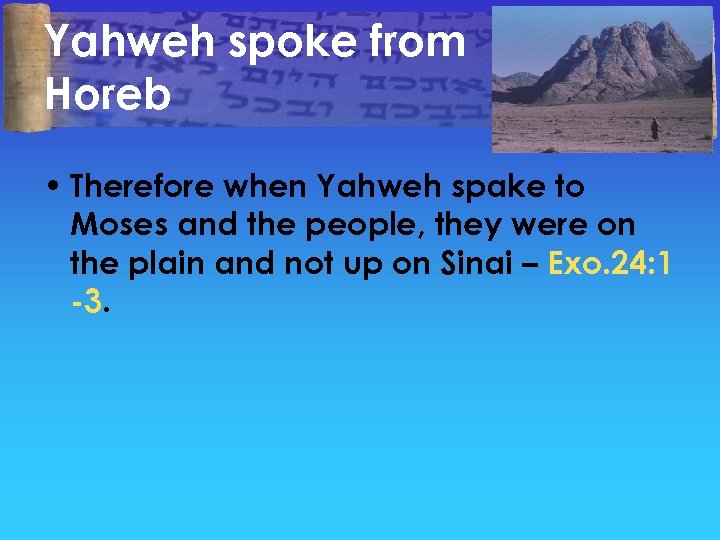
Yahweh spoke from Horeb • Therefore when Yahweh spake to Moses and the people, they were on the plain and not up on Sinai – Exo. 24: 1 -3.
‘The Mountains of the Bible’ John Mc. Farlane - 1848 The country in that region seems to be as nonproductive and wild now as it was then. A recent traveller tells us ' that there is no part of the world where the face of nature, and the natural landmarks, have remained so totally unchanged. In the days of Moses, as now, it was a barren, mountainous region; bare of verdure, and destitute of streams of living water. So that the Almighty was obliged to sustain his people with manna from heaven, and water from the rocks. '
‘The Mountains of the Bible’ John Mc. Farlane - 1848 It is proper, however, to notice, that the 'Horeb' of scripture, and the ' Sinai to be afterwards commented on, do not form two distinct mountains, though different names are used when referring to them. There appears to be a sense in which Horeb is Sinai, and Sinai is Horeb.
‘The Mountains of the Bible’ John Mc. Farlane - 1848 The other division, or second peak, is at present named ' Jebal Musa' by the Arabs, that is, the 'Mountain of Moses; ' so called because from its summit the law was promulgated, and there he received from God the two tables of stone on which that law was inscribed. To this peak, consequently, the name of Sinai has been given.
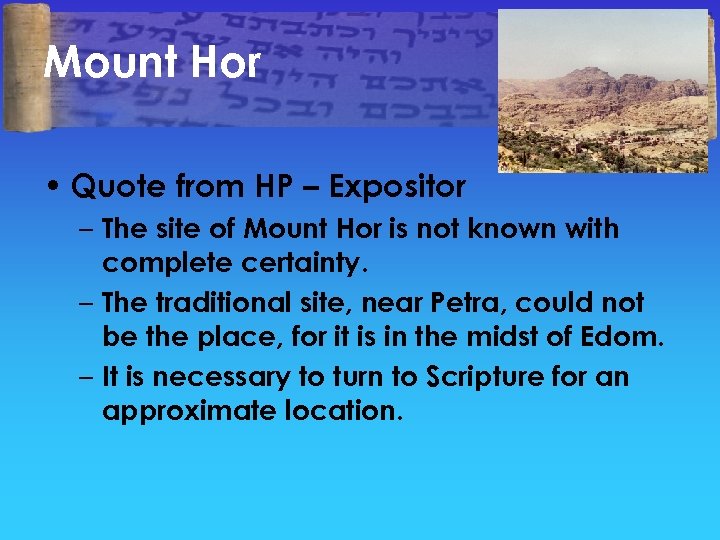
Mount Hor • Quote from HP – Expositor – The site of Mount Hor is not known with complete certainty. – The traditional site, near Petra, could not be the place, for it is in the midst of Edom. – It is necessary to turn to Scripture for an approximate location.
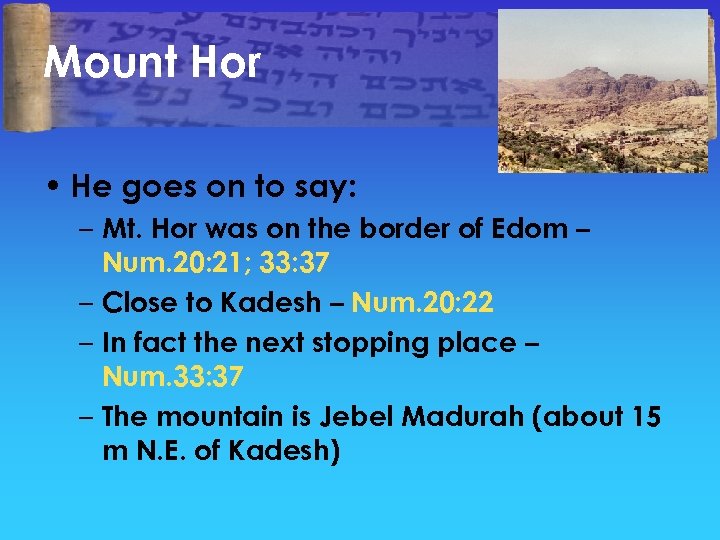
Mount Hor • He goes on to say: – Mt. Hor was on the border of Edom – Num. 20: 21; 33: 37 – Close to Kadesh – Num. 20: 22 – In fact the next stopping place – Num. 33: 37 – The mountain is Jebel Madurah (about 15 m N. E. of Kadesh)
Скачать презентацию Mountains of Yahweh Horeb Sinai and Hor
5b7d11eed3b6a6f6fef07efd1c04b74f.ppt