 Скачать презентацию MOTOROLA V 8 2 GB Service Engineeing
f1025ad90056c8797b588b43e8e8be12.ppt
- Количество слайдов: 25



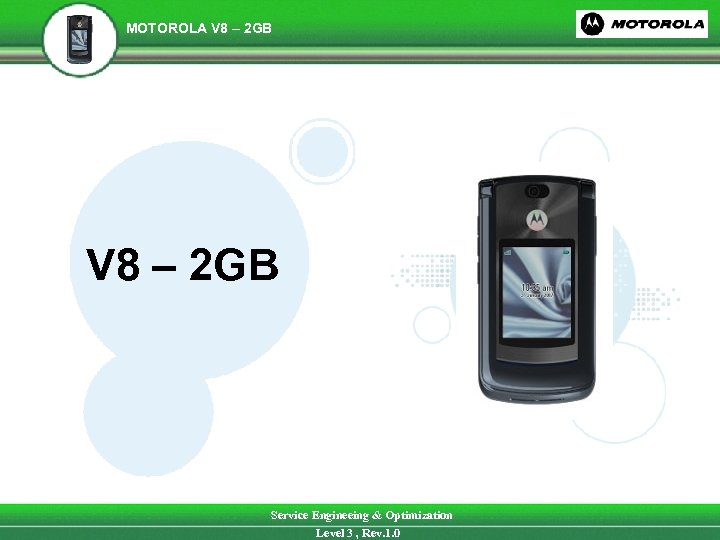
MOTOROLA V 8 – 2 GB Service Engineeing & Optimization Level 3 , Rev. 1. 0
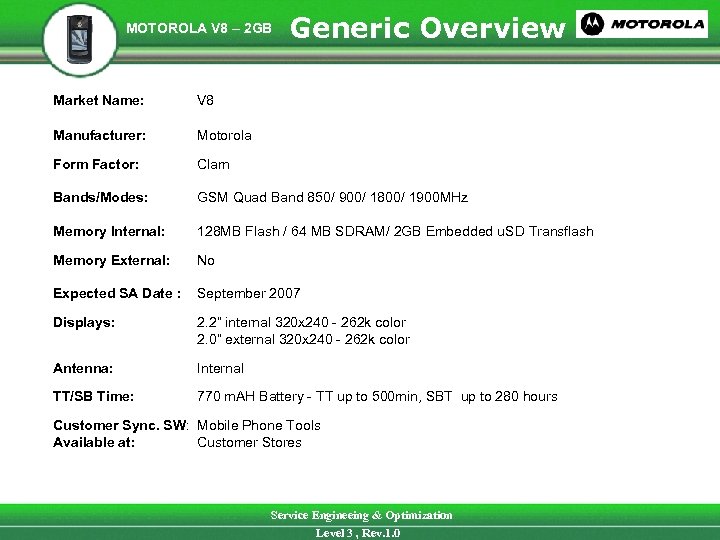
MOTOROLA V 8 – 2 GB Generic Overview Market Name: V 8 Manufacturer: Motorola Form Factor: Clam Bands/Modes: GSM Quad Band 850/ 900/ 1800/ 1900 MHz Memory Internal: 128 MB Flash / 64 MB SDRAM/ 2 GB Embedded u. SD Transflash Memory External: No Expected SA Date : September 2007 Displays: 2. 2” internal 320 x 240 - 262 k color 2. 0” external 320 x 240 - 262 k color Antenna: Internal TT/SB Time: 770 m. AH Battery - TT up to 500 min, SBT up to 280 hours Customer Sync. SW: Mobile Phone Tools Available at: Customer Stores Service Engineeing & Optimization Level 3 , Rev. 1. 0
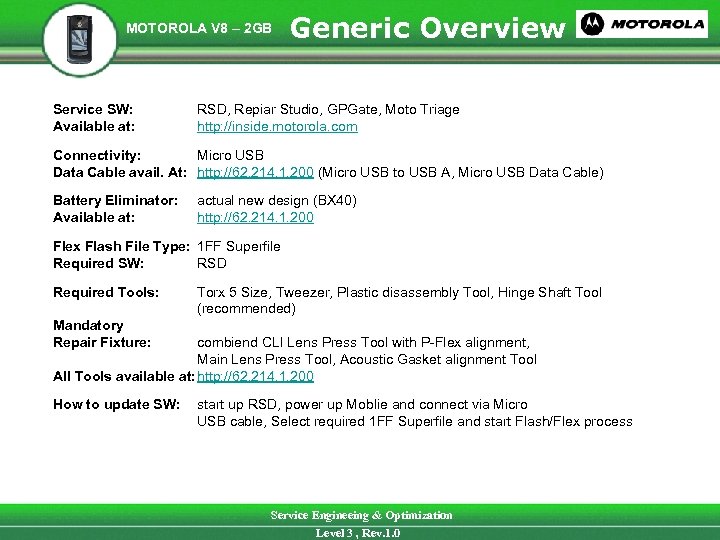
MOTOROLA V 8 – 2 GB Service SW: Available at: Generic Overview RSD, Repiar Studio, GPGate, Moto Triage http: //inside. motorola. com Connectivity: Micro USB Data Cable avail. At: http: //62. 214. 1. 200 (Micro USB to USB A, Micro USB Data Cable) Battery Eliminator: Available at: actual new design (BX 40) http: //62. 214. 1. 200 Flex Flash File Type: 1 FF Superfile Required SW: RSD Required Tools: Torx 5 Size, Tweezer, Plastic disassembly Tool, Hinge Shaft Tool (recommended) Mandatory Repair Fixture: combiend CLI Lens Press Tool with P-Flex alignment, Main Lens Press Tool, Acoustic Gasket alignment Tool All Tools available at: http: //62. 214. 1. 200 How to update SW: start up RSD, power up Moblie and connect via Micro USB cable, Select required 1 FF Superfile and start Flash/Flex process Service Engineeing & Optimization Level 3 , Rev. 1. 0
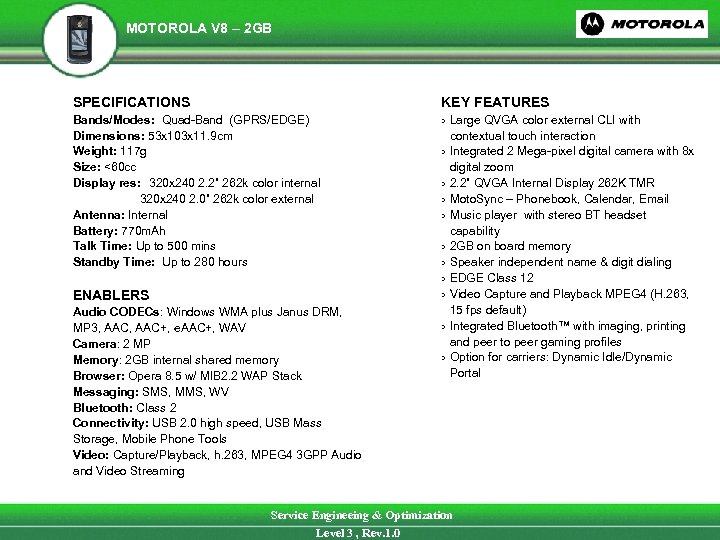
MOTOROLA V 8 – 2 GB SPECIFICATIONS KEY FEATURES Bands/Modes: Quad-Band (GPRS/EDGE) Dimensions: 53 x 103 x 11. 9 cm Weight: 117 g Size: <60 cc Display res: 320 x 240 2. 2” 262 k color internal 320 x 240 2. 0” 262 k color external Antenna: Internal Battery: 770 m. Ah Talk Time: Up to 500 mins Standby Time: Up to 280 hours > ENABLERS Audio CODECs: Windows WMA plus Janus DRM, MP 3, AAC+, e. AAC+, WAV Camera: 2 MP Memory: 2 GB internal shared memory Browser: Opera 8. 5 w/ MIB 2. 2 WAP Stack Messaging: SMS, MMS, WV Bluetooth: Class 2 Connectivity: USB 2. 0 high speed, USB Mass Storage, Mobile Phone Tools Video: Capture/Playback, h. 263, MPEG 4 3 GPP Audio and Video Streaming Large QVGA color external CLI with contextual touch interaction > Integrated 2 Mega-pixel digital camera with 8 x digital zoom > 2. 2” QVGA Internal Display 262 K TMR > Moto. Sync – Phonebook, Calendar, Email > Music player with stereo BT headset capability > 2 GB on board memory > Speaker independent name & digit dialing > EDGE Class 12 > Video Capture and Playback MPEG 4 (H. 263, 15 fps default) > Integrated Bluetooth™ with imaging, printing and peer to peer gaming profiles > Option for carriers: Dynamic Idle/Dynamic Portal Service Engineeing & Optimization Level 3 , Rev. 1. 0
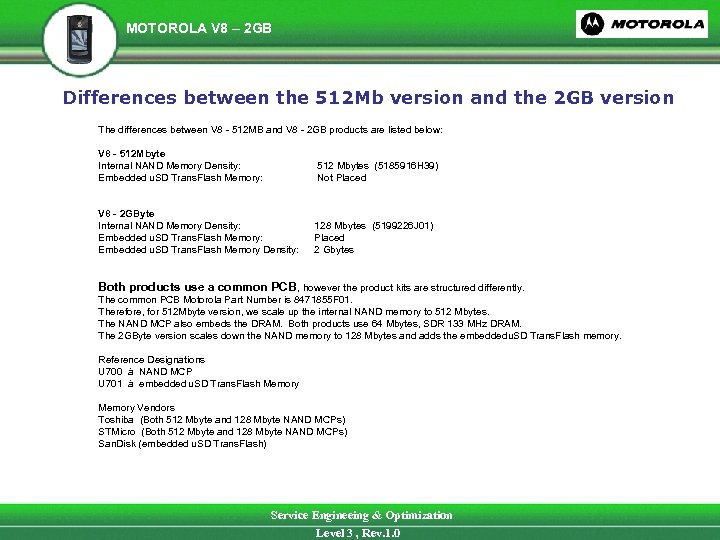
MOTOROLA V 8 – 2 GB Differences between the 512 Mb version and the 2 GB version The differences between V 8 - 512 MB and V 8 - 2 GB products are listed below: V 8 - 512 Mbyte Internal NAND Memory Density: 512 Mbytes (5185916 H 39) Embedded u. SD Trans. Flash Memory: Not Placed V 8 - 2 GByte Internal NAND Memory Density: 128 Mbytes (5199226 J 01) Embedded u. SD Trans. Flash Memory: Placed Embedded u. SD Trans. Flash Memory Density: 2 Gbytes Both products use a common PCB, however the product kits are structured differently. The common PCB Motorola Part Number is 8471855 F 01. Therefore, for 512 Mbyte version, we scale up the internal NAND memory to 512 Mbytes. The NAND MCP also embeds the DRAM. Both products use 64 Mbytes, SDR 133 MHz DRAM. The 2 GByte version scales down the NAND memory to 128 Mbytes and adds the embedded SD Trans. Flash memory. u Reference Designations U 700 à NAND MCP U 701 à embedded u. SD Trans. Flash Memory Vendors Toshiba (Both 512 Mbyte and 128 Mbyte NAND MCPs) STMicro (Both 512 Mbyte and 128 Mbyte NAND MCPs) San. Disk (embedded u. SD Trans. Flash) Service Engineeing & Optimization Level 3 , Rev. 1. 0
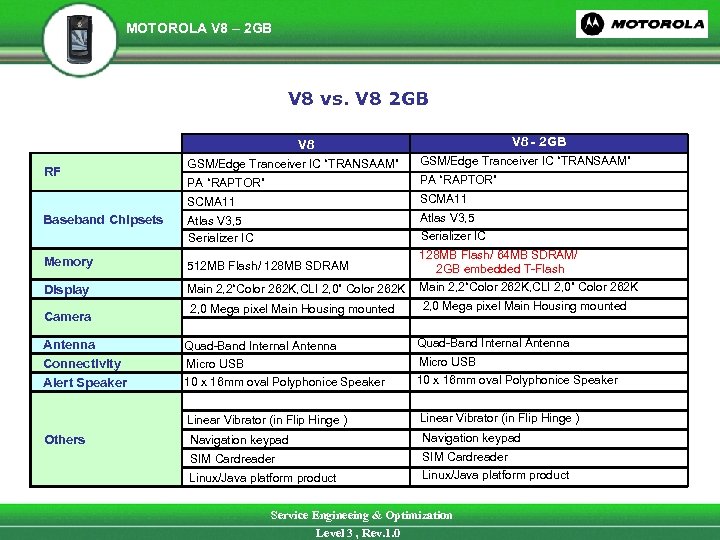
MOTOROLA V 8 – 2 GB V 8 vs. V 8 2 GB V 8 - 2 GB V 8 GSM/Edge Tranceiver IC “TRANSAAM” PA “RAPTOR” SCMA 11 Baseband Chipsets Atlas V 3, 5 Serializer IC Memory 512 MB Flash/ 128 MB SDRAM Display Main 2, 2“Color 262 K, CLI 2, 0” Color 262 K 128 MB Flash/ 64 MB SDRAM/ 2 GB embedded T-Flash Main 2, 2“Color 262 K, CLI 2, 0” Color 262 K 2, 0 Mega pixel Main Housing mounted RF Camera Others Quad-Band Internal Antenna Micro USB 10 x 16 mm oval Polyphonice Speaker Linear Vibrator (in Flip Hinge ) Antenna Connectivity Alert Speaker Linear Vibrator (in Flip Hinge ) Navigation keypad SIM Cardreader Linux/Java platform product Service Engineeing & Optimization Level 3 , Rev. 1. 0
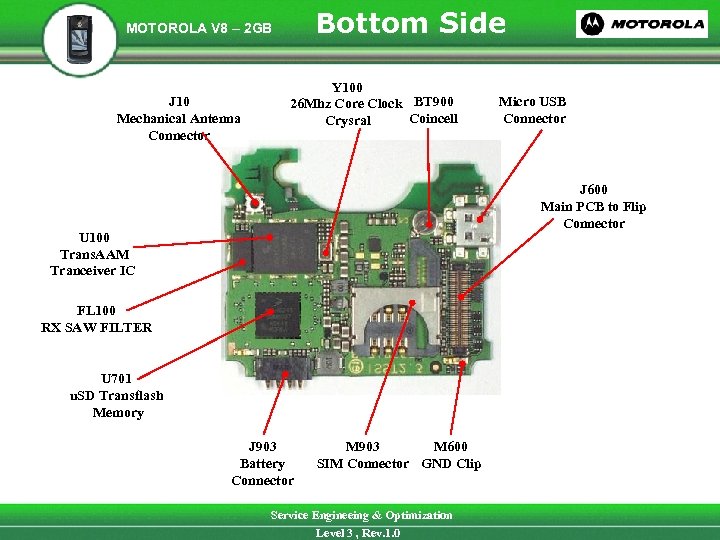
Bottom Side MOTOROLA V 8 – 2 GB J 10 Mechanical Antenna Connector Y 100 26 Mhz Core Clock BT 900 Coincell Crysral Micro USB Connector J 600 Main PCB to Flip Connector U 100 Trans. AAM Tranceiver IC FL 100 RX SAW FILTER U 701 u. SD Transflash Memory J 903 Battery Connector M 903 M 600 SIM Connector GND Clip Service Engineeing & Optimization Level 3 , Rev. 1. 0
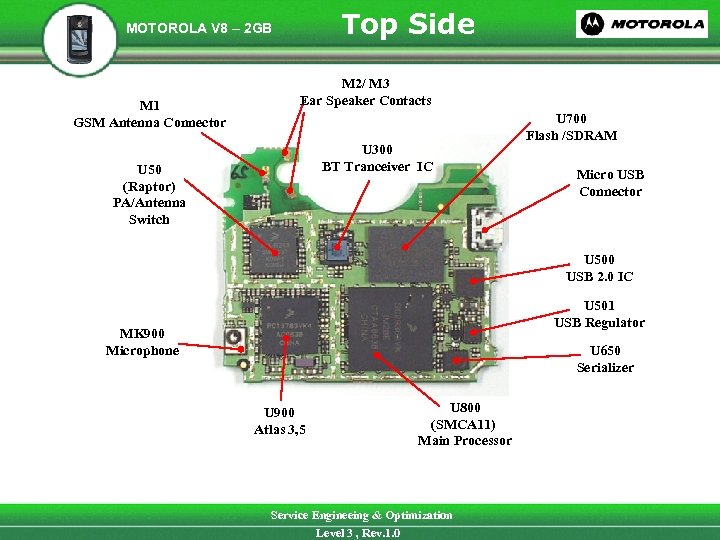
Top Side MOTOROLA V 8 – 2 GB M 1 GSM Antenna Connector M 2/ M 3 Ear Speaker Contacts U 300 BT Tranceiver IC U 50 (Raptor) PA/Antenna Switch U 700 Flash /SDRAM Micro USB Connector U 500 USB 2. 0 IC U 501 USB Regulator MK 900 Microphone U 650 Serializer U 900 Atlas 3, 5 U 800 (SMCA 11) Main Processor Service Engineeing & Optimization Level 3 , Rev. 1. 0
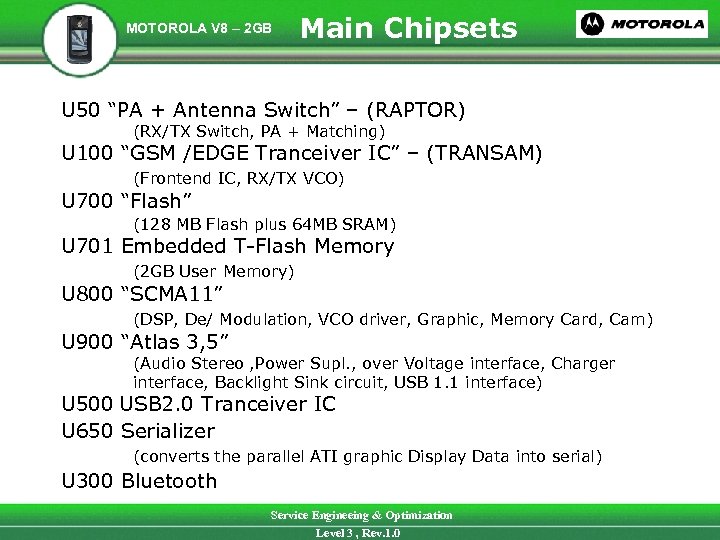
MOTOROLA V 8 – 2 GB Main Chipsets U 50 “PA + Antenna Switch” – (RAPTOR) (RX/TX Switch, PA + Matching) U 100 “GSM /EDGE Tranceiver IC” – (TRANSAM) (Frontend IC, RX/TX VCO) U 700 “Flash” (128 MB Flash plus 64 MB SRAM) U 701 Embedded T-Flash Memory (2 GB User Memory) U 800 “SCMA 11” (DSP, De/ Modulation, VCO driver, Graphic, Memory Card, Cam) U 900 “Atlas 3, 5” (Audio Stereo , Power Supl. , over Voltage interface, Charger interface, Backlight Sink circuit, USB 1. 1 interface) U 500 USB 2. 0 Tranceiver IC U 650 Serializer (converts the parallel ATI graphic Display Data into serial) U 300 Bluetooth Service Engineeing & Optimization Level 3 , Rev. 1. 0
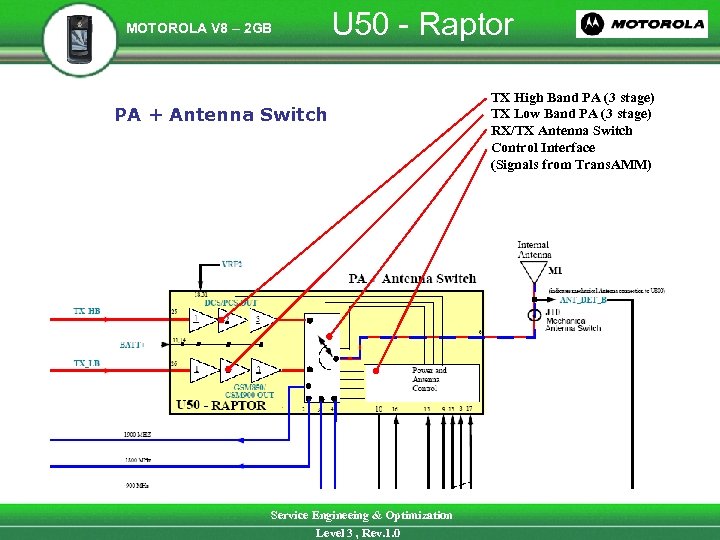
MOTOROLA V 8 – 2 GB U 50 - Raptor PA + Antenna Switch Service Engineeing & Optimization Level 3 , Rev. 1. 0 TX High Band PA (3 stage) TX Low Band PA (3 stage) RX/TX Antenna Switch Control Interface (Signals from Trans. AMM)
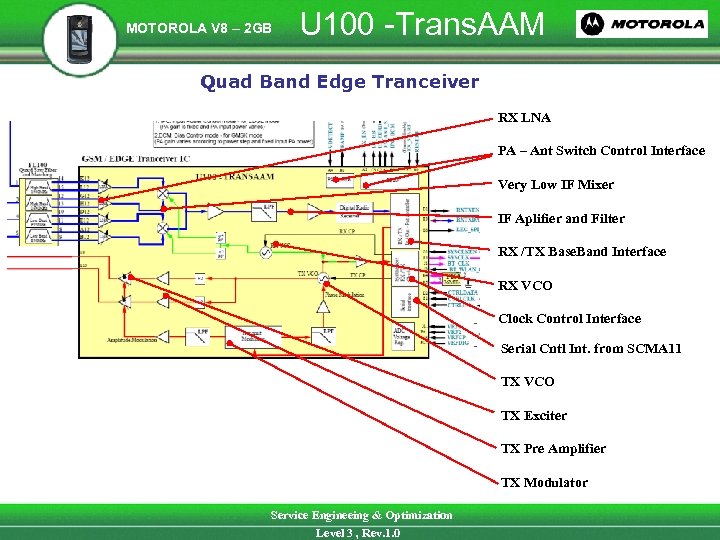
MOTOROLA V 8 – 2 GB U 100 -Trans. AAM Quad Band Edge Tranceiver RX LNA PA – Ant Switch Control Interface Very Low IF Mixer IF Aplifier and Filter RX /TX Base. Band Interface RX VCO Clock Control Interface Serial Cntl Int. from SCMA 11 TX VCO TX Exciter TX Pre Amplifier TX Modulator Service Engineeing & Optimization Level 3 , Rev. 1. 0
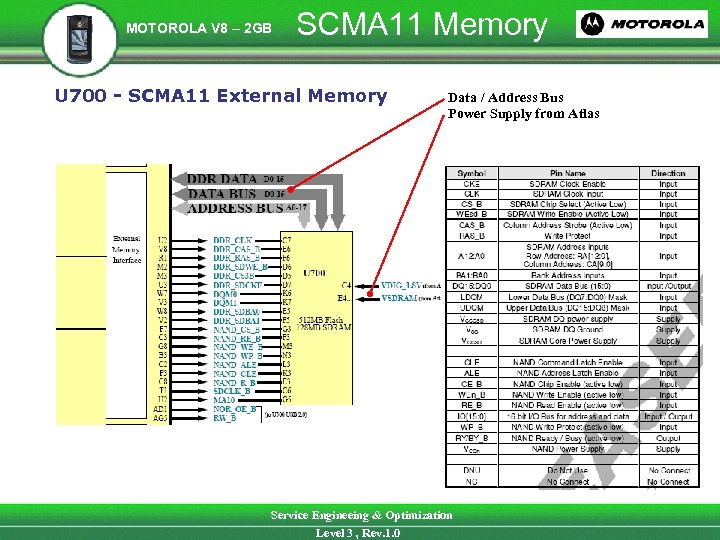
MOTOROLA V 8 – 2 GB SCMA 11 Memory U 700 - SCMA 11 External Memory Data / Address Bus Power Supply from Atlas Service Engineeing & Optimization Level 3 , Rev. 1. 0
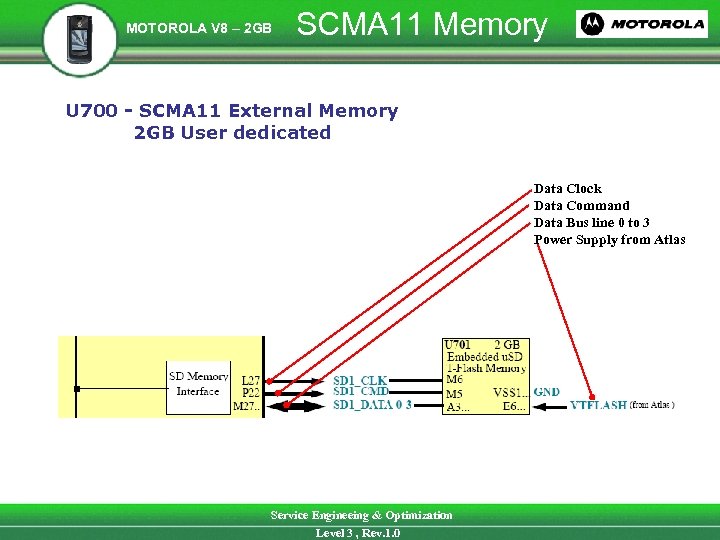
MOTOROLA V 8 – 2 GB SCMA 11 Memory U 700 - SCMA 11 External Memory 2 GB User dedicated Data Clock Data Command Data Bus line 0 to 3 Power Supply from Atlas Service Engineeing & Optimization Level 3 , Rev. 1. 0
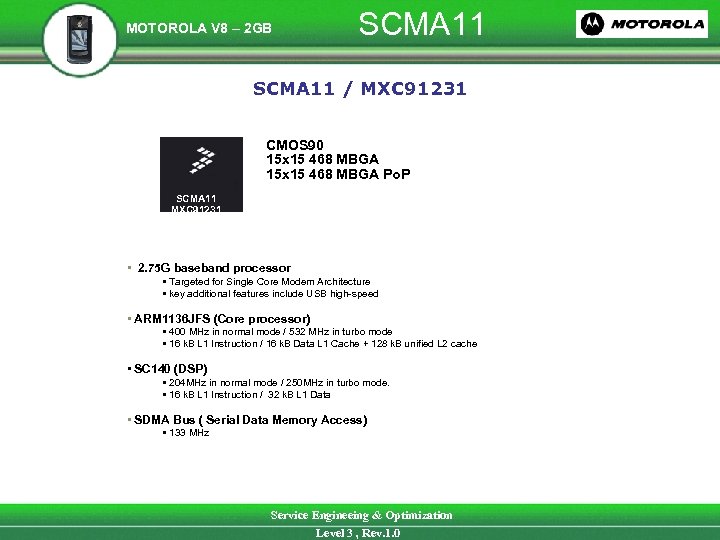
MOTOROLA V 8 – 2 GB SCMA 11 / MXC 91231 CMOS 90 15 x 15 468 MBGA Po. P SCMA 11 MXC 91231 • 2. 75 G baseband processor • Targeted for Single Core Modem Architecture • key additional features include USB high-speed • ARM 1136 JFS (Core processor) ARGON-LV • 400 MHz in normal mode / 532 MHz in turbo mode MXC 91321 • 16 k. B L 1 Instruction / 16 k. B Data L 1 Cache + 128 k. B unified L 2 cache • SC 140 (DSP) • 204 MHz in normal mode / 250 MHz in turbo mode. • 16 k. B L 1 Instruction / 32 k. B L 1 Data • SDMA Bus ( Serial Data Memory Access) • 133 MHz Service Engineeing & Optimization Level 3 , Rev. 1. 0
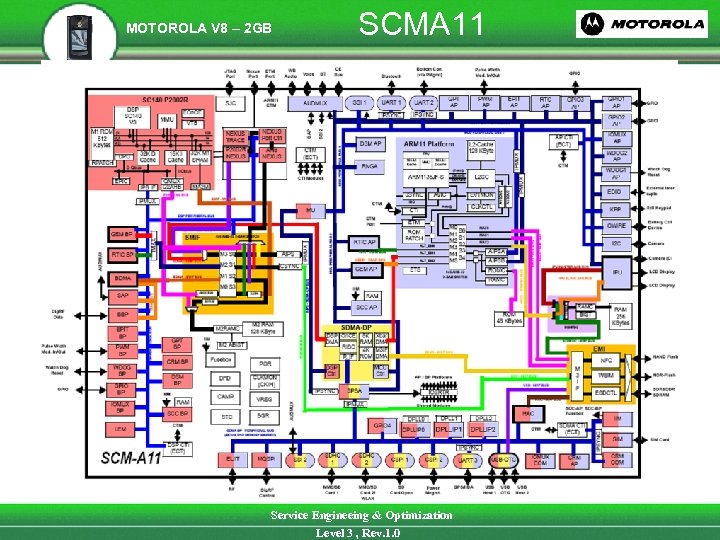
MOTOROLA V 8 – 2 GB SCMA 11 Service Engineeing & Optimization Level 3 , Rev. 1. 0
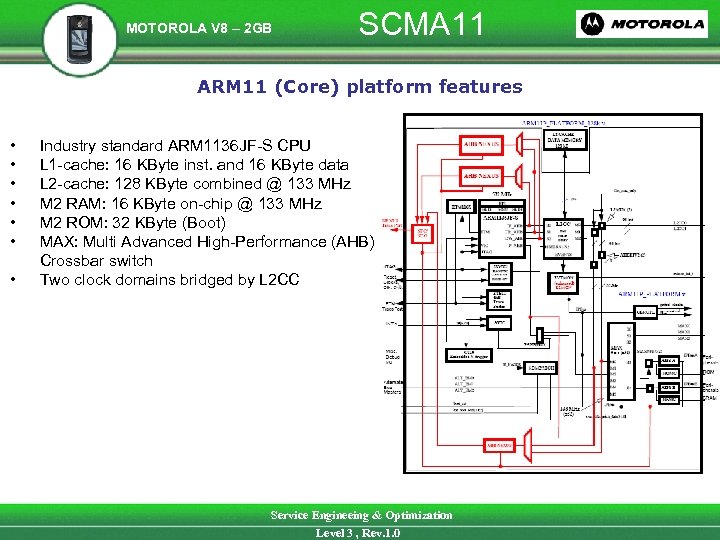
MOTOROLA V 8 – 2 GB SCMA 11 ARM 11 (Core) platform features • • Industry standard ARM 1136 JF-S CPU L 1 -cache: 16 KByte inst. and 16 KByte data L 2 -cache: 128 KByte combined @ 133 MHz M 2 RAM: 16 KByte on-chip @ 133 MHz M 2 ROM: 32 KByte (Boot) MAX: Multi Advanced High-Performance (AHB) Crossbar switch Two clock domains bridged by L 2 CC Service Engineeing & Optimization Level 3 , Rev. 1. 0
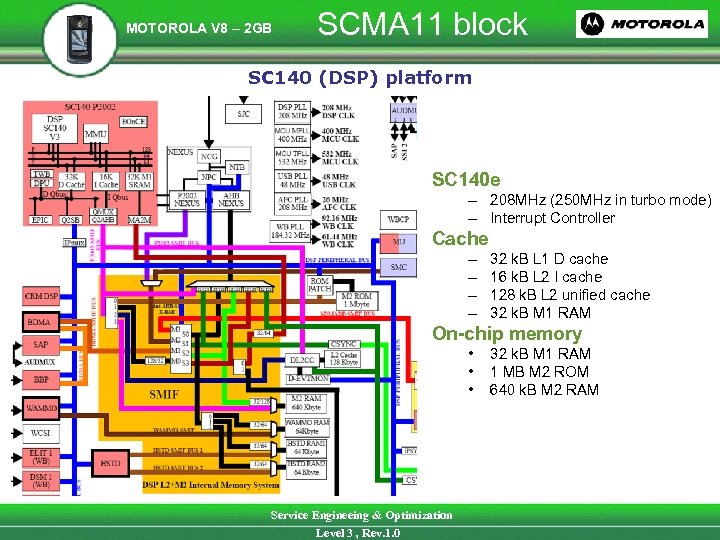
MOTOROLA V 8 – 2 GB SCMA 11 block SC 140 (DSP) platform SC 140 e – 208 MHz (250 MHz in turbo mode) – Interrupt Controller Cache – – 32 k. B L 1 D cache 16 k. B L 2 I cache 128 k. B L 2 unified cache 32 k. B M 1 RAM On-chip memory • • • Service Engineeing & Optimization Level 3 , Rev. 1. 0 32 k. B M 1 RAM 1 MB M 2 ROM 640 k. B M 2 RAM
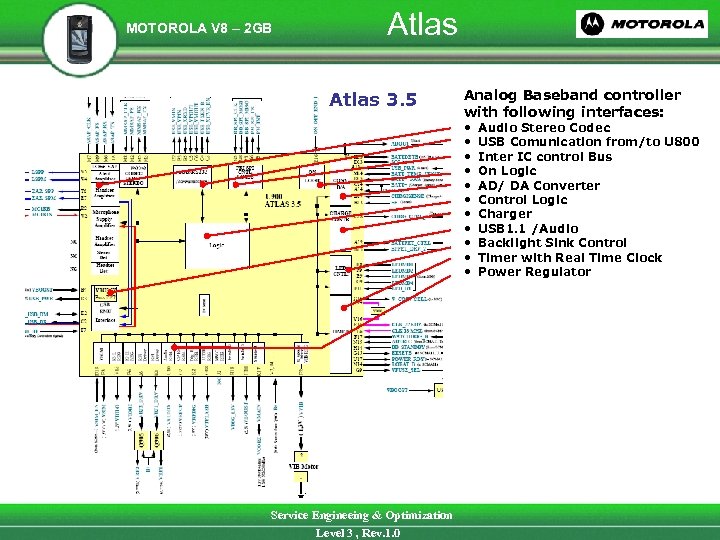
MOTOROLA V 8 – 2 GB Atlas 3. 5 Analog Baseband controller with following interfaces: • • • Service Engineeing & Optimization Level 3 , Rev. 1. 0 Audio Stereo Codec USB Comunication from/to U 800 Inter IC control Bus On Logic AD/ DA Converter Control Logic Charger USB 1. 1 /Audio Backlight Sink Control Timer with Real Time Clock Power Regulator
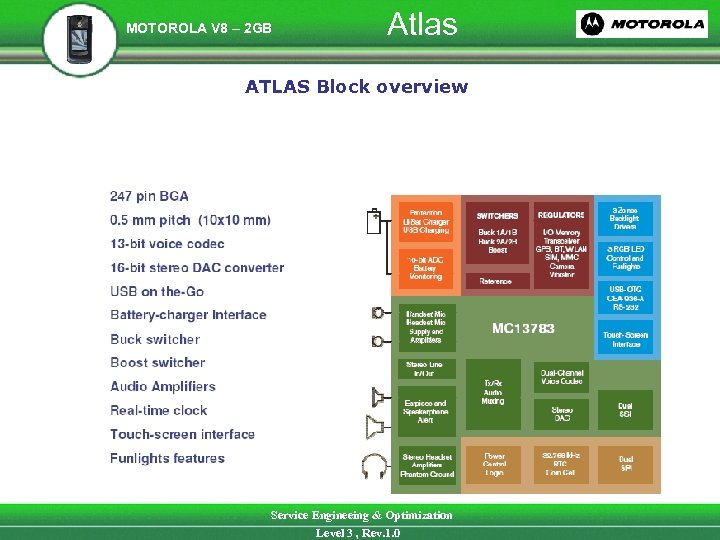
MOTOROLA V 8 – 2 GB Atlas ATLAS Block overview Service Engineeing & Optimization Level 3 , Rev. 1. 0
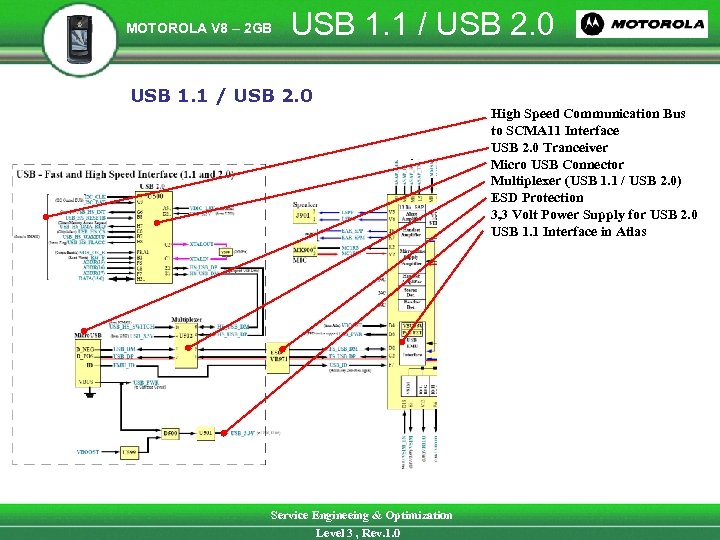
MOTOROLA V 8 – 2 GB USB 1. 1 / USB 2. 0 Service Engineeing & Optimization Level 3 , Rev. 1. 0 High Speed Communication Bus to SCMA 11 Interface USB 2. 0 Tranceiver Micro USB Connector Multiplexer (USB 1. 1 / USB 2. 0) ESD Protection 3, 3 Volt Power Supply for USB 2. 0 USB 1. 1 Interface in Atlas
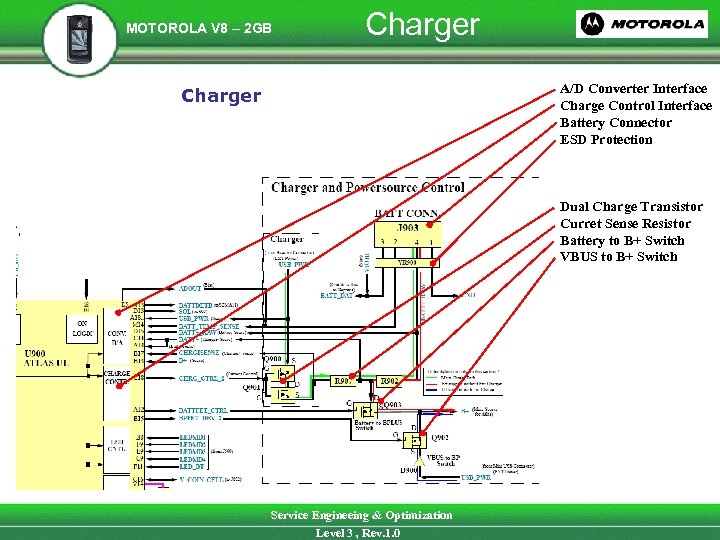
MOTOROLA V 8 – 2 GB Charger A/D Converter Interface Charge Control Interface Battery Connector ESD Protection Charger Dual Charge Transistor Curret Sense Resistor Battery to B+ Switch VBUS to B+ Switch Service Engineeing & Optimization Level 3 , Rev. 1. 0
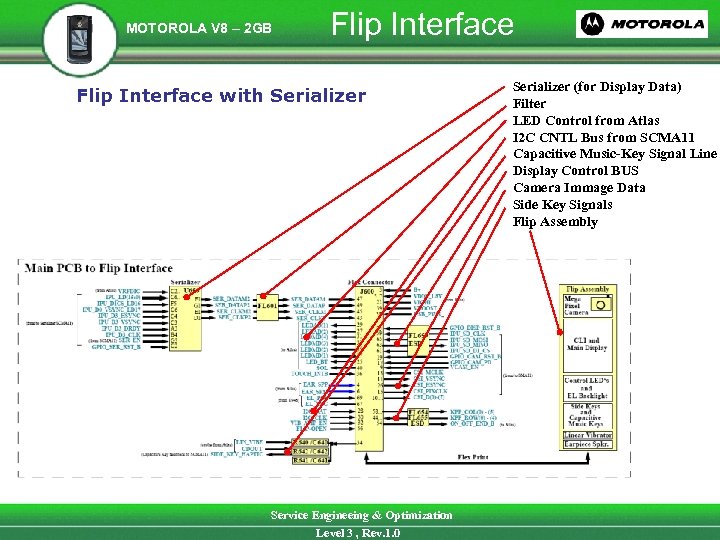
MOTOROLA V 8 – 2 GB Flip Interface with Serializer Service Engineeing & Optimization Level 3 , Rev. 1. 0 Serializer (for Display Data) Filter LED Control from Atlas I 2 C CNTL Bus from SCMA 11 Capacitive Music-Key Signal Line Display Control BUS Camera Immage Data Side Key Signals Flip Assembly
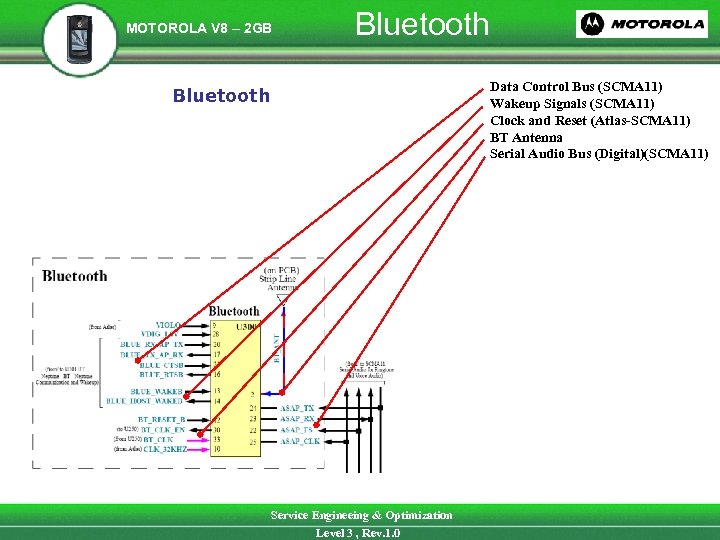
MOTOROLA V 8 – 2 GB Bluetooth Service Engineeing & Optimization Level 3 , Rev. 1. 0 Data Control Bus (SCMA 11) Wakeup Signals (SCMA 11) Clock and Reset (Atlas-SCMA 11) BT Antenna Serial Audio Bus (Digital)(SCMA 11)
MOTOROLA V 8 – 2 GB Test Requirments • This Product can be phased on following Testsets only: • Agilent 8960 • R&S CMU 200. Service Engineeing & Optimization Level 3 , Rev. 1. 0
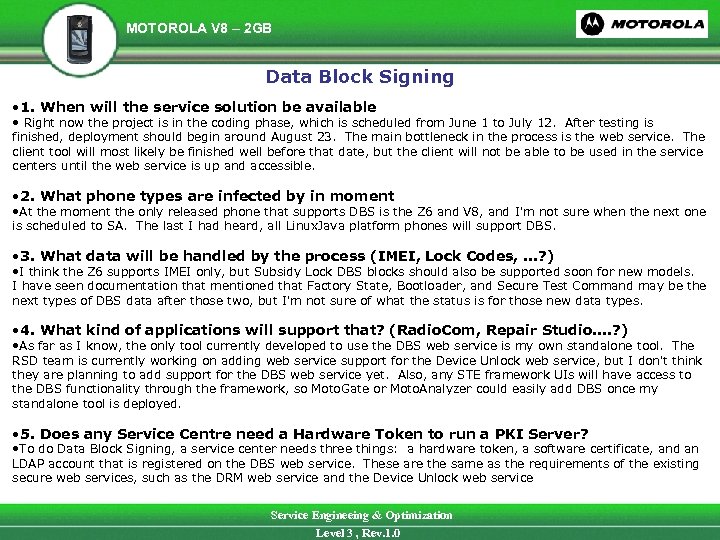
MOTOROLA V 8 – 2 GB Data Block Signing • 1. When will the service solution be available • Right now the project is in the coding phase, which is scheduled from June 1 to July 12. After testing is finished, deployment should begin around August 23. The main bottleneck in the process is the web service. The client tool will most likely be finished well before that date, but the client will not be able to be used in the service centers until the web service is up and accessible. • 2. What phone types are infected by in moment • At the moment the only released phone that supports DBS is the Z 6 and V 8, and I'm not sure when the next one is scheduled to SA. The last I had heard, all Linux. Java platform phones will support DBS. • 3. What data will be handled by the process (IMEI, Lock Codes, . . . ? ) • I think the Z 6 supports IMEI only, but Subsidy Lock DBS blocks should also be supported soon for new models. I have seen documentation that mentioned that Factory State, Bootloader, and Secure Test Command may be the next types of DBS data after those two, but I'm not sure of what the status is for those new data types. • 4. What kind of applications will support that? (Radio. Com, Repair Studio. . ? ) • As far as I know, the only tool currently developed to use the DBS web service is my own standalone tool. The RSD team is currently working on adding web service support for the Device Unlock web service, but I don't think they are planning to add support for the DBS web service yet. Also, any STE framework UIs will have access to the DBS functionality through the framework, so Moto. Gate or Moto. Analyzer could easily add DBS once my standalone tool is deployed. • 5. Does any Service Centre need a Hardware Token to run a PKI Server? • To do Data Block Signing, a service center needs three things: a hardware token, a software certificate, and an LDAP account that is registered on the DBS web service. These are the same as the requirements of the existing secure web services, such as the DRM web service and the Device Unlock web service Service Engineeing & Optimization Level 3 , Rev. 1. 0
Скачать презентацию MOTOROLA V 8 2 GB Service Engineeing
f1025ad90056c8797b588b43e8e8be12.ppt