 Скачать презентацию MOTOR INSURANCE CLAIMS BY R R JOSHI EX-MANAGER
72b1c4badc29cce3a53a1621f2cc03ec.ppt
- Количество слайдов: 95



MOTOR INSURANCE CLAIMS BY R. R. JOSHI EX-MANAGER UNITED INDIA INSURANCE COMPANY LTD.
Motor Constitutes 45% of Total Premium
DEFINITION OF MOTOR VEHICLE Motor vehicle means any mechanically propelled vehicle adapted for use upon roads whether the power of propulsion is transmitted thereto from an external or internal source and includes chassis to which a body has not been attached and a trailer
Historical Background First Motor Car was introduced into England in 1894 and first Motor Policy was introduced in 1895 to cover Third Party Liability. By 1899, accidental damage to the car was added to the policy n Road Traffic Act 1930 and 1934 introduced compulsory Third Party Insurance n In India, the Motor Vehicles Act was passed in 1939. The Act was revised in 1988 n The Motor Tariff was withdrawn in 2007. However, the policy formats and relevant General Regulations were allowed to continue n
LEGISLATIVE ENVIRONMENT n The Insurance act n The Motor Vehicle Act n The India Motor Tariff (erstwhile)
Application of Basic Principles Utmost Good Faith- Material facts in Motor Insurance are 1. Type of Vehicle and IDV 2. Zone of Registration/Use 3. Past loss experience 4. Driving History and traffic convictions of Driver q Insurable Interest-Policy will be normally issued in the name of the Registered Owner of the Vehicle. Financial Interest/Hypothecation is recognized by special endorsements n
Application of Basic Principles. . contd. n Indemnity—IDV will be the basis of settlement for TL/CTL/Theft claims and repair claims will be settled by applying depreciation as per policy table on the parts replaced n Subrogation –modification introduced by Knock-for Knock Agreement n Contribution –as per Insurance Law n Proximate Cause---as per Insurance Law
Salient provisions of Motor Vehicles Act as applicable to Insurance n n 1. 2. 3. 4. 5. 6. Sections 140 -144– deal with No Fault Liability Sections 145 -164— deal with Insurance of Motor Vehicles against T. P. Risks Sections 165 -176 --- deal with Claims Tribunals Sections of Special Relevance are. Section-140 ---NFL Sections-146 and 147 ---Compulsory Insurance and Limits of Liability Section— 149 --- Defences available to Insurers Section---161 --- Legislation regarding Hit and Run Section-163 A- Structured Compensation Section -166—Fault Liability
SECTION-146 -Compulsory Third Party Insurance No person shall use, except as a passenger, or allow any person to use, a motor vehicle in a public place unless there is in force in relation to the use of the vehicle by that person or that other person as the case may be, a policy of insurance complying with the requirements of this chapter Exemptions---Central and State Government Vehicles and Vehicles belonging to Local Authorities/State Transport Undertakings
SECTION-147 LIMIT OF THIRD PARTY LIABILITY Policy of insurance must be a policy which insures the classes of persons specified in the policy against. I. Any liability incurred by the insured in respect of death or bodily injury to ANY person including owner of the goods or his authorized representative carried in the vehicle II. Liability incurred in respect of damage to any property of a third party III. Liability incurred in respect of death or bodily injury of any passenger of a public service vehicle.
LIMIT OF THIRD PARTY LIABILITY (contd. . ) Liability arising under Workmen’s Compensation Act, 1923 in respect of death or bodily injury to: ( a ) Paid driver of the vehicle ( b ) Conductor or Ticket Examiner (Public Service Vehicles) ( c ) Cleaner/Coolies carried in goods vehicle V. Liability in respect of death or bodily injury of passengers who are carried for hire or reward or by reason of or in pursuance of contract of employment IV.
LIMIT OF THIRD PARTY LIABILITY (contd. . ) The policy of insurance should cover the liability incurred in respect of any one accident as follows : (A) In respect of death or bodily injury to any person: the amount of liability incurred i. e. unlimited (B) In respect of damage to any property of third party: limit of Rs. 6000/ Insurers are providing increased property damage cover as under: 1. Two Wheelers-----Rs. 100000/-
SECTION 140 ---NO FAULT LIABILITY n n The Supreme Court and High Courts had pointed out several times that proving negligence of Driver was a cumbersome task and the litigation became a prolonged and expensive process for the claimants. The Courts advocated the Principle of No Fault Liability, atleast as a measure of interim Relief. This led to the introduction of NFL in the Motor Vehicles Act As per the principle of no fault-- CLAIMANT IS NOT REQUIRED TO PROVE NEGLIGENCE OF THE DRIVER If there is a valid Insurance Policy covering the vehicle involved in the accident the Insurer is liable to pay Amount of compensation payable:
Section 149(2)---Defences available to the Insurer n There has been a breach of a specified condition of the policy viz. a condition – Excluding the use of the vehicle: a)for hire or reward, where the vehicle is a vehicle not covered by a permit to ply for hire or reward or; b)for organised racing and speed testing or; c)for a purpose not allowed by the permit under which the vehicle is used—where the vehicle is a transport vehicle 2. Excluding driving by a named person/persons or by any person who is not duly licenced or by any person who has been disqualified from holding/ obtaining a driving license, during the period of disqualification 1.
Section 149 (2)---Defences available to the Insurer. . contd. 3. Caused/contributed by war/civil commotion q The Policy is void on the ground that it was obtained by non-disclosure or misrepresentation of a material fact The Insurer is treated as a Judgement Debtor and is liable to relinquish the liability which devolves upon the Insured as per the MACT Award. His defences are limited within the provisions of Section 149(2). In case there is a collusion between the Insured and claimant, the Insurer can, as per provisions of Section 170, contest the claim on all/any of the grounds available to the Insured
Section 163(A)-Structured Compensation Special Provision to pay compensation on Structural Formula basis. Claimant is not required to prove negligence of the Driver n In case of Fatal Accidents, a Table of Compensation is provided in which the amount payable depends upon the age of the victim and the multiplier applicable n Compensation is reduced by 1/3 rd towards expenses of self maintenance incurred by the deceased, had he been alive n Amount of Compensation will not be less than Rs. 50, 000/n
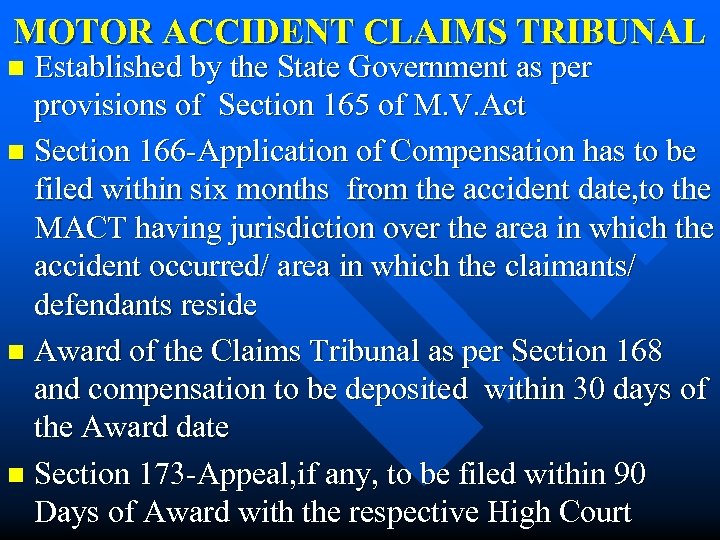
MOTOR ACCIDENT CLAIMS TRIBUNAL Established by the State Government as per provisions of Section 165 of M. V. Act n Section 166 -Application of Compensation has to be filed within six months from the accident date, to the MACT having jurisdiction over the area in which the accident occurred/ area in which the claimants/ defendants reside n Award of the Claims Tribunal as per Section 168 and compensation to be deposited within 30 days of the Award date n Section 173 -Appeal, if any, to be filed within 90 Days of Award with the respective High Court n
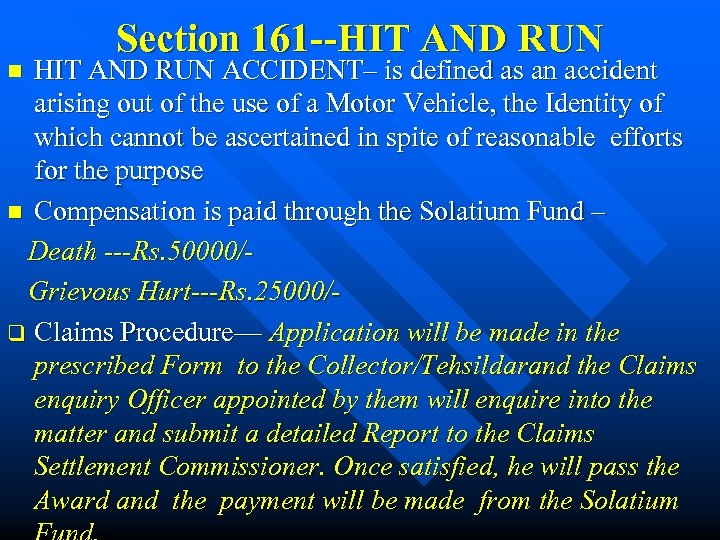
Section 161 --HIT AND RUN ACCIDENT– is defined as an accident arising out of the use of a Motor Vehicle, the Identity of which cannot be ascertained in spite of reasonable efforts for the purpose n Compensation is paid through the Solatium Fund – Death ---Rs. 50000/Grievous Hurt---Rs. 25000/q Claims Procedure— Application will be made in the prescribed Form to the Collector/Tehsildarand the Claims enquiry Officer appointed by them will enquire into the matter and submit a detailed Report to the Claims Settlement Commissioner. Once satisfied, he will pass the Award and the payment will be made from the Solatium n
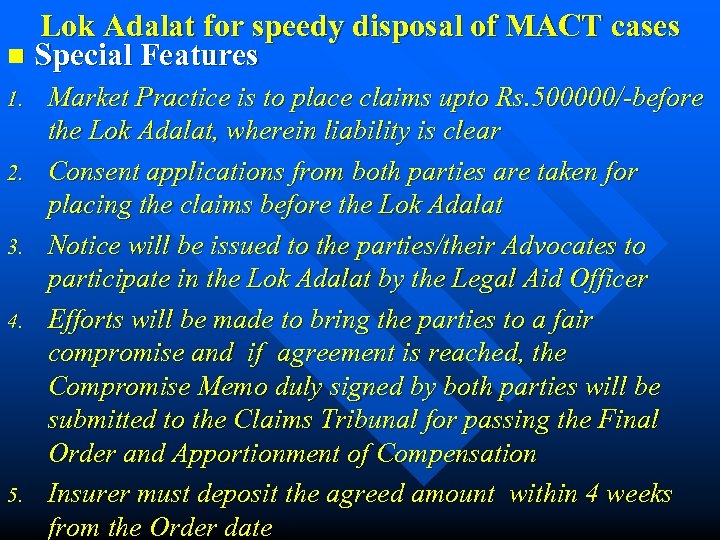
Lok Adalat for speedy disposal of MACT cases n Special Features 1. 2. 3. 4. 5. Market Practice is to place claims upto Rs. 500000/-before the Lok Adalat, wherein liability is clear Consent applications from both parties are taken for placing the claims before the Lok Adalat Notice will be issued to the parties/their Advocates to participate in the Lok Adalat by the Legal Aid Officer Efforts will be made to bring the parties to a fair compromise and if agreement is reached, the Compromise Memo duly signed by both parties will be submitted to the Claims Tribunal for passing the Final Order and Apportionment of Compensation Insurer must deposit the agreed amount within 4 weeks from the Order date
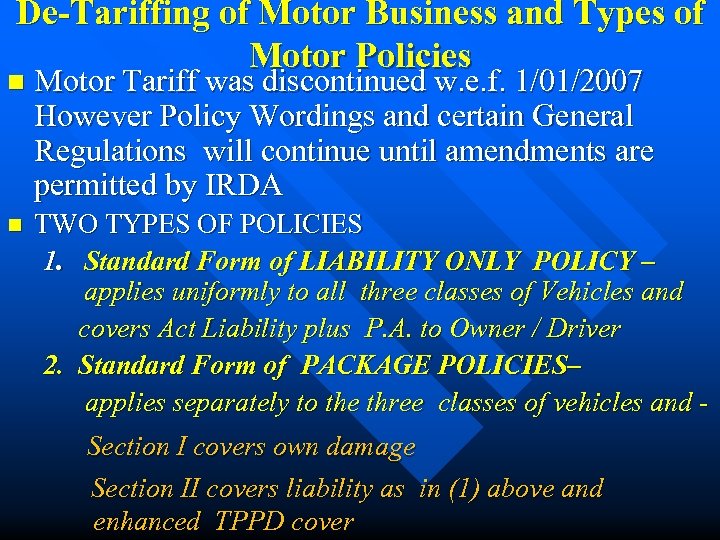
De-Tariffing of Motor Business and Types of Motor Policies n Motor Tariff was discontinued w. e. f. 1/01/2007 However Policy Wordings and certain General Regulations will continue until amendments are permitted by IRDA n TWO TYPES OF POLICIES 1. Standard Form of LIABILITY ONLY POLICY – applies uniformly to all three classes of Vehicles and covers Act Liability plus P. A. to Owner / Driver 2. Standard Form of PACKAGE POLICIES– applies separately to the three classes of vehicles and - Section I covers own damage Section II covers liability as in (1) above and enhanced TPPD cover
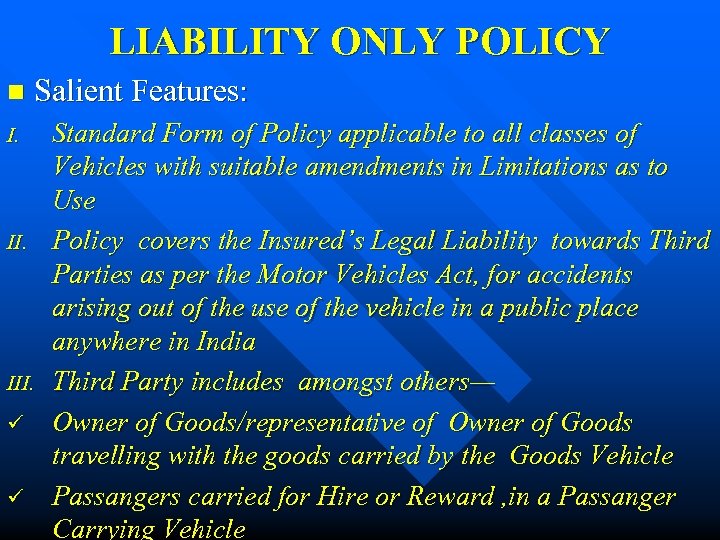
LIABILITY ONLY POLICY n Salient Features: I. III. ü ü Standard Form of Policy applicable to all classes of Vehicles with suitable amendments in Limitations as to Use Policy covers the Insured’s Legal Liability towards Third Parties as per the Motor Vehicles Act, for accidents arising out of the use of the vehicle in a public place anywhere in India Third Party includes amongst others— Owner of Goods/representative of Owner of Goods travelling with the goods carried by the Goods Vehicle Passangers carried for Hire or Reward , in a Passanger Carrying Vehicle
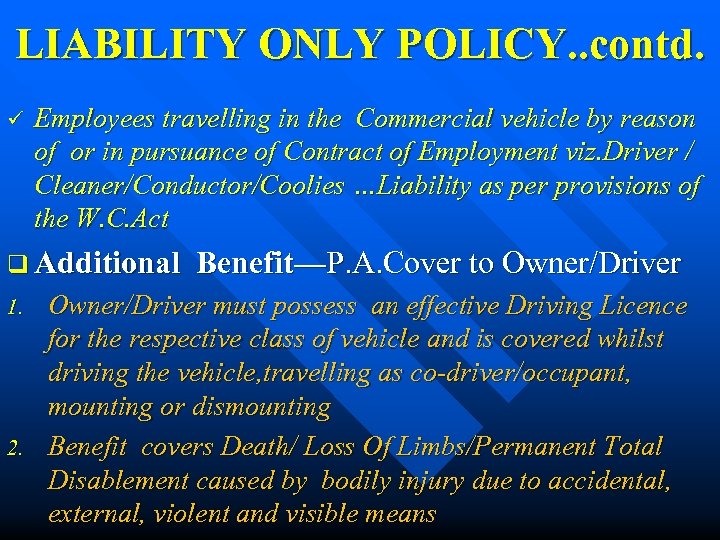
LIABILITY ONLY POLICY. . contd. ü Employees travelling in the Commercial vehicle by reason of or in pursuance of Contract of Employment viz. Driver / Cleaner/Conductor/Coolies …Liability as per provisions of the W. C. Act q Additional 1. 2. Benefit—P. A. Cover to Owner/Driver must possess an effective Driving Licence for the respective class of vehicle and is covered whilst driving the vehicle, travelling as co-driver/occupant, mounting or dismounting Benefit covers Death/ Loss Of Limbs/Permanent Total Disablement caused by bodily injury due to accidental, external, violent and visible means
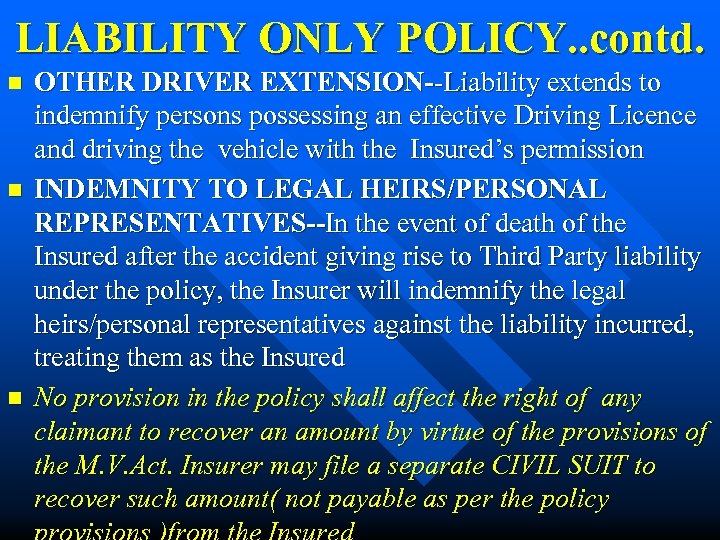
LIABILITY ONLY POLICY. . contd. n n n OTHER DRIVER EXTENSION--Liability extends to indemnify persons possessing an effective Driving Licence and driving the vehicle with the Insured’s permission INDEMNITY TO LEGAL HEIRS/PERSONAL REPRESENTATIVES--In the event of death of the Insured after the accident giving rise to Third Party liability under the policy, the Insurer will indemnify the legal heirs/personal representatives against the liability incurred, treating them as the Insured No provision in the policy shall affect the right of any claimant to recover an amount by virtue of the provisions of the M. V. Act. Insurer may file a separate CIVIL SUIT to recover such amount( not payable as per the policy
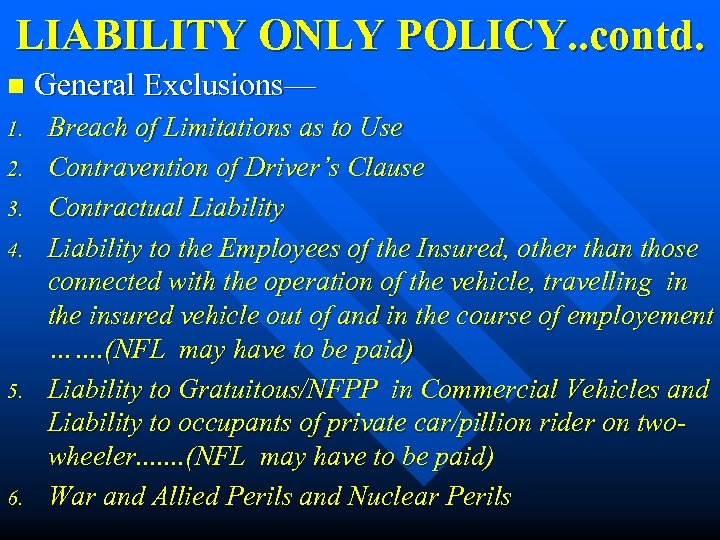
LIABILITY ONLY POLICY. . contd. n 1. 2. 3. 4. 5. 6. General Exclusions— Breach of Limitations as to Use Contravention of Driver’s Clause Contractual Liability to the Employees of the Insured, other than those connected with the operation of the vehicle, travelling in the insured vehicle out of and in the course of employement ……. (NFL may have to be paid) Liability to Gratuitous/NFPP in Commercial Vehicles and Liability to occupants of private car/pillion rider on twowheeler. . . . (NFL may have to be paid) War and Allied Perils and Nuclear Perils
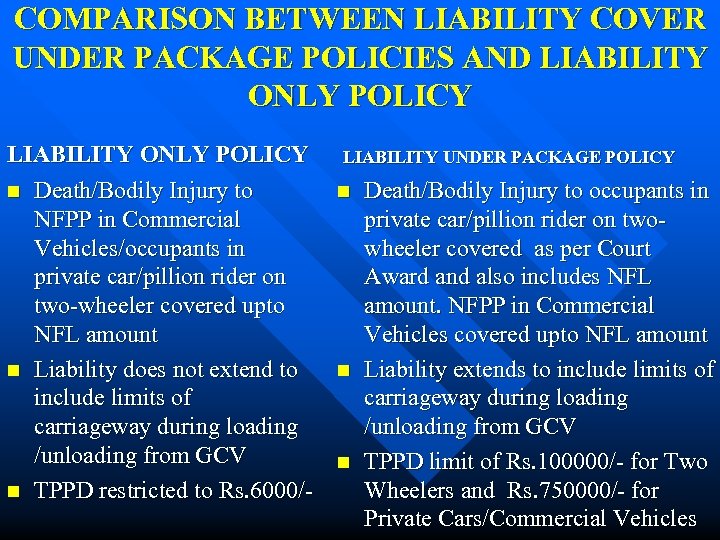
COMPARISON BETWEEN LIABILITY COVER UNDER PACKAGE POLICIES AND LIABILITY ONLY POLICY n Death/Bodily Injury to NFPP in Commercial Vehicles/occupants in private car/pillion rider on two-wheeler covered upto NFL amount n Liability does not extend to include limits of carriageway during loading /unloading from GCV n TPPD restricted to Rs. 6000/- LIABILITY UNDER PACKAGE POLICY n n n Death/Bodily Injury to occupants in private car/pillion rider on twowheeler covered as per Court Award and also includes NFL amount. NFPP in Commercial Vehicles covered upto NFL amount Liability extends to include limits of carriageway during loading /unloading from GCV TPPD limit of Rs. 100000/- for Two Wheelers and Rs. 750000/- for Private Cars/Commercial Vehicles
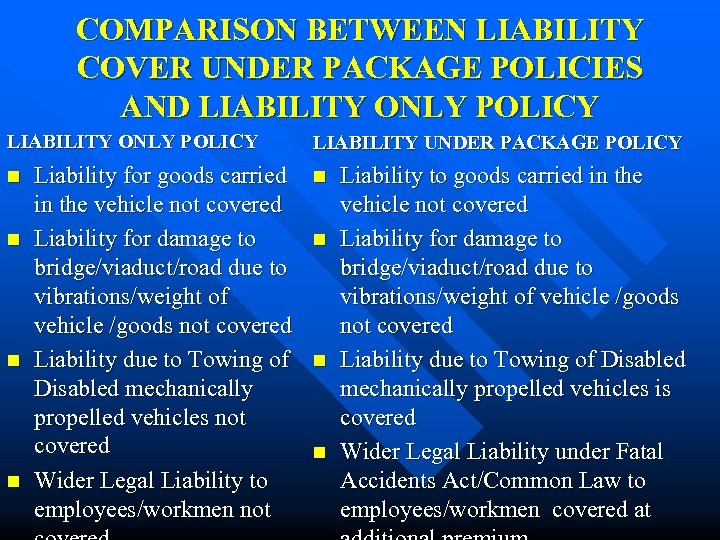
COMPARISON BETWEEN LIABILITY COVER UNDER PACKAGE POLICIES AND LIABILITY ONLY POLICY n n Liability for goods carried in the vehicle not covered Liability for damage to bridge/viaduct/road due to vibrations/weight of vehicle /goods not covered Liability due to Towing of Disabled mechanically propelled vehicles not covered Wider Legal Liability to employees/workmen not LIABILITY UNDER PACKAGE POLICY n n Liability to goods carried in the vehicle not covered Liability for damage to bridge/viaduct/road due to vibrations/weight of vehicle /goods not covered Liability due to Towing of Disabled mechanically propelled vehicles is covered Wider Legal Liability under Fatal Accidents Act/Common Law to employees/workmen covered at
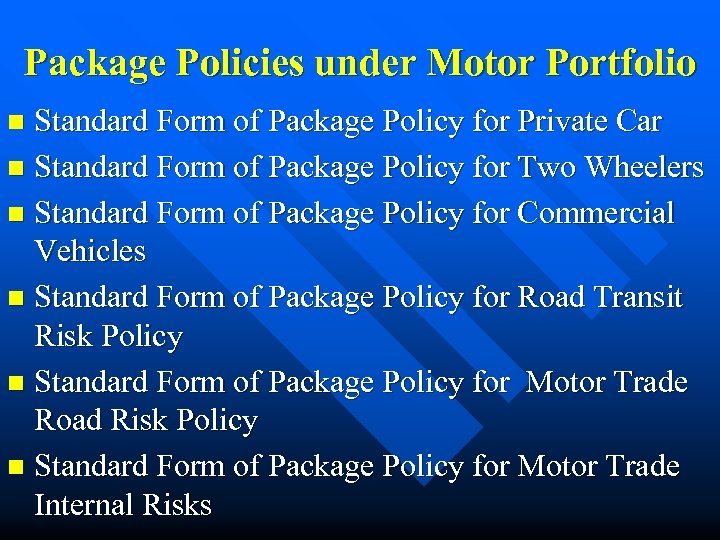
Package Policies under Motor Portfolio Standard Form of Package Policy for Private Car n Standard Form of Package Policy for Two Wheelers n Standard Form of Package Policy for Commercial Vehicles n Standard Form of Package Policy for Road Transit Risk Policy n Standard Form of Package Policy for Motor Trade Road Risk Policy n Standard Form of Package Policy for Motor Trade Internal Risks n
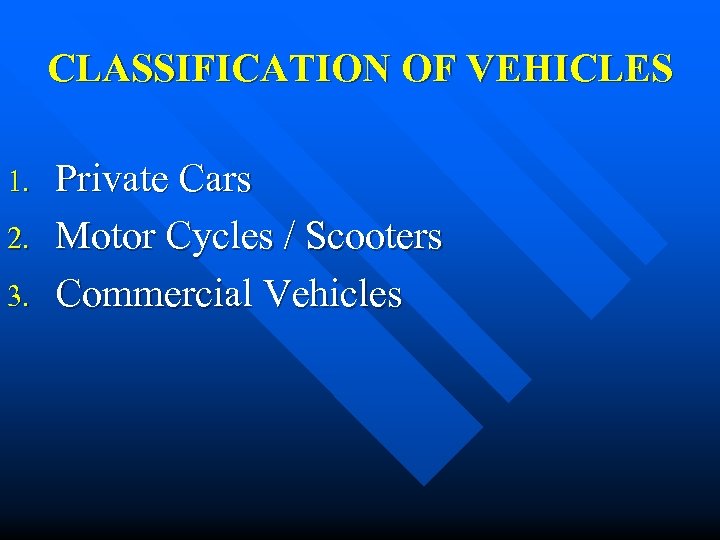
CLASSIFICATION OF VEHICLES 1. 2. 3. Private Cars Motor Cycles / Scooters Commercial Vehicles
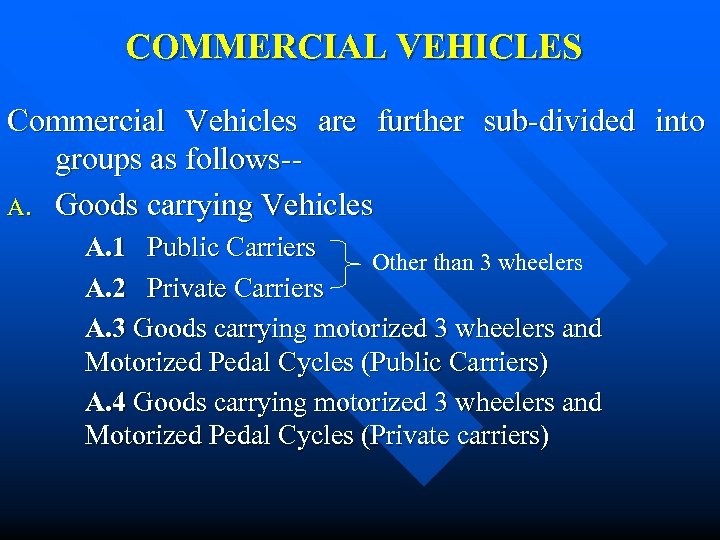
COMMERCIAL VEHICLES Commercial Vehicles are further sub-divided into groups as follows-A. Goods carrying Vehicles A. 1 Public Carriers Other than 3 wheelers A. 2 Private Carriers A. 3 Goods carrying motorized 3 wheelers and Motorized Pedal Cycles (Public Carriers) A. 4 Goods carrying motorized 3 wheelers and Motorized Pedal Cycles (Private carriers)
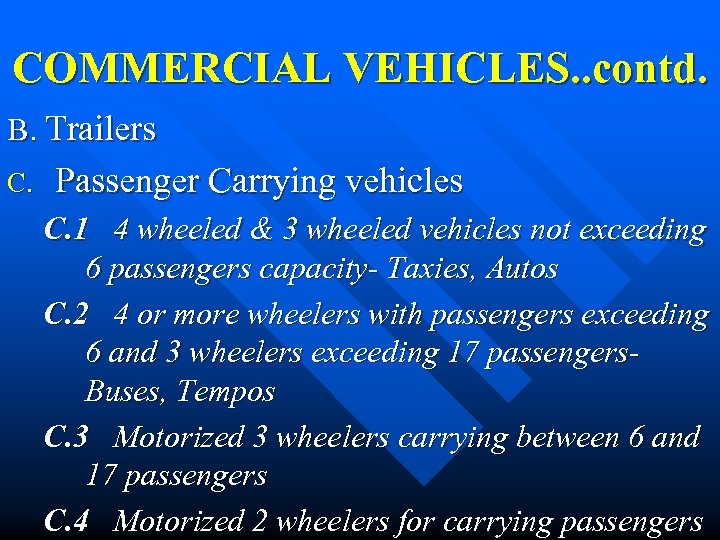
COMMERCIAL VEHICLES. . contd. B. Trailers C. Passenger Carrying vehicles C. 1 4 wheeled & 3 wheeled vehicles not exceeding 6 passengers capacity- Taxies, Autos C. 2 4 or more wheelers with passengers exceeding 6 and 3 wheelers exceeding 17 passengers. Buses, Tempos C. 3 Motorized 3 wheelers carrying between 6 and 17 passengers C. 4 Motorized 2 wheelers for carrying passengers
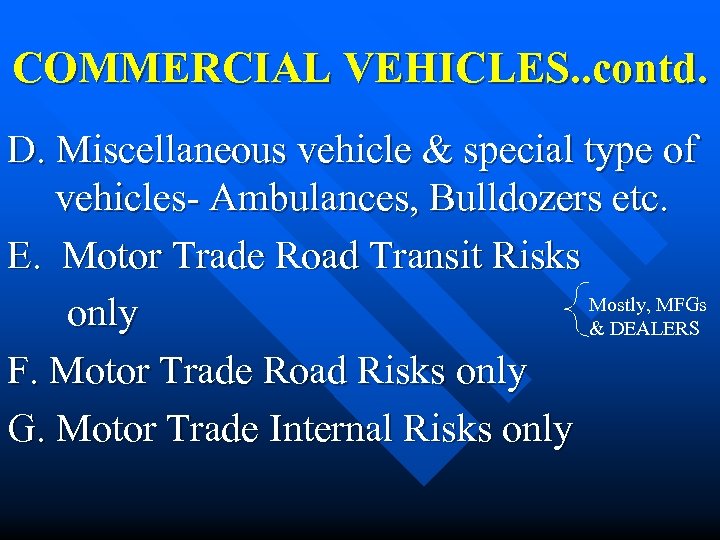
COMMERCIAL VEHICLES. . contd. D. Miscellaneous vehicle & special type of vehicles- Ambulances, Bulldozers etc. E. Motor Trade Road Transit Risks Mostly, MFGs only & DEALERS F. Motor Trade Road Risks only G. Motor Trade Internal Risks only
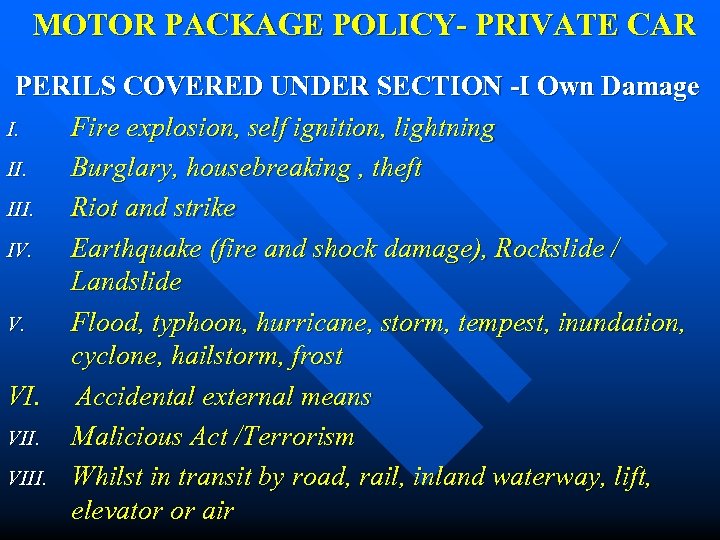
MOTOR PACKAGE POLICY- PRIVATE CAR PERILS COVERED UNDER SECTION -I Own Damage I. Fire explosion, self ignition, lightning II. Burglary, housebreaking , theft III. Riot and strike IV. Earthquake (fire and shock damage), Rockslide / Landslide V. Flood, typhoon, hurricane, storm, tempest, inundation, cyclone, hailstorm, frost VI. Accidental external means VII. Malicious Act /Terrorism VIII. Whilst in transit by road, rail, inland waterway, lift, elevator or air
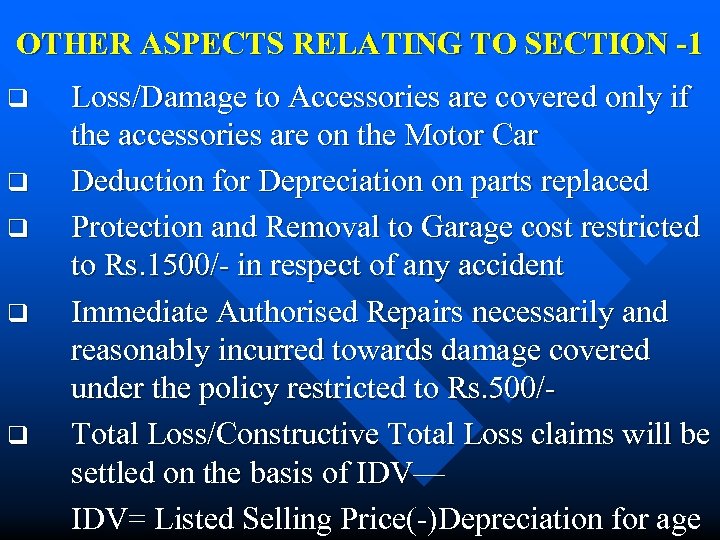
OTHER ASPECTS RELATING TO SECTION -1 Loss/Damage to Accessories are covered only if the accessories are on the Motor Car q Deduction for Depreciation on parts replaced q Protection and Removal to Garage cost restricted to Rs. 1500/- in respect of any accident q Immediate Authorised Repairs necessarily and reasonably incurred towards damage covered under the policy restricted to Rs. 500/q Total Loss/Constructive Total Loss claims will be settled on the basis of IDV— IDV= Listed Selling Price(-)Depreciation for age q
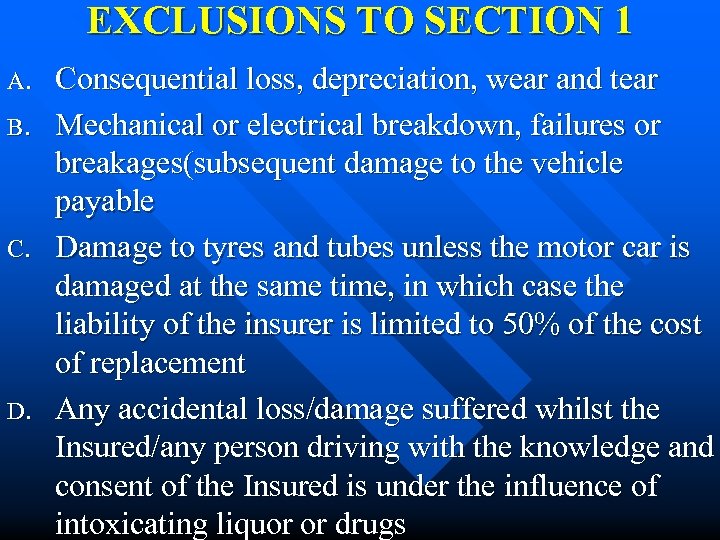
EXCLUSIONS TO SECTION 1 A. B. C. D. Consequential loss, depreciation, wear and tear Mechanical or electrical breakdown, failures or breakages(subsequent damage to the vehicle payable Damage to tyres and tubes unless the motor car is damaged at the same time, in which case the liability of the insurer is limited to 50% of the cost of replacement Any accidental loss/damage suffered whilst the Insured/any person driving with the knowledge and consent of the Insured is under the influence of intoxicating liquor or drugs
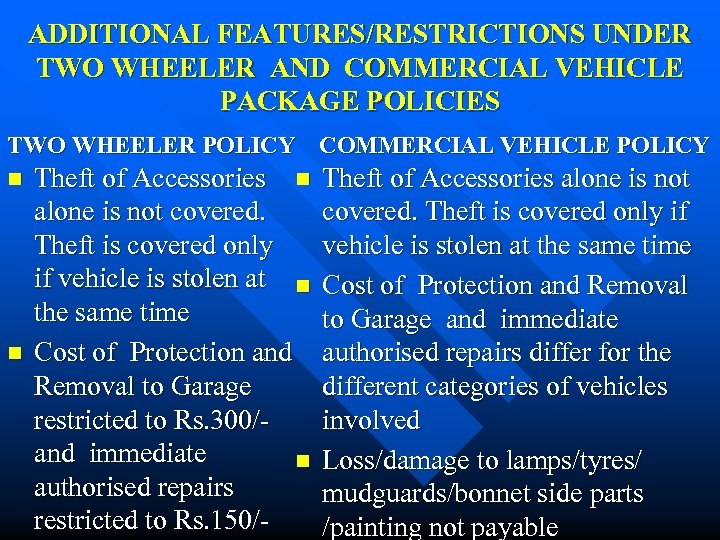
ADDITIONAL FEATURES/RESTRICTIONS UNDER TWO WHEELER AND COMMERCIAL VEHICLE PACKAGE POLICIES TWO WHEELER POLICY COMMERCIAL VEHICLE POLICY n n Theft of Accessories n alone is not covered. Theft is covered only if vehicle is stolen at n the same time Cost of Protection and Removal to Garage restricted to Rs. 300/- and immediate n authorised repairs restricted to Rs. 150/- Theft of Accessories alone is not covered. Theft is covered only if vehicle is stolen at the same time Cost of Protection and Removal to Garage and immediate authorised repairs differ for the different categories of vehicles involved Loss/damage to lamps/tyres/ mudguards/bonnet side parts /painting not payable
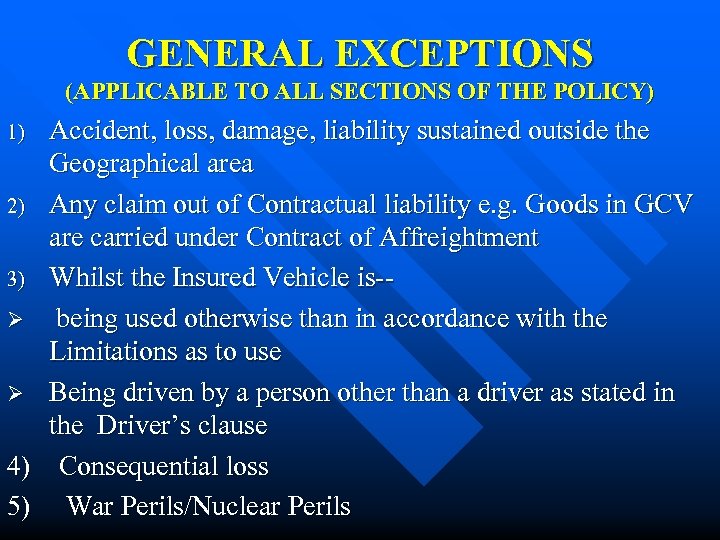
GENERAL EXCEPTIONS (APPLICABLE TO ALL SECTIONS OF THE POLICY) Accident, loss, damage, liability sustained outside the Geographical area 2) Any claim out of Contractual liability e. g. Goods in GCV are carried under Contract of Affreightment 3) Whilst the Insured Vehicle is-Ø being used otherwise than in accordance with the Limitations as to use Ø Being driven by a person other than a driver as stated in the Driver’s clause 4) Consequential loss 5) War Perils/Nuclear Perils 1)
DRIVER’S CLAUSE Any person including insured: Ø Provided that a person driving holds an effective driving licence at the time of accident and is not disqualified from holding or obtaining such a licence. Ø Provided also that the person holding an effective learner’s licence may also drive the vehicle and that such a person satisfies the requirement of Rule 3 of the CMV Rules 1989. -
LEARNER’S LICENCE PROVISIONS OF RULE 3 OF C. M. V RULES 1989 While receiving instructions or gaining experience in driving with the object of presenting himself for a test of competence to drive so long as: a) b) c) such a person is the holder of an effective learner’s licence issued to him in Form 3 to drive the Vehicle. Such a person is accompanied by an instructor holding an effective licence to drive the vehicle and such instructor is sitting in such a position to control or stop the vehicle and There is painted, in front and the rear of the vehicle or on a plate or card affixed to the front and the rear--the letter “L” in the red on a white background
Extensions/Additional Benefits under Package Policies Own Damage Section— 1. Electronic/Electrical Fittings are covered at higher premium rate 2. CNG/LPG Kits and Fibre Glass Tanks are covered by charging extra premium 3. Two wheeler Policies can be extended to cover theft of accessories alone by charging extra premium 4. Exclusion of Lamps/Tyres/Mudguards etc. in Commercial Vehicle Policies can be deleted by charging extra premium n
Motor Trade Policies These policies are taken by Motor Traders who may be either 1. Dealers/Distributers of Brand New/Second Hand Vehicles or 2. Engaged in their Overhaul/Repairs or 3. Both q The Motor Trader will require— 1. Motor Trade Road Transit Risk Policy for covering Road Transit Risks for brand new vehicles from the Manufacturer’s premises to their premises n
Motor Trade Policies…contd. 2. Motor Trade Road Risk Policy for demonstration of brand new vehicles to the prospective buyers. These vehicles can be taken out on the public roads for trial runs by temporarily attaching Trade Certificates. Similarly, named driver plates are used for driving second hand registered vehicles 3. Motor Trade Internal Risk Policy for damage to Customers/Customer’s vehicles entrusted to them for maintenance and/or repairs, due to accidents, fire, negligence of employees etc. on their premises
MOTOR INSURANCE PRACTICE n n n De-Tariffing of Motor Business w. e. f 01/01/2007 Insurers are free to charge rates for Own Damage premium based on the overall O/D Claims experience T. P. Premium structure as per IRDA guidelines. T. P. Premium collected by all Insurers was accumulated in a Pool administered by GIC till recently. T. P. Pool abolished w. e. f. 01/04/2012 Add-on covers to be filed and approved by IRDA Policy terms/ conditions and relevant General Regulations of erstwhile Tariff to continue
Some of the General Regulations still applicable are discussed in detail G R-4 Extension of Geographical Area n The geographical Area of Motor Policies can be extended, by charging a flat additional premium, to include the following SAARC countries— 1. 2. 3. 4. 5. 6. n Bangladesh Bhutan Nepal Pakistan Sri Lanka Maldives Loss/Damage during Air /Sea Voyage excluded
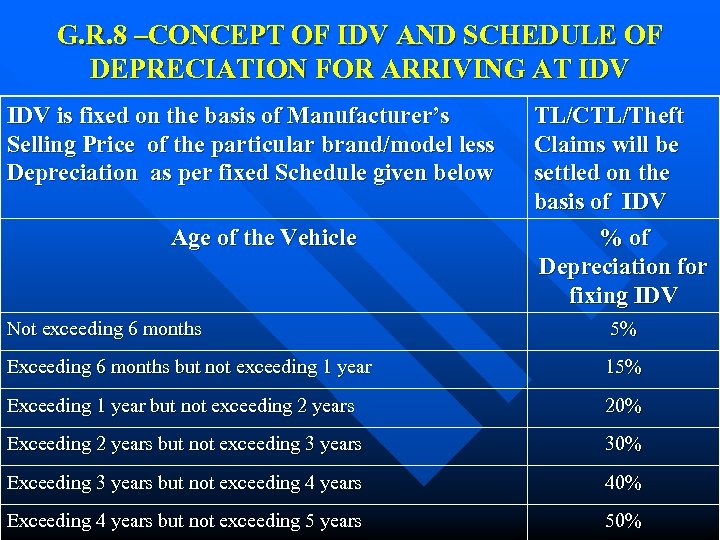
G. R. 8 –CONCEPT OF IDV AND SCHEDULE OF DEPRECIATION FOR ARRIVING AT IDV is fixed on the basis of Manufacturer’s Selling Price of the particular brand/model less Depreciation as per fixed Schedule given below Age of the Vehicle TL/CTL/Theft Claims will be settled on the basis of IDV % of Depreciation for fixing IDV Not exceeding 6 months 5% Exceeding 6 months but not exceeding 1 year 15% Exceeding 1 year but not exceeding 2 years 20% Exceeding 2 years but not exceeding 3 years 30% Exceeding 3 years but not exceeding 4 years 40% Exceeding 4 years but not exceeding 5 years 50%
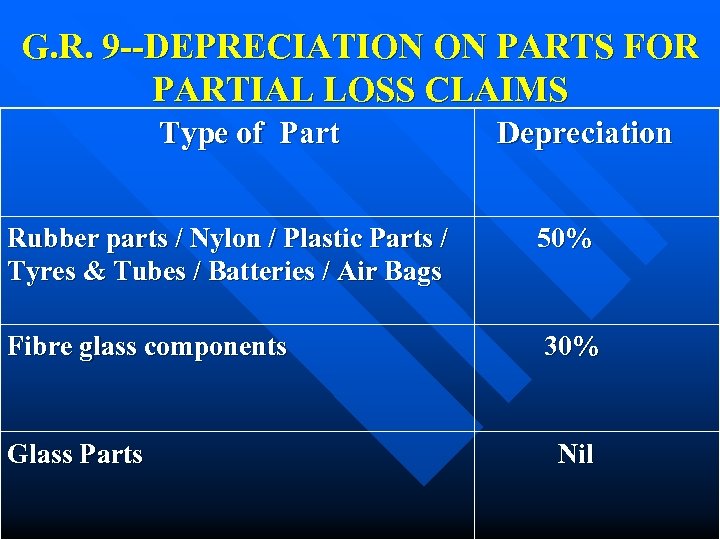
G. R. 9 --DEPRECIATION ON PARTS FOR PARTIAL LOSS CLAIMS Type of Part Depreciation Rubber parts / Nylon / Plastic Parts / Tyres & Tubes / Batteries / Air Bags 50% Fibre glass components 30% Glass Parts Nil
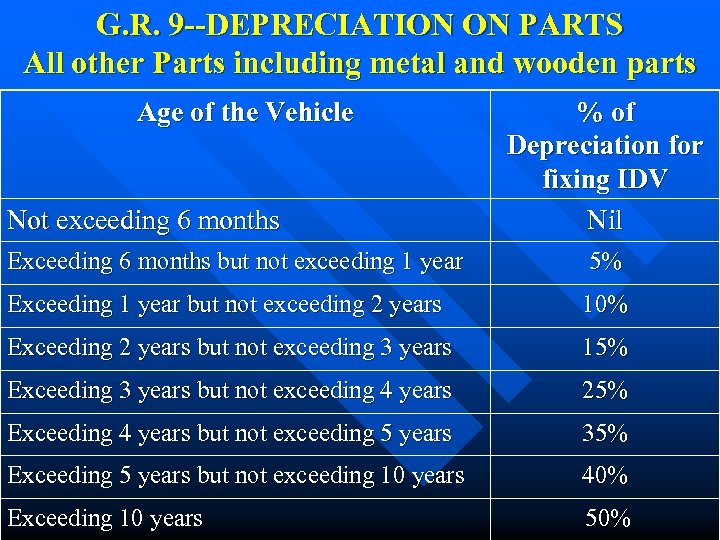
G. R. 9 --DEPRECIATION ON PARTS All other Parts including metal and wooden parts Age of the Vehicle Not exceeding 6 months % of Depreciation for fixing IDV Nil Exceeding 6 months but not exceeding 1 year 5% Exceeding 1 year but not exceeding 2 years 10% Exceeding 2 years but not exceeding 3 years 15% Exceeding 3 years but not exceeding 4 years 25% Exceeding 4 years but not exceeding 5 years 35% Exceeding 5 years but not exceeding 10 years 40% Exceeding 10 years 50%
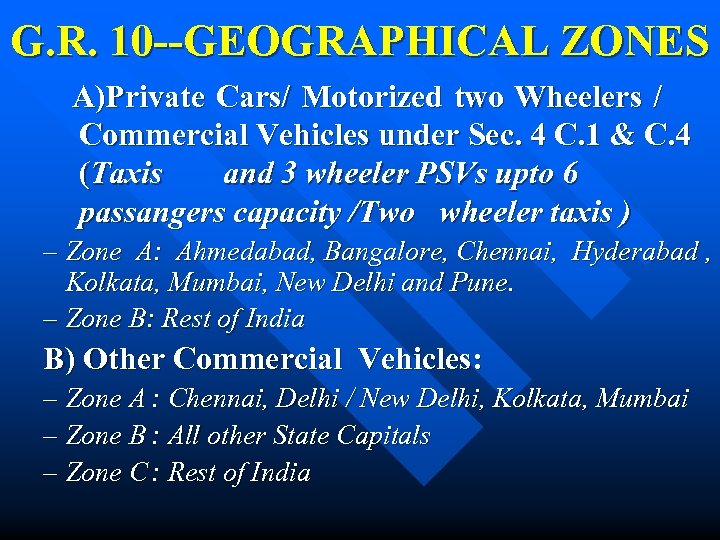
G. R. 10 --GEOGRAPHICAL ZONES A)Private Cars/ Motorized two Wheelers / Commercial Vehicles under Sec. 4 C. 1 & C. 4 (Taxis and 3 wheeler PSVs upto 6 passangers capacity /Two wheeler taxis ) – Zone A: Ahmedabad, Bangalore, Chennai, Hyderabad , Kolkata, Mumbai, New Delhi and Pune. – Zone B: Rest of India B) Other Commercial Vehicles: – Zone A : Chennai, Delhi / New Delhi, Kolkata, Mumbai – Zone B : All other State Capitals – Zone C : Rest of India
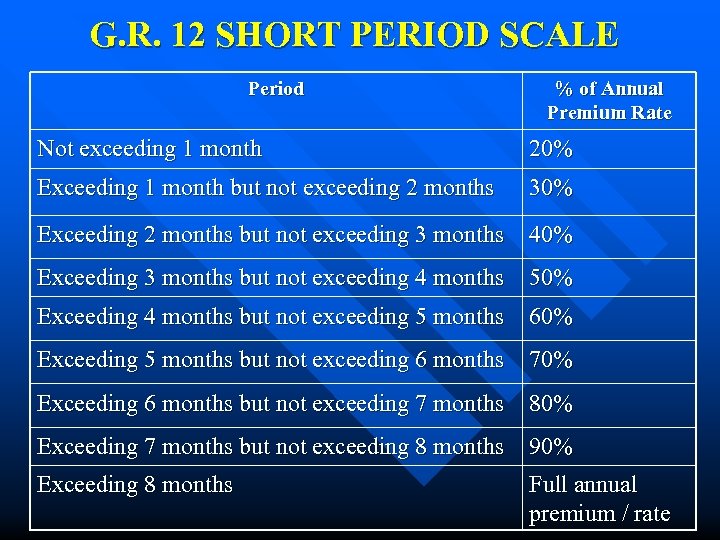
G. R. 12 SHORT PERIOD SCALE Period % of Annual Premium Rate Not exceeding 1 month 20% Exceeding 1 month but not exceeding 2 months 30% Exceeding 2 months but not exceeding 3 months 40% Exceeding 3 months but not exceeding 4 months 50% Exceeding 4 months but not exceeding 5 months 60% Exceeding 5 months but not exceeding 6 months 70% Exceeding 6 months but not exceeding 7 months 80% Exceeding 7 months but not exceeding 8 months 90% Exceeding 8 months Full annual premium / rate
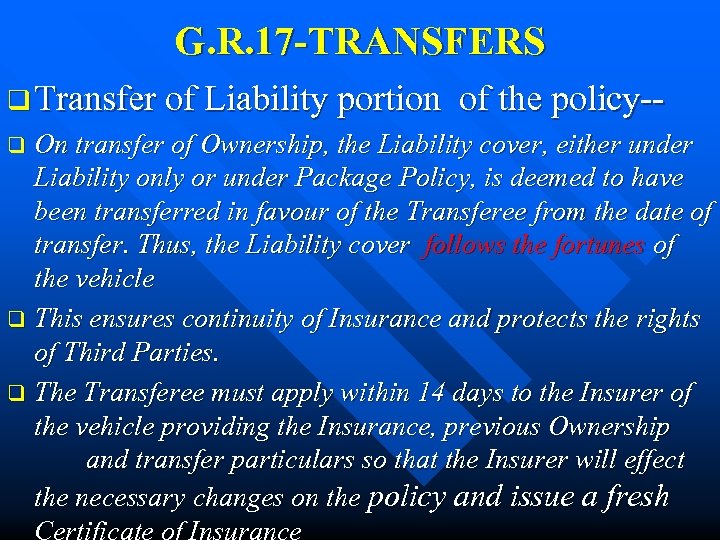
G. R. 17 -TRANSFERS q Transfer of Liability portion of the policy-q On transfer of Ownership, the Liability cover, either under Liability only or under Package Policy, is deemed to have been transferred in favour of the Transferee from the date of transfer. Thus, the Liability cover follows the fortunes of the vehicle q This ensures continuity of Insurance and protects the rights of Third Parties. q The Transferee must apply within 14 days to the Insurer of the vehicle providing the Insurance, previous Ownership and transfer particulars so that the Insurer will effect the necessary changes on the policy and issue a fresh
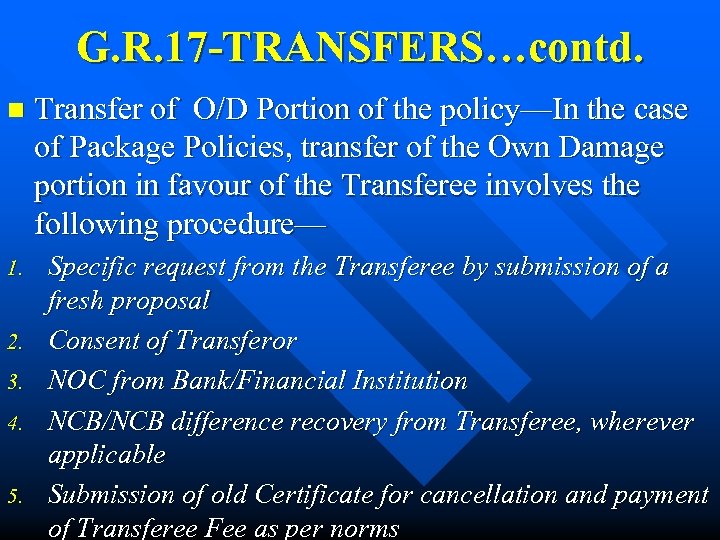
G. R. 17 -TRANSFERS…contd. n 1. 2. 3. 4. 5. Transfer of O/D Portion of the policy—In the case of Package Policies, transfer of the Own Damage portion in favour of the Transferee involves the following procedure— Specific request from the Transferee by submission of a fresh proposal Consent of Transferor NOC from Bank/Financial Institution NCB/NCB difference recovery from Transferee, wherever applicable Submission of old Certificate for cancellation and payment of Transferee Fee as per norms
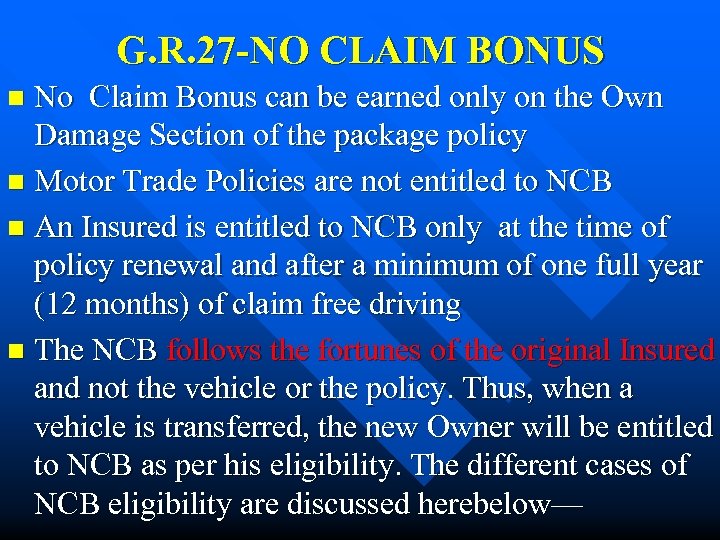
G. R. 27 -NO CLAIM BONUS No Claim Bonus can be earned only on the Own Damage Section of the package policy n Motor Trade Policies are not entitled to NCB n An Insured is entitled to NCB only at the time of policy renewal and after a minimum of one full year (12 months) of claim free driving n The NCB follows the fortunes of the original Insured and not the vehicle or the policy. Thus, when a vehicle is transferred, the new Owner will be entitled to NCB as per his eligibility. The different cases of NCB eligibility are discussed herebelow— n
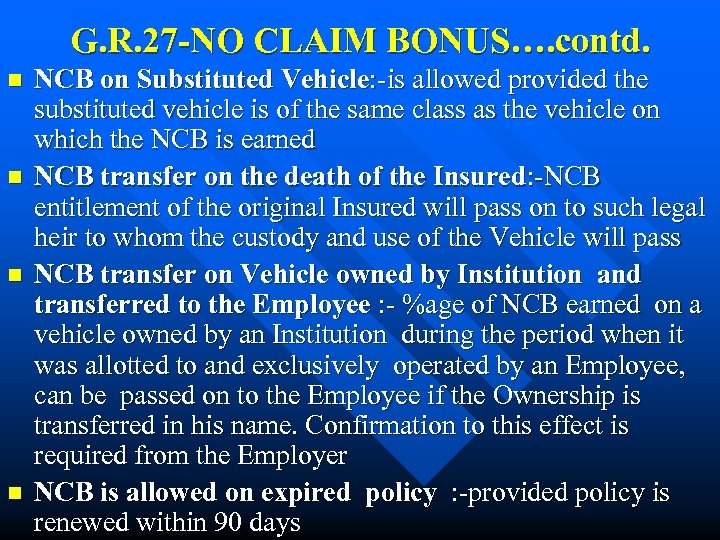
G. R. 27 -NO CLAIM BONUS…. contd. n n NCB on Substituted Vehicle: -is allowed provided the substituted vehicle is of the same class as the vehicle on which the NCB is earned NCB transfer on the death of the Insured: -NCB entitlement of the original Insured will pass on to such legal heir to whom the custody and use of the Vehicle will pass NCB transfer on Vehicle owned by Institution and transferred to the Employee : - %age of NCB earned on a vehicle owned by an Institution during the period when it was allotted to and exclusively operated by an Employee, can be passed on to the Employee if the Ownership is transferred in his name. Confirmation to this effect is required from the Employer NCB is allowed on expired policy : -provided policy is renewed within 90 days
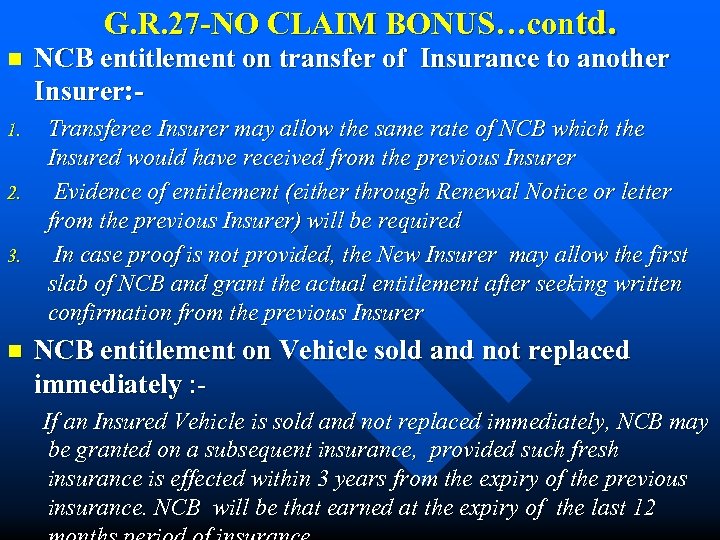
G. R. 27 -NO CLAIM BONUS…contd. n 1. 2. 3. n NCB entitlement on transfer of Insurance to another Insurer: Transferee Insurer may allow the same rate of NCB which the Insured would have received from the previous Insurer Evidence of entitlement (either through Renewal Notice or letter from the previous Insurer) will be required In case proof is not provided, the New Insurer may allow the first slab of NCB and grant the actual entitlement after seeking written confirmation from the previous Insurer NCB entitlement on Vehicle sold and not replaced immediately : - If an Insured Vehicle is sold and not replaced immediately, NCB may be granted on a subsequent insurance, provided such fresh insurance is effected within 3 years from the expiry of the previous insurance. NCB will be that earned at the expiry of the last 12
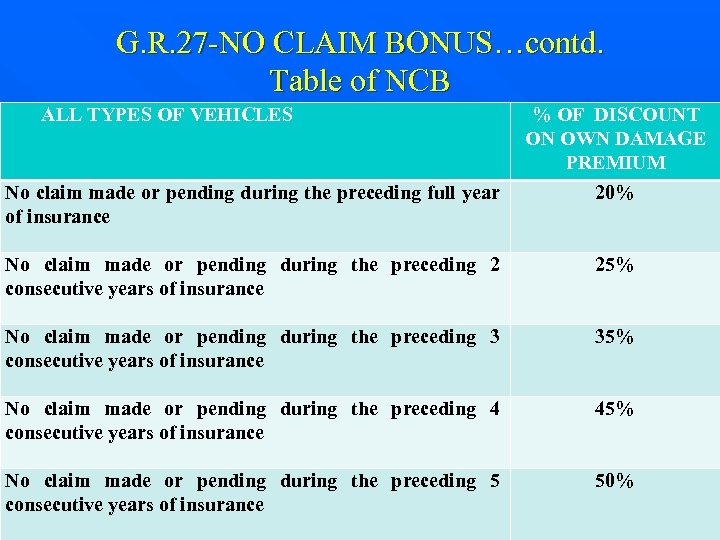
G. R. 27 -NO CLAIM BONUS…contd. Table of NCB ALL TYPES OF VEHICLES % OF DISCOUNT ON OWN DAMAGE PREMIUM No claim made or pending during the preceding full year of insurance 20% No claim made or pending during the preceding 2 consecutive years of insurance 25% No claim made or pending during the preceding 3 consecutive years of insurance 35% No claim made or pending during the preceding 4 consecutive years of insurance 45% No claim made or pending during the preceding 5 consecutive years of insurance 50%
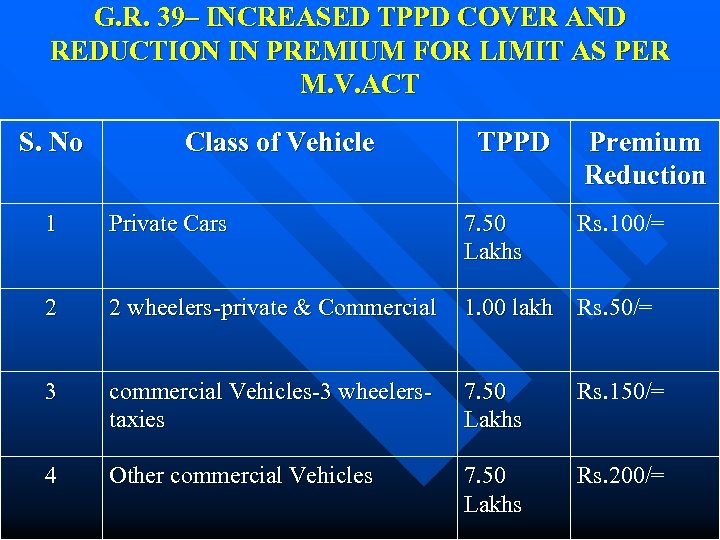
G. R. 39– INCREASED TPPD COVER AND REDUCTION IN PREMIUM FOR LIMIT AS PER M. V. ACT S. No Class of Vehicle TPPD Premium Reduction 1 Private Cars 7. 50 Lakhs Rs. 100/= 2 2 wheelers-private & Commercial 1. 00 lakh Rs. 50/= 3 commercial Vehicles-3 wheelerstaxies 7. 50 Lakhs Rs. 150/= 4 Other commercial Vehicles 7. 50 Lakhs Rs. 200/=
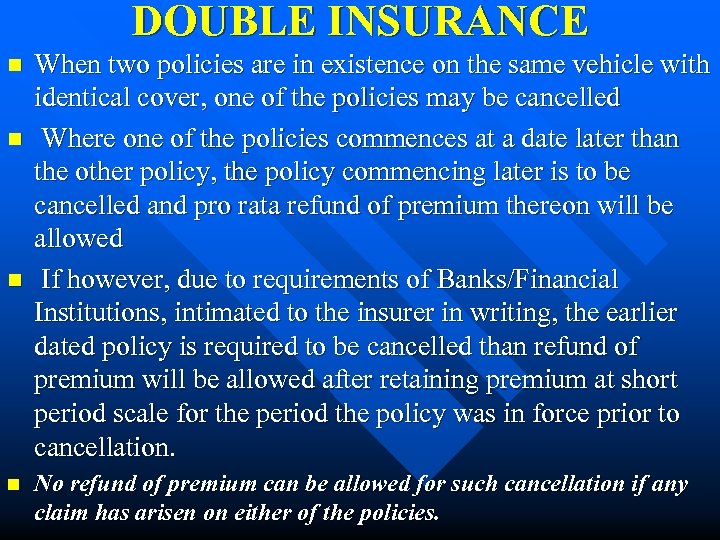
DOUBLE INSURANCE n n When two policies are in existence on the same vehicle with identical cover, one of the policies may be cancelled Where one of the policies commences at a date later than the other policy, the policy commencing later is to be cancelled and pro rata refund of premium thereon will be allowed If however, due to requirements of Banks/Financial Institutions, intimated to the insurer in writing, the earlier dated policy is required to be cancelled than refund of premium will be allowed after retaining premium at short period scale for the period the policy was in force prior to cancellation. No refund of premium can be allowed for such cancellation if any claim has arisen on either of the policies.
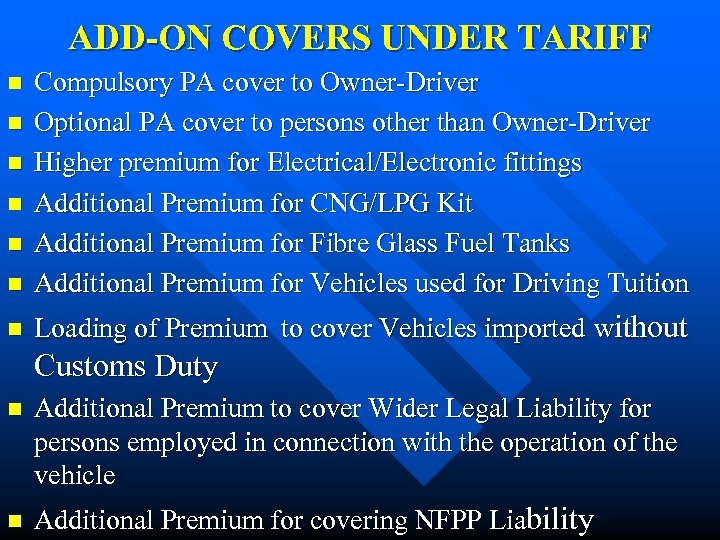
ADD-ON COVERS UNDER TARIFF n Compulsory PA cover to Owner-Driver Optional PA cover to persons other than Owner-Driver Higher premium for Electrical/Electronic fittings Additional Premium for CNG/LPG Kit Additional Premium for Fibre Glass Fuel Tanks Additional Premium for Vehicles used for Driving Tuition n Loading of Premium to cover Vehicles imported without n n n Customs Duty n Additional Premium to cover Wider Legal Liability for persons employed in connection with the operation of the vehicle n Additional Premium for covering NFPP Liability
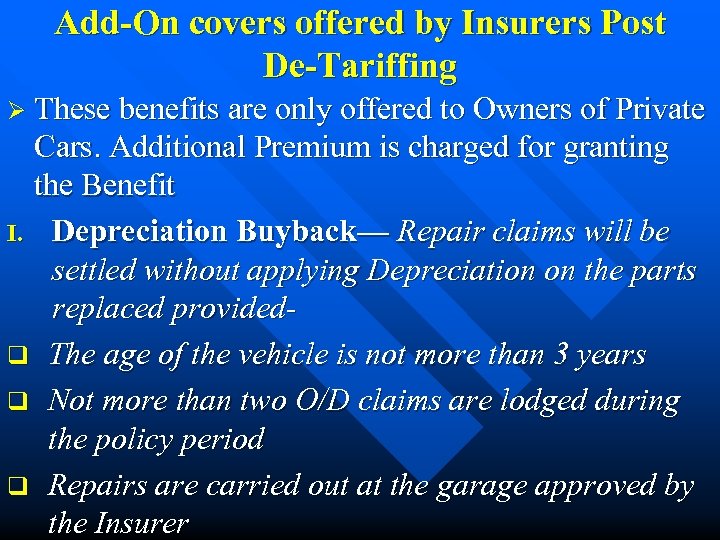
Add-On covers offered by Insurers Post De-Tariffing Ø These benefits are only offered to Owners of Private Cars. Additional Premium is charged for granting the Benefit I. Depreciation Buyback— Repair claims will be settled without applying Depreciation on the parts replaced providedq The age of the vehicle is not more than 3 years q Not more than two O/D claims are lodged during the policy period q Repairs are carried out at the garage approved by the Insurer
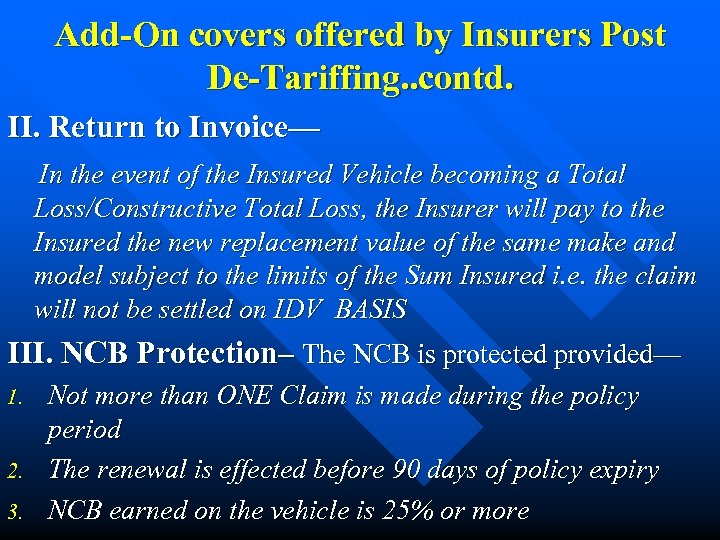
Add-On covers offered by Insurers Post De-Tariffing. . contd. II. Return to Invoice— In the event of the Insured Vehicle becoming a Total Loss/Constructive Total Loss, the Insurer will pay to the Insured the new replacement value of the same make and model subject to the limits of the Sum Insured i. e. the claim will not be settled on IDV BASIS III. NCB Protection– The NCB is protected provided— 1. 2. 3. Not more than ONE Claim is made during the policy period The renewal is effected before 90 days of policy expiry NCB earned on the vehicle is 25% or more
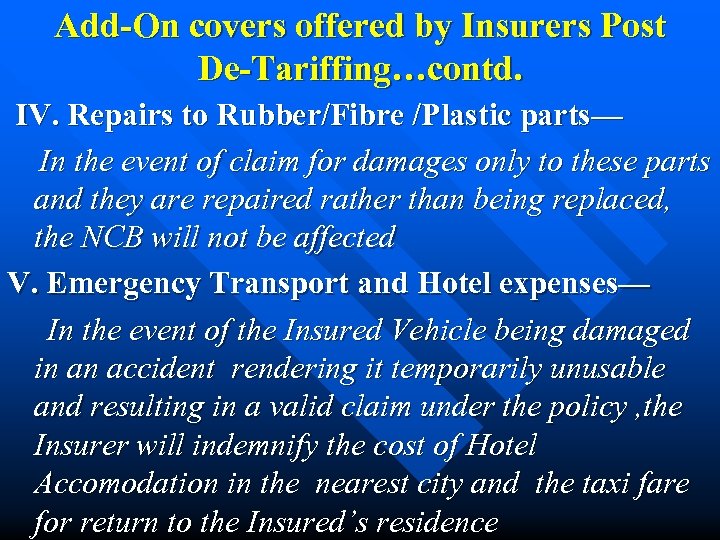
Add-On covers offered by Insurers Post De-Tariffing…contd. IV. Repairs to Rubber/Fibre /Plastic parts— In the event of claim for damages only to these parts and they are repaired rather than being replaced, the NCB will not be affected V. Emergency Transport and Hotel expenses— In the event of the Insured Vehicle being damaged in an accident rendering it temporarily unusable and resulting in a valid claim under the policy , the Insurer will indemnify the cost of Hotel Accomodation in the nearest city and the taxi fare for return to the Insured’s residence
Add-On covers offered by Insurers Post De-Tariffing…contd. VI. Loss of Personal Belongings— This extension will indemnify the loss of personal belongings(as defined) lying in the Insured Vehicle at the time of operation of the peril insured under Section 1 of the policy. Insurer will pay only if the claim for damage to the vehicle is admissible VII. Replacement of Locks/Keys---This extension will reimburse the cost of replacement of locks/keys if the vehicle is broken into or cost of locks/stolen keys if the keys are stolen
Add-On covers offered by Insurers Post De-Tariffing…. contd. VIII. Daily Allowance— In the event of the vehicle being sent to the Insurer’s authorised Repairers for undertaking repairs arising out of damages due to the operation of an Insured peril and where the time taken for executing the repairs exceeds 3 days, the Insurer will pay the cost of hired Transport upto 10 days for partial loss claims and 15 days for TL/CTL claims IX. Spot Assistance— This extension provides a number of emergency services incurred within a radius of 100 kms. from the city where the Insured resides. Services will include flat tyre/battery /medical coordination /fuel assistance/towing services etc.
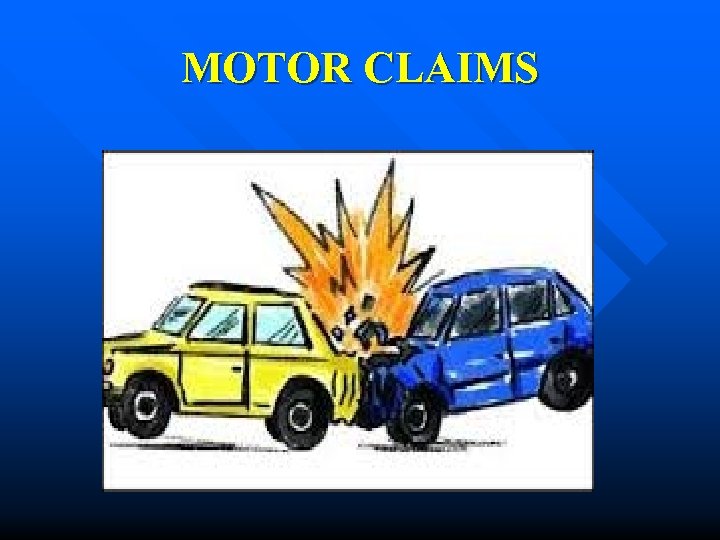
MOTOR CLAIMS
DRIVER’S CLAUSE - Any person including insured: Provided that a person driving holds an effective driving licence at the time of accident and is not disqualified from holding or obtaining such a licence. Provided also that the person holding an effective learner’s licence may also drive the vehicle and that such a person satisfies the requirement of Rule 3 of the CMV Rules 1989.
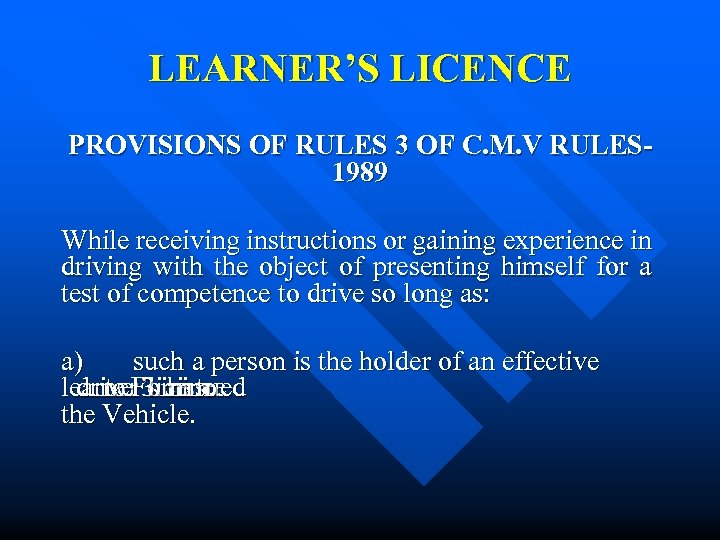
LEARNER’S LICENCE PROVISIONS OF RULES 3 OF C. M. V RULES 1989 While receiving instructions or gaining experience in driving with the object of presenting himself for a test of competence to drive so long as: a) such a person is the holder of an effective learner’s him drive 3 in to to Form licence issued the Vehicle.
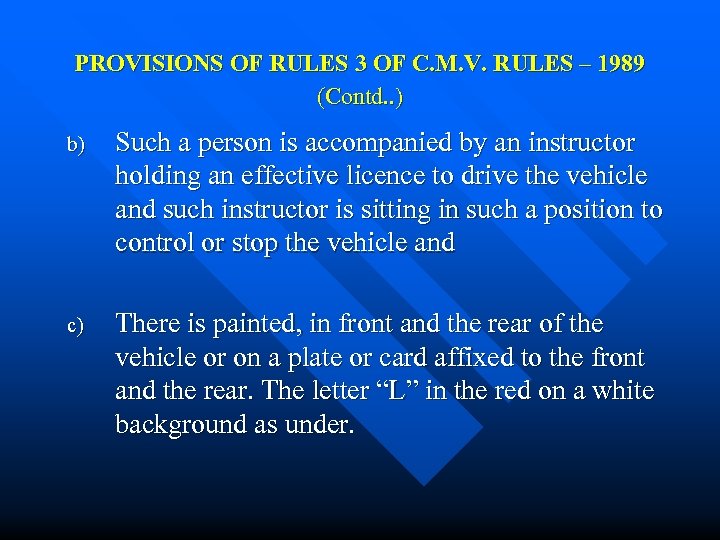
PROVISIONS OF RULES 3 OF C. M. V. RULES – 1989 (Contd. . ) b) Such a person is accompanied by an instructor holding an effective licence to drive the vehicle and such instructor is sitting in such a position to control or stop the vehicle and c) There is painted, in front and the rear of the vehicle or on a plate or card affixed to the front and the rear. The letter “L” in the red on a white background as under.
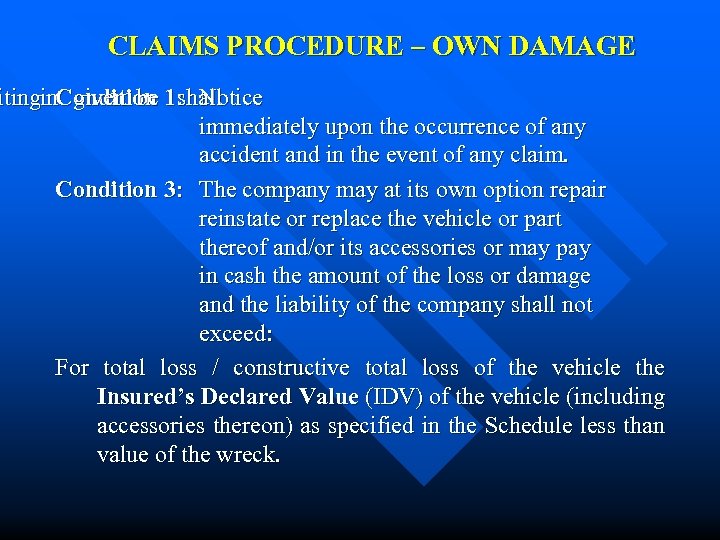
CLAIMS PROCEDURE – OWN DAMAGE iting Condition 1: Notice in given be shall immediately upon the occurrence of any accident and in the event of any claim. Condition 3: The company may at its own option repair reinstate or replace the vehicle or part thereof and/or its accessories or may pay in cash the amount of the loss or damage and the liability of the company shall not exceed: For total loss / constructive total loss of the vehicle the Insured’s Declared Value (IDV) of the vehicle (including accessories thereon) as specified in the Schedule less than value of the wreck.
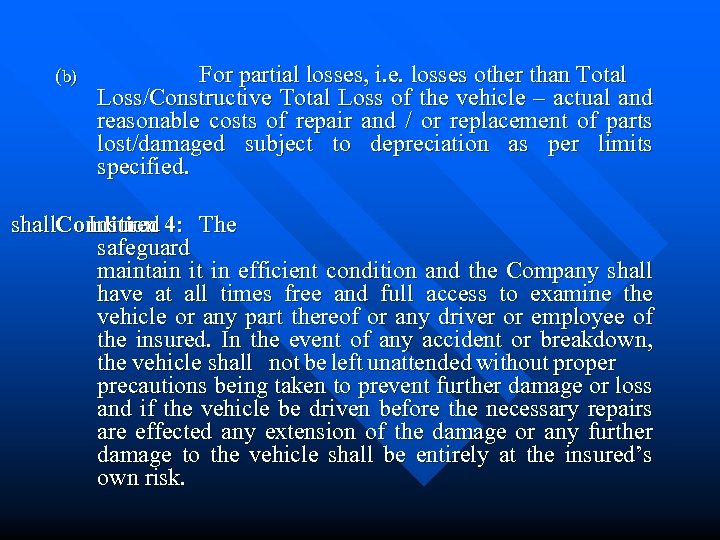
(b) For partial losses, i. e. losses other than Total Loss/Constructive Total Loss of the vehicle – actual and reasonable costs of repair and / or replacement of parts lost/damaged subject to depreciation as per limits specified. shall Insured 4: The Condition safeguard maintain it in efficient condition and the Company shall have at all times free and full access to examine the vehicle or any part thereof or any driver or employee of the insured. In the event of any accident or breakdown, the vehicle shall not be left unattended without proper precautions being taken to prevent further damage or loss and if the vehicle be driven before the necessary repairs are effected any extension of the damage or any further damage to the vehicle shall be entirely at the insured’s own risk.
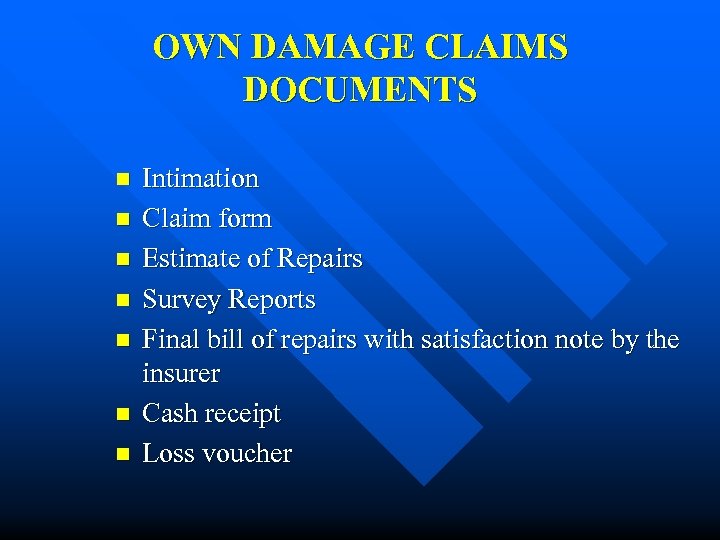
OWN DAMAGE CLAIMS DOCUMENTS n n n n Intimation Claim form Estimate of Repairs Survey Reports Final bill of repairs with satisfaction note by the insurer Cash receipt Loss voucher
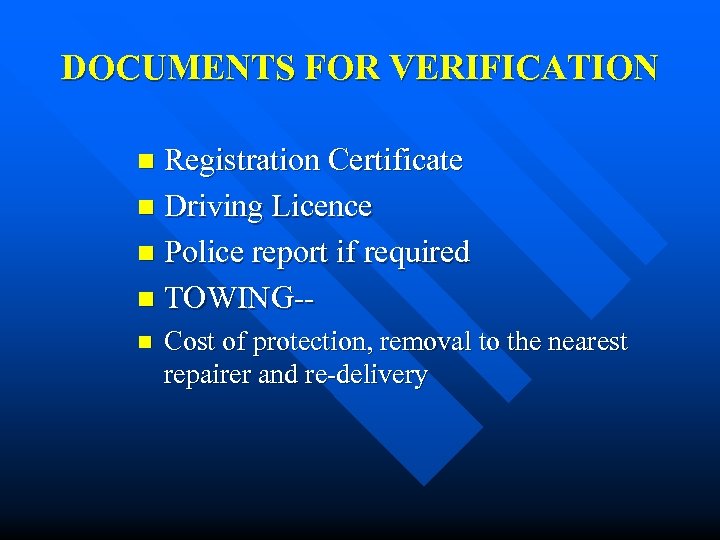
DOCUMENTS FOR VERIFICATION Registration Certificate n Driving Licence n Police report if required n TOWING-n n Cost of protection, removal to the nearest repairer and re-delivery
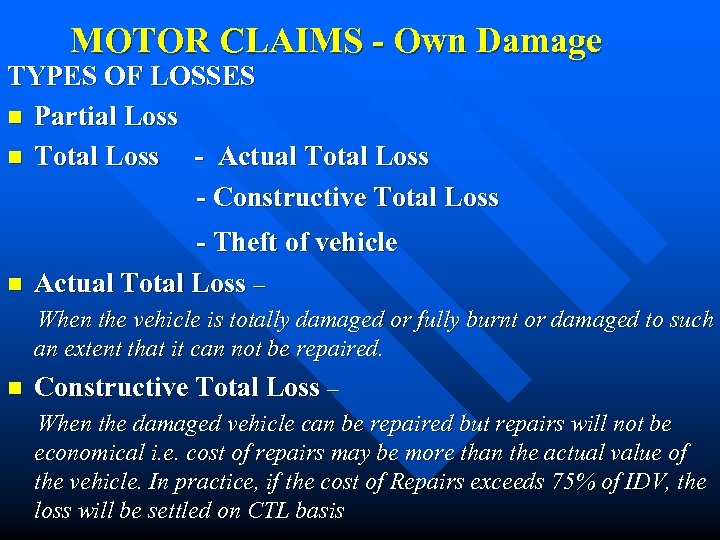
MOTOR CLAIMS - Own Damage TYPES OF LOSSES n Partial Loss n Total Loss - Actual Total Loss - Constructive Total Loss n - Theft of vehicle Actual Total Loss – When the vehicle is totally damaged or fully burnt or damaged to such an extent that it can not be repaired. n Constructive Total Loss – When the damaged vehicle can be repaired but repairs will not be economical i. e. cost of repairs may be more than the actual value of the vehicle. In practice, if the cost of Repairs exceeds 75% of IDV, the loss will be settled on CTL basis
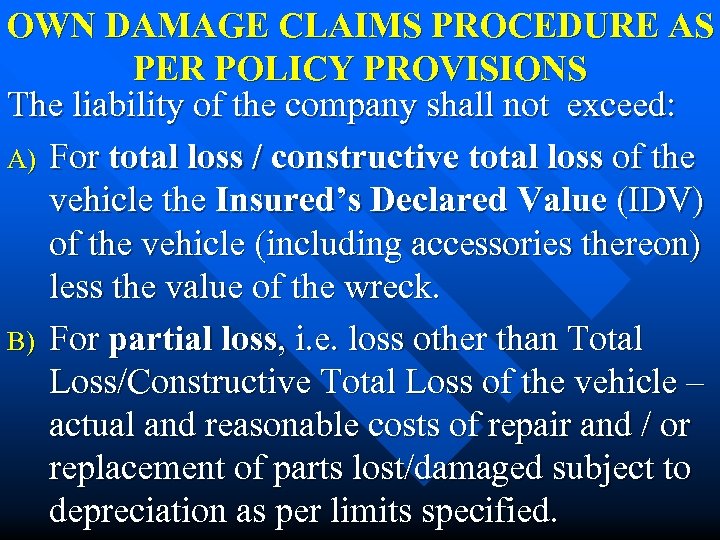
OWN DAMAGE CLAIMS PROCEDURE AS PER POLICY PROVISIONS The liability of the company shall not exceed: A) For total loss / constructive total loss of the vehicle the Insured’s Declared Value (IDV) of the vehicle (including accessories thereon) less the value of the wreck. B) For partial loss, i. e. loss other than Total Loss/Constructive Total Loss of the vehicle – actual and reasonable costs of repair and / or replacement of parts lost/damaged subject to depreciation as per limits specified.
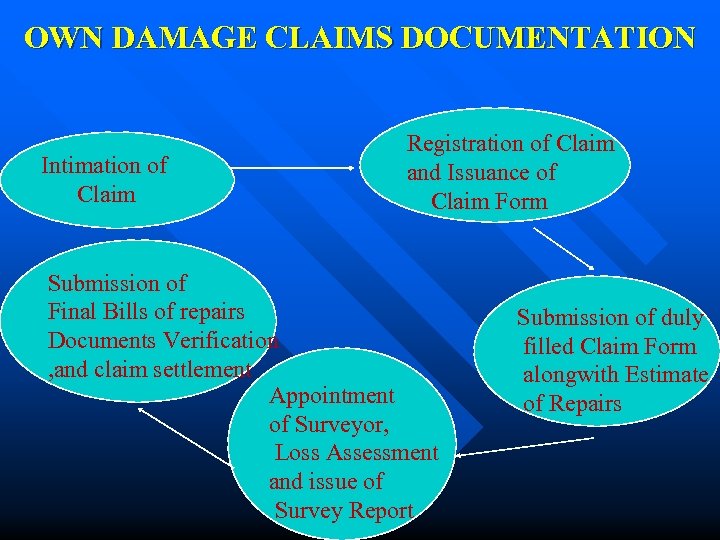
OWN DAMAGE CLAIMS DOCUMENTATION Intimation of Claim Registration of Claim and Issuance of Claim Form Submission of Final Bills of repairs Documents Verification , and claim settlement Appointment of Surveyor, Loss Assessment and issue of Survey Report Submission of duly filled Claim Form alongwith Estimate of Repairs
MOTOR CLAIMS - Own Damage REPORTING - After an accident resulting in damage / loss to the vehicle it has to be immediately reported to the office. n The claim is registered and a claim form is issued n The claim form duly filled & signed by the insured along with estimate of repairs has to be submitted to the office. - the insured is normally free to choose the repairer where he would like to repair the vehicle. n Many Insurers are providing cashless facilities for Private Cars/Two Wheelers, in which case, the procedure gets modified n
MOTOR CLAIMS - Own Damage ASSESSMENT n An independent automobile surveyor is appointed to survey and assess the loss. - In case the estimate is below Rs. 20, 000/- an inhouse surveyor may be appointed. n Surveyor inspects the vehicle, takes the photographs, inspects the damages, discusses with the repairer the cost of replacement of parts and labour charges and submits his report. n After the survey is complete the repairer is authorized to repair the vehicle.
MOTOR CLAIMS - Own Damage SETTLEMENT n After completion of repairs vehicle is re-inspected n A settlement is normally based on the recommendations of the surveyor contained in the survey report. n The survey report is examined by the officer concerned & claim is settled according to the terms & conditions of the policy, taking into account - the depreciation applicable - Salvage - Compulsory excess - Additional excess , if any
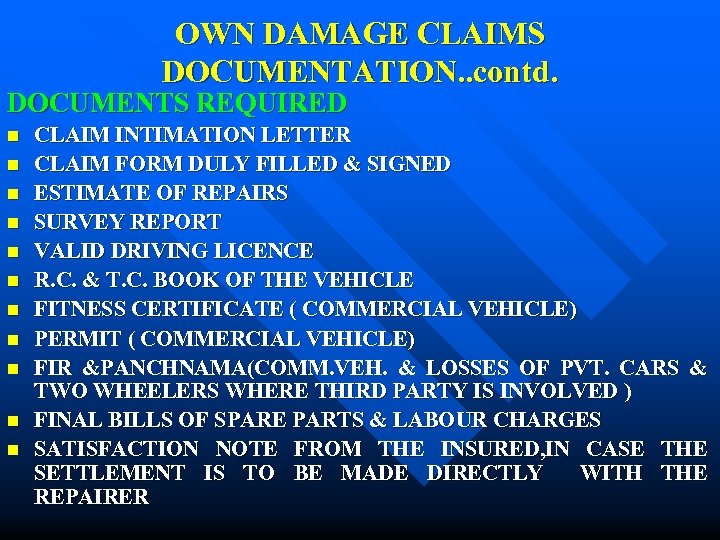
OWN DAMAGE CLAIMS DOCUMENTATION. . contd. DOCUMENTS REQUIRED n n n CLAIM INTIMATION LETTER CLAIM FORM DULY FILLED & SIGNED ESTIMATE OF REPAIRS SURVEY REPORT VALID DRIVING LICENCE R. C. & T. C. BOOK OF THE VEHICLE FITNESS CERTIFICATE ( COMMERCIAL VEHICLE) PERMIT ( COMMERCIAL VEHICLE) FIR &PANCHNAMA(COMM. VEH. & LOSSES OF PVT. CARS & TWO WHEELERS WHERE THIRD PARTY IS INVOLVED ) FINAL BILLS OF SPARE PARTS & LABOUR CHARGES SATISFACTION NOTE FROM THE INSURED, IN CASE THE SETTLEMENT IS TO BE MADE DIRECTLY WITH THE REPAIRER
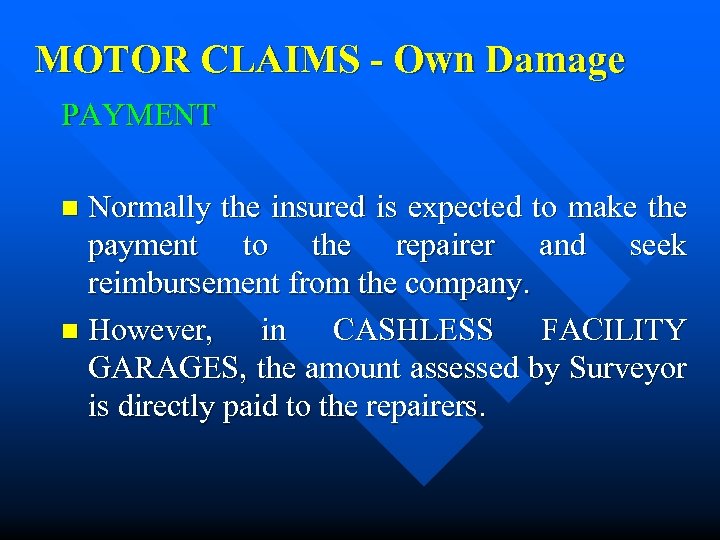
MOTOR CLAIMS - Own Damage PAYMENT Normally the insured is expected to make the payment to the repairer and seek reimbursement from the company. n However, in CASHLESS FACILITY GARAGES, the amount assessed by Surveyor is directly paid to the repairers. n
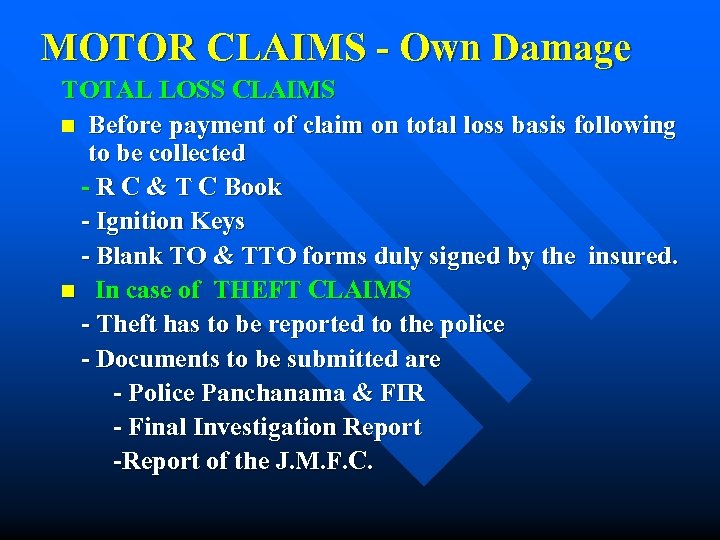
MOTOR CLAIMS - Own Damage TOTAL LOSS CLAIMS n Before payment of claim on total loss basis following to be collected - R C & T C Book - Ignition Keys - Blank TO & TTO forms duly signed by the insured. n In case of THEFT CLAIMS - Theft has to be reported to the police - Documents to be submitted are - Police Panchanama & FIR - Final Investigation Report -Report of the J. M. F. C.
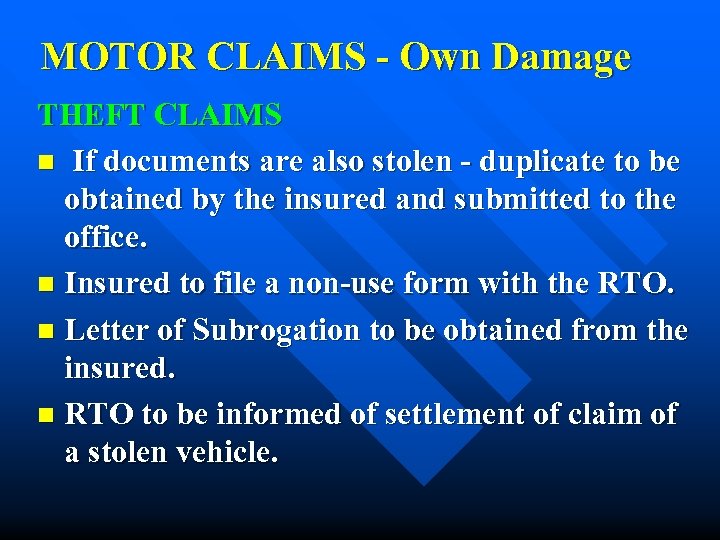
MOTOR CLAIMS - Own Damage THEFT CLAIMS n If documents are also stolen - duplicate to be obtained by the insured and submitted to the office. n Insured to file a non-use form with the RTO. n Letter of Subrogation to be obtained from the insured. n RTO to be informed of settlement of claim of a stolen vehicle.
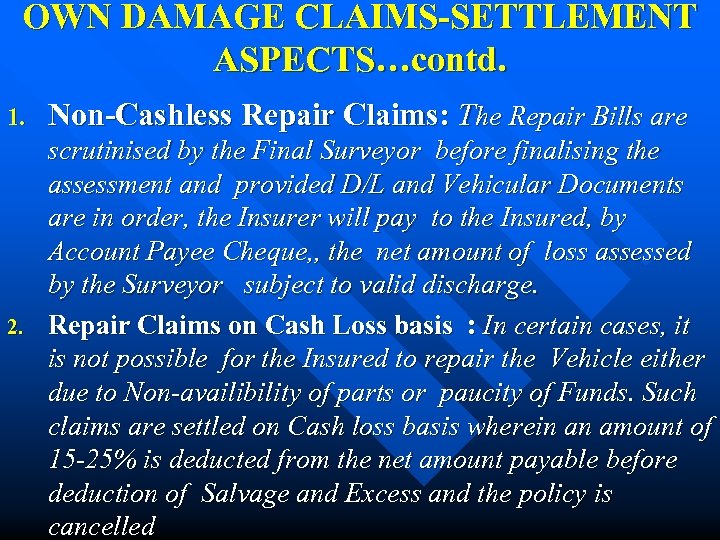
OWN DAMAGE CLAIMS-SETTLEMENT ASPECTS…contd. 1. 2. Non-Cashless Repair Claims: The Repair Bills are scrutinised by the Final Surveyor before finalising the assessment and provided D/L and Vehicular Documents are in order, the Insurer will pay to the Insured, by Account Payee Cheque, , the net amount of loss assessed by the Surveyor subject to valid discharge. Repair Claims on Cash Loss basis : In certain cases, it is not possible for the Insured to repair the Vehicle either due to Non-availibility of parts or paucity of Funds. Such claims are settled on Cash loss basis wherein an amount of 15 -25% is deducted from the net amount payable before deduction of Salvage and Excess and the policy is cancelled
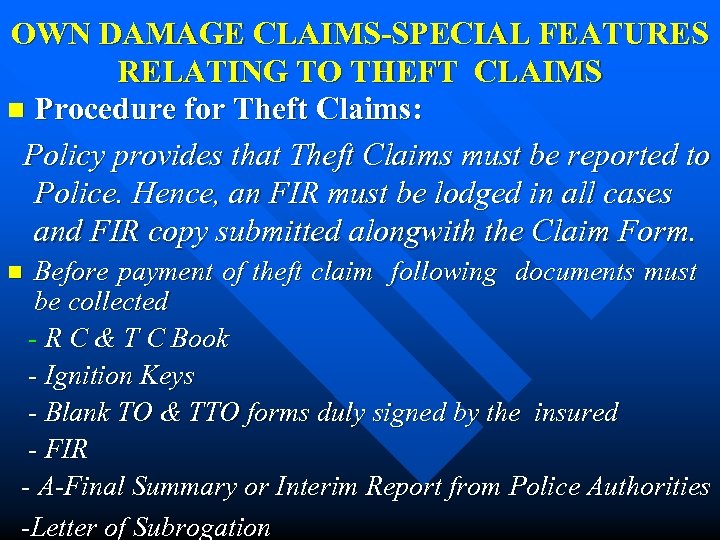
OWN DAMAGE CLAIMS-SPECIAL FEATURES RELATING TO THEFT CLAIMS n Procedure for Theft Claims: Policy provides that Theft Claims must be reported to Police. Hence, an FIR must be lodged in all cases and FIR copy submitted alongwith the Claim Form. Before payment of theft claim following documents must be collected - R C & T C Book - Ignition Keys - Blank TO & TTO forms duly signed by the insured - FIR - A-Final Summary or Interim Report from Police Authorities -Letter of Subrogation n
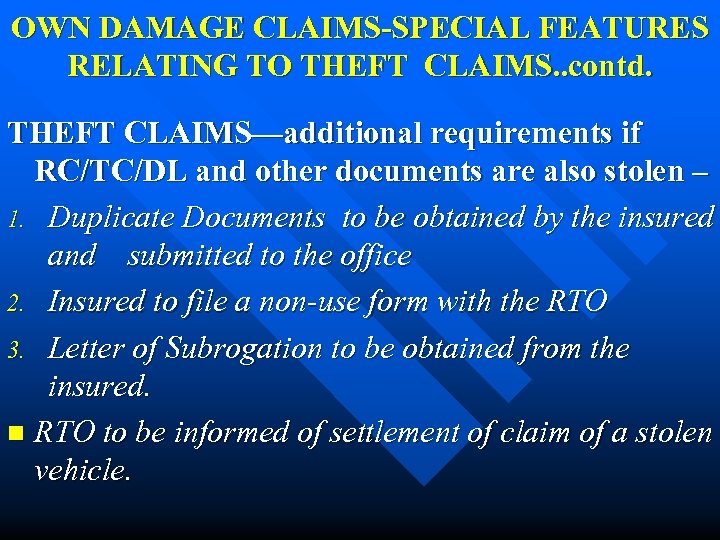
OWN DAMAGE CLAIMS-SPECIAL FEATURES RELATING TO THEFT CLAIMS. . contd. THEFT CLAIMS—additional requirements if RC/TC/DL and other documents are also stolen – 1. Duplicate Documents to be obtained by the insured and submitted to the office 2. Insured to file a non-use form with the RTO 3. Letter of Subrogation to be obtained from the insured. n RTO to be informed of settlement of claim of a stolen vehicle.
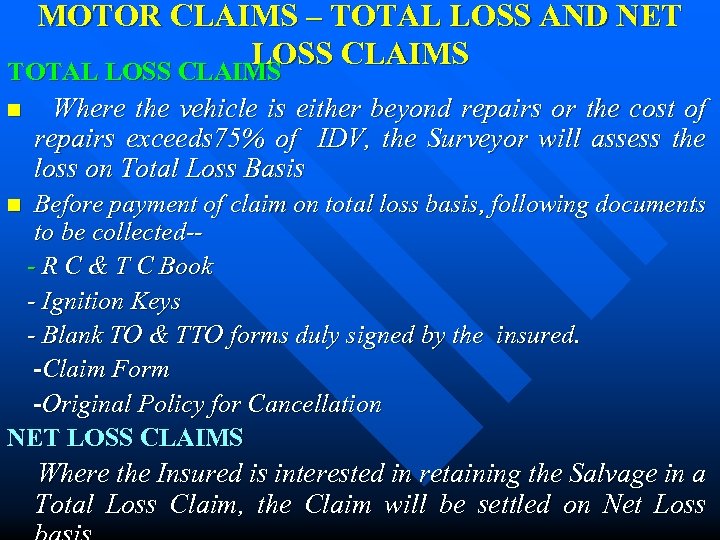
MOTOR CLAIMS – TOTAL LOSS AND NET LOSS CLAIMS TOTAL LOSS CLAIMS n Where the vehicle is either beyond repairs or the cost of repairs exceeds 75% of IDV, the Surveyor will assess the loss on Total Loss Basis Before payment of claim on total loss basis, following documents to be collected-- R C & T C Book - Ignition Keys - Blank TO & TTO forms duly signed by the insured. -Claim Form -Original Policy for Cancellation NET LOSS CLAIMS n Where the Insured is interested in retaining the Salvage in a Total Loss Claim, the Claim will be settled on Net Loss
CLAIMS PREOCEDURETHIRD PARTY MACT n Lok Adalat n
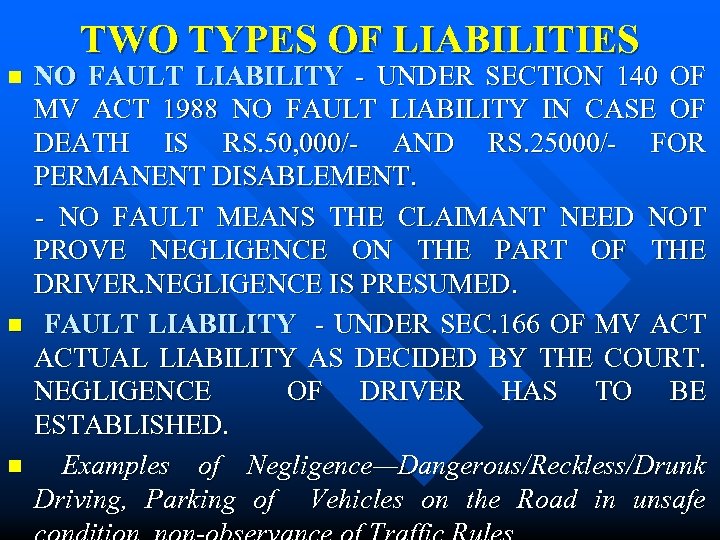
TWO TYPES OF LIABILITIES NO FAULT LIABILITY - UNDER SECTION 140 OF MV ACT 1988 NO FAULT LIABILITY IN CASE OF DEATH IS RS. 50, 000/- AND RS. 25000/- FOR PERMANENT DISABLEMENT. - NO FAULT MEANS THE CLAIMANT NEED NOT PROVE NEGLIGENCE ON THE PART OF THE DRIVER. NEGLIGENCE IS PRESUMED. n FAULT LIABILITY - UNDER SEC. 166 OF MV ACTUAL LIABILITY AS DECIDED BY THE COURT. NEGLIGENCE OF DRIVER HAS TO BE ESTABLISHED. n Examples of Negligence—Dangerous/Reckless/Drunk Driving, Parking of Vehicles on the Road in unsafe n
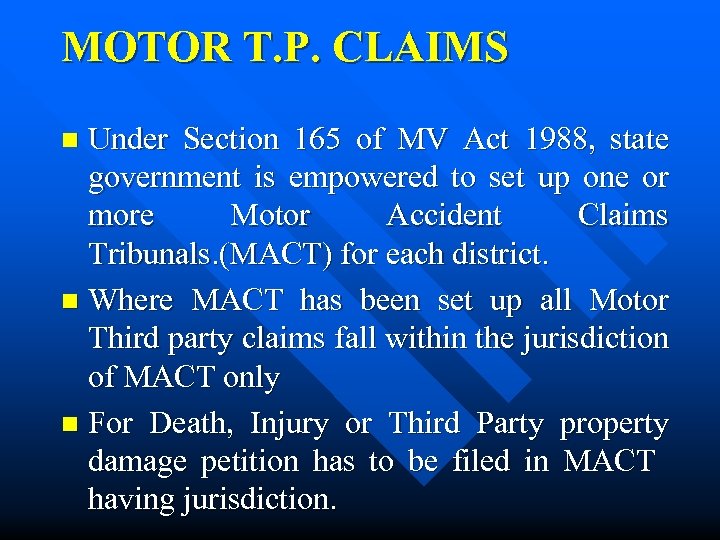
MOTOR T. P. CLAIMS Under Section 165 of MV Act 1988, state government is empowered to set up one or more Motor Accident Claims Tribunals. (MACT) for each district. n Where MACT has been set up all Motor Third party claims fall within the jurisdiction of MACT only n For Death, Injury or Third Party property damage petition has to be filed in MACT having jurisdiction. n
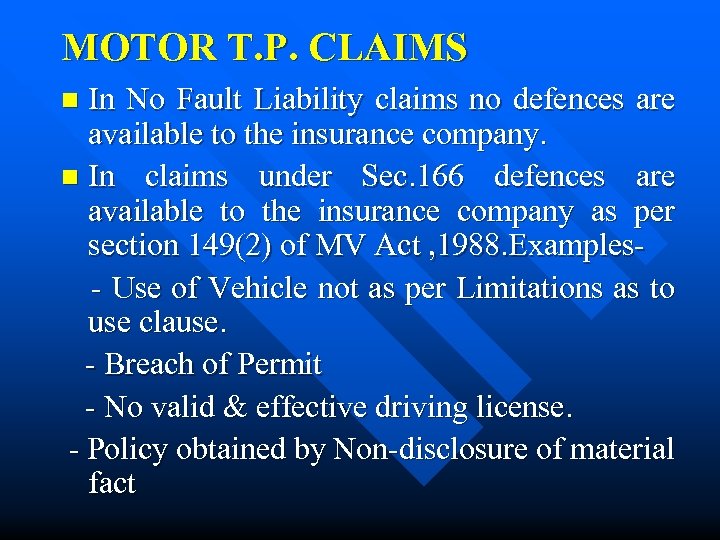
MOTOR T. P. CLAIMS In No Fault Liability claims no defences are available to the insurance company. n In claims under Sec. 166 defences are available to the insurance company as per section 149(2) of MV Act , 1988. Examples - Use of Vehicle not as per Limitations as to use clause. - Breach of Permit - No valid & effective driving license. - Policy obtained by Non-disclosure of material fact n
MOTOR T. P. CLAIMS DOCUMENTS REQUIRED n Vehicle Papers & Driving License n Police Report n Details of Driver’s Prosecution, if any n Death Certificate, Coroner’s report, if any (fatal claims) n Medical Certificate ( Bodily injury claims) n Details of age, income & number of dependents. n
CLAIMS PROCEDURE-THIRD PARTY LIABILITY CLAIMS n MACT Procedure— 1. 2. 3. Receipt of Notice of Claim from Insured/ Legal notice from T. P. Claimant/Summons from MACT Checking the 5 -Ps viz. Policy/Person/Peril/Property/ Premium and , if in order, registering the claim, issuing the claim form. If O/D Claim is also reported, keeping one set of the O/D claim papers in the T. P. file Appointment of Advocate by issuing Vakalatnama and providing him with copy of Summons, alongwith all supporting claims documents and D/L and Vehicle Document verification report
MOTOR THIRD PARTY CLAIMS n CONCEPT OFØ 1. 2. DAMAGES -- MONETARY COMPENSATION RECOVERABLE BY AN INJURED PARTY FROM THE DRIVER/ INSURED OWNER OF THE VEHICLE CAUSING THE DEATH/ INJURY BY THEIR NEGLIGENCE IN THE USE OF THE VEHICLE IN A PUBLIC PLACE. TWO TYPES OF DAMAGES---GENERAL DAMAGES-LOSS OF LOVE AND AFFECTION/PAIN AND SUFFERING etc. SPECIAL DAMAGES-CAPABLE OF MATHEMATICAL EVALUATION /SUPPORTED BY BILLS, REPORTS etc.
CONTRIBUTORY AND COMPOSITE NEGLIGENCE n Contributory Negligence : If the Injured Person through his negligence contributes to the accident, the damages will be apportioned amongst the negligent parties according to the degree of blame attaching to each party. Thus, if his negligence is 40%, the Driver/ Insured/ Insurer will pay only 60% of the damages q Composite Negligence : When more than one vehicle is involved in an accident in which injuries/damages are caused to innocent Third Parties—e. g. passangers travelling in a bus involved in a collision, pedestrians etc. , the innocent Third Parties can claim jointly and severally from both vehicle owners as there is a composite negligence on their part
MOTOR T. P. CLAIMS…LOK ADALAT COMPROMISE SETTLEMENTWhere liability is clear and the company sees that there are no defences available to it, the matter may be compromised either through a consent award OR in the Lok Adalat. The LOK ADALAT is --Ø An Institution of Legal Aid Ø Where liability is clear and the company has no defences available , matter is placed before Lok Adalat for speedy and amicable settlement Ø Legal Aid Board organises Lok Adalats in each district for speedy and amicable settlement of claims. n
MOTOR THIRD PARTY CLAIMS CONCEPT OFn GENERAL DAMAGES-LOSS OF LOVE AND AFFECTION/PAIN AND SUFFERING etc. n SPECIAL DAMAGES-CAPABLE OF MATHEMATICAL EVALUATION /SUPPORTED BY BILLS, REPORTS etc. n CONTRIBUTARY NEGLIGENCE n COMPOSITE NEGLIGENCE n

THANK YOU
Скачать презентацию MOTOR INSURANCE CLAIMS BY R R JOSHI EX-MANAGER
72b1c4badc29cce3a53a1621f2cc03ec.ppt