


 Скачать презентацию MOTION FORCES AND SIMPLE MACHINES Explore Activity
4d9ede3e3c699eb390a07be5423488c9.ppt
- Количество слайдов: 83
 MOTION, FORCES, AND SIMPLE MACHINES!
 Explore Activity Ü Release the ball from a point near the bottom of the curve. Describe the motion. How high does it go? When is its speed the greatest? Ü Release the ball from a point near the top of the curve. Describe the motion. How high does it go? When is its speed the greatest? Ü Compare your results.
 I. Motion Ü To describe how fast a bike is traveling, you must know two things about its motion: 1. The distance it has traveled 2. How much time it took to travel that distance.
 A. Average Speed Ü Average speed = Total distance traveled travel time s = speed, d = distance, and t = time s = d_ t
 Speed cont. Ü Because average speed is always calculated by dividing distance by time, its units will always be a distance unit divided by a time unit. Ü EX: Speed of a car? Miles / hour
 Calculating Average Speed Ü Riding your bike, it takes you 30 minutes to get to your friend’s house, which is 9 km away. What is your average speed? Ü SOLUTION: Ü What you know: d = 9 km t = 30 min = 0. 5 h Ü What you NEED to know: s Ü Equation you will use: s = d/t Ü Substitute in values: s = 9 km /
 Calculating Average Speed PRACTICE Ü If an airplane travels 1, 350 km in 3 h, what is its average speed? Ü SOLUTION: Ü What you know: d = 1, 350 km t=3 h Ü What you NEED to know: s Ü Equation you will use: s = d/t Ü Substitute in values: s = 1, 350 km / 3 h
 B. Instantaneous Speed Ü Average speed is useful when you don’t need to know details of the motion. Ü EX: a car trip…. . traffic lights, traffic jam, high speed highway…. Ü What if you want to know your speed at a certain time? Ü Instantaneous speed: the speed of an object at any instant of time. (in a car, how is your instantaneous speed given? )
 B. Instantaneous Speed cont. Ü How is instantaneous speed different from average speed?
 C. Constant Speed Ü Constant Speed is when an object’s instantaneous speed does not change. Ü At a constant speed, average speed and instantaneous speed are the same!
 D. Distance Ü If an object is moving with constant speed, you can use the equation you used for speed to calculate distance! Üs = d speed = distance / time t Üd = s x t distance = speed x time
 Calculating Distance A marathon runner can maintain a constant speed of 16 km/h, how far can she run in 24 min (0. 4 h)? Ü SOLUTION: Ü What you know: s = 16 km/h t = 0. 4 h Ü What you NEED to know: d Ü Equation: d=sxt Ü Substitute values d = 16 km/h x 0. 4 h Ü SOLUTION d = 6. 4 km NOTICE: units of time in the speed MUST be the same as the time or they won’t cancel! If Ü
 Calculating Distance Ü It takes your family 2 h to drive to Idlewild Park at an average speed of 73 km/h. How far away is the park? Ü SOLUTION: Ü What you know: s = 73 km / h t=2 h Ü What you NEED to know: d Ü Equation: d=sxt Ü Substitute values d = 73 km/h x 2 h Ü SOLUTION d = 146 km
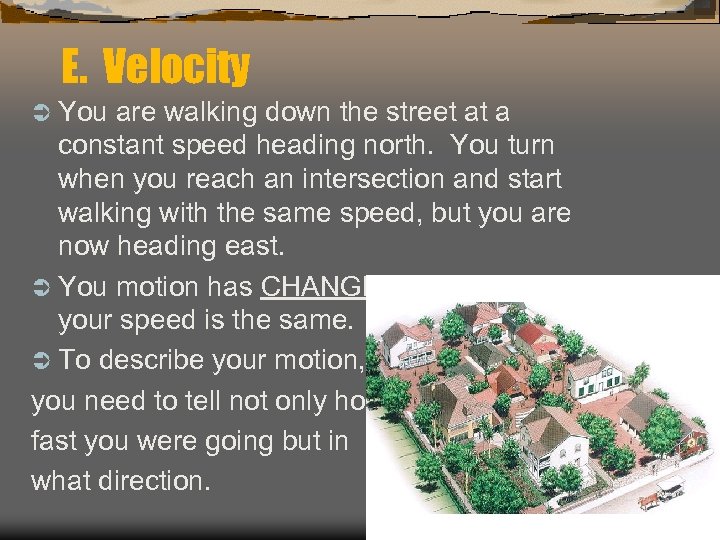 E. Velocity Ü You are walking down the street at a constant speed heading north. You turn when you reach an intersection and start walking with the same speed, but you are now heading east. Ü You motion has CHANGED even though your speed is the same. Ü To describe your motion, you need to tell not only how fast you were going but in what direction.
 E. Velocity Ü Velocity: the speed of an object and its direction of motion. Ü Velocity changes when speed changes, the direction of motion changes or both change! Ü When you turned the corner, even though your speed didn’t change, your direction did, SO your velocity changed.
 F. Acceleration Ü You’re skateboarding the half-pipe. Ü At the top, you are at rest, your speed is zero. Ü When you start down, you smoothly speed up, going faster and faster. Ü If the angle of the half-pipe were steeper, you would speed up at an even greater rate.
 F. Acceleration Ü Speed describes how distance traveled changes with time. Ü Acceleration describes how velocity changes with time. Ü Acceleration is the change in velocity divided by the time needed for the change to occur.
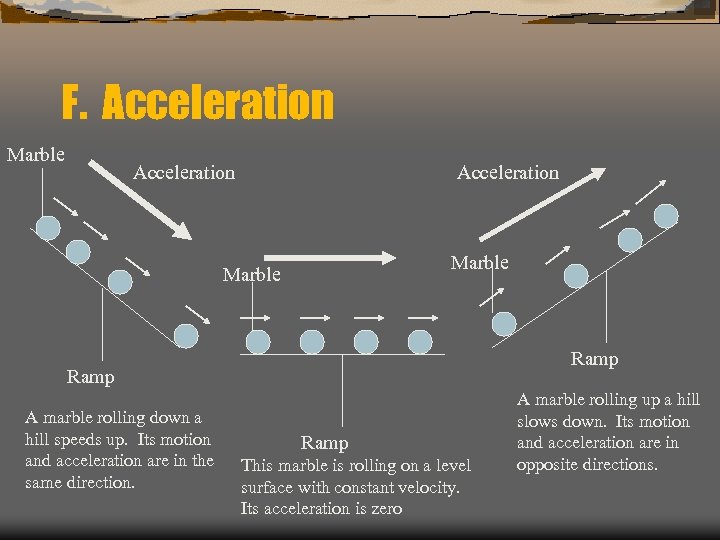 F. Acceleration Marble Ramp A marble rolling down a hill speeds up. Its motion and acceleration are in the same direction. Ramp This marble is rolling on a level surface with constant velocity. Its acceleration is zero A marble rolling up a hill slows down. Its motion and acceleration are in opposite directions.
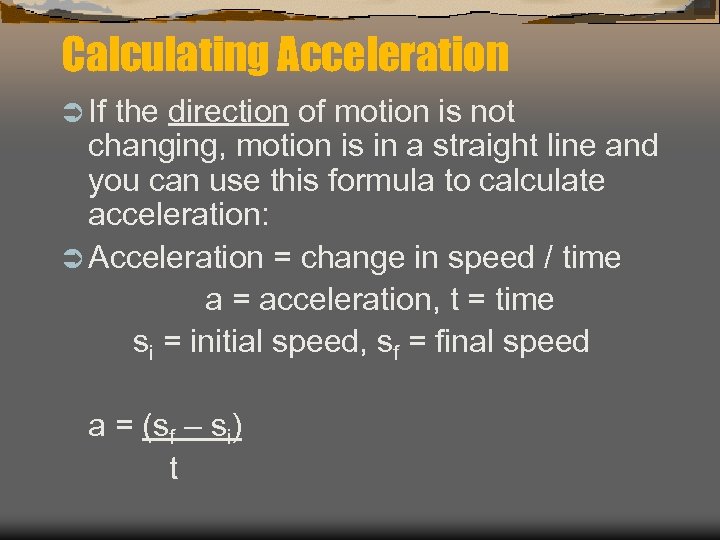 Calculating Acceleration Ü If the direction of motion is not changing, motion is in a straight line and you can use this formula to calculate acceleration: Ü Acceleration = change in speed / time a = acceleration, t = time si = initial speed, sf = final speed a = (sf – si) t
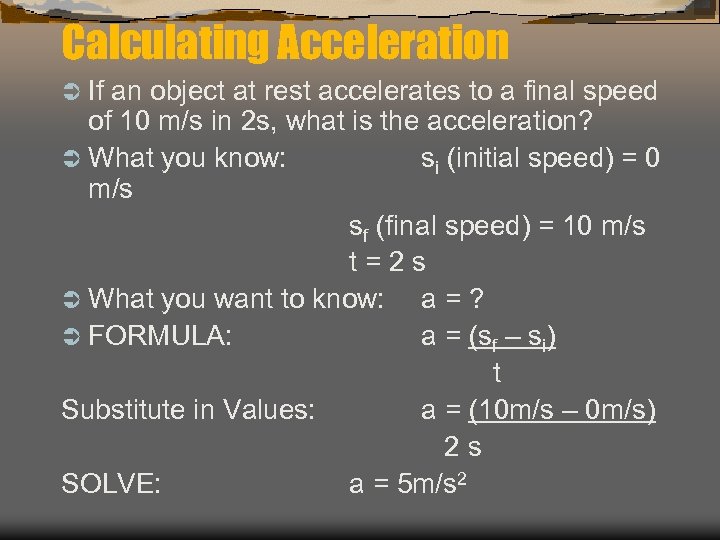 Calculating Acceleration Ü If an object at rest accelerates to a final speed of 10 m/s in 2 s, what is the acceleration? Ü What you know: si (initial speed) = 0 m/s sf (final speed) = 10 m/s t=2 s Ü What you want to know: a=? Ü FORMULA: a = (sf – si) t Substitute in Values: a = (10 m/s – 0 m/s) 2 s SOLVE: a = 5 m/s 2
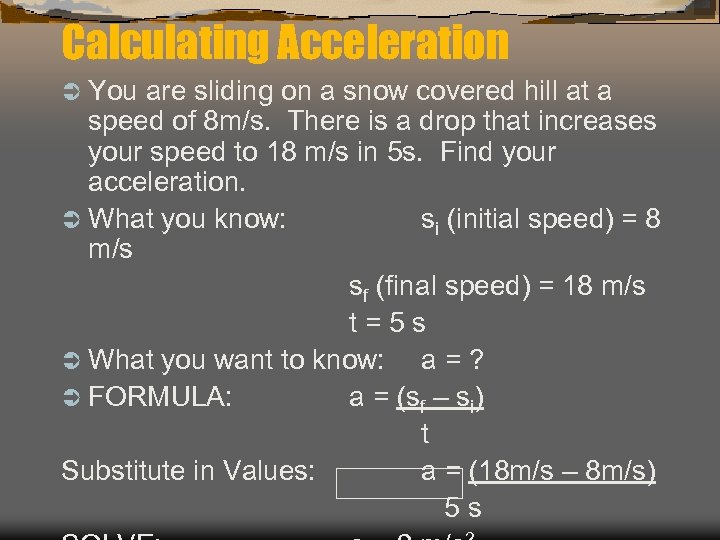 Calculating Acceleration Ü You are sliding on a snow covered hill at a speed of 8 m/s. There is a drop that increases your speed to 18 m/s in 5 s. Find your acceleration. Ü What you know: si (initial speed) = 8 m/s sf (final speed) = 18 m/s t=5 s Ü What you want to know: a=? Ü FORMULA: a = (sf – si) t Substitute in Values: a = (18 m/s – 8 m/s) 5 s
 Calculating Acceleration Ü Practice Ü The Problem: roller coaster you are on is moving at 10 m/s. 5 s later, it toes a loop-theloop and is now moving at 25 m/s. What is the roller coaster’s acceleration over this time?
 Calculating Acceleration Ü What you know: 10 m/s si (initial speed) = sf (final speed) = 25 t=5 s Ü What you want to know: a=? Ü FORMULA: a = (sf – si) t Substitute in Values: a = (25 m/s – 10 m/s)
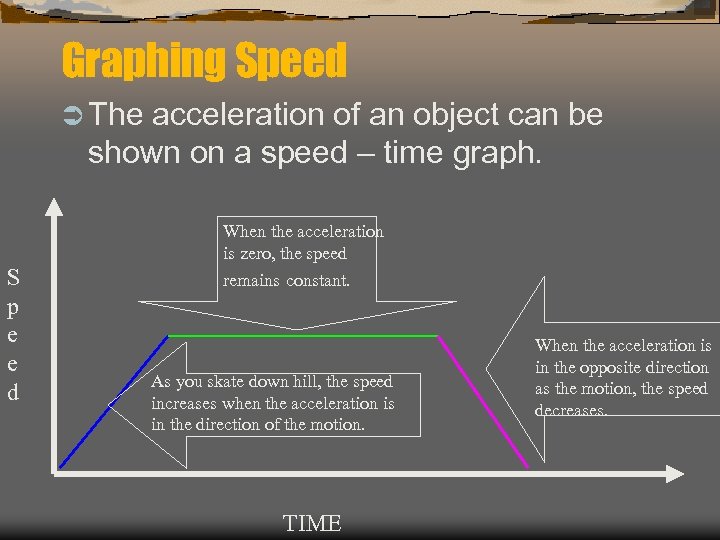 Graphing Speed Ü The acceleration of an object can be shown on a speed – time graph. When the acceleration is zero, the speed S p e e d remains constant. As you skate down hill, the speed increases when the acceleration is in the direction of the motion. TIME When the acceleration is in the opposite direction as the motion, the speed decreases.
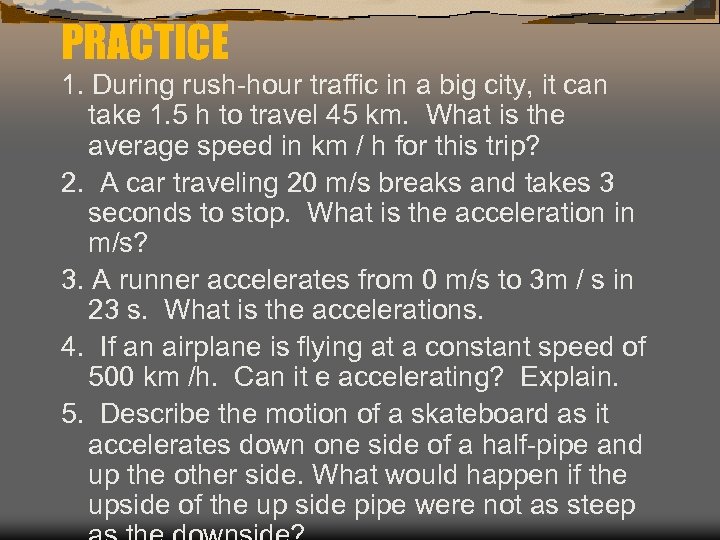 PRACTICE 1. During rush-hour traffic in a big city, it can take 1. 5 h to travel 45 km. What is the average speed in km / h for this trip? 2. A car traveling 20 m/s breaks and takes 3 seconds to stop. What is the acceleration in m/s? 3. A runner accelerates from 0 m/s to 3 m / s in 23 s. What is the accelerations. 4. If an airplane is flying at a constant speed of 500 km /h. Can it e accelerating? Explain. 5. Describe the motion of a skateboard as it accelerates down one side of a half-pipe and up the other side. What would happen if the upside of the up side pipe were not as steep
 Section 2 Newton’s Laws of Motion
 Objectives: Ü Describe how forces affect motion Ü Calculate acceleration using Newton’s second law of motion Ü Explain Newton’s third law of motion
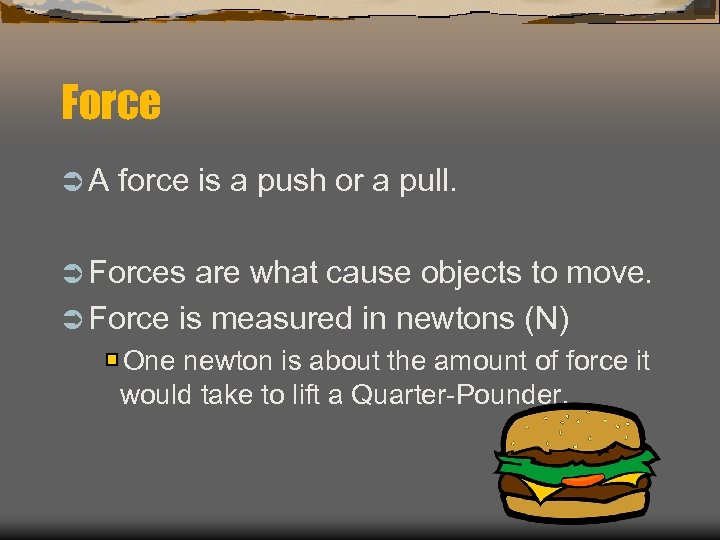 Force ÜA force is a push or a pull. Ü Forces are what cause objects to move. Ü Force is measured in newtons (N) One newton is about the amount of force it would take to lift a Quarter-Pounder.
 Force and Acceleration Ü Exerting a force on an object causes its motion to change. Ü THEREFORE: Forces cause objects to accelerate. Ü (an object has acceleration when it’s speed or direction of motion changes. ) Ü Anytime a force acts on something, its speed changes or its direction of motion changes, or BOTH change.
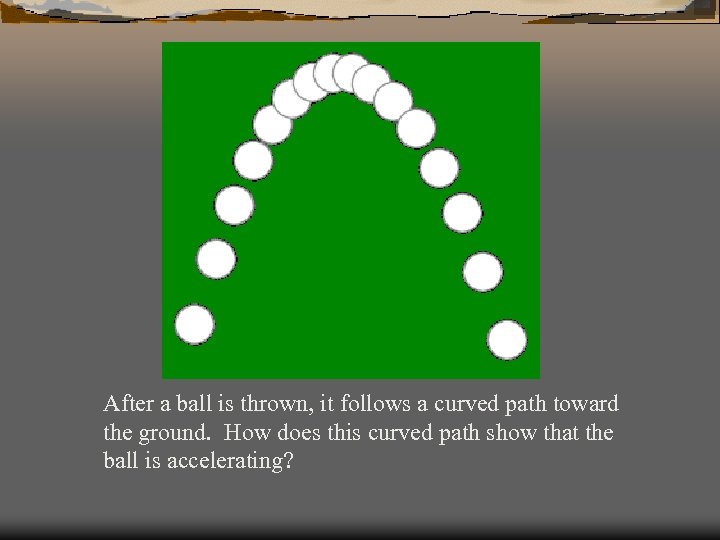 After a ball is thrown, it follows a curved path toward the ground. How does this curved path show that the ball is accelerating?
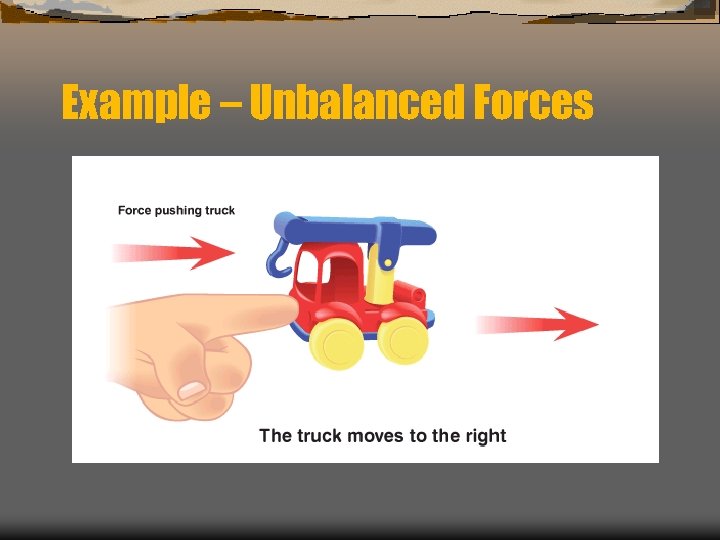
 Balanced and Unbalanced Forces Ü If more than one force is acting on an object and does not cause the objects motion to change, it is a balanced force. Balanced forces cancel each other out. Ü If more than one force is acting on an object and it’s motion DOES change, the forces are unbalanced. Unbalanced forces DO NOT cancel each other out.
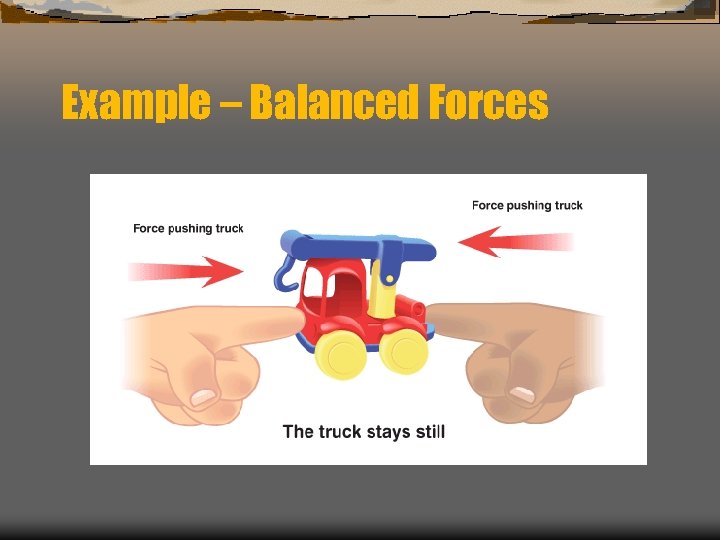 Example – Balanced Forces
 Example – Unbalanced Forces
 Combining Forces Ü When more than one force acts on an object, the forces combine Ü The combination of all of the forces acting on an object is called the net force.
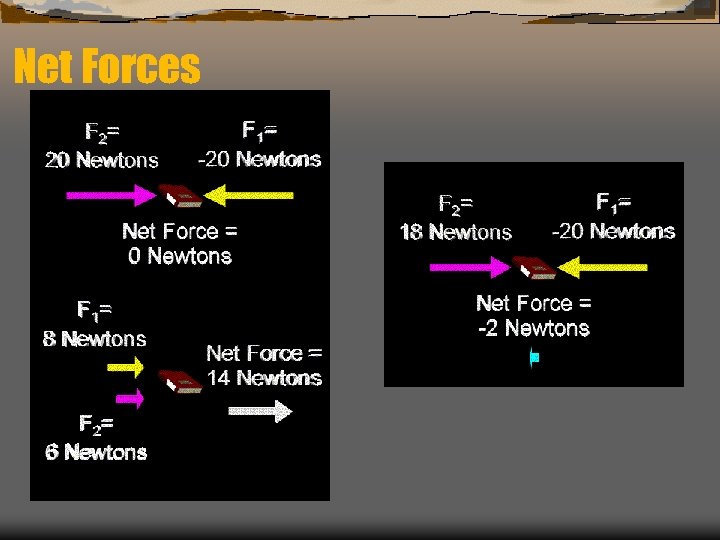
 Net Forces Ü If forces are in the same direction, they add together to form the net force. Ü If forces are in opposite directions, the net force is the difference between the two forces and is in the direction of the larger force.
 Net Forces
 Net Forces Practice
 Gravity Ü If you hold a basketball shoulder height then let it go, what force pulls it to the ground? Ü Gravity of course! Ü Gravity is defined as the pull that all objects exert on each other. Ü When you drop the basketball, the gravitational force between the ball and Earth, pulled it toward the Earth.
 Gravity Ü Objects don’t have to be touching to exert gravitational force on each other. Ü The gravitational force between two objects gets weaker as the objects get further apart. Ü Also, the gravitational force is weaker between objects of less mass – like you and your desk, compared to objects of greater mass like you and the Earth.
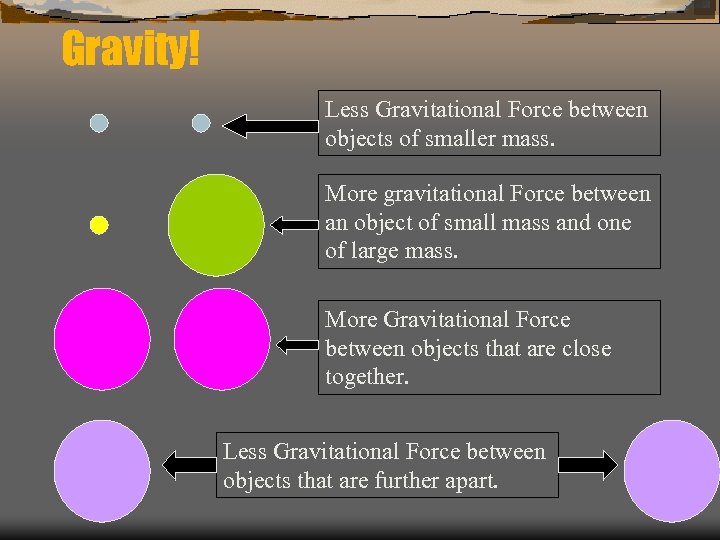 Gravity! Less Gravitational Force between objects of smaller mass. More gravitational Force between an object of small mass and one of large mass. More Gravitational Force between objects that are close together. Less Gravitational Force between objects that are further apart.
 Newton’s First Law of Motion Ü An object in motion stays in motion and an object at rest stays at rest until a force acts on it. Ü This means, an object’s motion won’t change unless a force acts on it. Ü EX: Your paper stays on your desk, unless you pick it up or a breeze blows it.
 Newton’s First Law of Motion Ü Also, an object in motion continues to stay in a constant motion, unless a force acts on it. Ü WAIT! Say I throw a football…. it eventually falls to the ground… Ü But I thought objects in motion stay in motion… Ü What force acted on the football? Ü GRAVITY!
 Friction Ü WAIT! Newton’s first law says that a moving object should never slow down or change direction until a force acts on it. Ü BUT if you push a book across the table, it slows down to a stop! WHY? Ü FRICTION! This is the force that acts on it and causes it to stop. Ü Friction is a force that resists motion between two surfaces that are in contact. It always acts in the opposite direction to motion. Ü To keep an object moving when friction is acting on it, you have to keep applying force!
 Friction cont. Ü Friction is caused by the roughness of the surfaces in contact. Ü A rougher surface will cause more friction and a smoother surface will cause less friction. Ü EX: if you push a hockey puck on ice it will travel further before it stops than if you push it on carpet.
 Inertia and Mass Ü How easy would you say it is to move a refrigerator? Ü Pretty difficult huh? Ü How about stopping a person on a skateboard who is much bigger than you are? Ü Ouch.
 Inertia and Mass Ü When moving or stopping a big object, the object resists a change in motion. Ü Inertia, is the tendency of an object to resist motion – this is another way to state Newton’s first law of motion. The Law of Inertia Ü The more matter an object has the more inertia it has!
 Newton’s Second Law of Motion Ü Newton’s first law says that a change in motion won’t occur unless there is a net force large enough to move the object or stop an object that is moving. Ü Newton’s SECOND law tells how a net force acting on an object changes the motion of an object.
 Newton’s Second Law of Motion Ü Newton’s second law says: A net force changes the velocity of the object and causes it to accelerate. Ü This includes two things: 1. 2. IF an object is acted on by a net force, the change in velocity will be in the direction of the net force. Acceleration can be calculated from the following equation: F=mxa F (force) m (mass) a(acceleration) in Newtons in kilograms in meters per
 Mass and Acceleration Ü When a net force acts on an object, it’s acceleration depends on the mass of the object! Ü The more mass an object has, the more force is necessary to cause it to accelerate! Ü EX: it’s much harder to move a refrigerator than it is to move an empty shopping cart,
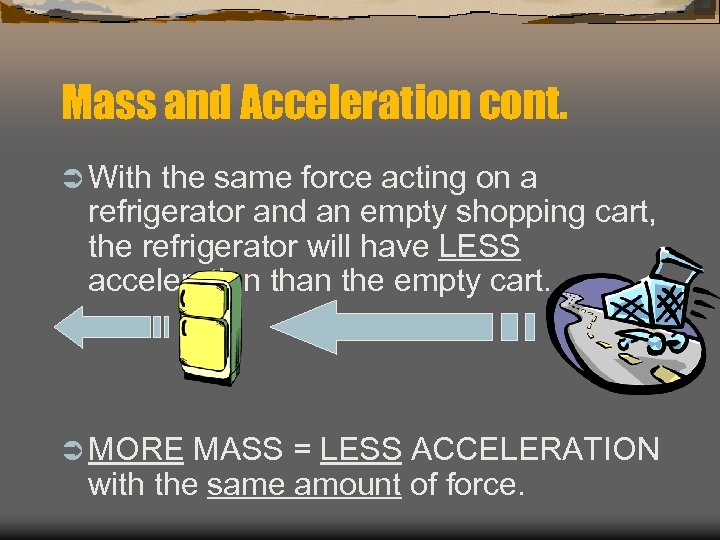 Mass and Acceleration cont. Ü With the same force acting on a refrigerator and an empty shopping cart, the refrigerator will have LESS acceleration than the empty cart. Ü MORE MASS = LESS ACCELERATION with the same amount of force.
 Newton’s Third Law of Motion Ü Remember when Ms. Smyder pushed the wall? Ü You might be surprised to know…. THE WALL PUSHED BACK! Ü Well…the wall isn’t alive, but Netwon’s Third Law says: Ü When one object exerts a force on a second object, the second object exerts an equal force in the opposite direction.
 Newton’s Third Law of Motion Ü EXAMPLE: When you walk, you push down on the sidewalk and it pushes back up on you with an equal and opposite force. Ü The force exerted by the first object is the action force, the force exerted by the second object is the reaction force.
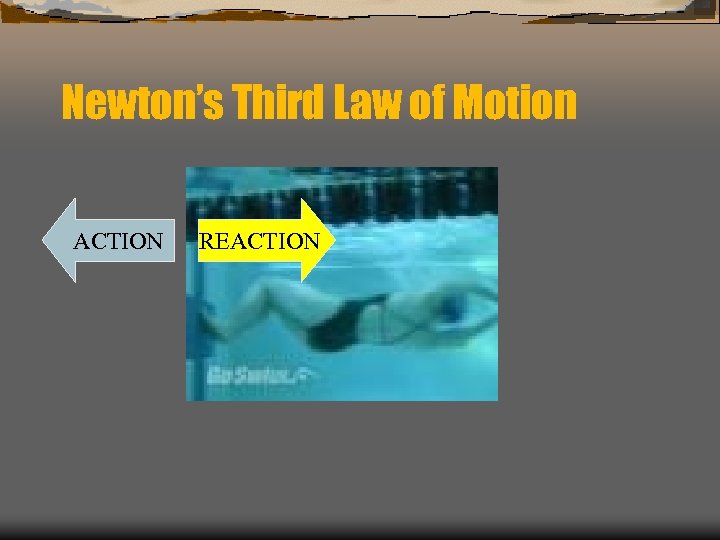 Newton’s Third Law of Motion ACTION REACTION
 Force Pairs Act on Different Objects Ü IF forces always act in equal but opposite pairs, you might ask – HOW CAN ANYTHING EVER MOVE? ? Ü Won’t forces acting on an object always cancel each other out? Ü REMEMBER, equal and opposite forces act on DIFFERENT objects. Ü When you push on a book, a force is acting on the book. When it pushes back on you, the force is acting on you!
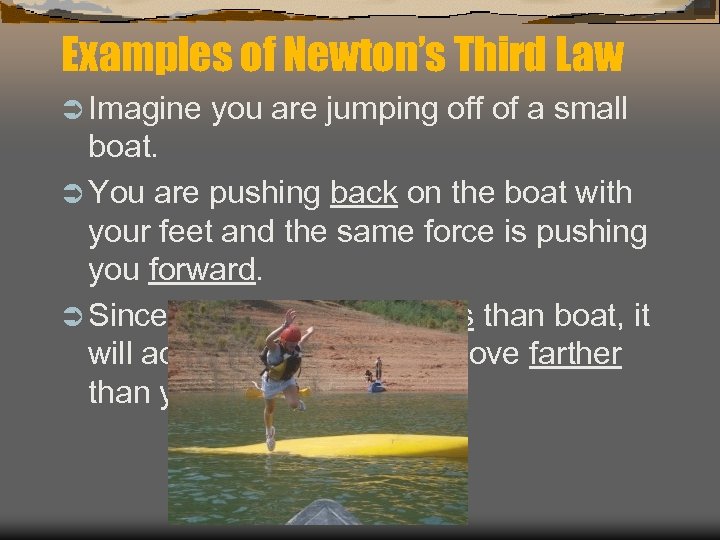 Examples of Newton’s Third Law Ü Imagine you are jumping off of a small boat. Ü You are pushing back on the boat with your feet and the same force is pushing you forward. Ü Since you have more mass than boat, it will accelerate more and move farther than you do.
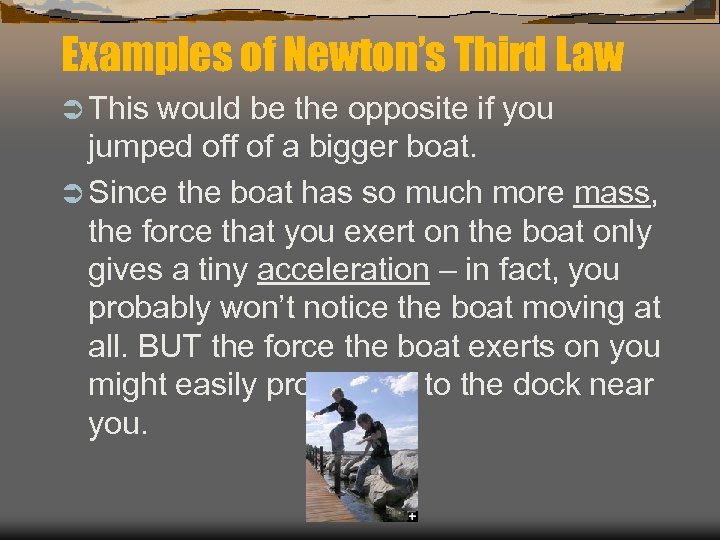 Examples of Newton’s Third Law Ü This would be the opposite if you jumped off of a bigger boat. Ü Since the boat has so much more mass, the force that you exert on the boat only gives a tiny acceleration – in fact, you probably won’t notice the boat moving at all. BUT the force the boat exerts on you might easily propel you to the dock near you.
 Section 2 - Practice Ü 1. Make a table listing Newton’s laws of motion. For each law, include the definition and give at least one example from your everyday life. Do not use examples from the notes!!!! Ü 2. Does a force act on a car if it moves at a constant speed while turning? Explain. Ü 3. You throw a ball to your friend. If the ball has a mass of 0. 15 kg and it accelerates at 20 m/s 2, what force did you exert on the ball? Ü 4. Give at least two examples of using inertia to your advantage. Ü 5. Newton’s third law is a good example of cause and effect. Explain why, using a ball
 Section 3 Work and Simple Machines Define Work Distinguish the different types of simple machines Explain how machines make work easier
 Work Ü Newton’s Laws explain how forces change the motion of an object. Ü When you apply an upward force on a box, it moves UP! Ü What is work? ?
 Work cont… Ü In science, WORK is done when a force causes an object to move in the same direction that the force is applied.
 Effort doesn’t always Equal Work Remember when Ms. Smyder pushed the wall? She tried really hard! But the wall didn’t move. Ü In order for WORK to be done, two things MUST happen: 1. A force must be applied on an object 2. The object must move in the direction of the force. If the object doesn’t move, no work was done. So, did Ms. Smyder do work when she pushed the wall? Ü
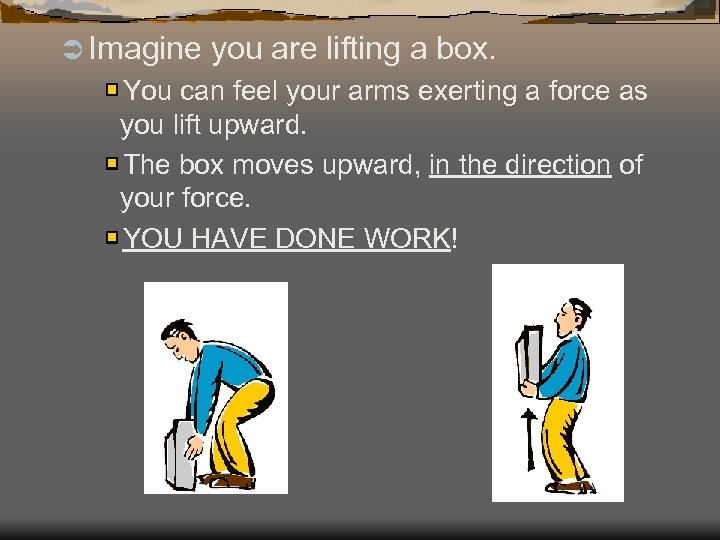 Ü Imagine you are lifting a box. You can feel your arms exerting a force as you lift upward. The box moves upward, in the direction of your force. YOU HAVE DONE WORK!
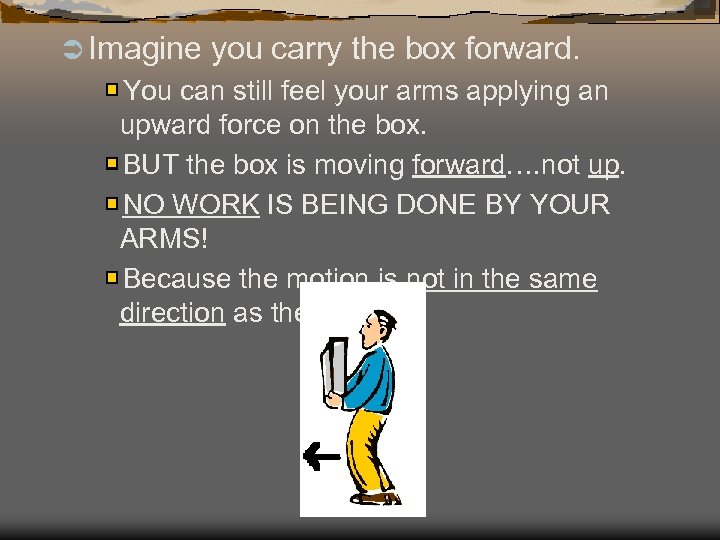 Ü Imagine you carry the box forward. You can still feel your arms applying an upward force on the box. BUT the box is moving forward…. not up. NO WORK IS BEING DONE BY YOUR ARMS! Because the motion is not in the same direction as the force.
 Calculating Work Ü The greater the force applied that makes an object move, the more work is done. Ü Which of these tasks would involve more work? Ü Lifting a shoe from the floor to your waist OR
 Calculating Work cont… Ü Even though you lifted them the same distance, more work is done when you lift the books because it takes more force to lift them! You can calculate work: work = force x distance W = F x d
 Calculating Work cont… Force is measured in newtons (N) Distance is measured in meters (m) Work is measured in joules (J) Energy is also measured in joules. Named for James Prescott Joule, a 19 th century physicist who showed that work and energy are related.
 Calculate Work ÜA weight lifter lifts a 500 N weight a distance of 2 m from the floor to a position over his head. How much work does he do? Ü Know: Force = F = 500 N distance = d = 2 m Ü Want to know: work = W Ü Equation: W=Fxd Ü Substitute: W = 500 N x 2 m Ü Solve: W = 1000 J
 PRACTICE Ü Using a force of 50 N, you push a computer cart 10 m across a classroom floor. How much work did you do? Know: F = 50 N d = 10 m Want to Know: W Equation: W=Fxd Substitute: W = 50 N x 10 m Solve: W = 500 J
 What is a Machine? ÜA machine is a device that you use that makes work easier. ÜA can opener changes a small force applied by your hand into a larger force and makes it easier to open the can.
 Simple Machines ÜA simple machine is a machine that uses only one movement. Ü The following are Simple Machines: 1. Inclined Plane 2. Wedge 3. Screw 4. Lever 5. Wheel and axle 6. Pulley
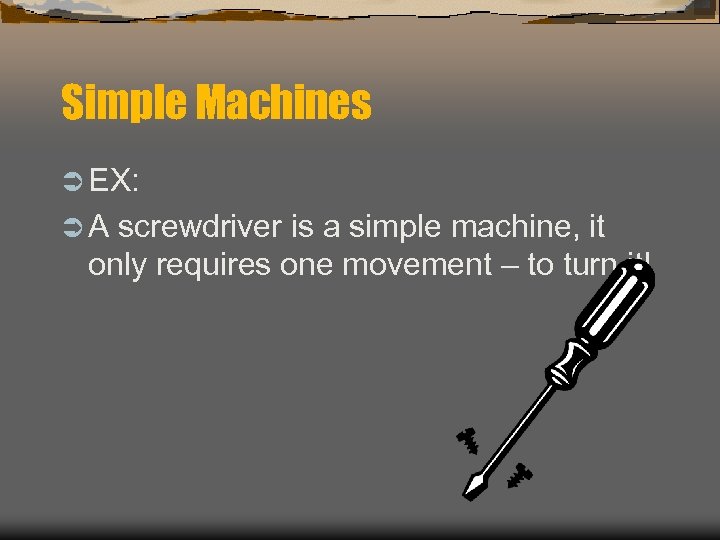 Simple Machines Ü EX: ÜA screwdriver is a simple machine, it only requires one movement – to turn it!
 Compound Machines ÜA compound machine is a combination of simple machines. Ü A can opener is an example of a compound machine – it combines several simple machines. Ü Machines make work easier in two ways: 1. They can change the size of a force applied
 Mechanical Advantage Ü The number of times the applied force is increased by a machine is called the mechanical advantage. Ü When you push on the handles of the can opener, the force that you apply is called the input force (Fi). Ü The can opener changes your input force to the force that is exerted by the metal cutting blade on the can. The force exerted by a machine is called the output force (Fo).
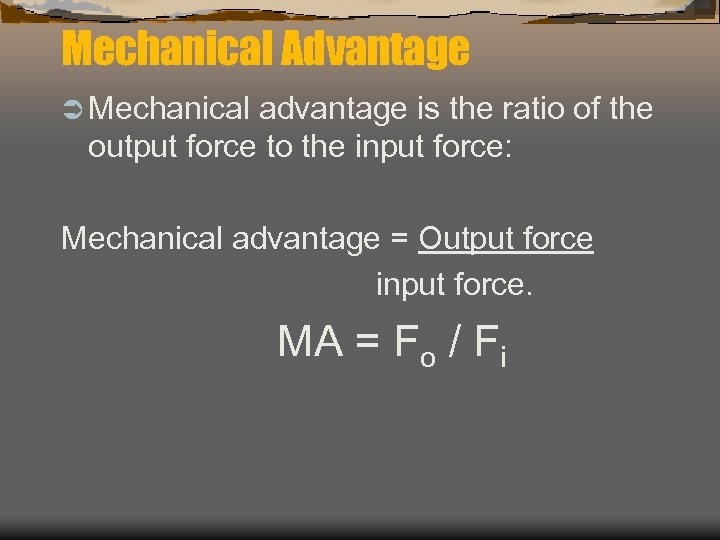 Mechanical Advantage Ü Mechanical advantage is the ratio of the output force to the input force: Mechanical advantage = Output force input force. MA = Fo / Fi
 Work in and Work out Ü In a simple machine, the input and the output force do work: You push on the handles of a can opener and the handles move – work is done (input) The blade of the can opener moves down and punctures the can – work is done (output) Ü In an ideal machine, there is no friction.
 Increasing Force ÜA simple machine can make a small input force into a larger output force. ÜW=Fxd Ü SO if work in is equal to work out, a smaller input force must be applied over a larger distance than the larger output force. Ü Think about that can opener, it increases the force that you apply to the handle SO the distance you move the handle is large compared to the distance the blade of the can opener moves as it pierces the can. Ü In all real machines, friction always occurs as one part moves past another.
 The Pulley
 The Lever
 The Wheel and Axle
 The Inclined Plane
 The Wedge
 The Screw
 Practice! 1. 2. 3. 4. 5. How much work would it take to lift a 1, 000 kg limestone block 146 m to the top of the Great Pyramid? Explain how you can tell if work is being done on an object. Using a pulley system with a mechanical advantage of 10, how large an input force would be needed to lift a stone slab weighing 2, 500 N? Compare a wheel and axle to a lever. Identify two levers in your body. What class of lever is each?