Скачать презентацию Moss Winn — Methodological Advances in the Field
27935e2864490f9827b73aa86c6278a7.ppt
- Количество слайдов: 31
 Moss. Winn - Methodological Advances in the Field of Mössbauer Data Analysis Zoltán Klencsár Budapest, Hungary http: //www. mosswinn. hu z. klencsar@mosswinn. hu ISIAME 2012 - Dalian - China
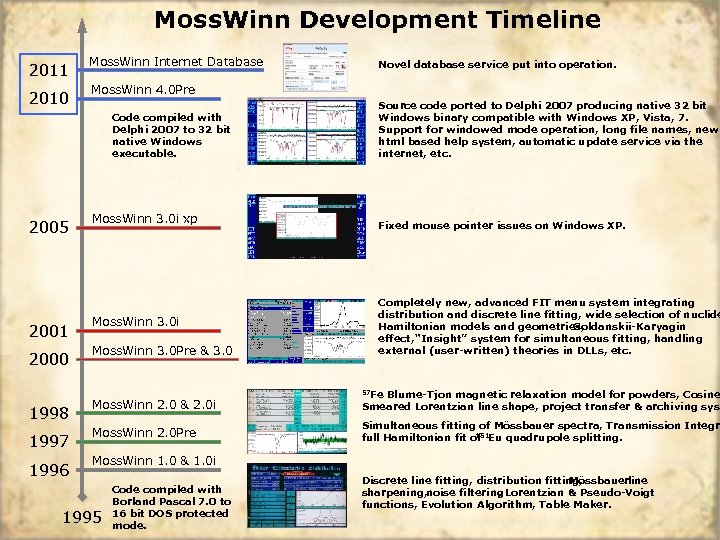 Moss. Winn Development Timeline 2011 2010 Moss. Winn Internet Database Moss. Winn 4. 0 Pre Code compiled with Delphi 2007 to 32 bit native Windows executable. 2005 2001 2000 1998 1997 1996 Novel database service put into operation. Moss. Winn 3. 0 i xp Moss. Winn 3. 0 i Moss. Winn 3. 0 Pre & 3. 0 Moss. Winn 2. 0 & 2. 0 i Moss. Winn 2. 0 Pre Source code ported to Delphi 2007 producing native 32 bit Windows binary compatible with Windows XP, Vista, 7. Support for windowed mode operation, long file names, new html based help system, automatic update service via the internet, etc. Fixed mouse pointer issues on Windows XP. Completely new, advanced FIT menu system integrating distribution and discrete line fitting, wide selection of nuclide Hamiltonian models and geometries, Goldanskii-Karyagin effect, “Insight” system for simultaneous fitting, handling external (user-written) theories in DLLs, etc. 57 Fe Blume-Tjon magnetic relaxation model for powders, Cosine Smeared Lorentzian line shape, project transfer & archiving syst Simultaneous fitting of Mössbauer spectra, Transmission Integr 151 full Hamiltonian fit of Eu quadrupole splitting. Moss. Winn 1. 0 & 1. 0 i 1995 Code compiled with Borland Pascal 7. 0 to 16 bit DOS protected mode. Discrete line fitting, distribution fitting, Mössbauerline sharpening, noise filtering Lorentzian & Pseudo-Voigt , functions, Evolution Algorithm, Table Maker.
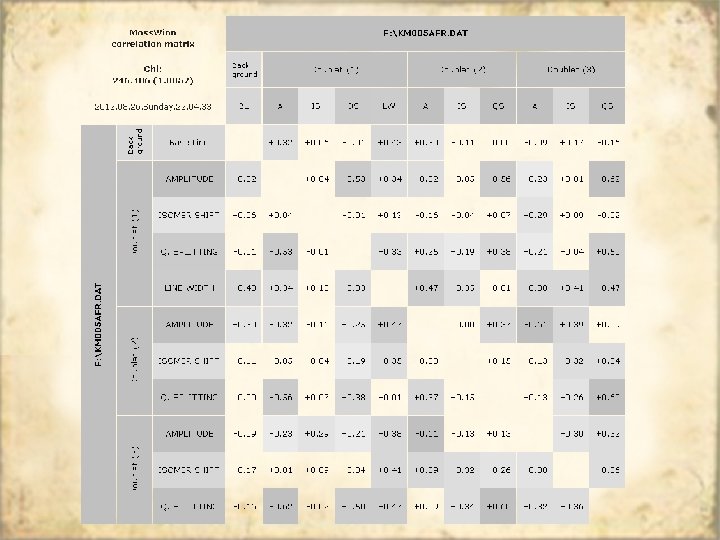
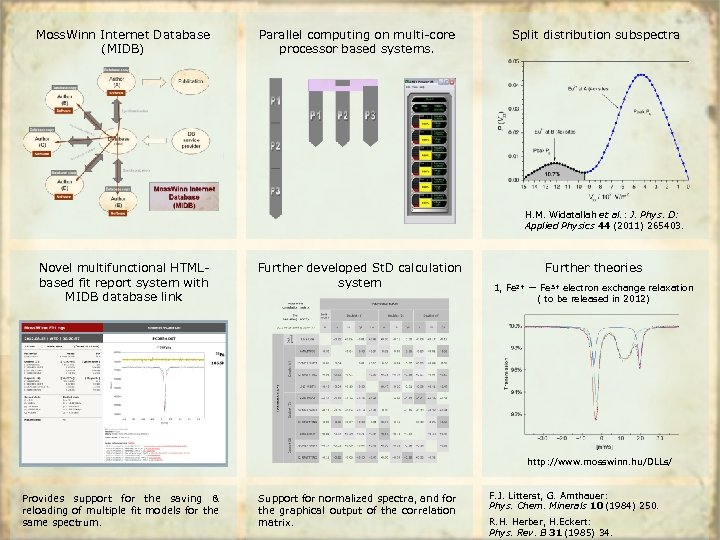 Moss. Winn Internet Database (MIDB) Parallel computing on multi-core processor based systems. Split distribution subspectra H. M. Widatallah et al. : J. Phys. D: Applied Physics 44 (2011) 265403. Novel multifunctional HTMLbased fit report system with MIDB database link Further developed St. D calculation system Further theories 1, Fe 2+ — Fe 3+ electron exchange relaxation ( to be released in 2012) http: //www. mosswinn. hu/DLLs/ Provides support for the saving & reloading of multiple fit models for the same spectrum. Support for normalized spectra, and for the graphical output of the correlation matrix. F. J. Litterst, G. Amthauer: Phys. Chem. Minerals 10 (1984) 250. R. H. Herber, H. Eckert: Phys. Rev. B 31 (1985) 34.
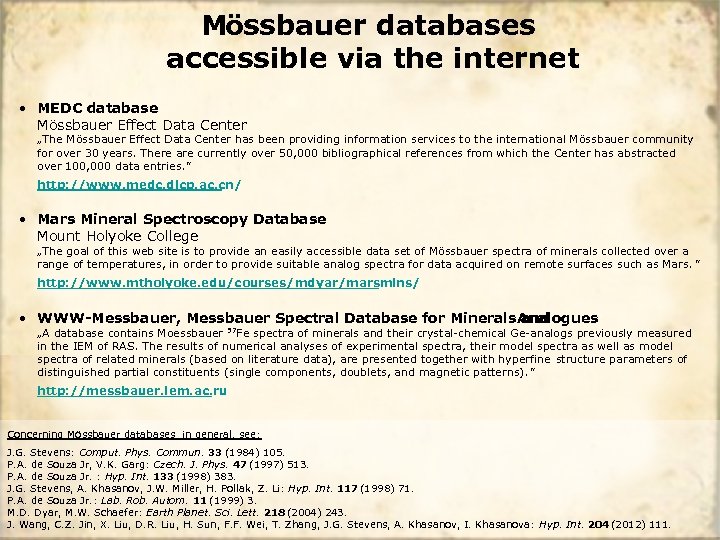 Mössbauer databases accessible via the internet • MEDC database Mössbauer Effect Data Center „The Mössbauer Effect Data Center has been providing information services to the international Mössbauer community for over 30 years. There are currently over 50, 000 bibliographical references from which the Center has abstracted over 100, 000 data entries. ” http: //www. medc. dicp. ac. cn/ • Mars Mineral Spectroscopy Database Mount Holyoke College „The goal of this web site is to provide an easily accessible data set of Mössbauer spectra of minerals collected over a range of temperatures, in order to provide suitable analog spectra for data acquired on remote surfaces such as Mars. ” http: //www. mtholyoke. edu/courses/mdyar/marsmins/ • WWW-Messbauer, Messbauer Spectral Database for Minerals. Analogues and „A database contains Moessbauer 57 Fe spectra of minerals and their crystal-chemical Ge-analogs previously measured in the IEM of RAS. The results of numerical analyses of experimental spectra, their model spectra as well as model spectra of related minerals (based on literature data), are presented together with hyperfine structure parameters of distinguished partial constituents (single components, doublets, and magnetic patterns). ” http: //messbauer. iem. ac. ru Concerning Mössbauer databases in general, see: J. G. Stevens: Comput. Phys. Commun. 33 (1984) 105. P. A. de Souza Jr, V. K. Garg: Czech. J. Phys. 47 (1997) 513. P. A. de Souza Jr. : Hyp. Int. 133 (1998) 383. J. G. Stevens, A. Khasanov, J. W. Miller, H. Pollak, Z. Li: Hyp. Int. 117 (1998) 71. P. A. de Souza Jr. : Lab. Rob. Autom. 11 (1999) 3. M. D. Dyar, M. W. Schaefer: Earth Planet. Sci. Lett. 218 (2004) 243. J. Wang, C. Z. Jin, X. Liu, D. R. Liu, H. Sun, F. F. Wei, T. Zhang, J. G. Stevens, A. Khasanov, I. Khasanova: Hyp. Int. 204 (2012) 111.
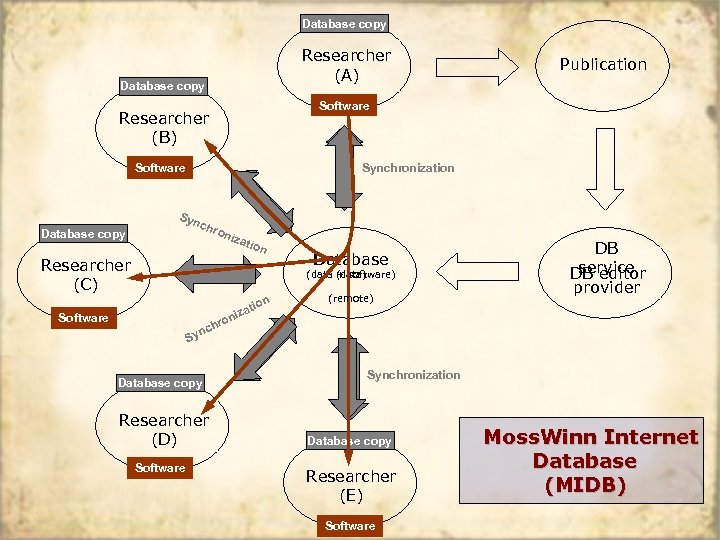 Database copy Researcher (A) Database copy Software Researcher (B) Software Database copy Publication Synchronization Syn chr oni zat ion Researcher (C) Database (data + software) (data) on ti iza (remote) DB service DB editor provider n Software Sy hro nc Database copy Researcher (D) Software Synchronization Database copy Researcher (E) Software Moss. Winn Internet Database (MIDB)
 What do we expect to gain ? q Records that inform about the measured spectrum. q Records that contain a faithful representation of the fit model that was fitted to the included spectrum by the author. q Records that double as a model library whose models can be used as a starting point for the fitting of pristine Mössbauer spectra. q Records that can be ranked according to their fitness to any particular Mössbauer spectrum by comparing the spectrum data counts. q To process queries and return answers in a prompt manner. q Records that are published and maintained by their respective authorswho decide themselves whether, when and how the record is published/edited/withdrawn(!). How can all these objectives become realized?
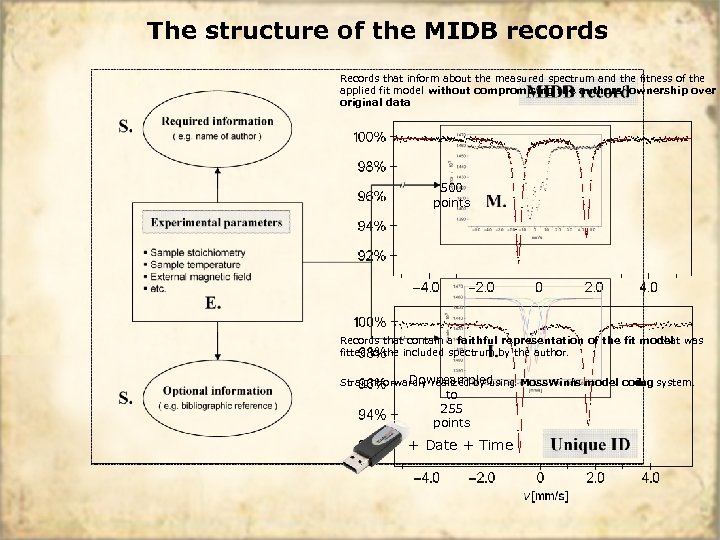 The structure of the MIDB records Records that inform about the measured spectrum and the fitness of the applied fit model without compromising the authors’ ownership over t original data. 500 points Records that contain a faithful representation of the fit model that was fitted to the included spectrum by the author. Downsampled Straightforwardly realized by using Moss. Winn model cod ’s ing system. to 255 points + Date + Time
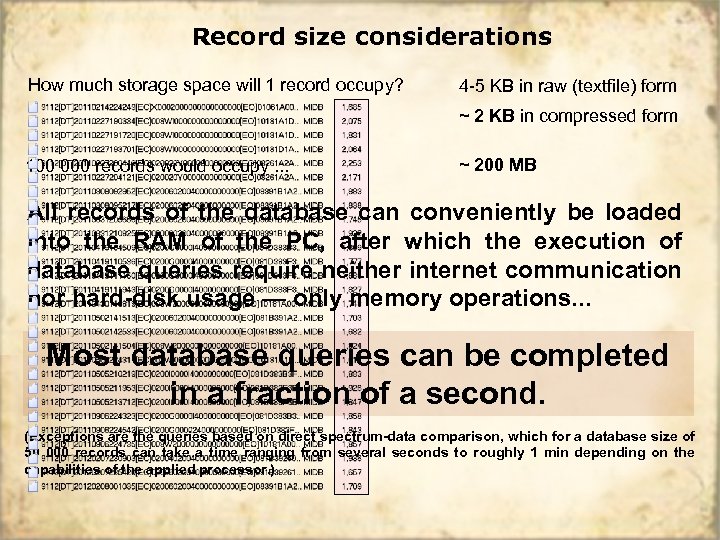 Record size considerations How much storage space will 1 record occupy? 4 -5 KB in raw (textfile) form ~ 2 KB in compressed form 100 000 records would occupy. . . ~ 200 MB All records of the database can conveniently be loaded into the RAM of the PC, after which the execution of database queries require neither internet communication nor hard-disk usage — only memory operations. . . Most database queries can be completed in a fraction of a second. (Exceptions are the queries based on direct spectrum-data comparison, which for a database size of 50 000 records can take a time ranging from several seconds to roughly 1 min depending on the capabilities of the applied processor. )
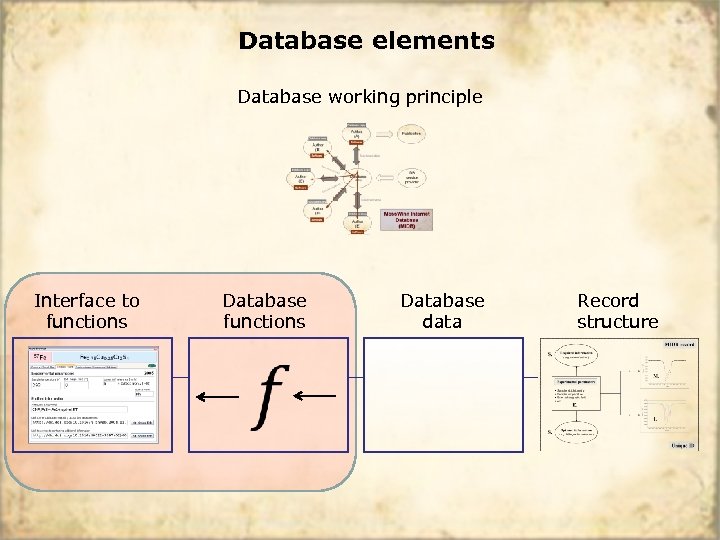 Database elements Database working principle Interface to functions Database functions Database data Record structure
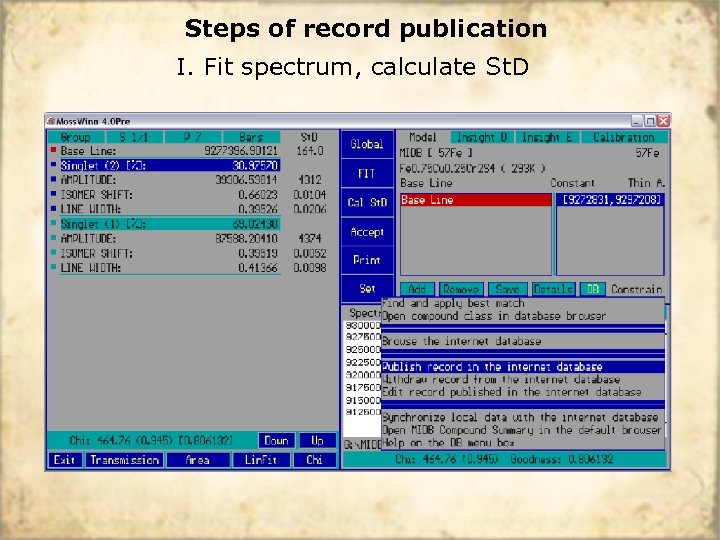 Steps of record publication I. Fit spectrum, calculate St. D
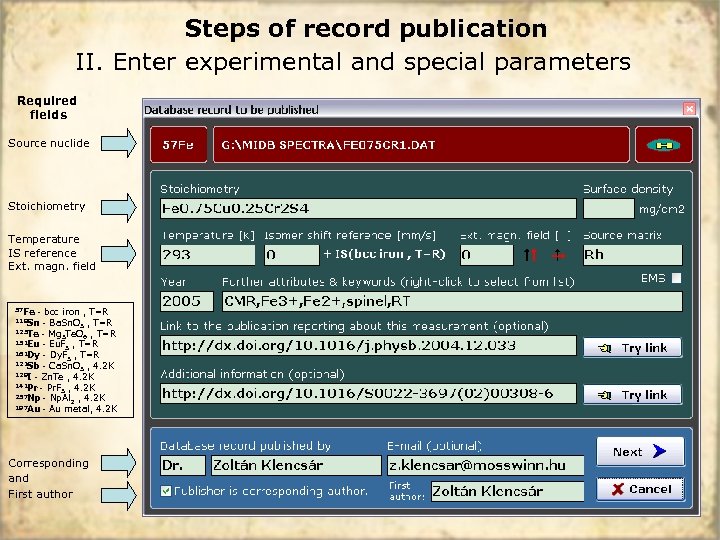 Steps of record publication II. Enter experimental and special parameters Required fields Source nuclide Stoichiometry Temperature IS reference Ext. magn. field 57 Fe - bcc iron , T=R 119 Sn - Ba. Sn. O , T=R 3 125 Te - Mg Te. O , T=R 3 6 151 Eu - Eu. F , T=R 3 161 Dy - Dy. F , T=R 3 121 Sb - Ca. Sn. O , 4. 2 K 3 129 I - Zn. Te , 4. 2 K 141 Pr - Pr. F , 4. 2 K 3 237 Np - Np. Al , 4. 2 K 2 197 Au - Au metal, 4. 2 K Corresponding and First author
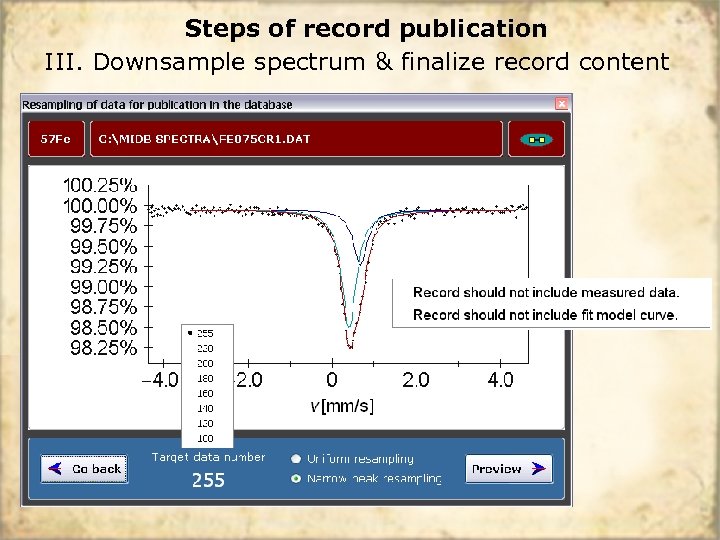 Steps of record publication III. Downsample spectrum & finalize record content
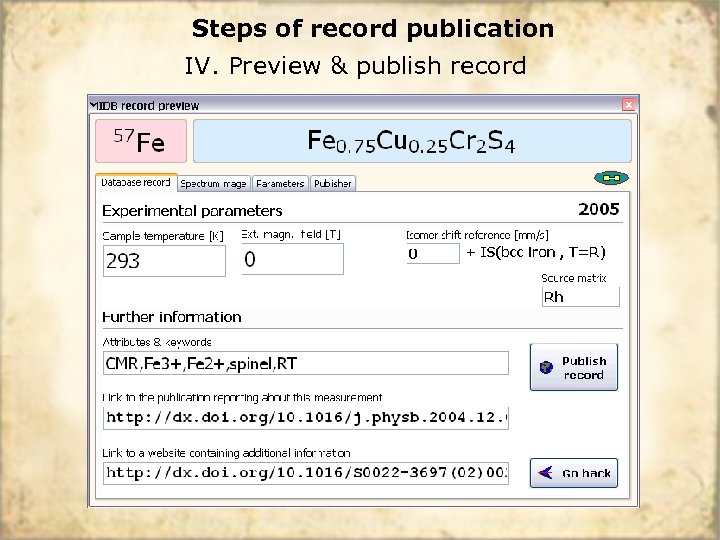 Steps of record publication IV. Preview & publish record
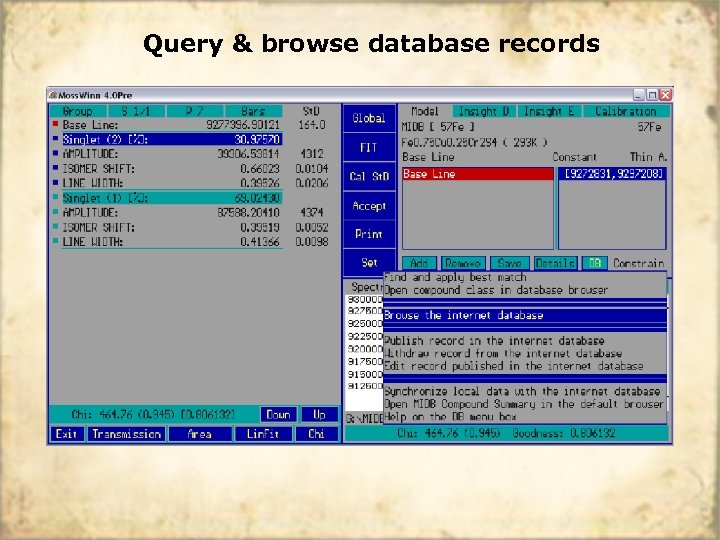 Query & browse database records
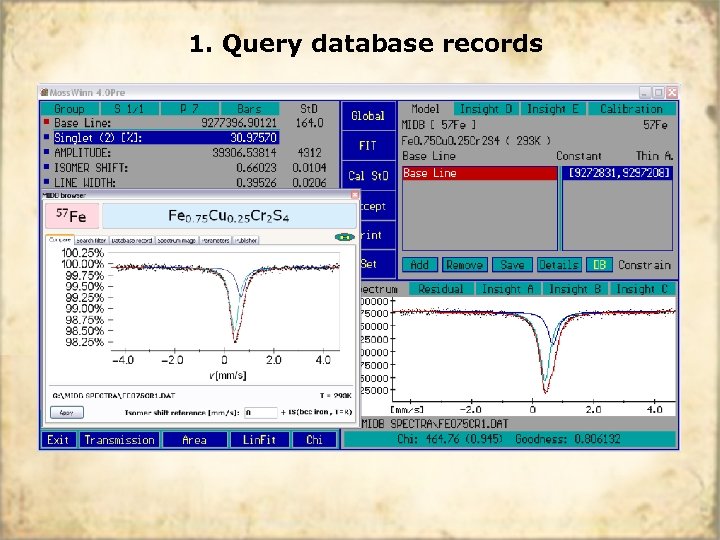 1. Query database records
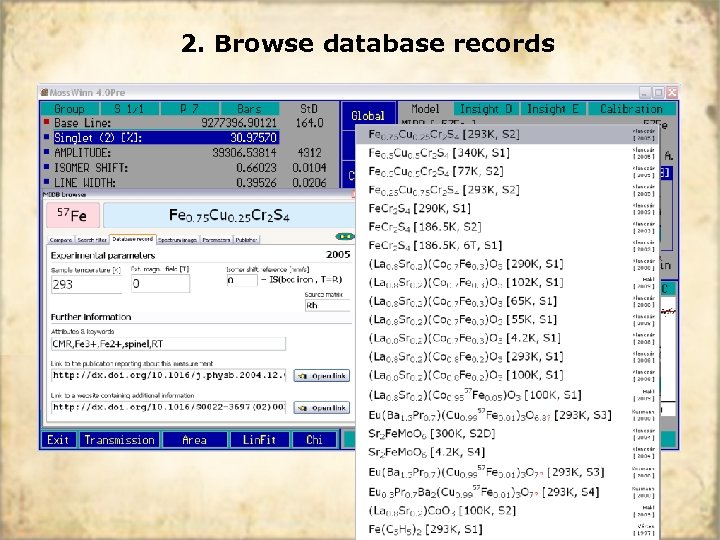 2. Browse database records
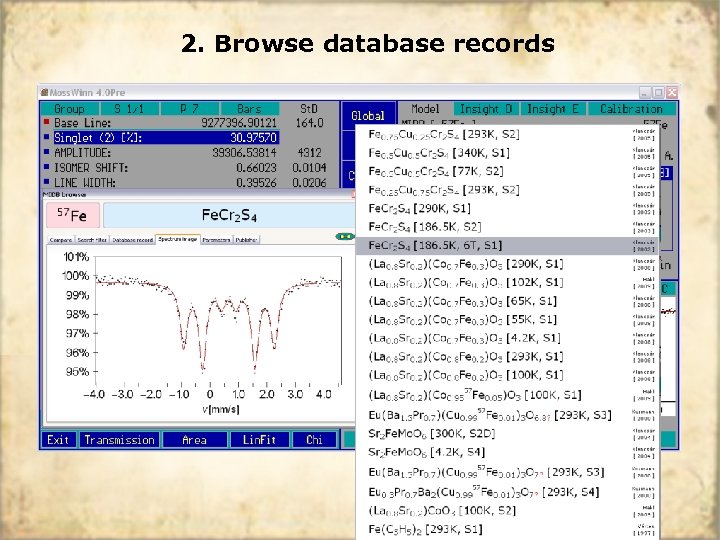 2. Browse database records
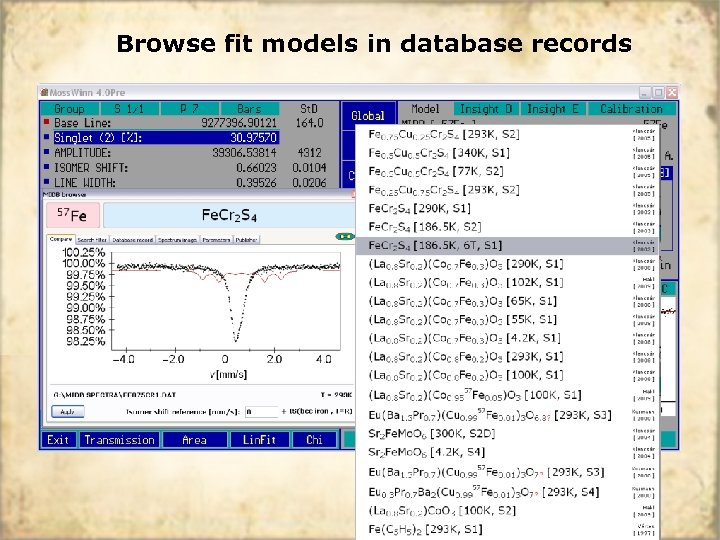 Browse fit models in database records
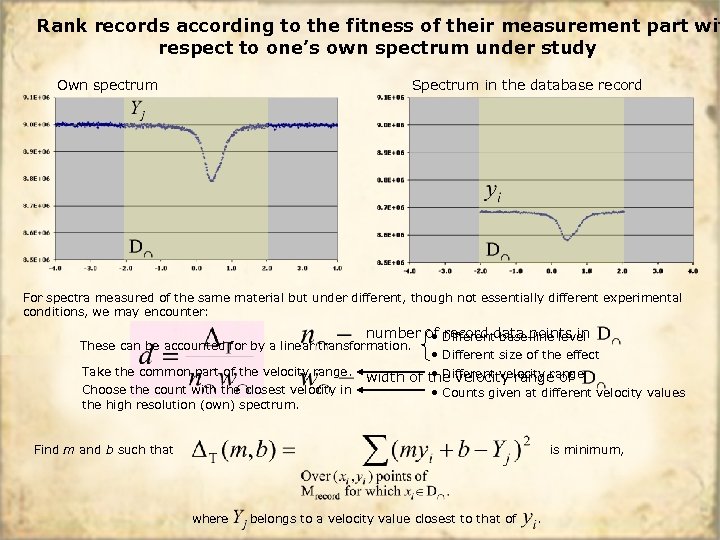 Rank records according to the fitness of their measurement part wit respect to one’s own spectrum under study Own spectrum Spectrum in the database record For spectra measured of the same material but under different, though not essentially different experimental conditions, we may encounter: number of record data points in • Different base-line level These can be accounted for by a linear transformation. • Different size of the effect Take the common part of the velocity range. width of the velocity range of • Different velocity range Choose the count with the closest velocity in • Counts given at different velocity values the high resolution (own) spectrum. Find m and b such that is minimum, where belongs to a velocity value closest to that of .
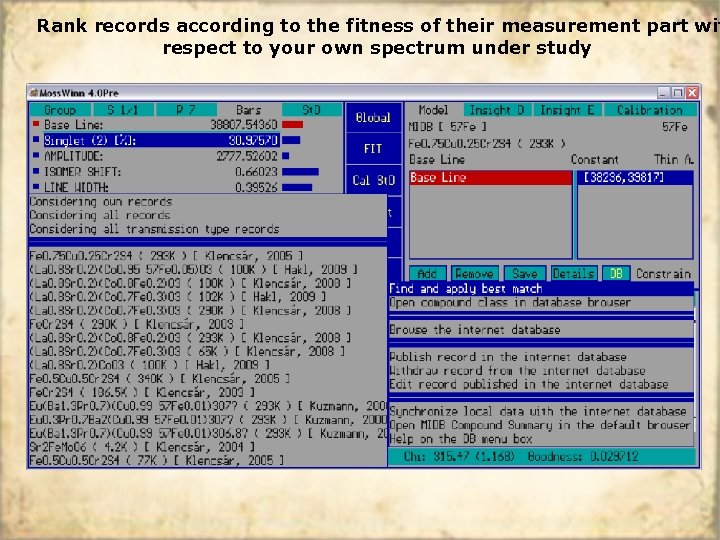 Rank records according to the fitness of their measurement part wit respect to your own spectrum under study
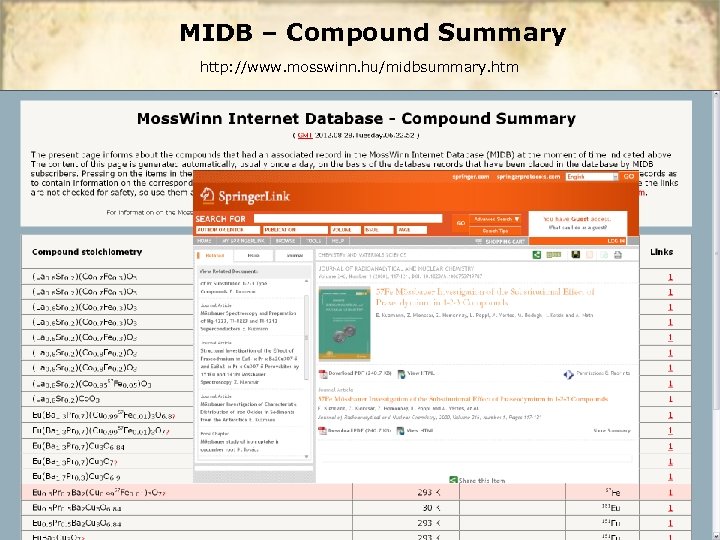 MIDB – Compound Summary http: //www. mosswinn. hu/midbsummary. htm
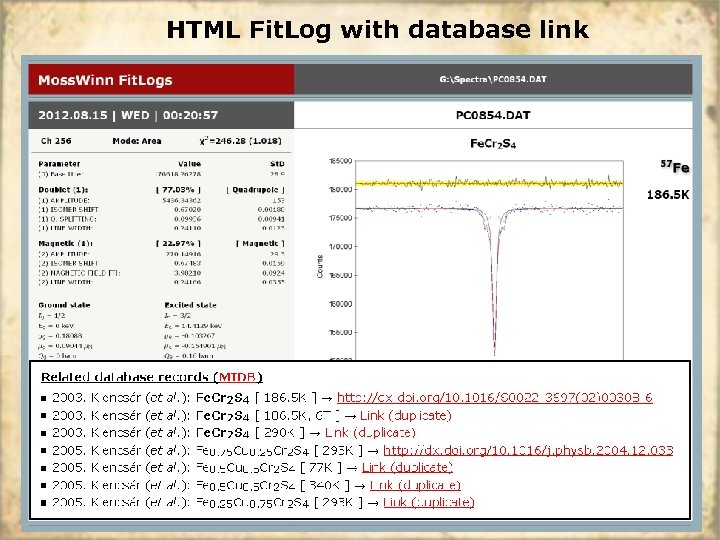 HTML Fit. Log with database link
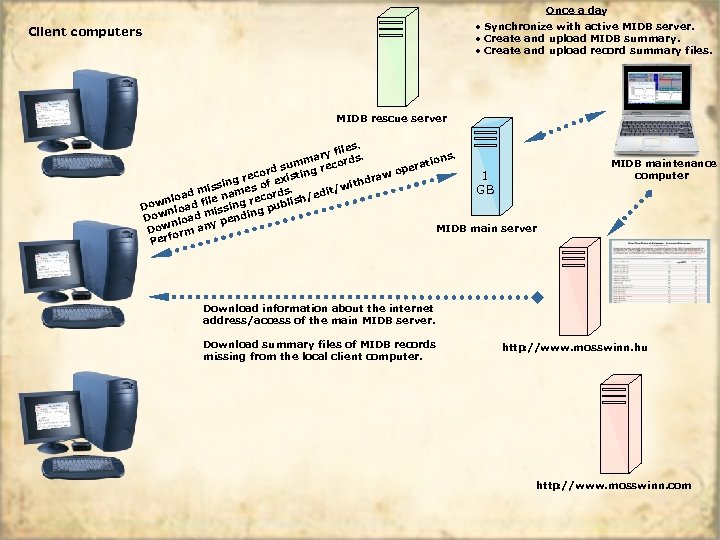 Once a day • Synchronize with active MIDB server. • Create and upload MIDB summary. • Create and upload record summary files. Client computers MIDB rescue server. files s. ary rds. m tion sum g reco era rd op 1 istin reco raw thd ing s of ex wi iss me GB m s. it/ na /ed oad cord wnl ad file ing re ublish Do nlo iss ng p Dow nload m pendi y MIDB main server Dow rm an erfo P MIDB maintenance computer Download information about the internet address/access of the main MIDB server. Download summary files of MIDB records missing from the local client computer. http : //www. mosswinn. hu http : //www. mosswinn. com
 We expected from the database. . . þ Records that inform about the measured spectrum and the fitness of the applied fit model without compromising the authors’ ownership over the original data. þ Records that contain a faithful representation of the fit model that was fitted to the included spectrum by the author. þ Records that double as a model library whose models can be used as a starting point for the fitting of pristine Mössbauer spectra. þ Records that can be ranked according to their fitness to any particular Mössbauer spectrum by comparing the spectrum data counts. þ To process queries and return answers in a prompt manner. þ Records that are published and maintained by their respective authorswho decide themselves whether, when and how the record is published/edited/withdrawn(!). All the aboveobjectiveswere realized.
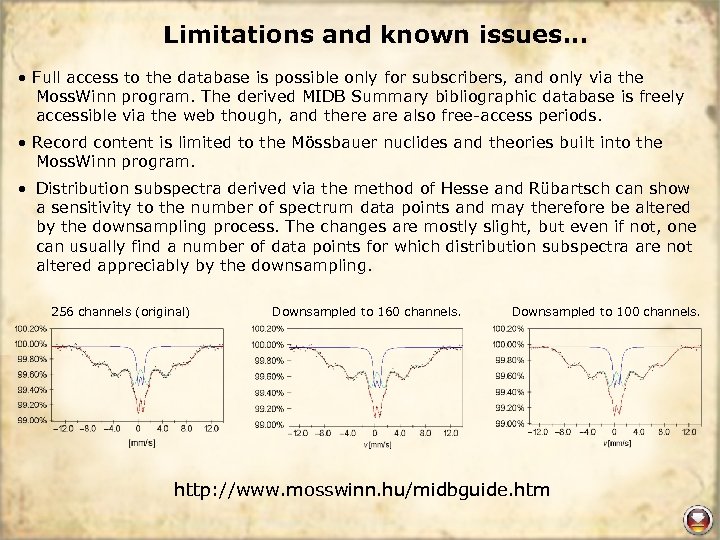 Limitations and known issues. . . • Full access to the database is possible only for subscribers, and only via the Moss. Winn program. The derived MIDB Summary bibliographic database is freely accessible via the web though, and there also free-access periods. • Record content is limited to the Mössbauer nuclides and theories built into the Moss. Winn program. • Distribution subspectra derived via the method of Hesse and Rübartsch can show a sensitivity to the number of spectrum data points and may therefore be altered by the downsampling process. The changes are mostly slight, but even if not, one can usually find a number of data points for which distribution subspectra are not altered appreciably by the downsampling. 256 channels (original) Downsampled to 160 channels. Downsampled to 100 channels. http: //www. mosswinn. hu/midbguide. htm
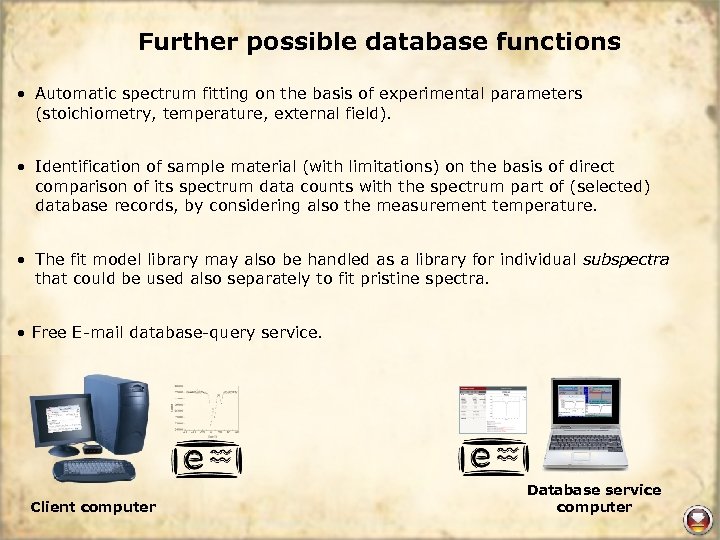 Further possible database functions • Automatic spectrum fitting on the basis of experimental parameters (stoichiometry, temperature, external field). • Identification of sample material (with limitations) on the basis of direct comparison of its spectrum data counts with the spectrum part of (selected) database records, by considering also the measurement temperature. • The fit model library may also be handled as a library for individual subspectra that could be used also separately to fit pristine spectra. • Free E-mail database-query service. Client computer Database service computer
 Conclusions • A novel Mössbauer spectroscopy database management system has been developed according to a scheme that relies on the coherent action of distributed database management programs operating on local copies of the whole database stored on the client computers, and interfacing the remote database server via the internet only for the sake of synchronization of database records between the server and the clients. • The integration of data analysis and database management functionalities in the same application software made it possible to implement functions that present an advance in the field of Mössbauer database applications as well as in the field of Mössbauer data analysis. • Only the records contributed to by the community of researchers can turn the database into being capable to realize the advanced features and possibilities brought about by the new database concept. • Several functions of Moss. Winn have been identified where the utilization of parallel computing techniques are beneficial provided that a multi-core processor is used for the execution. • The development of the Moss. Winn program continues. For further details on the MIDB see Ø http: //www. mosswinn. hu/midbguide. htm Ø http: //www. mosswinn. hu/midbmanual. pdf Ø http: //www. mosswinn. com/english/midb. htm Thank you for your attention !
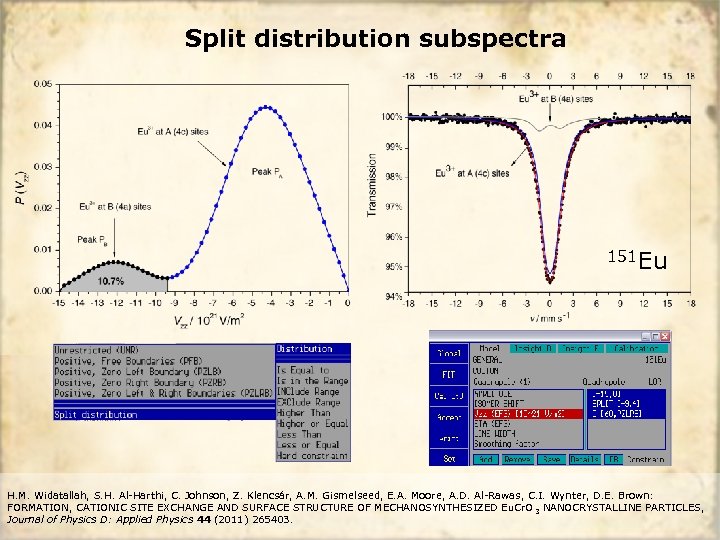 Split distribution subspectra 151 Eu H. M. Widatallah, S. H. Al-Harthi, C. Johnson, Z. Klencsár, A. M. Gismelseed, E. A. Moore, A. D. Al-Rawas, C. I. Wynter, D. E. Brown: FORMATION, CATIONIC SITE EXCHANGE AND SURFACE STRUCTURE OF MECHANOSYNTHESIZED Eu. Cr. O 3 NANOCRYSTALLINE PARTICLES, Journal of Physics D: Applied Physics 44 (2011) 265403.