


 Скачать презентацию MOSS CSR Summit 2007 Speaker Russell Workman Manager
739820e94c88ffbb34614d1ab69411a3.ppt
- Количество слайдов: 13
 MOSS CSR Summit 2007 Speaker: Russell Workman Manager Corporate Responsibility So you have company support for a TBL approach. How do you elevate from belief in what’s right to action and get immediate results?
 HBOSA BACKGROUND § HBOS Australia is part of a global expansion initiative of HBOSplc, in Australia this comprises Bank. West, Capital Finance, BOSI, St. Andrews and BOS Treasury. • HBOS is committed to being a positive corporate citizen and climate change leader and has now been included in a number of key leadership indices: • • Signatory to the Equator Principles Global 100 Most Sustainable Corporations in the World 2006 Accountability Rating (ranked 9 th globally) Ranked 10 th Business in the Community Corporate Responsibility Index • Included in Dow Jones Sustainability Index • Included FTSE 4 Good Index • Included in Carbon Disclosure Project
 Raine Square Headquarters PERTH The $450 million redevelopment of the new Perth headquarters demonstrates the company’s commitment to Western Australia as well as the environment as the building is set to have a minimum Australian Building Greenhouse Rating of 4½ stars. The Rating acknowledges best practice in design, operation and maintenance of commercial buildings to minimise greenhouse emissions. The proposed fit-out will also foster an environment of collaboration, flexibility and efficiency.
 HBOSA Foundation • Through its philanthropy the HBOSA FOUNDATION is a significant part of our commitment to improving society through being a good corporate citizen. • Donations to Australian Charities - Almost $2 million in last two years • Australian Business in the Community Network (ABCN) – HBOSA was a founding member of the ABCN which brings national business leaders together to create positive social change through practical programs which engage students, educators and business people. • Volunteering - Through the HBOSA Foundation colleagues can volunteer their services and expertise to benefit a charity, not-forprofit organisation or community project. • Workplace Giving – through the HBOSA Foundation colleagues have the opportunity to make regular contributions from their pay to benefit the Foundation’s partners and programs.
 KEY points • Awareness • Alignment with overall business strategy doc and reports • Be realistic • Top Down and Bottom Up • Benchmarking • Reassurance & Sell the benefits • Just the beginning • Network with other CR managers
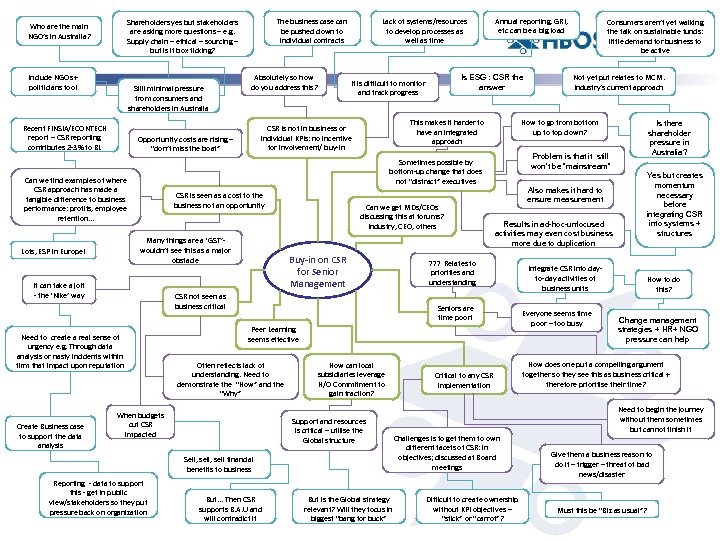 Include NGOs + politicians too! Still minimal pressure from consumers and shareholders in Australia Recent FINSIA/ECONTECH report – CSR reporting contributes 2 -3% to BL Absolutely so how do you address this? Annual reporting, GRI, etc can be a big load Is ESG : CSR the answer It is difficult to monitor and track progress CSR is seen as a cost to the business not an opportunity It can take a jolt - the ‘Nike’ way Can we get MDs/CEOs discussing this at forums? Industry, CEO, others Buy-in on CSR for Senior Management CSR not seen as business critical Need to create a real sense of urgency e. g. Through data analysis or nasty incidents within firm that impact upon reputation When budgets cut CSR impacted Support and resources is critical – utilise the Global structure Sell, sell financial benefits to business Reporting - data to support this - get in public view/stakeholders so they put pressure back on organization Also makes it hard to ensure measurement Results in ad-hoc-unfocused activities may even cost business more due to duplication ? ? ? Relates to priorities and understanding Peer Learning seems effective How can local subsidiaries leverage H/O Commitment to gain traction? But. . . Then CSR supports B. A. U and will contradict it But is the Global strategy relevant? Will they focus in biggest “bang for buck” Not yet put relates to MCM. Industry’s current approach Is there shareholder pressure in Australia? Problem is that it still won’t be “mainstream” Seniors are time poor! Often reflects lack of understanding. Need to demonstrate the “How” and the “Why” Consumers aren’t yet walking the talk on sustainable funds: little demand for business to be active How to go from bottom up to top down? This makes it harder to have an integrated approach Sometimes possible by bottom-up change that does not “distract” executives Many things are a ‘GST’wouldn’t see this as a major obstacle Lots, ESP in Europe! Lack of systems/resources to develop processes as well as time CSR is not in business or individual KPIs: no incentive for involvement/ buy-in Opportunity costs are rising – “don’t miss the boat” Can we find examples of where CSR approach has made a tangible difference to business performance: profits, employee retention. . . Create Business case to support the data analysis The business case can be pushed down to individual contracts Shareholders yes but stakeholders are asking more questions – e. g. Supply chain – ethical – sourcing – but is it box ticking? Who are the main NGO’s in Australia? Critical to any CSR implementation Challenges is to get them to own different facets of CSR: in objectives; discussed at Board meetings Difficult to create ownership without KPI objectives – “stick” or “carrot”? Yes but creates momentum necessary before integrating CSR into systems + structures Integrate CSR into dayto-day activities of business units Everyone seems time poor – too busy How to do this? Change management strategies + HR+ NGO pressure can help How does one put a compelling argument together so they see this as business critical + therefore prioritise their time? Need to begin the journey without them sometimes but cannot finish it Give them a business reason to do it – trigger – threat of bad news/disaster Must this be “Biz as usual”?
 Awareness. • Awareness is key: many people don’t understand what CR exactly is, HBOSA uses BITC model. • Marketplace which includes creating value for customers; financial inclusion; responsible lending; transparency and dealing fairly with suppliers. • Workplace which includes diversity; remuneration; culture; and employment conditions. • Environment which includes waste, energy and water management; and environmental community programs. • Community which includes wealth creation; purchases of goods and services; tax payments; social initiatives such as national and local community programs; and the HBOS Australia Foundation.
 Alignment of business strategy & reports • Remember your company IS NOT an environmental group, or a social welfare agency. • Sustainability requires that your business is served by all CR agendas and actions. • A balanced approach is required. • Incorporate CR into business strategy. • Build in, not Bolt on. .
 Be realistic • Realistic expectations of what can be delivered. • Don’t set too high targets that are beyond achievement. • Don’t be overly comparative: do your own thing, own your own journey. • Be supportive to your people, praise, praise.
 Top Down and Bottom Up • Think about formal and informal communication process. • Incentive for staff and executive are highly likely to be different, leading to need to develop appropriate strategies for engagement.
 Benchmarking • Benchmarking adds to legitimacy of CR, executives can see they are part of something greater than the individual business. In turn this builds confidence in CR as a positive way forward.
 Reassurance & Sell the benefits • Identify what your company is doing NOW i. e. many companies have already great achievements in the workplace, and community. • Show these things have changed your business for the positive, and then align and include them to your overall CR strategy.
 Just at the beginning • Now 300 CR positions in Australia • Is CR on the HR journey? • Even though you may have executive buy in, not everyone may agree, and that’s OK. • Don’t give up.