


 Скачать презентацию Mortgages Foreclosures and the Military AFCPE Military Pre-Conference
80b0debe0eb2418fd02978e778e6ba84.ppt
- Количество слайдов: 104
 Mortgages, Foreclosures, and the Military AFCPE Military Pre-Conference Hyatt Regency Orange County Garden Grove, California November 18, 2008 http: //www. responsiblelending. org
 About CRL § Nonprofit, nonpartisan research and policy organization dedicated to protecting homeownership and family wealth by working to eliminate abusive financial practices. § Affiliated with Self-Help, one of the nation’s largest community development financial institutions. http: //www. responsiblelending. org 2
 Basics of Mortgage Transactions Parties involved include: § § § § Borrower Mortgage Broker Appraiser Lender Loan Owner Servicer Insurer/Guarantor http: //www. responsiblelending. org 3
 Mortgage Brokers § Entity that interacts with borrower during loan origination process. § Conduit between borrower and lender who receive fees for each loan they completed but do not face risk if loan fails, creating bad incentives. § Regulated by the states § Limited duty to act in borrowers’ best interest. § Typically relatively small operations with limited assets. Many have gone out of business in last two years. § Often employ individuals with shady backgrounds and/or individuals looking for a big payday (see the recent Miami Herald “Borrowers Betrayed” series). http: //www. responsiblelending. org 4
 Appraisers § Regulated by the states § Inflated appraisals were common during lending boom. § Appraisers are supposed to have independence, but they often received pressure from other parties in lending process to provide high appraisals (see the New York AG’s lawsuit related to Washington Mutual’s pressure on appraisers). http: //www. responsiblelending. org 5
 Lenders § Company that underwrites the loan: Makes decision on whether the borrower will receive the loan. § Can either be regulated banks (i. e. Wells Fargo; Washington Mutual; Indy. Mac) or private finance companies (i. e. Countrywide; Ameriquest; New Century). § The lender is the party named on the borrower’s promissory note (although the borrower may be unaware of the lender’s existence). § Lenders sold many of their loans and received payment for each loan sold without retaining default risk, creating bad incentives. § Many lenders have gone out of business in last two years (includes bankruptcy, FDIC takeover). § Many lenders still in business no longer work with brokers. § Many lenders have imposed more stringent lending standards in past year. http: //www. responsiblelending. org 6
 Owners of Loans § Many loans were sold to investors (pension funds, overseas investors, etc. ) who thought they were getting high interest rates with little risk. § Borrowers typically will not know who owns their loan if their lender sold the loan. § Basic legal structure of securitization: Lenders sell pools of loans to a trust that sends the loan payments to investors. § Set up by Wall Street investment banks who make money on each completed deal, creating bad incentives. § Rating agencies, who were paid by the investment banks, gave high ratings to many of these pools of loans. § Securitization allows lenders to have more money to make loans. http: //www. responsiblelending. org 7
 Servicers § Company that interacts with borrower after the loan is made: collects monthly payments, handles escrow accounts, handles modification requests, manages defaults and commences foreclosures. § Borrowers will usually know the identity of their servicer because it sends the monthly bills. (Borrowers may wrongly assume this is the owner of their mortgage. ) § Most big lenders (i. e. Countrywide, Washington Mutual) continue to act as servicers, even when they have sold the loan to a new owner. § Many servicers have significant problems with handling volume of consumer contacts created by rising defaults. http: //www. responsiblelending. org 8
 Insurers/Guarantors § Several loan programs (FHA, VA) include government guarantee of repayment to lenders for borrowers who meet government qualification standards. Many more FHA loans in the past year. § Other loans sold to investors with guarantee of repayment by the quasi-governmental guarantors Fannie. Mae and Freddie. Mac, who set certain standards for loans they guarantee. § Some loans (typically loans for >80% of house’s value) require borrower to pay for private mortgage insurance. http: //www. responsiblelending. org 9
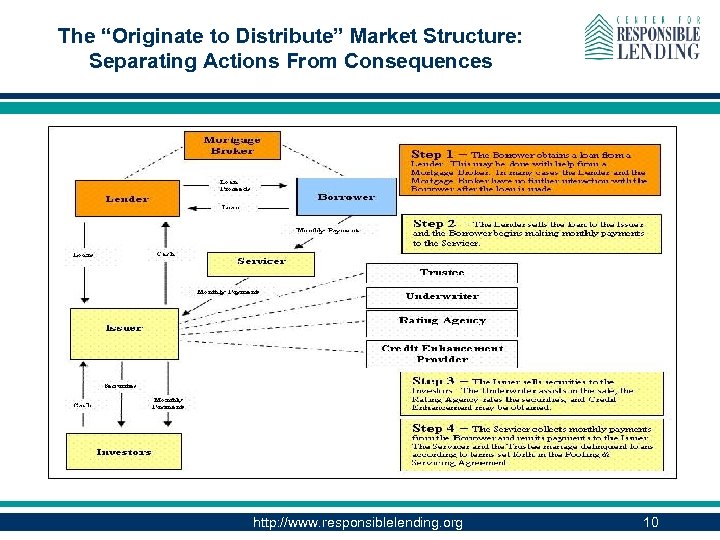 The “Originate to Distribute” Market Structure: Separating Actions From Consequences http: //www. responsiblelending. org 10
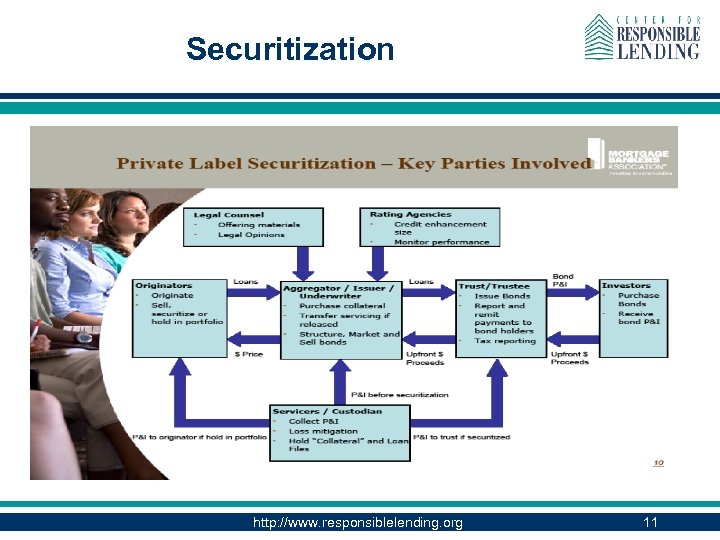 Securitization http: //www. responsiblelending. org 11
 Market Incentives § “The big demand was not so much on the part of the borrowers as it was on the part of the suppliers who were giving loans which really most people couldn't afford. ” (Alan Greenspan to Newsweek, “The Oracle Reveals All, ” (9/24/2007) pp. 32 -3) § Yield Spread Premiums – paying brokers to put borrowers into loans with higher rates than they qualify for. § “The market is paying me to do a no-income-verification loan more than it is paying me to do the full documentation loans … What would you do? ”(CEO of Ownit Mortgage to The New York Times (1/26/2007) pp. C 1, C 4. § Why would lenders make unsustainable loans? “Because investors continued to buy the loans. ” (Mortgage Bankers Ass’n Chief Economist to CNN Money. com (2/20/2008)) http: //www. responsiblelending. org 12
 Types of Mortgages Categories Based on Borrower Characteristics: § Prime § Alt-A § Subprime Categories Based on Terms of Loan: § Fixed Rate § Adjustable Rate http: //www. responsiblelending. org 13
 What is a “Subprime” Loan? § High cost home loan intended for people with weak or blemished credit histories. § 7. 2 million families held a subprime mortgage in 2007. http: //www. responsiblelending. org 14
 Subprime Home Loan Traits § Typically hybrid ARMs with built-in payment shock § High interest rates: “Teaser” rates averaged around 8% § Most carry large prepayment penalties for refinancing prior to first interest rate adjustment § No escrows for taxes or insurance – prompts further refinances § Typically were refinance loans § Typically were broker-originated § Up-front fees far higher than in prime market § Debt-to-income ratios can rise as high as 55% § Underwritten to introductory rate – no expectation that borrower could afford the loan after rate adjustment http: //www. responsiblelending. org 15
 Key Subprime Facts § § § 7. 5 million borrowers; $1. 4 trillion loans outstanding 3 million subprime loans each year in 2005 and 2006 1 in 5 subprime loans from 2005 and 2006 will end in lost home. 57% of 2005 subprime loans not bank-affiliated 72% of subprime as exploding ARMs (Lehman, 2004) § Rates jump from 8% to 12% § Monthly payments up 30% or more in 3 rd year § $600 billion rate reset in next two years § § 70% lack escrows, which leads to “flipping” 70% of subprime have prepay penalties; only 2% in prime 50% utilize stated income for “ability to repay” 50% of 2006 subprime were “ 80/20” LTV with piggyback 2 nd liens http: //www. responsiblelending. org 16
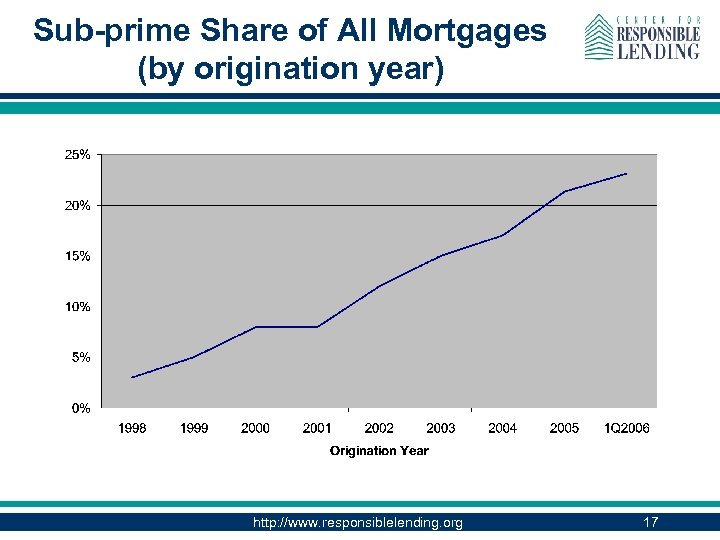 Sub-prime Share of All Mortgages (by origination year) http: //www. responsiblelending. org 17
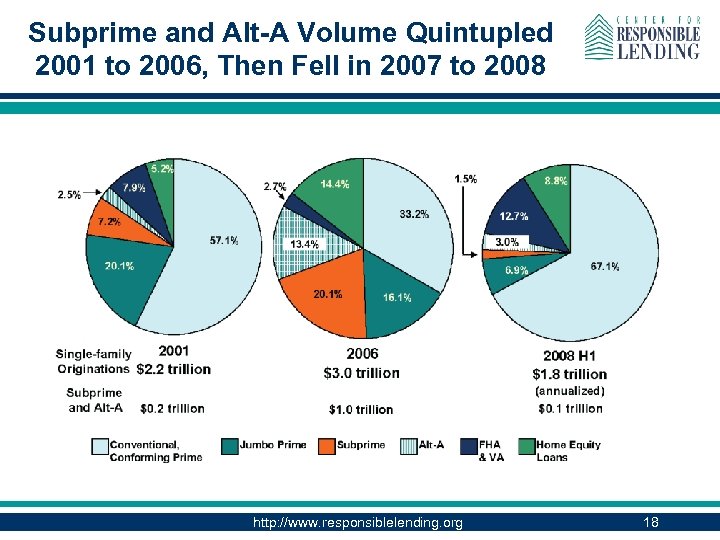 Subprime and Alt-A Volume Quintupled 2001 to 2006, Then Fell in 2007 to 2008 http: //www. responsiblelending. org 18
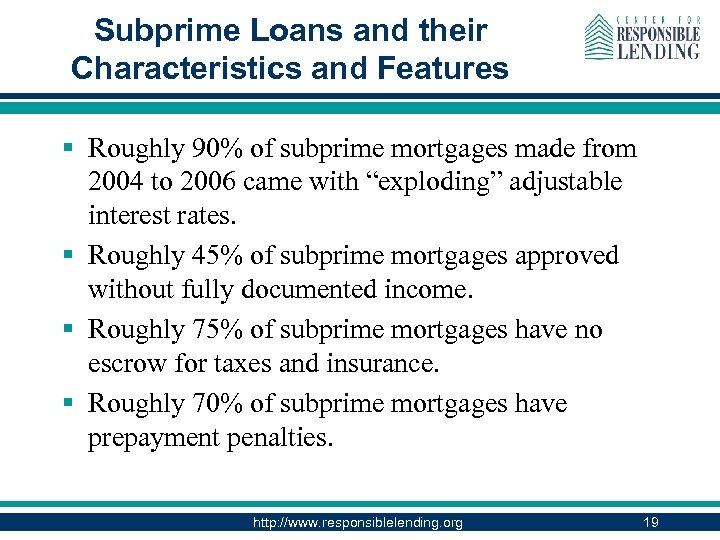 Subprime Loans and their Characteristics and Features § Roughly 90% of subprime mortgages made from 2004 to 2006 came with “exploding” adjustable interest rates. § Roughly 45% of subprime mortgages approved without fully documented income. § Roughly 75% of subprime mortgages have no escrow for taxes and insurance. § Roughly 70% of subprime mortgages have prepayment penalties. http: //www. responsiblelending. org 19
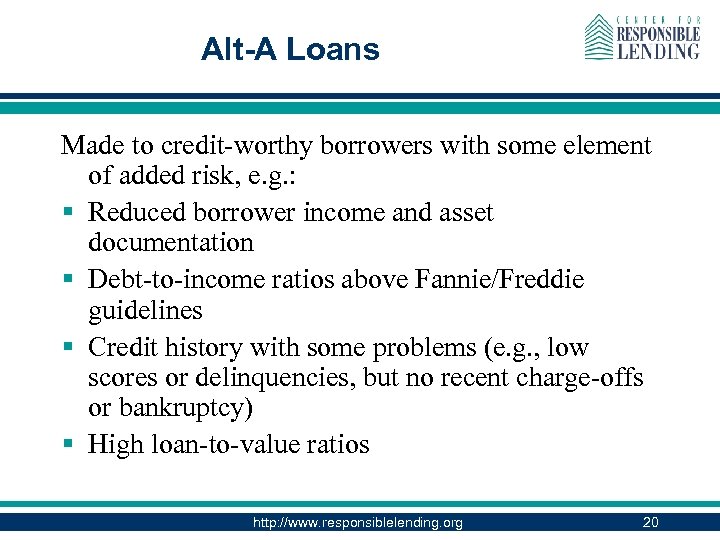 Alt-A Loans Made to credit-worthy borrowers with some element of added risk, e. g. : § Reduced borrower income and asset documentation § Debt-to-income ratios above Fannie/Freddie guidelines § Credit history with some problems (e. g. , low scores or delinquencies, but no recent charge-offs or bankruptcy) § High loan-to-value ratios http: //www. responsiblelending. org 20
 Traditional Adjustable Rate Mortgages § § Interest rate varied throughout term Went both up and down Indexed to one year T-bill Fully amortizing http: //www. responsiblelending. org 21
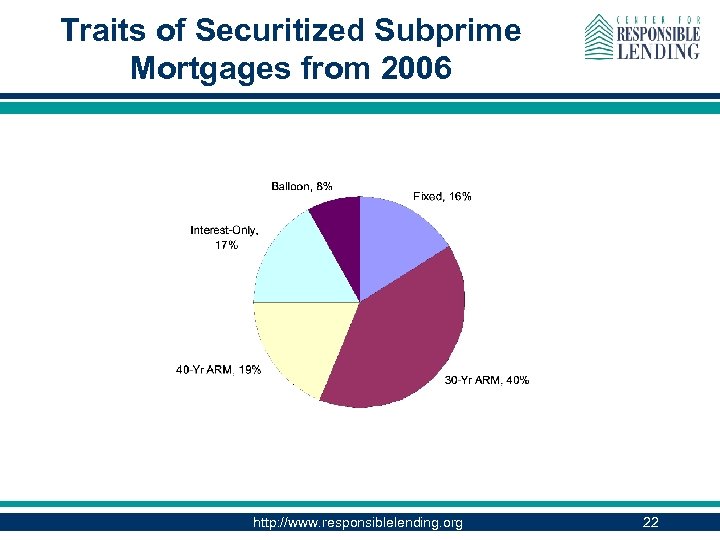 Traits of Securitized Subprime Mortgages from 2006 http: //www. responsiblelending. org 22
 Today’s Adjustable Rate Mortgages § Often start with fixed interest rates for limited period § Teaser rates that adjust upwards § Indexed to more volatile indexes § Many are interest only or payment option adjustable rate mortgages § Underwriting typically only to initial rate § Prepayment penalties http: //www. responsiblelending. org 23
 Problems with ARMS § Borrowers underestimate interest rate risk § Borrowers sometimes don't realize they have an ARM § Borrowers seldom know index § Borrowers can't do interest rate and payment calculations http: //www. responsiblelending. org 24
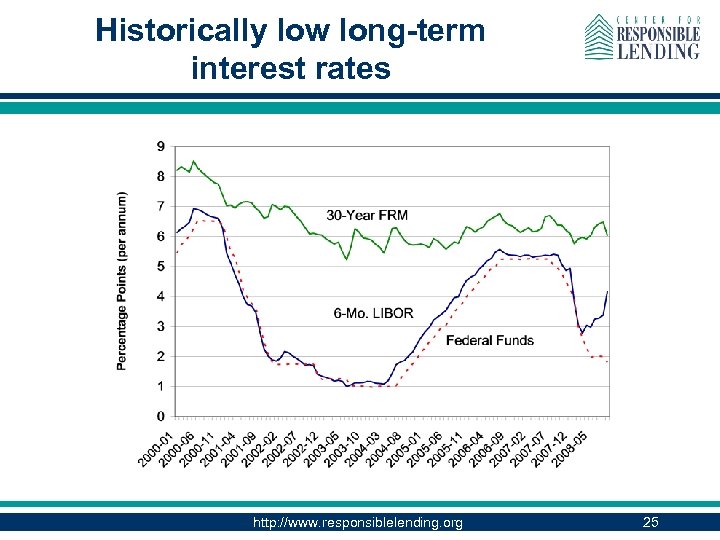 Historically low long-term interest rates http: //www. responsiblelending. org 25
 “Teaser” Rates § An initial rate on an adjustable rate mortgage (ARM). This rate will typically be below the going market rate, and is used by lenders to entice borrowers to choose ARMs over traditional mortgages. § The teaser rate will be in effect for only a few days, months, or years, at which point the rate will gradually climb until it reaches the full indexed rate, which will be a static margin rate plus the floating rate index to which the mortgage is tied (usually the LIBOR index). § Lower than the fully indexed rate and thus a “teaser. ” http: //www. responsiblelending. org 26
 “Fully Indexed” Rates § The Fully Indexed rate is the total rate that a mortgage payment is based on. The fully indexed rate is equal to the margin plus the index. § The fully indexed rate is calculated based on the index, possible indexes could be Prime, LIBOR, COFI, MTA, etc. . . , plus the margin. http: //www. responsiblelending. org 27
 Index + Margin § The margin will remain constant (the same) for the life of the loan. However, the index is what will vary. § An example would be a loan where you have Prime as your index, and Prime is currently 7. 5%, and your margin is 2. 5%, so your fully indexed rate would be 7. 5 + 2. 5 = 10. 0%. § Another example would be an adjustable rate mortgage that is indexed to the one-year treasury bill rate. The current value of the index is 6%. A margin of 2. 5 percentage points is applied to the loan. The fully indexed rate is 8. 5%. http: //www. responsiblelending. org 28
 “HYBRID” Adjustable Rate Mortgages § Fixed for initial period, then adjust § Common are 2/28’s, 3/27’s ARMs § Fixed for two or three years, adjustable for remaining years in 30 year term § Interest rate never lower than at outset § After initial fixed period, rate increases to fully indexed rate http: //www. responsiblelending. org 29
 Prevalence of HYBRID ARMS § Hybrid ARMs represent the majority of the subprime market § Interest-only ARMs have shown high growth § Originations of payment option ARMs peaked in late 2006 (12% of all 2006 originations). http: //www. responsiblelending. org 30
 Problems with Hybrid ARMS § Borrowers typically have a 30% to 50% increase in monthly payment once the teaser rate expires. § 1. 8 million subprime mortgages will have their teaser rates expire in 2007 and 2008. These mortgages have a value of $450 billion. http: //www. responsiblelending. org 31
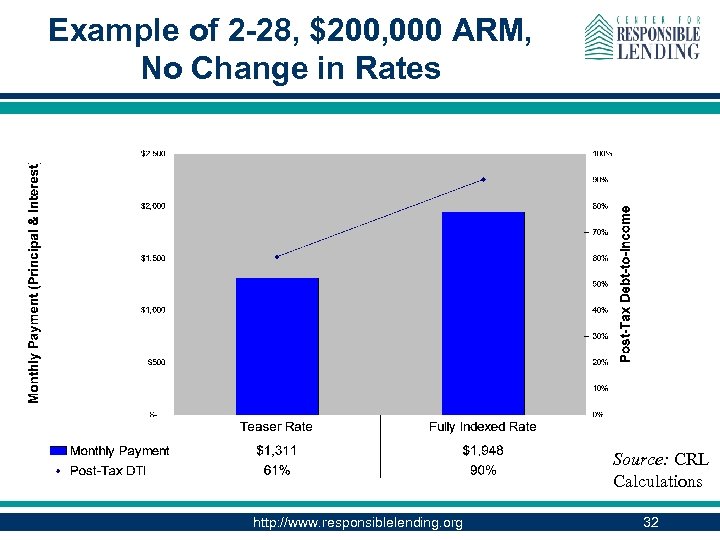 Example of 2 -28, $200, 000 ARM, No Change in Rates Source: CRL Calculations http: //www. responsiblelending. org 32
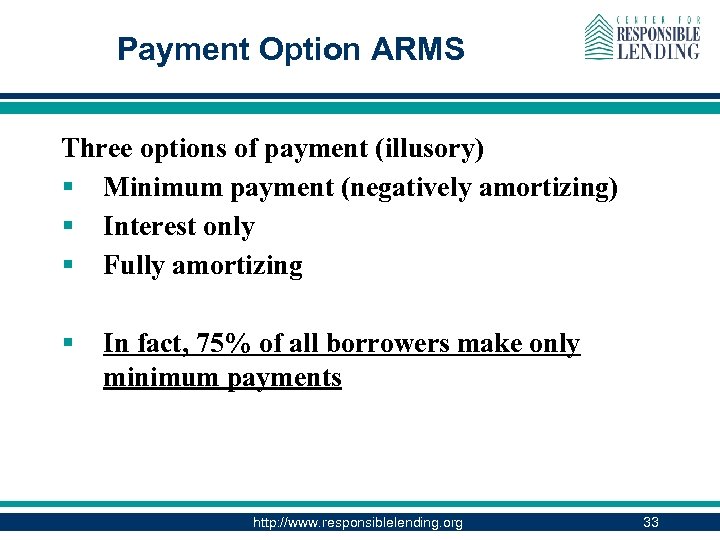 Payment Option ARMS Three options of payment (illusory) § Minimum payment (negatively amortizing) § Interest only § Fully amortizing § In fact, 75% of all borrowers make only minimum payments http: //www. responsiblelending. org 33
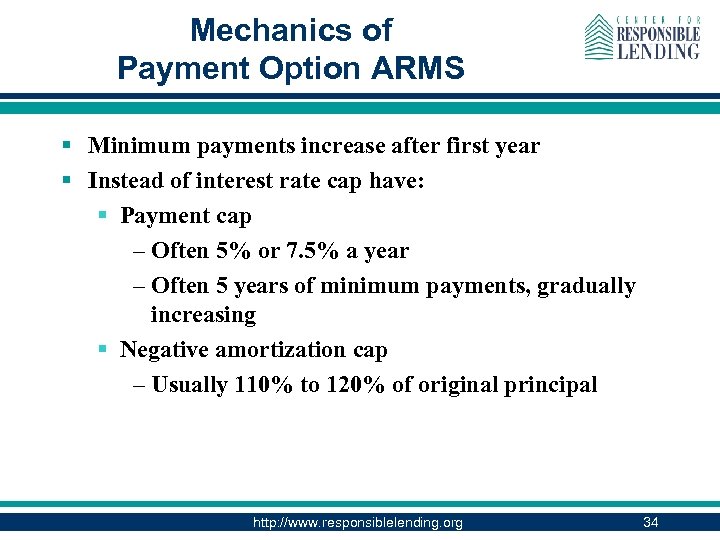 Mechanics of Payment Option ARMS § Minimum payments increase after first year § Instead of interest rate cap have: § Payment cap – Often 5% or 7. 5% a year – Often 5 years of minimum payments, gradually increasing § Negative amortization cap – Usually 110% to 120% of original principal http: //www. responsiblelending. org 34
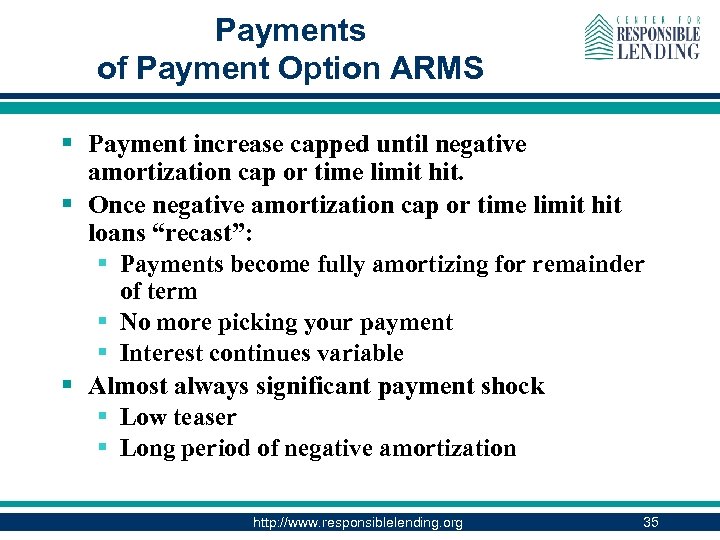 Payments of Payment Option ARMS § Payment increase capped until negative amortization cap or time limit hit. § Once negative amortization cap or time limit hit loans “recast”: § Payments become fully amortizing for remainder of term § No more picking your payment § Interest continues variable § Almost always significant payment shock § Low teaser § Long period of negative amortization http: //www. responsiblelending. org 35
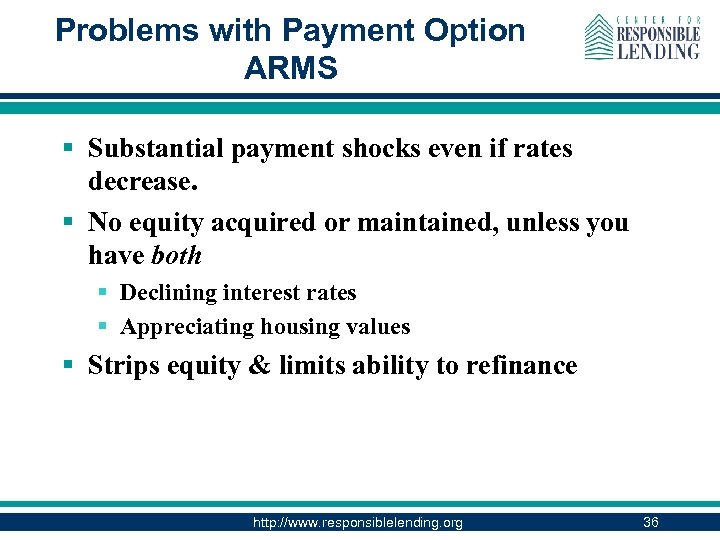 Problems with Payment Option ARMS § Substantial payment shocks even if rates decrease. § No equity acquired or maintained, unless you have both § Declining interest rates § Appreciating housing values § Strips equity & limits ability to refinance http: //www. responsiblelending. org 36
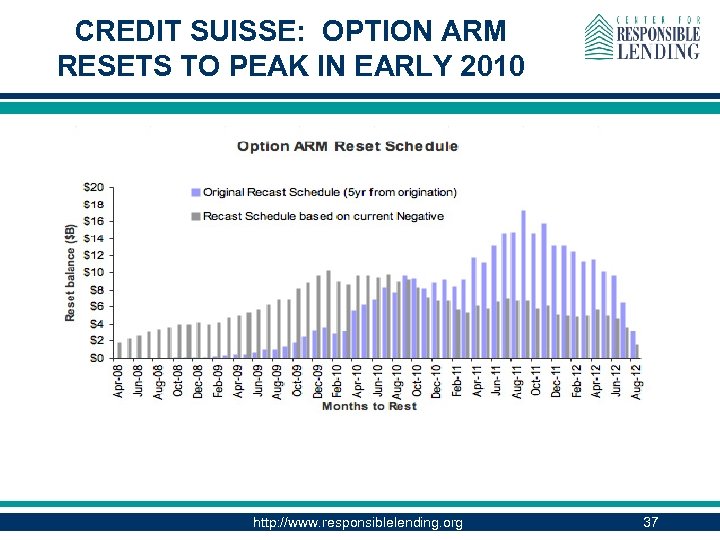 CREDIT SUISSE: OPTION ARM RESETS TO PEAK IN EARLY 2010 http: //www. responsiblelending. org 37
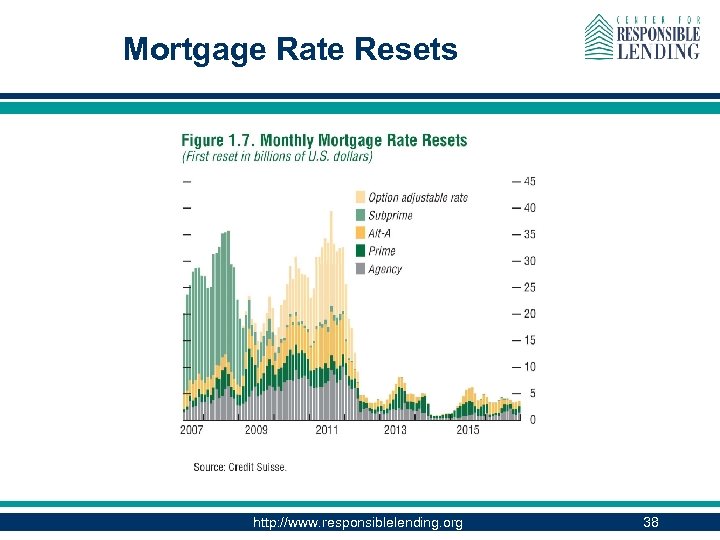 Mortgage Rate Resets http: //www. responsiblelending. org 38
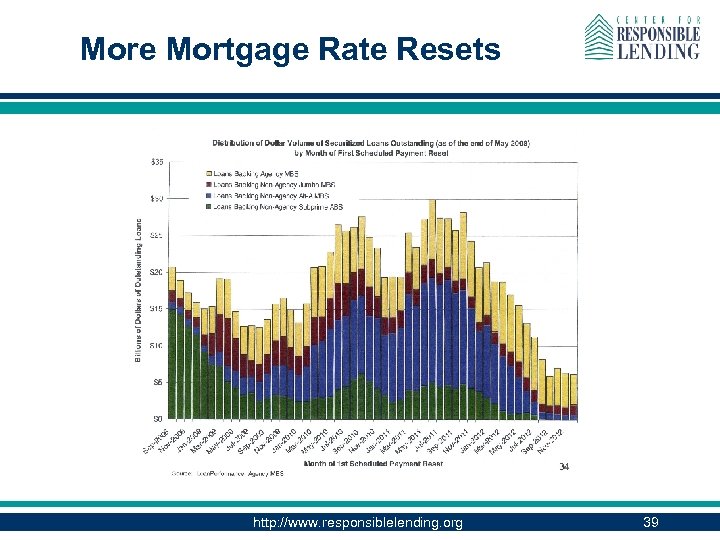 More Mortgage Rate Resets http: //www. responsiblelending. org 39
 Racial Impact of Subprime Lending Proportion of all 2006 home loans that were subprime: § African American families: 52. 44% § Hispanic and Latino families: 40. 66% § White non-Hispanic families: 22. 20% http: //www. responsiblelending. org 40
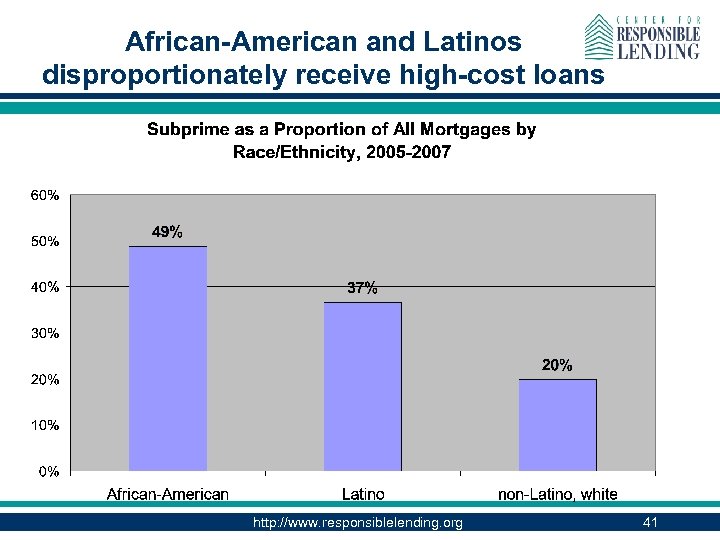 African-American and Latinos disproportionately receive high-cost loans http: //www. responsiblelending. org 41
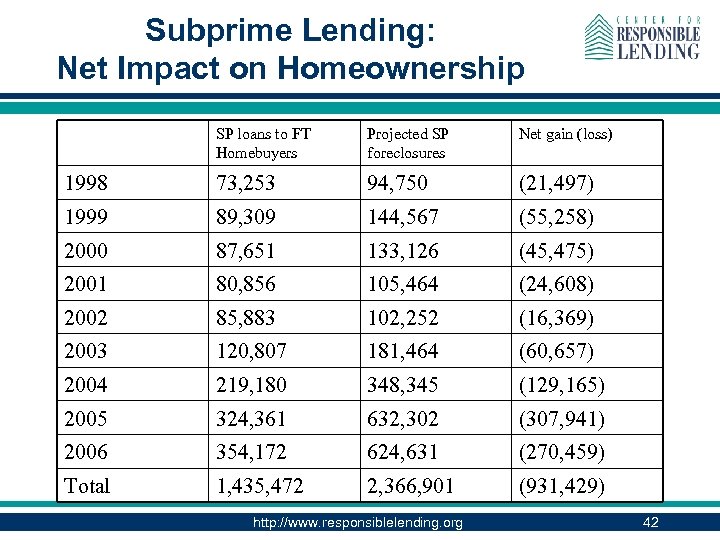 Subprime Lending: Net Impact on Homeownership SP loans to FT Homebuyers Projected SP foreclosures Net gain (loss) 1998 73, 253 94, 750 (21, 497) 1999 89, 309 144, 567 (55, 258) 2000 87, 651 133, 126 (45, 475) 2001 80, 856 105, 464 (24, 608) 2002 85, 883 102, 252 (16, 369) 2003 120, 807 181, 464 (60, 657) 2004 219, 180 348, 345 (129, 165) 2005 324, 361 632, 302 (307, 941) 2006 354, 172 624, 631 (270, 459) Total 1, 435, 472 2, 366, 901 (931, 429) http: //www. responsiblelending. org 42
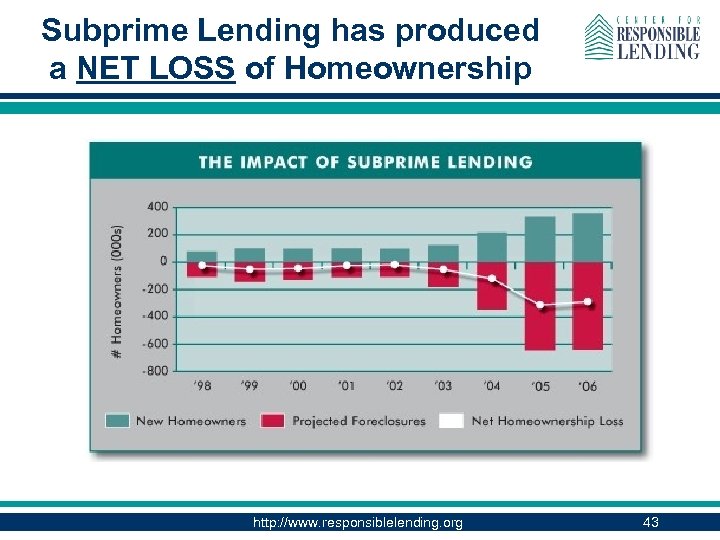 Subprime Lending has produced a NET LOSS of Homeownership http: //www. responsiblelending. org 43
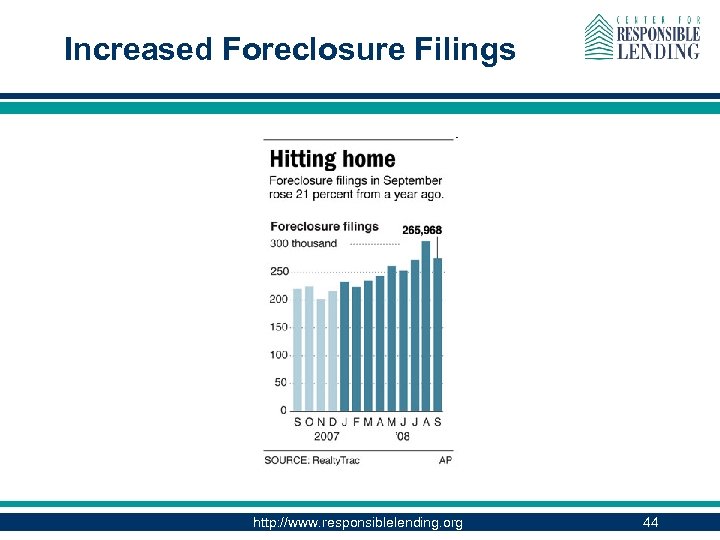 Increased Foreclosure Filings http: //www. responsiblelending. org 44
 Foreclosure Filings Statistics § Nearly 766, 000 homes received at least one foreclosure-related notice from July through September (71% increase from same period last year) § Six States (California, Florida, Arizona, Ohio, Michigan, and Nevada) accounted for more than 60% of all foreclosure activity in 3 rd Quarter 2008 § California made up almost 25% of all foreclosure filings http: //www. responsiblelending. org 45
 Impact of Foreclosures § More than 1 million bank-owned properties will be for sale (33% of all properties for sale) by December 2008 § Steep discounts in sales of foreclosed properties are bringing down neighboring property values http: //www. responsiblelending. org 46
 Projected Subprime Foreclosure Impact in U. S. § Subprime foreclosures expected to occur (primarily in late 2008 through end of 2009) = § 2, 164, 000 homes lost § Spillover impact-surrounding homes suffering price declines caused by nearby subprime foreclosures: 40. 6 million homes § Decrease in home values: $352 billion § Average decrease in home value per unit affected: $8, 667 http: //www. responsiblelending. org 47
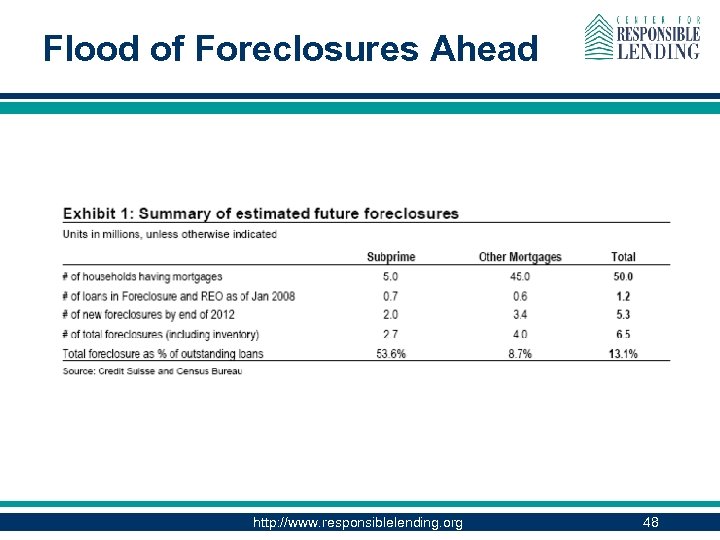 Flood of Foreclosures Ahead http: //www. responsiblelending. org 48
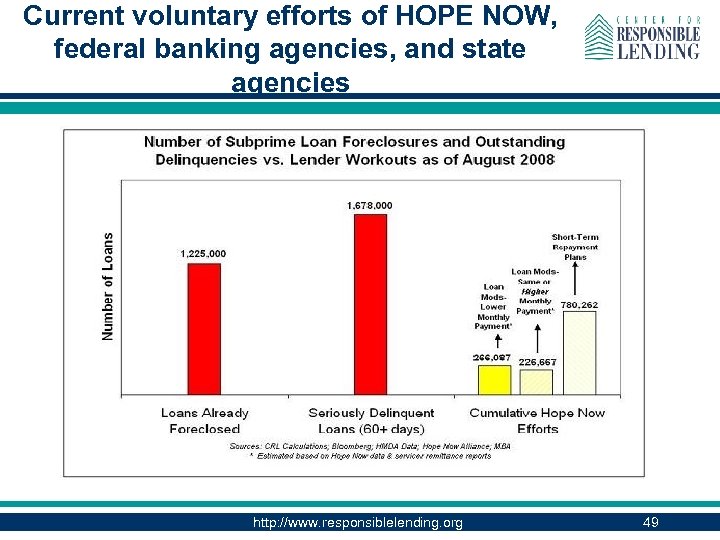 Current voluntary efforts of HOPE NOW, federal banking agencies, and state agencies http: //www. responsiblelending. org 49
 State Foreclosure Working Group Report § Covers 13 servicers, 57% of the subprime market, and 4. 6 million subprime loans § Finds servicer modification progress to be “profoundly disappointing” § Their data indicates that nearly eight out of ten seriously delinquent homeowners are not on track for any loss mitigation outcome, up from seven out of ten from their last report § An increasingly small number of homeowners are on track for loss mitigation § Even the homeowners who get some kind of loss mitigation actions are increasingly losing their house through a short sale or deed-in-lieu rather than keeping the home through a loan modification or workout http: //www. responsiblelending. org 50
 Obstacles to Voluntary Loan Modification § Insufficient Servicer Staffing § Misaligned Financial Incentives for Servicers § Fear of Investor Lawsuits § Pooling and Servicing Agreement Limitations § Piggyback Second Mortgages http: //www. responsiblelending. org 51
 Federal Voluntary Modification Efforts § Neither the Housing and Economic Recovery Act of 2008 (HERA) nor the Emergency Economic Stabilization Act of 2008 (EESA) requires more than voluntary modifications. § HERA creates an expanded FHA program that will help facilitate refinancing of troubled mortgages, but use of that program is voluntary and left entirely up to individual lenders and servicers. § EESA, the legislation that permits the Treasury to buy troubled assets, also relies on Treasury voluntarily working with servicers to modify the loans that it buys. http: //www. responsiblelending. org 52
 Federal Assistance to Neighborhoods § Congress created the program in July 2008 § On September 26, 2008, the U. S. Department of Housing and Urban allocated more than 300 Neighborhood Stabilization Program grants to state and local jurisdictions totaling $3. 92 billion. § States receiving the largest allocations include California ($530 million), Florida ($541 million), Michigan ($264 million), Ohio ($258 million) and Texas ($178 million). http: //www. responsiblelending. org 53
 State and Local Government Action Plans § By December 1, 2008, State and local governments must submit an action plan § Plans to detail how they will distribute the Neighborhood Stabilization Program funds, which are supposed to go to high-risk areas with the greatest percentage of subprime loans and foreclosures. http: //www. responsiblelending. org 54
 Federal and State Foreclosure Deferment/Moratorium Initiatives § Federal HR 6076 (Matsui) (pending) – Up to 9 months deferral period for certain subprime and negative amortization loans. Borrower is required to pay minimum monthly payment. § Minnesota (H. F. 3612) (passed by legislature; vetoed by Governor) – Up to 1 -year deferral period for certain subprime, negative amortization and adjustable loans. Borrower is required to pay lesser of payment at origination or 65% of payment at time of default. § New York (AB 9695) (passed General Assembly) – Court may issue up to one-year postponement orders upon application by homeowner, with Court setting monthly payment schedule. http: //www. responsiblelending. org 55
 State Foreclosure Mediation/Intervention Programs § § § City of Philadelphia (court administrative order) – Requires representative for servicer to meet with borrower in court before a foreclosure sale to seek a loan modification and avoid foreclosure. New York (legislation) – Requires 90 -day pre-foreclosure notice, and mandatory settlement conference for certain foreclosure proceedings. Court will appoint an attorney if needed. North Carolina (emergency legislation) – Requires 45 -day pre-foreclosure notice, and creation of foreclosure database that Commissioner of Banks reviews to determine which subprime loans are appropriate foreclosure avoidance efforts. May delay foreclosure on these loans up to 30 days. Connecticut (legislation) – Requires a mortgage holder to serve a foreclosure notice and Foreclosure Mediation Request form to the homeowner. A homeowner has 15 days to request mediation; mortgage holder cannot foreclose during 60 -day mediation period. Ohio (established by Ohio Supreme Court) – Provides options to enable courts handing residential foreclosure cases to make loan modifications based on available mediation resources. http: //www. responsiblelending. org 56
 State Foreclosure Process Extension/Modification § California (emergency legislation) – Prohibits servicer from initiating foreclosure until 30 days after engaging in due diligence to meet with the borrower to discuss foreclosure avoidance options. § Maryland (legislation) – Extended foreclosure process from 15 to 150 days. § Pennsylvania (legislation) – Requires 30 -day pre-foreclosure notice and 30 -day period to meet with the servicer or approved credit counseling agency to try to resolve the delinquency. If the meeting is unsuccessful, the borrower may apply for assistance and lender/servicer may not initiate foreclosure while eligibility is being determined (60 days). § Connecticut (legislation) – Requires lender/servicer to provide written notice to borrower that it has 60 days (increased from 30) to request meeting with the lender or a consumer credit agency to try to resolve the default, and to provide information about EMAP. Provides additional funding for EMAP (mortgage refinance and payment assistance program). http: //www. responsiblelending. org 57
 CRL Recommendations to Congress § Congress should lift the ban on judicial loan modifications § Treasury should embark on a concentrated, multi-pronged effort to increase affordable loan modifications made through the Troubled Asset Relief Program (TARP) § (Similar to what FDIC has done with loans owned by Indy. Mac, targeting the 34% debt-to-income ratio that is part of the recent settlement of state Attorneys General and Bank of America over Countrywide’s practices) § Congress should merge the Office of Thrift Supervision into the Office of the Comptroller of the Currency, eliminate thrift charter and transfer the holding companies to the Federal Reserve http: //www. responsiblelending. org 58
 Recommendations continued The Federal Reserve should extend its HOEPA rule to prohibit yield-spread premiums on subprime and nontraditional mortgages, and extend the protections provided for subprime to nontraditional loans. § Congress should pass the Homeownership Preservation and Protection Act (S 2452) sponsored by Senator Dodd. http: //www. responsiblelending. org 59
 Policy Recommendations 1. Avert Future Foreclosures Ø Require sound lending practices Ø Establish borrower ability to repay Ø Underwrite to fully indexed rate Ø Third party verification of Income Ø Escrow for taxes and insurance Ø Eliminate incentives that put brokers’ interests in conflict with their clients’ interests Ø Make clear that brokers owe fiduciary duties to their clients Ø Require loan purchasers to take reasonable steps to avoid purchasing predatory loans http: //www. responsiblelending. org 60
 2. Help Borrowers at Risk of Losing their Homes ØRequire Lenders to offer, on reasonable terms, loan modifications and refinancing into sustainable loans. ØBankruptcy Code amendment to end the favored status of home mortgage loans. ØTax Code amendment to ensure that borrowers are not hit with an income tax liability when lenders agree to write down their outstanding mortgage debt. http: //www. responsiblelending. org 61
 Foreclosures affecting Military Members and their Families Resources include: § Base Legal Assistance Officer § Local attorneys § City, County, and State Government offices including State Banking Departments § Federal Government programs such as FHA Secure http: //www. responsiblelending. org 62
 Understanding the Client’s Situation § Why is the client facing foreclosure? § Temporary loss of income § Permanent loss of income § Never had enough income § Victim of scam § What outcome does the client want? § To stay in the house and keep making the same payments § To stay in the house and make smaller payments § To move § Are the client’s desired outcomes realistic? http: //www. responsiblelending. org 63
 Working It Out § Lenders insist they want to work with borrowers who want to stay in their house. § Federal guarantors (FHA, VA, Fannie/Freddie) loan modification guidelines § Data shows a growing number of loan modifications, although still woefully inadequate § Several lenders (Indy. Mac and Countrywide) are systematically modifying certain loans for certain borrowers § Growing federal government programs to facilitate modifications, including refinancing through HUD Hope for Homeowner loans (although, to date, none are mandatory) § Politicians now focused on reducing foreclosures through loan modifications, so keep aware of new developments http: //www. responsiblelending. org 64
 Modification Tips § Look for local housing counseling groups that have good track record in getting good modifications § Ensure that the modification will be sustainable for the long-term § Watch out for excessive fees and/or waivers of rights in modifications § Warn clients about scammers http: //www. responsiblelending. org 65
 Types of Foreclosure Systems § Judicial—lender must first obtain judgment in an affirmative lawsuit (e. g. New York, Ohio, Florida) § Nonjudicial—lender can foreclose without filing suit (e. g. California, Texas, Virginia, Georgia) § Hybrid nonjudicial—lenders can foreclose after limited quasi-judicial process (e. g. North Carolina proceeding run by Clerk of Court) http: //www. responsiblelending. org 66
 Start of Foreclosure Proceedings § All states require borrower be sent notice at the beginning of the foreclosure process. (Many states do not require personal service. ) § Lenders typically begin the foreclosure process after 90 days of delinquency. § A number of states have passed laws within the past couple of years mandating additional/earlier foreclosure notices for all borrowers (e. g. Maryland) or for borrowers who received subprime loans (e. g. North Carolina). http: //www. responsiblelending. org 67
 How the Process Starts § In a judicial state, the foreclosure process begins with the lender filing a complaint with the court. § In a nonjudicial state, the process begins with the lender sending notice to a borrower that (s)he is in default and must cure the default within a stated period or else the house will be sold at public auction. http: //www. responsiblelending. org 68
 Ways to Respond to Notice of Pending Foreclosure § Judicial states—File answer/counterclaims to lender’s foreclosure lawsuit § Nonjudicial states—File affirmative lawsuit seeking injunction, alleging defenses to default and/or offsetting claims § Quasi-judicial—Raise (typically quite limited) allowable defenses in quasi-judicial process § Bankruptcy—File (Chapter 13) petition to get the benefit of the automatic stay § Negotiation—Seek a modification, short sale, or temporary delay http: //www. responsiblelending. org 69
 Possible Defenses § Borrower not in default (mistakes do exist in payment histories) § Defect in mortgage or promissory note that makes them void under state law (e. g. forgery, defective notarization) § Entitlement to Servicemembers Civil Relief Act protections § Violation of state foreclosure process statutes (e. g. defective notice) § Party seeking to foreclose lacks proof that it owned the mortgage and promissory note at the time it started foreclosure (lack of standing) § Foreclosure is inequitable http: //www. responsiblelending. org 70
 Possible Counterclaims § Violation of federal lending laws (e. g. Truth in Lending Act) § Most of these laws provide small damages with short statutes of limitation. § May provide for the ability to rescind/unwind the loan (including recovery of all interest and fee paid-to-date), provided the borrower can repay the resulting loan balance. § Unfair/Predatory lending counterclaim § Typically filed under state consumer protection law § Likely to be time/resource intensive, but offer potential of substantial recovery § State common law (e. g. breach of contract; fraud) http: //www. responsiblelending. org 71
 Bankruptcy Benefits § Filing under Chapter 7 or 13 stops all foreclosure proceedings while the automatic stay is in effect § Quickest way to stop an imminent foreclosure sale § Chapter 13 allows a borrower to become current and repay their arrearage through the repayment plan § Bankruptcy (at least for now) provides nothing more than a temporary delay if the borrower cannot afford the monthly payments even with all unsecured debt wiped away. http: //www. responsiblelending. org 72
 Is It Too Late? § Vast majority of borrowers never respond to foreclosure § A quick process—typically takes 2 -10 months from start to finish § Necessary to vacate judgment in judicial state if judgment already entered § Rule 50 standards § Fairly hard to undo once auction has occurred § Right to redeem § Challenge to sale confirmation § Virtually impossible to undo once property is sold to a bone fide thirdparty without notice (lis pendis) § But don’t rely on borrower’s belief about status of foreclosure (frequent misunderstandings) or planned sales date on notices (often delayed/cancelled) http: //www. responsiblelending. org 73
 TITLE II--MORTGAGE FORECLOSURE PROTECTIONS FOR SERVICEMEMBERS § SEC. 2201. TEMPORARY INCREASE IN MAXIMUM LOAN GUARANTY AMOUNT FOR CERTAIN HOUSING LOANS GUARANTEED BY THE SECRETARY OF VETERANS AFFAIRS. § Notwithstanding subparagraph (C) of section 3703(a)(1) of title 38, United States Code, for purposes of any loan described in subparagraph (A)(i)(IV) of such section that is originated during the period beginning on the date of the enactment of this Act and ending on December 31, 2008, the term `maximum guaranty amount' shall mean an amount equal to 25 percent of the higher of-(1) the limitation determined under section 305(a)(2) of the Federal Home Loan Mortgage Corporation Act (12 U. S. C. 1454(a)(2)) for the calendar year in which the loan is originated for a single-family residence; or (2) 125 percent of the area median price for a single-family residence, but in no case to exceed 175 percent of the limitation determined under such section 305(a)(2) for the calendar year in which the loan is originated for a singlefamily residence. § § http: //www. responsiblelending. org 74
 SEC. 2202. COUNSELING ON MORTGAGE FORECLOSURES FOR MEMBERS OF THE ARMED FORCES RETURNING FROM SERVICE ABROAD. § § § (a) In General- The Secretary of Defense shall develop and implement a program to advise members of the Armed Forces (including members of the National Guard and Reserve) who are returning from service on active duty abroad (including service in Operation Iraqi Freedom and Operation Enduring Freedom) on actions to be taken by such members to prevent or forestall mortgage foreclosures. (b) Elements- The program required by subsection (a) shall include the following: (1) Credit counseling. (2) Home mortgage counseling. (3) Such other counseling and information as the Secretary considers appropriate for purposes of the program. (c) Timing of Provision of Counseling- Counseling and other information under the program required by subsection (a) shall be provided to a member of the Armed Forces covered by the program as soon as practicable after the return of the member from service as described in subsection (a). http: //www. responsiblelending. org 75
 SEC. 2203. ENHANCEMENT OF PROTECTIONS FOR SERVICEMEMBERS RELATING TO MORTGAGES AND MORTGAGE FORECLOSURES. § § § § (a) Extension of Period of Protections Against Mortgage Foreclosures(1) EXTENSION OF PROTECTION PERIOD- Subsection (c) of section 303 of the Servicemembers Civil Relief Act (50 U. S. C. App. 533) is amended by striking `90 days' and inserting `9 months'. (2) EXTENSION OF STAY OF PROCEEDINGS PERIOD- Subsection (b) of such section is amended by striking `90 days' and inserting `9 months'. (b) Treatment of Mortgages as Obligations Subject to Interest Rate Limitation- Section 207 of the Servicemembers Civil Relief Act (50 U. S. C. App. 527) is amended-(1) in subsection (a)(1), by striking `in excess of 6 percent' the second place it appears and all that follows and inserting `in excess of 6 percent-(A) during the period of military service and one year thereafter, in the case of an obligation or liability consisting of a mortgage, trust deed, or other security in the nature of a mortgage; or (B) during the period of military service, in the case of any other obligation or liability. '; and (2) by striking subsection (d) and inserting the following new subsection: http: //www. responsiblelending. org 76
 Section 2203 continued § `(d) Definitions- In this section: § `(1) INTEREST- The term `interest' includes service charges, renewal charges, fees, or any other charges (except bona fide insurance) with respect to an obligation or liability. § `(2) OBLIGATION OR LIABILITY- The term `obligation or liability' includes an obligation or liability consisting of a mortgage, trust deed, or other security in the nature of a mortgage. '. § (c) Effective Date; Sunset§ (1) EFFECTIVE DATE- The amendment made by subsection (a) shall take effect on the date of enactment of this Act. § (2) SUNSET- The amendments made by subsection (a) shall expire on December 31, 2010. Effective January 1, 2011, the provisions of subsections (b) and (c) of section 303 of the Servicemembers Civil Relief Act, as in effect on the day before the date of the enactment of this Act, are hereby revived. http: //www. responsiblelending. org 77
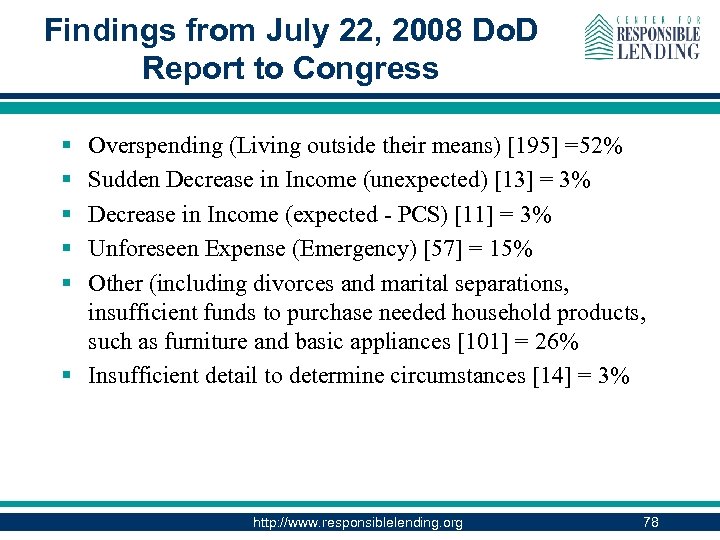 Findings from July 22, 2008 Do. D Report to Congress § § § Overspending (Living outside their means) [195] =52% Sudden Decrease in Income (unexpected) [13] = 3% Decrease in Income (expected - PCS) [11] = 3% Unforeseen Expense (Emergency) [57] = 15% Other (including divorces and marital separations, insufficient funds to purchase needed household products, such as furniture and basic appliances [101] = 26% § Insufficient detail to determine circumstances [14] = 3% http: //www. responsiblelending. org 78
 Debt Levels and Cash Needs § The average level of debt for enlisted clients was $28, 888 (excluding cases that referenced mortgages as being part of the outstanding debt) § They needed an average of $2, 351 to satisfy their immediate cash needs http: //www. responsiblelending. org 79
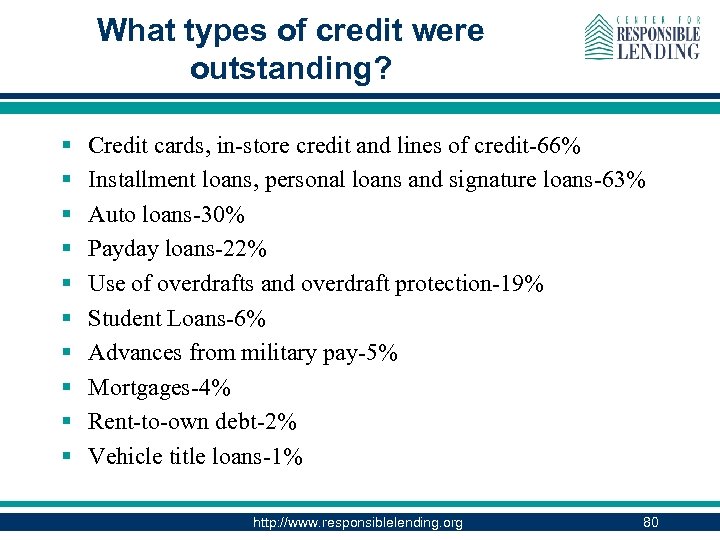 What types of credit were outstanding? § § § § § Credit cards, in-store credit and lines of credit-66% Installment loans, personal loans and signature loans-63% Auto loans-30% Payday loans-22% Use of overdrafts and overdraft protection-19% Student Loans-6% Advances from military pay-5% Mortgages-4% Rent-to-own debt-2% Vehicle title loans-1% http: //www. responsiblelending. org 80
 General Client Profile § § § Junior non-commissioned officers Married with a single income Over $28, 000 in debt An immediate cash need of approximately $2, 300 Multiple debts that can no longer be managed Some intervention is needed http: //www. responsiblelending. org 81
 CRL Over Draft Research § Market Size Estimate § Who Pays the Fees § Which Transactions Trigger OD’s § Future Research http: //www. responsiblelending. org 82
 Who Pays the Fees § Random digit dial telephone survey of 3, 310 checking account holders. § Conducted between October 2005 and January 2006. § Who is the typical OD user and who pays most of the fees? http: //www. responsiblelending. org 83
 Who Pays the Fees § A small group of consumers pay the vast majority of fees: 16% of overdrafters pay 71% of the fees. § Statistically significant differences between chronic overdrafters and non-chronic overdrafters in terms of income, marital status, race, and homeownership status. http: //www. responsiblelending. org 84
 Data Source § Ultimate Consumer Panel developed by Forrester Research and now owned by Lightspeed. § Transactional level detail from over 5, 000 households. § Data from January 2005 to June 2006. § Survey Component http: //www. responsiblelending. org 85
 Research Questions § What percentage of overdrafts are caused by checks, debit card purchases, and ATM withdrawals? § What are the size of the purchases consumers make when they overdraft, loan amounts, and days to repay? § Consumer Preference http: //www. responsiblelending. org 86
 Identifying Triggers § Looked at Transactions from 15 largest banks. § Identified 8, 527 overdrafts. § Able to connect 5, 656 overdrafts with clearly identifiable triggers. § “Mixed” triggers had multiple possible transaction types. http: //www. responsiblelending. org 87
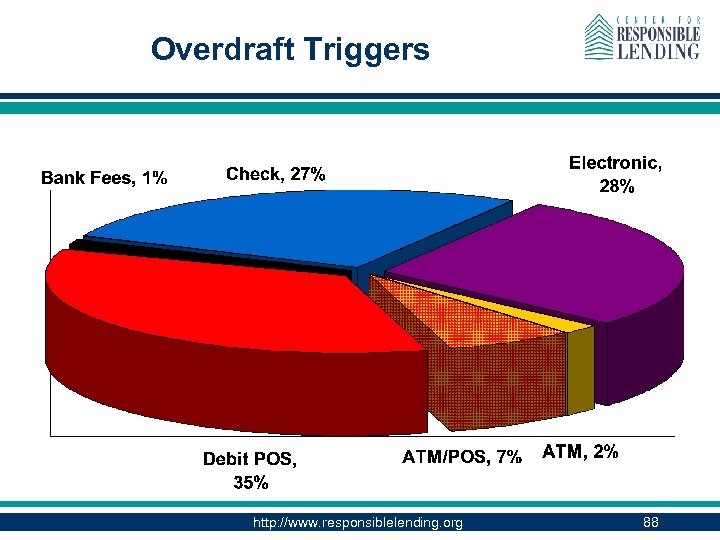 Overdraft Triggers http: //www. responsiblelending. org 88
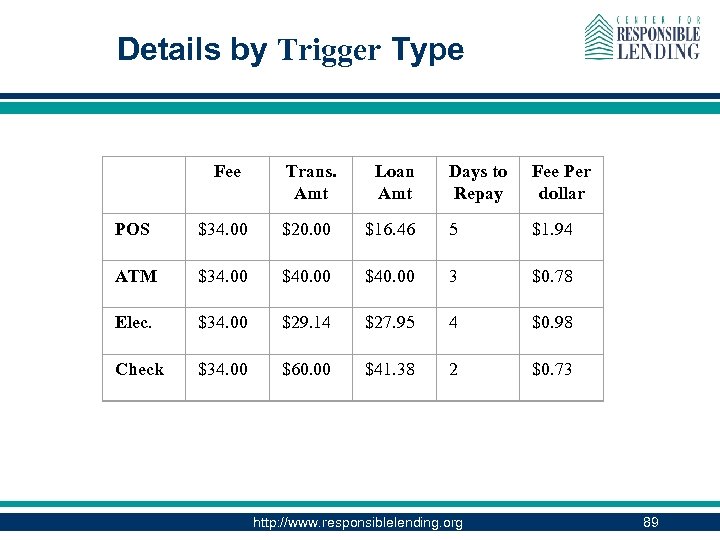 Details by Trigger Type Fee Trans. Amt Loan Amt Days to Repay Fee Per dollar POS $34. 00 $20. 00 $16. 46 5 $1. 94 ATM $34. 00 $40. 00 3 $0. 78 Elec. $34. 00 $29. 14 $27. 95 4 $0. 98 Check $34. 00 $60. 00 $41. 38 2 $0. 73 http: //www. responsiblelending. org 89
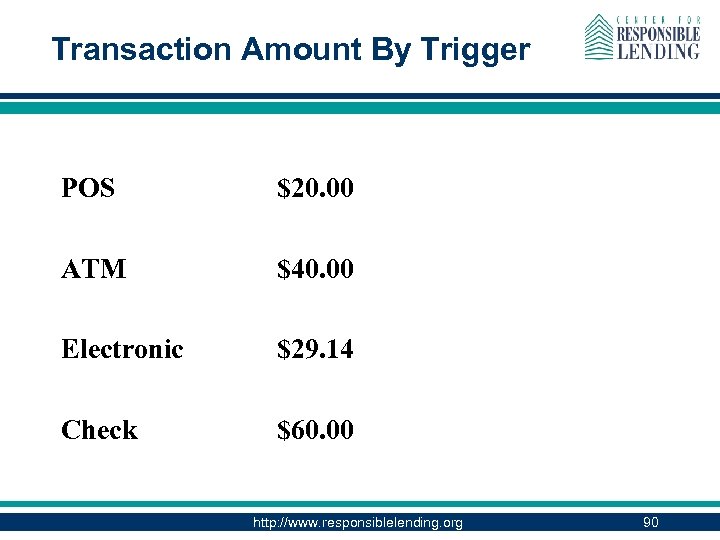 Transaction Amount By Trigger POS $20. 00 ATM $40. 00 Electronic $29. 14 Check $60. 00 http: //www. responsiblelending. org 90
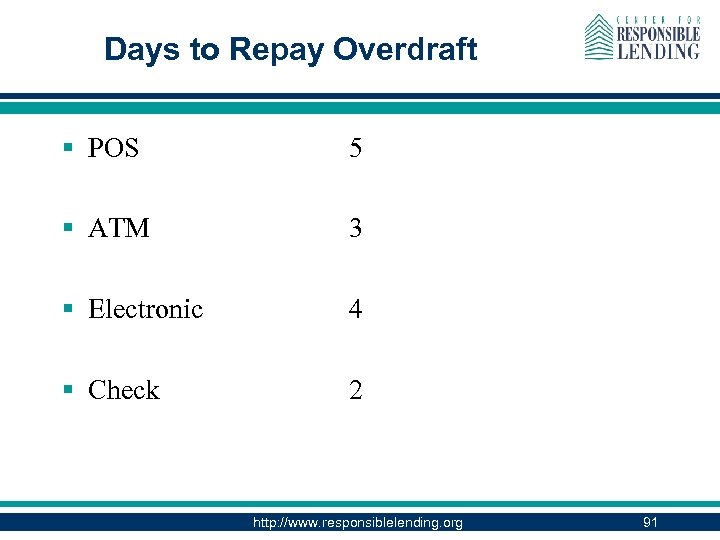 Days to Repay Overdraft § POS 5 § ATM 3 § Electronic 4 § Check 2 http: //www. responsiblelending. org 91
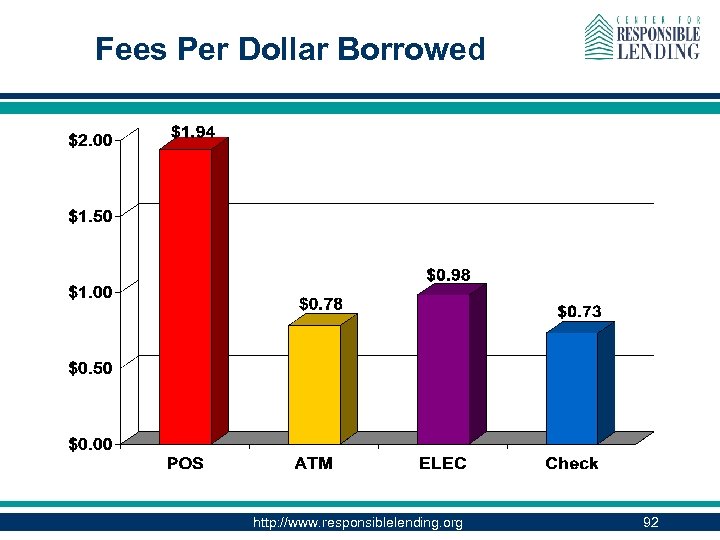 Fees Per Dollar Borrowed http: //www. responsiblelending. org 92
 Consumer Preference § ATM: 84% of consumers said that they would always cancel an ATM transaction if they were warned that it would trigger an overdraft. § Debit POS: 61% of consumers would prefer their institution denied a debit card purchase at the checkout if the purchase would cause an overdraft. http: //www. responsiblelending. org 93
 Military Survey § Those who receive their income by direct deposit from the Defense Finance and Accounting Service (DFAS) § Civilian employees § Military Service members and their families § Military retirees and annuitants http: //www. responsiblelending. org 94
 Military Survey Findings § § 228 transactions—average overdraft fee of $34 0. 4% caused by ATM withdrawal 3% caused by bank fees 15% caused by ACH transactions (online bill pay) § 41% caused by debit card point of sale (POS) § 42% caused by checks http: //www. responsiblelending. org 95
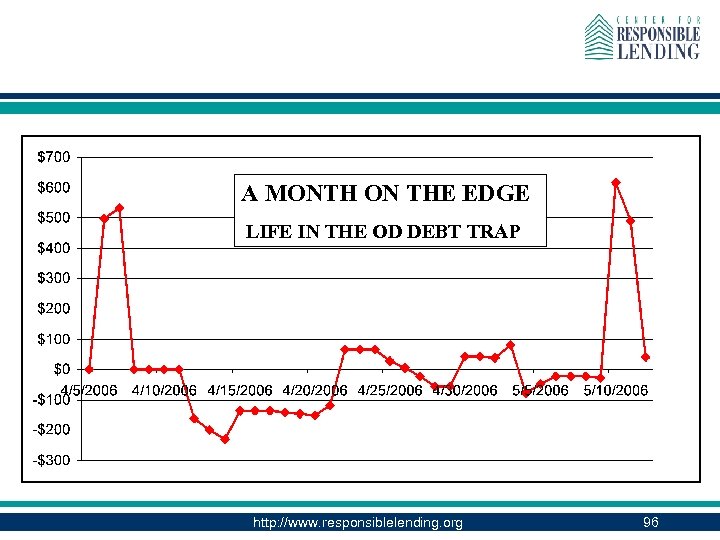 A MONTH ON THE EDGE LIFE IN THE OD DEBT TRAP http: //www. responsiblelending. org 96
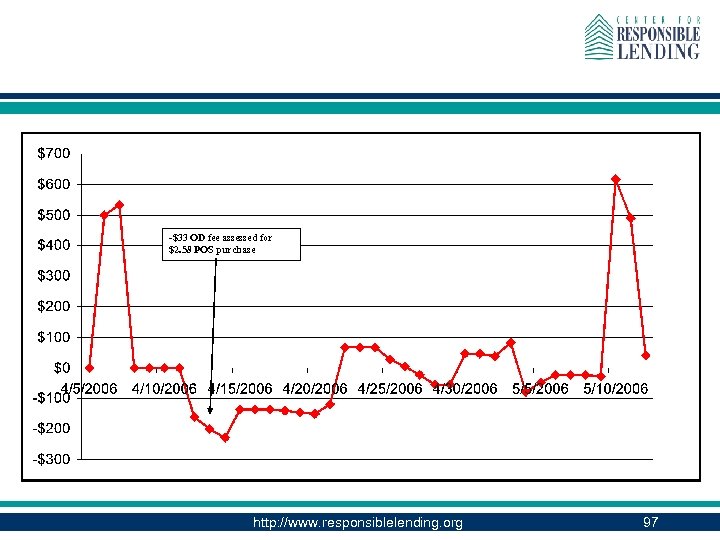 -$33 OD fee assessed for $2. 58 POS purchase http: //www. responsiblelending. org 97
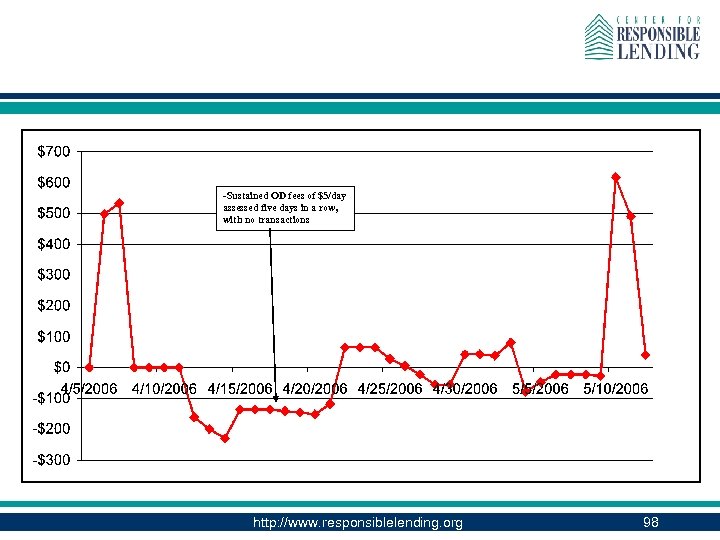 -Sustained OD fees of $5/day assessed five days in a row, with no transactions http: //www. responsiblelending. org 98
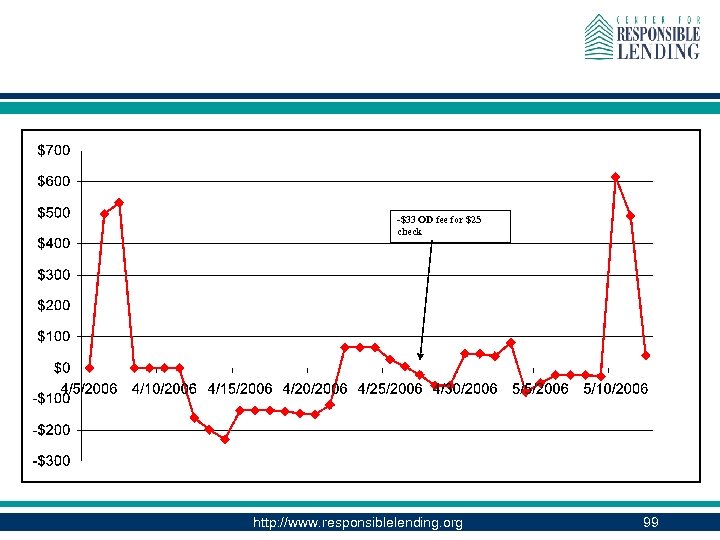 -$33 OD fee for $25 check http: //www. responsiblelending. org 99
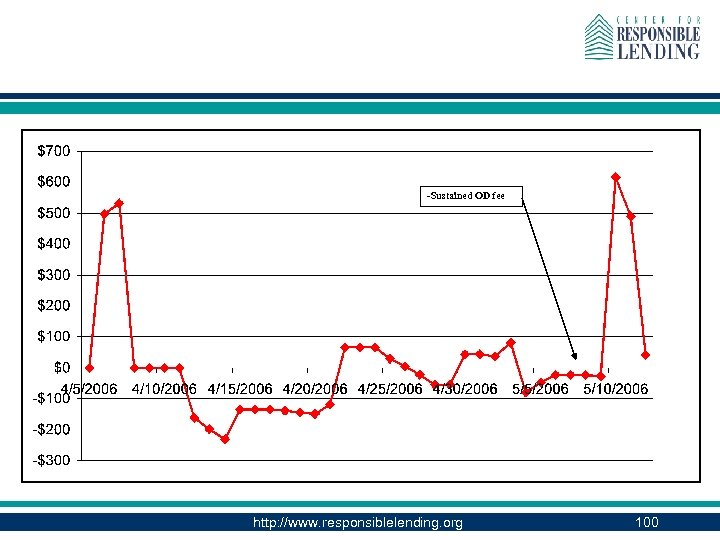 -Sustained OD fee http: //www. responsiblelending. org 100
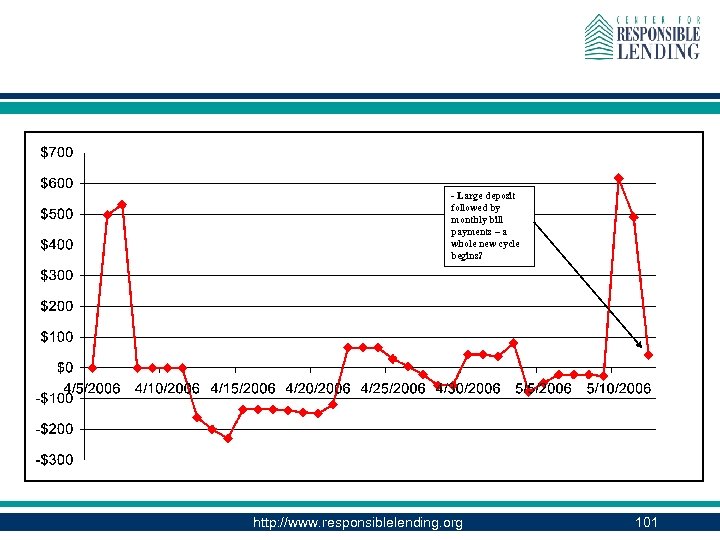 - Large deposit followed by monthly bill payments – a whole new cycle begins? http: //www. responsiblelending. org 101
 Out of Balance § CRL’s newest OD release § Released in July 2007 § Quantifies effects of abusive OD loans on consumers http: //www. responsiblelending. org 102
 Out of Balance § Consumers pay $17. 5 billion each year in abusive overdraft loan fees to banks and credit unions § In comparison, consumers only receive $15. 8 billion each year in credit from abusive OD loans § Check-ordering and deposit manipulation by institutions contribute to abusive OD loans http: //www. responsiblelending. org 103
 Policy Recommendations § TILA with Opt-in. § Warning at ATM & Debit, unless in a traditional OD protection program. § Expand LOC programs to more customers. http: //www. responsiblelending. org 104