


 Скачать презентацию Morphology The study of the internal structure of
210eee40415ea9fbae93eeabda8b7c7c.ppt
- Количество слайдов: 15
 Morphology The study of the internal structure of words
 What is Morphology? u. Morphology is the study of word formation u. Morphologists identify different classes of morphemes, and study the patterns that occur in the combination of morphemes v. Ex: {re-} only comes before verbs
 The smallest meaningful unit u. What does it mean to be the smallest meaningful unit in a language? u. Divide the following sentence into the smallest meaningful unit: v. I have two dogs. v. I / have / two / dogs v. I / have / two / dog / -s
 Morphemes u. Meaningful units “I have two cats” “She wants to leave soon” “He walked across the room” “Her behavior was unbelievable”
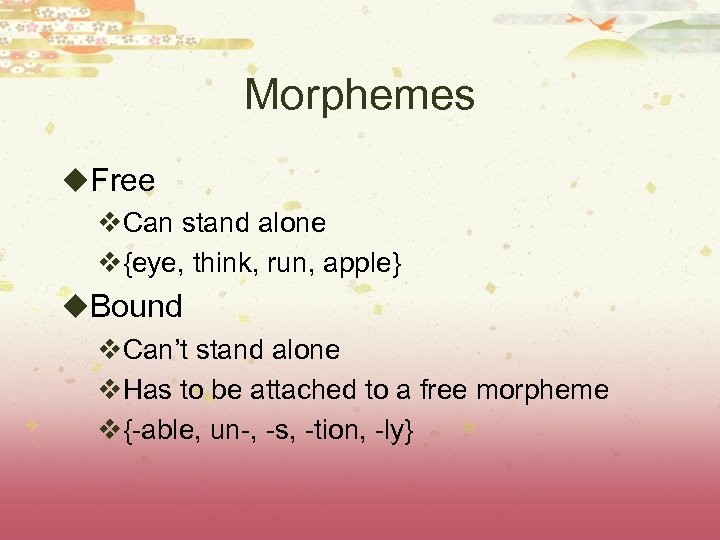 Morphemes u. Free v. Can stand alone v{eye, think, run, apple} u. Bound v. Can’t stand alone v. Has to be attached to a free morpheme v{-able, un-, -s, -tion, -ly}
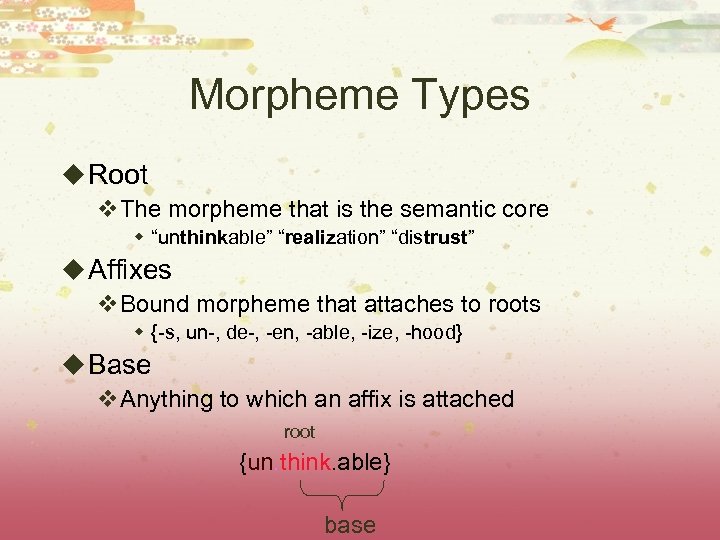 Morpheme Types u Root v. The morpheme that is the semantic core w “unthinkable” “realization” “distrust” u Affixes v. Bound morpheme that attaches to roots w {-s, un-, de-, -en, -able, -ize, -hood} u Base v. Anything to which an affix is attached root {un. think. able} base
 Affixes u. The most common way to build new words v. Prefix v. Suffix v. Infix v. Affix
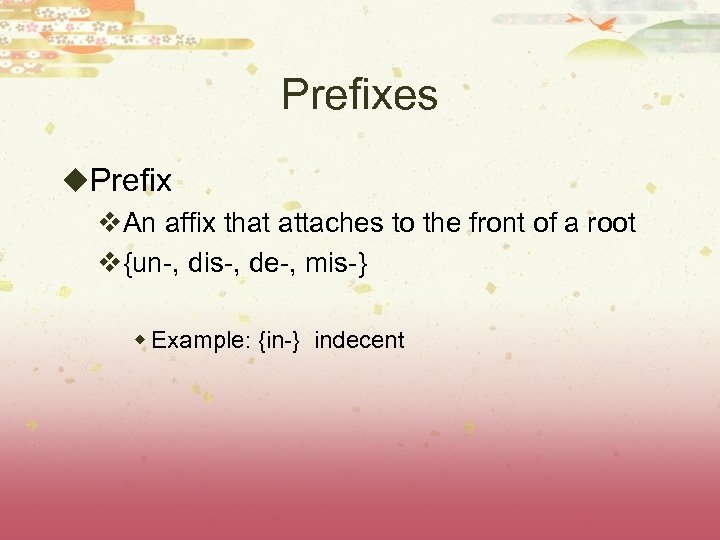 Prefixes u. Prefix v. An affix that attaches to the front of a root v{un-, dis-, de-, mis-} w Example: {in-} indecent
![Prefixes u Karok [pasip] [nipasip] [/upasip] “Shoot!” “I shoot” “She/he shoots” u {pasip} u](https://present5.com/presentation/210eee40415ea9fbae93eeabda8b7c7c/image-9.jpg "Prefixes u Karok [pasip] [nipasip] [/upasip] “Shoot!” “I shoot” “She/he shoots” u {pasip} u") Prefixes u Karok [pasip] [nipasip] [/upasip] “Shoot!” “I shoot” “She/he shoots” u {pasip} u {ni-} u {/u-} “shoot “ 1 st person singular” “ 3 rd person singular”
Prefixes u Karok [pasip] [nipasip] [/upasip] “Shoot!” “I shoot” “She/he shoots” u {pasip} u {ni-} u {/u-} “shoot “ 1 st person singular” “ 3 rd person singular”
 Suffixes u. Suffix v. An affix that attaches to the end of a root v{-able, -ing, -ed, -s} v. Most common affix w Example: {-ful} careful
![Suffixes u. Mende [p. El. E] [p. El. Ei] [m. Em. Ei] “house” “the](https://present5.com/presentation/210eee40415ea9fbae93eeabda8b7c7c/image-11.jpg "Suffixes u. Mende [p. El. E] [p. El. Ei] [m. Em. Ei] “house” “the") Suffixes u. Mende [p. El. E] [p. El. Ei] [m. Em. Ei] “house” “the house” “glass” “the glass” u{-i} “the”
Suffixes u. Mende [p. El. E] [p. El. Ei] [m. Em. Ei] “house” “the house” “glass” “the glass” u{-i} “the”
 Infix u. Infix v. An affix that attaches within the root v. No English example
![Infix u Bontoc [fikas] [fumikas] [fusul] [fumusal] “strong” “she is becoming strong” “enemy” “she](https://present5.com/presentation/210eee40415ea9fbae93eeabda8b7c7c/image-13.jpg "Infix u Bontoc [fikas] [fumikas] [fusul] [fumusal] “strong” “she is becoming strong” “enemy” “she") Infix u Bontoc [fikas] [fumikas] [fusul] [fumusal] “strong” “she is becoming strong” “enemy” “she is becoming an enemy” u {-um-} “becoming”
Infix u Bontoc [fikas] [fumikas] [fusul] [fumusal] “strong” “she is becoming strong” “enemy” “she is becoming an enemy” u {-um-} “becoming”
 Affix u. Affix v. General term to cover all the previous terms v. Affixes can attach to other affixes w boy. ish. ness w dis. en. tangle
 Group Work u. Identify and isolate the morphemes u. Decide if it is Free or Bound u. Decide what kind of affix is involved (if any)