 Скачать презентацию Morphological Structure of the English Word-building Julia E
Morphlogy and word-building.ppt
- Количество слайдов: 25



Morphological Structure of the English Word-building. Julia E. Mishina
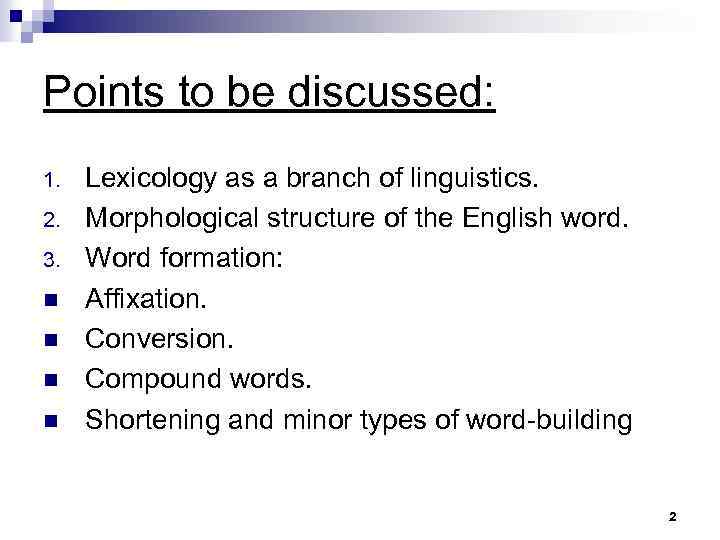
Points to be discussed: 1. 2. 3. n n Lexicology as a branch of linguistics. Morphological structure of the English word. Word formation: Affixation. Conversion. Compound words. Shortening and minor types of word-building 2
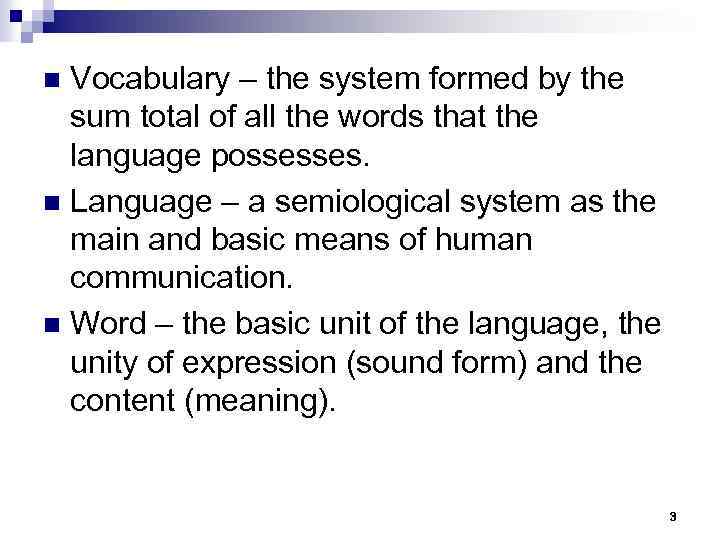
Vocabulary – the system formed by the sum total of all the words that the language possesses. n Language – a semiological system as the main and basic means of human communication. n Word – the basic unit of the language, the unity of expression (sound form) and the content (meaning). n 3
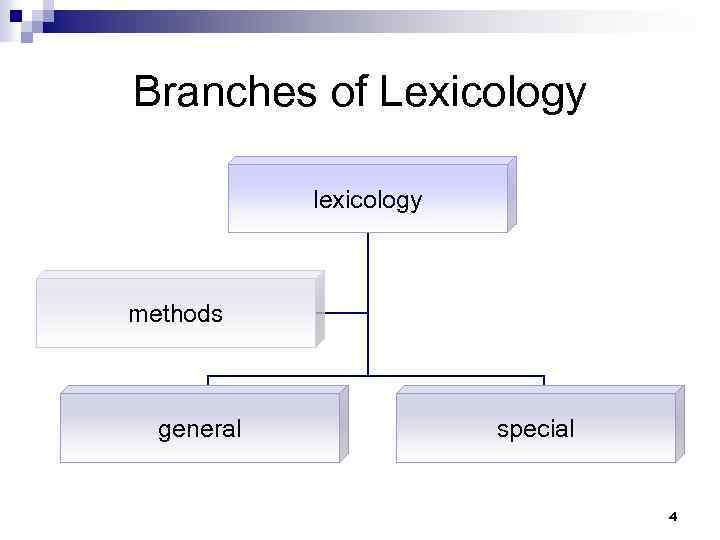
Branches of Lexicology lexicology methods general special 4
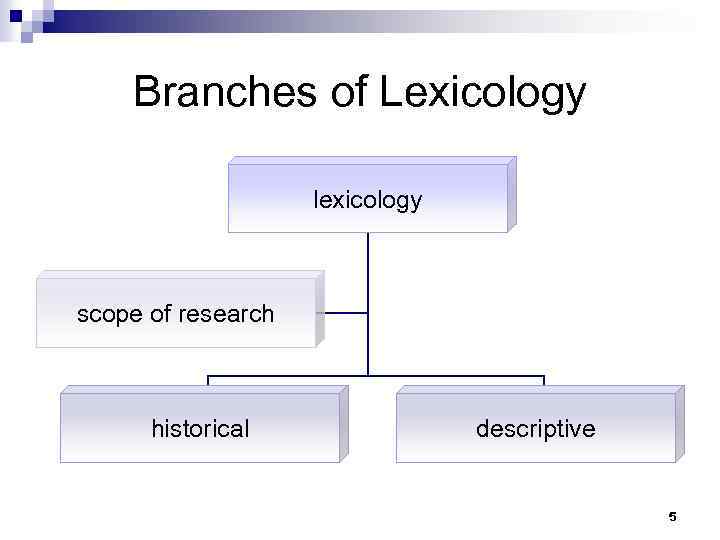
Branches of Lexicology lexicology scope of research historical descriptive 5
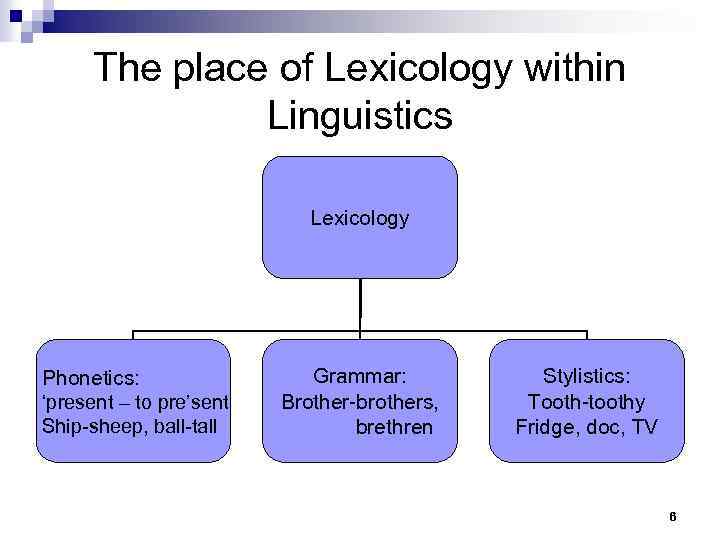
The place of Lexicology within Linguistics Lexicology Phonetics: ‘present – to pre’sent Ship-sheep, ball-tall Grammar: Brother-brothers, brethren Stylistics: Tooth-toothy Fridge, doc, TV 6
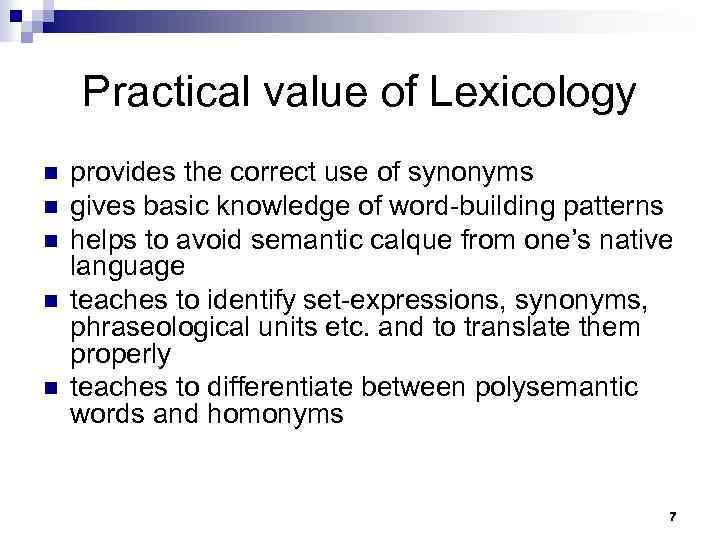
Practical value of Lexicology n n n provides the correct use of synonyms gives basic knowledge of word-building patterns helps to avoid semantic calque from one’s native language teaches to identify set-expressions, synonyms, phraseological units etc. and to translate them properly teaches to differentiate between polysemantic words and homonyms 7
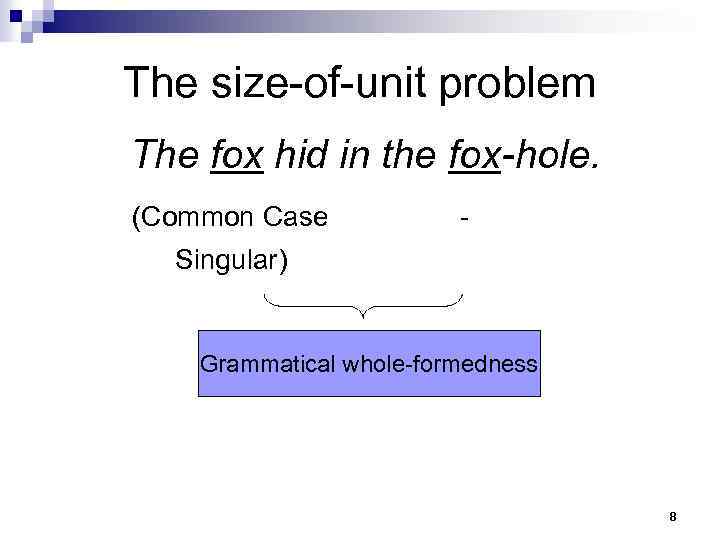
The size-of-unit problem The fox hid in the fox-hole. (Common Case - Singular) Grammatical whole-formedness 8
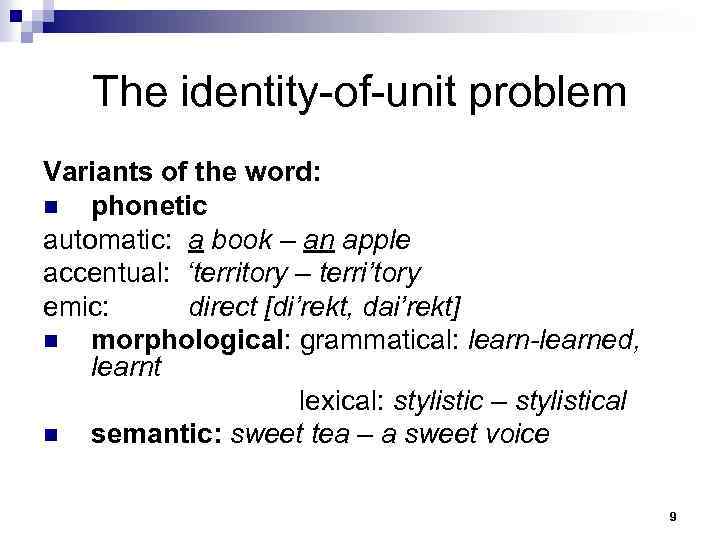
The identity-of-unit problem Variants of the word: n phonetic automatic: a book – an apple accentual: ‘territory – terri’tory emic: direct [di’rekt, dai’rekt] n morphological: grammatical: learn-learned, learnt lexical: stylistic – stylistical n semantic: sweet tea – a sweet voice 9
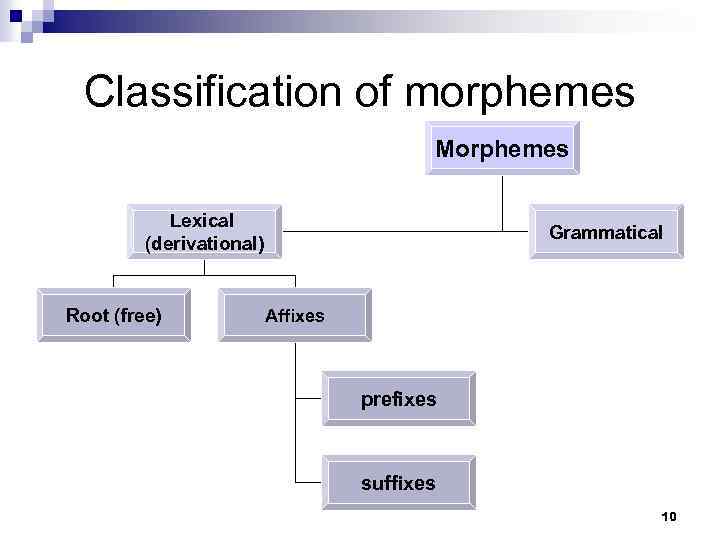
Classification of morphemes Morphemes Lexical (derivational) Root (free) Grammatical Affixes prefixes suffixes 10
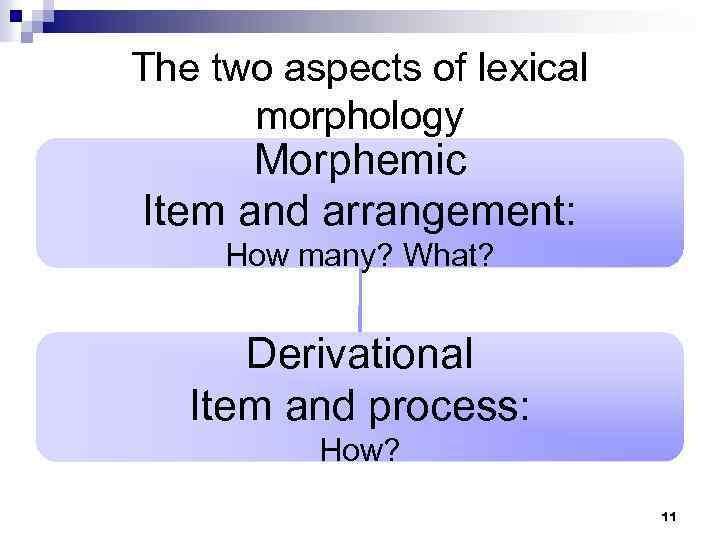
The two aspects of lexical morphology Morphemic Item and arrangement: How many? What? Derivational Item and process: How? 11
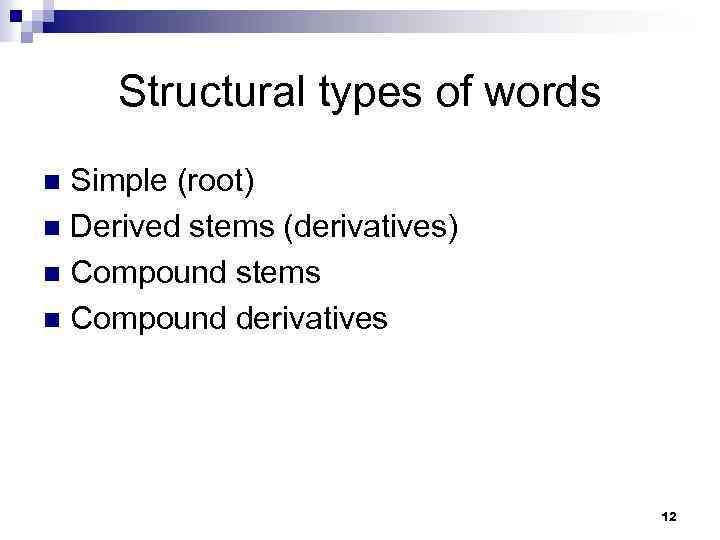
Structural types of words Simple (root) n Derived stems (derivatives) n Compound stems n Compound derivatives n 12
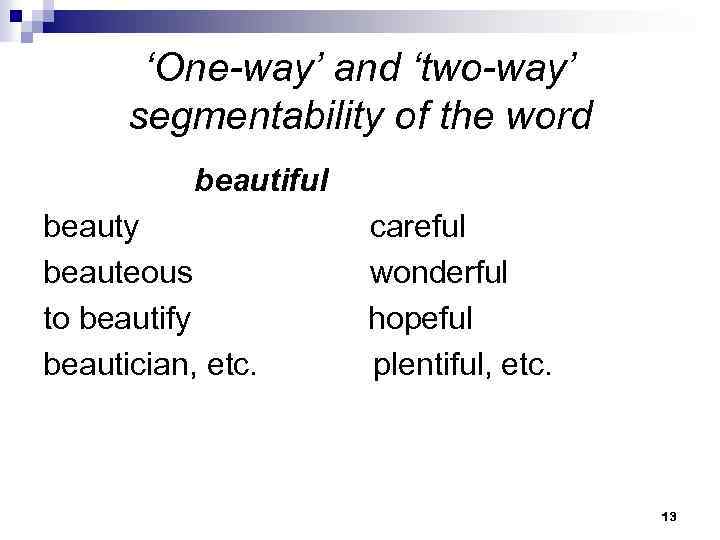
‘One-way’ and ‘two-way’ segmentability of the word beautiful beauty beauteous to beautify beautician, etc. careful wonderful hopeful plentiful, etc. 13
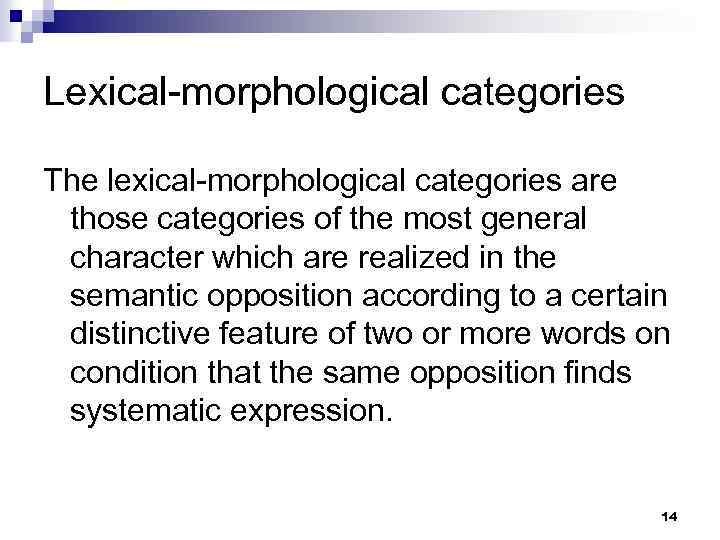
Lexical-morphological categories The lexical-morphological categories are those categories of the most general character which are realized in the semantic opposition according to a certain distinctive feature of two or more words on condition that the same opposition finds systematic expression. 14
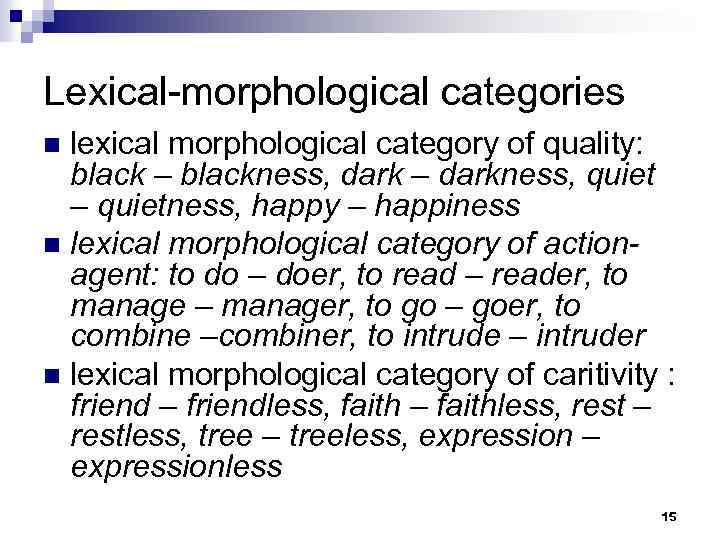
Lexical-morphological categories lexical morphological category of quality: black – blackness, dark – darkness, quiet – quietness, happy – happiness n lexical morphological category of actionagent: to do – doer, to read – reader, to manage – manager, to go – goer, to combine –combiner, to intrude – intruder n lexical morphological category of caritivity : friend – friendless, faith – faithless, rest – restless, tree – treeless, expression – expressionless n 15
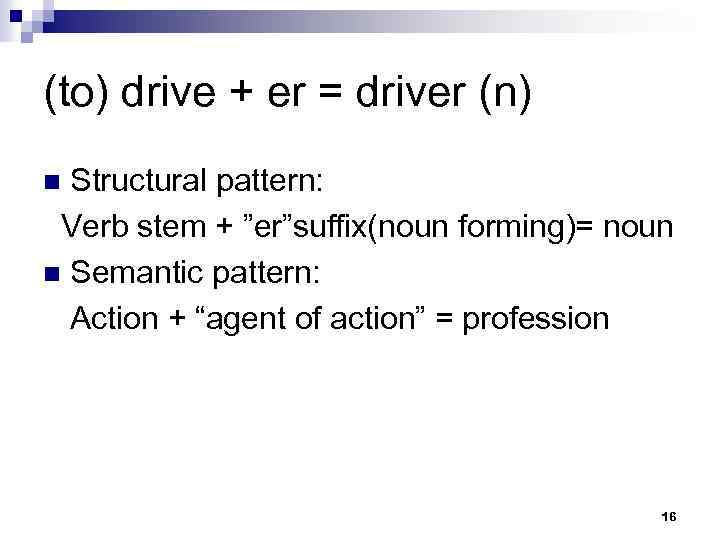
(to) drive + er = driver (n) Structural pattern: Verb stem + ”er”suffix(noun forming)= noun n Semantic pattern: Action + “agent of action” = profession n 16
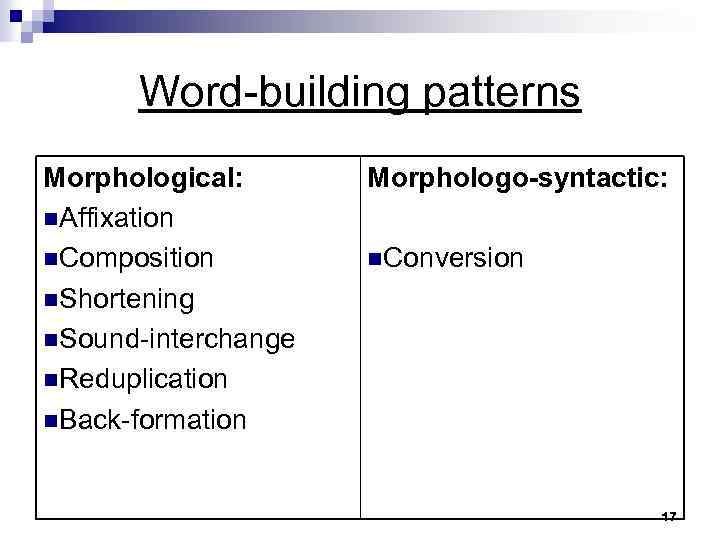
Word-building patterns Morphological: n. Affixation n. Composition n. Shortening n. Sound-interchange n. Reduplication n. Back-formation Morphologo-syntactic: n. Conversion 17
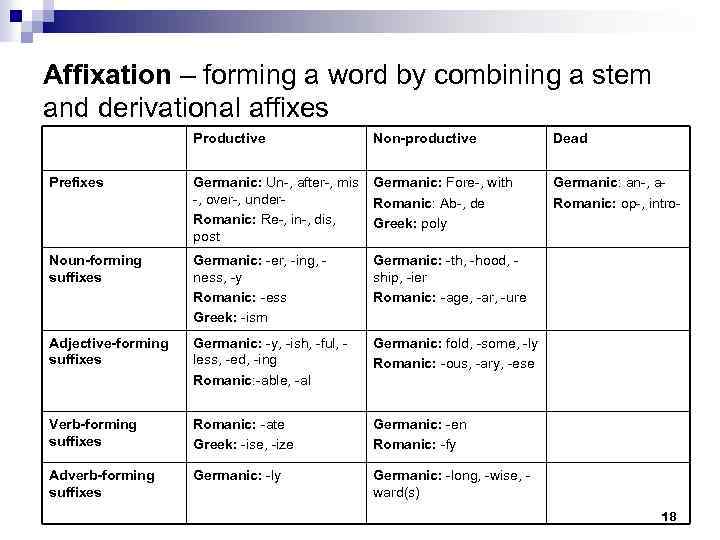
Affixation – forming a word by combining a stem and derivational affixes Productive Non-productive Dead Prefixes Germanic: Un-, after-, mis -, over-, under. Romanic: Re-, in-, dis, post Germanic: Fore-, with Romanic: Ab-, de Greek: poly Germanic: an-, a. Romanic: op-, intro- Noun-forming suffixes Germanic: -er, -ing, ness, -y Romanic: -ess Greek: -ism Germanic: -th, -hood, ship, -ier Romanic: -age, -ar, -ure Adjective-forming suffixes Germanic: -y, -ish, -ful, less, -ed, -ing Romanic: -able, -al Germanic: fold, -some, -ly Romanic: -ous, -ary, -ese Verb-forming suffixes Romanic: -ate Greek: -ise, -ize Germanic: -en Romanic: -fy Adverb-forming suffixes Germanic: -ly Germanic: -long, -wise, ward(s) 18
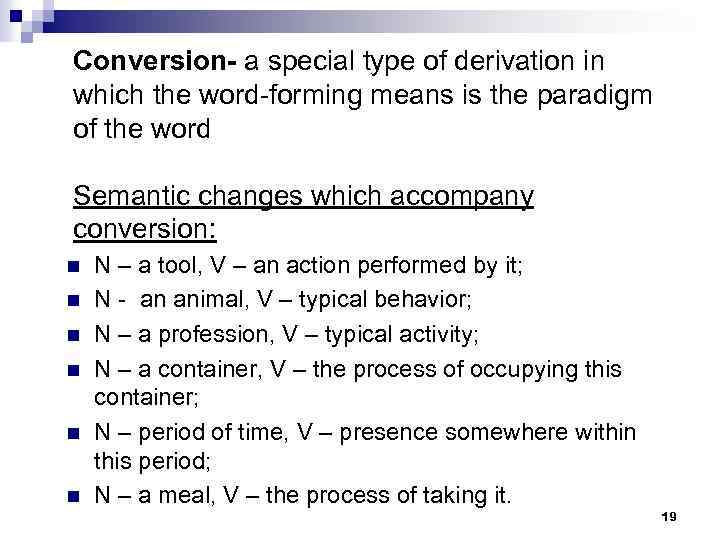
Conversion- a special type of derivation in which the word-forming means is the paradigm of the word Semantic changes which accompany conversion: n n n N – a tool, V – an action performed by it; N - an animal, V – typical behavior; N – a profession, V – typical activity; N – a container, V – the process of occupying this container; N – period of time, V – presence somewhere within this period; N – a meal, V – the process of taking it. 19
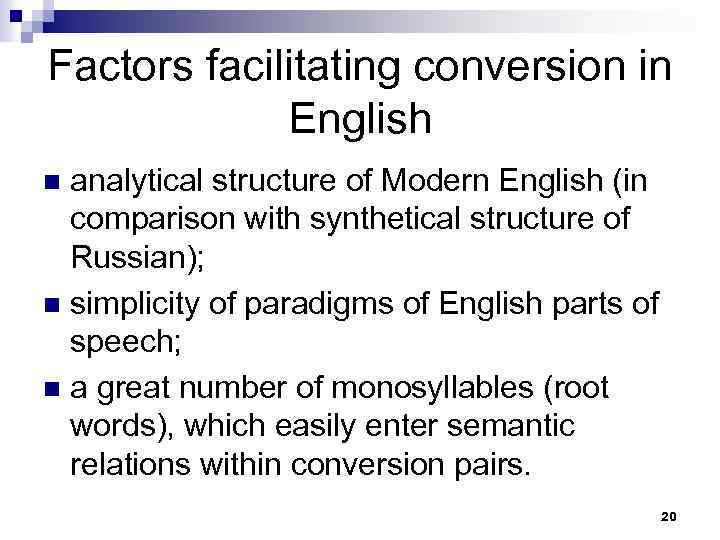
Factors facilitating conversion in English analytical structure of Modern English (in comparison with synthetical structure of Russian); n simplicity of paradigms of English parts of speech; n a great number of monosyllables (root words), which easily enter semantic relations within conversion pairs. n 20
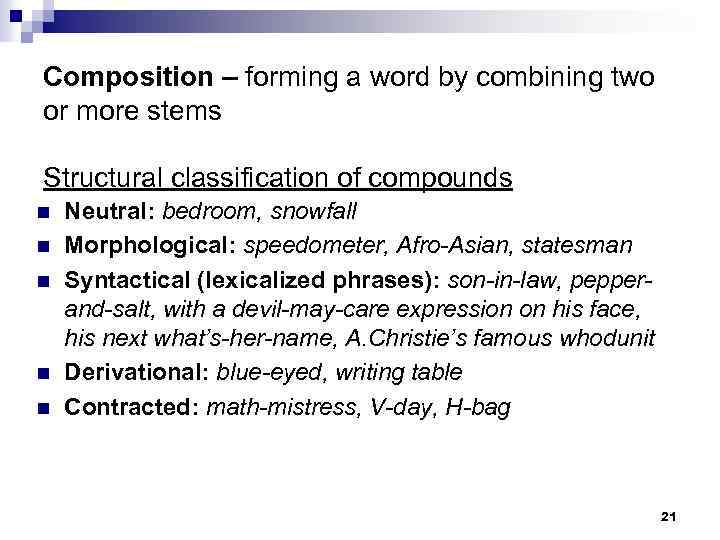
Composition – forming a word by combining two or more stems Structural classification of compounds n n n Neutral: bedroom, snowfall Morphological: speedometer, Afro-Asian, statesman Syntactical (lexicalized phrases): son-in-law, pepperand-salt, with a devil-may-care expression on his face, his next what’s-her-name, A. Christie’s famous whodunit Derivational: blue-eyed, writing table Contracted: math-mistress, V-day, H-bag 21
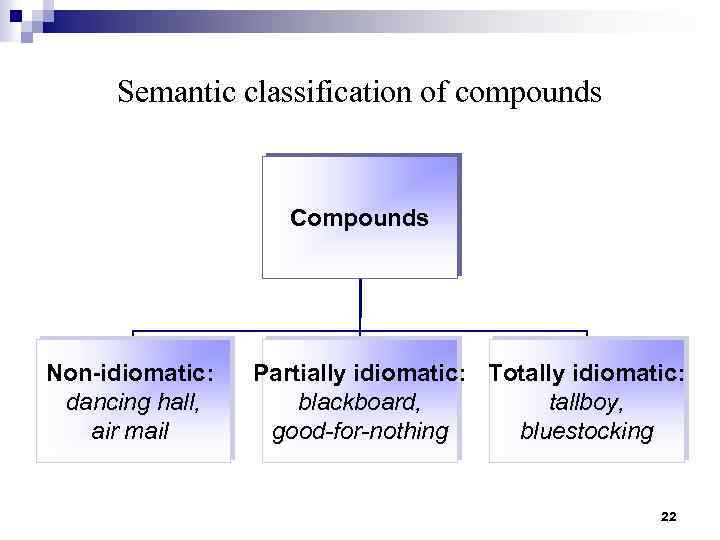
Semantic classification of compounds Compounds Non-idiomatic: dancing hall, air mail Partially idiomatic: Totally idiomatic: blackboard, tallboy, good-for-nothing bluestocking 22
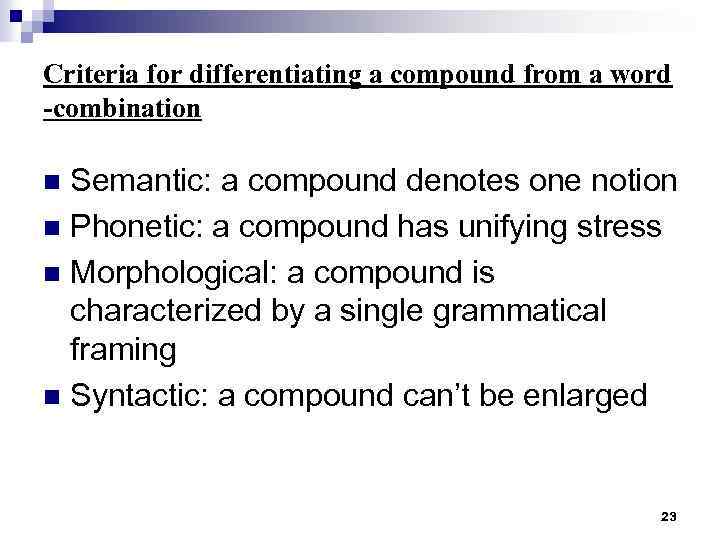
Criteria for differentiating a compound from a word -combination Semantic: a compound denotes one notion n Phonetic: a compound has unifying stress n Morphological: a compound is characterized by a single grammatical framing n Syntactic: a compound can’t be enlarged n 23
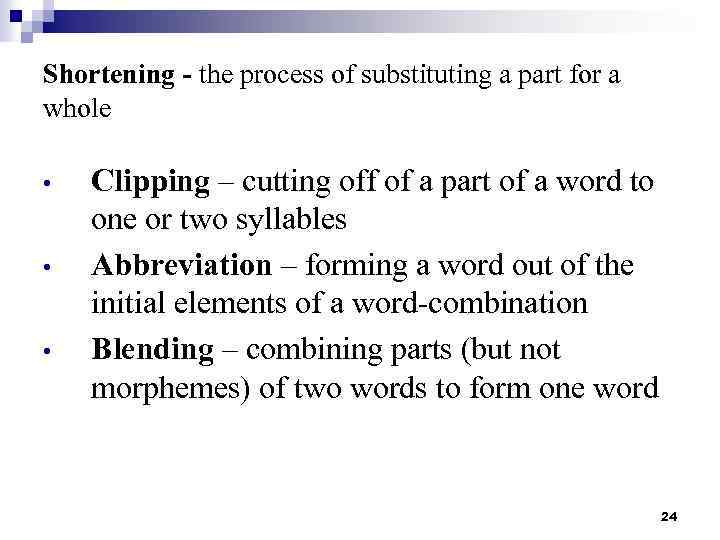
Shortening - the process of substituting a part for a whole • • • Clipping – cutting off of a part of a word to one or two syllables Abbreviation – forming a word out of the initial elements of a word-combination Blending – combining parts (but not morphemes) of two words to form one word 24
Minor types of word-building • • Sound and stress interchange Sound imitation Reduplication Back-formation 25
Скачать презентацию Morphological Structure of the English Word-building Julia E
Morphlogy and word-building.ppt