 Скачать презентацию More possibilities on Creative Intervention Sans Soleil 1983 Notebook
0e736453120e3fbb39a3b12552aebd0f.ppt
- Количество слайдов: 21



More possibilities on Creative Intervention |Sans Soleil (1983)|Notebook on Cities & Clothes (1989)|The Gleaners & I (2001) |Manufactured Landscape (2007)| Wandering Island 《穿在中途島:六件衣服的故事》 Evan Ziporyn's “A House in Bali” on Margaret Mead
Visual anthropology: the case of Maya Deren (Avant-garde filmmaker/experimentation in visual anthropology) • Apparatus: exploring the material possibilities of the camera • Reflexivity • Ritual: union of cultural FORM and CONTENT Moral commitment to aesthetic sensibility
Visual anthropology: the case of Maya Deren Filmmaker’s artistic sensibility “The problem of the filmmaker then becomes not how to make a thing look like itself, so much as how to make it look like what he wants the audience to feel about it. He must discover how to translate his emotion about something into a visual film expression. ” [Legend of Maya Deren, 1942 -47, p. 300]
Visual anthropology: the case of Maya Deren embodies both the artist and the researcher Distinction between art and science; anthropology seen as science Deren combined the rational with emotive aspects of the world (the two cannot be separated)
Sans Soleil (1983) / Chris Marker • A film about traveling in world cities. . . • footage from 8 locations around the world • edited together as a global travelogue • linked by the eye of a fictional filmmaker, credited as Sandor Kasna • . . . about place, everyday banality – highlight ordinary places
Sans Soleil (1983) / Chris Marker • Use VO instead of ambient sounds: ties disparate images together, highlight truncated images – image ad sound dialectical • Images limit themselves to the surface: aesthetic strategy • anti-semiotics and the opposite of 'depth hermaneutics': • – look at something and only show the surface • Content of VO: • Poetic – philosophizing – 'higher' than images? • Hearing and seeing experience not balanced
Sans Soleil (1983) / Chris Marker • VO narration – voice of a woman. . . • . . . writing in the form of her re-telling the contents of letters she receives from a man who travels around the world filming people, places and animals. . . • Catherine Russell, Experimental Ethnography, p. 301
Sans Soleil (1983) / Chris Marker • Self-conscious strategy • articulates the use of images at beginning: 'found images, found linkages between them', but association is only clear to the author • Editing method: gaps between shots, every shot has its own autonomy
Sans Soleil (1983) / Chris Marker • Video imaging as 'archive' • All video works building up archive of places he's been to • Attempt to organize images by types • Categorization is important to Marker • This is also his strategy to keep from drawing definitive statements about a place
Sans Soleil (1983) / Chris Marker • See Marker's Immemoria • His response to his own work. . . • a digital archive
Sans Soleil (1983) / Chris Marker • “As an auto-ethnographic text, it is distinctly silent about the identity of its maker, who hides himself within an intricate pattern of first-person pronouns. ” • Catherine Russell, Experimental Ethnography, p. 301
Experimental Ethnography “Experimental ethnography involves, above all, dismantling the universalist impulse of realist aesthetics into a clash of voices, cultures, bodies, and language. ” (p. xvii)
Notebook on Cities and Clothes (1989) Wim Wenders • Wenders was asked by the Centre Georges Pompidou in Paris to make a short film in the context of fashion. Yohji Yamamoto • “The world of fashion. I'm interested in the world, not in the fashion! But, maybe I was too quick to put down fashion. Why not look at it without prejudice? Why not examine it like any other industry, like the movies for example? ” • “Filmmaking. . . should just remain a way of life sometimes, like taking a walk, reading a newspaper, eating, writing notes, driving a car or shooting this film here, for instance, made from day to day, carried along by nothing other than its curiosity – a notebook on cities and clothes. ” • – Wim Wenders
The Gleaners and I (2001, Agnes Varda) • • • Drifting Collecting Objects and things → people The life of things Spatial transportation of objects
Manufactured Landscapes (2007) / Jennifer Baichwal Macroviews: start detached, then more personal Opens up discussion, but draws no conclusion Still photography (Edward Burtynsky) combined with video footage 2 mediums in same piece and location
Manufactured Landscapes (2007) / Jennifer Baichwal An implied criticism on art photography. . . Photo: focus on graphical order | Footage: can see the chaos • Through photo, subject becomes object – humanistic issues become mere aesthetic objects • Flow of work is the commentary: real life turned into object – Put in gallery space, access to knowledge based only on photographer’s speech during opening turned into political capital
Manufactured Landscapes (2007) / Jennifer Baichwal Issues of art gallery: not merely aesthetic, also political. . . • Zoe Leonard critical of large format (Andreas Gursky); wideshots not necessarily more ‘objective’ JB has intention to be objective Complicated shooting technique: foresee result of photo, use video to capture a more naturalistic view behind it
Wandering Island 《穿在中途島:六件衣服的故事》/ HO Chao-ti 賀照緹 • To see Taiwan as part of the global network of economy via the ordinary clothes ordinary people wear. . .
A House in Bali (2009) / Evan Ziporyn Margaret Mead turned into an opera Libretto by Paul Schick Based on a memoir by Colin Mc. Phee Traces the anthropological trips of Margaret Mead, composer Collin Mc. Phee and artist Walter Spies
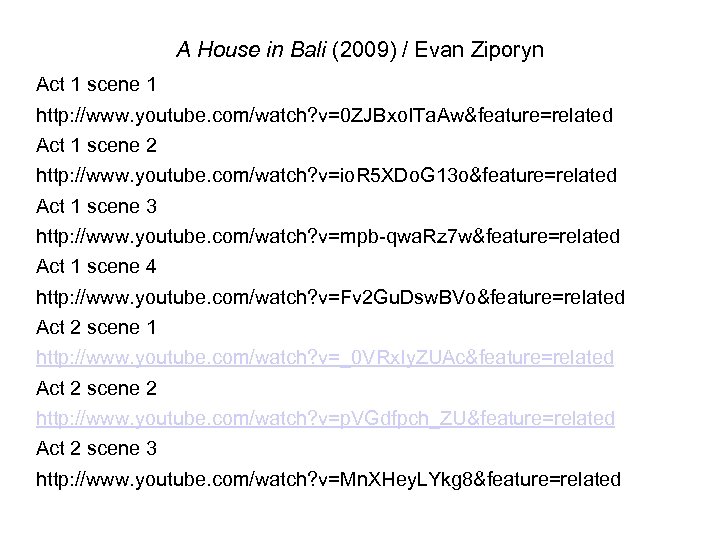
A House in Bali (2009) / Evan Ziporyn Act 1 scene 1 http: //www. youtube. com/watch? v=0 ZJBxo. ITa. Aw&feature=related Act 1 scene 2 http: //www. youtube. com/watch? v=io. R 5 XDo. G 13 o&feature=related Act 1 scene 3 http: //www. youtube. com/watch? v=mpb-qwa. Rz 7 w&feature=related Act 1 scene 4 http: //www. youtube. com/watch? v=Fv 2 Gu. Dsw. BVo&feature=related Act 2 scene 1 http: //www. youtube. com/watch? v=_0 VRx. Iy. ZUAc&feature=related Act 2 scene 2 http: //www. youtube. com/watch? v=p. VGdfpch_ZU&feature=related Act 2 scene 3 http: //www. youtube. com/watch? v=Mn. XHey. LYkg 8&feature=related
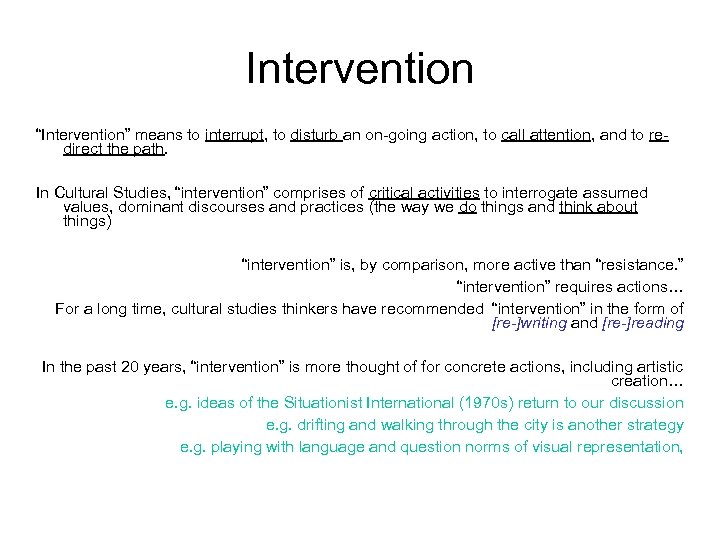
Intervention “Intervention” means to interrupt, to disturb an on-going action, to call attention, and to redirect the path. In Cultural Studies, “intervention” comprises of critical activities to interrogate assumed values, dominant discourses and practices (the way we do things and think about things) “intervention” is, by comparison, more active than “resistance. ” “intervention” requires actions… For a long time, cultural studies thinkers have recommended “intervention” in the form of [re-]writing and [re-]reading In the past 20 years, “intervention” is more thought of for concrete actions, including artistic creation… e. g. ideas of the Situationist International (1970 s) return to our discussion e. g. drifting and walking through the city is another strategy e. g. playing with language and question norms of visual representation,
Скачать презентацию More possibilities on Creative Intervention Sans Soleil 1983 Notebook
0e736453120e3fbb39a3b12552aebd0f.ppt