


 Скачать презентацию More on TCP IP and Networking CS-328 Dick Steflik
b60cd74bcedcbb05becabf00729c0cf1.ppt
- Количество слайдов: 13
 More on TCP/IP and Networking CS-328 Dick Steflik
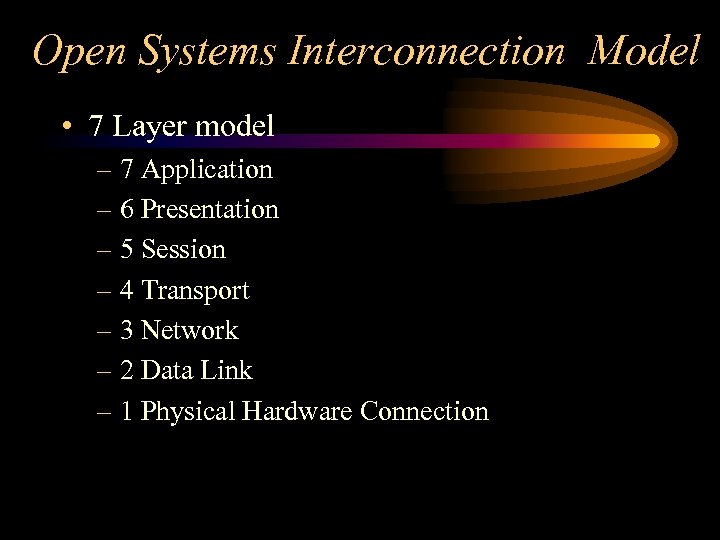 Open Systems Interconnection Model • 7 Layer model – 7 Application – 6 Presentation – 5 Session – 4 Transport – 3 Network – 2 Data Link – 1 Physical Hardware Connection
 X. 25 and the ISO Model • International Standard • Fully compliant with the OSI 7 layer model • X. 25 is the set of protocols recommended by Telecommunications Section of the International Telecommunications Union (ITU-TS)
 Physical Layer • X. 25 specifies a standard for physical interconnection – electrical specs (voltages, current) – connectors
 Data Link Layer • specifies how data travels between a host and the packet switch it is connected to – frame - unit of data – specs for framing of data • what defines start of frame and end of frame • frame checksuming and acknowledgement and receipt – HDLC - High level data Link Control
 Network Layer • also called the network or communication subnet layer • defines the basic Unit of Transfer – includes destination addressing and routing • assembles a packet and uses layer to transfer it to the packet switch
 Transport Layer • provides end-to-end reliability • double checks what was done at the lower layers
 Session Layer • Remote Terminal Access – so important that it occupies its own layer
 Presentation Layer • services used by applications – text compression/decompression – graphic object serialization
 Application Layer • applications that use the network – e-mail - x. 400 – file transfer
 X. 25 vs TCP/IP • Main difference is approach to reliability – X. 25 - reliability is at link level and insurance is provided at all layers • causes possible retries many times – TCP/IP - reliability is an end-to-end problem • done almost exclusively at Transport layer – retries only done at transport layer rather than every layer
 Another Difference • X. 25 - idea of a network is a utility that provides transport service – network vendor provides billing, handling routing problems, flow control – network is complex with simple hosts at the end points
 Another Difference (more) • TCP/IP • hosts actively participate in reliability, routing and network control (ICMP) • the network is a simple packet delivery system with complex hosts at end points