


 Скачать презентацию More on Cryptography CS 136 Computer Security Peter
50b6c17f9888ab2f5fae714f07fb37e0.ppt
- Количество слайдов: 72
 More on Cryptography CS 136 Computer Security Peter Reiher October 4, 2011 CS 136, Fall 2011 Lecture 4 Page 1
 Outline • • • Desirable characteristics of ciphers Stream and block ciphers Cryptographic modes Uses of cryptography Symmetric and asymmetric cryptography • Digital signatures CS 136, Fall 2011 Lecture 4 Page 2
 Desirable Characteristics of Ciphers • Well matched to requirements of application – Amount of secrecy required should match labor to achieve it • Freedom from complexity – The more complex algorithms or key choices are, the worse CS 136, Fall 2011 Lecture 4 Page 3
 More Characteristics • Simplicity of implementation – Seemingly more important for hand ciphering – But relates to probability of errors in computer implementations • Errors should not propagate CS 136, Fall 2011 Lecture 4 Page 4
 Yet More Characteristics • Ciphertext size should be same as plaintext size • Encryption should maximize confusion – Relation between plaintext and ciphertext should be complex • Encryption should maximize diffusion – Plaintext information should be distributed throughout ciphertext CS 136, Fall 2011 Lecture 4 Page 5
 Stream and Block Ciphers • Stream ciphers convert one symbol of plaintext immediately into one symbol of ciphertext • Block ciphers work on a given sized chunk of data at a time CS 136, Fall 2011 Lecture 4 Page 6
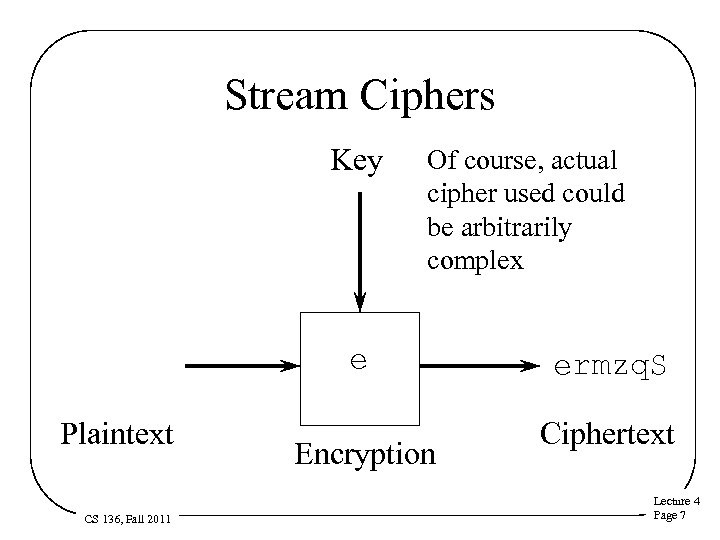 Stream Ciphers Key fsna fsn fs fsnar. T f fsnar Plaintext CS 136, Fall 2011 Of course, actual cipher used could be arbitrarily complex e f a r n m r z q S s T Encryption S ermzq. S q. S Ciphertext Lecture 4 Page 7
 Advantages of Stream Ciphers + Speed of encryption and decryption • Each symbol encrypted as soon as it’s available + Low error propagation • Errors affect only the symbol where the error occurred • Depending on cryptographic mode CS 136, Fall 2011 Lecture 4 Page 8
 Disadvantages of Stream Ciphers – Low diffusion • Each symbol separately encrypted • Each ciphertext symbol only contains information about one plaintext symbol – Susceptible to insertions and modifications – Not good match for many common uses of cryptography – Some disadvantages can be mitigated by use of proper cryptographic mode CS 136, Fall 2011 Lecture 4 Page 9
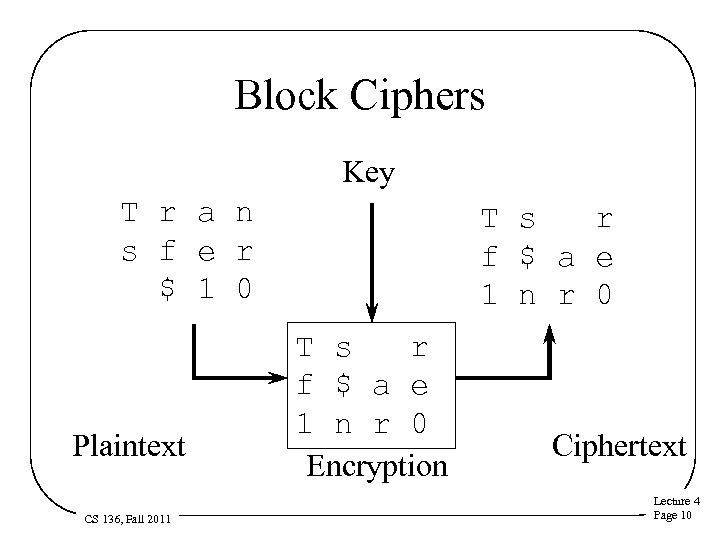 Block Ciphers Key T r a n s f e r $ 1 0 Plaintext CS 136, Fall 2011 T s r f $ a e 1 n r 0 T s a r T r n f $ a e s f e r 1 n r 0 $ 1 0 Encryption Ciphertext Lecture 4 Page 10
 Advantages of Block Ciphers + Good diffusion • Easier to make a set of encrypted characters depend on each other + Immunity to insertions • Encrypted text arrives in known lengths Most common Internet crypto done with block ciphers CS 136, Fall 2011 Lecture 4 Page 11
 Disadvantages of Block Ciphers – Slower • Need to wait for block of data before encryption/decryption starts – Worse error propagation • Errors affect entire blocks CS 136, Fall 2011 Lecture 4 Page 12
 Cryptographic Modes • Let’s say you have a bunch of data to encrypt – Using the same cipher and key • How do you encrypt the entire set of data? – Given block ciphers have limited block size – And stream ciphers just keep going CS 136, Fall 2011 Lecture 4 Page 13
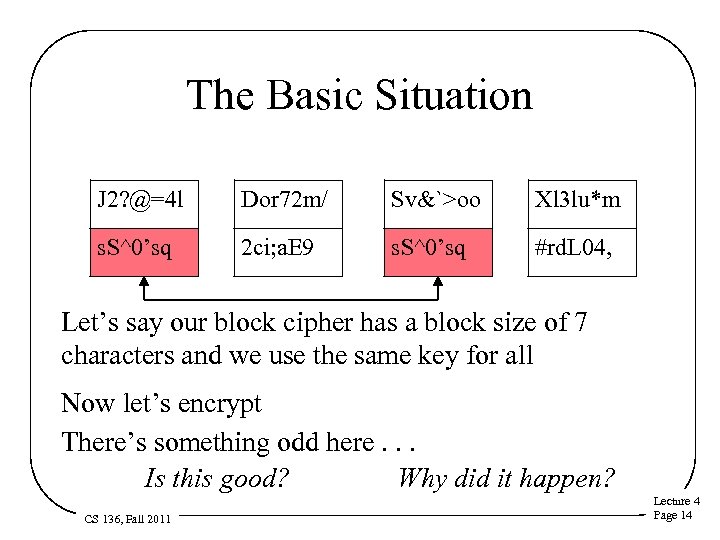 The Basic Situation J 2? @=4 l 1840326 Dor 72 m/ 5610993 Sv&`>oo 3370259 Xl 3 lu*m 6840924 s. S^0’sq $100. 00 2 ci; a. E 9 $550. 00 s. S^0’sq $100. 00 #rd. L 04, $225. 00 Let’s say our block cipher has a block size of 7 characters and we use the same key for all Now let’s encrypt There’s something odd here. . . Why did it happen? Is this good? CS 136, Fall 2011 Lecture 4 Page 14
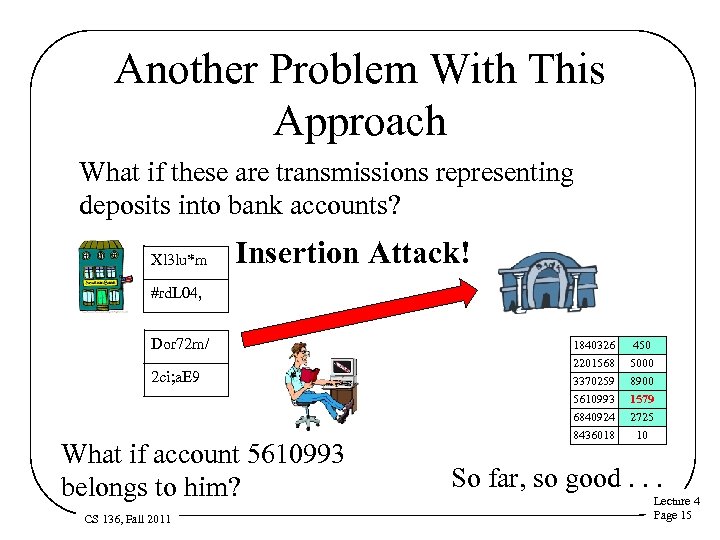 Another Problem With This Approach What if these are transmissions representing deposits into bank accounts? Xl 3 lu*m Sv&`>oo Dor 72 m/ J 2? @=4 l Insertion Attack! #rd. L 04, s. S^0’sq 2 ci; a. E 9 Dor 72 m/ 5610993 2 ci; a. E 9 $550. 00 What if account 5610993 belongs to him? CS 136, Fall 2011 1840326 2201568 3370259 5610993 6840924 8436018 450 350 5000 8900 8800 1579 1029 479 2725 2500 10 So far, so good. . . Lecture 4 Page 15
 What Caused the Problems? • Each block of data was independently encrypted – With the same key • So two blocks with identical plaintext encrypt to the same ciphertext • Not usually a good thing • We used the wrong cryptographic mode – Electronic Codebook (ECB) Mode CS 136, Fall 2011 Lecture 4 Page 16
 Cryptographic Modes • A cryptographic mode is a way of applying a particular cipher – Block or stream • The same cipher can be used in different modes – But other things are altered a bit • A cryptographic mode is a combination of cipher, key, and feedback – Plus some simple operations CS 136, Fall 2011 Lecture 4 Page 17
 So What Mode Should We Have Used? • Cipher Block Chaining (CBC) mode might be better • Ties together a group of related encrypted blocks • Hides that two blocks are identical • Foils insertion attacks CS 136, Fall 2011 Lecture 4 Page 18
 Cipher Block Chaining Mode • Adds feedback into encryption process • The encrypted version of the previous block is used to encrypt this block • For block X+1, XOR the plaintext with the ciphertext of block X – Then encrypt the result • Each block’s encryption depends on all previous blocks’ contents • Decryption is similar CS 136, Fall 2011 Lecture 4 Page 19
 What About the First Block? • If we send the same first block in two messages with the same key, – Won’t it be encrypted the same way? • Might easily happen with message headers or standardized file formats • CBC as described would encrypt the first block of the same message sent twice the same way both times CS 136, Fall 2011 Lecture 4 Page 20
 Initialization Vectors • A technique used with CBC – And other crypto modes – Abbreviated IV • Ensures that encryption results are always unique – Even for duplicate message using the same key • XOR a random string with the first block – plaintext IV – Then do CBC for subsequent blocks CS 136, Fall 2011 Lecture 4 Page 21
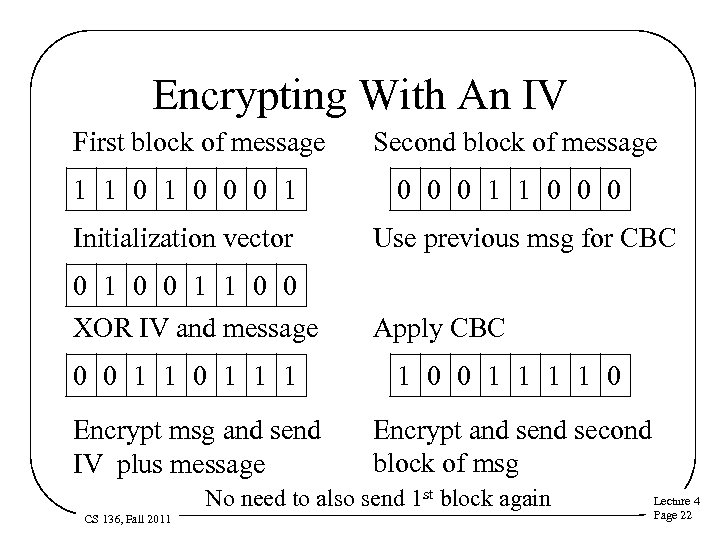 Encrypting With An IV First block of message 1 1 0 0 0 1 Initialization vector Second block of message 0 0 0 1 1 0 0 0 Use previous msg for CBC 0 1 0 0 1 1 0 0 XOR IV and message 0 1 0 0 1 1 1 0 1 Encrypt msg and send IV plus message Apply CBC 1 0 0 1 1 1 1 0 Encrypt and second block of msg No need to also send 1 st block again CS 136, Fall 2011 Lecture 4 Page 22
 How To Decrypt With Initialization Vectors? • First block received decrypts to P = plaintext IV • plaintext = P IV • No problem if receiver knows IV – Typically, IV is sent in the message • Subsequent blocks use standard CBC – So can be decrypted that way CS 136, Fall 2011 Lecture 4 Page 23
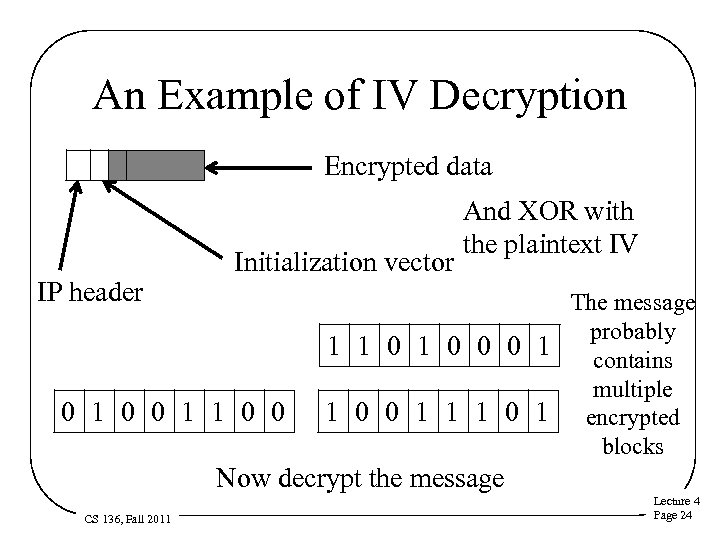 An Example of IV Decryption Encrypted data IP header Initialization vector 0 1 0 0 1 1 0 0 And XOR with the plaintext IV The message probably 1 1 0 0 0 1 contains multiple 1 0 0 1 1 1 0 1 encrypted blocks Now decrypt the message CS 136, Fall 2011 Lecture 4 Page 24
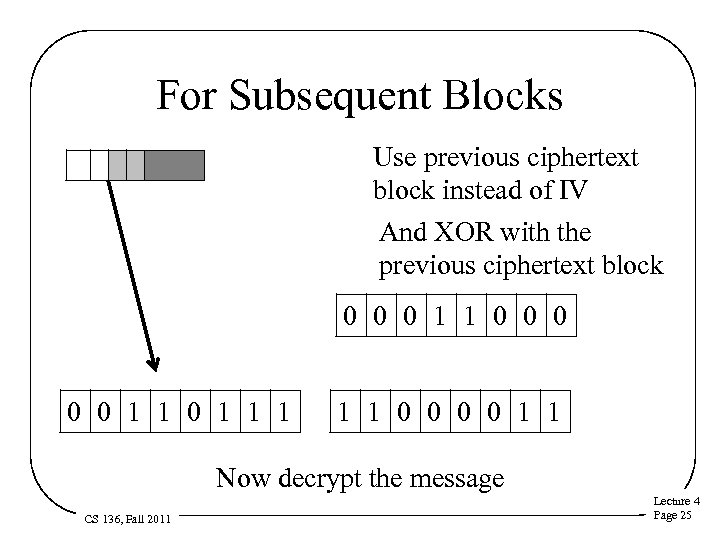 For Subsequent Blocks Use previous ciphertext block instead of IV And XOR with the previous ciphertext block 0 0 0 1 1 1 1 1 0 0 0 1 1 1 1 0 0 Now decrypt the message CS 136, Fall 2011 Lecture 4 Page 25
 Some Important Crypto Modes • Electronic codebook mode (ECB) • Cipher block chaining mode (CBC) • Cipher-feedback mode (CFB) and Output-feedback mode (OFB) Both convert block to stream cipher CS 136, Fall 2011 Lecture 4 Page 26
 Uses of Cryptography • What can we use cryptography for? • Lots of things – Secrecy – Authentication – Prevention of alteration CS 136, Fall 2011 Lecture 4 Page 27
 Cryptography and Secrecy • Pretty obvious • Only those knowing the proper keys can decrypt the message – Thus preserving secrecy • Used cleverly, it can provide other forms of secrecy CS 136, Fall 2011 Lecture 4 Page 28
 Cryptography and Authentication • How can I prove to you that I created a piece of data? • What if I give you the data in encrypted form? – Using a key only you and I know • Then only you or I could have created it – Unless one of us told someone else the key. . . CS 136, Fall 2011 Lecture 4 Page 29
 Using Cryptography for Authentication • If both parties cooperative, standard cryptography can authenticate – Problems with non-repudiation, though • What if three parties want to share a key? – No longer certain who created anything – Public key cryptography can solve this problem • What if I want to prove authenticity without secrecy? CS 136, Fall 2011 Lecture 4 Page 30
 Cryptography and Non. Alterability • Changing one bit of an encrypted message completely garbles it – For many forms of cryptography • If a checksum is part of encrypted data, that’s detectable • If you don’t need secrecy, can get the same effect – By encrypting only the checksum CS 136, Fall 2011 Lecture 4 Page 31
 Cryptography and Zero. Knowledge Proofs • With really clever use, cryptography can be used to prove I know a secret – Without telling you the secret • Seems like magic, but it can work • Basically, using multiple iterations of cryptography in very clever ways CS 136, Fall 2011 Lecture 4 Page 32
 Symmetric and Asymmetric Cryptosystems • Symmetric - the encrypter and decrypter share a secret key – Used for both encrypting and decrypting • Asymmetric – encrypter has different key than decrypter CS 136, Fall 2011 Lecture 4 Page 33
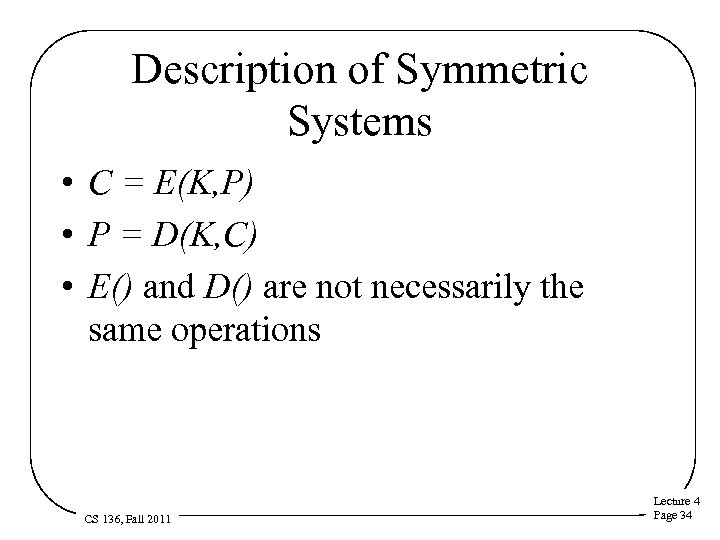 Description of Symmetric Systems • C = E(K, P) • P = D(K, C) • E() and D() are not necessarily the same operations CS 136, Fall 2011 Lecture 4 Page 34
 Advantages of Symmetric Key Systems + Encryption and authentication performed in a single operation + Well-known (and trusted) ones perform faster than asymmetric key systems + Doesn’t require any centralized authority • Though key servers help a lot CS 136, Fall 2011 Lecture 4 Page 35
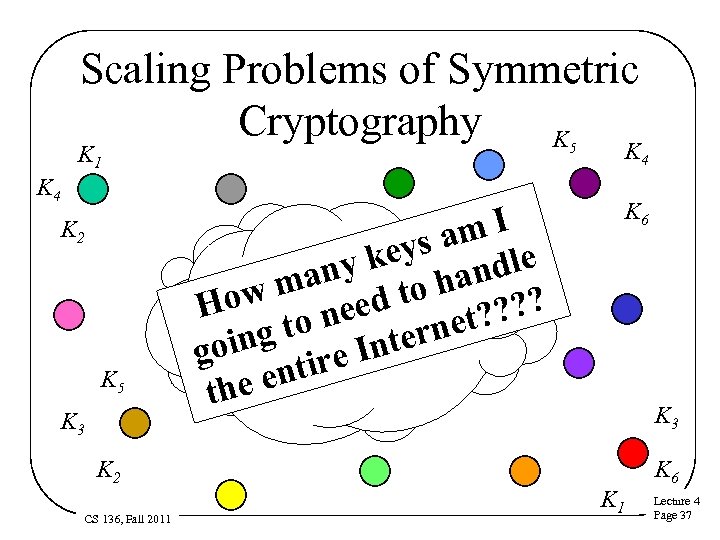
 Disadvantage of Symmetric Key Systems – Encryption and authentication performed in a single operation • Makes signature more difficult – Non-repudiation hard without servers – Key distribution can be a problem – Scaling CS 136, Fall 2011 Lecture 4 Page 36
 Scaling Problems of Symmetric Cryptography K K 4 K 2 K 5 K 3 K 2 CS 136, Fall 2011 K 4 5 K 1 K 6 m. I ys a le y ke hand man d to How o nee ? ? t net oing ire Inter g ent the K 3 K 1 K 6 Lecture 4 Page 37
 Sample Symmetric Key Ciphers • The Data Encryption Standard • The Advanced Encryption Standard • There are many others CS 136, Fall 2011 Lecture 4 Page 38
 The Data Encryption Standard • Well known symmetric cipher • Developed in 1977, still much used – Shouldn’t be, for anything serious • Block encryption, using substitutions, permutations, table lookups – With multiple rounds – Each round is repeated application of operations • Only serious problem based on short key CS 136, Fall 2011 Lecture 4 Page 39
 The Advanced Encryption Standard • A relatively new cryptographic algorithm • Intended to be the replacement for DES • Chosen by NIST – Through an open competition • Chosen cipher was originally called Rijndael – Developed by Dutch researchers – Uses combination of permutation and substitution CS 136, Fall 2011 Lecture 4 Page 40
 Increased Popularity of AES • Gradually replacing DES – As was intended • Various RFCs describe using AES in IPsec • Free. S/WAN IPsec (for Linux) includes AES • Some commercial VPNs use AES • Various Windows AES products available – Used for some purposes in Vista – Used for most purposes in Windows 7 CS 136, Fall 2011 Lecture 4 Page 41
 Is AES Secure? • No complete breaks discovered so far • But some disturbing problems – Attacks that work on versions of AES using fewer rounds – Attacks that can get keys in less time than pure brute force • But not practical time (e. g. in 2126 operations) • Unusable crypto flaws often lead to usable ones CS 136, Fall 2011 Lecture 4 Page 42
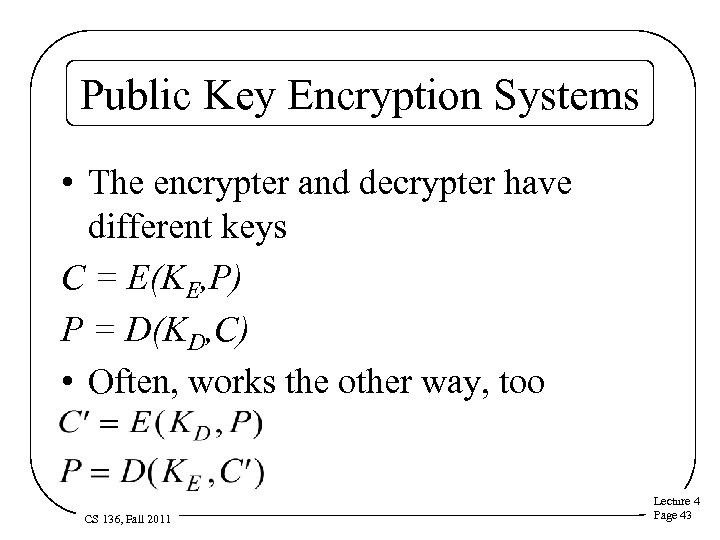 Public Key Encryption Systems • The encrypter and decrypter have different keys C = E(KE, P) P = D(KD, C) • Often, works the other way, too CS 136, Fall 2011 Lecture 4 Page 43
 History of Public Key Cryptography • Invented by Diffie and Hellman in 1976 • Merkle and Hellman developed Knapsack algorithm in 1978 • Rivest-Shamir-Adelman developed RSA in 1978 – Most popular public key algorithm • Many public key cryptography advances secretly developed by British and US government cryptographers earlier CS 136, Fall 2011 Lecture 4 Page 44
 Practical Use of Public Key Cryptography • • Keys are created in pairs One key is kept secret by the owner The other is made public to the world If you want to send an encrypted message to someone, encrypt with his public key – Only he has private key to decrypt CS 136, Fall 2011 Lecture 4 Page 45
 Authentication With Shared Keys • If only two people know the key, and I didn’t create a properly encrypted message – The other guy must have • But what if he claims he didn’t? • Or what if there are more than two? • Requires authentication servers CS 136, Fall 2011 Lecture 4 Page 46
 Authentication With Public Keys • If I want to “sign” a message, encrypt it with my private key • Only I know private key, so no one else could create that message • Everyone knows my public key, so everyone can check my claim directly CS 136, Fall 2011 Lecture 4 Page 47
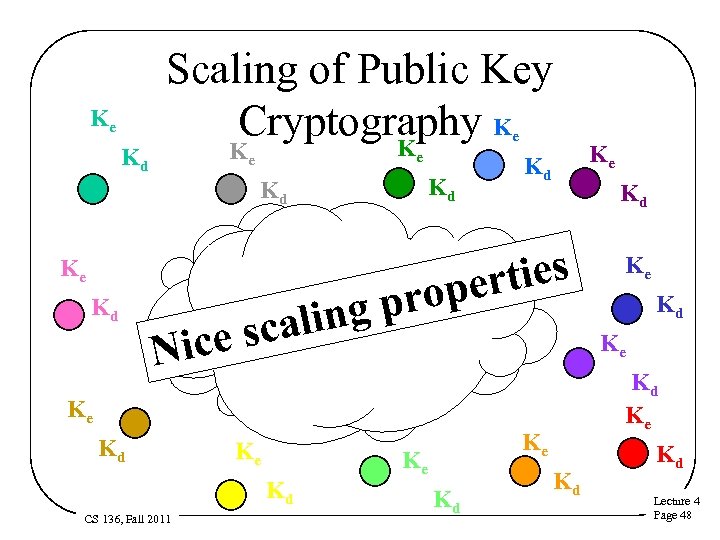 Ke Kd Scaling of Public Key Cryptography K K e Ke e Kd Kd Kd rties ope g pr alin e sc Nic Ke Kd CS 136, Fall 2011 Ke Kd Ke Ke Ke Kd Kd Kd Lecture 4 Page 48
 Key Management Issues • To communicate via shared key cryptography, key must be distributed – In trusted fashion • To communicate via public key cryptography, need to find out each other’s public key – “Simply publish public keys” CS 136, Fall 2011 Lecture 4 Page 49
 Issues of Key Publication • Security of public key cryptography depends on using the right public key • If I am fooled into using the wrong one, that key’s owner reads my message • Need high assurance that a given key belongs to a particular person • Which requires a key distribution infrastructure CS 136, Fall 2011 Lecture 4 Page 50
 RSA Algorithm • Most popular public key cryptographic algorithm • In wide use • Has withstood much cryptanalysis • Based on hard problem of factoring large numbers CS 136, Fall 2011 Lecture 4 Page 51
 RSA Keys • Keys are functions of a pair of 100 -200 digit prime numbers • Relationship between public and private key is complex • Recovering plaintext without private key (even knowing public key) is supposedly equivalent to factoring product of the prime numbers CS 136, Fall 2011 Lecture 4 Page 52
 Comparison of AES and RSA • AES is much more complex • However, AES uses only simple arithmetic, logic, and table lookup • RSA uses exponentiation to large powers – Computationally 1000 times more expensive in hardware, 100 times in software • RSA key selection also much more expensive CS 136, Fall 2011 Lecture 4 Page 53
 Security of RSA • Conjectured that security depends on factoring large numbers – But never proven – Some variants proven equivalent to factoring problem • Probably the conjecture is correct • Key size for RSA doesn’t have same meaning as DES and AES CS 136, Fall 2011 Lecture 4 Page 54
 Attacks on Factoring RSA Keys • In 2005, a 663 bit RSA key was successfully factored • A 768 bit key factored in 2009 • Research on integer factorization suggests keys up to 2048 bits may be insecure • Size will keep increasing • The longer the key, the more expensive the encryption and decryption CS 136, Fall 2011 Lecture 4 Page 55
 Elliptical Cryptography • RSA and similar algorithms related to factoring products of large primes • Other math can be used for PK, instead – Properties of elliptical curves, e. g. • Can give same security as other public key schemes, with much smaller keys • Widely studied, regarded as safe – Often used for small devices CS 136, Fall 2011 Lecture 4 Page 56
 Combined Use of Symmetric and Asymmetric Cryptography • Common to use both in a single session • Asymmetric cryptography essentially used to “bootstrap” symmetric crypto • Use RSA (or another PK algorithm) to authenticate and establish a session key • Use AES with that session key for the rest of the transmission CS 136, Fall 2011 Lecture 4 Page 57
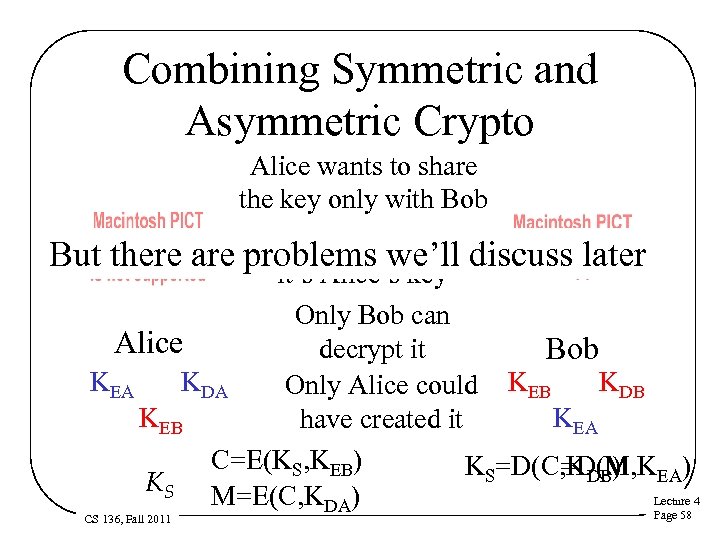 Combining Symmetric and Asymmetric Crypto Alice wants to share the key only with Bob wants to be sure But there are problems we’ll discuss later it’s Alice’s key Only Bob can Alice decrypt it Bob KDA KDB KEA Only Alice could KEB KEA have created it C=E(KS, KEB) KS=D(C, KDB) EA) C=D(M, K M KS M=E(C, K ) Lecture 4 DA CS 136, Fall 2011 Page 58
 Quantum Cryptography • Using quantum mechanics to perform crypto – Mostly for key exchange • Rely on quantum indeterminacy or quantum entanglement • Existing implementations rely on assumptions – Quantum hacks have attacked those assumptions • Not ready for real-world use, yet • Quantum computing (to attack crypto) even further off CS 136, Fall 2011 Lecture 4 Page 59
 Digital Signature Algorithms • In some cases, secrecy isn’t required • But authentication is • The data must be guaranteed to be that which was originally sent • Especially important for data that is long-lived CS 136, Fall 2011 Lecture 4 Page 60
 Desirable Properties of Digital Signatures • • Unforgeable Verifiable Non-repudiable Cheap to compute and verify Non-reusable No reliance on trusted authority Signed document is unchangeable CS 136, Fall 2011 Lecture 4 Page 61
 Encryption and Digital Signatures • Digital signature methods are based on encryption • The basic act of having performed encryption can be used as a signature – If only I know K, then C=E(P, K) is a signature by me – But how to check it? CS 136, Fall 2011 Lecture 4 Page 62
 Signatures With Shared Key Encryption • Requires a trusted third party • Signer encrypts document with secret key shared with third party • Receiver checks validity of signature by consulting with trusted third party • Third party required so receiver can’t forge the signature CS 136, Fall 2011 Lecture 4 Page 63
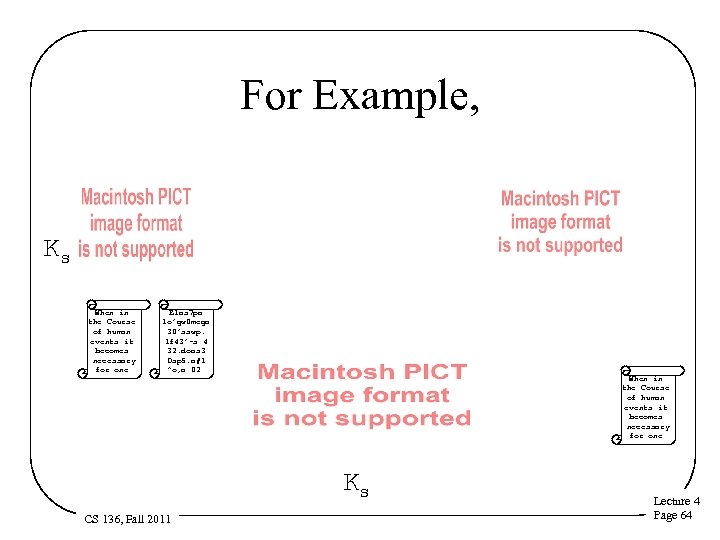 For Example, Ks When in the Course of human events it becomes necessary for one Elas 7 pa 1 o’gw 0 mega 30’sswp. 1 f 43’-s 4 32. doas 3 Dsp 5. a#l ^o, a 02 When in the Course of human events it becomes necessary for one Ks CS 136, Fall 2011 Lecture 4 Page 64
 Signatures With Public Key Cryptography • Signer encrypts document with his private key • Receiver checks validity by decrypting with signer’s public key • Only signer has the private key – So no trusted third party required • But receiver must be certain that he has the right public key CS 136, Fall 2011 Lecture 4 Page 65
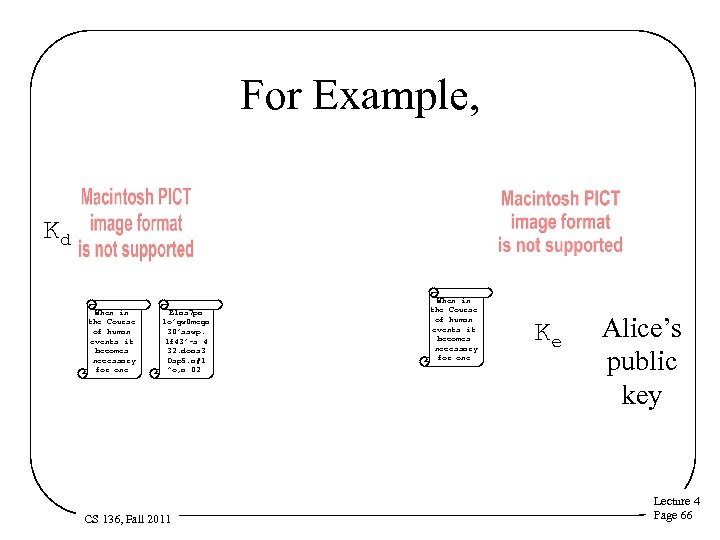 For Example, Kd When in the Course of human events it becomes necessary for one Elas 7 pa 1 o’gw 0 mega 30’sswp. 1 f 43’-s 4 32. doas 3 Dsp 5. a#l ^o, a 02 CS 136, Fall 2011 When in the Course of human events it becomes necessary for one Ke Alice’s public key Lecture 4 Page 66
 Problems With Simple Encryption Approach • Computationally expensive – Especially with public key approach • Document is encrypted – Must be decrypted for use – If in regular use, must store encrypted and decrypted versions CS 136, Fall 2011 Lecture 4 Page 67
 Steganography • Another means of hiding data in plain sight • In general terms, refers to embedding data into some other data • In modern use, usually hiding data in an image – People have talked about using sound and other kinds of data CS 136, Fall 2011 Lecture 4 Page 68
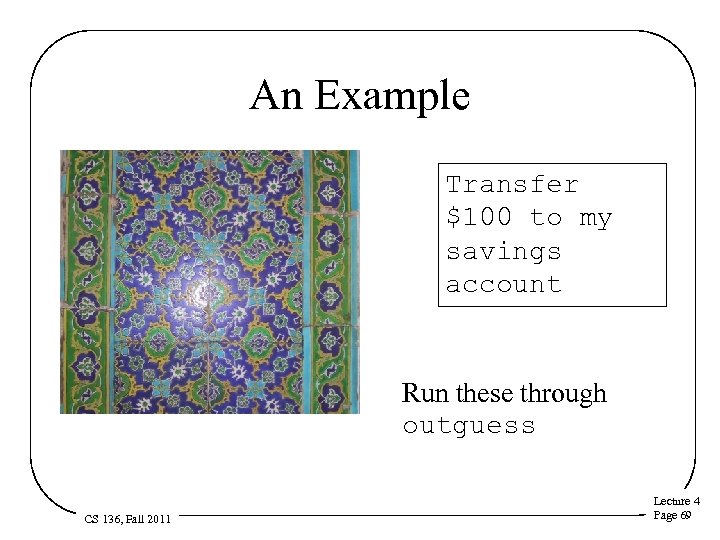 An Example Transfer $100 to my savings account Run these through outguess CS 136, Fall 2011 Lecture 4 Page 69
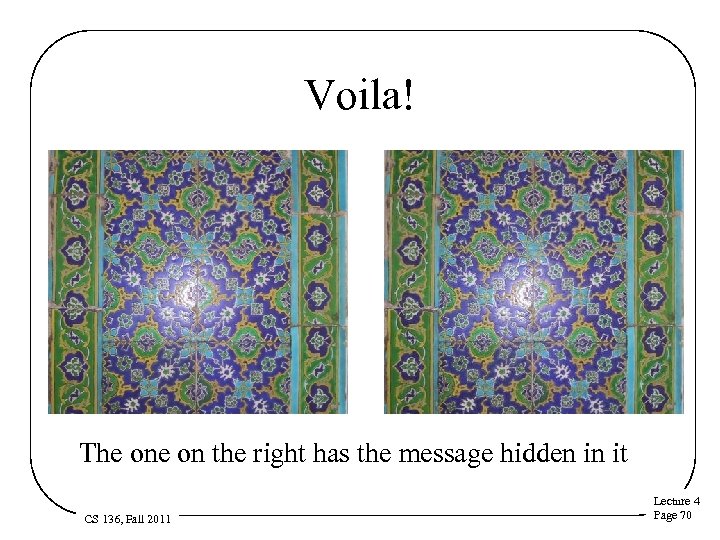 Voila! The on the right has the message hidden in it CS 136, Fall 2011 Lecture 4 Page 70
 How It Works • Encode the message in the low order bits of the image • Differences in these bits aren’t humanvisible • More sophisticated methods also work • Detected by looking for unlikely patterns • Often foiled by altering images • Steganography designers try to be robust against these problems CS 136, Fall 2011 Lecture 4 Page 71
 What’s Steganography Good For? • Used by some printer manufacturers to prove stuff came from them • Stories of use by Al-Qaeda – No evidence of truth of stories • Recent Shady Rat attacks apparently used it to hide code to contact botnet servers • Most useful if opponents don’t suspect you’re using it CS 136, Fall 2011 Lecture 4 Page 72