


 Скачать презентацию More Askers More Money How Everyone Can
eb90053fb5411aab51ae95aebac73c55.ppt
- Количество слайдов: 25
 More Askers = More Money: How Everyone Can Participate in Building Philanthropic Partnerships Presented by Andy Robinson Sponsored by The University of Arizona Foundation GIFT Center
 To raise money successfully, you need four things: ● A strong case for giving ● Prospective donors to ask ● People to do the asking ● Systems and resources to track data, money, donor recognition, etc.
 Most nonprofits and institutions can be stronger in all these areas, but the biggest challenge is: √ A strong case for giving √ Prospective donors to ask !!! Not enough askers √ Systems and resources to track data, money, donor recognition, etc.
 Many organizations emphasize encouraging board members to ask, but board members are volunteers – and how much influence do you have over a volunteer?
 Why can’t we deploy our faculty and staff more effectively?
 Case study: Toxics Action Center, www. toxicsaction. org Mission: “Organizing with residents to clean up and prevent pollution since 1987. ”
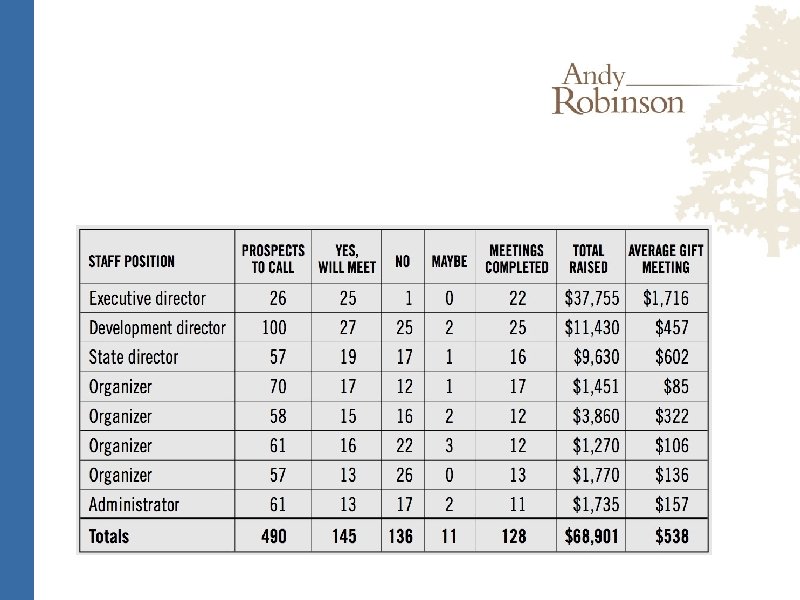
 ● Annual budget +/- $500, 000 ● Revenue split between grants and community-based fundraising ● Major gifts category = $250+ ● 250 -300 donor visits per year
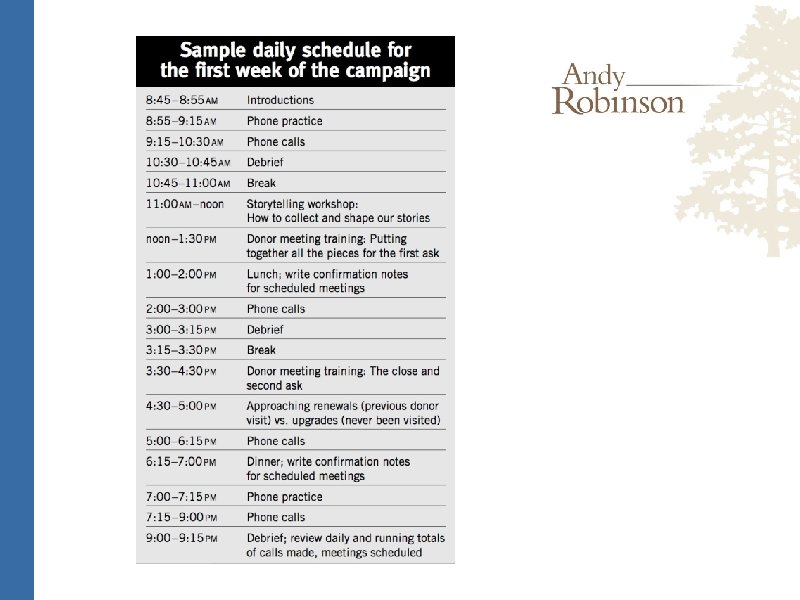
 All-staff model (really, ALL staff) ● Two-week major gifts campaigns twice per year ● A “house list” of donors who’ve given at least $50 via canvas and/or mail ● Program work is severely restricted during the two-week campaign
 Week one: Training, role plays, phoning (and phoning) for visits Week two: Donor visits, with a goal of 1518 visits per staff member
 What makes this model work? 1. Leadership buy-in and follow-through 2. A campaign structure 3. Devotion to the numbers
 4. A commitment to storytelling 5. A “culture of practice” 6. Persistence powered by a dose of realism
 7. A culture of mutual support 8. Transparency in recruitment 9. The courage to ask for much larger gifts
 Rule: Donors will give 5 -10 times more money in person than they will send through the mail.
 10. Embracing the wisdom that fundraising equals ● Donor engagement (not just “asking”) ● Advocacy ● Education ● Market research
 Challenges and barriers Why wouldn’t this model work with your organization or institution?
 1. Staff and leadership resistance: “We don’t do it that way” 2. Geography: National donor pool, hard to meet in person 3. Logistics and coordination are always more challenging in large institutions 4. Timing: Our work never stops
 Adapting this strategy for your organization Given the challenges and barriers we’ve identified, how can you adapt this model to work for your institution?
 1. Reduce the time commitment 2. Spread out the time commitment 3. Recruit a smaller faculty/staff team 4. Share the numbers – keep everyone informed about how fundraising works in your organization
 Collect & share stories; build a story bank: “Statistics raise eyebrows but emotions raise money. ” ● Testimonials ● Favorite anecdotes ● Photos ● Videos ● News clippings ● An organizational timeline on your wall/website
 Develop a fundraising culture within university departments and centers ● Create a faculty/staff fundraising menu so people can choose how they want to participate ● Challenge gifts based on faculty/staff engagement benchmarks ● Option? Use the money raised for professional development or other benefits
 Questions?
 This presentation is based on the article “More Askers = More Money, ” available from the Grassroots Fundraising Journal, www. grassrootsfundraising. org.
 Good luck and stay in touch! www. andyrobinsononline. com