 Скачать презентацию MORBIDITY OF CHILDREN UNDER 5 YEARS OF AGE
fba7b9fe7310848d95b2d54deed917f3.ppt
- Количество слайдов: 35



MORBIDITY OF CHILDREN UNDER 5 YEARS OF AGE AND UTILIZATION OF VEGETABLES PRODUCED USING SEWAGE WATER AND HUMAN WASTE IN DANDORA-NAIROBI BY ILHAM MUTAWAKIL ABDALLA A 56/69398/2013
TABLE OF CONTENTS
BACKGROUND • Urban agriculture is the practice of cultivating, processing, and distributing food in or around a village, town, or city ( Bailkey M et al. , 2000), and can reflect varying levels of economic and social development of the area. • Residents of Nairobi’s sprawling slum are cultivating urban gardens in a bid to increase food security in the area, caused by rural urban migration.
BACKGROUND • In Dandora area, untreated sewer water has been used widely irrespective of the purposed health risks, as it’s often the only source of water for irrigation in the slum areas. • Small scale farmers often prefer wastewater because its high nutrient content reduces or even eliminates the need for expensive chemical fertilizers. • Concern for human health and the environment are the most important constraints in the reuse of wastewater (van der Hoek W. et al, . 2000).
BACKGROUND • Morbidity and mortality has been seen globally among farmers using untreated sewer water for vegetable production in the general population. • Children are uniquely sensitive to environmental contaminants and their kidneys do not have adult capabilities of removing toxins from the body. • In Dandora, it has not been shown whether the vegetables grown using sewer that children are fed from may constitute toxins that may cause morbidity among them.
PROBLEM STATEMENT • Untreated sewage is full of harmful matter exceeding permissible limits. • Dandora residents have developed health problems which are suspected to be associated with sewage exposure. • It has not been pin pointed exactly what health risk is found at particular stages of sewage exposure.
PROBLEM STATEMENT • It also does not show if these hazards can be a source of morbidity for children less than 5 years of age. • Despite the high content of nutrients in the sewer, research shows a high content of germs which pose a health hazard to the public.
JUSTIFICATION • Vegetables are a daily part of the meals among Dandora residents, and every individual likes the vegetables that look so green with big leaves irrespective of where they buy them from • Health risks have been reported in different parts of the community whose major etiology are parasites, heavy metals and bacteria which can be associated with sewage water.
JUSTIFICATION • This study will determine if exactly there are germs of health hazard to humans and are related to the morbidity of children less than 5 years hence creating awareness to the residents and farmers.
STUDY AIM/PURPOSE • To determine the health hazards that cause morbidity to children less than 5 years when utilizing vegetables grown using sewage water for farming.
MAIN OBJECTIVE • To determine the relationship between morbidity of children less than 5 years and utilization of vegetables produced using sewage water and human waste in Nairobi.
SPECIFIC OBJECTIVES • To determine the socio-economic and sociodemographic characterization of individuals utilizing vegetables produced using sewage water. • To determine the agricultural practices and utilization of vegetables produced using sewage water. • To analyze specific hazards found in the vegetable produced using sewage water at the production, at the markets and during consumption. • To associate the morbidity of children less than 5 years of age to utilization of vegetables produced using sewage water.
RESEARCH QUESTIONS • Is there a relationship between morbidity of children less than 5 years and utilization of vegetables produced using sewage water and human waste? • Are the socio-economic and socio-demographic factors influence the utilization of vegetables produced using sewage water? • What agricultural practices are used to produce vegetable using sewage water? • Are the bacteria, parasites and heavy metal load in these vegetables at the pre-harvest, postharvest and consumable high enough which can cause a health hazard?
HYPOTHESIS • Use of untreated sewage water in production of vegetables is associated to morbidity of children less than 5 years of age.
ASSUMPTIONS AND LIMITATIONS • Some farmers may not be willing to participate in the study. • Problems of accessing swampy, smelling sewage farms. • Resistance of residents to stepping into their farms. • Some vegetables not being ready for harvest at the time of sample collection. • Bad weather conditions like rain which may hinder movement during sample collection.
LITERATURE REVIEW TOPICS 2. 1 Overview of Urban Farming 2. 2 Disease caused by use of sewage 2. 2. 1 Diarrhoea 2. 2. 2 Schistosomiasis 2. 2. 3 Trachoma 2. 2. 4 Intestinal Helminthes 2. 2. 5 Parasitic Protozoa 2. 2. 6 Hepatitis A 2. 2. 7 Heavy metals toxicities
LITERATURE REVIEW TOPICS • 2. 3 Pollution from Agriculture • 2. 4 Pollution from Industry and Mining • 2. 5 The Agriculture Sanitation Gap
STUDY AREA • Dandora is an Eastern suburb in Nairobi Kenya. • It is part of the Embakasi division. Surrounding neighbourhoods called estates include Kariobangi, Baba Dogo, Gitare Mariogo and Korogocho. • Nairobi's principal dumping site is situated in Dandora, probably causing health problems for local residents (WHO July 2009).
SAMPLING POPULATION AND SAMPLING FRAME • With the new constitution, Dandora has been divided into four wards with a total population of approximately 150, 000 people. • A street map shall be used as a frame for a door-to-door survey; although it doesn't show individual houses, I shall select streets from the map and then select houses on those streets.
STUDY DESIGN • This will be a cross-sectional study design that will establish the association of the morbidity of children less than 5 years with the utilization of vegetables produced using sewage water.
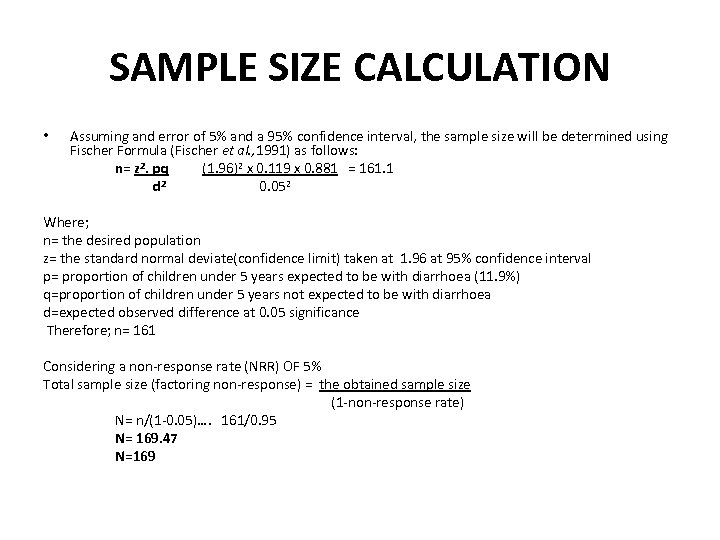
SAMPLE SIZE CALCULATION • Assuming and error of 5% and a 95% confidence interval, the sample size will be determined using Fischer Formula (Fischer et al. , 1991) as follows: n= z 2. pq (1. 96)2 x 0. 119 x 0. 881 = 161. 1 d 2 0. 052 Where; n= the desired population z= the standard normal deviate(confidence limit) taken at 1. 96 at 95% confidence interval p= proportion of children under 5 years expected to be with diarrhoea (11. 9%) q=proportion of children under 5 years not expected to be with diarrhoea d=expected observed difference at 0. 05 significance Therefore; n= 161 Considering a non-response rate (NRR) OF 5% Total sample size (factoring non-response) = the obtained sample size (1 -non-response rate) N= n/(1 -0. 05)…. 161/0. 95 N= 169. 47 N=169
SAMPLING PROCEDURE • I will use stratified simple random selection, the strata will be obtained through the street mapping. • Maps will show houses in different streets and they will be randomly selected. The selected houses will be marked for easy identification during data collection.
SAMPLE COLLECTION • Samples will be collected from the farms as sewage water, soil and the vegetables before harvesting. Sewage and soil will be carried in sterile plastic bottles, while the leafy vegetables carried in individual bags. • Vegetable samples will also be collected at the market place as post-harvest and finally in some households after cooking then transported to the laboratory for analysis
SIMULATION OF COOKING PROCEDURE • This will be done in the household where I shall observe how the residents do it and samples collected in plastic food carriers. • I shall finance the requirements for the cooking and then take a portion for analysis this will be to encourage the families to participate in the simulation process. • All the samples collected will be transported to the laboratories for analysis. The vegetables will be crushed to get the liquid portion for analysis

LABORATORY PROCEDURES • Samples will be analysed in Laboratory for: 1. Parasites using ‘The modified Bailenger method’. 2. Bacteria using the medical Laboratory SOPs. 3. Heavy metals using ICP-MS (INDUCTIVELY COUPLED PLASMA MASS SPECTROMETER).
RECRUITMENT AND TRAINING OF RESEARCH ASSISTANTS • I will recruit two research assistants one of them who must meet the following requirements; over 18 years of age, a resident of the Dandora area for at least five years, understands the area well. • The second research assistant will have to meet the following requirements; at least has medical or environmental background in his education, has good righting and communication skills to talk to residents
RECRUITMENT AND TRAINING OF RESEARCH ASSISTANTS • This will be done month before start of the project. I will train them on ethical issues pertaining research, such as consent from the participants is key to obtaining data, courtesy while talking to participants, the language to use, how to react from unwilling members of the community, how to aseptically collect data and transportation.
PRETSTING OF RESEARCH TOOLS • A pilot test will be done three weeks prior to commencing with the research. • A section of the sector 6 of Dandora will be used to determine if the research assistants actually have the intended content and can put it into practice. • The questionnaire will capture all the intended data, and as long as the residents are willing to give the required information and analytical procedures of the samples are working properly, this will determine how well the project will run and we will proceed as planned.
DATA QUALITY • All subjects will be assigned a subject identification number (SIN). • All data entered into the study databases will be re-identified and only associated with a SIN in password protected files. • The study will maintain a double entry system for the data. All paper research records will be kept in a password protected, locked filing cabinet located in a restricted-access room at my residence.

ETHICAL CLEARANCE • Ethical consent will be sought from the area chief and the participants will be informed prior to the commencement of the project and they will be ask to sign for their consent on the questionnaires.
GAPS IN KNOWLEDGE • A lot of research has been done to prove that YES there health hazards while utilizing vegetables grown using sewage water and human waste but there is still no information regarding at what particular stages (pre-harvest, post-harvest and consumption)the hazards are carried along. • There is also no information relating whether these health hazards may constitute to the morbidity of children less than 5 years of age.
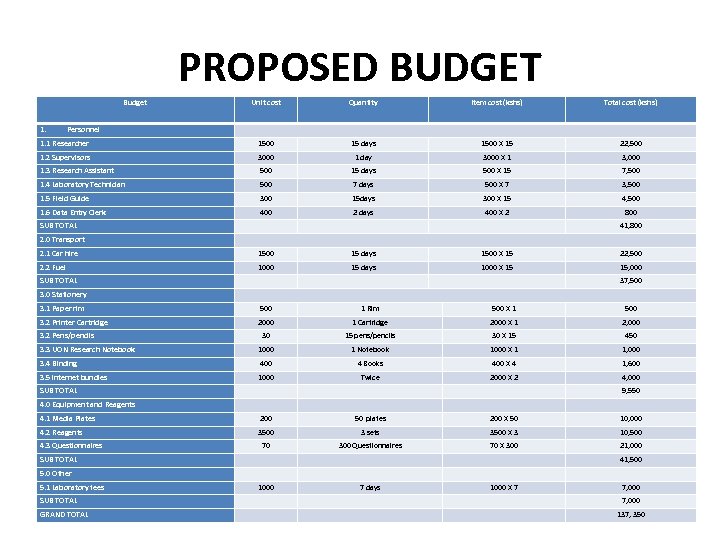
PROPOSED BUDGET Budget Unit cost Quantity Item cost (kshs) Total cost (kshs) 1. 1 Researcher 1500 15 days 1500 X 15 22, 500 1. 2 Supervisors 3000 1 day 3000 X 1 3, 000 1. 3 Research Assistant 500 15 days 500 X 15 7, 500 1. 4 Laboratory Technician 500 7 days 500 X 7 3, 500 1. 5 Field Guide 300 15 days 300 X 15 4, 500 1. 6 Data Entry Clerk 400 2 days 400 X 2 800 1. Personnel SUB TOTAL 2. 0 Transport 2. 1 Car hire 1500 2. 2 Fuel 3. 0 Stationery 41, 800 15 days 1500 X 15 22, 500 15 days 1000 SUB TOTAL 1000 X 15 15, 000 37, 500 3. 1 Paper rim 500 1 Rim 500 X 1 500 3. 2 Printer Cartridge 2000 1 Cartridge 2000 X 1 2, 000 30 15 pens/pencils 30 X 15 450 3. 3 UON Research Notebook 1000 1 Notebook 1000 X 1 1, 000 3. 4 Binding 400 4 Books 400 X 4 1, 600 3. 5 internet bundles 1000 Twice 2000 X 2 4, 000 3. 2 Pens/pencils SUB TOTAL 4. 0 Equipment and Reagents 9, 550 4. 1 Media Plates 200 50 plates 200 X 50 10, 000 4. 2 Reagents 3500 3 sets 3500 X 3 10, 500 70 300 Questionnaires 70 X 300 21, 000 4. 3 Questionnaires SUB TOTAL 5. 0 Other 5. 1 Laboratory fees 41, 500 1000 7 days 1000 X 7 7, 000 SUB TOTAL GRAND TOTAL 7, 000 137, 350
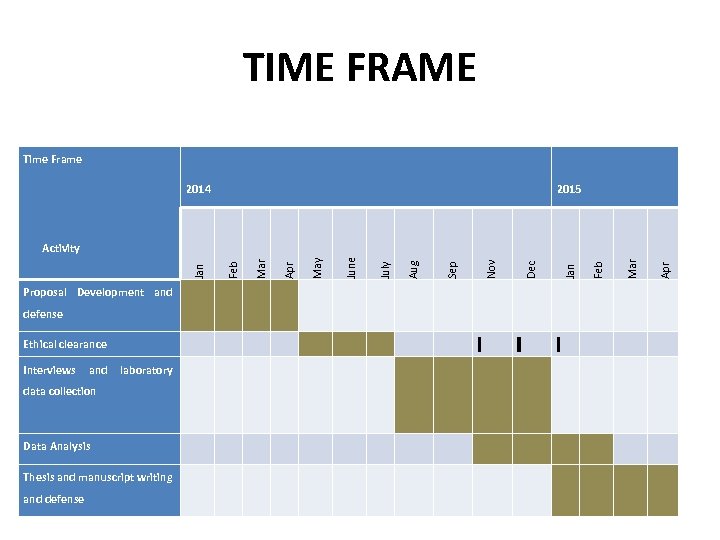
TIME FRAME Time Frame 2014 2015 defense Apr Mar Feb Jan Dec Nov Sep July June May Apr Feb Jan Proposal Development and Ethical clearance Mar Activity Aug Interviews and laboratory Thesis and manuscript writing data collection Data Analysis and defense
REFERENCES Bailkey, M. and Nasr, J (2000). From Brownfields to Greenfields: Producing Food in North American Cities. Community Food Security News. World Health Organization (WHO) (2002). World Health Report: Reducing Risks, Promoting Healthy Life. France. Retrieved 14 July 2009, from http: //www. who. int/whr/2002/en/whr 02_en. pdf. Van der Hoek, W. , Van Linder, B. & J. -J. Ch. Meyer (2000)`On Agents That Have the Ability to Choose', Studia Logica 65: 79 -119.
REFERNCES Kakar, R. G. , Yasinzai, M. , Salarzai, A. U. , Oad, F. C. and Siddqui, M. H. (2006). Irrigation with sewage water: Assessment of water quality, nutrients and heavy metal distribution. Asian Journal of Plant Sciences 5: 438 -440. Kuo, H. W. , Shu. S. L. , Wu. C. C. and Lai, J. S. (1999). Characteristics of medical waste in Taiwan. Water Air Soil Pollution 114: 413 -21.
Скачать презентацию MORBIDITY OF CHILDREN UNDER 5 YEARS OF AGE
fba7b9fe7310848d95b2d54deed917f3.ppt