 Скачать презентацию Mooting Workshop Overview Written Submissions
958f3fc9e58985bd47b3100d426b885e.ppt
- Количество слайдов: 16



Mooting Workshop
Overview • Written Submissions • Oral Submissions • Taking it to the next level • Questions
Written Submissions • Preliminary Step: Receive the Problem

Written Submissions • Step 1: Legal Research • 1. 1. Textbooks: establish an understanding of the basic principles • 1. 2. Cases and legislation: find those relevant to the problem • 1. 3. Academic journals/other jurisdictions: if stuck/for nuance
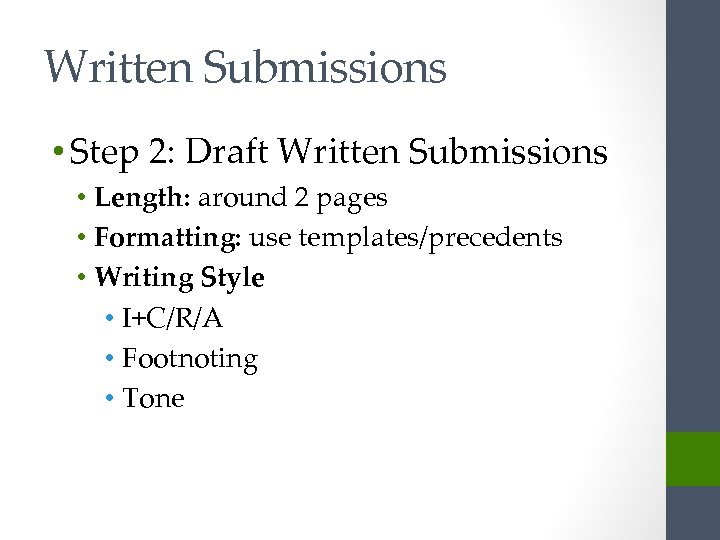
Written Submissions • Step 2: Draft Written Submissions • Length: around 2 pages • Formatting: use templates/precedents • Writing Style • I+C/R/A • Footnoting • Tone
Oral Submissions • Three points: • First, the purpose of oral submissions; • Second, the delivery of oral submissions; and • Third, good and bad approaches to oral submissions.
Oral Submissions: Purpose • When preparing for oral submissions, consider why you are there in the first place. • You are there to advocate for a position: construction of statute, application of rule, etc. • Oral submissions is where the advocacy groundwork of the written submissions is really developed. • Keep in mind: • There is a dispute because the outcome is uncertain. • Uncertainty creates opportunity. (‘In the midst of chaos, there is opportunity. ’ #quiztime) • Use the uncertainty to your advantage • Take home: the purpose of orals tells us that the content must be advocacy, not discussion/summaries.
Oral Submissions: Delivery • Recalling the point is to get the outcome you want, you need to get the judge to take your view. How? • Two take-homes: 1. 2. Structure; and Simplicity. Let’s focus on structure, simplicity is self-explanatory. • Structuring your arguments is essential. Structure according to your pleadings. • Essential method of structuring: ‘signposting’. Signposting is a description of your argument.
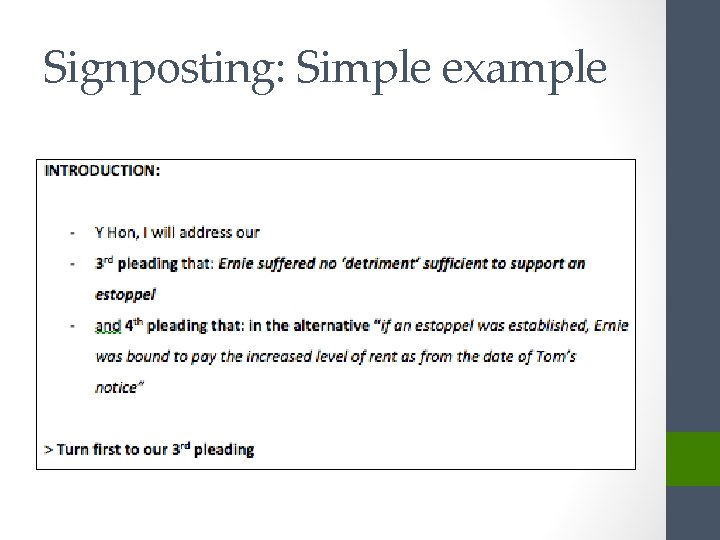
Signposting: Simple example
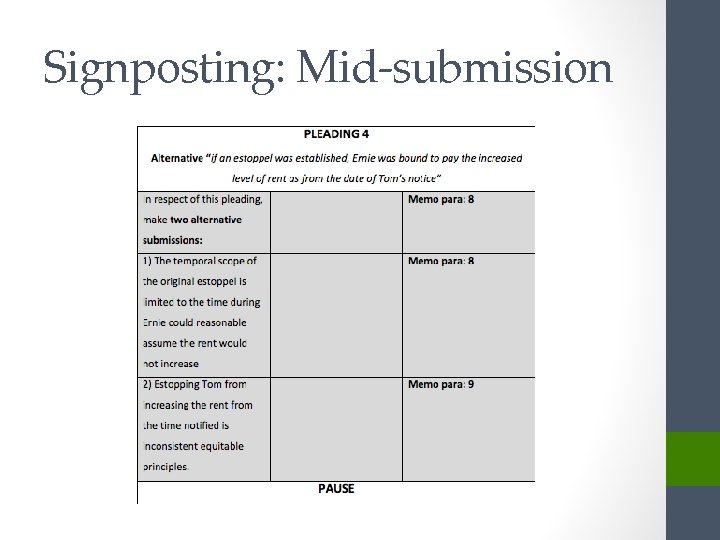
Signposting: Mid-submission
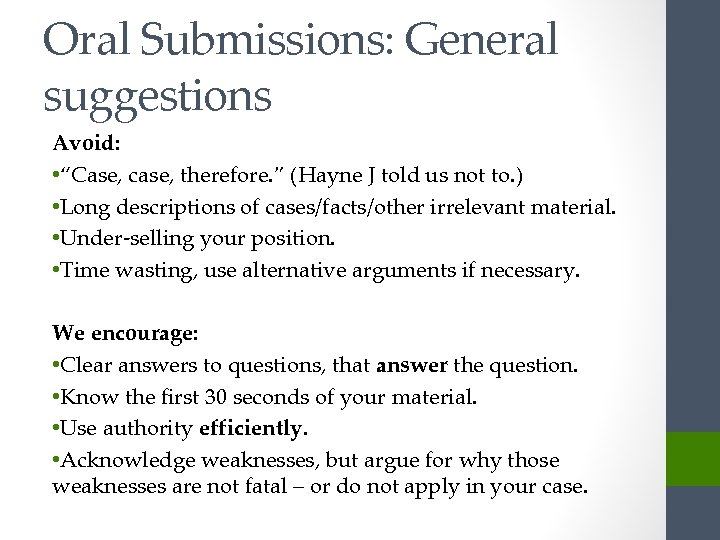
Oral Submissions: General suggestions Avoid: • “Case, case, therefore. ” (Hayne J told us not to. ) • Long descriptions of cases/facts/other irrelevant material. • Under-selling your position. • Time wasting, use alternative arguments if necessary. We encourage: • Clear answers to questions, that answer the question. • Know the first 30 seconds of your material. • Use authority efficiently. • Acknowledge weaknesses, but argue for why those weaknesses are not fatal – or do not apply in your case.
Oral Submissions • Three points: • First, the purpose of oral submissions; • Second, the delivery of oral submissions; and • Third, good and bad approaches to oral submissions.
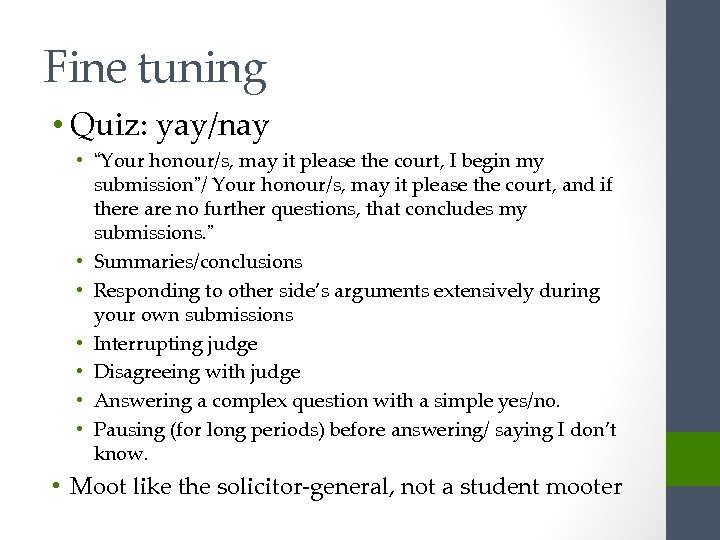
Fine tuning • Quiz: yay/nay • “Your honour/s, may it please the court, I begin my submission”/ Your honour/s, may it please the court, and if there are no further questions, that concludes my submissions. ” • Summaries/conclusions • Responding to other side’s arguments extensively during your own submissions • Interrupting judge • Disagreeing with judge • Answering a complex question with a simple yes/no. • Pausing (for long periods) before answering/ saying I don’t know. • Moot like the solicitor-general, not a student mooter

How to get practice • International Moots • • Jessup Price Vis WTO Moot • National moots: • • Gibbs Constitutional Moot Australian Private Law Moot Castan Human Rights Centre Moot ALSA Championship Moot / Red Cross IHL Moot Shine Torts Moot AAT Moot Etc etc
Summary • Written Submissions • Oral Submissions • Taking it to the next level
Questions?
Скачать презентацию Mooting Workshop Overview Written Submissions
958f3fc9e58985bd47b3100d426b885e.ppt