


 Скачать презентацию Mood Tone Mood is the feeling that
db1f1e6f3ef3bffb59e63080ff9da857.ppt
- Количество слайдов: 37
 Mood & Tone Mood is the feeling that the author intends to create in the reader. Tone is the author’s attitude toward the subject or audience of the story.
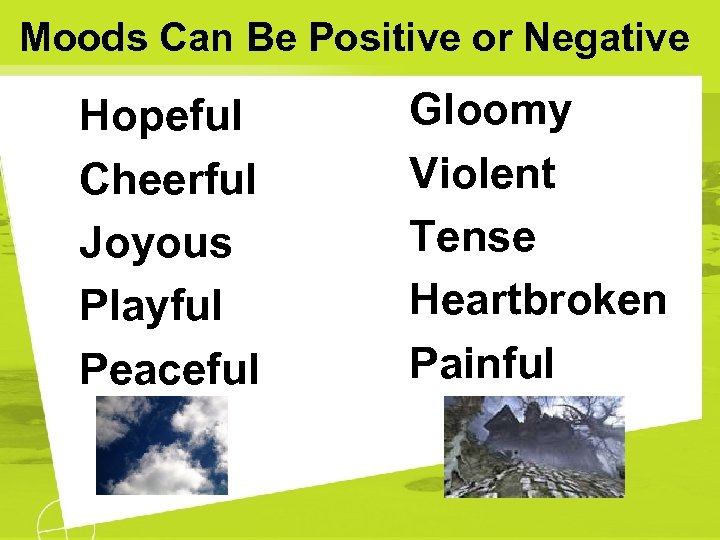 Moods Can Be Positive or Negative Hopeful Cheerful Joyous Playful Peaceful Gloomy Violent Tense Heartbroken Painful
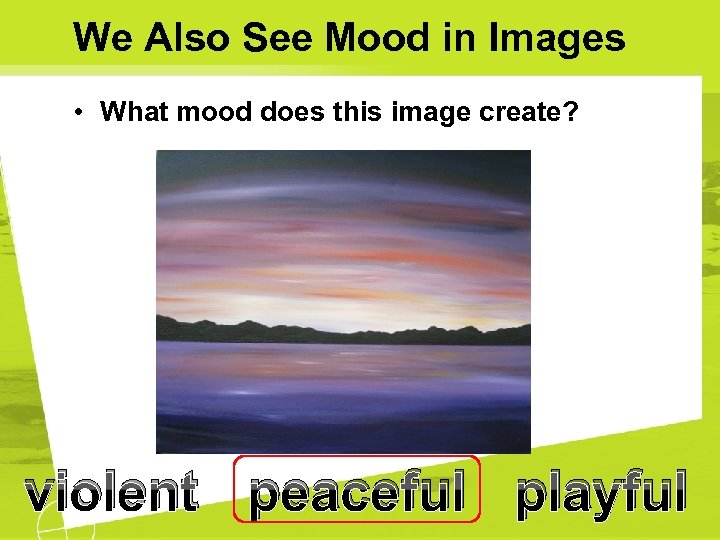 We Also See Mood in Images • What mood does this image create? violent peaceful playful
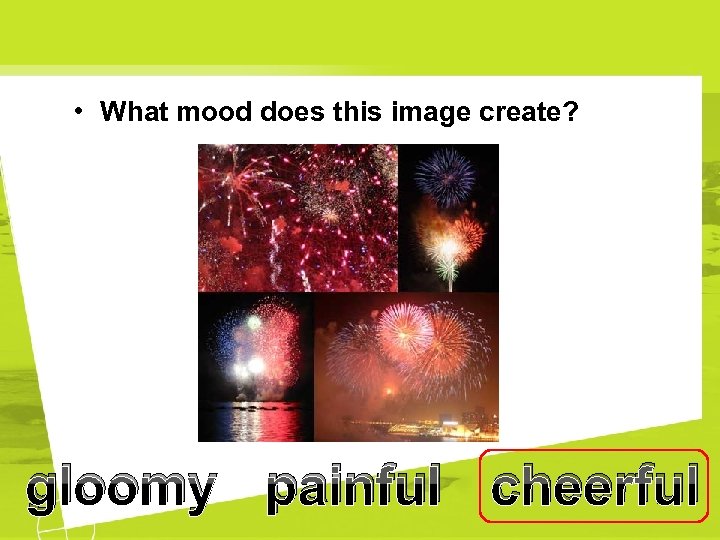 • What mood does this image create? gloomy painful cheerful
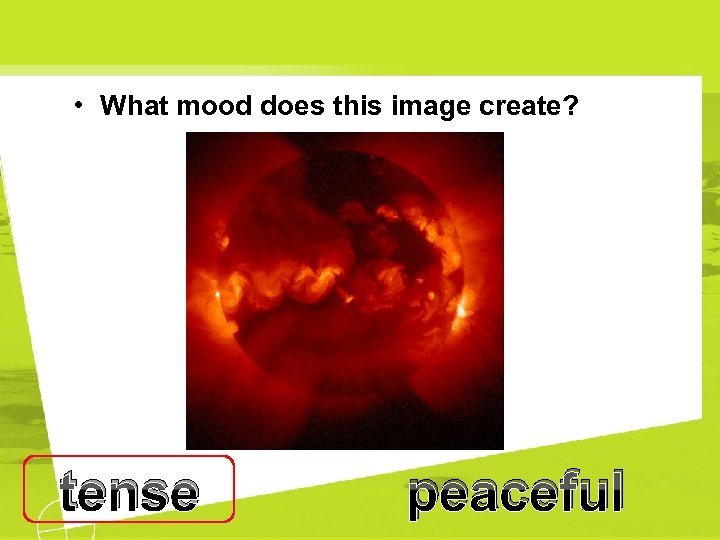 • What mood does this image create? tense peaceful
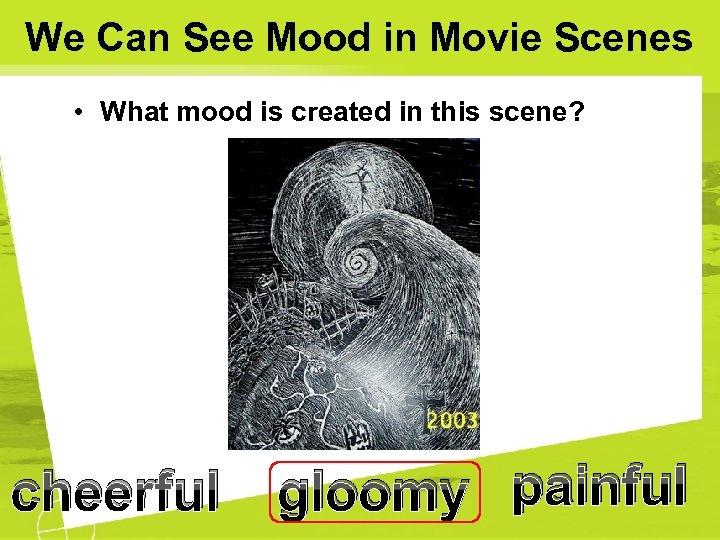 We Can See Mood in Movie Scenes • What mood is created in this scene? cheerful gloomy painful
 How Does a Writer Create Mood? The setting, use of descriptive words & figurative language, the punctuation used, and the sound or connotation of words all work to create the mood of a story.
 Tone • While mood is the feeling that a story creates in a reader, tone is the writer’s attitude toward the subject or audience of the story. • Look for clues in the language the writer uses to identify how the writer feels about the subject.
 “The Fall of the House of Usher” by Edgar Allan Poe During the whole of a dull, dark, and soundless day in the autumn of the year, when the clouds hung oppressively low in the heavens, I had been passing alone, on horseback, through a singularly dreary tract of country; and at length found myself, as the shades of the evening drew on, within view of the melancholy House of Usher. I know not how it was --but, with the first glimpse of the building, a sense of insufferable gloom pervaded my spirit. I looked upon the scene before me --upon the mere house, and the simple landscape features of the domain --upon the bleak walls --upon the vacant eye-like windows --upon a few rank sedges --and upon a few white trunks of decayed trees --with an utter depression of soul which I can compare to no earthly sensation. What was it --I paused to think --what was it that so unnerved me in the contemplation of the House of Usher? Subject: Author: Narrator: Are they the same?
 Animal Farm by George Orwell A little way down the pasture there was a knoll that commanded a view of most of the farm. The animals rushed to the top of it and gazed round them in the clear morning light. Yes, it was theirs— everything that they could see was theirs! In the ecstasy of that thought they gamboled round and round, they hurled themselves into the air in great leaps of excitement. They rolled in the dew, they cropped mouthfuls of the sweet summer grass, they kicked up clods of the black earth and snuffed its rich scent. It was as though they had never seen these things before, and even now they could hardly believe that it was all their own. Subject: Author: Speaker: Are they the same?
 “Buffalo Dusk” by Carl Sandburg The buffaloes are gone. And those who saw the buffaloes are gone. Those who saw the buffaloes by thousands and how they pawed the prairie sod into dust with their hoofs, their great heads down pawing on in a great pageant of dusk, Those who saw the buffaloes are gone. And the buffaloes are gone. Subject: Author: Speaker: Are they the same?
 Siddhartha by Hermann Hesse The Buddha went quietly on his way, lost in thought. His peaceful countenance was neither happy nor sad. He seemed to be smiling gently inwardly. With a secret smile, not unlike that of a healthy child, he walked along, peacefully, quietly. He wore his gown and walked along exactly like the other monks, but his face and his step, his peaceful downward glance, his peaceful downward-hanging hand, and every finger of his hand spoke of peace, spoke of completeness, sought nothing, imitated nothing, reflected a continuous quiet, and unfading light, an invulnerable peace. Subject: Author: Speaker: Are they the same?
 “The Yellow Wallpaper” by Charlotte Perkins Gilman I never saw a worse paper in my life. One of those sprawling flamboyant patterns committing every artistic sin. It is dull enough to confuse the eye in following, pronounced enough to constantly irritate and provoke study, and when you follow the lame uncertain curves for a little distance they suddenly commit suicide--plunge off at outrageous angles, destroy themselves in unheard of contradictions. The color is repellent, almost revolting; a smouldering unclean yellow, strangely faded by the slow-turning sunlight. It is a dull yet lurid orange in some places, a sickly sulphur tint in others. Subject: Author: Speaker: Are they the same?
 Why are Mood and Tone Important? Mood and tone are important because they help the reader to determine the author’s purpose and the overall theme or main idea of the story.
 What is an author’s tone? Tone: Often an author's tone is described by adjectives, such as: cynical, depressed, sympathetic, cheerful, outraged, positive, angry, sarcastic, prayerful, ironic, solemn, vindictive, intense, excited.
 Tone is not an action. It is an attitude.
 Real-life Example You can say the same phrase in different ways, each showing a different attitude or tone. Try saying, “Come here, Sam” using the following tones: • Commanding or bossy • Secretive • Loving • Angry • Excited • Playful
 Tone is not explained or expressed directly. Therefore, a reader must “read between the lines” to feel the author’s attitude and identify the tone.
 Tone is the author’s own attitude toward the subject. Mood is the emotion the author wants the readers to feel while reading about the subject.
 Author’s Tone leads to Story’s Atmosphere & Mood
 Example: An author writes a horror story using a serious and sinister tone. That tone helps create a scary atmosphere and a nervous, frightened mood for the readers.
 Another Example: An author writes a satire, making fun of a horror story using a playful or sarcastic tone. That playful tone helps create a humorous mood for the readers.
 Literary Examples of Author’s Tones…
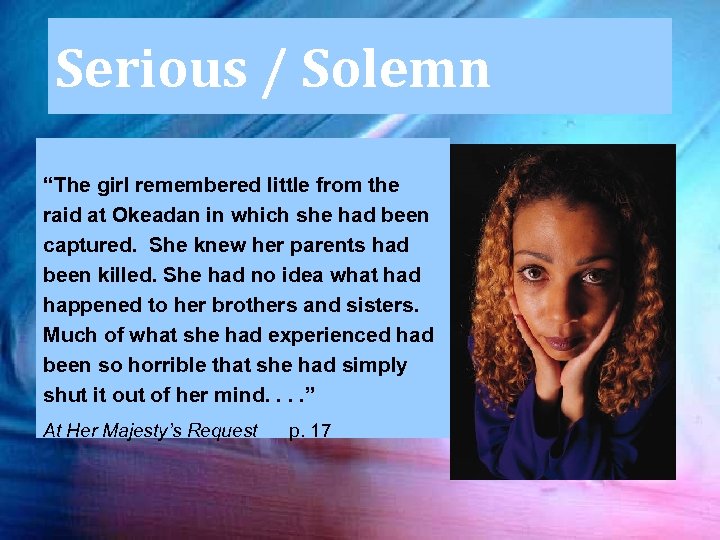 Serious / Solemn “The girl remembered little from the raid at Okeadan in which she had been captured. She knew her parents had been killed. She had no idea what had happened to her brothers and sisters. Much of what she had experienced had been so horrible that she had simply shut it out of her mind. . ” At Her Majesty’s Request p. 17
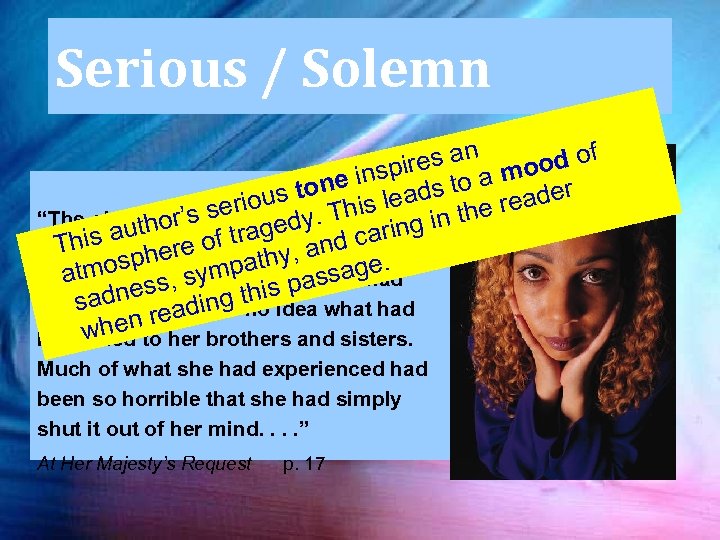 Serious / Solemn es an mood of inspir to a e r s ton is leads eade iou r r “The girl remembered littley. Th the raidn the r’s se ged from ing i autho of tra ar at. This Okeadan inrwhich shey, and c had been e he osp. She sympath parentsghad sa e. atm captured. ss, knew her pas his sadne She ing tno idea what had been killed. readhad whento her brothers and sisters. happened Much of what she had experienced had been so horrible that she had simply shut it out of her mind. . ” At Her Majesty’s Request p. 17
 Sarcastic “Just look at the Titanic. The captain said, ‘Even God can’t sink this ship. ’ Then, on the first voyage across the Atlantic Ocean, boom, it hit an iceberg and sank. And as soon as a daredevil utters the words ‘piece of cake’ before attempting a stunt, he is doomed. ‘Piece of cake’ becomes his ‘famous last words. ’ …” My Brother’s Arm p. 111 -2
 Sarcastic “Just look at the Titanic. The captain slightly a said, pires dy. the ‘Even God can’t sink thiseship. ’ Then, on ins ton trage boom, first voyage acrossic Atlanticf Ocean, cast then spite o ood. ’s sar andre i it hit uthor an iceberg phe sank. And as soon as a ical m his a us atmos r in a cyn daredevil utters the words ‘piece of cake’ T moro attemptinge stunt, he is doomed. before s the read a hu t is p of ‘Pieceu cake’ becomes his ‘famous last Th words. ’ …” My Brother’s Arm p. 111 -2
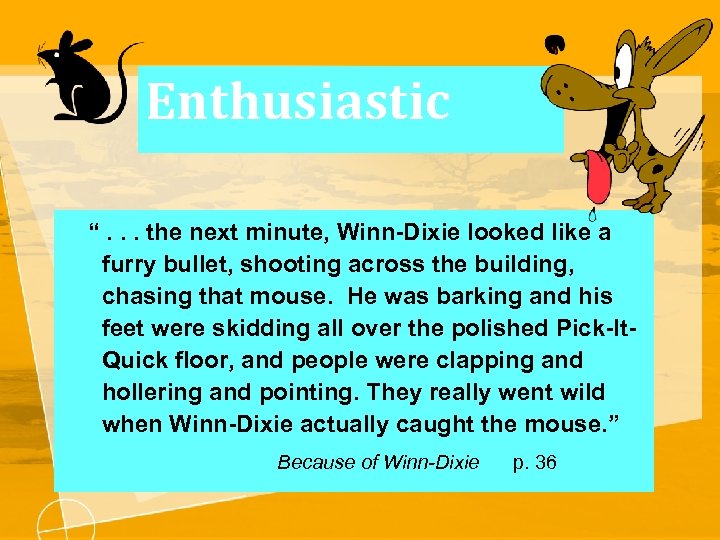 Enthusiastic “. . . the next minute, Winn-Dixie looked like a furry bullet, shooting across the building, chasing that mouse. He was barking and his feet were skidding all over the polished Pick-It. Quick floor, and people were clapping and hollering and pointing. They really went wild when Winn-Dixie actually caught the mouse. ” Because of Winn-Dixie p. 36
 Enthusiastic , active res an nc “. . . the next minute, Winn-Dixie lookedelike a i e e insp c tonacross thenbuilding, o i flu ti furry bullet, shooting opes t g usias h th ipatin r n c or’s e chasing that The autho. He wasd, anti mouse. barking and his h o is aut d mo h ere. T feet osph skiddingxcite atm were be in an e all over the polished Pick-Itlively. Quicksfloor, and people were clapping and o der t ea the rhollering and pointing. They really went wild ction. ea morwhen Winn-Dixie actually caught the mouse. ” Because of Winn-Dixie p. 36
 Hostile / Angry “Dana grinned malevolently. His teeth were nubby and yellow, like an old barn dog’s. Kneeling on Roy’s chest, he hauled back to hit him again. ” Hoot p. 184
 Hostile / Angry iolent es a v inspir e ing to e hop ry ton ay b s ang in the hor m thor’ ood is au “Dana The aut malevolently. His teeth were m tory. grinned Th s ere. neasy icts in the h and u mosp nubby and yellow, clikelan old barn dog’s. at onf nse te e a Kneelingzing the chest, he hauled back asi on Roy’s inspir emphhim again. ” ader, to hit re Hoot p. 184
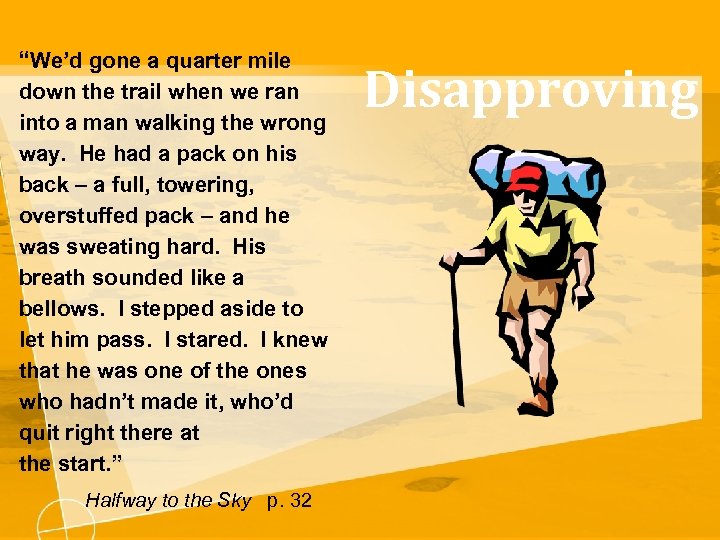 “We’d gone a quarter mile down the trail when we ran into a man walking the wrong way. He had a pack on his back – a full, towering, overstuffed pack – and he was sweating hard. His breath sounded like a bellows. I stepped aside to let him pass. I stared. I knew that he was one of the ones who hadn’t made it, who’d quit right there at the start. ” Halfway to the Sky p. 32 Disapproving
 “We’d gone a quarter mile Disapproving down the trail when we ran into a man walking the wrong a ts up way. He had a pack on his ne se ing to back – a full, towering, approv g to a dis helps sand he ere, leadin overstuffeduthor’– It also a pack tmosph This ader. ents a His re was sweatingitive plishm et hard. od in the ccom o comp breath soundedtlike a the a n al m te d I me bellows. gstepped apprecia aside to ju ader let himtpass. I stared. I knew he re ters. harac ones that he washe c of the f t one o who hadn’t made it, who’d quit right there at the start. ” Halfway to the Sky p. 32
 PERSONAL Personal “I feel alive for the first time in years, ” said Faber. “I feel I’m doing what I should’ve done a lifetime ago. “I feel alive for the first time in For a little while I’m not afraid. Maybe it’s because years, ” said Faber. last. . “ I’m doing the right thing at“I feel. I’m doing what I should’ve done a lifetime ago. p. 131 Fahrenheit 451 For a little while I’m not afraid. Maybe it’s because I’m doing the right thing at last. . . ” Fahrenheit 451 p. 131
 PERSONAL Personal e “I feel alive for the first time in years, ”psaid Faber. “I s her atmo ndone a lifetime ago. a feel I’m doing what I should’ve s to time he author “I feel alive for ne lead. T in o the first tion. Maybe it’sg For a little rsonal I’m not afraid. while t arin because re la e said Faber. ve“I feelnd shdoing years, ” right thing y. . “ I’mhor’s p the ssion and at tlast. . a. I’m d care t doing re n i lit s auwhat exshould’vendoneaa lifetime ago. fide Thi nd an l I p o ta Fahrenheit 451 p. 131 d of c otiona nders u of em For et a moowhile m to not afraid. to s a littlelping the. I’m s e hope Maybe , it’s because I’m doing the ers h d. e rea act rs n th rightcthingeat last. . . ” i r e ha h bout t a Fahrenheit 451 p. 131
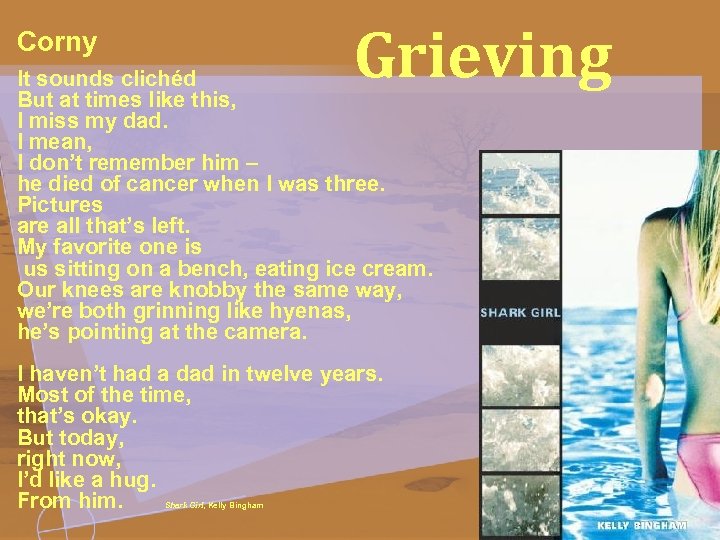 Grieving Corny It sounds clichéd But at times like this, I miss my dad. I mean, I don’t remember him – he died of cancer when I was three. Pictures are all that’s left. My favorite one is us sitting on a bench, eating ice cream. Our knees are knobby the same way, we’re both grinning like hyenas, he’s pointing at the camera. I haven’t had a dad in twelve years. Most of the time, that’s okay. But today, right now, I’d like a hug. From him. Shark Girl, Kelly Bingham
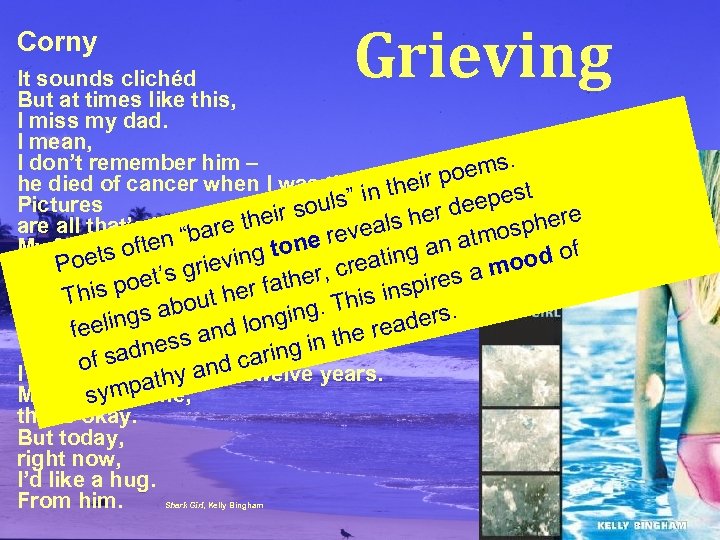 Grieving Corny It sounds clichéd But at times like this, I miss my dad. I mean, I don’t remember him – ems. he died of cancer when I was three. their po epest uls” in Pictures e eir so her d are all that’s left. bare th als phere e atmos e rev en “ n t n My favorite fone is f ets o a bench, g to iceeating a in eating cr cream. o ood o ev P us sitting on t’s gri e knobby rthether, way, spires a m a Our knees o This p are bout he f samehis in we’re both gs a grinning likenging. T hyenas, ders. lin at the camera. o a fee he’s pointing s and l the re s adne ring in a of s and ctwelve years. I haven’t had thy a a dad in ptime, Most of ym s the that’s okay. But today, right now, I’d like a hug. From him. Shark Girl, Kelly Bingham