


 Скачать презентацию Mood Disorders Prof Anatoly Kreinin MD Ph D
Mood 211017.ppt
- Количество слайдов: 70
 Mood Disorders Prof. Anatoly Kreinin MD, Ph. D Maale Carmel Mental Health Center, affiliated to Bruce Rappoport Medical Faculty, Technion, Haifa
 Objectives • Mood, affect, mood disorders (mood D/O’s) • Nosology, epidemiology, treatment (tx) of: • Major depressive disorder (MDD) • Persistent depressive disorder • Premenstrual dysphoric disorder • Disruptive mood dysregulation disorder • Bipolar disorder (BD) • Cyclothymic disorder • Differential diagnosis (Ddx), including: • Depressive v. bipolar & related disorder due to another medical condition • Substance/medication-induced depressive v. bipolar & related disorder • Other specified depressive v. bipolar & related disorder • Unspecified depressive v. bipolar & related disorder
 • Mood - The subjective sense indicates the long, deep and constant feeling that affects a person, his functioning and his environment • Affect - An objective impression of the examiner or other persons, and marks the passing and instantaneous emotion expressed in the present and observable a. Not compatible or compatible with the content of thinking b. The situation. . . • In normal mode a person moves in range of MOODS with varying degrees of control • Mood disorders control the patient
 • Mood - The subjective sense indicates the long, deep and constant feeling that affects a person, his functioning and his environment • Affect - An objective impression of the examiner or other persons, and marks the passing and instantaneous emotion expressed in the present and observable a. Not compatible or compatible with the content of thinking b. The situation. . . • In normal mode a person moves in range of MOODS with varying degrees of control • Mood disorders control the patient
 Major Depressive Disorder
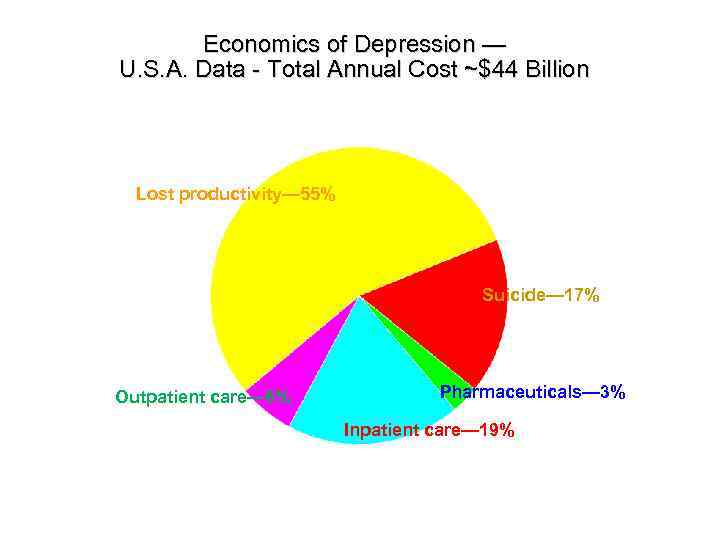 Economics of Depression — U. S. A. Data - Total Annual Cost ~$44 Billion Lost productivity— 55% Suicide— 17% Outpatient care— 6% Pharmaceuticals— 3% Inpatient care— 19% 9
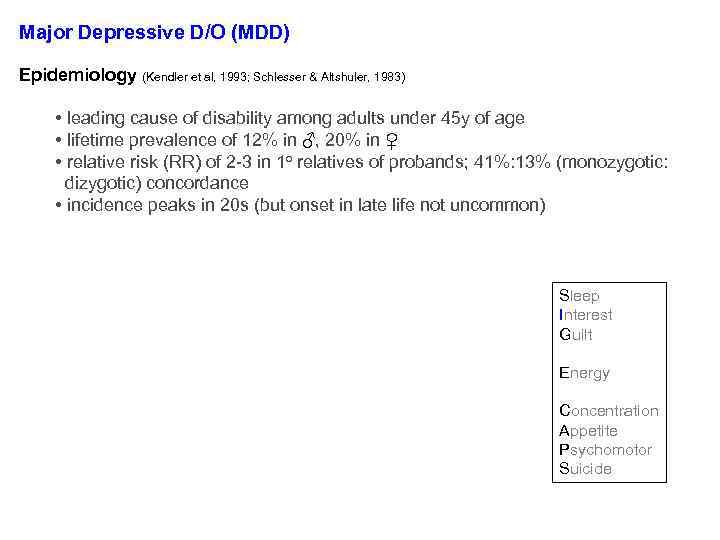 Major Depressive D/O (MDD) Epidemiology (Kendler et al, 1993; Schlesser & Altshuler, 1983) • leading cause of disability among adults under 45 y of age • lifetime prevalence of 12% in ♂, 20% in ♀ • relative risk (RR) of 2 -3 in 1 o relatives of probands; 41%: 13% (monozygotic: dizygotic) concordance • incidence peaks in 20 s (but onset in late life not uncommon) Diagnosis req’s ≥ 1 major depressive episode (MDE) MDE = ≥ 2 wks of • ↓’d mood • anhedonia • signif wt Δ (↓ or ↑) • insomnia or hypersomnia • Ψmotor agitation/retardation (PMA/PMR) • fatigue or anergia • guilt/worthlessness (G/W) • ↓’d [ ] • recurrent thoughts of death or SI 5 symptoms (with ≥ 1 sx in blue) Sleep Interest Guilt Energy Concentration Appetite Psychomotor Suicide
 Question: When does a major depressive episode (MDE) ≠ Major Depressive Disorder?
 Major Depressive D/O (MDD) EXCLUSIONS: • not attributable to a substance/medication or another medical condition • no prior [endogenous] episodes of mania or hypomania Regarding bereavement: • no longer a formal exclusion in DSM-5 because: • the ‘ 2 month’ rule did not reflect reality • the depressive feelings associated with bereavement-related depression respond to the same psychosocial and Rx txs • evidence does not support a different natural course once criteria are met for an MDE… • use your clinical judgment, consider norms for the individual, his/her hx, culture • consider: pangs of grief, preserved self-esteem (v. self-loathing), guilt of failing the deceased (v. more general self-criticism), etc.
![w/ seasonal pattern w/ anxious distress w/ mood-[congruent, incongruent] psychotic features Major depressive disorder](https://present5.com/presentation/5575147_457056262/image-10.jpg "w/ seasonal pattern w/ anxious distress w/ mood-[congruent, incongruent] psychotic features Major depressive disorder") w/ seasonal pattern w/ anxious distress w/ mood-[congruent, incongruent] psychotic features Major depressive disorder w/ mixed features w/ peripartum onset w/ catatonia w/ atypical features ≥ 2 of the following: • keyed-up/tense • unusually restless • can’t concentrate b/c of worry • fear something awful may happen • might lose control w/ melancholic features
w/ seasonal pattern w/ anxious distress w/ mood-[congruent, incongruent] psychotic features Major depressive disorder w/ mixed features w/ peripartum onset w/ catatonia w/ atypical features ≥ 2 of the following: • keyed-up/tense • unusually restless • can’t concentrate b/c of worry • fear something awful may happen • might lose control w/ melancholic features
![w/ seasonal pattern w/ anxious distress w/ mood-[congruent, incongruent] psychotic features Major depressive disorder](https://present5.com/presentation/5575147_457056262/image-11.jpg "w/ seasonal pattern w/ anxious distress w/ mood-[congruent, incongruent] psychotic features Major depressive disorder") w/ seasonal pattern w/ anxious distress w/ mood-[congruent, incongruent] psychotic features Major depressive disorder w/ mixed features w/ peripartum onset w/ catatonia w/ atypical features w/ melancholic features ≥ 3 of the following nearly everyday during an MDE: [drawn from list of sxs for a manic/hypomanic episode, minus distractibility; this list includes elevated/expansive mood, insomnia, grandiose, flight of Ideas, activity (goal-directed), sexual, talkative (i. e. , pressured speech)]
w/ seasonal pattern w/ anxious distress w/ mood-[congruent, incongruent] psychotic features Major depressive disorder w/ mixed features w/ peripartum onset w/ catatonia w/ atypical features w/ melancholic features ≥ 3 of the following nearly everyday during an MDE: [drawn from list of sxs for a manic/hypomanic episode, minus distractibility; this list includes elevated/expansive mood, insomnia, grandiose, flight of Ideas, activity (goal-directed), sexual, talkative (i. e. , pressured speech)]
![w/ seasonal pattern w/ anxious distress w/ mood-[congruent, incongruent] psychotic features Major depressive disorder](https://present5.com/presentation/5575147_457056262/image-12.jpg "w/ seasonal pattern w/ anxious distress w/ mood-[congruent, incongruent] psychotic features Major depressive disorder") w/ seasonal pattern w/ anxious distress w/ mood-[congruent, incongruent] psychotic features Major depressive disorder w/ mixed features w/ peripartum onset w/ catatonia w/ atypical features w/ melancholic features ≥ 1 of the following during the most severe portion of the current episode: • absolute anhedonia or absolute mood non-reactivity plus ≥ 3 of the following: • a distinct quality of depressed mood (e. g. , worse than prior MDEs) • worse in the AM • early AM awakening (by at least 2 h) • marked PMA or PMR • significant appetite or wt loss • excessive guilt
w/ seasonal pattern w/ anxious distress w/ mood-[congruent, incongruent] psychotic features Major depressive disorder w/ mixed features w/ peripartum onset w/ catatonia w/ atypical features w/ melancholic features ≥ 1 of the following during the most severe portion of the current episode: • absolute anhedonia or absolute mood non-reactivity plus ≥ 3 of the following: • a distinct quality of depressed mood (e. g. , worse than prior MDEs) • worse in the AM • early AM awakening (by at least 2 h) • marked PMA or PMR • significant appetite or wt loss • excessive guilt
![w/ seasonal pattern w/ anxious distress w/ mood-[congruent, incongruent] psychotic features Major depressive disorder](https://present5.com/presentation/5575147_457056262/image-13.jpg "w/ seasonal pattern w/ anxious distress w/ mood-[congruent, incongruent] psychotic features Major depressive disorder") w/ seasonal pattern w/ anxious distress w/ mood-[congruent, incongruent] psychotic features Major depressive disorder w/ mixed features w/ peripartum onset w/ catatonia w/ atypical features • mood reactivity w/ melancholic features MAO-I’s (but SSRI’s still 1 st line…) plus ≥ 2 of the following: • significant appetite or wt increase • hypersomnia • long-standing interpersonal rejection sensitivity leading to social/work problems
w/ seasonal pattern w/ anxious distress w/ mood-[congruent, incongruent] psychotic features Major depressive disorder w/ mixed features w/ peripartum onset w/ catatonia w/ atypical features • mood reactivity w/ melancholic features MAO-I’s (but SSRI’s still 1 st line…) plus ≥ 2 of the following: • significant appetite or wt increase • hypersomnia • long-standing interpersonal rejection sensitivity leading to social/work problems
![w/ seasonal pattern w/ anxious distress w/ mood-[congruent, incongruent] psychotic features Major depressive disorder](https://present5.com/presentation/5575147_457056262/image-14.jpg "w/ seasonal pattern w/ anxious distress w/ mood-[congruent, incongruent] psychotic features Major depressive disorder") w/ seasonal pattern w/ anxious distress w/ mood-[congruent, incongruent] psychotic features Major depressive disorder w/ mixed features w/ peripartum onset w/ catatonia w/ atypical features w/ melancholic features • delusions &/or hallucinations • examples of congruent delusions: personal inadequacy, guilt, death, nihilism, deserved punishment
w/ seasonal pattern w/ anxious distress w/ mood-[congruent, incongruent] psychotic features Major depressive disorder w/ mixed features w/ peripartum onset w/ catatonia w/ atypical features w/ melancholic features • delusions &/or hallucinations • examples of congruent delusions: personal inadequacy, guilt, death, nihilism, deserved punishment
![w/ seasonal pattern w/ mood-[congruent, incongruent] psychotic features w/ anxious distress Major depressive disorder](https://present5.com/presentation/5575147_457056262/image-15.jpg "w/ seasonal pattern w/ mood-[congruent, incongruent] psychotic features w/ anxious distress Major depressive disorder") w/ seasonal pattern w/ mood-[congruent, incongruent] psychotic features w/ anxious distress Major depressive disorder w/ mixed features w/ peripartum onset w/ catatonia w/ atypical features w/ melancholic features during most of the episode, ≥ 3 of the following: • stupor • catalepsy (passive induction of a posture held against gravity) • waxy flexibility • mutism • negativism • posturing (spontaneous, maintenance against gravity) • mannerism (odd cariacture of a normal action) • stereotypy • agitation (indep of external stimulus) • grimacing • echolalia or echopraxia
w/ seasonal pattern w/ mood-[congruent, incongruent] psychotic features w/ anxious distress Major depressive disorder w/ mixed features w/ peripartum onset w/ catatonia w/ atypical features w/ melancholic features during most of the episode, ≥ 3 of the following: • stupor • catalepsy (passive induction of a posture held against gravity) • waxy flexibility • mutism • negativism • posturing (spontaneous, maintenance against gravity) • mannerism (odd cariacture of a normal action) • stereotypy • agitation (indep of external stimulus) • grimacing • echolalia or echopraxia
![w/ seasonal pattern w/ anxious distress w/ mood-[congruent, incongruent] psychotic features Major depressive disorder](https://present5.com/presentation/5575147_457056262/image-16.jpg "w/ seasonal pattern w/ anxious distress w/ mood-[congruent, incongruent] psychotic features Major depressive disorder") w/ seasonal pattern w/ anxious distress w/ mood-[congruent, incongruent] psychotic features Major depressive disorder w/ mixed features w/ peripartum onset w/ catatonia w/ atypical features • during pregnancy or in the 4 wks after delivery w/ melancholic features
w/ seasonal pattern w/ anxious distress w/ mood-[congruent, incongruent] psychotic features Major depressive disorder w/ mixed features w/ peripartum onset w/ catatonia w/ atypical features • during pregnancy or in the 4 wks after delivery w/ melancholic features
![w/ seasonal pattern w/ anxious distress w/ mood-[congruent, incongruent] psychotic features Major depressive disorder](https://present5.com/presentation/5575147_457056262/image-17.jpg "w/ seasonal pattern w/ anxious distress w/ mood-[congruent, incongruent] psychotic features Major depressive disorder") w/ seasonal pattern w/ anxious distress w/ mood-[congruent, incongruent] psychotic features Major depressive disorder w/ mixed features w/ peripartum onset w/ catatonia w/ atypical features w/ melancholic features • relapses and remissions occur at characteristic times of the year • at least 2 seasonal MDE’s in the last 2 y (and no non-seasonal MDEs during this period) • seasonal episodes outnumber non-seasonal episodes (lifetime) If a patient always gets depressed with season unemployment (or the beginning of the school year), would we call this ‘w/ seasonal pattern? ’ No.
w/ seasonal pattern w/ anxious distress w/ mood-[congruent, incongruent] psychotic features Major depressive disorder w/ mixed features w/ peripartum onset w/ catatonia w/ atypical features w/ melancholic features • relapses and remissions occur at characteristic times of the year • at least 2 seasonal MDE’s in the last 2 y (and no non-seasonal MDEs during this period) • seasonal episodes outnumber non-seasonal episodes (lifetime) If a patient always gets depressed with season unemployment (or the beginning of the school year), would we call this ‘w/ seasonal pattern? ’ No.
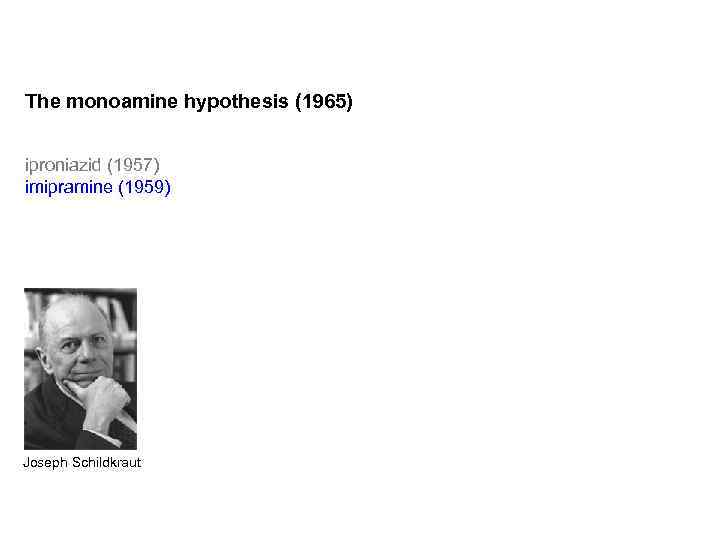 The monoamine hypothesis (1965) iproniazid (1957) imipramine (1959) Joseph Schildkraut Belmaker RH and Agam G, NEJM 2008, 358: 55 -68
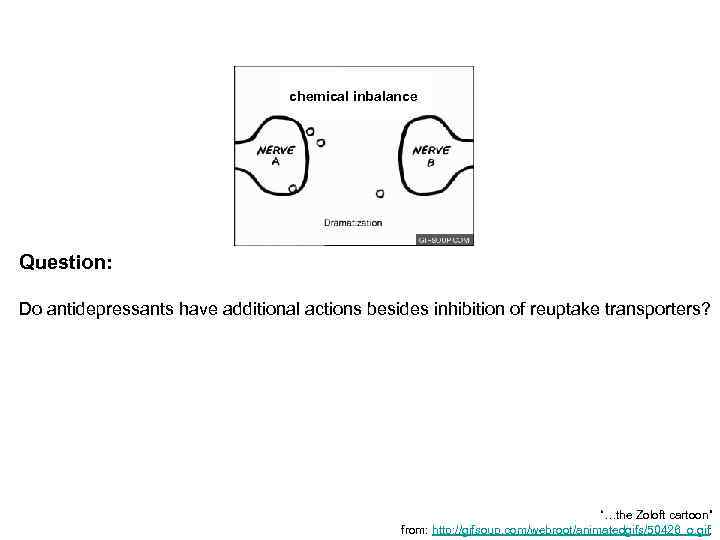 chemical inbalance Question: Do antidepressants have additional actions besides inhibition of reuptake transporters? “…the Zoloft cartoon” from: http: //gifsoup. com/webroot/animatedgifs/50426_o. gif;
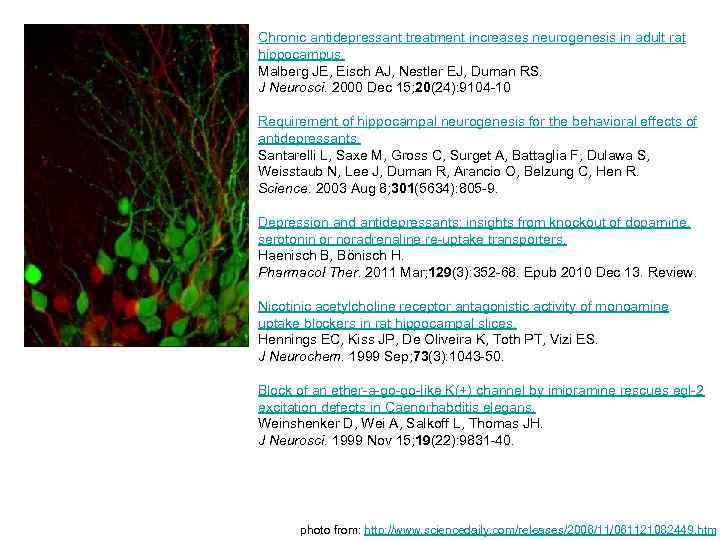 Chronic antidepressant treatment increases neurogenesis in adult rat hippocampus. Malberg JE, Eisch AJ, Nestler EJ, Duman RS. J Neurosci. 2000 Dec 15; 20(24): 9104 -10 Requirement of hippocampal neurogenesis for the behavioral effects of antidepressants. Santarelli L, Saxe M, Gross C, Surget A, Battaglia F, Dulawa S, Weisstaub N, Lee J, Duman R, Arancio O, Belzung C, Hen R. Science. 2003 Aug 8; 301(5634): 805 -9. Depression and antidepressants: insights from knockout of dopamine, serotonin or noradrenaline re-uptake transporters. Haenisch B, Bönisch H. Pharmacol Ther. 2011 Mar; 129(3): 352 -68. Epub 2010 Dec 13. Review. Nicotinic acetylcholine receptor antagonistic activity of monoamine uptake blockers in rat hippocampal slices. Hennings EC, Kiss JP, De Oliveira K, Toth PT, Vizi ES. J Neurochem. 1999 Sep; 73(3): 1043 -50. Block of an ether-a-go-go-like K(+) channel by imipramine rescues egl-2 excitation defects in Caenorhabditis elegans. Weinshenker D, Wei A, Salkoff L, Thomas JH. J Neurosci. 1999 Nov 15; 19(22): 9831 -40. photo from: http: //www. sciencedaily. com/releases/2006/11/061121082449. htm
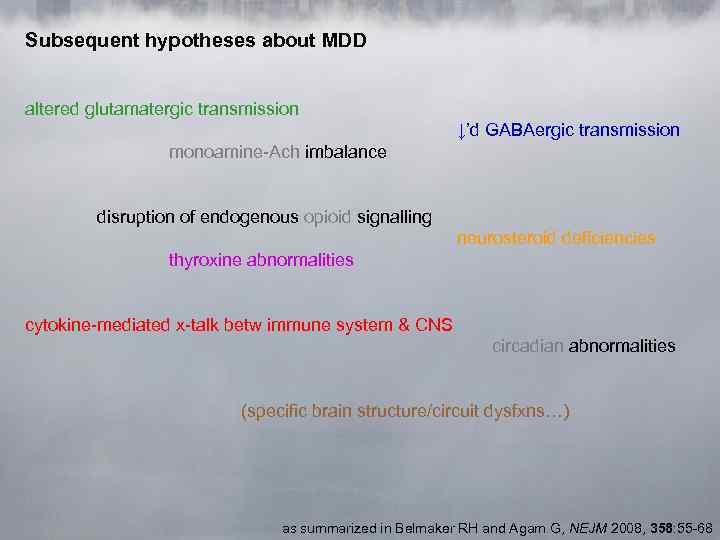 Subsequent hypotheses about MDD altered glutamatergic transmission ↓’d GABAergic transmission monoamine-Ach imbalance disruption of endogenous opioid signalling neurosteroid deficiencies thyroxine abnormalities cytokine-mediated x-talk betw immune system & CNS circadian abnormalities (specific brain structure/circuit dysfxns…) as summarized in Belmaker RH and Agam G, NEJM 2008, 358: 55 -68
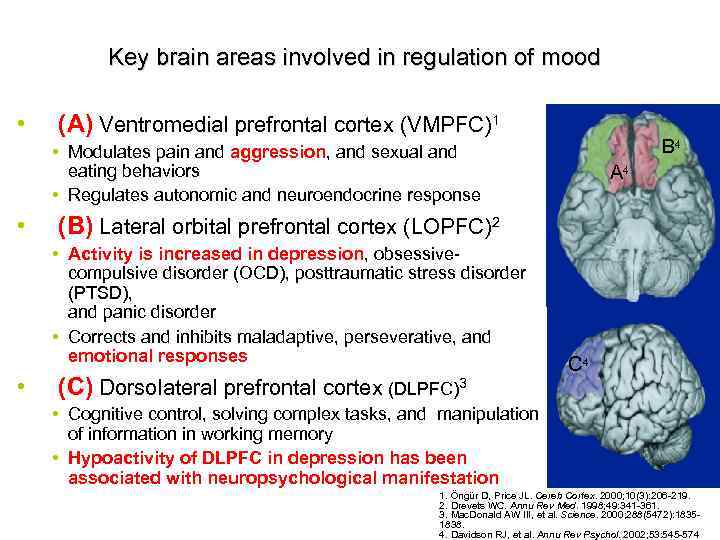 Key brain areas involved in regulation of mood • (A) Ventromedial prefrontal cortex (VMPFC)1 B 4 • Modulates pain and aggression, and sexual and eating behaviors • Regulates autonomic and neuroendocrine response • (B) Lateral orbital prefrontal cortex (LOPFC)2 • Activity is increased in depression, obsessivecompulsive disorder (OCD), posttraumatic stress disorder (PTSD), and panic disorder • Corrects and inhibits maladaptive, perseverative, and emotional responses • A 4 (C) Dorsolateral prefrontal cortex (DLPFC)3 C 4 • Cognitive control, solving complex tasks, and manipulation of information in working memory • Hypoactivity of DLPFC in depression has been associated with neuropsychological manifestation of 1. Öngür D, Price JL. Cereb Cortex. 2000; 10(3): 206 -219. depression 2. Drevets WC. Annu Rev Med. 1998; 49: 341 -361. 3. Mac. Donald AW III, et al. Science. 2000; 288(5472): 18351838. 4. Davidson RJ, et al. Annu Rev Psychol. 2002; 53: 545 -574.
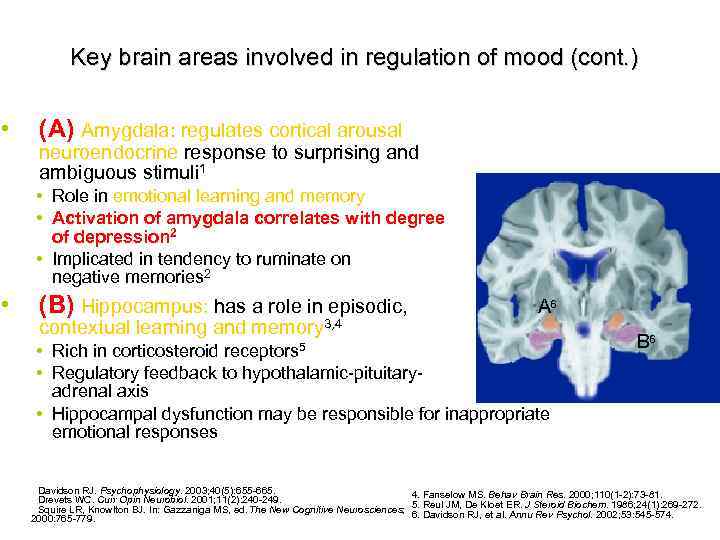 • • Key brain areas involved in regulation of mood (cont. ) (A) Amygdala: regulates cortical arousal and neuroendocrine response to surprising and ambiguous stimuli 1 • Role in emotional learning and memory • Activation of amygdala correlates with degree of depression 2 • Implicated in tendency to ruminate on negative memories 2 (B) Hippocampus: has a role in episodic, contextual learning and memory 3, 4 A 6 • Rich in corticosteroid • Regulatory feedback to hypothalamic-pituitaryadrenal axis • Hippocampal dysfunction may be responsible for inappropriate emotional responses receptors 5 B 6 1. Davidson RJ. Psychophysiology. 2003; 40(5): 655 -665. 4. Fanselow MS. Behav Brain Res. 2000; 110(1 -2): 73 -81. 2. Drevets WC. Curr Opin Neurobiol. 2001; 11(2): 240 -249. 53 3. Squire LR, Knowlton BJ. In: Gazzaniga MS, ed. The New Cognitive Neurosciences; 5. Reul JM, De Kloet ER. J Steroid Biochem. 1986; 24(1): 269 -272. 6. Davidson RJ, et al. Annu Rev Psychol. 2002; 53: 545 -574. 2000: 765 -779.
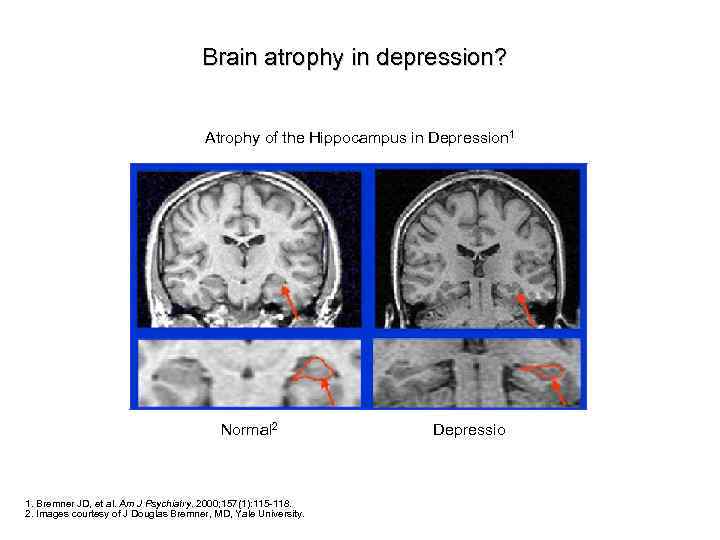 Brain atrophy in depression? Atrophy of the Hippocampus in Depression 1 Normal 2 1. Bremner JD, et al. Am J Psychiatry. 2000; 157(1): 115 -118. 2. Images courtesy of J Douglas Bremner, MD, Yale University. Depression 2
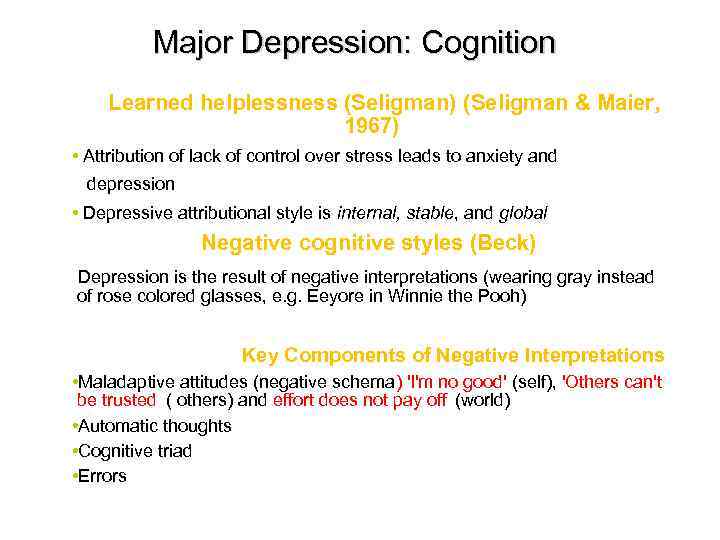 Major Depression: Cognition Learned helplessness (Seligman) (Seligman & Maier, 1967) • Attribution of lack of control over stress leads to anxiety and depression • Depressive attributional style is internal, stable, and global Negative cognitive styles (Beck) Depression is the result of negative interpretations (wearing gray instead of rose colored glasses, e. g. Eeyore in Winnie the Pooh) Key Components of Negative Interpretations • Maladaptive attitudes (negative schema) 'I'm no good' (self), 'Others can't be trusted' ( others) and effort does not pay off' (world) • Automatic thoughts • Cognitive triad • Errors in thinking 29
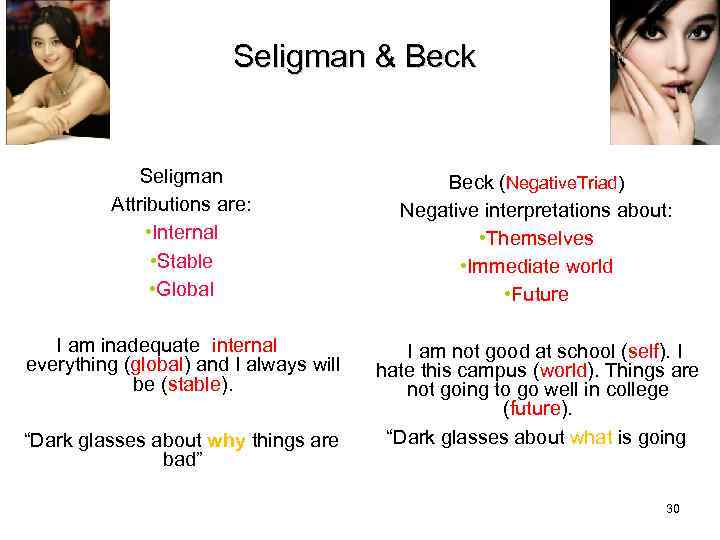 Seligman & Beck Seligman Attributions are: • Internal • Stable • Global Beck (Negative. Triad) Negative interpretations about: • Themselves • Immediate world • Future I am inadequate (internal) at everything (global) and I always will be (stable). I am not good at school (self). I hate this campus (world). Things are not going to go well in college (future). “Dark glasses about what is going on” “Dark glasses about why things are bad” 30
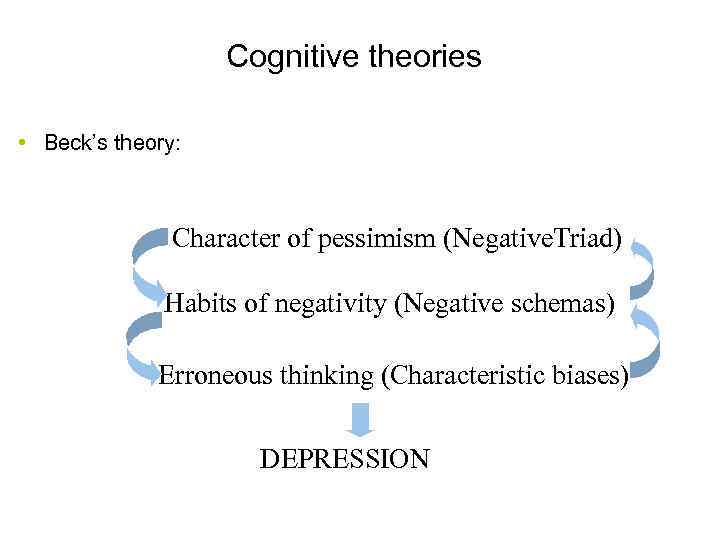 Cognitive theories • Beck’s theory: Character of pessimism (Negative. Triad) Habits of negativity (Negative schemas) Erroneous thinking (Characteristic biases) DEPRESSION 31
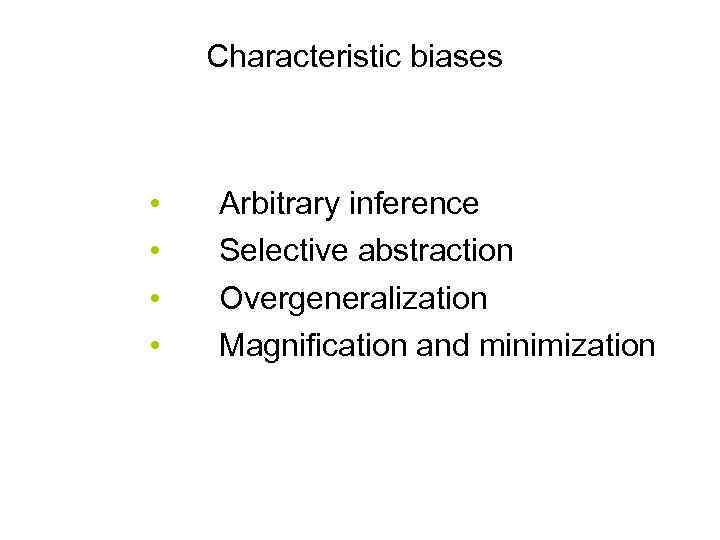 Characteristic biases • • Arbitrary inference Selective abstraction Overgeneralization Magnification and minimization 32
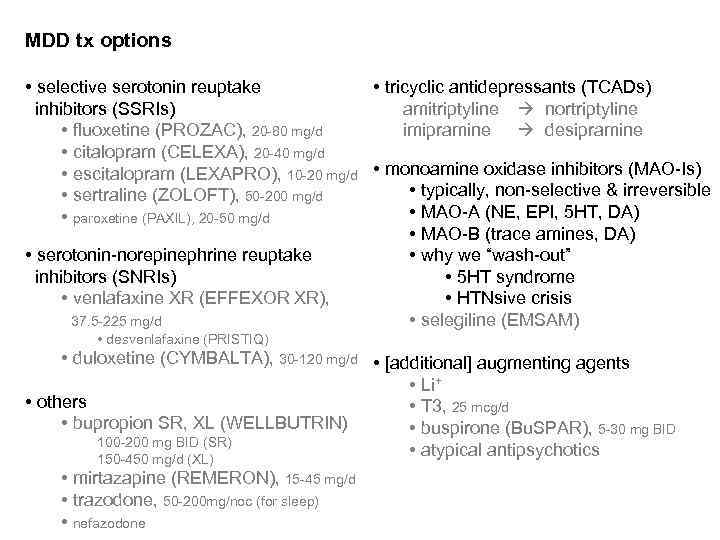 MDD tx options • tricyclic antidepressants (TCADs) • selective serotonin reuptake amitriptyline nortriptyline inhibitors (SSRIs) imipramine desipramine • fluoxetine (PROZAC), 20 -80 mg/d • citalopram (CELEXA), 20 -40 mg/d • escitalopram (LEXAPRO), 10 -20 mg/d • monoamine oxidase inhibitors (MAO-Is) • typically, non-selective & irreversible • sertraline (ZOLOFT), 50 -200 mg/d • MAO-A (NE, EPI, 5 HT, DA) • paroxetine (PAXIL), 20 -50 mg/d • MAO-B (trace amines, DA) • serotonin-norepinephrine reuptake • why we “wash-out” inhibitors (SNRIs) • 5 HT syndrome • venlafaxine XR (EFFEXOR XR), • HTNsive crisis • selegiline (EMSAM) 37. 5 -225 mg/d • desvenlafaxine (PRISTIQ) • duloxetine (CYMBALTA), 30 -120 mg/d • [additional] augmenting agents • Li+ • others • T 3, 25 mcg/d • bupropion SR, XL (WELLBUTRIN) • buspirone (Bu. SPAR), 5 -30 mg BID 100 -200 mg BID (SR) • atypical antipsychotics 150 -450 mg/d (XL) • mirtazapine (REMERON), 15 -45 mg/d • trazodone, 50 -200 mg/noc (for sleep) • nefazodone
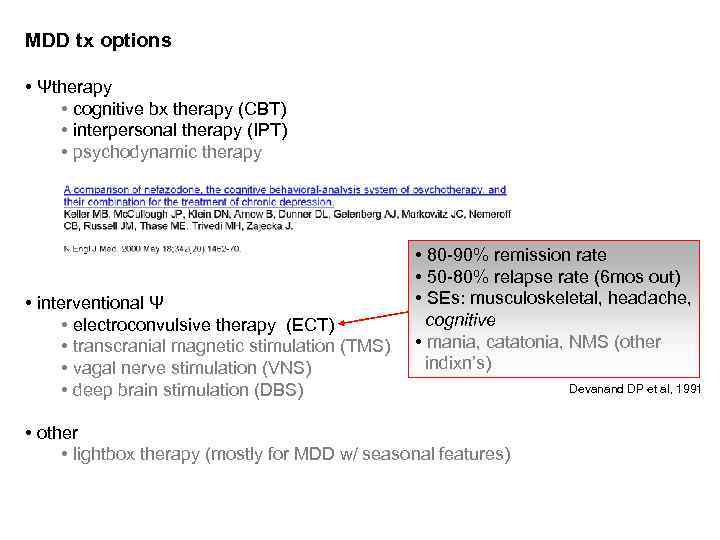 MDD tx options • Ψtherapy • cognitive bx therapy (CBT) • interpersonal therapy (IPT) • psychodynamic therapy • interventional Ψ • electroconvulsive therapy (ECT) • transcranial magnetic stimulation (TMS) • vagal nerve stimulation (VNS) • deep brain stimulation (DBS) • 80 -90% remission rate • 50 -80% relapse rate (6 mos out) • SEs: musculoskeletal, headache, cognitive • mania, catatonia, NMS (other indixn’s) • other • lightbox therapy (mostly for MDD w/ seasonal features) Devanand DP et al, 1991
 Major Depressive D/O (MDD) NATURAL HISTORY (Frank E and Thase ME, 1999 & DSM-5) • recovery usually begins: • w/in 3 mos for two in five indivs • w/in 1 y for four in five indivs • risk of subsequent episodes (w/in 3 y) increases w/ n: • ≥ 50% if n=1 • ≥ 70% if n=2 • ≥ 90% if n=3 • dz course does not typically change as one ages • 5 -10% will eventually be dx’d w/ bipolar disorder (BD) • more likely w/: • onset of ‘MDD’ in adolescence • a family history of BD • ‘mixed features’ • 6% lifetime SUI risk (Davies S et al, 2001); up to 15% w/ severe MDD
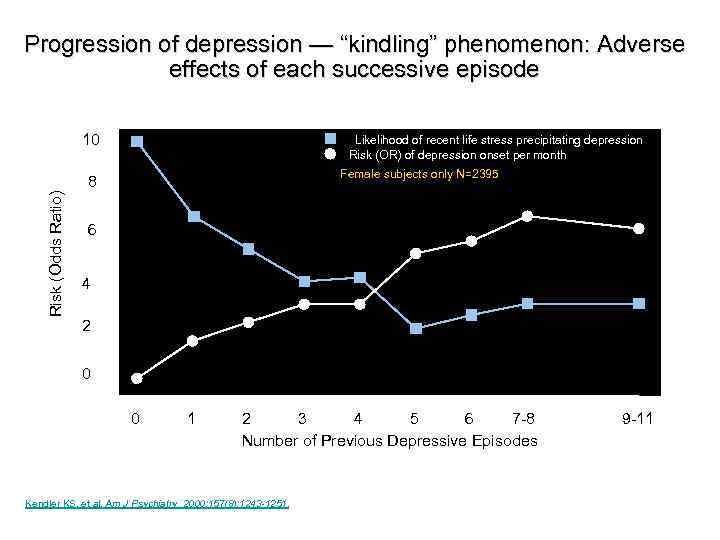 Progression of depression — “kindling” phenomenon: Adverse effects of each successive episode 10 Likelihood of recent life stress precipitating depression Risk (OR) of depression onset per month Female subjects only N=2395 Risk (Odds Ratio) 8 6 4 2 0 0 1 2 3 4 5 6 7 -8 Number of Previous Depressive Episodes Kendler KS, et al. Am J Psychiatry. 2000; 157(8): 1243 -1251. 11 9 -11
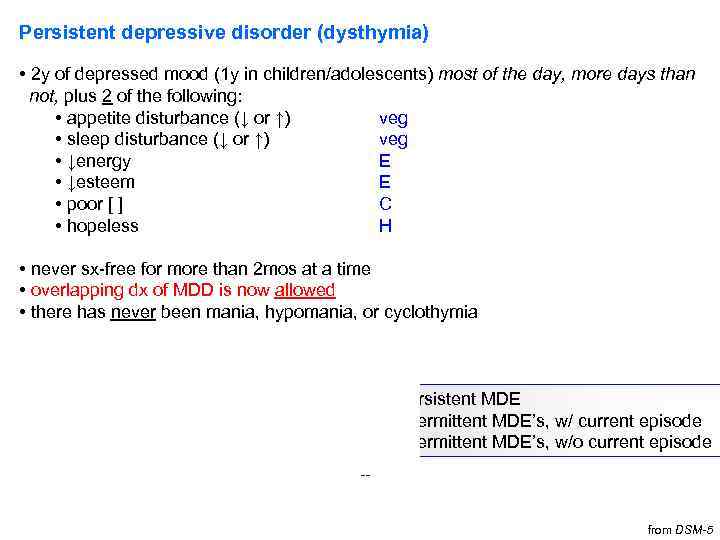 Persistent depressive disorder (dysthymia) • 2 y of depressed mood (1 y in children/adolescents) most of the day, more days than not, plus 2 of the following: • appetite disturbance (↓ or ↑) veg • sleep disturbance (↓ or ↑) veg • ↓energy E • ↓esteem E • poor [ ] C • hopeless H • never sx-free for more than 2 mos at a time • overlapping dx of MDD is now allowed • there has never been mania, hypomania, or cyclothymia • MDD specifiers can also be used for dysthymia • additionally: • early onset (before age 21) • w/ persistent MDE • late onset (at age 21 or older) • w/ intermittent MDE’s, w/ current episode • w/ pure dysthymic syndrome • w/ intermittent MDE’s, w/o current episode -- from DSM-5
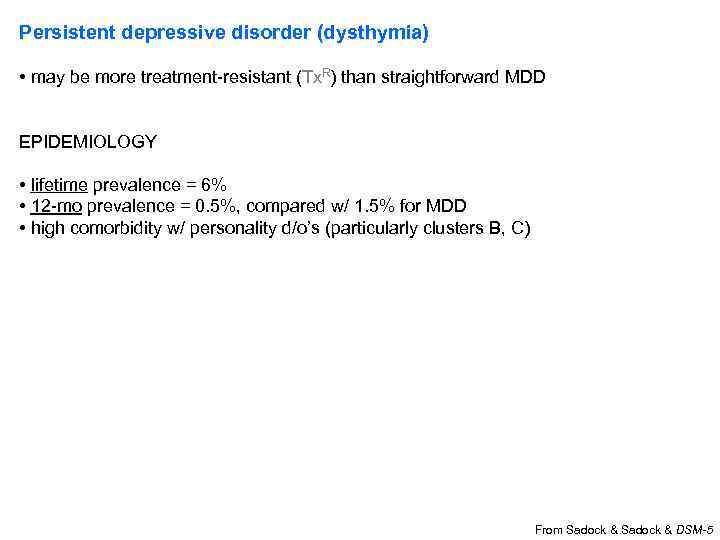 Persistent depressive disorder (dysthymia) • may be more treatment-resistant (Tx. R) than straightforward MDD EPIDEMIOLOGY • lifetime prevalence = 6% • 12 -mo prevalence = 0. 5%, compared w/ 1. 5% for MDD • high comorbidity w/ personality d/o’s (particularly clusters B, C) From Sadock & DSM-5
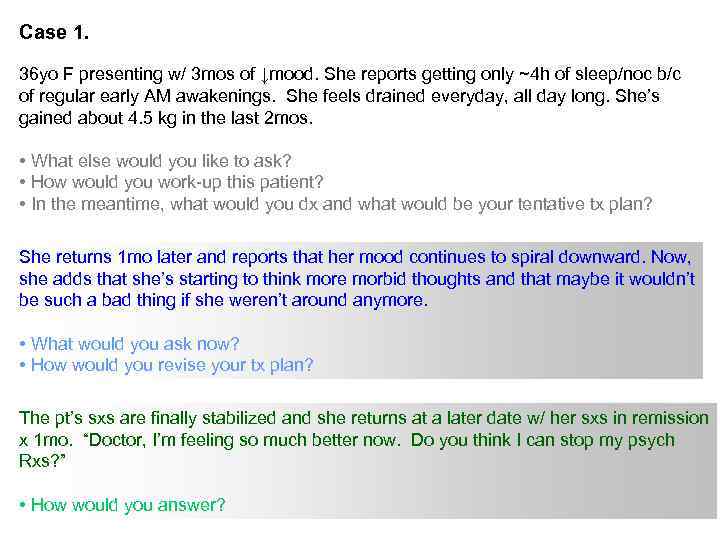 Case 1. 36 yo F presenting w/ 3 mos of ↓mood. She reports getting only ~4 h of sleep/noc b/c of regular early AM awakenings. She feels drained everyday, all day long. She’s gained about 4. 5 kg in the last 2 mos. • What else would you like to ask? • How would you work-up this patient? • In the meantime, what would you dx and what would be your tentative tx plan? She returns 1 mo later and reports that her mood continues to spiral downward. Now, she adds that she’s starting to think more morbid thoughts and that maybe it wouldn’t be such a bad thing if she weren’t around anymore. • What would you ask now? • How would you revise your tx plan? The pt’s sxs are finally stabilized and she returns at a later date w/ her sxs in remission x 1 mo. “Doctor, I’m feeling so much better now. Do you think I can stop my psych Rxs? ” • How would you answer?
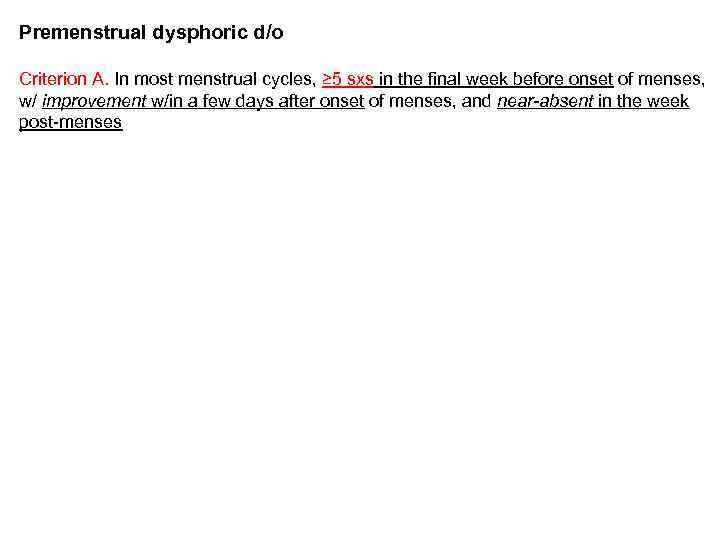 Premenstrual dysphoric d/o Criterion A. In most menstrual cycles, ≥ 5 sxs in the final week before onset of menses, w/ improvement w/in a few days after onset of menses, and near-absent in the week post-menses Criterion B. ≥ 1 (or more) sx of marked: 1. lability (e. g. , mood swings, suddenly sad, increased rejection sensitivity) 2. irritability /anger / increase in interpersonal conflicts 3. anxiety / tension / keyed-up feeling/edginess Criterion C. ≥ 1 (or more) sx to reach a total of 5 in combation w/ previous list: 1. anhedonia 2. [ ] impairment 3. anergia 4. significant appetite change (including specific food cravings) 5. sleep disturbance (↑ or ↓) 6. feeling overwhelmed or out of control 7. px sxs (e. g. , breast tenderness/swelling, arthralgias/myalgias, bloating, wt gain) Special notes. Can’t just be menstrual exacerbation of MDD or other Axis I or II dx; must have confirmation by prospective daily rating scales during at least 2 sx-ic cycles (provisional dx allowed beforehand)
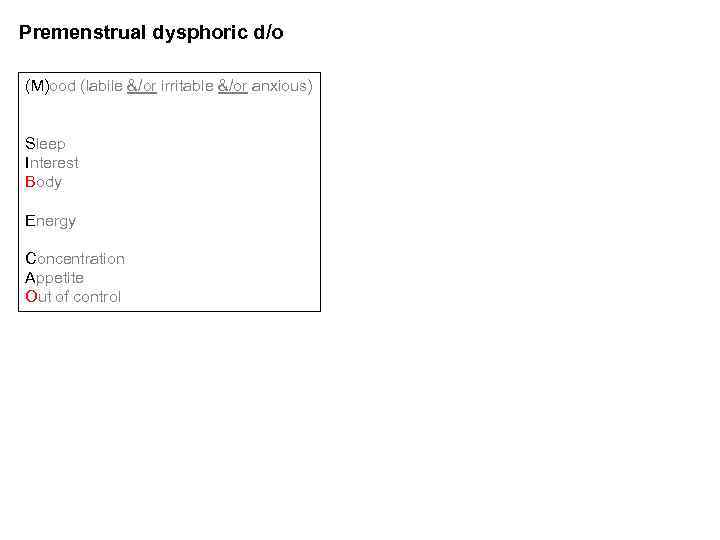 Premenstrual dysphoric d/o (M)ood (labile &/or irritable &/or anxious) Sleep Interest Body Energy Concentration Appetite Out of control Treatment: • SSRI • daily • luteal phase only (i. e. , day 14 of cycle menses) • some data suggest
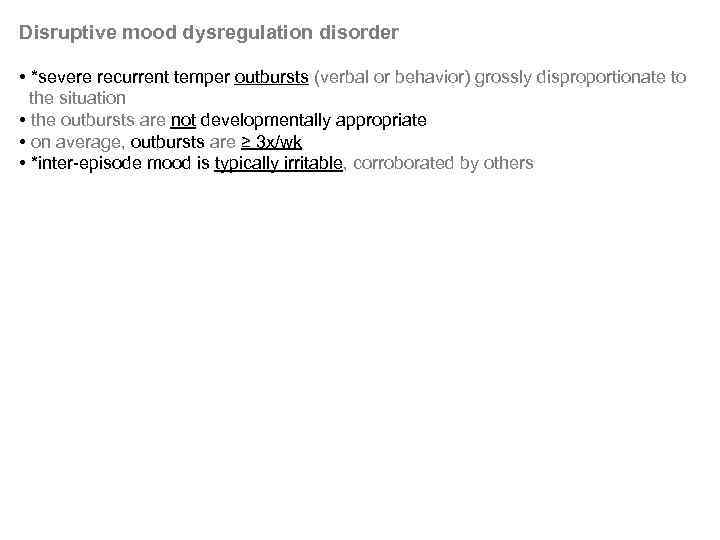 Disruptive mood dysregulation disorder • *severe recurrent temper outbursts (verbal or behavior) grossly disproportionate to the situation • the outbursts are not developmentally appropriate • on average, outbursts are ≥ 3 x/wk • *inter-episode mood is typically irritable, corroborated by others • sxs present for ≥ 12 mos, w/ no more than 3 consecutive mos attenuated or sx-free • 2 of 3 settings (*outbursts & *irritability), at least 1 of which w/ severe manifestations • ages 6 -18 only; onset must be before age 10 • no more than 1 d of mania/hypomania Designed to avoid excessive dx of bipolar disorder (BD) in children. Meant to capture non-episodic irritability (v. discrete, episodic irritability of bipolar).
 Bipolar disorder
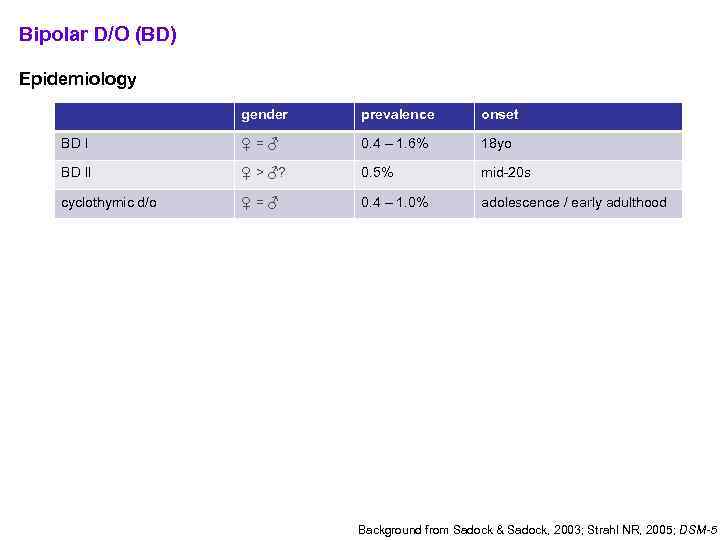 Bipolar D/O (BD) Epidemiology gender prevalence onset BD I ♀=♂ 0. 4 – 1. 6% 18 yo BD II ♀ > ♂? 0. 5% mid-20 s cyclothymic d/o ♀=♂ 0. 4 – 1. 0% adolescence / early adulthood Diagnostic criteria: • BD I • ≥ 1 manic episode • MDE is neither sufficient nor necessary • BD II • ≥ 1 hypomanic episode • ≥ 1 MDE • (Cyclothymic D/O) • 2 y of subsyndromal depression + subsyndromal hypomania Background from Sadock & Sadock, 2003; Strahl NR, 2005; DSM-5
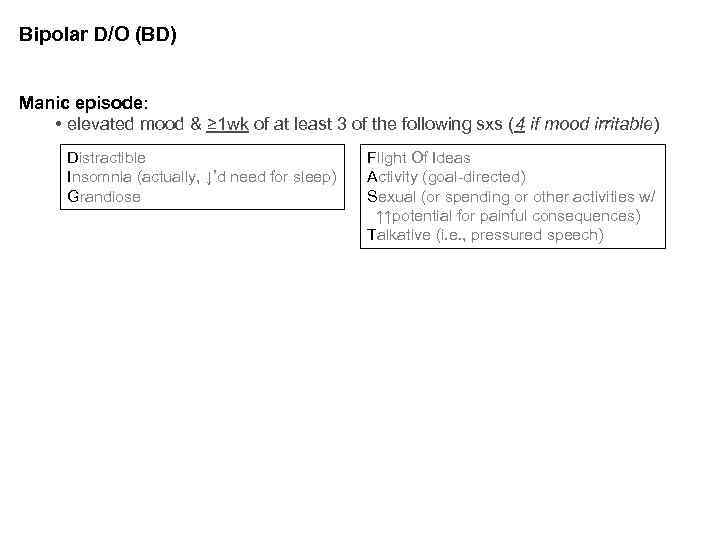 Bipolar D/O (BD) Manic episode: • elevated mood & ≥ 1 wk of at least 3 of the following sxs (4 if mood irritable) Distractible Insomnia (actually, ↓’d need for sleep) Grandiose Flight Of Ideas Activity (goal-directed) Sexual (or spending or other activities w/ ↑↑potential for painful consequences) Talkative (i. e. , pressured speech) Hypomanic episode: • elevated mood & ≥ 4 d of at least 3 of the above sxs (4 if mood irritable) • NO significant fxn’l impairment, but an unmistakeable change in fxn uncharacteristic for the individual when asymptomatic that is appreciable by others. (contrast w/ BD II…) Depressive episode (MDE): • (previously defined)
 Bipolar Disorder (BD) EXCLUSIONS: • another medical cause • substance/medication causes SPECIFIERS: • same as w/ MDD plus: • rapid cycling (4 mood episodes / 1 yr) (Bauer M et al, 2008) • affects 10 -20% BD pts • can be more Tx. R • 2/3 are ♀ NOTES: • By the numbers (as detailed in Barondes S, Mood Genes): • 1% risk of BD goes to 7% w/ one 1 o relative; ~49% w/ two parents. • 1% risk of BD stays at 1% w/ a single 2 o relative (aunt, uncle, grandparent) and no affected 1 o relatives.
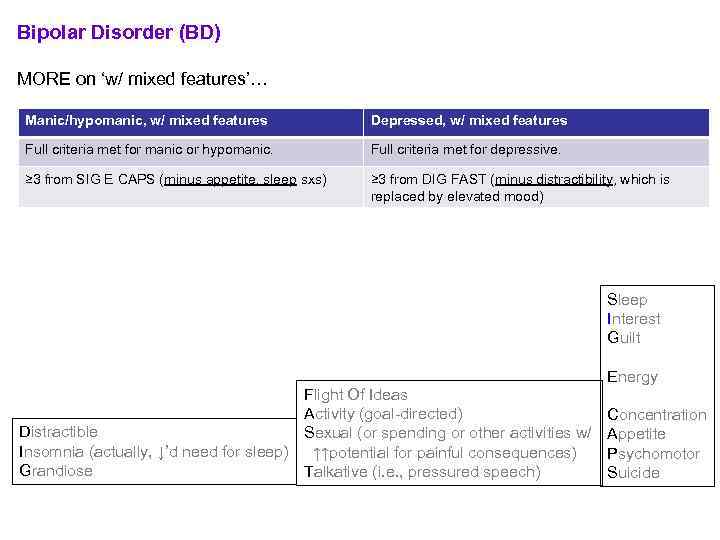 Bipolar Disorder (BD) MORE on ‘w/ mixed features’… Manic/hypomanic, w/ mixed features Depressed, w/ mixed features Full criteria met for manic or hypomanic. Full criteria met for depressive. ≥ 3 from SIG E CAPS (minus appetite, sleep sxs) ≥ 3 from DIG FAST (minus distractibility, which is replaced by elevated mood) • IF full criteria met for both poles, the default dx is ‘manic, w/ mixed features. ’ • ‘mixed episodes’ (as defined in DSM-IV) do not exist in DSM-5. • mixed presentations = • ‘dysphoric mania’ • ‘activated depression’ Flight Of Ideas Activity (goal-directed) Distractible Sexual (or spending or other activities w/ Insomnia (actually, ↓’d need for sleep) ↑↑potential for painful consequences) Grandiose Talkative (i. e. , pressured speech) Sleep Interest Guilt Energy Concentration Appetite Psychomotor Suicide
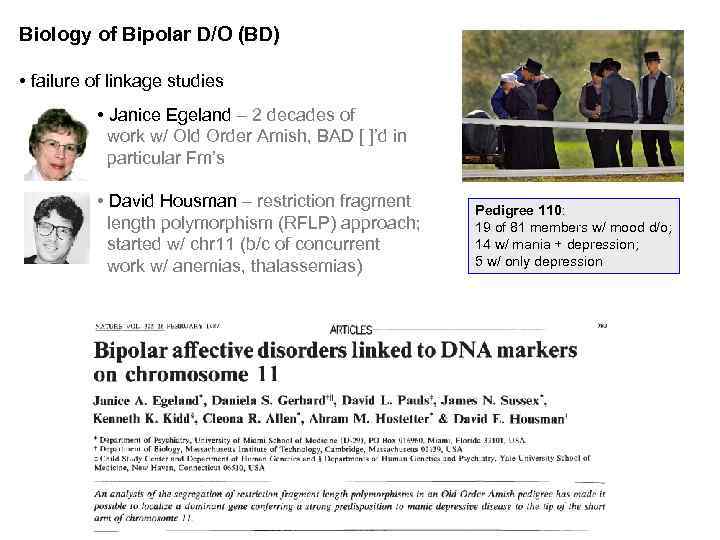 Biology of Bipolar D/O (BD) • failure of linkage studies • Janice Egeland – 2 decades of work w/ Old Order Amish, BAD [ ]’d in particular Fm’s • David Housman – restriction fragment length polymorphism (RFLP) approach; started w/ chr 11 (b/c of concurrent work w/ anemias, thalassemias) Pedigree 110: 19 of 81 members w/ mood d/o; 14 w/ mania + depression; 5 w/ only depression
 * ’s • 2 accompanying papers (same issue of Nature) unable to replicate chr 11 assocn’s in independent pedigrees • just 2 yrs later: • 2 previously negative indivs (pedigree 110) became ill • addn’l branches of pedigree 110 strongly excluded chr 11 • linkage scores [i. e. , log(differentiation) scores] now close to zero
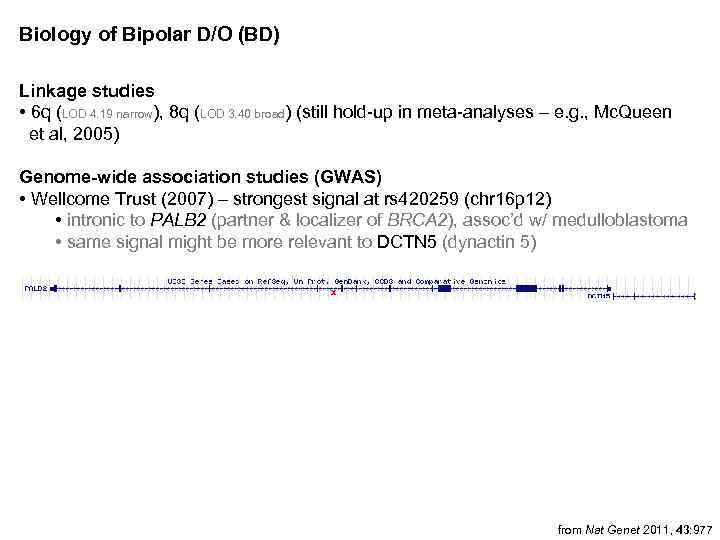 Biology of Bipolar D/O (BD) Linkage studies • 6 q (LOD 4. 19 narrow), 8 q (LOD 3. 40 broad) (still hold-up in meta-analyses – e. g. , Mc. Queen et al, 2005) Genome-wide association studies (GWAS) • Wellcome Trust (2007) – strongest signal at rs 420259 (chr 16 p 12) • intronic to PALB 2 (partner & localizer of BRCA 2), assoc’d w/ medulloblastoma • same signal might be more relevant to DCTN 5 (dynactin 5) x • Psychiatric GWAS Consortium meta-analysis, 2011 (Nat Genet 43: 977) • 11 GWA samples, 7, 481 cases v. 9, 250 controls from Nat Genet 2011, 43: 977
 More on select GWA-identified candidates • CACNA 1 C • α 1 subunit of a voltage-dependent Ca 2+ channel • per citations in PGC paper, separate literature has associated mutations w/ brain imaging changes (both strux and fxnl) • also an assoc’n finding in schizophrenia, MDD (not genomewide-significant) • ANK 3 • ankyrin G • isoforms specific to nervous system • localization in axonal initial segments, nodes of Ranvier • fxn in ion channel maintenance? cell adhesion? • SYNE 1 • synaptic nuclear envelope protein 1 • not emphasized in PGC paper, but has prior literature in syndromes r/t ataxia, muscular dystrophy, mental retardation • ODZ 4 • odd oz / ten-m homolog 4 • pair-rule gene • cell-surface signalling, neuronal pathfinding
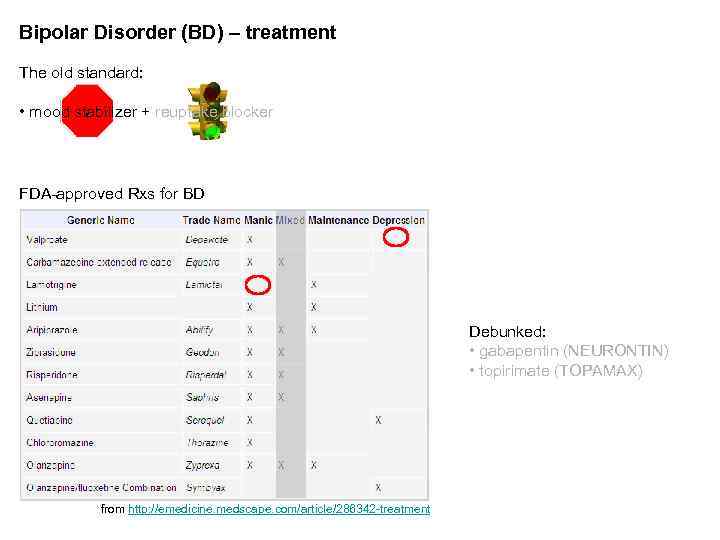 Bipolar Disorder (BD) – treatment The old standard: • mood stabilizer + reuptake blocker FDA-approved Rxs for BD Debunked: • gabapentin (NEURONTIN) • topirimate (TOPAMAX) from http: //emedicine. medscape. com/article/286342 -treatment
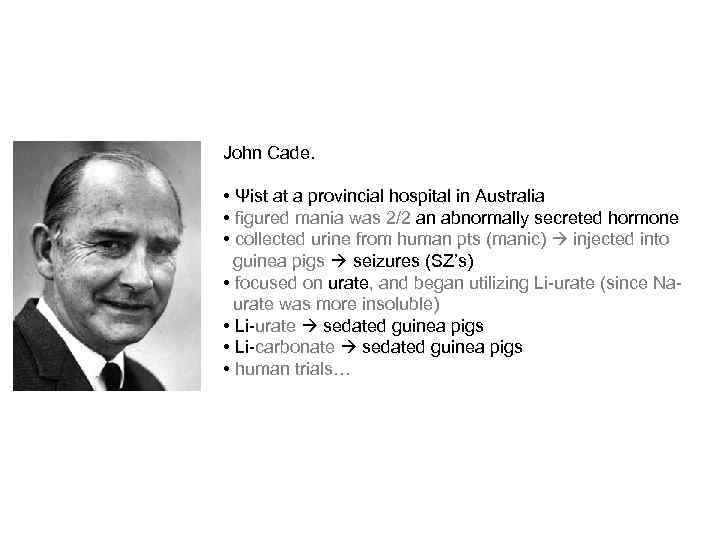 John Cade. • Ψist at a provincial hospital in Australia • figured mania was 2/2 an abnormally secreted hormone • collected urine from human pts (manic) injected into guinea pigs seizures (SZ’s) • focused on urate, and began utilizing Li-urate (since Naurate was more insoluble) • Li-urate sedated guinea pigs • Li-carbonate sedated guinea pigs • human trials…
 Bipolar Disorder (BD) – treatment (cont’d) Li+ v. Depakote / valproate (VPA) (Bowden CL, 2001) • Li+ tends to have a more favorable response in tx-naïve cases than in BD indivs w/ longer tx hxs • VPA may be >successful in tx’ing mixed episodes, BD indivs w/ comorbid substance issues Areas of concern: • Li+ ↔ renal; interaction w/ NSAIDs • VPA ↔ liver; VPA in young ♀ polycystic ovarian syndrome (PCOS) Teratogenicity • Li+ Ebstein’s anomaly (1 st trimester) • hazard ratio 10 -20, but AR still 1: 1000 • VPA neural tube defects • AR 10% OTHER NOTES: • CBZ: auto-induction, agranulocytosis • Lamictal: Stevens-Johnson syndrome (SJS), interaxn w/ oral contraceptives (OCPs), interaxn w/ VPA
 Bipolar Disorder (BD) – treatment (cont’d) How many agents to use? • combination tx often helpful in acute stabilization • antipsychotics REQ’D when there are psychotic features to mood episode Adjuncts • benzos --Don’t forget about ECT… Manic switch w/… • reuptake blockers • Lamictal, too! (van der Loos ML et al, 2009)
 Bipolar Disorder (BD) – natural history • 60% of manic episodes immediately precede an MDE • MDE’s usually significantly outnumber hypomanic and manic episodes • ~10% of BD II’s BD I • episodes tend to increase in frequency/duration w/ age • re: suicide… • 35% lifetime prevalence of at least one SUI attempt in bipolar • 15% suicide completion rate (may be an overestimate) • 15 x the risk of the general population (for completions) • perhaps ¼ of all suicides in the population • >lethality of SUI attempts in BD II (than BD I) adapated, in part, from DSM-5
 Cyclothymic D/O • 2 y of fluctuating mood (1 y in children, adolescents) • hypomanic symptoms (but NOT episodes) • dysthymic symptoms (but no MDEs) • ≥ half the time & (no more than 2 mos sx-free) • EXCLUSIONS • no manic/hypomanic episodes • no depressive episodes
 Differential diagnosis
 Phenocopies and gray areas… • Anxiety D/O’s (esp. GAD, PTSD) • Schizoaffective D/O • Delirium • Dementia • Personality D/O’s • Substance/Medication-induced Depressive D/O • Depressive D/O d/t Another Medical Condition • Other Specified Depressive D/O • Unspecified Depressive D/O • Substance/Medication-induced Bipolar and Related D/O • Bipolar and Related D/O d/t Another Medical Condition • Other Specified Bipolar and Related D/O • Unspecified Bipolar and Related D/O
 Depressive, Bipolar & Related D/O d/t a Another Medical Condition • Endocrine (e. g. , thyroid, hypothalamic-pituitary-adrenal/HPA) • Neurologic (e. g. , multiple sclerosis, CVA, brain tumor, Parkinson’s, Alzheimer’s/other dementia, Huntington’s, seizure d/o) • Neoplastic (e. g. , pancreas) • TBI • Autoimmune (e. g. , neuropsychiatric systemic lupus erythematosus / NPSLE) • Hematologic (e. g. , acute intermittent porphyria / AIP) • typically: anx/depr >> s/t Ψosis, mania (rare) • acute abdominal pain, muscle weakness • port wine-colored urine (porphobilinogen) • transient damage to nerve cells • Nutritional (e. g. , B 12) • Infectious (e. g. , HIV, Syphilis)
 Substance/Medication-induced Depressive, Bipolar & Related D/O ILLICITS • can be from intoxication or withdrawal phases • Et. OH – typically depressive • stimulants – typically manic/hypomanic • --good to ask about sxs during windows of sobriety (ideally, ≥ 6 mos) • high substance comorbidity rates w/ endogenous Axis I Ψ d/o’s, though (esp. BD I) Prescription Rxs • steroids • IFN-α 2 b, RBV (HCV tx) • β-blockers • antidepressants • α-TB drugs
 Mood D/O’s lab w/u • CBC • Chem panel • TSH • B 12 • U-tox • U-preg (dep on demographics) • RPR (syphilis) • HIV-1, 2 ELISA (lower threshold for BD patients…)
 5 Myths and Facts About Suicide Myth #1: Fact: • People who talk • Most people who about killing commit suicide themselves rarely have given some commit suicide. verbal clues or warnings of their intentions 40
 5 Myths and Facts About Suicide Myth #2: • The suicidal person wants to die and feels there is no turning back. Fact: • Suicidal people are usually ambivalent about dying; they may desperately want to live but can not see alternatives to problems. 41
 5 Myths and Facts About Suicide Myth # 3: • If you ask someone about their suicidal intentions, you will only encourage them to kill themselves. Fact: • The opposite is true. Asking lowers their anxiety and helps deter suicidal behavior. Discussion of suicidal feelings allow for accurate risk assessment. 42
 5 Myths and Facts About Suicide Myth # 4: • All suicidal people are deeply depressed. Fact: • Although suicide is usually associated with depression, not all suicidal people are obviously depressed. Once they make the decision, they may appear happier/carefree. 43
 5 Myths and Facts About Suicide Myths # 5: • Suicidal people rarely seek medical attention. Fact: • 75% of suicidal individuals will visit a physician within the month before they kill themselves. 44
 Socio-demographic Risk Factors • • Male > 60 years Widowed or Divorced White or Native American Living alone (social isolation) Unemployed (financial difficulties) Recent adverse life events Chronic Illness 45
 Clinical Risk Factors • • Previous Attempts Clinical depression or schizophrenia Substance Abuse Feelings of hopelessness Severe anxiety, particularly with depression Severe loss of interest in usual activities Impaired thought process Impulsivity 46
 Suicide: Treatment • • Problem-solving Cognitive behavioral therapy Coping skills Stress reduction 47

 Major depressive disorder (MDD) – Key Points • • MDD can be a chronic, recurrent, and progressive condition 1, 2 MDD is associated with alterations in functional and structural changes in the brain 2 -4 MDD, stress, and pain are all associated with similar suppression of neurotrophic factors and compromised neuroplasticity 2 -4 Remission not response is the ultimate goal of treatment 5, 6 1. Kendler KS, et al. Am J Psychiatry. 2000; 157(8): 1243 -1251. 2. Maletic V, et al. Int J Clin Pract. 2007; 61: 2030 -2040. 3. Duman RS. Biol Psychiatry. 2004; 56: 140 -145. 4. Maletic V. Prim Psychiatry. 2005; 12(suppl 10): 7 -9. 5. Keller MB, et al. Arch Gen Psychiatry. 1992; 49(10): 809 -816. 6. APA. Am J Psychiatry. 2000; 157(4 suppl): 1 -45.
 Summary • Mood D/O’s are Ψ conditions where emotional dysregulation is the primary issue. • Mood d/o’s can be endogenous, due to substances/medication, or due to another medical condition. There additional phenocopies which should always be in your Ddx, including Anxiety D/O’s, Schizoaffective D/O, Personality D/O’s, Delirium, and Mild/Major Neurocognitive D/O’s. • The monoamine hypothesis of depression is only a preliminary framework for conceptualizing Mood d/o’s and their tx, and requires significant theoretical revision. • Mood D/O’s, like other Ψ conditions in the DSM, are best conceived as syndromes rather than as unitary or homogeneous medical conditions. • A little less than ½ of tx-naïve pts will respond to their first antidepressant; only 1/3 will remit without further intervention. • Non-pharmacologic approaches to treating Mood D/O’s include psychotherapy and interventional procedures (e. g. , ECT).
 ``qw 0 82