 Скачать презентацию MOOCs and SPOCs Where is the Library Peter
e6d4e705f092bda13c4c1f692238eaac.ppt
- Количество слайдов: 33



MOOCs and SPOCs: Where is the Library? Peter E Sidorko The University of Hong Kong
Overview What are MOOCs? Benefits and Limitations MOOCs and HKU Libraries and MOOCs: Opportunities and Challenges • SPOCs • •
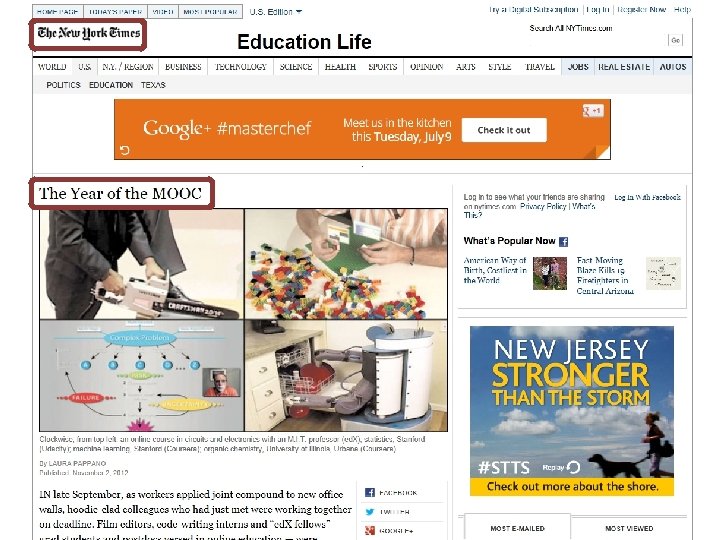
What are MOOCs? • • Massive Open Online Courses Online courses that are free and open to anyone “Canned” lectures, automated quizzes and tests Large scale – but low success rate (eg 5% pass rate)
MOOCs: see also • Distance education • MIT Open. Course. Ware • Khan Academy • TED • Social networking • etc

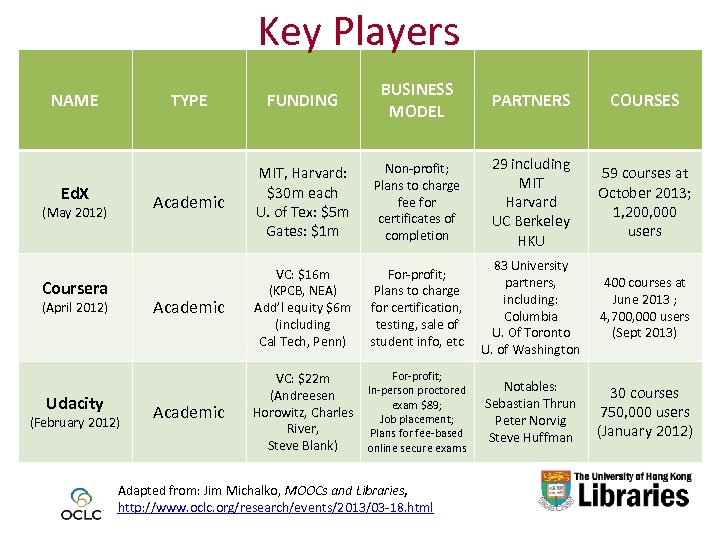
Key Players TYPE (May 2012) Coursera (April 2012) Udacity (February 2012) BUSINESS MODEL PARTNERS COURSES MIT, Harvard: $30 m each U. of Tex: $5 m Gates: $1 m Non-profit; Plans to charge fee for certificates of completion 29 including MIT Harvard UC Berkeley HKU 59 courses at October 2013; 1, 200, 000 users Academic Ed. X FUNDING Academic NAME VC: $16 m (KPCB, NEA) Add’l equity $6 m (including Cal Tech, Penn) For-profit; Plans to charge for certification, testing, sale of student info, etc 83 University partners, including: Columbia U. Of Toronto U. of Washington 400 courses at June 2013 ; 4, 700, 000 users (Sept 2013) Academic For-profit; VC: $22 m In-person proctored (Andreesen exam $89; Horowitz, Charles Job placement; River, Plans for fee-based Steve Blank) online secure exams Notables: Sebastian Thrun Peter Norvig Steve Huffman 30 courses 750, 000 users (January 2012) Adapted from: Jim Michalko, MOOCs and Libraries, http: //www. oclc. org/research/events/2013/03 -18. html
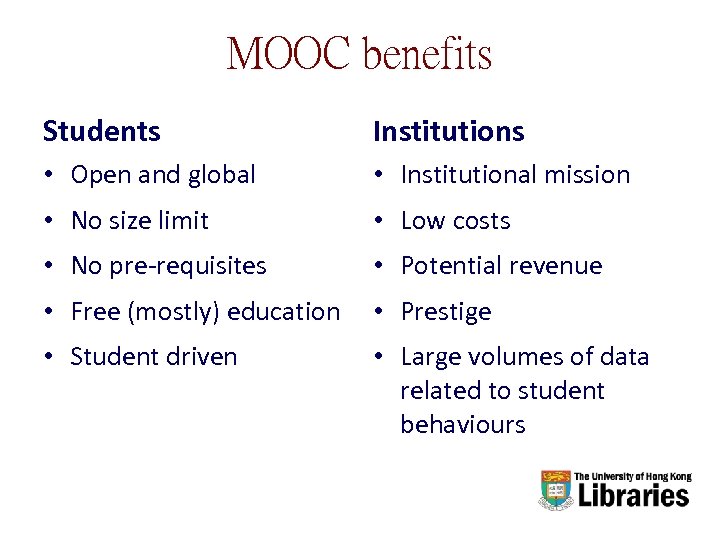
MOOC benefits Students Institutions • Open and global • Institutional mission • No size limit • Low costs • No pre-requisites • Potential revenue • Free (mostly) education • Prestige • Student driven • Large volumes of data related to student behaviours
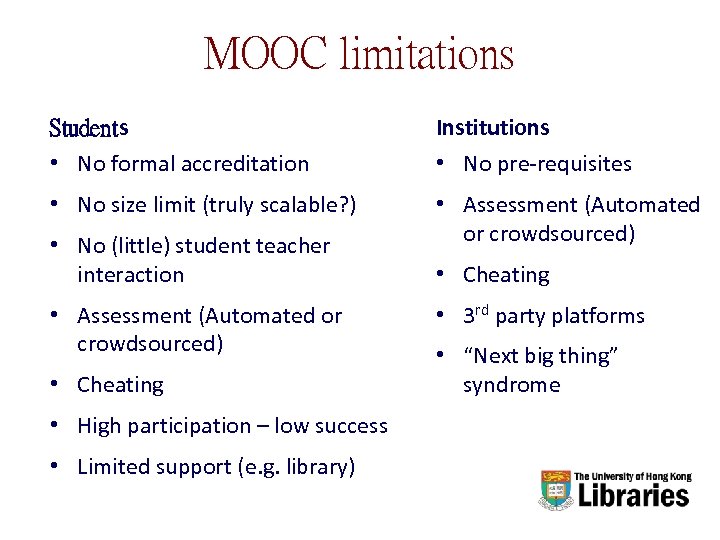
MOOC limitations Students Institutions • No formal accreditation • No pre-requisites • No size limit (truly scalable? ) • Assessment (Automated or crowdsourced) • No (little) student teacher interaction • Assessment (Automated or crowdsourced) • Cheating • High participation – low success • Limited support (e. g. library) • Cheating • 3 rd party platforms • “Next big thing” syndrome
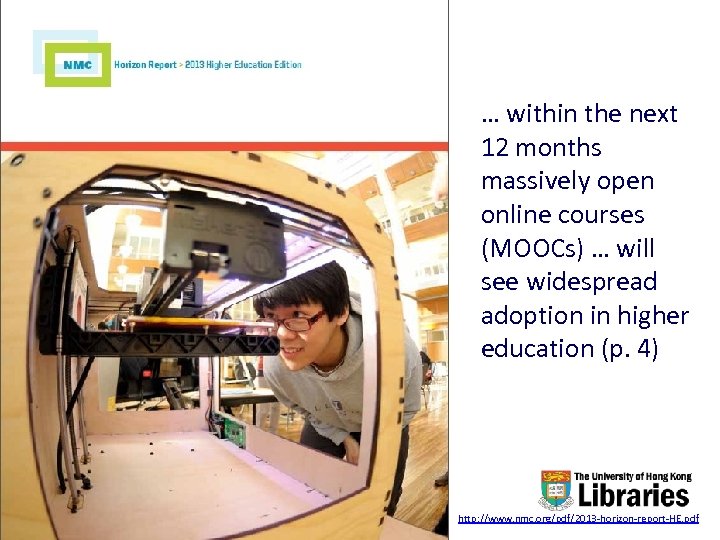
… within the next 12 months massively open online courses (MOOCs) … will see widespread adoption in higher education (p. 4) http: //www. nmc. org/pdf/2013 -horizon-report-HE. pdf
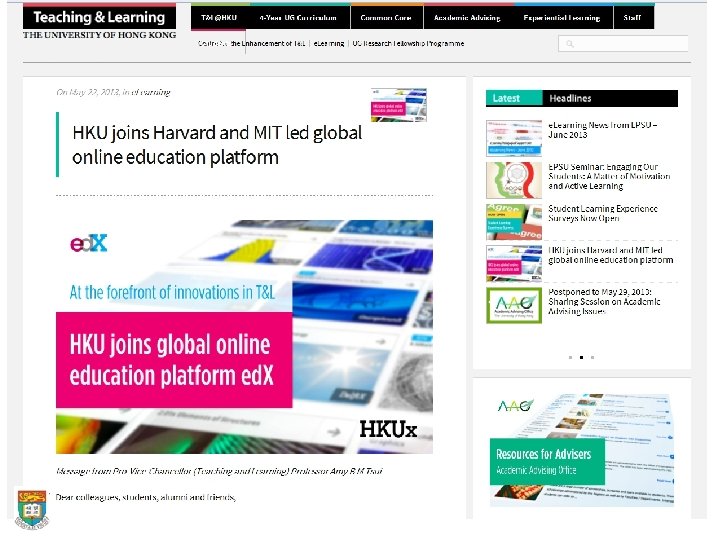
MOOCs and HKU • “MOOCs are an educational innovation that will bring about a seismic change in the higher education landscape that has yet to be understood. The opportunity to witness and contribute to this change cannot be missed. ” • HKU Professor Amy B M Tsui, Pro-Vice-Chancellor (Teaching and Learning), http: //tl. hku. hk/tag/mooc/.
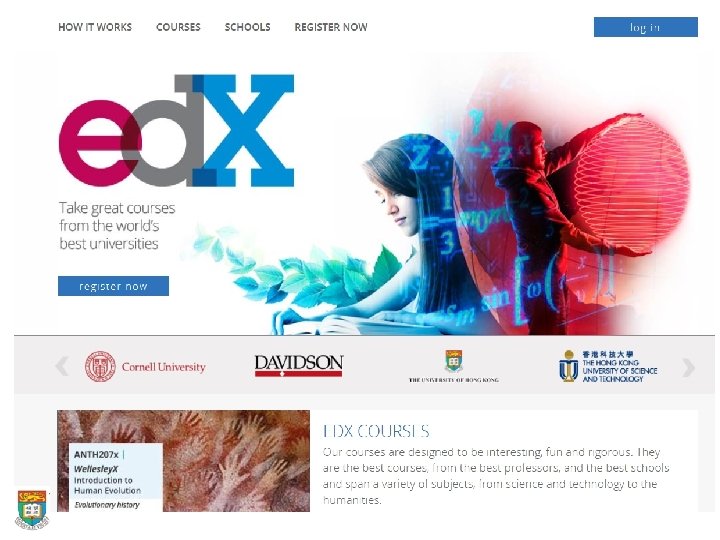
HKUx Subjects • Vernacular heritage in Asia • Law, economy and society • Chinese and Western philosophy • Infectious disease and public health
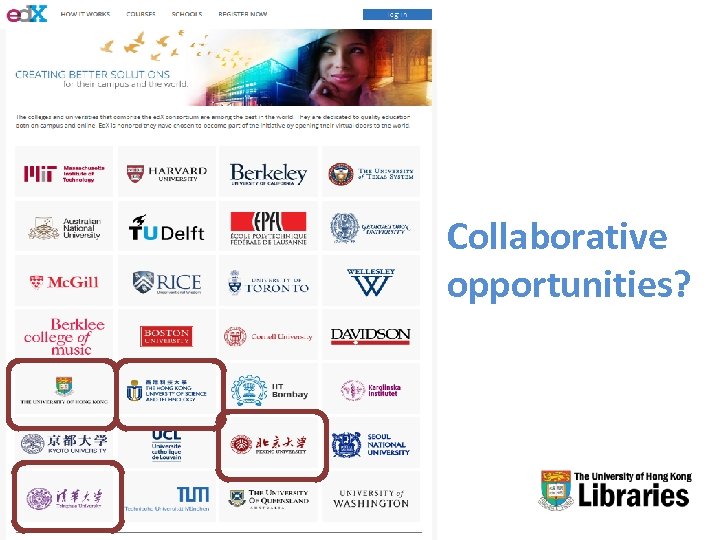
Collaborative opportunities?
Libraries and MOOCs: Opportunities • Access to resources • Recommending resources • Physical space for MOOC students • Copyright consultants to faculty • Research support for faculty • Embedded online information literacy tutorials • "Ask a Librarian“ • Reaching a new client base
Libraries and MOOCs: Challenges • Scale • International diversity of student body – Language • Students not affiliated with the organisation • Licensing of resources • Third-party hosts – Technology (e. g. ed. X, Coursera etc) – Socioeconomic status
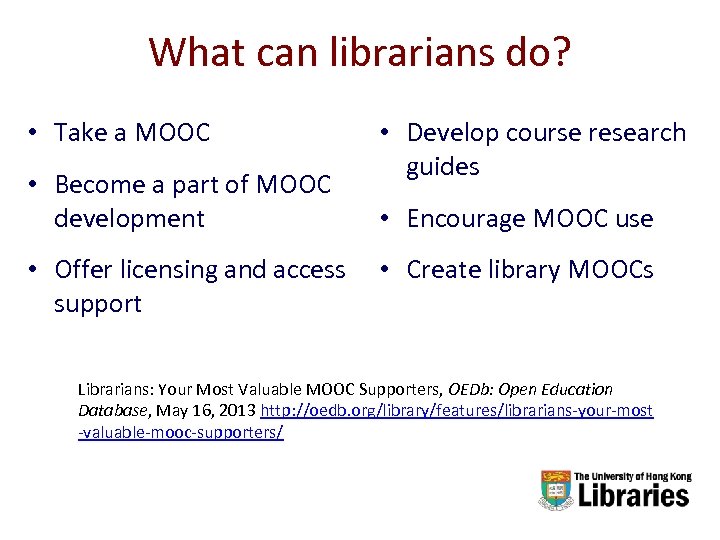
What can librarians do? • Take a MOOC • Become a part of MOOC development • Develop course research guides • Encourage MOOC use • Offer licensing and access • Create library MOOCs support Librarians: Your Most Valuable MOOC Supporters, OEDb: Open Education Database, May 16, 2013 http: //oedb. org/library/features/librarians-your-most -valuable-mooc-supporters/
• “Much of what was said resonates with my thinking. The library can, and indeed should, play a part. ” • HKU Professor Amy B M Tsui, Pro-Vice-Chancellor (Teaching and Learning), email dated 22/5/2013.
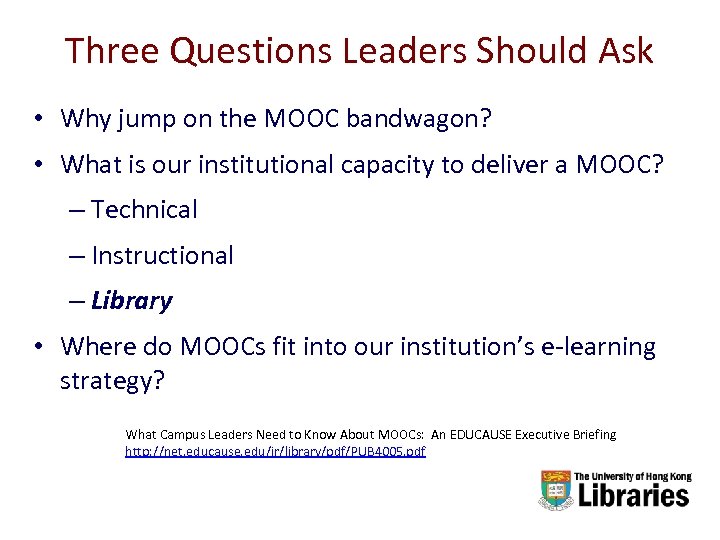
Three Questions Leaders Should Ask • Why jump on the MOOC bandwagon? • What is our institutional capacity to deliver a MOOC? – Technical – Instructional – Library • Where do MOOCs fit into our institution’s e-learning strategy? What Campus Leaders Need to Know About MOOCs: An EDUCAUSE Executive Briefing http: //net. educause. edu/ir/library/pdf/PUB 4005. pdf
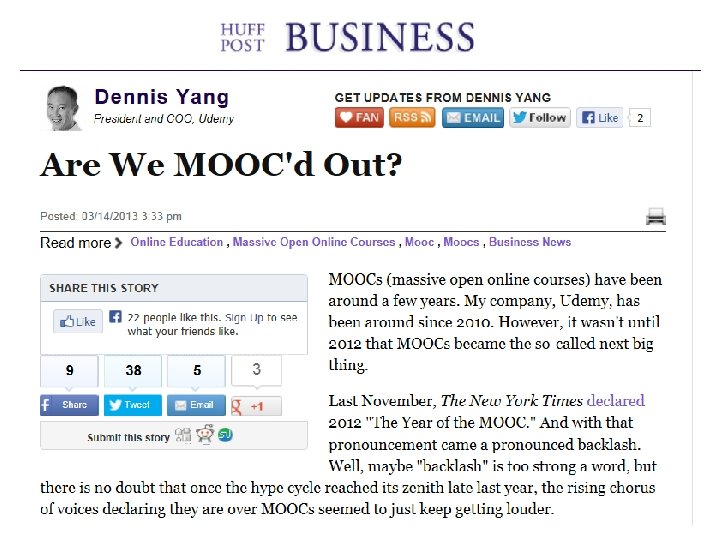
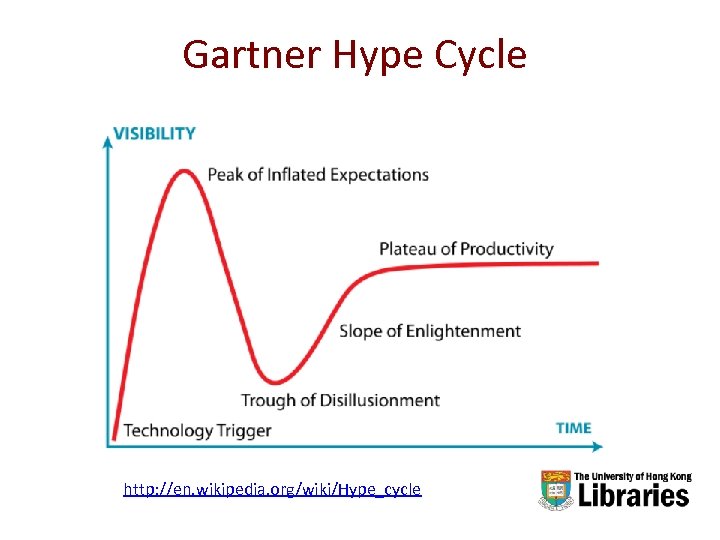
Gartner Hype Cycle http: //en. wikipedia. org/wiki/Hype_cycle
SPOCs: Solution to the Hype?
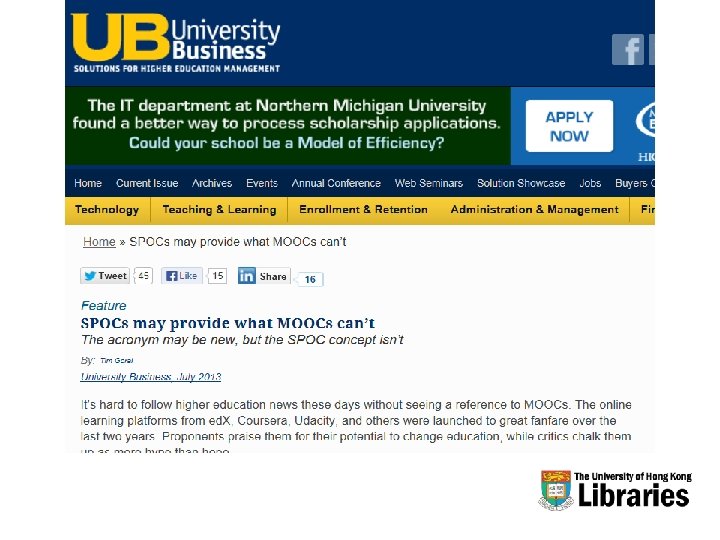
SPOCs • Small Private Online Courses • MOOCs => SPOCs • SPOCs => MOOCs
An Example of ed. X-based SPOC • HLS 1 x, Harvard. X, Jan-April 2013 • Enrollment: Limited to 500 participants – Diverse along many dimensions, including country of residence, age, occupation, educational background, and gender
An Example of ed. X-based SPOC • Actions for students – Watch pre-recorded lectures – Engage in interactive live webcasts of events in which guest speakers address especially controversial issues – Discuss legal problems in online forums – Participate once a week in an 80 -minute online seminar (Most important) – Take a three-hour exam • Graded by teaching fellows
An Example of ed. X-based SPOC • “Participants who receive passing grades will be awarded certificates of completion and will be provided written assessments of their degree of proficiency. ” • 500 participants are supervised by 21 teaching fellows • “The limit on the enrollment does not mean, however, that we are not allowing access to the course materials; they are made publicly available. ”
Another Example of ed. X-based SPOC • HKS 211. 1 x, Harvard. X, Oct- 2013 – About “American National Security” – “This course will be offered in an experimental format. You may apply to be among 500 participants in the Harvard Online Classroom or you may enroll in the course (no application required) as an auditor by clicking the blue "Register for HKS 211. 1 x" button on this page. Those admitted to the Harvard Online Classroom will watch the videos, read approximately 75 pages a week, complete ALL assignments including three Strategic Options Memos by the deadlines set in the course, participate in sections led by Harvard Teaching Fellows, and contribute to moderated discussion forums with students online and in the Harvard campus classroom. At the conclusion of the course, those students who have satisfied all the requirements will receive a Harvard. X certificate. ”
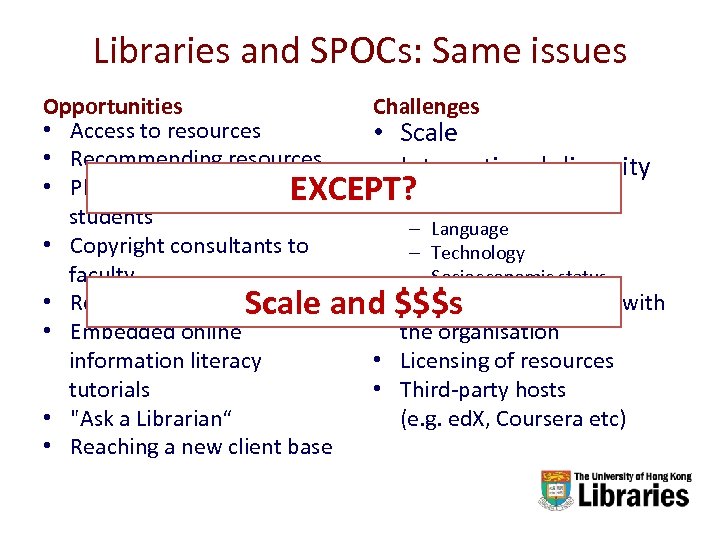
Libraries and SPOCs: Same issues Opportunities Challenges • Access to resources • Scale • Recommending resources • International diversity • Physical space for MOOC EXCEPT? of student body students – Language • Copyright consultants to – Technology faculty – Socioeconomic status • Research support for faculty • $$$s Scale and Students not affiliated with • Embedded online the organisation information literacy • Licensing of resources tutorials • Third-party hosts • "Ask a Librarian“ (e. g. ed. X, Coursera etc) • Reaching a new client base
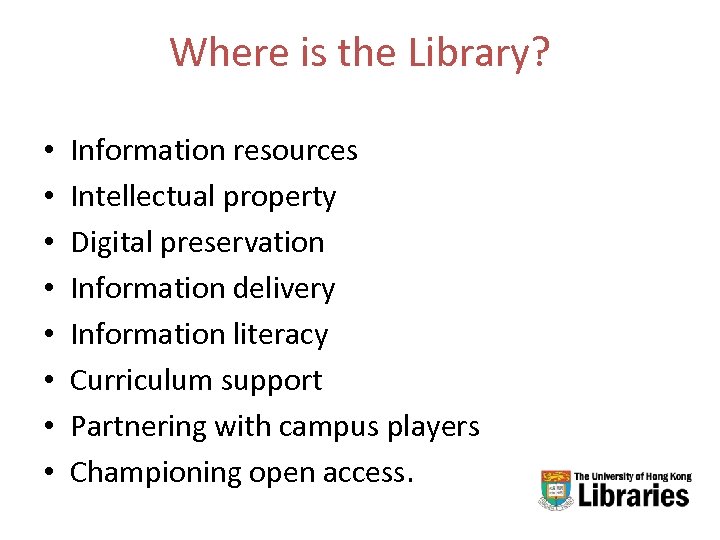
Where is the Library? • • Information resources Intellectual property Digital preservation Information delivery Information literacy Curriculum support Partnering with campus players Championing open access.
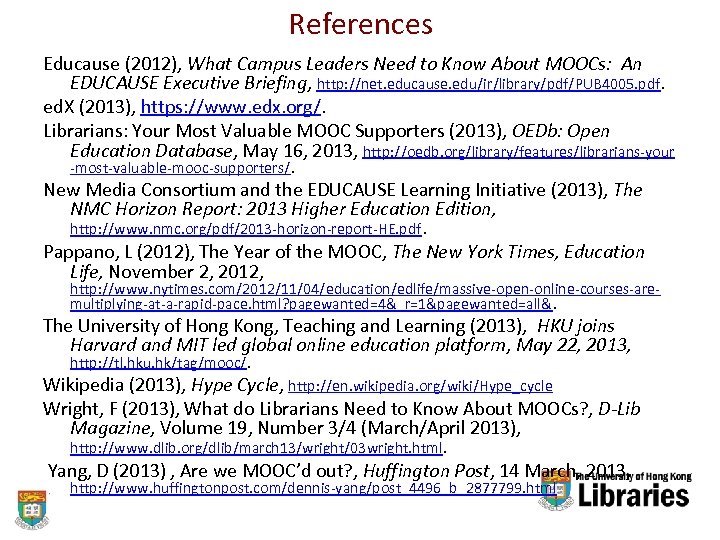
References Educause (2012), What Campus Leaders Need to Know About MOOCs: An EDUCAUSE Executive Briefing, http: //net. educause. edu/ir/library/pdf/PUB 4005. pdf. ed. X (2013), https: //www. edx. org/. Librarians: Your Most Valuable MOOC Supporters (2013), OEDb: Open Education Database, May 16, 2013, http: //oedb. org/library/features/librarians-your -most-valuable-mooc-supporters/. New Media Consortium and the EDUCAUSE Learning Initiative (2013), The NMC Horizon Report: 2013 Higher Education Edition, http: //www. nmc. org/pdf/2013 -horizon-report-HE. pdf. Pappano, L (2012), The Year of the MOOC, The New York Times, Education Life, November 2, 2012, http: //www. nytimes. com/2012/11/04/education/edlife/massive-open-online-courses-aremultiplying-at-a-rapid-pace. html? pagewanted=4&_r=1&pagewanted=all&. The University of Hong Kong, Teaching and Learning (2013), HKU joins Harvard and MIT led global online education platform, May 22, 2013, http: //tl. hku. hk/tag/mooc/. Wikipedia (2013), Hype Cycle, http: //en. wikipedia. org/wiki/Hype_cycle Wright, F (2013), What do Librarians Need to Know About MOOCs? , D-Lib Magazine, Volume 19, Number 3/4 (March/April 2013), http: //www. dlib. org/dlib/march 13/wright/03 wright. html. Yang, D (2013) , Are we MOOC’d out? , Huffington Post, 14 March, 2013, http: //www. huffingtonpost. com/dennis-yang/post_4496_b_2877799. html
Thank you !
Скачать презентацию MOOCs and SPOCs Where is the Library Peter
e6d4e705f092bda13c4c1f692238eaac.ppt