Скачать презентацию Monty Hall and options Demonstration Monty Hall
323ad89d5ac4ccc9196da9c49d93dfe4.ppt
- Количество слайдов: 34
 Monty Hall and options
 Demonstration: Monty Hall 4 A prize is behind one of three doors. 4 Contestant chooses one. 4 Host opens a door that is not the chosen door and not the one concealing the prize. (He knows where the prize is. ) 4 Contestant is allowed to switch doors.
 Solution 4 The contestant should always switch. 4 Why? Because the host has information that is revealed by his action.
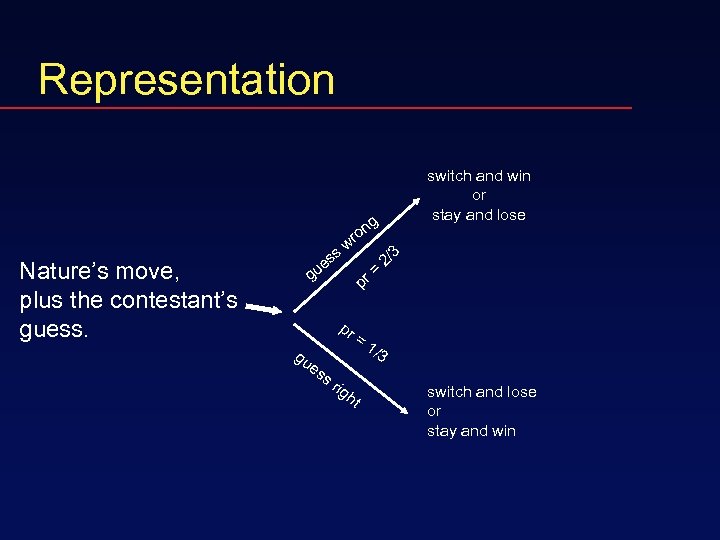 Representation switch and win or stay and lose g Nature’s move, plus the contestant’s guess. s s ue g n ro w pr gu es pr = sr igh t 3 = 2/ 1/3 switch and lose or stay and win
 Definition of a call option 4 A call option is the right but not the obligation to buy 100 shares of the stock at a stated exercise price on or before a stated expiration date. 4 The price of the option is not the exercise price.
 Example 4 A share of IBM sells for 75. 4 The call has an exercise price of 76. 4 The value of the call seems to be zero. 4 In fact, it is positive and in one example equal to 2.
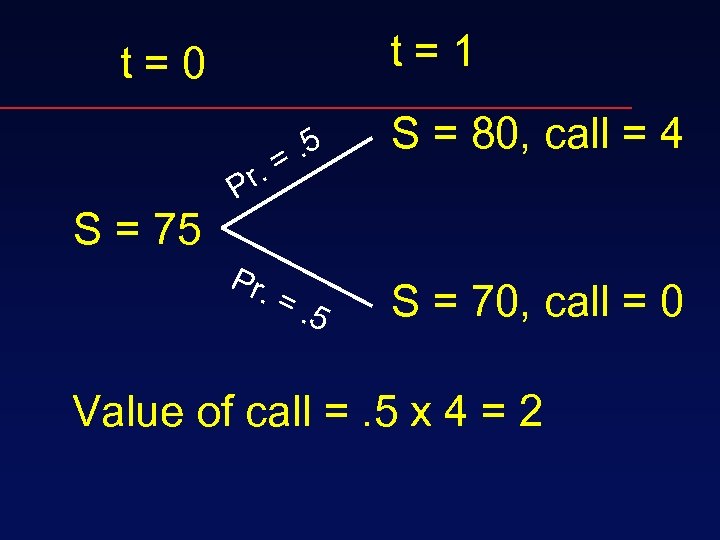 t=1 t=0 S = 75 r. P Pr. . 5 = =. 5 S = 80, call = 4 S = 70, call = 0 Value of call =. 5 x 4 = 2
 Definition of a put option 4 A put option is the right but not the obligation to sell 100 shares of the stock at a stated exercise price on or before a stated expiration date. 4 The price of the option is not the exercise price.
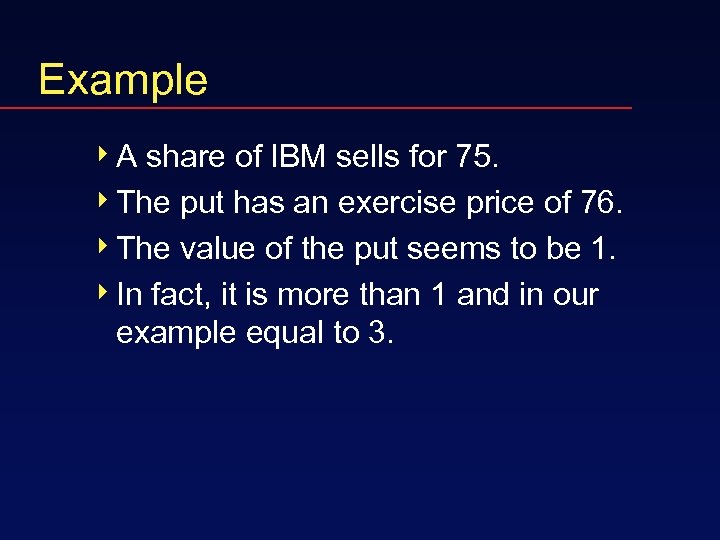 Example 4 A share of IBM sells for 75. 4 The put has an exercise price of 76. 4 The value of the put seems to be 1. 4 In fact, it is more than 1 and in our example equal to 3.
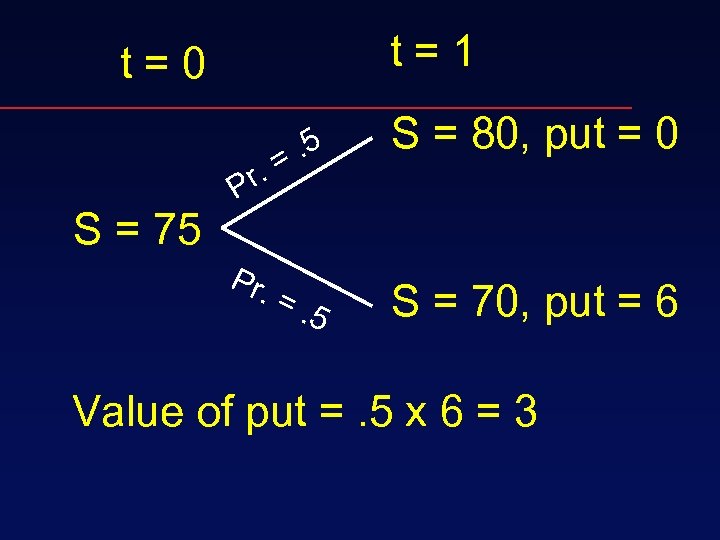 t=1 t=0 S = 75 r. P Pr. . 5 = =. 5 S = 80, put = 0 S = 70, put = 6 Value of put =. 5 x 6 = 3
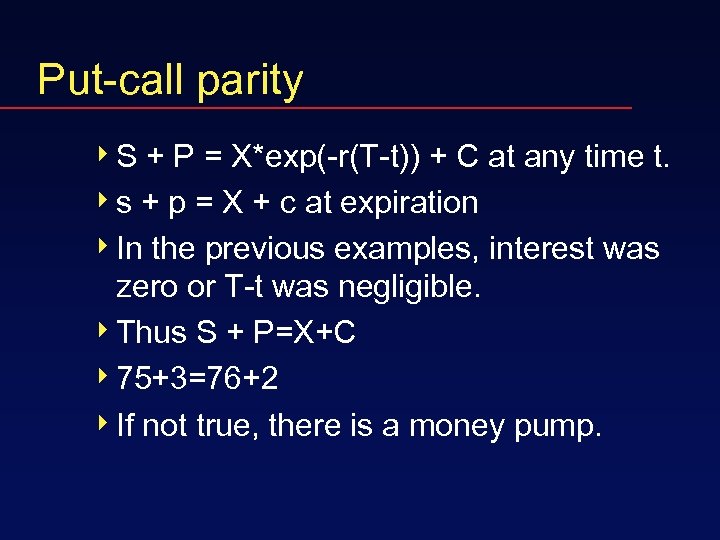 Put-call parity 4 S + P = X*exp(-r(T-t)) + C at any time t. 4 s + p = X + c at expiration 4 In the previous examples, interest was zero or T-t was negligible. 4 Thus S + P=X+C 4 75+3=76+2 4 If not true, there is a money pump.
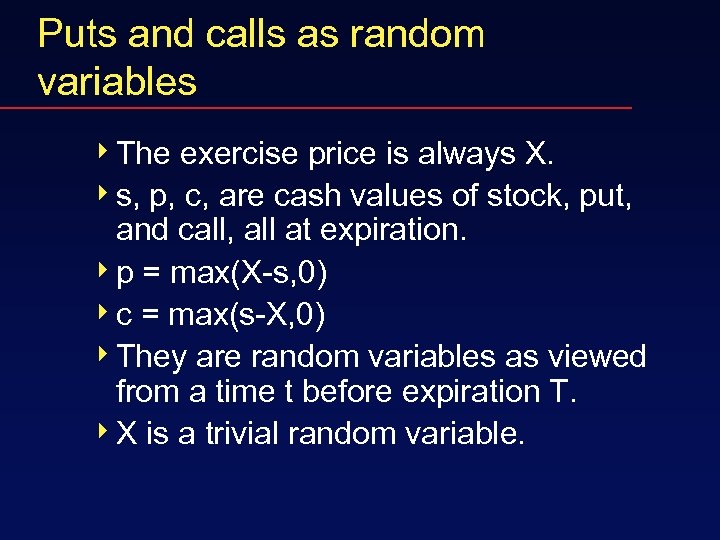 Puts and calls as random variables 4 The exercise price is always X. 4 s, p, c, are cash values of stock, put, and call, all at expiration. 4 p = max(X-s, 0) 4 c = max(s-X, 0) 4 They are random variables as viewed from a time t before expiration T. 4 X is a trivial random variable.
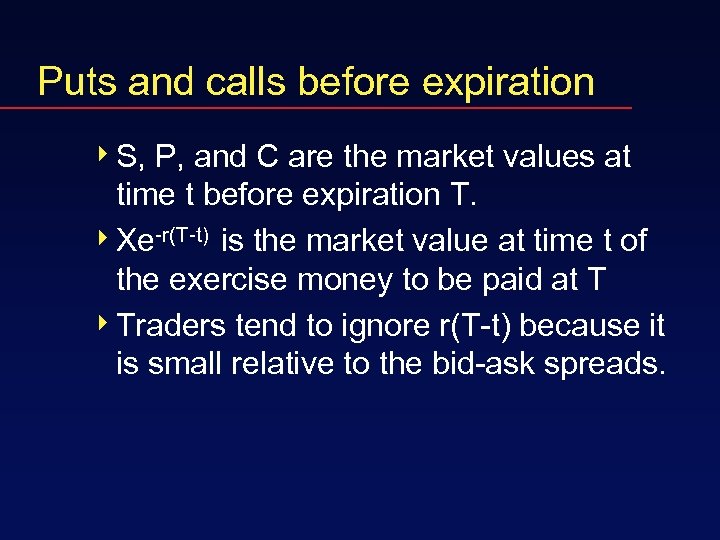 Puts and calls before expiration 4 S, P, and C are the market values at time t before expiration T. 4 Xe-r(T-t) is the market value at time t of the exercise money to be paid at T 4 Traders tend to ignore r(T-t) because it is small relative to the bid-ask spreads.
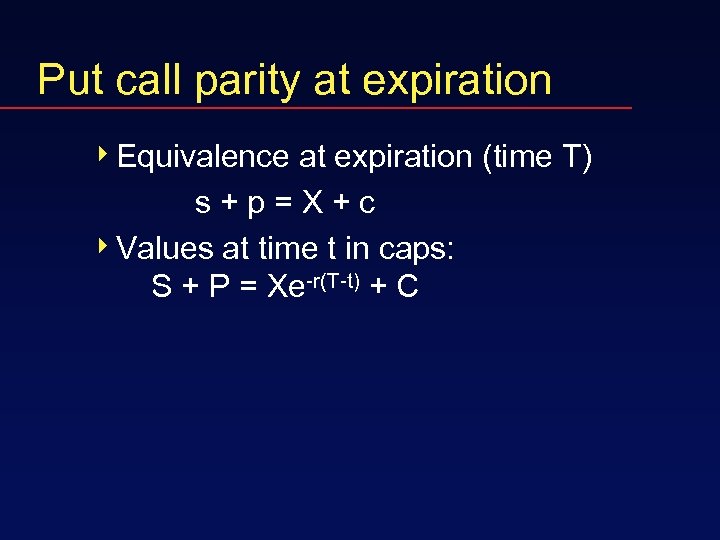 Put call parity at expiration 4 Equivalence at expiration (time T) s+p=X+c 4 Values at time t in caps: S + P = Xe-r(T-t) + C
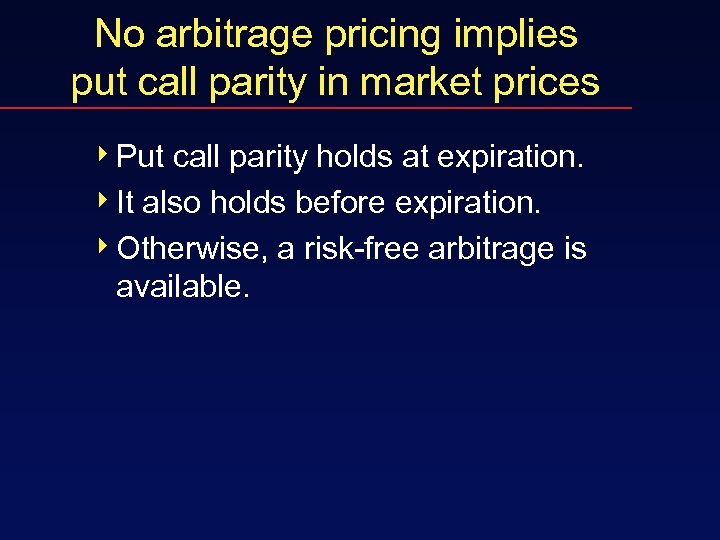 No arbitrage pricing implies put call parity in market prices 4 Put call parity holds at expiration. 4 It also holds before expiration. 4 Otherwise, a risk-free arbitrage is available.
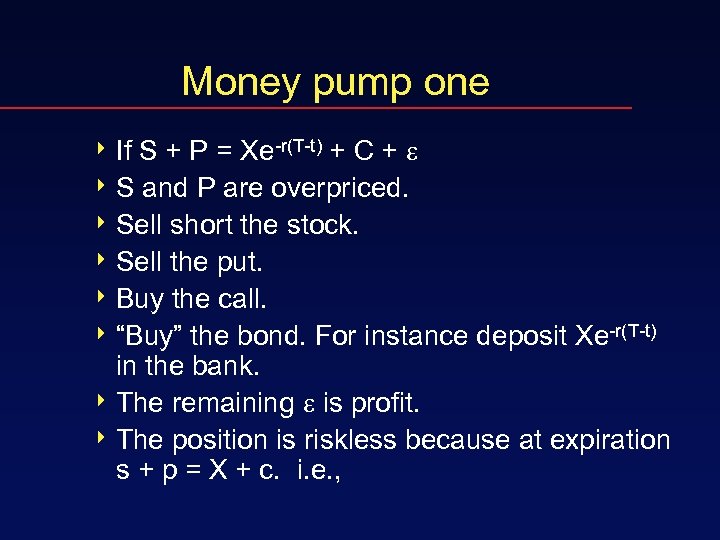 Money pump one S + P = Xe-r(T-t) + C + e 4 S and P are overpriced. 4 Sell short the stock. 4 Sell the put. 4 Buy the call. 4 “Buy” the bond. For instance deposit Xe-r(T-t) in the bank. 4 The remaining e is profit. 4 The position is riskless because at expiration s + p = X + c. i. e. , 4 If
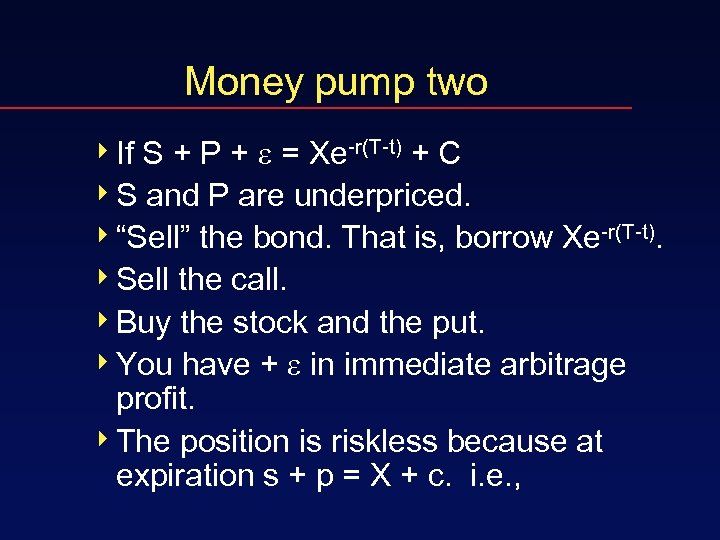 Money pump two S + P + e = Xe-r(T-t) + C 4 S and P are underpriced. 4 “Sell” the bond. That is, borrow Xe-r(T-t). 4 Sell the call. 4 Buy the stock and the put. 4 You have + e in immediate arbitrage profit. 4 The position is riskless because at expiration s + p = X + c. i. e. , 4 If
 Money pump either way 4 If the prices persist, do the same thing over and over – a MONEY PUMP. 4 The existence of the e violates noarbitrage pricing.
 Measuring risk Rocket science
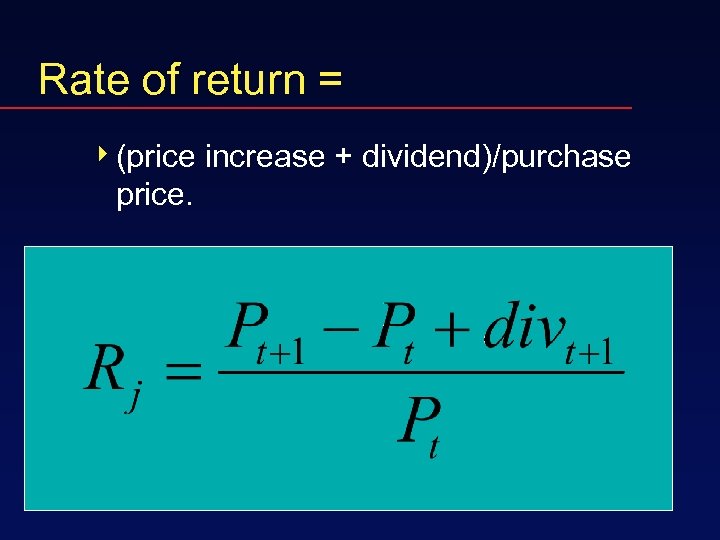 Rate of return = 4 (price. increase + dividend)/purchase
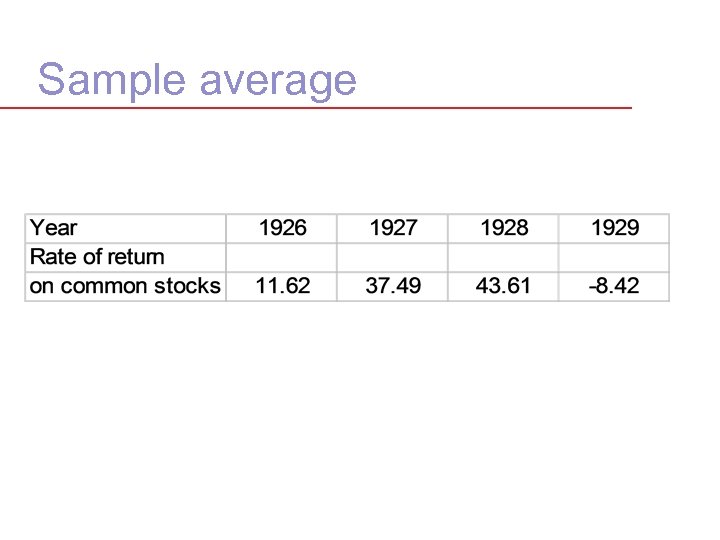 Sample average
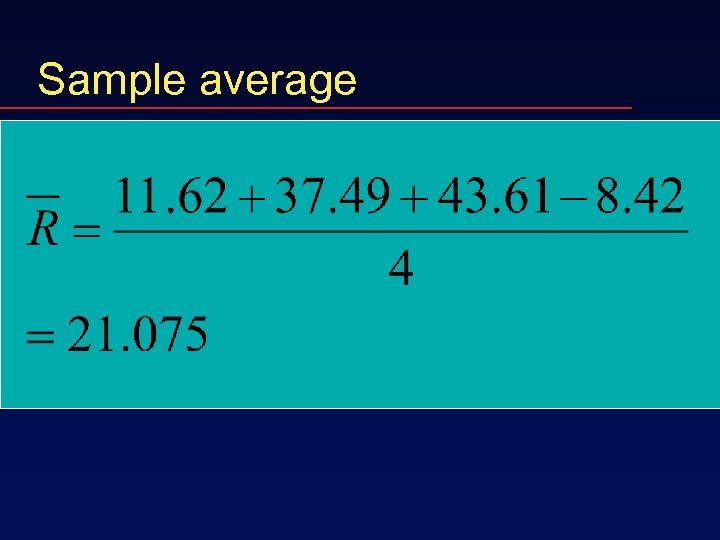 Sample average
 Sample versus population 4 A sample is a series of random draws from a population. 4 Sample is inferential. For instance the sample average. 4 Population: model: For instance the probabilities in the problem set.
 Population mean 4 The value to which the sample average tends in a very long time. 4 Each sample average is an estimate, more or less accurate, of the population mean.
 Abstraction of finance 4 Theory works for the expected values. 4 In practice one uses sample means.
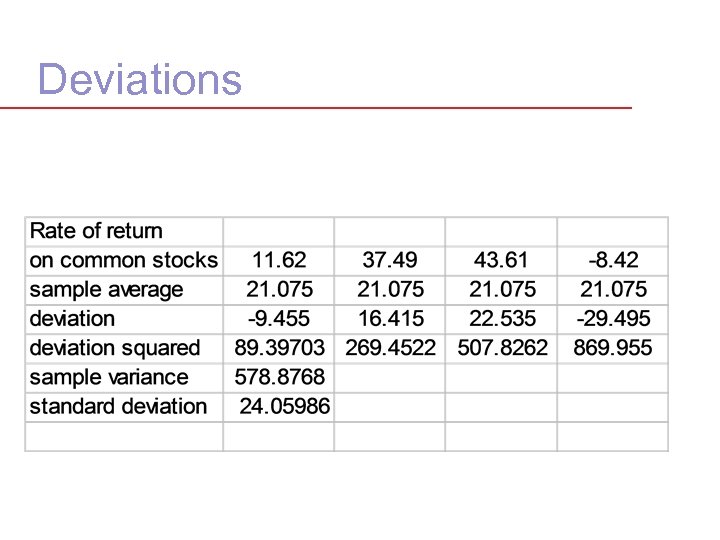 Deviations
 Explanation 4 Square deviations to measure both types of risk. 4 Take square root of variance to get comparable units. 4 Its still an estimate of true population risk.
 Why divide by 3 not 4? 4 Sample deviations are probably too small … 4 because the sample average minimizes them. 4 Correction needed. 4 Divide by T-1 instead of T.
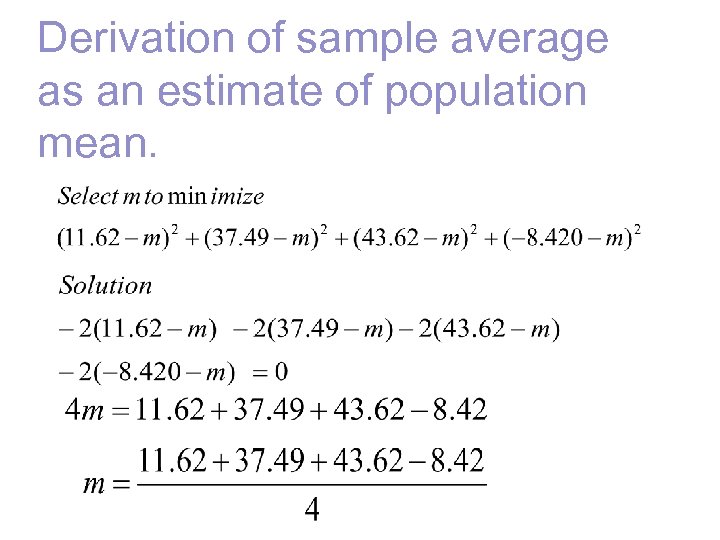 Derivation of sample average as an estimate of population mean.
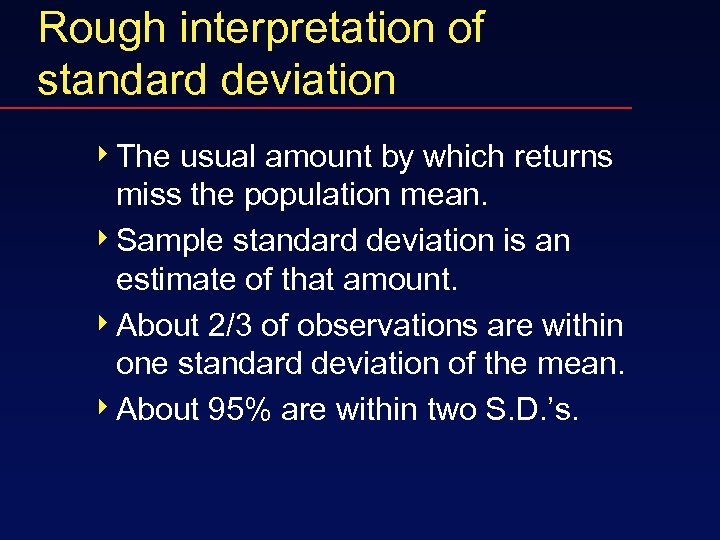 Rough interpretation of standard deviation 4 The usual amount by which returns miss the population mean. 4 Sample standard deviation is an estimate of that amount. 4 About 2/3 of observations are within one standard deviation of the mean. 4 About 95% are within two S. D. ’s.
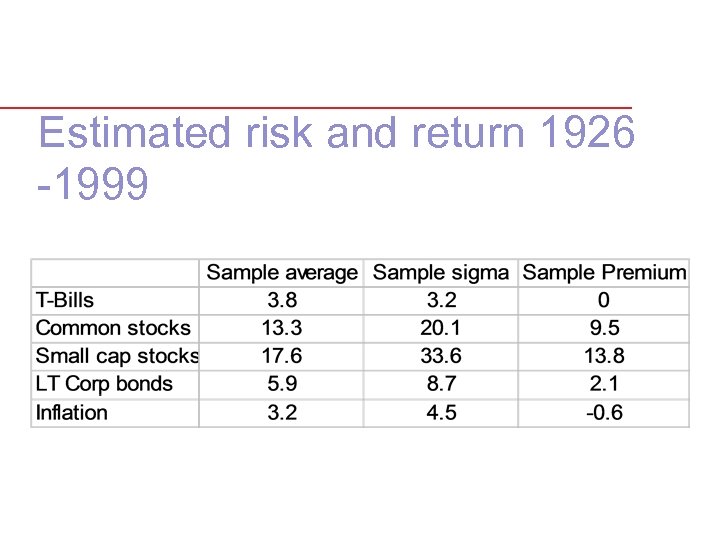 Estimated risk and return 1926 -1999
 Review question 4 What is the difference between the population mean and the sample average?
 Answer 4 Take a sample of T observations drawn from the population 4 The sample average is (sum of the rates)/T 4 The sample average tends to the population mean as the number of observations T becomes large.