


 Скачать презентацию Monte Carlo indexing with Mc Maille A Le
94a4f838ca662a2ae07ce0b76e96935a.ppt
- Количество слайдов: 31
 Monte Carlo indexing with Mc. Maille A. Le Bail Université du Maine Laboratoire des Fluorures CNRS – UMR 6010 FRANCE alb@cristal. org http: //cristal. org/
 Content - Introduction : indexing in the powder diffraction maze -The SDPD Round Robin 2002 indexing part – ultra brief report - Mc. Maille (pronounce « Mac. My » ) demonstrations - « Simplicity » of the Monte Carlo algorithm in Mc. Maille - Mc. Maille v 2 : Gaussian profiles - Mc. Maille v 3 : Columnar peak shape - About the (accuracy + enlarged peaks) apparent contradiction - « Refinement » and optimization - Indexing multiphase patterns and impurity lines problems - Conclusions
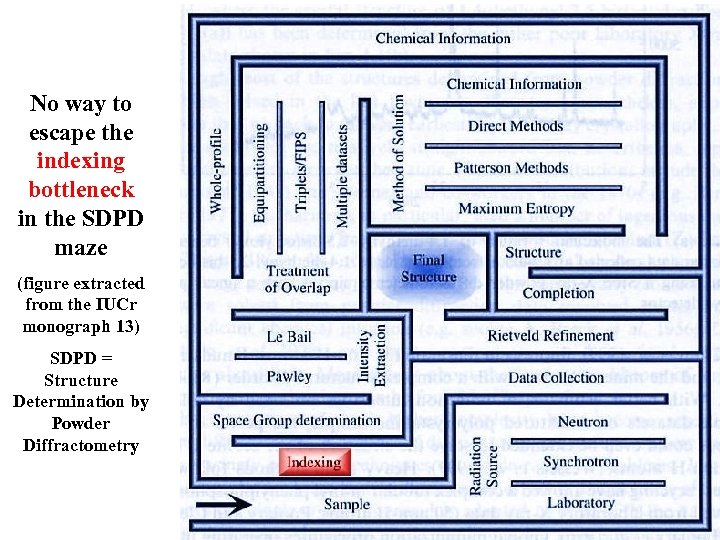 No way to escape the indexing bottleneck in the SDPD maze (figure extracted from the IUCr monograph 13) SDPD = Structure Determination by Powder Diffractometry
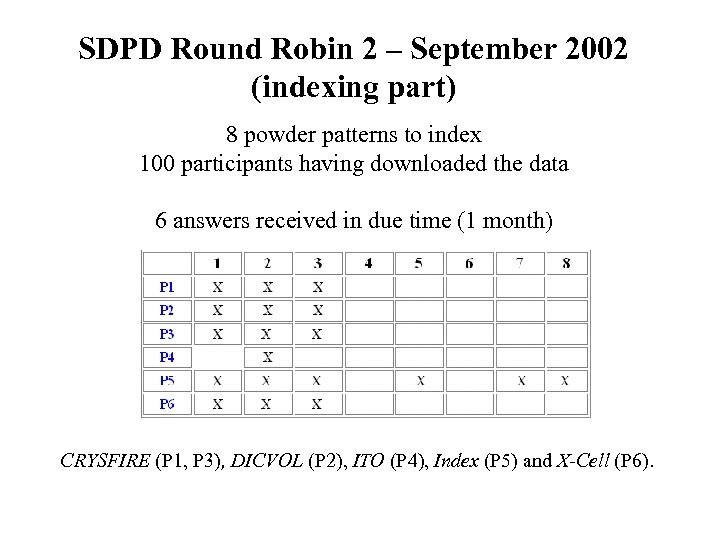 SDPD Round Robin 2 – September 2002 (indexing part) 8 powder patterns to index 100 participants having downloaded the data 6 answers received in due time (1 month) CRYSFIRE (P 1, P 3), DICVOL (P 2), ITO (P 4), Index (P 5) and X-Cell (P 6).
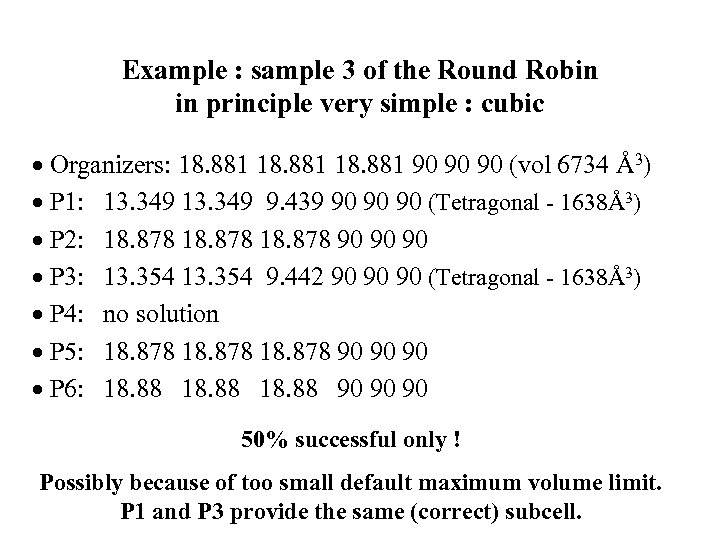 Example : sample 3 of the Round Robin in principle very simple : cubic · Organizers: 18. 881 90 90 90 (vol 6734 Å3) · P 1: 13. 349 9. 439 90 90 90 (Tetragonal - 1638Å3) · P 2: 18. 878 90 90 90 · P 3: 13. 354 9. 442 90 90 90 (Tetragonal - 1638Å3) · P 4: no solution · P 5: 18. 878 90 90 90 · P 6: 18. 88 90 90 90 50% successful only ! Possibly because of too small default maximum volume limit. P 1 and P 3 provide the same (correct) subcell.
 Well, the Round Robin conclusion is that indexing would not be that easy ? Hence the need for more efforts in the less explored directions for indexing, using not only peak positions but also intensities, and why not the whole powder profile (that way was initiated by Kariuki et al. , 1999, applying a genetic algorithm). Mc. Maille follows the same route by using the Monte Carlo method in order to generate randomly cell parameters tested against an idealized powder profile. Find more details about the SDPD-2002 Round Robin at : Web site : http: //sdpd. univ-lemans. fr/sdpdrr 2/results/ Report : in the IUCr - CPD – Newsletter N° 29 – July 2003
 Mc. Maille demonstrations Program download (GNU Public Licence) : http: //www. cristal. org/Mc. Maille/ Crystallographers want solutions fast ! Is that possible with Mc. Maille ? YES… if you consider 5 -15 minutes being fast… The first recommended approach with Mc. Maille is to use the quite simple automated « black box » mode. Peak positions and intensities can be extracted by using the Win. Plotr program which is able to build the Mc. Maille entry data file directly for the automated mode.
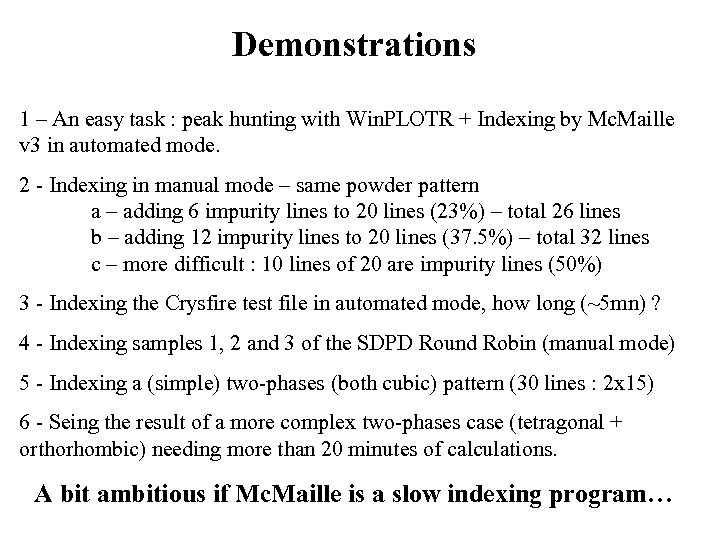 Demonstrations 1 – An easy task : peak hunting with Win. PLOTR + Indexing by Mc. Maille v 3 in automated mode. 2 - Indexing in manual mode – same powder pattern a – adding 6 impurity lines to 20 lines (23%) – total 26 lines b – adding 12 impurity lines to 20 lines (37. 5%) – total 32 lines c – more difficult : 10 lines of 20 are impurity lines (50%) 3 - Indexing the Crysfire test file in automated mode, how long (~5 mn) ? 4 - Indexing samples 1, 2 and 3 of the SDPD Round Robin (manual mode) 5 - Indexing a (simple) two-phases (both cubic) pattern (30 lines : 2 x 15) 6 - Seing the result of a more complex two-phases case (tetragonal + orthorhombic) needing more than 20 minutes of calculations. A bit ambitious if Mc. Maille is a slow indexing program…
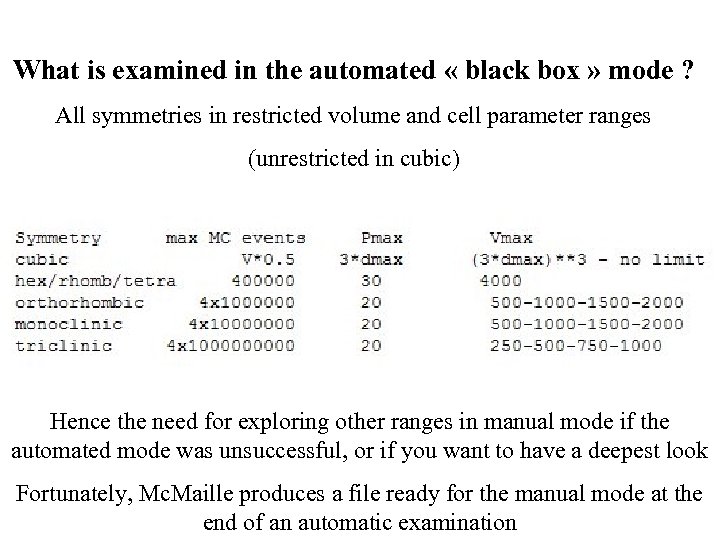 What is examined in the automated « black box » mode ? All symmetries in restricted volume and cell parameter ranges (unrestricted in cubic) Hence the need for exploring other ranges in manual mode if the automated mode was unsuccessful, or if you want to have a deepest look Fortunately, Mc. Maille produces a file ready for the manual mode at the end of an automatic examination
 Now let us examine more closely all the Mc. Maille « secrets »
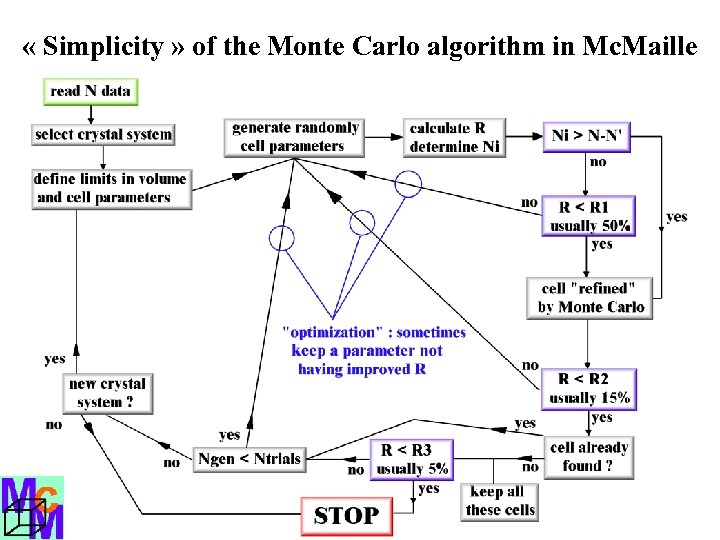 « Simplicity » of the Monte Carlo algorithm in Mc. Maille
 Saving time with the hkl list hkl Miller indices are predetermined (400 to 1000) for every crystal system and saved in files read once at the beginning. They are only selected (not ordered which would be too long) according to the cell parameters trial and cut off at d(hkl)min. If a calculated profile do not intercept any observed one, then the corresponding hkl set is considered as unobserved, not taken into account.
 Mc. Maille v 1 and v 2 : Gaussian profiles - Choice was made of an idealized profile (Gaussian shape applied to extracted peak positions) rather than using the raw pattern – for velocity reasons. Fit by 3 iterations of the Rietveld decomposition formula (= Le Bail method). -Version 1 worked only in cubic for studying the feasibility which was quite encouraging with 1000 tests per second by using a > 2 GHz processor. -Version 2 extended to all crystal systems, 300 tests per second in triclinic. Not fast enough with low symmetries needing 108 -109 tests…
 Mc. Maille v 3 : Columnar peak shape Speed increased by a factor 20… 20. 000 tests per second in cubic, 6000 in triclinic. No real need for a fit, the observed and calculated columns are given the same height and same width. The R factor becomes function of the percentage of overlapping between observed and calculated columns.
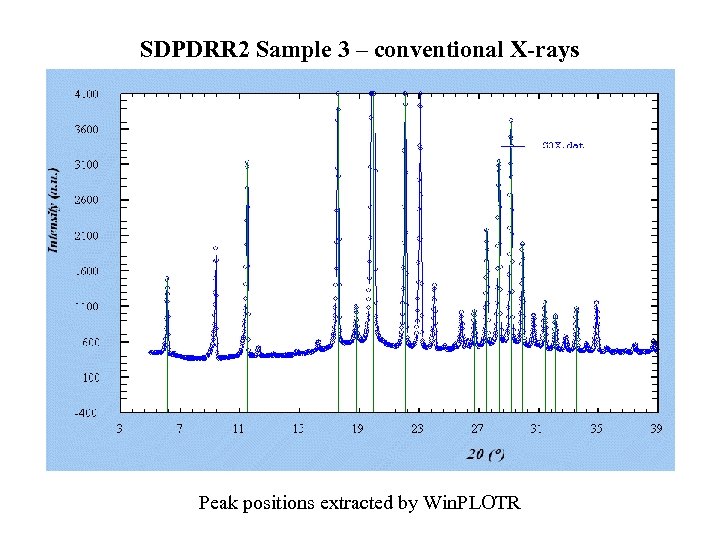 SDPDRR 2 Sample 3 – conventional X-rays Peak positions extracted by Win. PLOTR
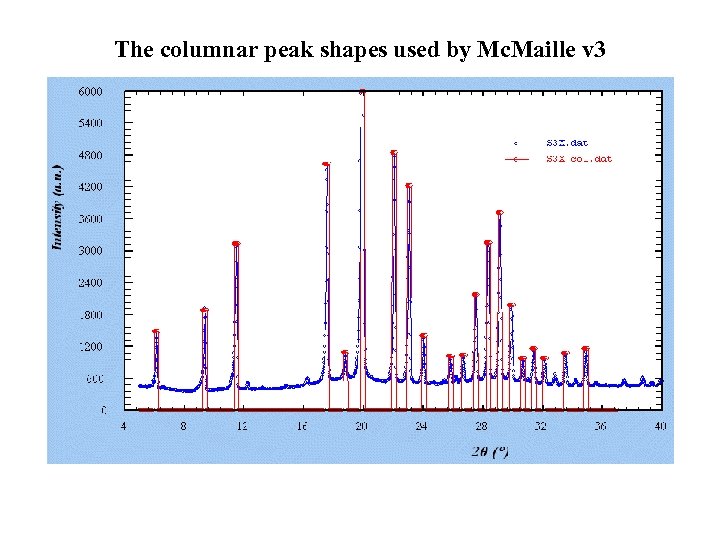 The columnar peak shapes used by Mc. Maille v 3
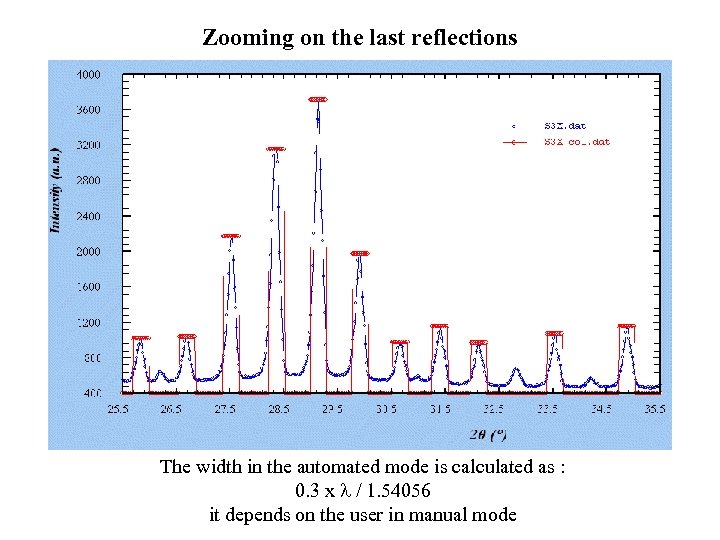 Zooming on the last reflections The width in the automated mode is calculated as : 0. 3 x / 1. 54056 it depends on the user in manual mode
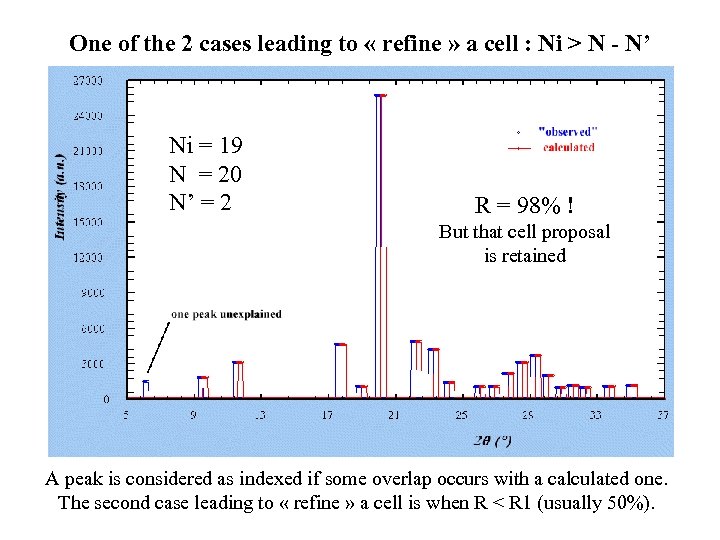 One of the 2 cases leading to « refine » a cell : Ni > N - N’ Ni = 19 N = 20 N’ = 2 R = 98% ! But that cell proposal is retained A peak is considered as indexed if some overlap occurs with a calculated one. The second case leading to « refine » a cell is when R < R 1 (usually 50%).
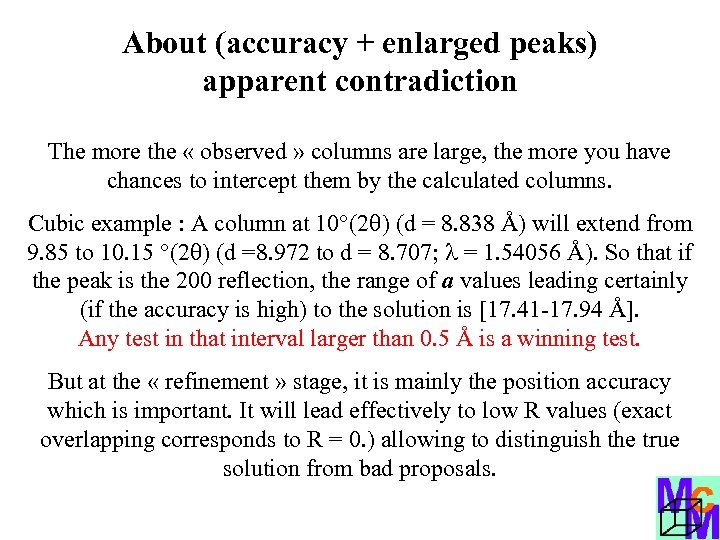 About (accuracy + enlarged peaks) apparent contradiction The more the « observed » columns are large, the more you have chances to intercept them by the calculated columns. Cubic example : A column at 10°(2 ) (d = 8. 838 Å) will extend from 9. 85 to 10. 15 °(2 ) (d =8. 972 to d = 8. 707; = 1. 54056 Å). So that if the peak is the 200 reflection, the range of a values leading certainly (if the accuracy is high) to the solution is [17. 41 -17. 94 Å]. Any test in that interval larger than 0. 5 Å is a winning test. But at the « refinement » stage, it is mainly the position accuracy which is important. It will lead effectively to low R values (exact overlapping corresponds to R = 0. ) allowing to distinguish the true solution from bad proposals.
 More on the cell « refinement » in Mc. Maille At R ~ 50%, no least square refinement is possible So that the cell parameters are adjusted by Monte Carlo (200 steps in cubic to 5000 steps in triclinic) with small amplitude change (|delta max| = 0. 02 Å). Similar to tempering ? The best proposal at R < R 3 ~ 5% is finally least-squared refined and classical figures of merit (M 20, F 20) are calculated.
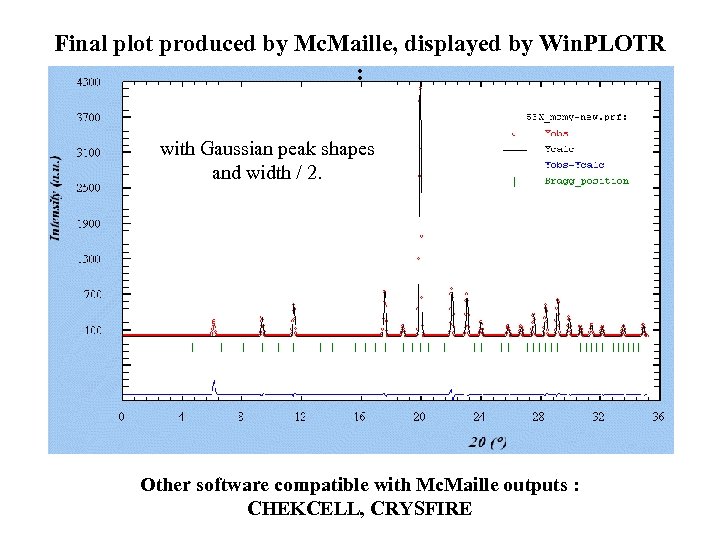 Final plot produced by Mc. Maille, displayed by Win. PLOTR : with Gaussian peak shapes and width / 2. Other software compatible with Mc. Maille outputs : CHEKCELL, CRYSFIRE
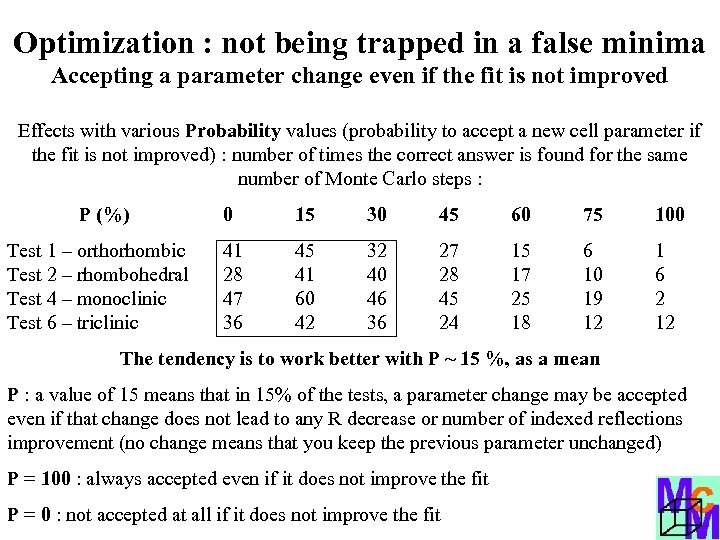 Optimization : not being trapped in a false minima Accepting a parameter change even if the fit is not improved Effects with various Probability values (probability to accept a new cell parameter if the fit is not improved) : number of times the correct answer is found for the same number of Monte Carlo steps : P (%) Test 1 – orthorhombic Test 2 – rhombohedral Test 4 – monoclinic Test 6 – triclinic 0 15 30 45 60 75 100 41 28 47 36 45 41 60 42 32 40 46 36 27 28 45 24 15 17 25 18 6 10 19 12 1 6 2 12 The tendency is to work better with P ~ 15 %, as a mean P : a value of 15 means that in 15% of the tests, a parameter change may be accepted even if that change does not lead to any R decrease or number of indexed reflections improvement (no change means that you keep the previous parameter unchanged) P = 100 : always accepted even if it does not improve the fit P = 0 : not accepted at all if it does not improve the fit
 Relative insensitivity to impurity The user decides by two control parameters : N’ : number of unindexed lines. R 2 : consider only proposals with R < R 2. Fixing it at 15% means that cell proposals explaining at least 85% of the peaks total intensity will be listed. An impurity should not concern more than 15% of the total intensity, right ? But the number of (small) peaks belonging to the impurity can be high…
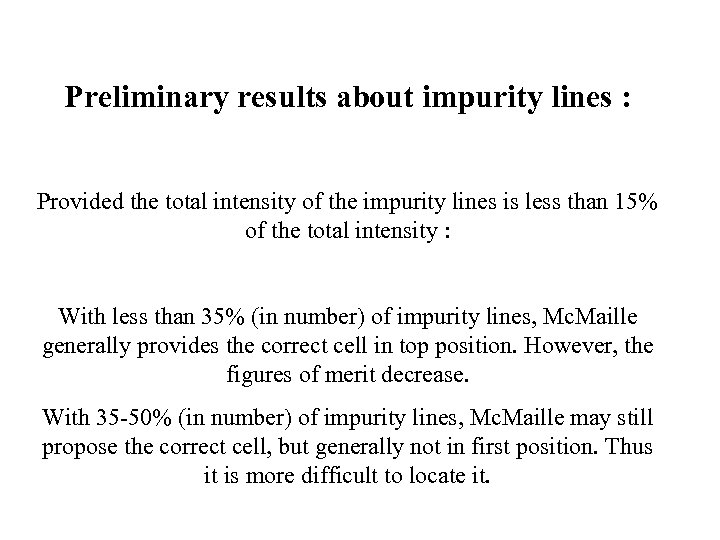 Preliminary results about impurity lines : Provided the total intensity of the impurity lines is less than 15% of the total intensity : With less than 35% (in number) of impurity lines, Mc. Maille generally provides the correct cell in top position. However, the figures of merit decrease. With 35 -50% (in number) of impurity lines, Mc. Maille may still propose the correct cell, but generally not in first position. Thus it is more difficult to locate it.
 Beyong impurities, indexing multiphase patterns Multiple synthesis in varying conditions should reveal the multiphase nature of the sample. It is much better to adjust the synthesis conditions, and even if the phases cannot be prepared as pure phases, intensities variations should allow to define the peaks belonging to one or the other phase. But if really you want to attempt indexing of a mixture, let us see the cost on the Mc. Maille organization chart…
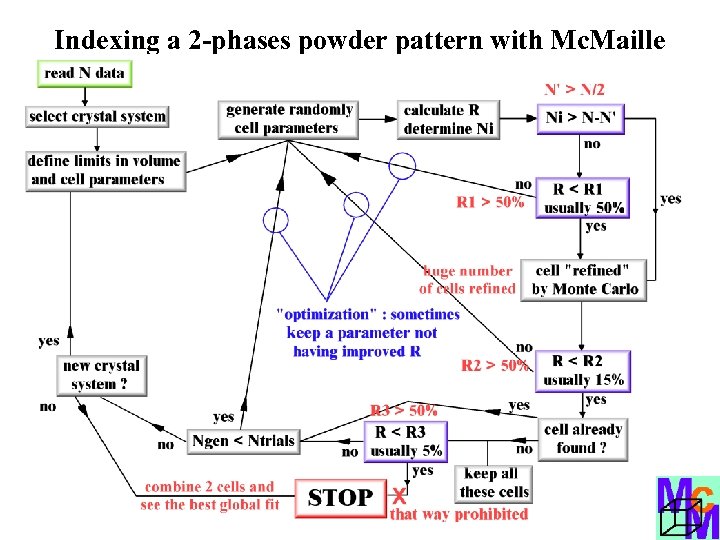 Indexing a 2 -phases powder pattern with Mc. Maille
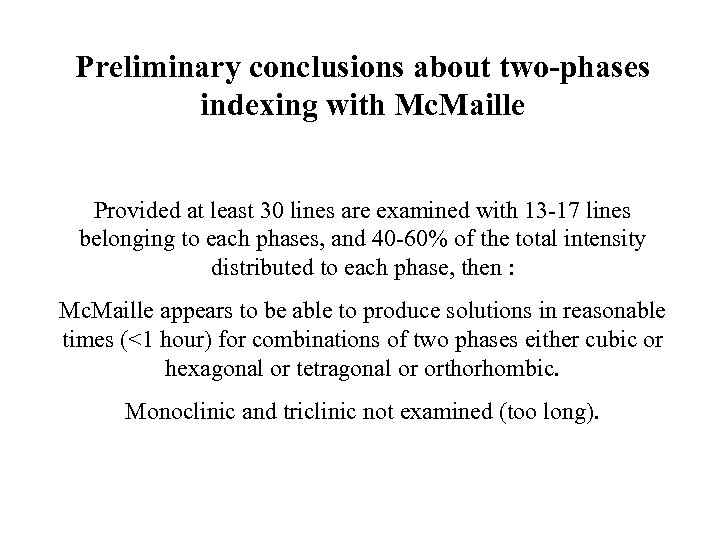 Preliminary conclusions about two-phases indexing with Mc. Maille Provided at least 30 lines are examined with 13 -17 lines belonging to each phases, and 40 -60% of the total intensity distributed to each phase, then : Mc. Maille appears to be able to produce solutions in reasonable times (<1 hour) for combinations of two phases either cubic or hexagonal or tetragonal or orthorhombic. Monoclinic and triclinic not examined (too long).
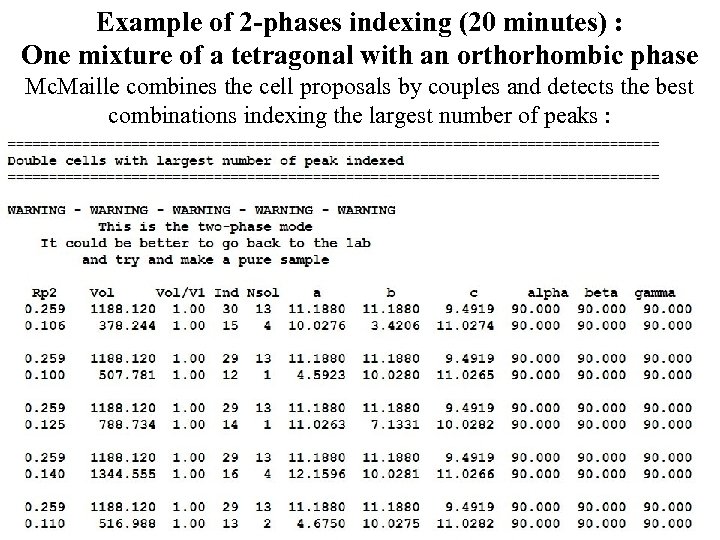 Example of 2 -phases indexing (20 minutes) : One mixture of a tetragonal with an orthorhombic phase Mc. Maille combines the cell proposals by couples and detects the best combinations indexing the largest number of peaks :
 Conclusions - Promising (? ) method… - Already quite efficient if you have time and a fast computer. - Needs some skills in manual mode, but nothing to do in « black box » mode (except finding the zeropoint). - Improve it if you have some ideas (GNU Public Licence). - Completely free access. - Use cautiously the 2 -phases mode… A useful address for a distance learning course : SDPD Internet Course http: //sdpd. univ-lemans. fr/course/
 Some words about Mc. Maille from Robin Shirley : (in IUCr Computing Commission Newsletter No. 2, July 2003) http: //www. iucr. org/iucr-top/comm/ccom/newsletters/ « … the fact that it can work effectively at all shows how risky it can be to make negative predictions – less than a year ago at the Geneva Congress I predicted that it would be many years before computers became fast enough for whole-profile-based indexing to become feasible ! »
 If finally you solve your problem with public licensed software, why not to deposit your results in the public domain ? See the recommendations to IUCr journals authors : § 1. 5 : « The inclusion of material in an informal publication, e. g. a preprint server or a newsletter, does not preclude publication in an IUCr journal »