


 Скачать презентацию Monopoly Marginal Cost as the Competitive Firm s
Monopoly - March 2015 - sent.pptx
- Количество слайдов: 48
 Monopoly
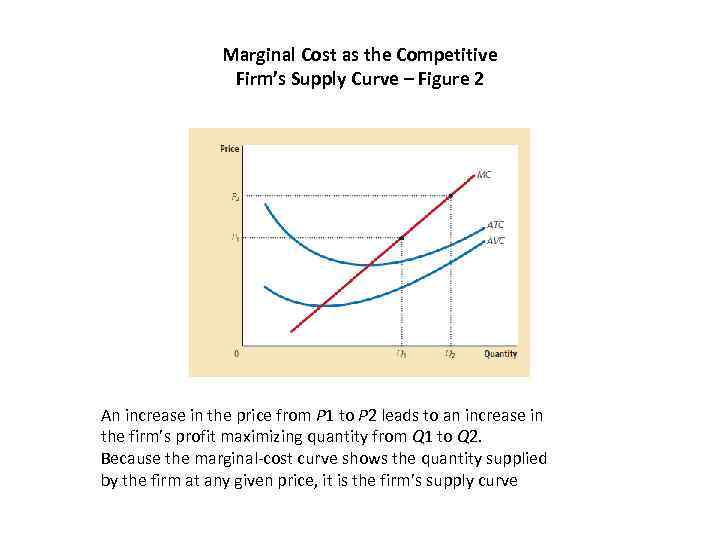 Marginal Cost as the Competitive Firm’s Supply Curve – Figure 2 An increase in the price from P 1 to P 2 leads to an increase in the firm’s profit maximizing quantity from Q 1 to Q 2. Because the marginal-cost curve shows the quantity supplied by the firm at any given price, it is the firm’s supply curve
 A competitive firm takes the price of its output as given by the market and then chooses the quantity it will supply so that price equals marginal cost. By contrast, a monopoly charges a price that exceeds marginal cost. Monopolies charge high prices for their products. Customers of monopolies might seem to have little choice but to pay whatever the monopoly charges. But if so, why does a copy of Windows not cost $1, 000? Or $10, 000?
 The reason is that if Microsoft sets the price that high, fewer people would buy the product. People would buy fewer computers, switch to other operating systems, or make illegal copies. A monopoly firm can control the price of the good it sells, but because a high price reduces the quantity that its customers buy, the monopoly’s profits are not unlimited.
 What is the implications of monopoly for society as a whole? . Monopoly firms, like competitive firms, aim to maximize profit. But this goal has very different ramifications for competitive and monopoly firms. In competitive markets, self- interested consumers and producers behave as if they are guided by an invisible hand to promote general economic well-being. By contrast, because monopoly firms are unchecked by competition, the outcome in a market with a monopoly is often not in the best interest of society.
 • A firm is considered a monopoly if. . . – it is the sole seller of its product. – its product does not have close substitutes.
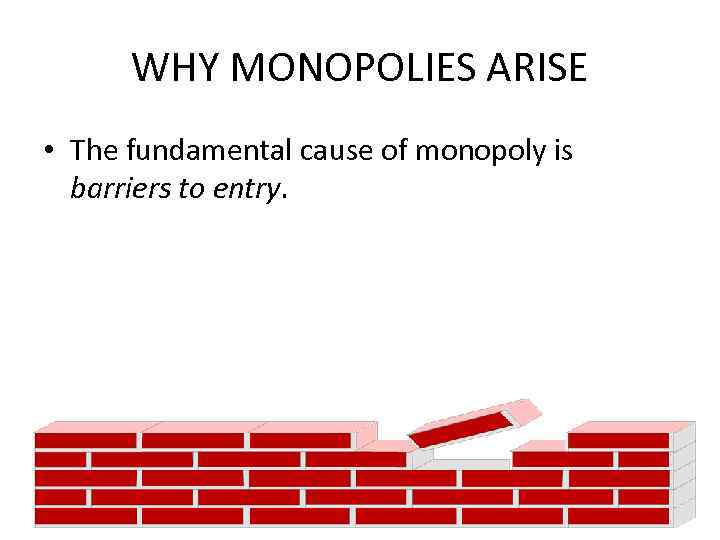 WHY MONOPOLIES ARISE • The fundamental cause of monopoly is barriers to entry.
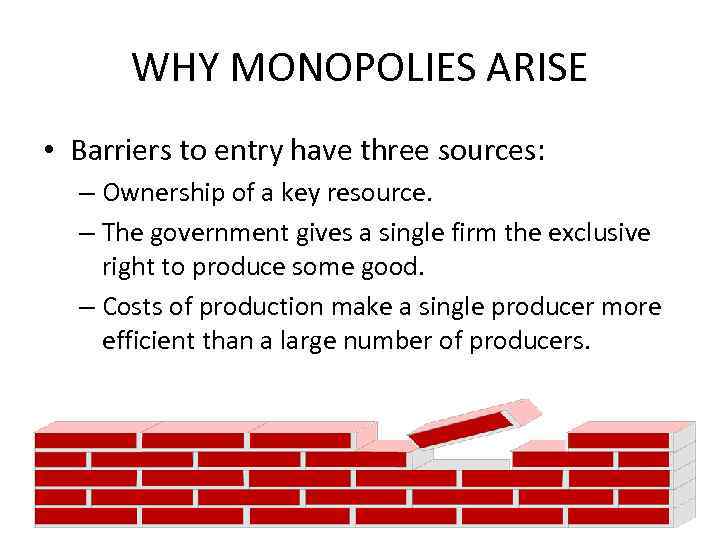 WHY MONOPOLIES ARISE • Barriers to entry have three sources: – Ownership of a key resource. – The government gives a single firm the exclusive right to produce some good. – Costs of production make a single producer more efficient than a large number of producers.
 Monopoly Resources • Although exclusive ownership of a key resource is a potential source of monopoly, in practice monopolies rarely arise for this reason.
 barriers to entry - a monopoly remains the only seller in its market because other firms cannot enter the market and compete with it. Barriers to entry, in turn, have three main sources: • Monopoly resources: A key resource required for production is owned by a single firm. • Government regulation: The government gives a single firm the exclusive right to produce some good or service. The production process: A single firm can produce output at a lower cost than can a larger number of producers
 Government-Created Monopolies • Governments may restrict entry by giving a single firm the exclusive right to sell a particular good in certain markets.
 The patent and copyright laws are two important examples. When a pharmaceutical company discovers a new drug, it can apply to the government for a patent The effects of patent and copyright laws are easy to see. Because these laws give one producer a monopoly, they lead to higher prices than would occur under competition. But by allowing these monopoly producers to charge higher prices and earn higher profits, the laws also encourage some desirable behavior. Thus, the laws governing patents and copyrights have benefits and costs. The benefits of the patent and copyright laws are the increased incentives for creative activity.
 Government-Created Monopolies • Patent and copyright laws are two important examples of how government creates a monopoly to serve the public interest.
 An example of a natural monopoly is the distribution of water. To provide water to residents of a town, a firm must build a network of pipes throughout the town. If two or more firms were to compete in the provision of this service, each firm would have to pay the fixed cost of building a network. Thus, the average total cost of water is lowest if a single firm serves the entire market.
 Natural Monopolies • An industry is a natural monopoly when a single firm can supply a good or service to an entire market at a smaller cost than could two or more firms.
 • While a competitive firm is a price taker, a monopoly firm is a price maker.
 Natural Monopolies • A natural monopoly arises when there are economies of scale over the relevant range of output.
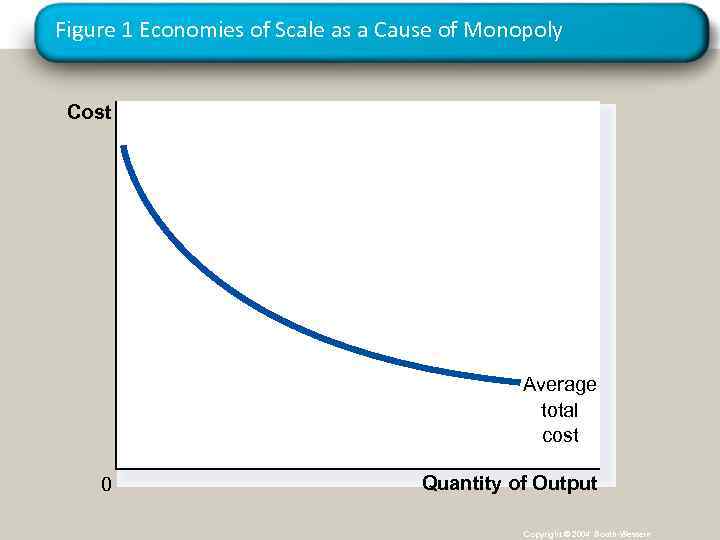 Figure 1 Economies of Scale as a Cause of Monopoly Cost Average total cost 0 Quantity of Output Copyright © 2004 South-Western
 The key difference between a competitive firm and a monopoly is the monopoly’s ability to influence the price of its output. A competitive firm is small relative to the market in which it operates and, therefore, has no power to influence the price of its output. It takes the price as given by market conditions. By contrast, because a monopoly is the sole producer in its market, it can alter the price of its good by adjusting the quantity it supplies to the market.
 HOW MONOPOLIES MAKE PRODUCTION AND PRICING DECISIONS One way to view this difference between a competitive firm and a monopoly is to consider the demand curve that each firm faces. Because a competitive firm can sell as much or as little as it wants at this price, the competitive firm faces a horizontal demand. The demand curve that any one firm faces is perfectly elastic.
 By contrast, because a monopoly is the sole producer in its market, its demand curve is the market demand curve. Thus, the monopolist’s demand curve slopes downward. If the monopolist raises the price of its good, consumers buy less of it. If the monopolist reduces the quantity of output it produces and sells, the price of its output increases. The market demand curve provides a constraint on a monopoly’s ability to profit from its market power. A monopolist would prefer, if it were possible, to charge a high price and sell a large quantity at that high price.
 The market demand curve makes that outcome impossible. In particular, the market demand curve describes the combinations of price and quantity that are available to a monopoly firm. By adjusting the quantity produced (or equivalently, the price charged), the monopolist can choose any point on the demand curve, but it cannot choose a point off the demand curve
 HOW MONOPOLIES MAKE PRODUCTION AND PRICING DECISIONS • Monopoly versus Competition – Monopoly • Is the sole producer • Faces a downward-sloping demand curve • Is a price maker • Reduces price to increase sales – Competitive Firm • Is one of many producers • Faces a horizontal demand curve • Is a price taker • Sells as much or as little at same price
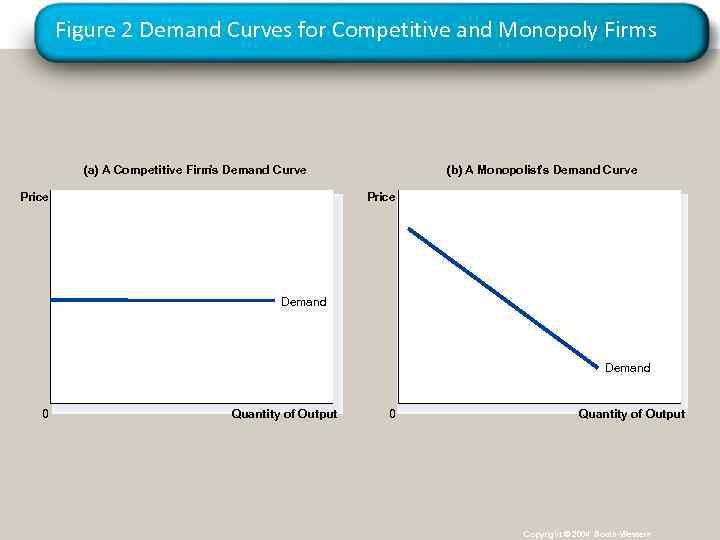 Figure 2 Demand Curves for Competitive and Monopoly Firms (a) A Competitive Firm Demand Curve ’s Price (b) A Monopolist’s Demand Curve Price Demand 0 Quantity of Output Copyright © 2004 South-Western
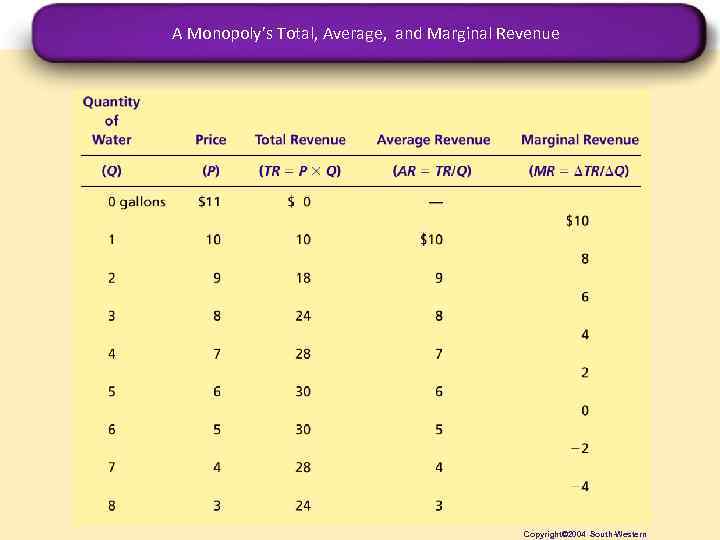 A Monopoly’s Total, Average, and Marginal Revenue Copyright© 2004 South-Western
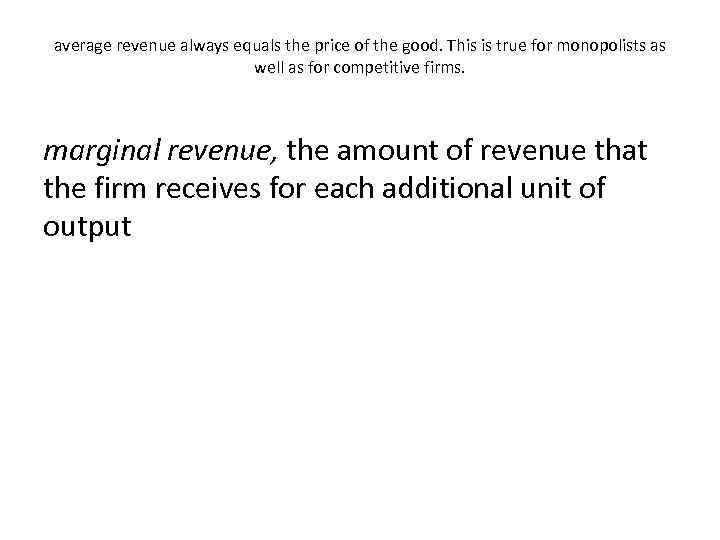 average revenue always equals the price of the good. This is true for monopolists as well as for competitive firms. marginal revenue, the amount of revenue that the firm receives for each additional unit of output
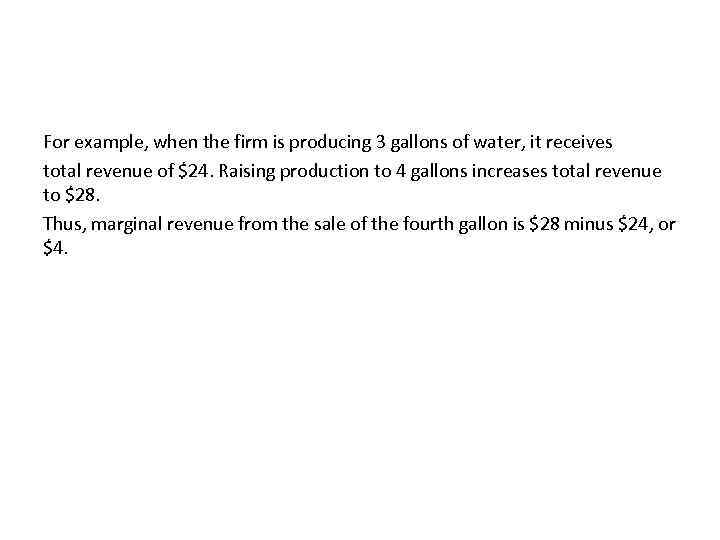 For example, when the firm is producing 3 gallons of water, it receives total revenue of $24. Raising production to 4 gallons increases total revenue to $28. Thus, marginal revenue from the sale of the fourth gallon is $28 minus $24, or $4.
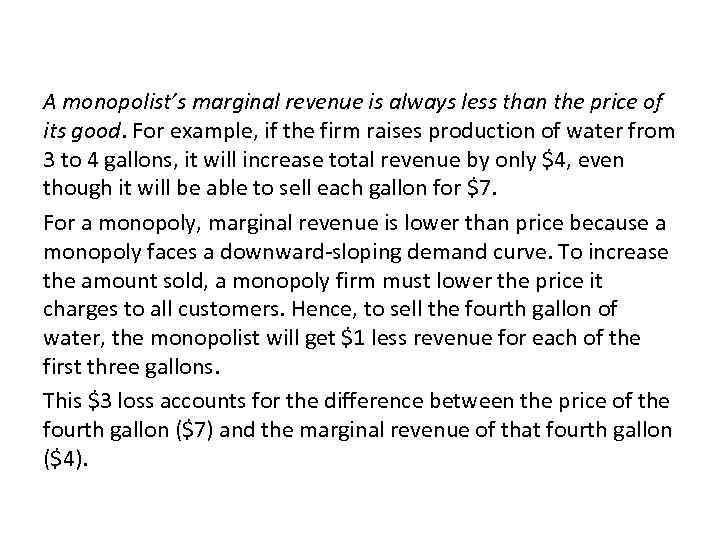 A monopolist’s marginal revenue is always less than the price of its good. For example, if the firm raises production of water from 3 to 4 gallons, it will increase total revenue by only $4, even though it will be able to sell each gallon for $7. For a monopoly, marginal revenue is lower than price because a monopoly faces a downward-sloping demand curve. To increase the amount sold, a monopoly firm must lower the price it charges to all customers. Hence, to sell the fourth gallon of water, the monopolist will get $1 less revenue for each of the first three gallons. This $3 loss accounts for the difference between the price of the fourth gallon ($7) and the marginal revenue of that fourth gallon ($4).
 Marginal revenue for monopolies is very different from marginal revenue for competitive firms. When a monopoly increases the amount it sells, this action has two effects on total revenue (P. Q): • The output effect: More output is sold, so Q is higher, which tends to increase total revenue. • The price effect: The price falls, so P is lower, which tends to decrease total revenue.
 Because a competitive firm can sell all it wants at the market price, there is no price effect. When it increases production by 1 unit, it receives the market price for that unit, and it does not receive any less for the units it was already selling. That is, because the competitive firm is a price taker, its marginal revenue equals the price of its good. By contrast, when a monopoly increases production by 1 unit, it must reduce the price it charges for every unit it sells, and this cut in price reduces revenue on the units it was already selling. As a result, a monopoly’s marginal revenue is less than its price.
 A Monopoly’s Revenue • A Monopoly’s Marginal Revenue – A monopolist’s marginal revenue is always less than the price of its good. • The demand curve is downward sloping. • When a monopoly drops the price to sell one more unit, the revenue received from previously sold units also decreases.
 A Monopoly’s Revenue • A Monopoly’s Marginal Revenue – When a monopoly increases the amount it sells, it has two effects on total revenue (P Q). • The output effect—more output is sold, so Q is higher. • The price effect—price falls, so P is lower.
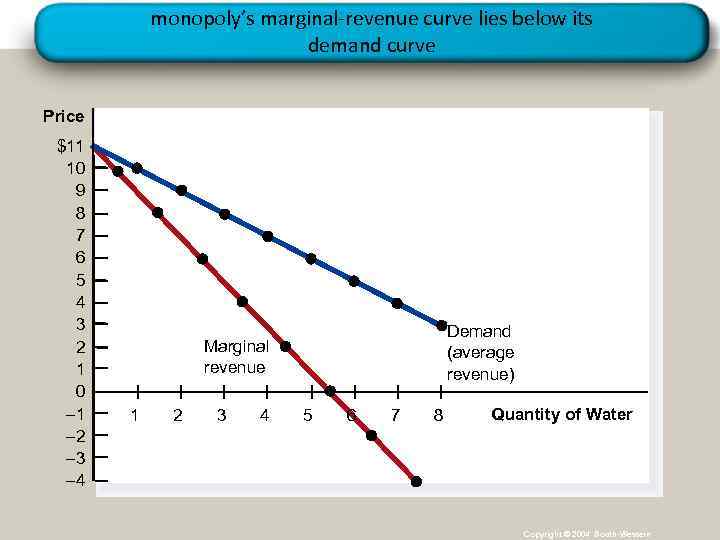 monopoly’s marginal-revenue curve lies below its demand curve Price $11 10 9 8 7 6 5 4 3 2 1 0 – 1 – 2 – 3 – 4 Demand (average revenue) Marginal revenue 1 2 3 4 5 6 7 8 Quantity of Water Copyright © 2004 South-Western
 Profit Maximization A monopoly maximizes profit by producing the quantity at which marginal revenue equals marginal cost. It then uses the demand curve to find the price that will induce consumers to buy that quantity.
 marginal revenue can even become negative. Marginal revenue is negative when the price effect on revenue is greater than the output effect. In this case, when the firm produces an extra unit of output, the price falls by enough to cause the firm’s total revenue to decline, even though the firm is selling more units.
 rational people think at the margin. This lesson is as true for monopolists as it is for competitive firms.
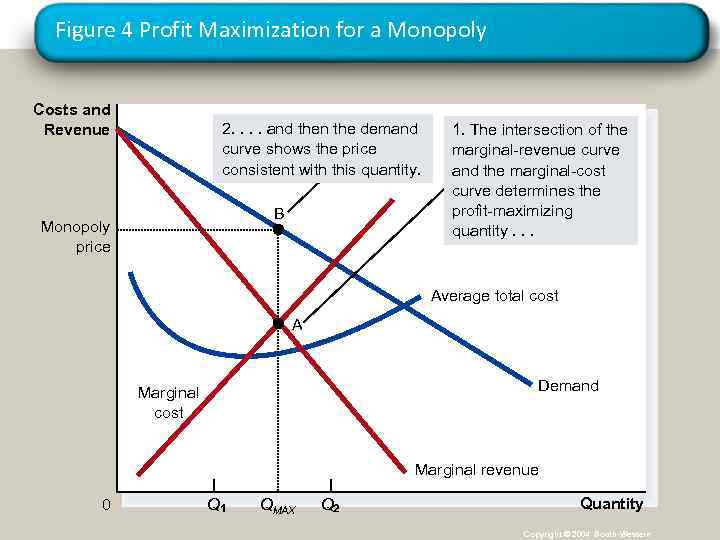 Figure 4 Profit Maximization for a Monopoly Costs and Revenue 2. . and then the demand curve shows the price consistent with this quantity. B Monopoly price 1. The intersection of the marginal-revenue curve and the marginal-cost curve determines the profit-maximizing quantity. . . Average total cost A Demand Marginal cost Marginal revenue 0 Q QMAX Q Quantity Copyright © 2004 South-Western
 first, that the firm is producing at a low level of output, such as Q 1. In this case, marginal cost is less than marginal revenue. If the firm increased production by 1 unit, the additional revenue would exceed the additional costs, and profit would rise. Thus, when marginal cost is less than marginal revenue, the firm can increase profit by producing more units. A similar argument applies at high levels of output, such as Q 2. In this case, marginal cost is greater than marginal revenue. If the firm reduced production by 1 unit, the costs saved would exceed the revenue lost. Thus, if marginal cost is greater than marginal revenue, the firm can raise profit by reducing production. In the end, the firm adjusts its level of production until the quantity reaches QMAX, at which marginal revenue equals marginal cost. Thus, the monopolist’s profitmaximizing
 quantity of output is determined by the intersection of the marginal-revenue curve and the marginal-cost curve. In Figure 4, this intersection occurs at point A. You might recall from the previous chapter that competitive firms also choose the quantity of output at which marginal revenue equals marginal cost. In following this rule for profit maximization, competitive firms and monopolies are alike.
 But there is also an important difference between these types of firms: The marginal revenue of a competitive firm equals its price, whereas the marginal revenue of a monopoly is less than its price. That is, For a competitive firm: P = MR = MC. For a monopoly firm: P. MR = MC. The equality of marginal revenue and marginal cost determines the profit maximizing quantity for both types of firm. What differs is how the price is related to marginal revenue and marginal cost.
 How does the monopoly find the profit-maximizing price for its product? The demand curve answers this question because the demand curve relates the amount that customers are willing to pay to the quantity sold. Thus, after the monopoly firm chooses the quantity of output that equates marginal revenue and marginal cost, it uses the demand curve to find the highest price it can charge for that quantity. We can now see a key difference between markets with competitive firms and markets with a monopoly firm: In competitive markets, price equals marginal cost. In monopolized markets, price exceeds marginal cost.
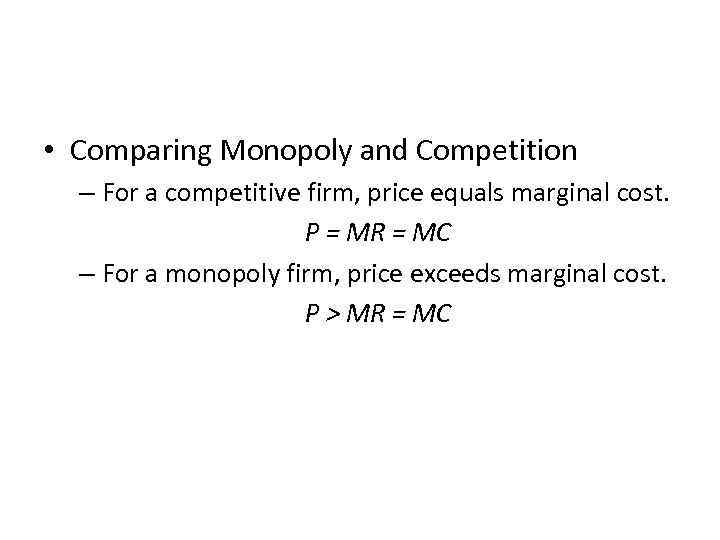 Profit Maximization • Comparing Monopoly and Competition – For a competitive firm, price equals marginal cost. P = MR = MC – For a monopoly firm, price exceeds marginal cost. P > MR = MC
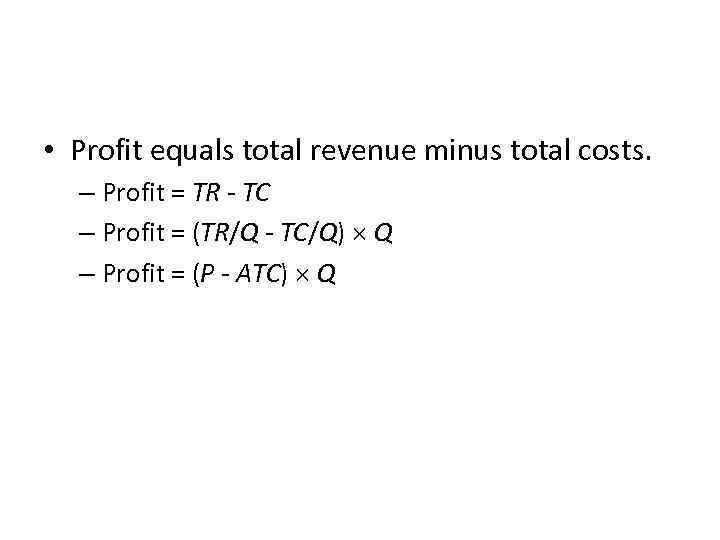 A Monopoly’s Profit • Profit equals total revenue minus total costs. – Profit = TR - TC – Profit = (TR/Q - TC/Q) Q – Profit = (P - ATC) Q
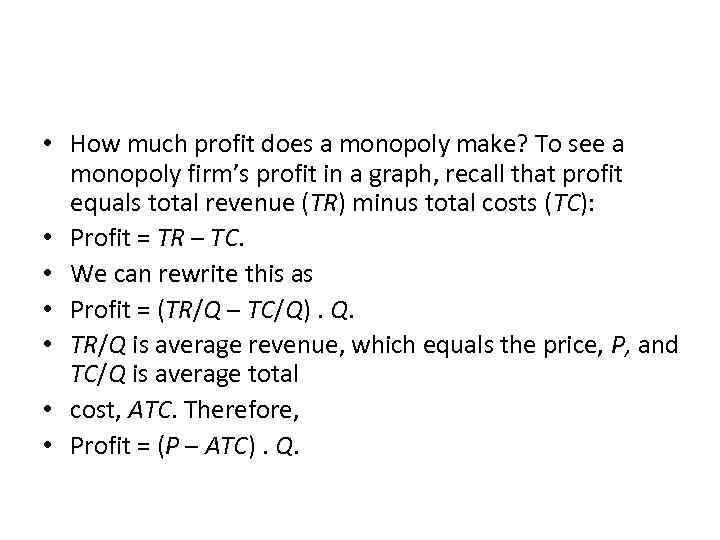 • How much profit does a monopoly make? To see a monopoly firm’s profit in a graph, recall that profit equals total revenue (TR) minus total costs (TC): • Profit = TR – TC. • We can rewrite this as • Profit = (TR/Q – TC/Q). Q. • TR/Q is average revenue, which equals the price, P, and TC/Q is average total • cost, ATC. Therefore, • Profit = (P – ATC). Q.
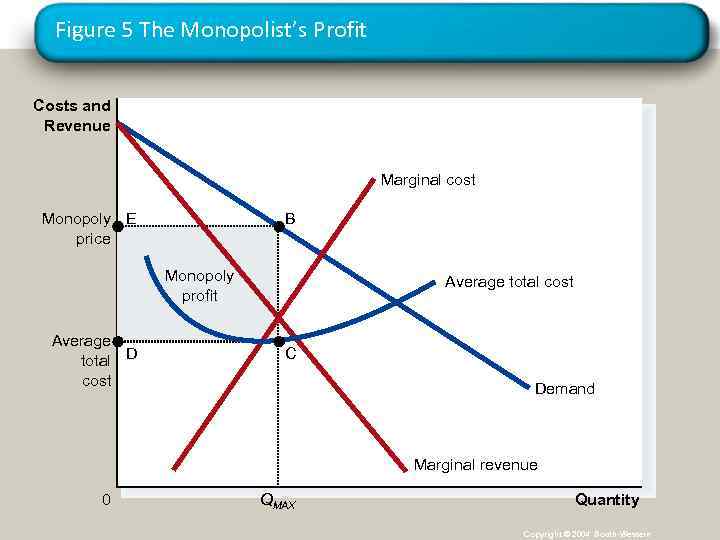 Figure 5 The Monopolist’s Profit Costs and Revenue Marginal cost Monopoly E price B Monopoly profit Average total D cost Average total cost C Demand Marginal revenue 0 QMAX Quantity Copyright © 2004 South-Western
 A Monopolist’s Profit • The monopolist will receive economic profits as long as price is greater than average total cost.
 Case study market for pharmaceutical drugs because this market takes on both market structures. When a firm discovers a new drug, patent laws give the firm a monopoly on the sale of that drug. But later the firm’s patent runs out, and any company can make and sell the drug. At that time, the market switches from being monopolistic to being competitive. What should happen to the price of a drug when the patent runs out? The marginal cost of producing the drug is constant. (This is approximately true for many drugs. ) During the life of the patent, the monopoly firm maximizes profit by producing the quantity at which marginal revenue equals marginal cost and charging a price well above marginal cost. But when the patent runs out, the profit from making the drug should encourage new firms to enter the market. As the market becomes more competitive, the price should fall to equal marginal cost.
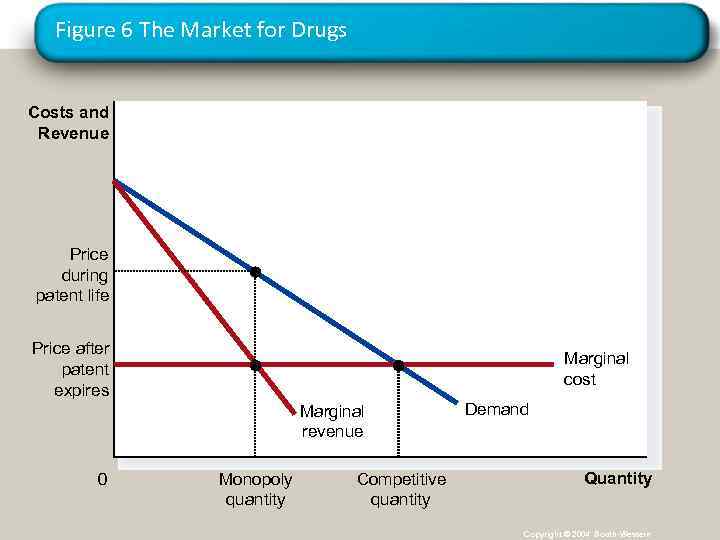 Figure 6 The Market for Drugs Costs and Revenue Price during patent life Price after patent expires Marginal cost Marginal revenue 0 Monopoly quantity Competitive quantity Demand Quantity Copyright © 2004 South-Western