


 Скачать презентацию Monitoring of Spent Nuclear Fuel Reprocessing Studies via
502c3ff33ae6f95f4ff03c045216376f.ppt
- Количество слайдов: 24
 Monitoring of Spent Nuclear Fuel Reprocessing Studies via UV-Visible Spectroscopy Jamie L. Warburton Radiochemistry Ph. D Candidate University of Nevada, Las Vegas Harry Reid Center for Environmental Studies ANS Student Conference, April 3 rd, 2009
 Outline • Introduction • ANL experiments • Experimental Setup • Results • UNLV • Experimental Setup • Results • Conclusions ANS Student Conference, April 3 rd, 2009 2
 Introduction • • • Process monitoring can improve safeguards in spent nuclear fuel reprocessing Several parameters can be monitored • Mass, temperature, flow rate, p. H, concentration UV-Vis is an effective technique for concentration monitoring • Portable • On-line capability • Very fast spectral acquisition • Rapid analysis possible to confirm process chemistry and for materials accountability • Peak to peak ratio measurements • Significant changes in absorbance ANS Student Conference, April 3 rd, 2009 3
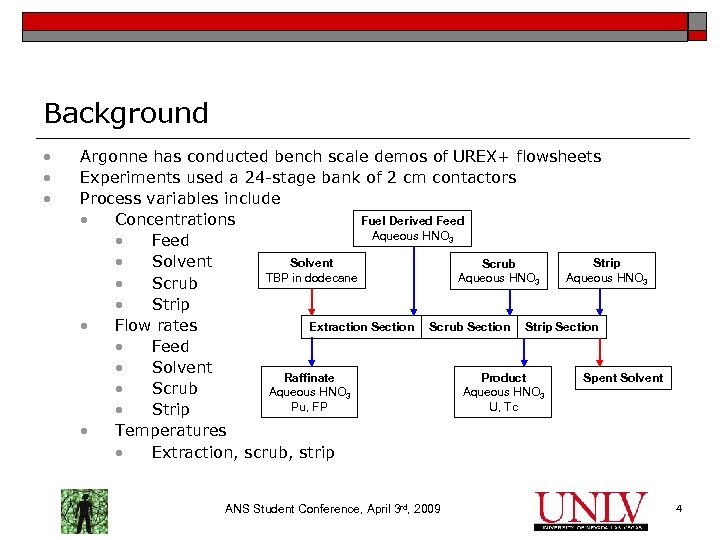 Background • • • Argonne has conducted bench scale demos of UREX+ flowsheets Experiments used a 24 -stage bank of 2 cm contactors Process variables include • Concentrations Fuel Derived Feed Aqueous HNO 3 • Feed Solvent Strip • Solvent Scrub TBP in dodecane Aqueous HNO 3 • Scrub • Strip • Flow rates Extraction Section Scrub Section Strip Section • Feed • Solvent Raffinate Product Spent Solvent • Scrub Aqueous HNO 3 Pu, FP U, Tc • Strip • Temperatures • Extraction, scrub, strip ANS Student Conference, April 3 rd, 2009 4
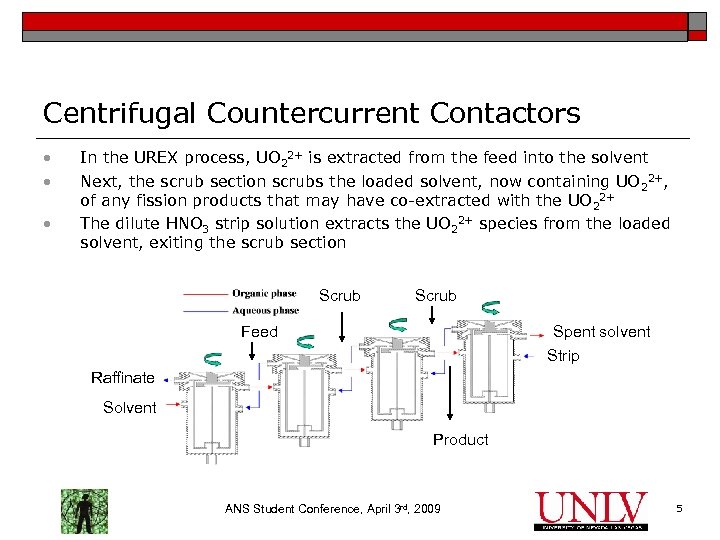 Centrifugal Countercurrent Contactors • • • In the UREX process, UO 22+ is extracted from the feed into the solvent Next, the scrub section scrubs the loaded solvent, now containing UO 22+, of any fission products that may have co-extracted with the UO 22+ The dilute HNO 3 strip solution extracts the UO 22+ species from the loaded solvent, exiting the scrub section Scrub Feed Spent solvent Strip Raffinate Solvent Product ANS Student Conference, April 3 rd, 2009 5
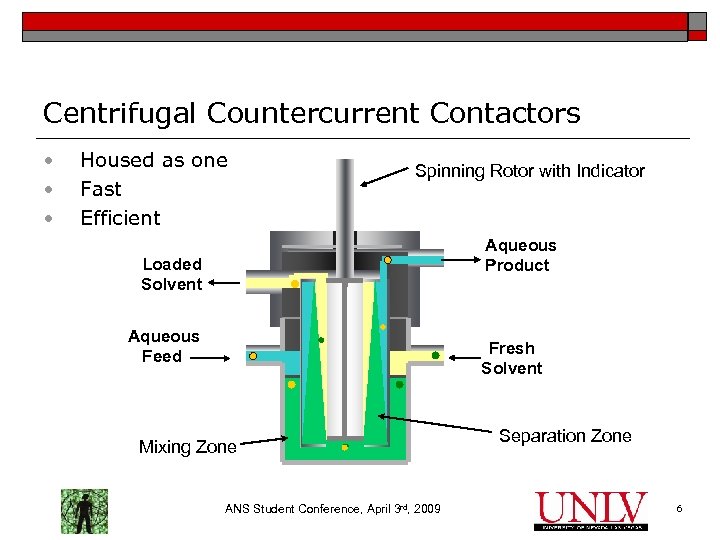 Centrifugal Countercurrent Contactors • • • Housed as one Fast Efficient Spinning Rotor with Indicator Aqueous Product Loaded Solvent Aqueous Feed Fresh Solvent Mixing Zone ANS Student Conference, April 3 rd, 2009 Separation Zone 6
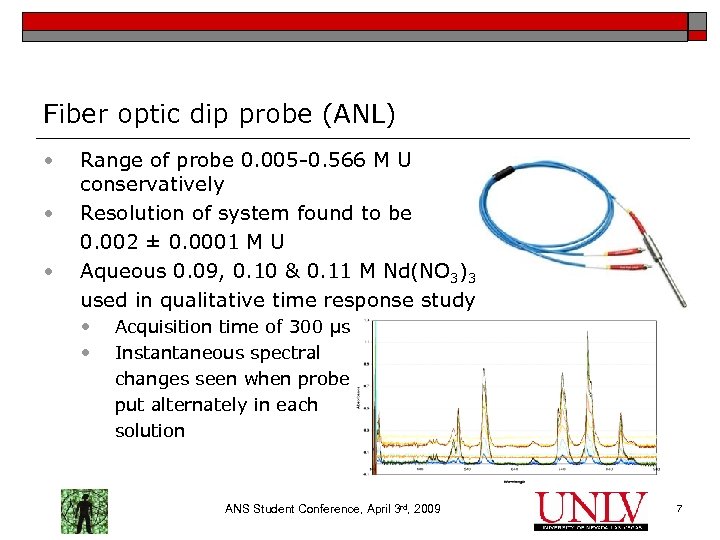 Fiber optic dip probe (ANL) • • • Range of probe 0. 005 -0. 566 M U conservatively Resolution of system found to be 0. 002 ± 0. 0001 M U Aqueous 0. 09, 0. 10 & 0. 11 M Nd(NO 3)3 used in qualitative time response study • • Acquisition time of 300 μs Instantaneous spectral changes seen when probe put alternately in each solution ANS Student Conference, April 3 rd, 2009 7
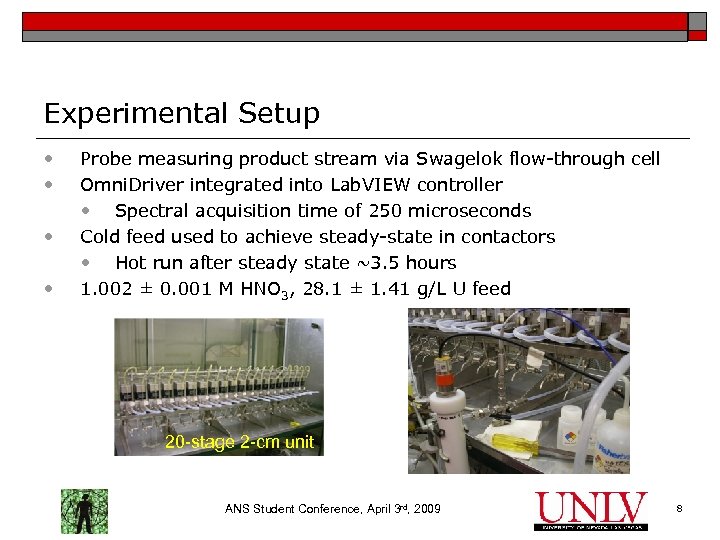 Experimental Setup • • Probe measuring product stream via Swagelok flow-through cell Omni. Driver integrated into Lab. VIEW controller • Spectral acquisition time of 250 microseconds Cold feed used to achieve steady-state in contactors • Hot run after steady state ~3. 5 hours 1. 002 ± 0. 001 M HNO 3, 28. 1 ± 1. 41 g/L U feed 20 -stage 2 -cm unit ANS Student Conference, April 3 rd, 2009 8
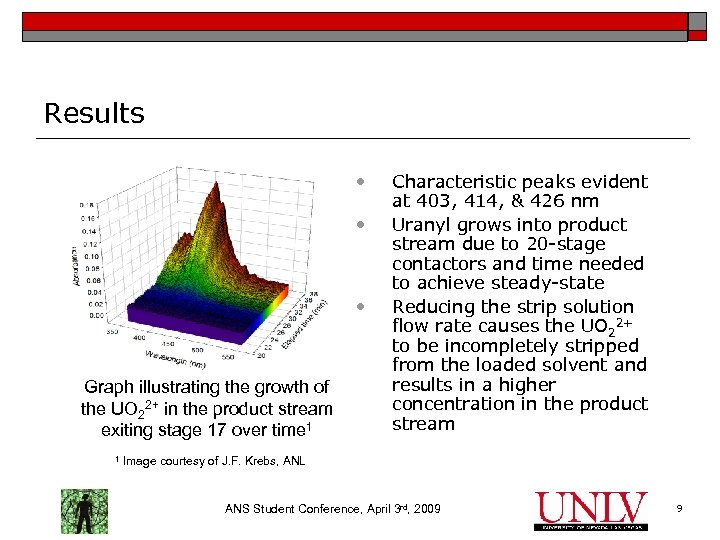 Results • • • Graph illustrating the growth of the UO 22+ in the product stream exiting stage 17 over time 1 1 Characteristic peaks evident at 403, 414, & 426 nm Uranyl grows into product stream due to 20 -stage contactors and time needed to achieve steady-state Reducing the strip solution flow rate causes the UO 22+ to be incompletely stripped from the loaded solvent and results in a higher concentration in the product stream Image courtesy of J. F. Krebs, ANL ANS Student Conference, April 3 rd, 2009 9
 Summary • • Fiber optic probe setup is successful in monitoring product conditions in simulated UREX run • Varying flow rate does not affect spectral acquisition, but does affect product concentration UV-Vis monitoring used in conjunction with flow rate meters to identify source of absorbance changes • Intended vs. unintended flow rate alterations • Material diversion Acquisition time of 250 ms • Online automated monitoring of peaks as well as peak to peak comparison is needed – user monitoring is too slow Flow rates result in slugs of solution in product stream ANS Student Conference, April 3 rd, 2009 10
 Flow-thru Cuvettes (UNLV) • • Hellma flow-through cuvettes instead of fiber optic dip probe • Utilizing robust UV-Vis while peristaltic pump provides sample flow • Sample “stock” is outside UV-Vis and can be changed during absorbance measurements • Various pathlengths available (1 cm, 0. 5 cm, 0. 1 cm) • Disassemble setup to change pathlength Flow rates • Previously (ANL) looking at 5 -40 m. L/min • Peristaltic pump’s (UNLV) range is ~0. 5 -4 m. L/min • Industrial scale will be ~ L/min • Slight variations due to tightness of clamps and tubing size ANS Student Conference, April 3 rd, 2009 11
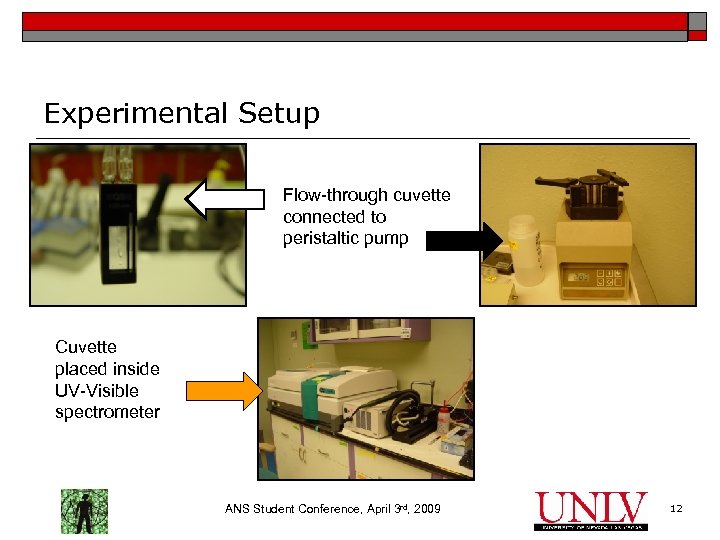 Experimental Setup Flow-through cuvette connected to peristaltic pump Cuvette placed inside UV-Visible spectrometer ANS Student Conference, April 3 rd, 2009 12
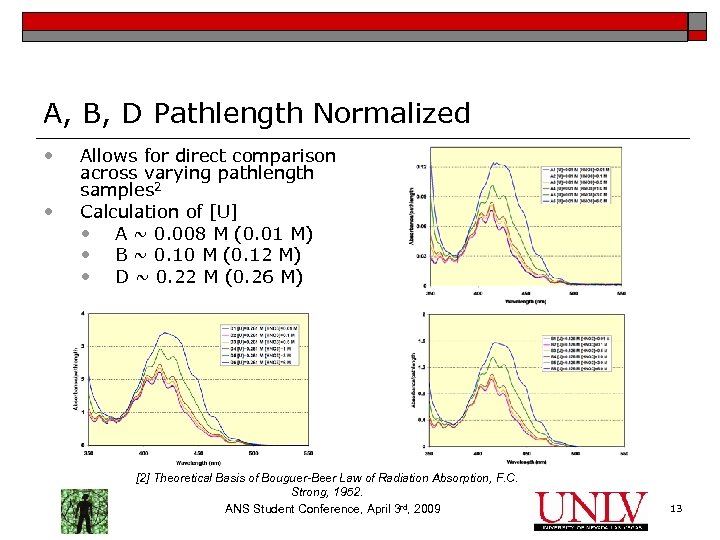 A, B, D Pathlength Normalized • • Allows for direct comparison across varying pathlength samples 2 Calculation of [U] • A ~ 0. 008 M (0. 01 M) • B ~ 0. 10 M (0. 12 M) • D ~ 0. 22 M (0. 26 M) [2] Theoretical Basis of Bouguer-Beer Law of Radiation Absorption, F. C. Strong, 1952. ANS Student Conference, April 3 rd, 2009 13
![E, G, H Pathlength normalized • Calculation of [U] • E ~ 0. 57](https://present5.com/presentation/502c3ff33ae6f95f4ff03c045216376f/image-14.jpg "E, G, H Pathlength normalized • Calculation of [U] • E ~ 0. 57") E, G, H Pathlength normalized • Calculation of [U] • E ~ 0. 57 M (0. 63 M) • G ~ 0. 96 M (1. 01 M) • H ~ 1. 28 M (1. 26 M) ANS Student Conference, April 3 rd, 2009 14
E, G, H Pathlength normalized • Calculation of [U] • E ~ 0. 57 M (0. 63 M) • G ~ 0. 96 M (1. 01 M) • H ~ 1. 28 M (1. 26 M) ANS Student Conference, April 3 rd, 2009 14
 Summary • Loss of peak resolution evident at 6 M HNO 3 across uranyl concentrations • Peak ratio changes throughout uranyl concentrations for [H+] ≥ 3 M • At highest uranyl (1. 26 M) shouldering in spectra across [H+] range • Calculation assuming ε=10 M-1 cm-1 provides method and experimental check ANS Student Conference, April 3 rd, 2009 15
![Influence of Acid 0. 01 M & 0. 1 M [H+] ANS Student Conference,](https://present5.com/presentation/502c3ff33ae6f95f4ff03c045216376f/image-16.jpg "Influence of Acid 0. 01 M & 0. 1 M [H+] ANS Student Conference,") Influence of Acid 0. 01 M & 0. 1 M [H+] ANS Student Conference, April 3 rd, 2009 16
Influence of Acid 0. 01 M & 0. 1 M [H+] ANS Student Conference, April 3 rd, 2009 16
![Influence of Acid 0. 5 M & 1 M [H+] ANS Student Conference, April](https://present5.com/presentation/502c3ff33ae6f95f4ff03c045216376f/image-17.jpg "Influence of Acid 0. 5 M & 1 M [H+] ANS Student Conference, April") Influence of Acid 0. 5 M & 1 M [H+] ANS Student Conference, April 3 rd, 2009 17
Influence of Acid 0. 5 M & 1 M [H+] ANS Student Conference, April 3 rd, 2009 17
![Influence of Acid 3 M [H+] ANS Student Conference, April 3 rd, 2009 18](https://present5.com/presentation/502c3ff33ae6f95f4ff03c045216376f/image-18.jpg "Influence of Acid 3 M [H+] ANS Student Conference, April 3 rd, 2009 18") Influence of Acid 3 M [H+] ANS Student Conference, April 3 rd, 2009 18
Influence of Acid 3 M [H+] ANS Student Conference, April 3 rd, 2009 18
![Influence of Acid 6 M [H+] ANS Student Conference, April 3 rd, 2009 19](https://present5.com/presentation/502c3ff33ae6f95f4ff03c045216376f/image-19.jpg "Influence of Acid 6 M [H+] ANS Student Conference, April 3 rd, 2009 19") Influence of Acid 6 M [H+] ANS Student Conference, April 3 rd, 2009 19
Influence of Acid 6 M [H+] ANS Student Conference, April 3 rd, 2009 19
![Summary • No change across • 0. 01 M & 0. 1 M [H+]](https://present5.com/presentation/502c3ff33ae6f95f4ff03c045216376f/image-20.jpg "Summary • No change across • 0. 01 M & 0. 1 M [H+]") Summary • No change across • 0. 01 M & 0. 1 M [H+] • 0. 5 M & 1 M [H+] • Trends in peak ratios remain similar • Rapid changes seen at 3 M & 6 M [H+] • Complete loss of peak resolution • Significant trend alterations in peak ratios No distinct peaks at 6 M [H+] ANS Student Conference, April 3 rd, 2009 20
Summary • No change across • 0. 01 M & 0. 1 M [H+] • 0. 5 M & 1 M [H+] • Trends in peak ratios remain similar • Rapid changes seen at 3 M & 6 M [H+] • Complete loss of peak resolution • Significant trend alterations in peak ratios No distinct peaks at 6 M [H+] ANS Student Conference, April 3 rd, 2009 20
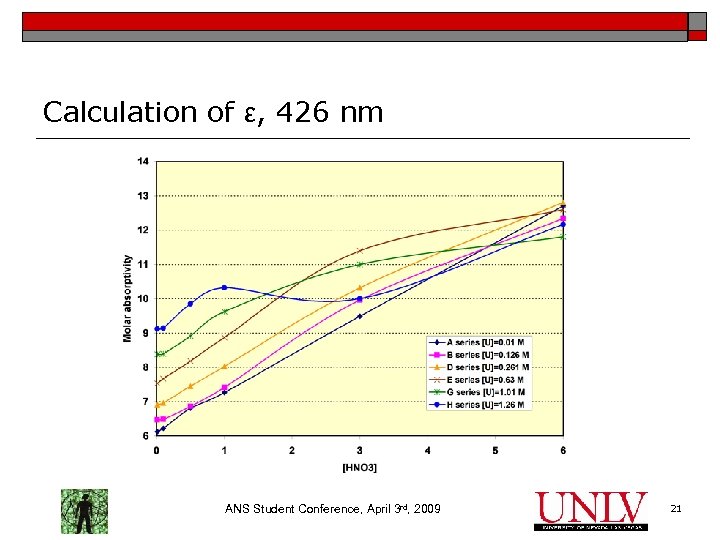 Calculation of ε, 426 nm ANS Student Conference, April 3 rd, 2009 21
 Conclusions • Alleviated slug flow obstacle seen in fiber optic dip probe via cuvette flow-through cell • At high [HNO 3] (or high [NO 3 -]) and high [UO 22+] • Still see loss of peak definition as expected 3 • Calculations of ε confirm [HNO 3] and [U] dependence • UV-Vis spectroscopy can be used effectively in process monitoring to demonstrate a more proliferation-resistant fuel reprocessing plant [3] The Simultaneous Analysis of Uranium and Nitrate, D. T. Bostick et al, 1978. ANS Student Conference, April 3 rd, 2009 22
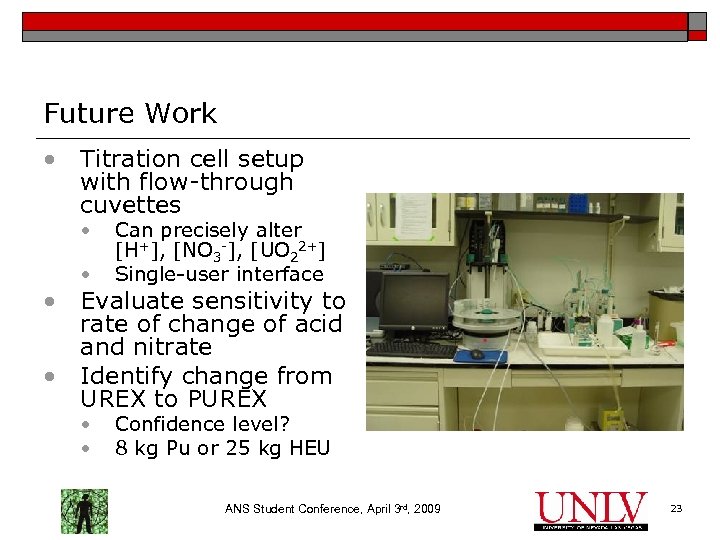 Future Work • Titration cell setup with flow-through cuvettes • • Can precisely alter [H+], [NO 3 -], [UO 22+] Single-user interface • • Confidence level? 8 kg Pu or 25 kg HEU • Evaluate sensitivity to rate of change of acid and nitrate • Identify change from UREX to PUREX ANS Student Conference, April 3 rd, 2009 23
 Acknowledgements • • Dr. Kenneth Ronald Czerwinski Dr. Patricia Paviet-Hartmann Dr. Gary Steven Cerefice Nick Smith Amber Wright Dr. John F. Krebs, ANL This work was performed under the Nuclear Forensics Graduate Fellowship Program which is sponsored by the U. S. Department of Homeland Security’s Domestic Nuclear Detection Office and the U. S. Department of Defense’s Domestic Threat Reduction Agency ANS Student Conference, April 3 rd, 2009 24