


 Скачать презентацию MONITORING EARLY CHILDHOOD DEVELOPMENT National ECD CONFERENCE 29
53a1c0b90570dfd47dd8db8ea0b95728.ppt
- Количество слайдов: 29
 MONITORING EARLY CHILDHOOD DEVELOPMENT National ECD CONFERENCE 29 March 2012
 OUTLINE OF PRESENTATION This presentation includes three parts: 1. THE MANDATE OF DWCPD 2. CONSIDERATIONS FOR MONITORING ECCD 3. RECOMMENDATIONS FOR THE ROAD AHEAD
 THE PURPOSE OF THIS PAPER SO WHY THIS PRESENTATION? • To stimulate discussion and possibly a process for development of an effective M&E framework for the sector – • To contextualize the development of a monitoring framework for ECCD within the government wide M&E framework.
 OVERVIEW OF DWCPD Vision of the Department of Women, Children and People with Disabilities is: “A fully inclusive society free from unfair discrimination, inequality, abuse and exploitation. ” Mandate: To promote, facilitate, coordinate and monitor the realisation of the rights of women, children and people with disabilities.
 MANDATE • The DWCPD was instituted in terms of section 7(5)(a) of the Public Service Act, 1994 (Proclamation No. 103 of 1994, on 6 July 2009. • “A new Ministry has been created for Women, Youth, Children and People with Disability, to emphasise the need for equity and access to development opportunities for the vulnerable groups in our society”
 • “monitor other government departments to ensure the mainstreaming of gender, children’s rights and disability considerations into all programmes of government and other sectors. This will help government to respond to issues of these targeted groups in an integrated and coherent manner”
 5 Key Strategic Objectives • Advocate for the promotion and protection of the rights of women, children and people with disabilities; • Monitor and evaluate gender, disability and children’s rights by ensuring that the national compendium of macroindicators integrate targets for women, children and people with disabilities; • Ensure that mainstreaming of gender, disability and children’s rights happens at Cabinet, FOSAD, cluster, departmental, provincial and local government levels, as well as public funded institutions, the private sector and civil society • strengthen institutional capacity to deliver quality service; and • strengthen participation in strategic bilateral and multilateral initiatives
 APPROACH • The M&E strategy for women, children and people with disabilities is conceptualised and developed within the context, procedures and processes of government’s Performance Management Monitoring and Evaluation Policy Framework (2007). • This results-based M&E system promotes accountability and good governance for the progressive realization of rights and is applicable to all entities in the national, provincial, and local spheres of government
 APPROACH • There is greater appreciation that as important as the financial, human resource and audit systems are - government also need a good performance feedback system. • Enabling a systematic process of producing regular information that is transparent, trustworthy and relevant (quarterly) • Starts with Min. Performance agreements etc.
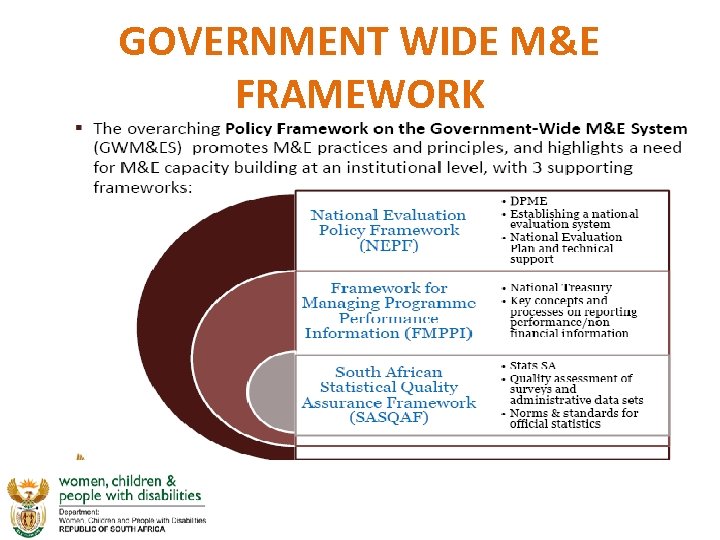 GOVERNMENT WIDE M&E FRAMEWORK
 DWCPD METHODOLOGY • Development of M&E Strategy: Diagnostic Phase • Work closely with other departments • An appropriate regime of measurable indicators to progressively track key dimensions and trends • Improve the coordination of all data gathering efforts and contribute to better consistency in measurements and reduced duplication.
 KEY CONSIDERATIONS FOR DEVELOPING M&E SYSTEMS • Building a ECCD system –cant’ be a discrete event, unconnected to other public sector and public administration reform efforts and processes- • Linking ECCD M&E to these existing initiatives and processes creates the desired interdependency that is good for sustainability. • In the end it is the creation of a system that is aligned from one level to the other that is most critical. In this way information can flow up and down government systems and shared across levels.
 Key questions that drive ECCD indicator work • What do we know about the scope, nature, and impact of Early Childhood Development programmes? • Can policymakers adequately assess children’s wellbeing & service delivery across health, education, and social development ? • What do practitioners feel is important and relevant when it comes to understanding, monitoring and learning from the effects and impact of their work?
 KEY REASONS FOR M&E SYSTEM FOR ECCD It can assist to: • Define the key national outcomes for ECCD • Track performance systematically – across sectors • Provide specific measures as a means of demonstrating such improvements • Facilitate documentation and reporting -stakeholders • Facilitate internal – management, systems improve decision making. • Facilitate coordination, collaboration, joint planning, resourcing, identification and redress of the barriers and bottlenecks in the overall ECCD delivery system.
 BUILDING M&E FOR ECCD: LESSONS LEARNT • The process of arriving at indicators to be used is as important as the particular indicators that are created and eventually monitored. • A long process that requires a sustained coordinated M&E approach and process. • M&E is not an end unto itself –its a tool to promote good management practices and better accountability, support innovation, reform, better governance and outcomes for children, families.
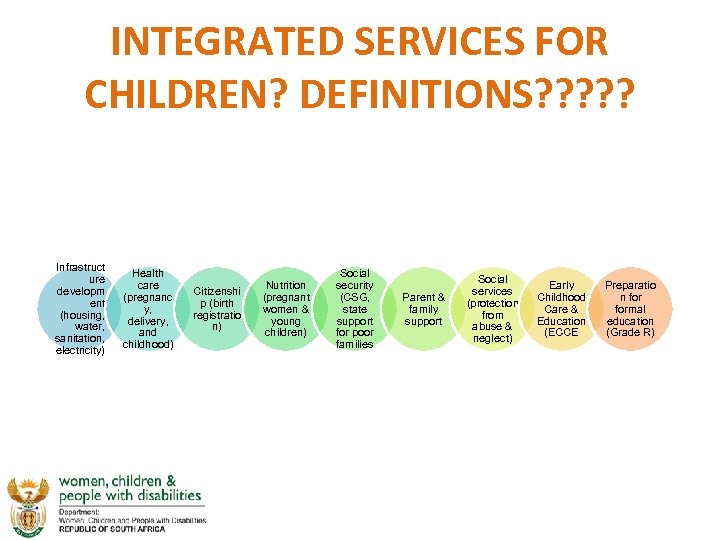 INTEGRATED SERVICES FOR CHILDREN? DEFINITIONS? ? ? Infrastruct ure developm ent (housing, water, sanitation, electricity) Health care (pregnanc y, delivery, and childhood) Citizenshi p (birth registratio n) Nutrition (pregnant women & young children) Social security (CSG, state support for poor families Parent & family support Social services (protection from abuse & neglect) Early Childhood Care & Education (ECCE Preparatio n formal education (Grade R)
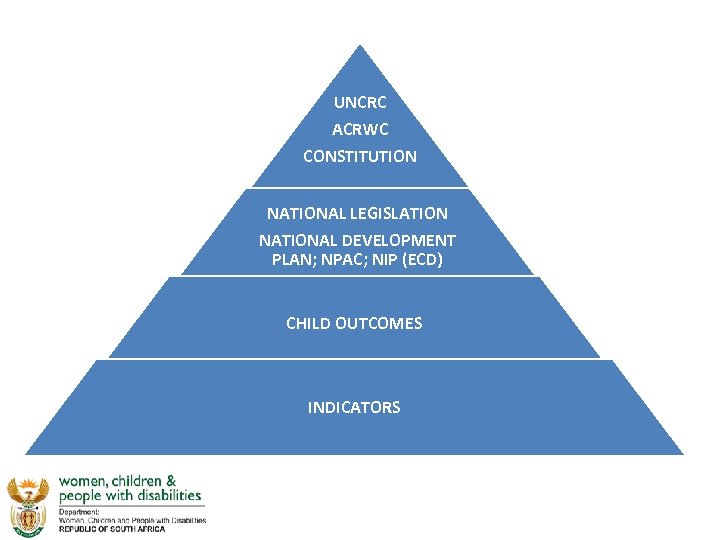 UNCRC ACRWC CONSTITUTION NATIONAL LEGISLATION NATIONAL DEVELOPMENT PLAN; NPAC; NIP (ECD) CHILD OUTCOMES INDICATORS
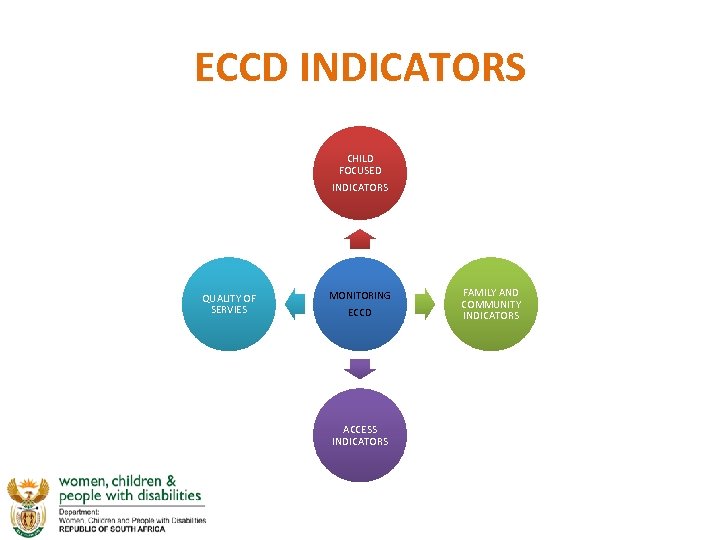 ECCD INDICATORS CHILD FOCUSED INDICATORS QUALITY OF SERVIES MONITORING ECCD ACCESS INDICATORS FAMILY AND COMMUNITY INDICATORS
 KEY CONSIDERATIONS FOR DEVELOPING M&E SYSTEMS • MUST INCLUDE: (i) Indicators that monitor the general status of children during their early years (quality of programme initiatives +quality of the contexts AS WELL AS: • Indicators that monitors the performance of government’s institutional and operational systems • Without grounded (evidence) it will remain difficult to leverage the kind of support and resources that is required for sustained quality ECCD/DATA/MANAGEMENT
 What can indicators tell us? • Context (e. g. , Gross Domestic Product, income distribution, population size, availability of health services, communications media, longevity, general educational attainment of the population). • Financial capacity to support programmes (social expenditures, percentage of budgets devoted to various sectors and programmes). • Effort put forth (enrolment ratios and growth, indicators of quality such as adult/child ratios, certification levels). • Efficiency (cost per participant or graduate, graduates as percentage of those who began, etc. ). • Effects (developmental indicators, "achievement, " values, and attitudes). • Social well-being (mortality rates, literacy rates, delinquency levels
 What can indicators tell us? • Context (e. g. , Gross Domestic Product, income distribution, population size, availability of health services, communications media, longevity, general educational attainment of the population). • Financial capacity to support programmes (social expenditures, percentage of budgets devoted to various sectors and programmes). • Effort put forth (enrolment ratios and growth, indicators of quality such as adult/child ratios, certification levels). • Efficiency (cost per participant or graduate, graduates as percentage of those who began, etc. ). • Effects (developmental indicators, "achievement, " values, and attitudes). • Social well-being (mortality rates, literacy rates, delinquency levels
 QUESTION? • What constitutes such a set of basic indicators for ECCD and how do we arrive at there ? • THERE IS NO CONCENSUS ON HOW MANY STEPS GO INTO BUILDING AN M&E SYSTEM • (Kusek & Rists, 2004 )
 LITERATURE AND EXAMPLES • In South Africa the work of Dawes, Bray, and the Child & Youth Research programme at UWC; CI; HSRC; DSD. • Robert G. Myers (NGO group on ECD) and others examined the work of different international organisations and provide some useful insights into the difficulties involved in framing indicators. • International organizations such as UNICEF, WHO, UNESCO; child watch International; ISCI; TRENDS; has produced domains and lists of possible indicators
 The sixteen possible indicators are organised in the following categories • • • Coverage, access, use Programme quality Political will: policy and financing Costs and expenditures Status of or effects on children and parents
 TOWARDS A COORDINATED APPROACH TO MONITOR ECCD • Establish an inter-sectoral and interdisciplinary ECCD task team to develop proposed M&E framework to monitor the (i) status of young children, the environments affecting their development, the programmes intended to improve their development (ii) government and civil society’s performance in regard to the commitments made in regard to ECCD.
 Specifically to consider • Purpose and scope: What is it that we must measure and why • Approach and levels of monitoring and evaluation: Who does this: National provincial or sub province level • Selection of domains, indicators and measures: what are the domains and indicators that will best represent what we must monitor? How do we align these into a comprehensive and integrated regime across data sources. • Sources of data and partnerships: who will generate the data? Existing and new gaps identified • Information dissemination and use – products to be produced and what do we do with these- impact change?
 CHALLENGES • The creation of an M&E system requires interdependency, alignment and coordination across different levels • Information systems of government departments are at different stages - specific contribution to the full set of domains and indicators. • Arriving at instruments to measure child development continues to be contentious and difficult –
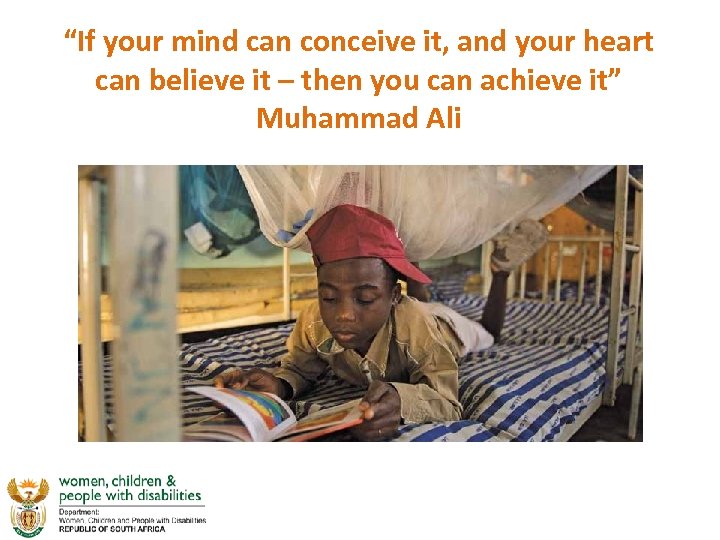 “If your mind can conceive it, and your heart can believe it – then you can achieve it” Muhammad Ali
 Conclusion Thank you