


 Скачать презентацию MONGOLIAN NATIONAL UNIVETSITY OF MEDICAL SCIENCES INTRODUCTION OF
0b97eef25a09fb488853edfe70364bf1.ppt
- Количество слайдов: 37
 MONGOLIAN NATIONAL UNIVETSITY OF MEDICAL SCIENCES INTRODUCTION OF MONGOLIAN MEDICINE Professor D. Tserendagva 2014. 12, Seoul, Korea
 DALKH TSERENDAGVA, MD, Ph. D, Professor • Director, Traditional medical Institute, School of Medicine, Mongolian National University of Medical Sciences, Ulaanbaatar, Mongolia • Head of department internal medicine, Traditional medical institute • Academician, Mongolian Academy of Medical Sciences • Member, Medical Ethics Committee of Ministry of Health • Member, Traditional committee of Ministry of Health • Member, Academic Board of Mongolian National University of Medical Sciences • General director, Health Science Journal
 INTRODUCTION OF MONGOLIAN MEDICINE Contents: • Brief introduction • Policy, Regulatory situation • History of Mongolian Medicine • Education system • Research • Service
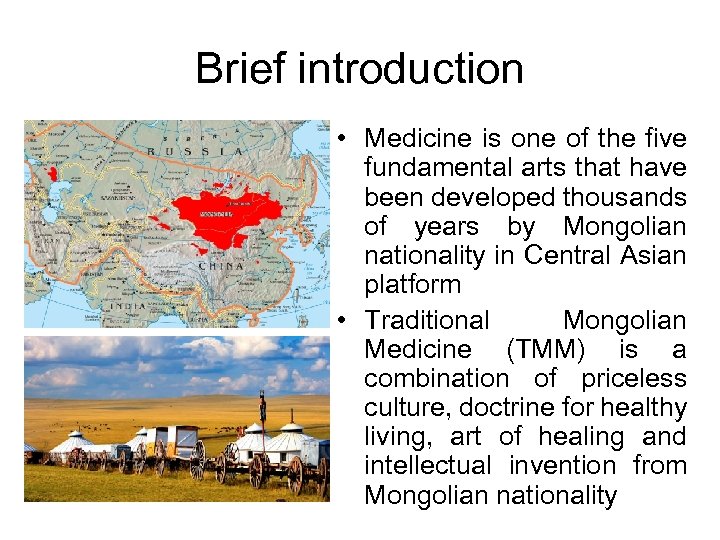 Brief introduction • Medicine is one of the five fundamental arts that have been developed thousands of years by Mongolian nationality in Central Asian platform • Traditional Mongolian Medicine (TMM) is a combination of priceless culture, doctrine for healthy living, art of healing and intellectual invention from Mongolian nationality
 1 POLICY 1
 Regional Strategy for Traditional Medicine • Legal status of traditional medicine and complementary/ alternative medicine: A worldwide review. WHO. 2001 • National policy on traditional medicine and regulation of herbal medicines. Report of a WHO global survey. Geneva 2005 • The Regional Strategy for Traditional Medicine in the Western Pacific (20112020)
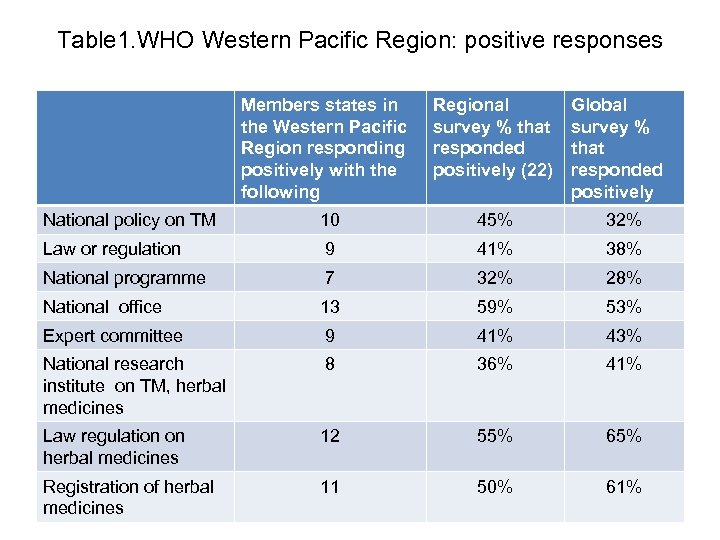 Table 1. WHO Western Pacific Region: positive responses Members states in the Western Pacific Region responding positively with the following Regional survey % that responded positively (22) Global survey % that responded positively National policy on TM 10 45% 32% Law or regulation 9 41% 38% National programme 7 32% 28% National office 13 59% 53% Expert committee 9 41% 43% National research institute on TM, herbal medicines 8 36% 41% Law regulation on herbal medicines 12 55% 65% Registration of herbal medicines 11 50% 61%
 Regulatory situation • in 1999, Mongolia issued its national policy on TM in the state policy for development of Mongolian Traditional Medicine. • No national Laws or regulations specifically for TM have been issued or are in development; however, all health –related aspects are regulated under the health and drug laws. • There have been two national programmes on traditional medicine, 1992 -1996 and 1997 -2000. • In 1961, the Institute for Natural Compounds of the Mongolian Academy Sciences was established and later was transformed into the Institute of Folk Medicine, and finally TMSTPC in 1998. • The national expert committee was established in 1991, and called the Professional Committee for Traditional Medicine. • Regulation on herbal medicine were issued in 1998 and 2001; laws are same for herbal medicines as for conventional pharmaceuticals.
 2 HISTORY OF MONGOLIAN MEDICINE
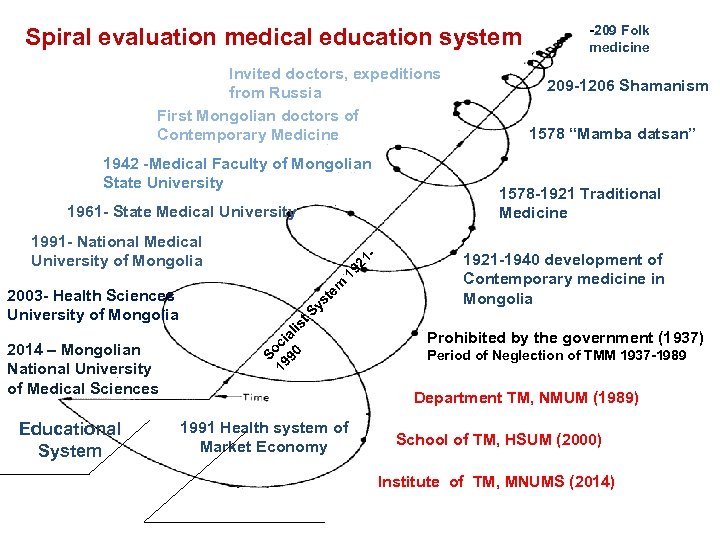 Spiral evaluation medical education system Invited doctors, expeditions from Russia First Mongolian doctors of Contemporary Medicine 1942 -Medical Faculty of Mongolian State University 1961 - State Medical University 2014 – Mongolian National University of Medical Sciences Educational System 19 21 em ys t 209 -1206 Shamanism 1578 “Mamba datsan” 1578 -1921 Traditional Medicine 1921 -1940 development of Contemporary medicine in Mongolia t. S S 19 oci 90 ali s 2003 - Health Sciences University of Mongolia - 1991 - National Medical University of Mongolia -209 Folk medicine Prohibited by the government (1937) Period of Neglection of TMM 1937 -1989 Department TM, NMUM (1989) 1991 Health system of Market Economy School of TM, HSUM (2000) Institute of TM, MNUMS (2014)
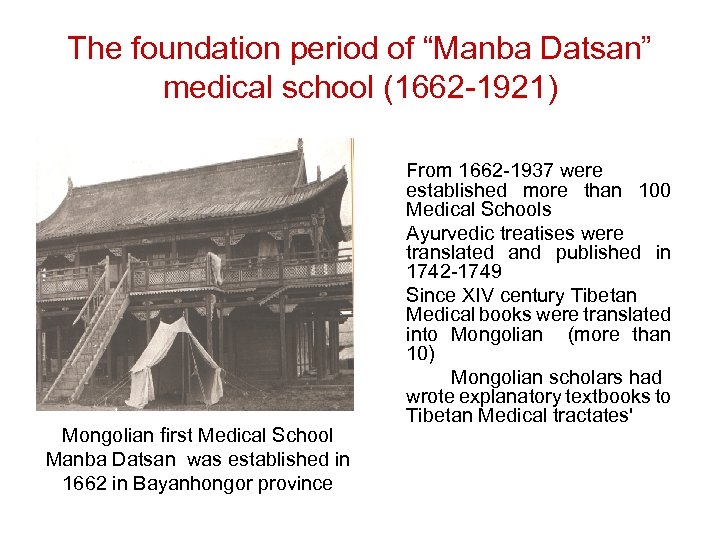 The foundation period of “Manba Datsan” medical school (1662 -1921) Mongolian first Medical School Manba Datsan was established in 1662 in Bayanhongor province From 1662 -1937 were established more than 100 Medical Schools Ayurvedic treatises were translated and published in 1742 -1749 Since XIV century Tibetan Medical books were translated into Mongolian (more than 10) Mongolian scholars had wrote explanatory textbooks to Tibetan Medical tractates'
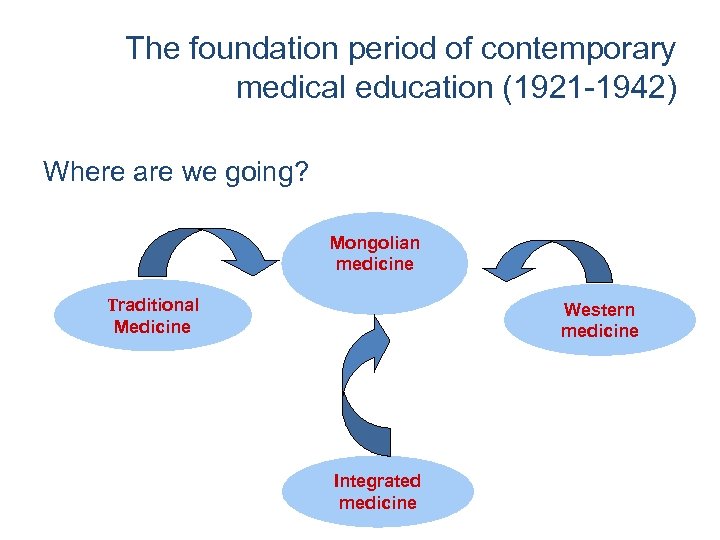 The foundation period of contemporary medical education (1921 -1942) Where are we going? Mongolian medicine Traditional Medicine Western medicine Integrated medicine
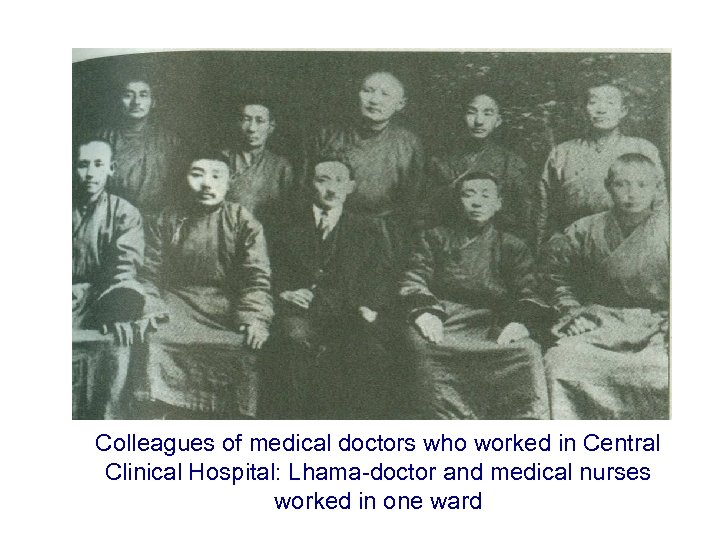 Colleagues of medical doctors who worked in Central Clinical Hospital: Lhama-doctor and medical nurses worked in one ward
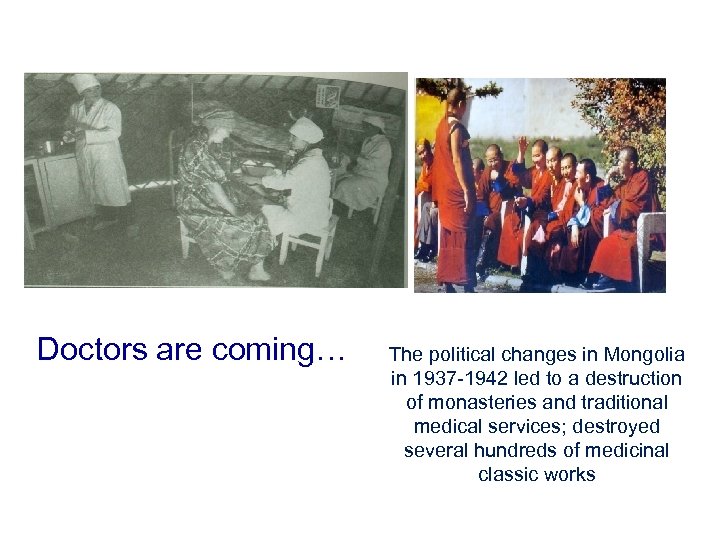 Doctors are coming… The political changes in Mongolia in 1937 -1942 led to a destruction of monasteries and traditional medical services; destroyed several hundreds of medicinal classic works
 3 EDUCATION SYSTEM 1
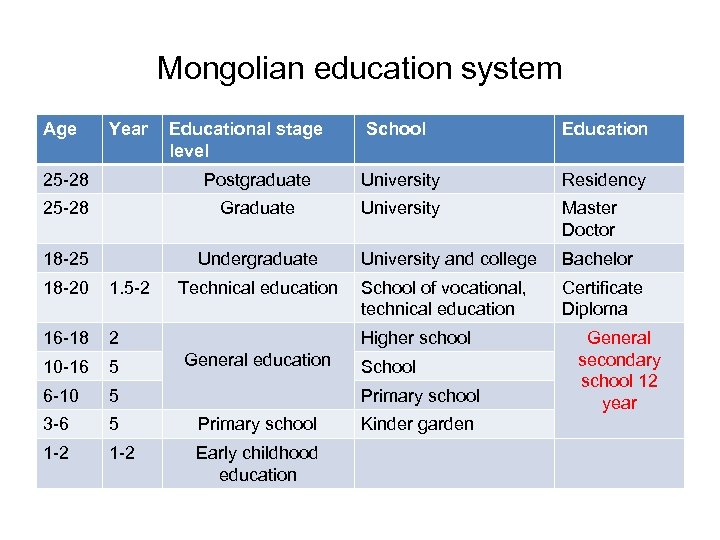 Mongolian education system Age Year Educational stage level School Education 25 -28 Postgraduate University Residency 25 -28 Graduate University Master Doctor 18 -25 Undergraduate University and college Bachelor Technical education School of vocational, technical education Certificate Diploma 18 -20 1. 5 -2 16 -18 2 10 -16 5 6 -10 5 3 -6 5 Primary school 1 -2 Early childhood education Higher school General education School Primary school Kinder garden General secondary school 12 year
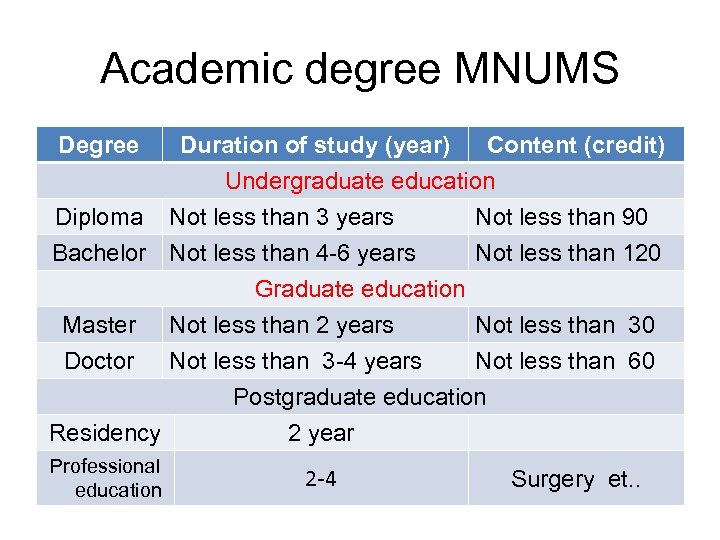 Academic degree MNUMS Degree Duration of study (year) Content (credit) Undergraduate education Diploma Not less than 3 years Not less than 90 Bachelor Not less than 4 -6 years Not less than 120 Graduate education Master Not less than 2 years Not less than 30 Doctor Not less than 3 -4 years Not less than 60 Postgraduate education Residency 2 year Professional education 2 -4 Surgery et. .
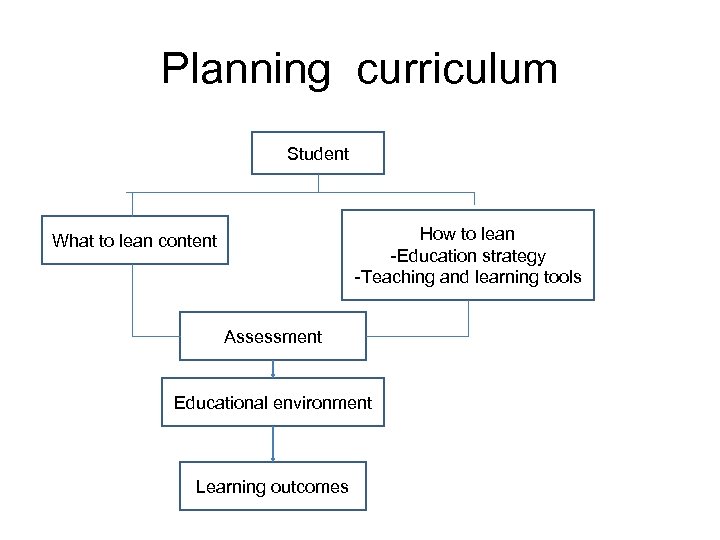 Planning curriculum Student How to lean -Education strategy -Teaching and learning tools What to lean content Assessment Educational environment Learning outcomes
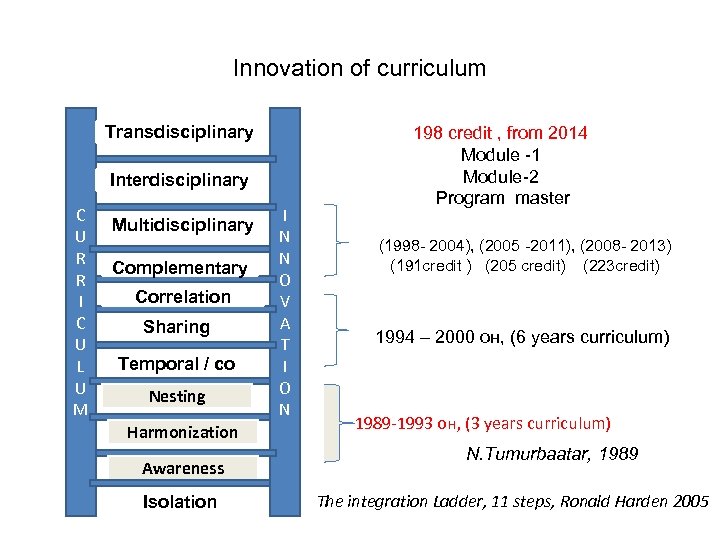 Innovation of curriculum Transdisciplinary Interdisciplinary C U R R I C U L U M Multidisciplinary Complementary Correlation Sharing Temporal / co Nesting Harmonization Awareness Isolation I N N O V A T I O N 198 credit , from 2014 Моdule -1 Моdule-2 Program master (1998 - 2004), (2005 -2011), (2008 - 2013) (191 credit ) (205 credit) (223 credit) 1994 – 2000 он, (6 years curriculum) 1989 -1993 он, (3 years curriculum) N. Tumurbaatar, 1989 The integration Ladder, 11 steps, Ronald Harden 2005
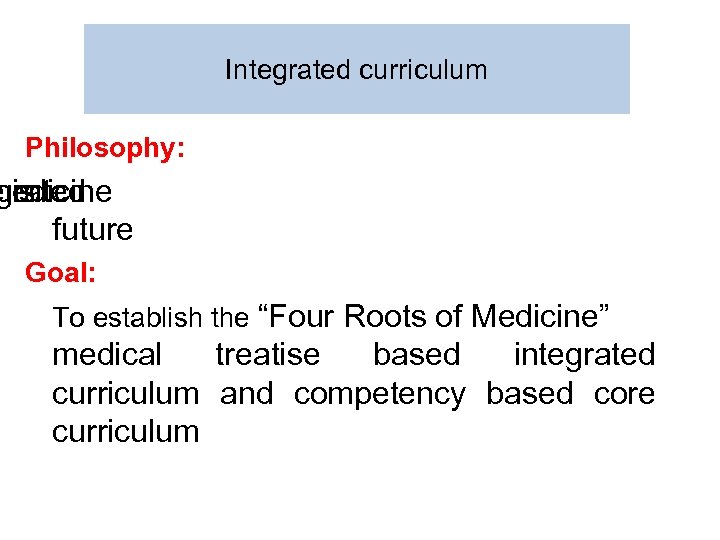 Integrated curriculum Philosophy: medicine e is grated future Goal: To establish the “Four Roots of Medicine” medical treatise based integrated curriculum and competency based core curriculum
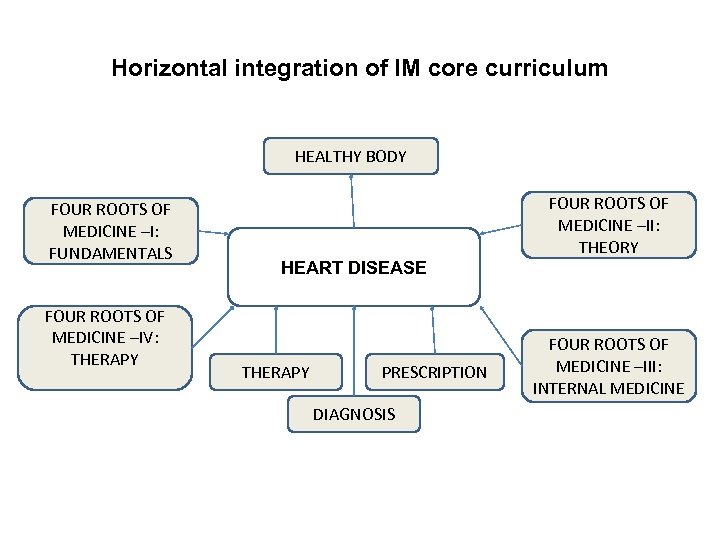 Horizontal integration of IM core curriculum HEALTHY BODY FOUR ROOTS OF MEDICINE –I: FUNDAMENTALS FOUR ROOTS OF MEDICINE –IV: THERAPY HEART DISEASE THERAPY PRESCRIPTION DIAGNOSIS FOUR ROOTS OF MEDICINE –II: THEORY FOUR ROOTS OF MEDICINE –III: INTERNAL MEDICINE
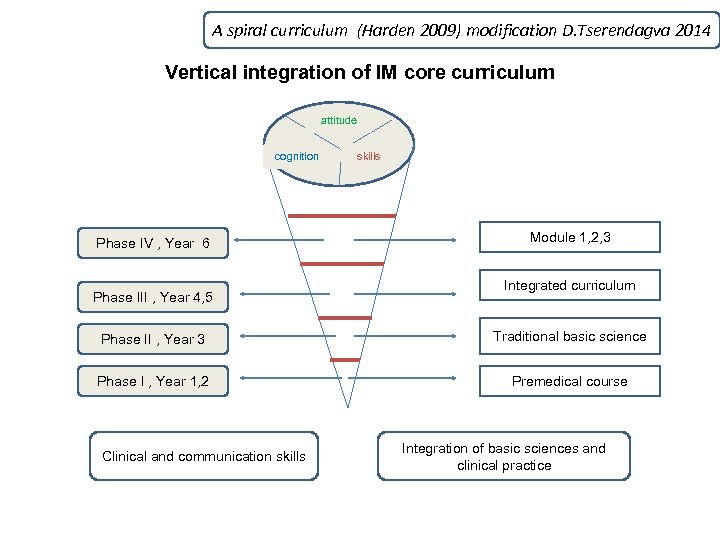 A spiral curriculum (Harden 2009) modification D. Tserendagva 2014 Vertical integration of IM core curriculum attitude cognition Phase IV , Year 6 Phase III , Year 4, 5 skills Мodule 1, 2, 3 Integrated curriculum Phase II , Year 3 Traditional basic science Phase I , Year 1, 2 Premedical course Clinical and communication skills Integration of basic sciences and clinical practice
 4 RESEARCH 1
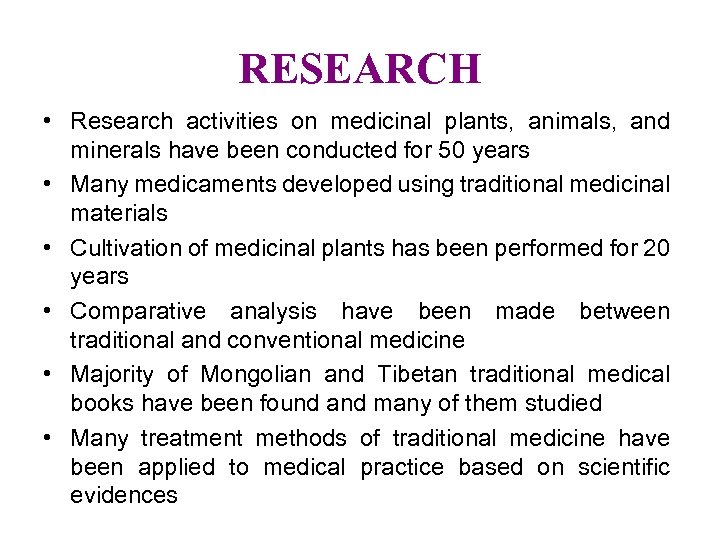 RESEARCH • Research activities on medicinal plants, animals, and minerals have been conducted for 50 years • Many medicaments developed using traditional medicinal materials • Cultivation of medicinal plants has been performed for 20 years • Comparative analysis have been made between traditional and conventional medicine • Majority of Mongolian and Tibetan traditional medical books have been found and many of them studied • Many treatment methods of traditional medicine have been applied to medical practice based on scientific evidences
 Manpower capacity of Traditional Medical Research field in Mongolia During these redevelopment period of Mongolian traditional medicine - 5 academicians of Mongolian Academy of Science - 5 Doctors of Science - 40 Philosophy Doctors, 200 Masters and many researchers and traditional medical doctors were born.
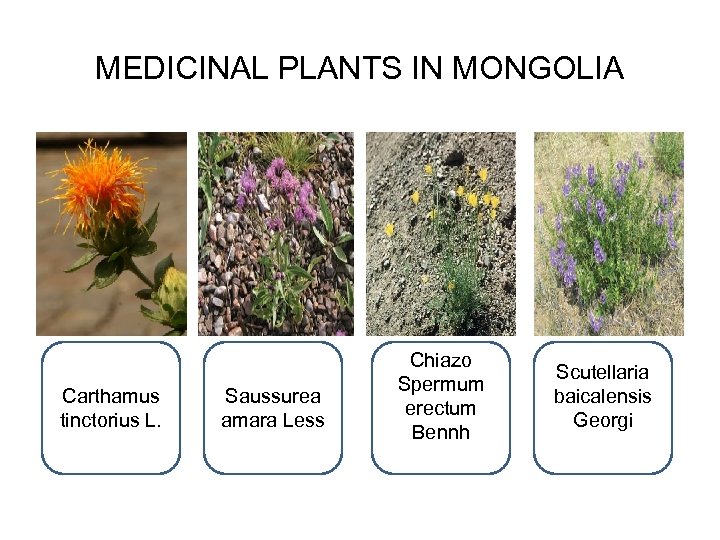 MEDICINAL PLANTS IN MONGOLIA Carthamus tinctorius L. Saussurea amara Less Chiazo Spermum erectum Bennh Scutellaria baicalensis Georgi
 • Carthamus tinctorius, cultivated in our country, exhibited a hepatoprotective effect, and reduced hepatocelullar decomposition. • A sesquiterpene lactone from Saussurea amara L. exhibited a pronounced cytotoxic effect on the breast cancer cell line; original water extract from Saussurea amara and Chiazospermum erectum L. exhibit moderate cytotoxic effect on hepatocellulocarcinoma cell line.
 • The plant extract of Scutellaria baicalensis Georgi and Skullcap preparation did not show any destructive and decomposition effects on DNA of the cell genome. • The ethanol extraction of Scutellaria baicalensis Georgi derived from upper part of the plant does not induce apoptosis, but transmembrane proteins can block cancer cell division by inhibiting their gene expression.
 5 SERVICE 1
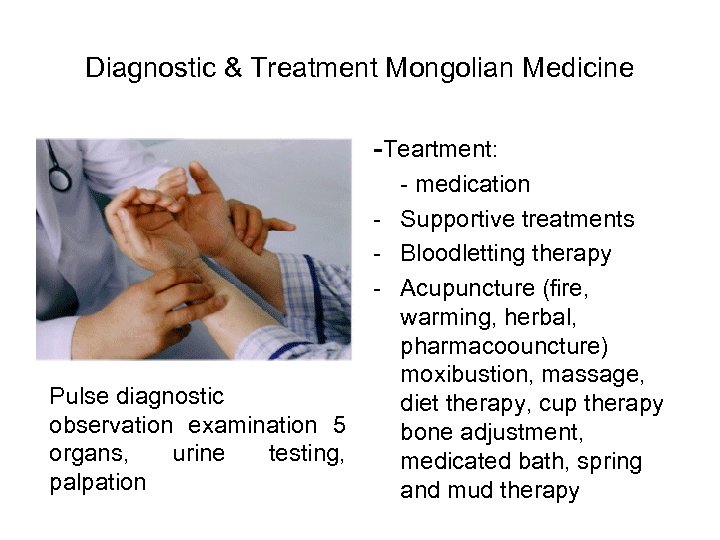 Diagnostic & Treatment Mongolian Medicine -Teartment: Pulse diagnostic observation examination 5 organs, urine testing, palpation - medication - Supportive treatments - Bloodletting therapy - Acupuncture (fire, warming, herbal, pharmacoouncture) moxibustion, massage, diet therapy, cup therapy bone adjustment, medicated bath, spring and mud therapy
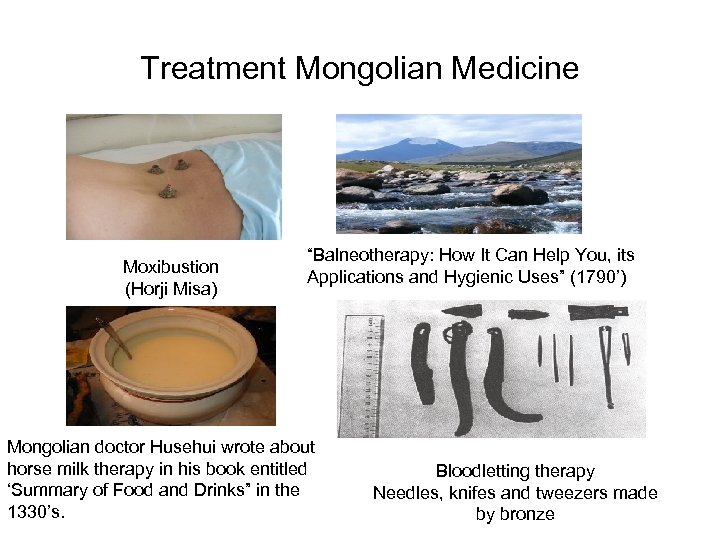 Treatment Mongolian Medicine Moxibustion (Horji Misa) “Balneotherapy: How It Can Help You, its Applications and Hygienic Uses” (1790’) Mongolian doctor Husehui wrote about horse milk therapy in his book entitled ‘Summary of Food and Drinks” in the 1330’s. Bloodletting therapy Needles, knifes and tweezers made by bronze
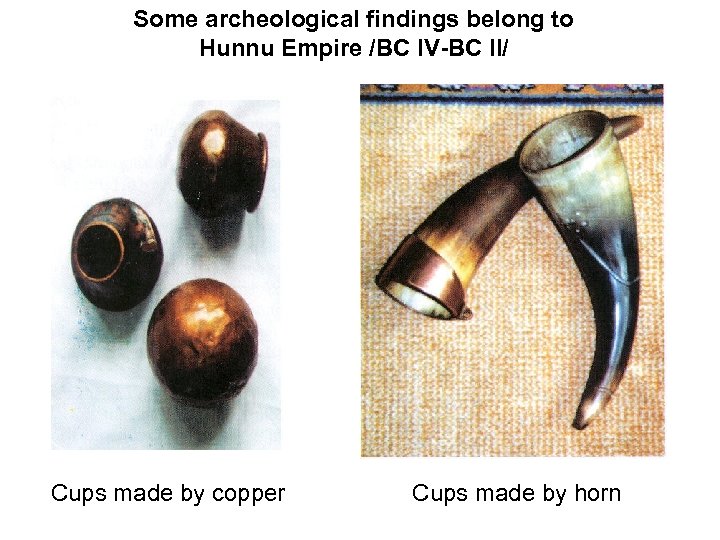 Some archeological findings belong to Hunnu Empire /BC IV-BC II/ Cups made by copper Cups made by horn
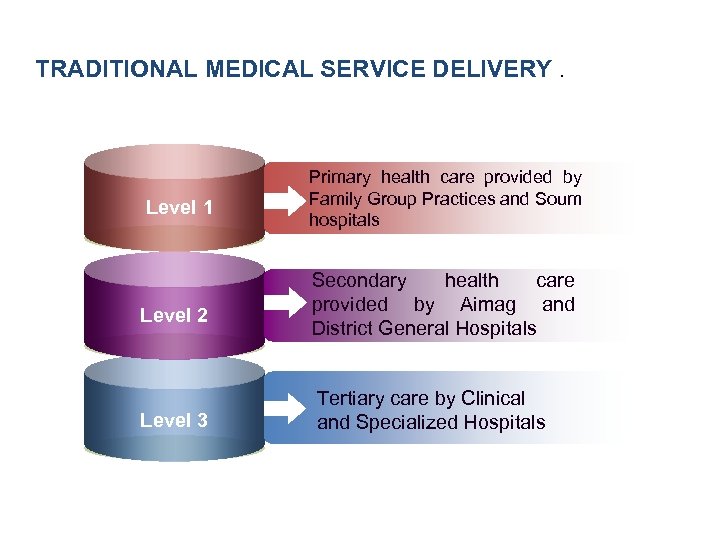 TRADITIONAL MEDICAL SERVICE DELIVERY Level 1 Level 2 Level 3 . Primary health care provided by Family Group Practices and Soum hospitals Secondary health care provided by Aimag and District General Hospitals Tertiary care by Clinical and Specialized Hospitals
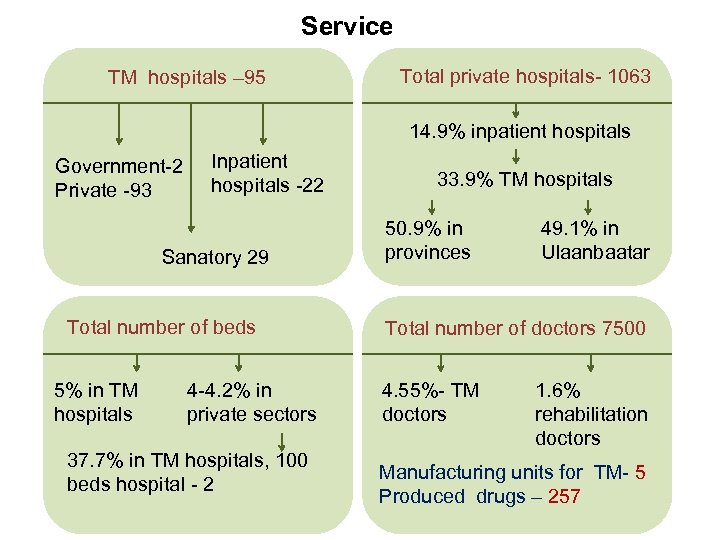 Service TM hospitals – 95 Total private hospitals- 1063 14. 9% inpatient hospitals Government-2 Private -93 Inpatient hospitals -22 Sanatory 29 Total number of beds 5% in TM hospitals 4 -4. 2% in private sectors 37. 7% in TM hospitals, 100 beds hospital - 2 33. 9% TM hospitals 50. 9% in provinces 49. 1% in Ulaanbaatar Total number of doctors 7500 4. 55%- TM doctors 1. 6% rehabilitation doctors Manufacturing units for TM- 5 Produced drugs – 257
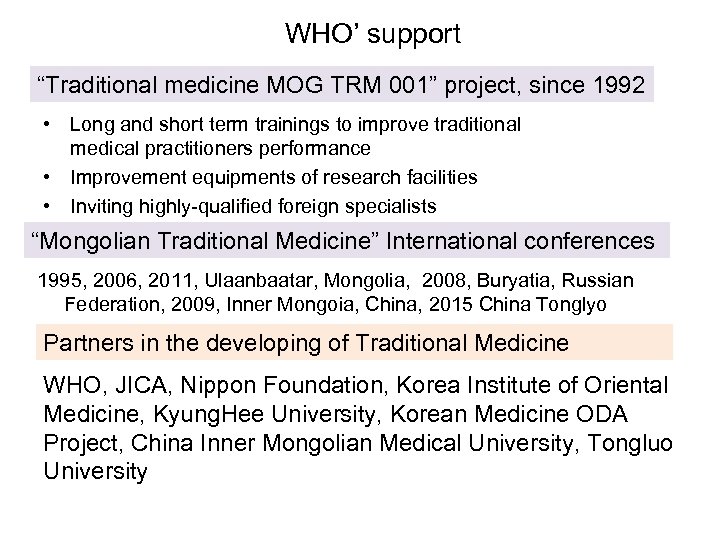 WHO’ support “Traditional medicine MOG TRM 001” project, since 1992 • Long and short term trainings to improve traditional medical practitioners performance • Improvement equipments of research facilities • Inviting highly-qualified foreign specialists “Mongolian Traditional Medicine” International conferences 1995, 2006, 2011, Ulaanbaatar, Mongolia, 2008, Buryatia, Russian Federation, 2009, Inner Mongoia, China, 2015 China Tonglyo Partners in the developing of Traditional Medicine WHO, JICA, Nippon Foundation, Korea Institute of Oriental Medicine, Kyung. Hee University, Korean Medicine ODA Project, China Inner Mongolian Medical University, Tongluo University
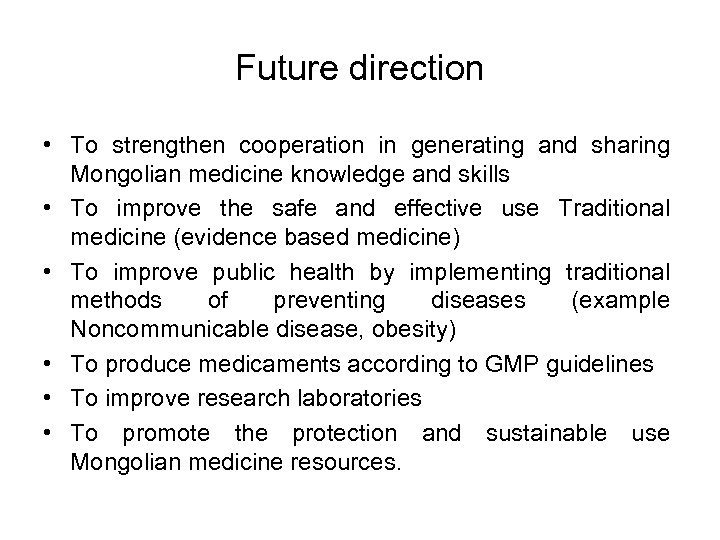 Future direction • To strengthen cooperation in generating and sharing Mongolian medicine knowledge and skills • To improve the safe and effective use Traditional medicine (evidence based medicine) • To improve public health by implementing traditional methods of preventing diseases (example Noncommunicable disease, obesity) • To produce medicaments according to GMP guidelines • To improve research laboratories • To promote the protection and sustainable use Mongolian medicine resources.
 Thank you for attention