



 "Money" Shpakov Vladimir 8”V”
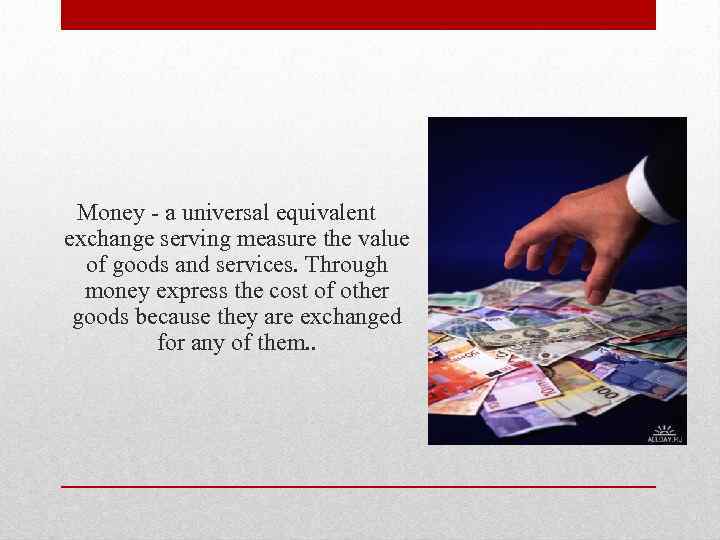 Money - a universal equivalent exchange serving measure the value of goods and services. Through money express the cost of other goods because they are exchanged for any of them. .
 Money - a specific product (item), which is equivalent to the cost of other goods. .
 . Money can be different things, liabilities and proprietary systems of obligation. Typically, the money becomes a commodity with high liquidity, that is, one that is most easily exchanged for other goods.
 . In modern conditions, the money is not so much specific products (such as gold, which in the past were made coins) as liabilities (debts) state or central bank. Self-worth that kind of money and do not have are the equivalent of only nominally. The basis of their appeal is the state government, which requires citizens to accept money as means of payment in the territory.
 Types of money Given the nature of the material, there are two main types of money: natural and symbolic. .
 That kind of money are all kinds of goods, which were equivalent to the initial stages of the circulation of commodities (cattle, grain, furs, shells, etc. ), as well as metal money - copper, bronze, silver, gold coins Weighted. .
 Miscellaneous goods and today play the role of money in specific conditions. For example, cigarettes prisoners and prisoners of war, vodka and sugar in times of economic crisis, weapons and ammunition in areas of armed conflict. .
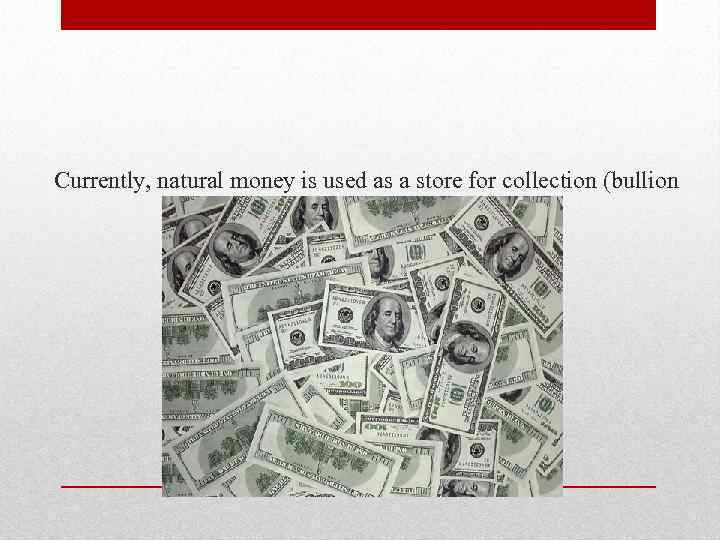 Currently, natural money is used as a store for collection (bullion coin).
 On the foreign exchange market in 1971 was suspended, and in 1976 stopped using the gold equivalent. .
 Symbolic (decreed, fake) money Money without having an independent value or it is disproportionate to the denomination. Usually it is lending money.
 Today money is the main form of non-cash, in particular, electronic money and banknotes. With the proliferation of plastic cards gradually replaced banknotes from circulation.
 Gradually as money moved to the metals in the form of first bars of different shapes and with a VII. BC. e. - In the form of hammered coins. Before capitalism, the role of money carried copper, bronze and silver. In some countries (Egypt and Assyria) another 2 millennium BC. e. used gold for money.
 The rapid spread of coins due to the convenience of their storage, crushing and compounds relative high cost and low weight and volume, which is very convenient for exchange. With the development of commodity production rapidly increased the cost and the number of daily transactions. Required increase in the cost of equivalent exchange. Worldwide gold and silver have become cash items as goods with high value and low weight and volume.
 THE END
 The first paper money appeared in China in 812 BC. e. . The earliest editions of the world's banknotes were made in Stockholm in 1661. In Russia, the first paper money (banknotes) were introduced during the reign of Catherine II (1769).