


Money is any item or verifiable record that is generally accepted as payment for goods and services and repayment of debts in a particular country or socio-economic context. The main functions of money are distinguished as: a medium of exchange; a unit of account; a store of value; and, sometimes, a standard of deferred payment. Any item or verifiable record that fulfills these functions can be considered money.
Etymology The word "money" is believed to originate from a temple of Juno, on Capitoline, one of Rome's seven hills. In the ancient world Juno was often associated with money. The temple of Juno Moneta at Rome was the place where the mint of Ancient Rome was located. [10] The name "Juno" may derive from the Etruscan goddess Uni (which means "the one", "unique", "unit", "union", "united") and "Moneta" either from the Latin word "monere" (remind, warn, or instruct) or the Greek word "moneres" (alone, unique). In the Western world, a prevalent term for coin-money has been specie, stemming from Latin in specie, meaning 'in kind'
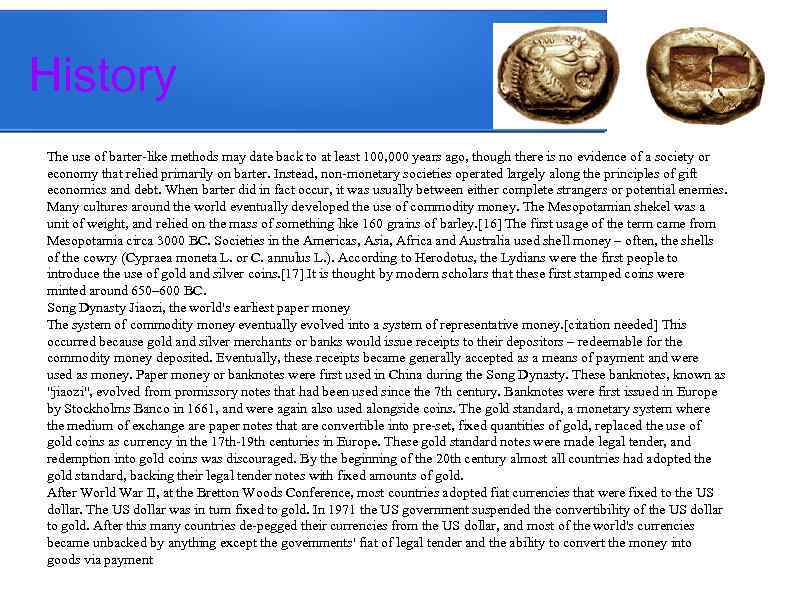
History The use of barter-like methods may date back to at least 100, 000 years ago, though there is no evidence of a society or economy that relied primarily on barter. Instead, non-monetary societies operated largely along the principles of gift economics and debt. When barter did in fact occur, it was usually between either complete strangers or potential enemies. Many cultures around the world eventually developed the use of commodity money. The Mesopotamian shekel was a unit of weight, and relied on the mass of something like 160 grains of barley. [16] The first usage of the term came from Mesopotamia circa 3000 BC. Societies in the Americas, Asia, Africa and Australia used shell money – often, the shells of the cowry (Cypraea moneta L. or C. annulus L. ). According to Herodotus, the Lydians were the first people to introduce the use of gold and silver coins. [17] It is thought by modern scholars that these first stamped coins were minted around 650– 600 BC. Song Dynasty Jiaozi, the world's earliest paper money The system of commodity money eventually evolved into a system of representative money. [citation needed] This occurred because gold and silver merchants or banks would issue receipts to their depositors – redeemable for the commodity money deposited. Eventually, these receipts became generally accepted as a means of payment and were used as money. Paper money or banknotes were first used in China during the Song Dynasty. These banknotes, known as "jiaozi", evolved from promissory notes that had been used since the 7 th century. Banknotes were first issued in Europe by Stockholms Banco in 1661, and were again also used alongside coins. The gold standard, a monetary system where the medium of exchange are paper notes that are convertible into pre-set, fixed quantities of gold, replaced the use of gold coins as currency in the 17 th-19 th centuries in Europe. These gold standard notes were made legal tender, and redemption into gold coins was discouraged. By the beginning of the 20 th century almost all countries had adopted the gold standard, backing their legal tender notes with fixed amounts of gold. After World War II, at the Bretton Woods Conference, most countries adopted fiat currencies that were fixed to the US dollar. The US dollar was in turn fixed to gold. In 1971 the US government suspended the convertibility of the US dollar to gold. After this many countries de-pegged their currencies from the US dollar, and most of the world's currencies became unbacked by anything except the governments' fiat of legal tender and the ability to convert the money into goods via payment
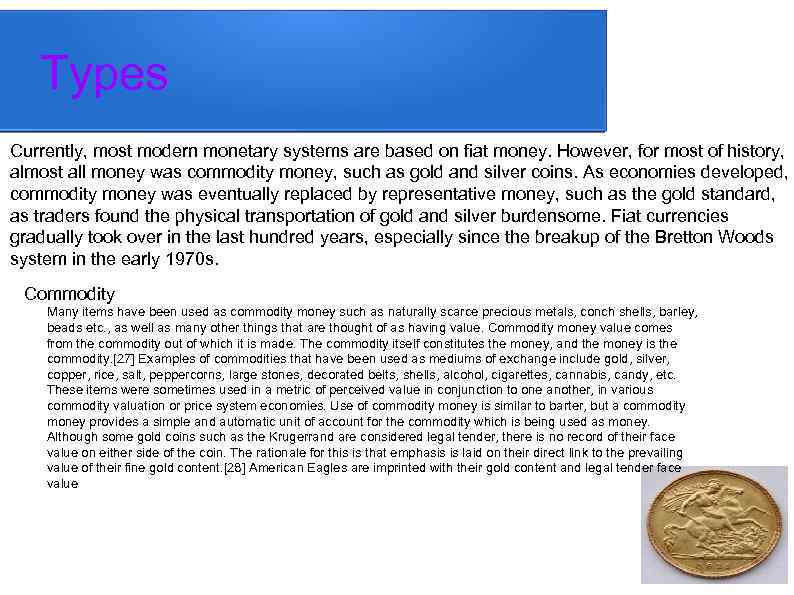
Types Currently, most modern monetary systems are based on fiat money. However, for most of history, almost all money was commodity money, such as gold and silver coins. As economies developed, commodity money was eventually replaced by representative money, such as the gold standard, as traders found the physical transportation of gold and silver burdensome. Fiat currencies gradually took over in the last hundred years, especially since the breakup of the Bretton Woods system in the early 1970 s. Commodity Many items have been used as commodity money such as naturally scarce precious metals, conch shells, barley, beads etc. , as well as many other things that are thought of as having value. Commodity money value comes from the commodity out of which it is made. The commodity itself constitutes the money, and the money is the commodity. [27] Examples of commodities that have been used as mediums of exchange include gold, silver, copper, rice, salt, peppercorns, large stones, decorated belts, shells, alcohol, cigarettes, cannabis, candy, etc. These items were sometimes used in a metric of perceived value in conjunction to one another, in various commodity valuation or price system economies. Use of commodity money is similar to barter, but a commodity money provides a simple and automatic unit of account for the commodity which is being used as money. Although some gold coins such as the Krugerrand are considered legal tender, there is no record of their face value on either side of the coin. The rationale for this is that emphasis is laid on their direct link to the prevailing value of their fine gold content. [28] American Eagles are imprinted with their gold content and legal tender face value
Types Representative In 1875, the British economist William Stanley Jevons described the money used at the time as "representative money". Representative money is money that consists of token coins, paper money or other physical tokens such as certificates, that can be reliably exchanged for a fixed quantity of a commodity such as gold or silver. The value of representative money stands in direct and fixed relation to the commodity that backs it, while not itself being composed of that commodity. [30] Fiat Gold coins are an example of legal tender that are traded for their intrinsic value, rather than their face value. Fiat money or fiat currency is money whose value is not derived from any intrinsic value or guarantee that it can be converted into a valuable commodity (such as gold). Instead, it has value only by government order (fiat). Usually, the government declares the fiat currency (typically notes and coins from a central bank, such as the Federal Reserve System in the U. S. ) to be legal tender, making it unlawful not to accept the fiat currency as a means of repayment for all debts, public and private. Some bullion coins such as the Australian Gold Nugget and American Eagle are legal tender, however, they trade based on the market price of the metal content as a commodity, rather than their legal tender face value (which is usually only a small fraction of their bullion value)
Types Coinage Main article: Coin These factors led to the shift of the store of value being the metal itself: at first silver, then both silver and gold, and at one point there was bronze as well. Now we have copper coins and other non-precious metals as coins. Metals were mined, weighed, and stamped into coins. This was to assure the individual taking the coin that he was getting a certain known weight of precious metal. Coins could be counterfeited, but they also created a new unit of account, which helped lead to banking. Archimedes' principle provided the next link: coins could now be easily tested for their fine weight of metal, and thus the value of a coin could be determined, even if it had been shaved, debased or otherwise tampered with (see Numismatics). In most major economies using coinage, copper, silver and gold formed three tiers of coins. Gold coins were used for large purchases, payment of the military and backing of state activities. Silver coins were used for midsized transactions, and as a unit of account for taxes, dues, contracts and fealty, while copper coins represented the coinage of common transaction. This system had been used in ancient India since the time of the Mahajanapadas. In Europe, this system worked through the medieval period because there was virtually no new gold, silver or copper introduced through mining or conquest. [citation needed] Thus the overall ratios of the three coinages remained roughly equivalent. Paper Main article: Banknote Huizi currency, issued in 1160 In premodern China, the need for credit and for circulating a medium that was less of a burden than exchanging thousands of copper coins led to the introduction of paper money, commonly known today as banknotes. This economic phenomenon was a slow and gradual process that took place from the late Tang Dynasty (618– 907) into the Song Dynasty (960– 1279). It began as a means for merchants to exchange heavy coinage for receipts of deposit issued as promissory notes from shops of wholesalers, notes that were valid for temporary use in a small regional territory. In the 10 th century, the Song Dynasty government began circulating these notes amongst the traders in their monopolized salt industry. The Song government granted several shops the sole right to issue banknotes, and in the early 12 th century the government finally took over these shops to produce state-issued currency. Yet the banknotes issued were still regionally valid and temporary; it was not until the mid 13 th century that a standard and uniform government issue of paper money was made into an acceptable nationwide currency. The already widespread
