


 Скачать презентацию Money Investments What is an investment
7cc98e3651fabd48ad653ffa44f6a494.ppt
- Количество слайдов: 30
 Money Investments § What is an investment? § Investment is something bought for future financial benefit. § Promotes economic growth § Contributes to wealth of a nation § ex. Houses § Cars § Physical capital § Human capital
 Money and Investing § Financial system - allows the transfer between savers and borrowers. § Financial Intermediaries – an institution that helps channel funds from savers to borrowers. § They are the link. § Can anybody give an example of a financial intermediary? § § § banks, pension funds, credit unions, insurance company’s, finance company’s Mutual Funds
 Money and Investing § Financial intermediaries § Share risk: § Diversification: § Mutual Funds: § Portfolio’s § Provide Information § On investments (companies) § Prospectus § Provide more liquidity § Speed to change investment into cash
 Money and Investing § Return –amount of money that an investor receives above and beyond the sum that has been invested. § Rate of Return – refers to the return stated in a percentage of the total amount invested. § Capital gains –difference between the selling price and the purchase price that results in the financial gain of the seller. (per share) § Capital losses – difference between the selling price and the purchase price that results in the financial loss of the seller. (per share)
 Do Now Who can give an example of what a financial asset or security is?
 Financial Assets or securities § A claim on the property or income of a borrower. § Give examples ? § Bonds § Stocks § Options. § Homes ownership § Loans.
 Types of Markets § Capital markets – a market in which money is lent for periods longer than a year § Money markets – a market in which money is lent for periods of less than a year
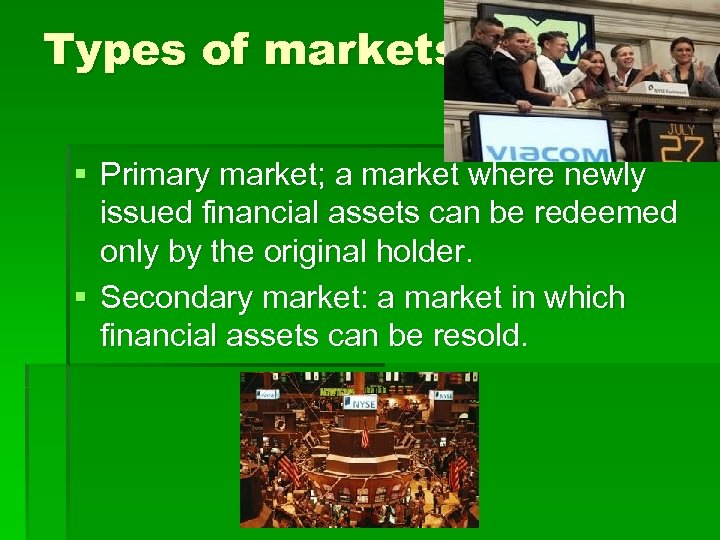 Types of markets § Primary market; a market where newly issued financial assets can be redeemed only by the original holder. § Secondary market: a market in which financial assets can be resold.
 What is a bond? § Bonds are debt. § When you buy a bond you are lending money. § Parts of a bond. § Coupon – is the interest rate a seller will pay a buyer § Maturity – time when a loan is to be repaid. § The longer the maturity the larger the risk. § Par – amount to be repaid to the investor.
 Do Now? § What is an investment? § Give examples § What is a financial asset ? § Give examples § What is a financial intermediary? § Give examples. § What are the four types of markets and how are they different?
 Types of Bonds. § U. S. saving bonds § Treasury Bonds § T Bills – under 1 year § T notes 2 yr , 3 yr, 5 yr, 10 yr 30 yr. § Are the least risky because they are back by the United States Government.
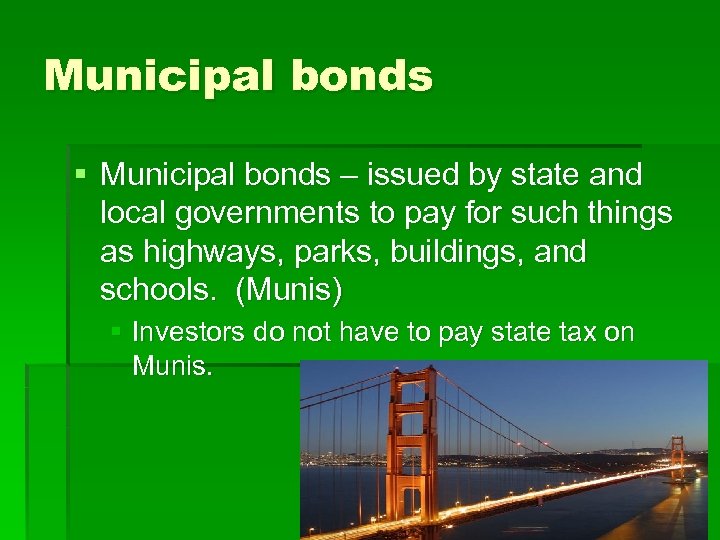 Municipal bonds § Municipal bonds – issued by state and local governments to pay for such things as highways, parks, buildings, and schools. (Munis) § Investors do not have to pay state tax on Munis.
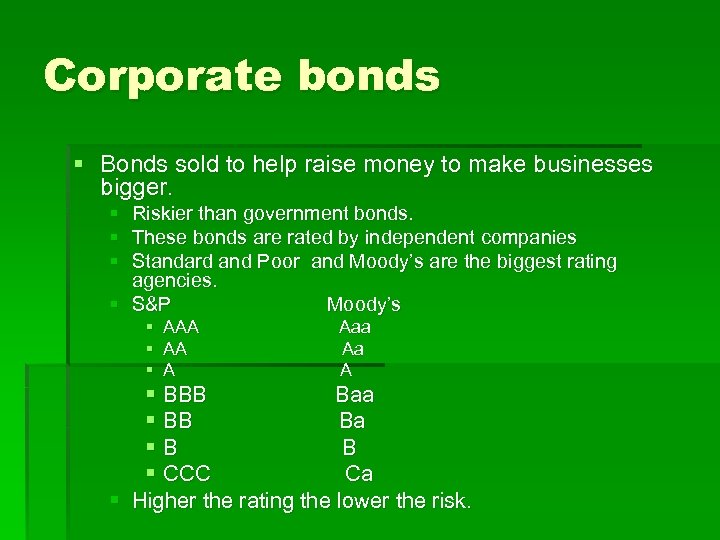 Corporate bonds § Bonds sold to help raise money to make businesses bigger. § Riskier than government bonds. § These bonds are rated by independent companies § Standard and Poor and Moody’s are the biggest rating agencies. § S&P Moody’s § AAA § A Aaa Aa A § BBB Baa § BB Ba §B B § CCC Ca § Higher the rating the lower the risk.
 Certificates of Deposit § Certificates of Deposit or CD’s. § Safe investment, § Can’t take money out until the maturity.
 Do now § Does a bond with a maturity date that is two years away more or less risky than a bond that has a maturity that is 10 years away? § Comparatively a bond with which rating will pay the highest interest rate and why? § AAA § BBB § CCC
 Junk bonds/ High Yield § Junk bonds are high risk and possibly high yield. § They are not investment grade § Anything below BBB Baa
 The Stock Market § Stocks are certificates that signifies percentage ownership within a company. § Ex. § Under Armour (UA) § § § Market cap Last trade 52 week high and low http: //finance. yahoo. com/q? s=ua&ql=1
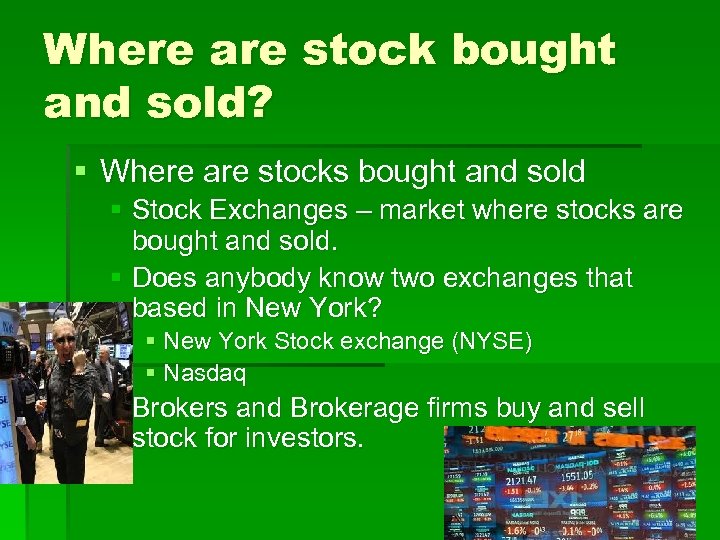 Where are stock bought and sold? § Where are stocks bought and sold § Stock Exchanges – market where stocks are bought and sold. § Does anybody know two exchanges that based in New York? § New York Stock exchange (NYSE) § Nasdaq § Brokers and Brokerage firms buy and sell stock for investors.
 The Stock Market § All holders of stock have a say in the company. § The holders of the majority of stock in the company can make the decisions for the company § http: //www. youtube. com/watch? v=Kc 2_j. IB 2 jy. A &feature=related
 Do Now? 1. 2. 3. 4. 5. What is a share of stock? Where can u buy shares? From whom can you buy shares? Why do company’s go public? (IPO) How are risk, liquidity, and return related?
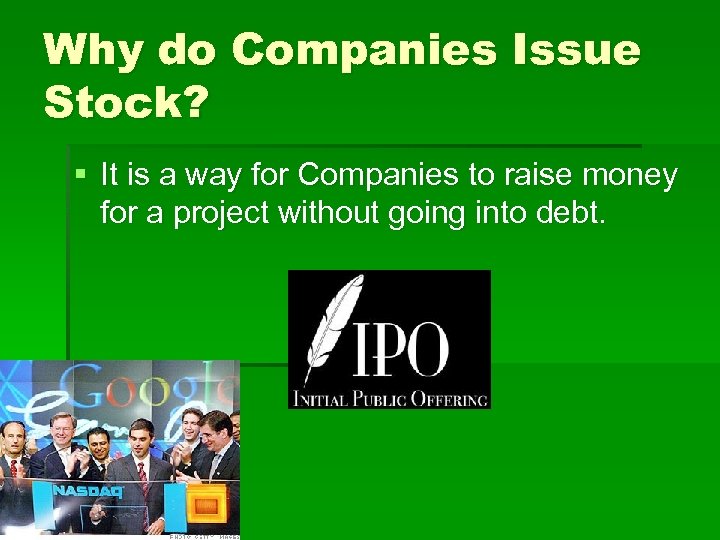 Why do Companies Issue Stock? § It is a way for Companies to raise money for a project without going into debt.
 Common Vs. preferred stock § Preferred stock owners § No voting rights § Bankrupt collect before common shareholders § Pay dividends § Common Stock § Voting rights for officers § Have say in company policy
 Do now 1. Why do companies sell IPO’s? 2. What is the difference between a common stock and preferred stock? 3. What do the ratings of a bond tell us about that bond?
 Income vs. Growth stocks § Income stocks § Give extra income § Pay dividends § http: //finance. yahoo. com/q? s=gs&ql=1 § Growth § Use income to build business § Grow in value over time § http: //finance. yahoo. com/q? s=ua&ql=1
 Options and Futures § Futures are contracts to buy or sell commodities or financial assets in the future at a price set today. § Options give a holder of a stock the right to buy or sell stock at a set price or a set period of time. § Call option - right to buy § Put option - right to sell
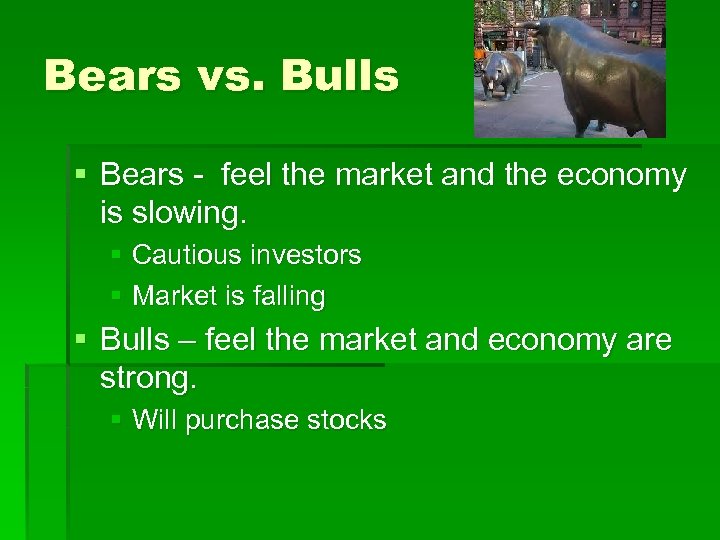 Bears vs. Bulls § Bears - feel the market and the economy is slowing. § Cautious investors § Market is falling § Bulls – feel the market and economy are strong. § Will purchase stocks
 How to track the market § Dow Jones industrial average § 30 top industrial stocks on the NYSE § The S&P 500 or Standard and Poor’s 500 § Tracks the 500 stocks on both the NYSE and the NASDAQ.
 Company’s in the Dow § http: //money. cnn. com/data/markets/dow/
 TRACKING Individual STOCKS § 52 WEEK HIGHS AND LOWS. § MANY PERIODICALS TRACK 52 WEEK HIGHS AND LOWS FOR THE NYSE AND THE NASDAQ § IT IS THE HIGH AND LOW CLOSING PRICE FOR THE LAST 52 WEEKS.
 Round up § What is a difference between a future and option? § Why would an investor want to diversify? § Can you sell a stock without owning it?