 Скачать презентацию Money Banking and Financial Markets Econ 212
a5a633ed56288c0814e9ad3f8ce9027b.ppt
- Количество слайдов: 39



Money, Banking, and Financial Markets : Econ. 212 Stephen G. Cecchetti Chapter 17 The Central Bank Balance Sheet and the Money Supply Process Economics of International Finance Prof. M. El-Sakka CBA. Kuwait University
Economics of International Finance Prof. M. El-Sakka CBA. Kuwait University
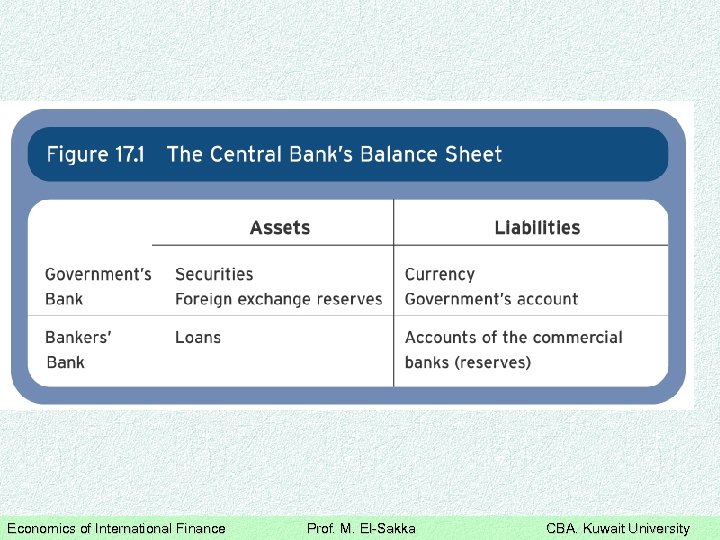
The Central Bank’s Balance Sheet § The central bank engages in numerous financial transactions, all of which cause changes in its balance sheet. § Central banks publish their balance sheets regularly; the Central Bank and the ECB do so weekly. Publication is a crucial part of transparency. § Assets The central bank’s balance sheet shows three basic assets: securities, foreign exchange reserves, and loans. It can be divided as assets due to its function as a government’s bank and assets due to its function as bankers bank Economics of International Finance Prof. M. El-Sakka CBA. Kuwait University
§ As government’s bank § Securities: the primary assets of most central banks; independent central banks determine the quantity of securities that they purchase (treasury securities). § Foreign Exchange Reserves: the central bank’s and government’s balances of foreign currency. They are held as bonds issued by foreign governments. These reserves are used in foreign exchange market interventions. Economics of International Finance Prof. M. El-Sakka CBA. Kuwait University
§ As bankers’ bank § Loans extended to commercial banks, they fall into two categories: discount loans and float. § Discount loans: the loans the Central Bank makes when commercial banks need short-term cash. § Float: a byproduct of the Central Bank’s check-clearing business. The Central Bank credits the reserve account of the bank receiving the check before it debits the account of the bank on which the check was drawn and this creates float. § Note: § Through its holdings of treasury securities the Central Bank controls the inter-bank rate and the availability of money and credit. § Gold reserves, while still an asset of many central banks, are virtually irrelevant. Economics of International Finance Prof. M. El-Sakka CBA. Kuwait University
§ Liabilities There are three major liabilities: currency, the government’s deposit account, and the deposit accounts of the commercial banks. As government’s bank § Currency: nearly all central banks have a monopoly on the issuance of currency, and currency accounts for over 90 percent of the central bank’s liabilities. § Government’s account: the central bank provides the government with an account into which it deposits funds (primarily tax revenues) and from which it writes checks and makes electronic payments. As bankers’ bank. § Reserves: Commercial bank reserves consist of cash in the bank’s own vault and deposits at the central bank , which function like the commercial bank’s checking account. Economics of International Finance Prof. M. El-Sakka CBA. Kuwait University
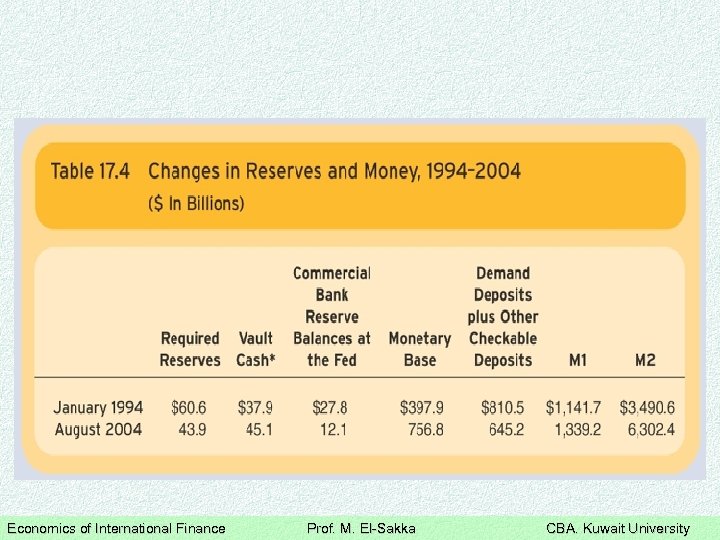
§ § Note: Central banks run their monetary policy operations through changes in banking system reserves. § § The Importance of Disclosure The balance sheet published by the central bank is probably the most important information that it makes public; it is an essential aspect of central bank transparency. § § The Monetary Base (MB) Currency in the hands of the public (C) and the reserves of the banking system (R) are the two components of the monetary base, also called high-powered money. § The central bank can control the size of the monetary base and therefore the quantity of money. Economics of International Finance Prof. M. El-Sakka CBA. Kuwait University
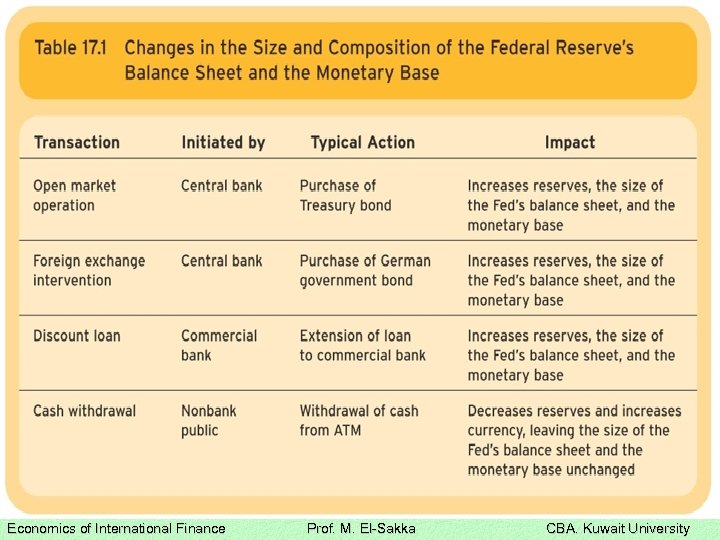
Changing the Size and Composition of the Balance Sheet § The central bank controls the size of its balance sheet. Policymakers can enlarge or reduce their assets and liabilities at will. § The central bank can buy things, like a bond, and create liabilities to pay for them. It can increase the size of its balance sheet as much as it wants. § There are four specific types of transactions which can affect the balance sheets of both the central bank and the banking system: (1) an open market operation, in which the central bank buys or sells a security; (2) a foreign exchange intervention, in which the central bank buys or sells foreign currency reserves; (3) the central bank’s extension of a discount loan to a commercial bank; and (4) the decision by an individual to withdraw cash from a bank. Economics of International Finance Prof. M. El-Sakka CBA. Kuwait University
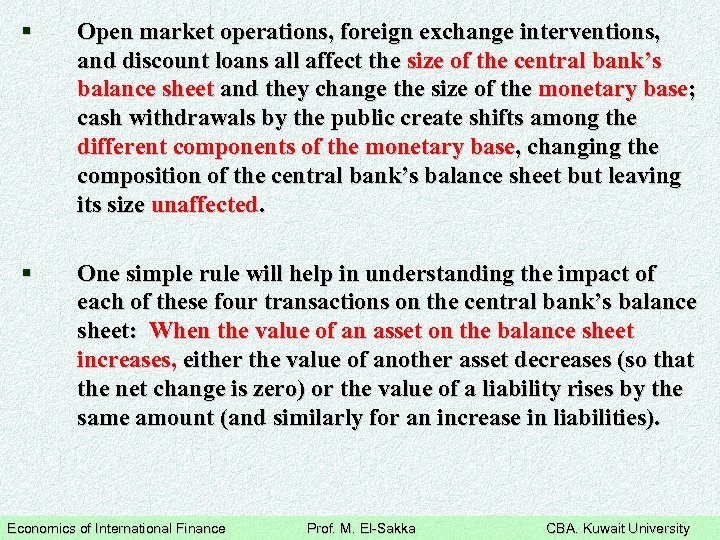
§ Open market operations, foreign exchange interventions, and discount loans all affect the size of the central bank’s balance sheet and they change the size of the monetary base; cash withdrawals by the public create shifts among the different components of the monetary base, changing the composition of the central bank’s balance sheet but leaving its size unaffected. § One simple rule will help in understanding the impact of each of these four transactions on the central bank’s balance sheet: When the value of an asset on the balance sheet increases, either the value of another asset decreases (so that the net change is zero) or the value of a liability rises by the same amount (and similarly for an increase in liabilities). Economics of International Finance Prof. M. El-Sakka CBA. Kuwait University
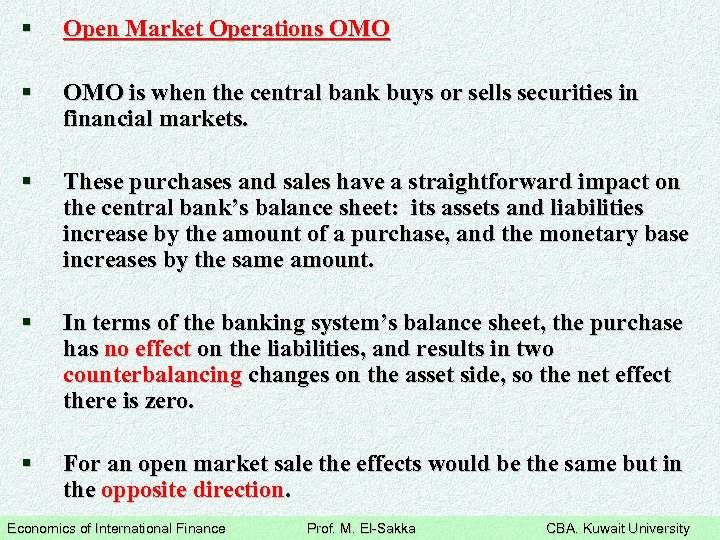
§ Open Market Operations OMO § OMO is when the central bank buys or sells securities in financial markets. § These purchases and sales have a straightforward impact on the central bank’s balance sheet: its assets and liabilities increase by the amount of a purchase, and the monetary base increases by the same amount. § In terms of the banking system’s balance sheet, the purchase has no effect on the liabilities, and results in two counterbalancing changes on the asset side, so the net effect there is zero. § For an open market sale the effects would be the same but in the opposite direction. Economics of International Finance Prof. M. El-Sakka CBA. Kuwait University
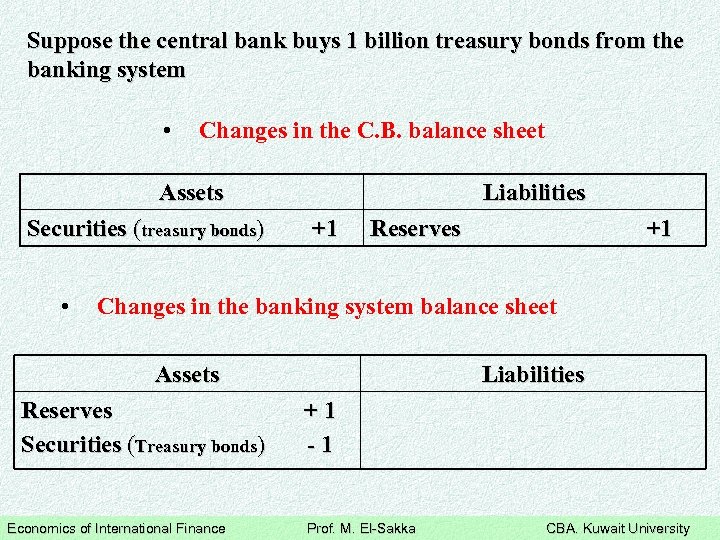
Suppose the central bank buys 1 billion treasury bonds from the banking system • Changes in the C. B. balance sheet Assets Securities (treasury bonds) • Liabilities +1 Reserves +1 Changes in the banking system balance sheet Assets Reserves Securities (Treasury bonds) Economics of International Finance Liabilities +1 -1 Prof. M. El-Sakka CBA. Kuwait University
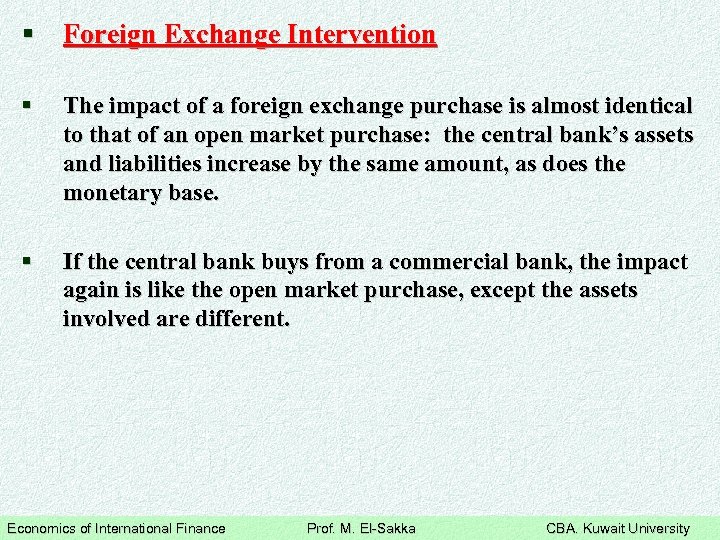
§ Foreign Exchange Intervention § The impact of a foreign exchange purchase is almost identical to that of an open market purchase: the central bank’s assets and liabilities increase by the same amount, as does the monetary base. § If the central bank buys from a commercial bank, the impact again is like the open market purchase, except the assets involved are different. Economics of International Finance Prof. M. El-Sakka CBA. Kuwait University
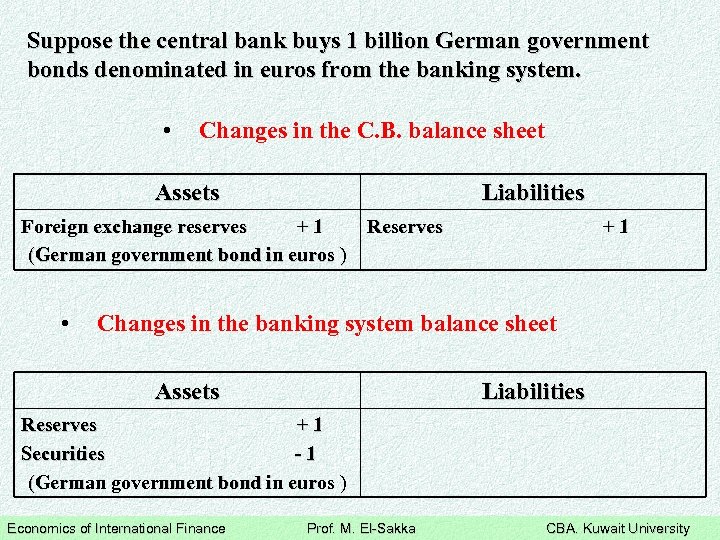
Suppose the central bank buys 1 billion German government bonds denominated in euros from the banking system. • Changes in the C. B. balance sheet Assets Liabilities Foreign exchange reserves +1 (German government bond in euros ) • Reserves +1 Changes in the banking system balance sheet Assets Liabilities Reserves +1 Securities -1 (German government bond in euros ) Economics of International Finance Prof. M. El-Sakka CBA. Kuwait University
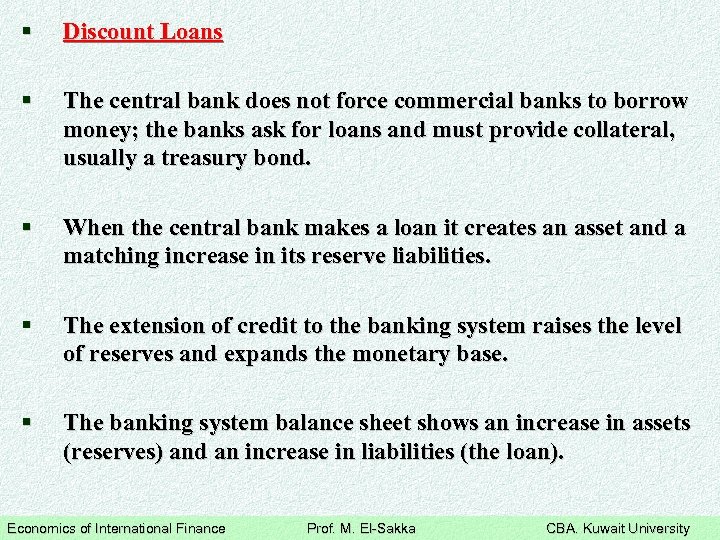
§ Discount Loans § The central bank does not force commercial banks to borrow money; the banks ask for loans and must provide collateral, usually a treasury bond. § When the central bank makes a loan it creates an asset and a matching increase in its reserve liabilities. § The extension of credit to the banking system raises the level of reserves and expands the monetary base. § The banking system balance sheet shows an increase in assets (reserves) and an increase in liabilities (the loan). Economics of International Finance Prof. M. El-Sakka CBA. Kuwait University
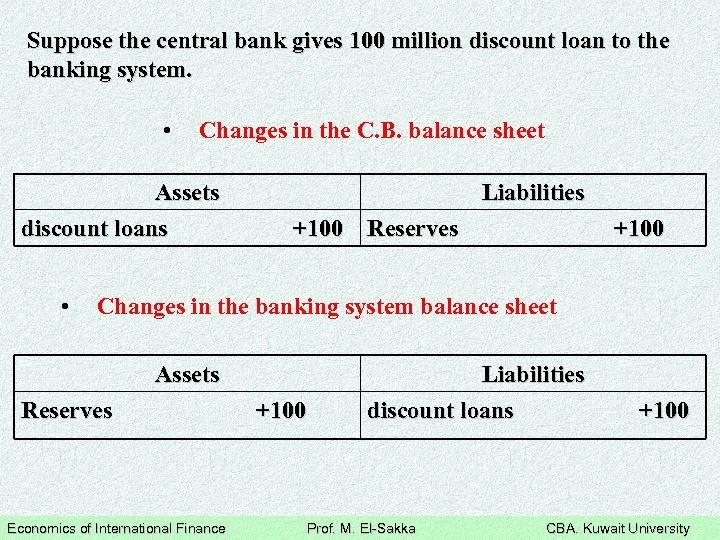
Suppose the central bank gives 100 million discount loan to the banking system. • Changes in the C. B. balance sheet Assets discount loans • Liabilities +100 Reserves +100 Changes in the banking system balance sheet Assets Reserves Economics of International Finance +100 Liabilities discount loans Prof. M. El-Sakka +100 CBA. Kuwait University
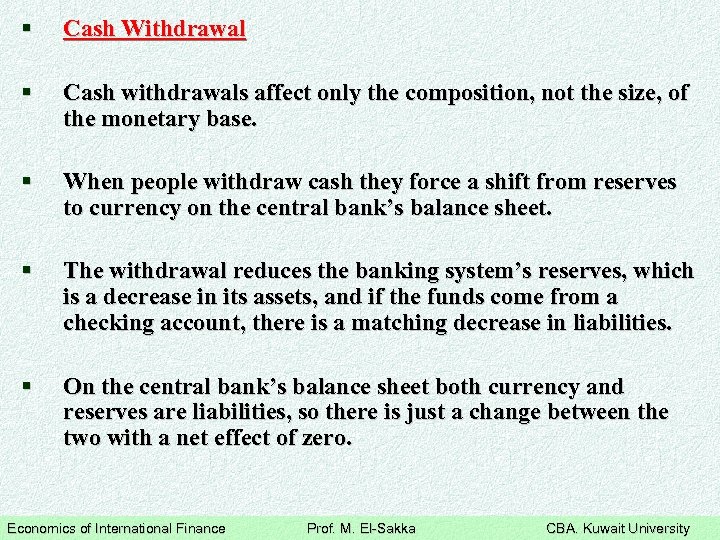
§ Cash Withdrawal § Cash withdrawals affect only the composition, not the size, of the monetary base. § When people withdraw cash they force a shift from reserves to currency on the central bank’s balance sheet. § The withdrawal reduces the banking system’s reserves, which is a decrease in its assets, and if the funds come from a checking account, there is a matching decrease in liabilities. § On the central bank’s balance sheet both currency and reserves are liabilities, so there is just a change between the two with a net effect of zero. Economics of International Finance Prof. M. El-Sakka CBA. Kuwait University
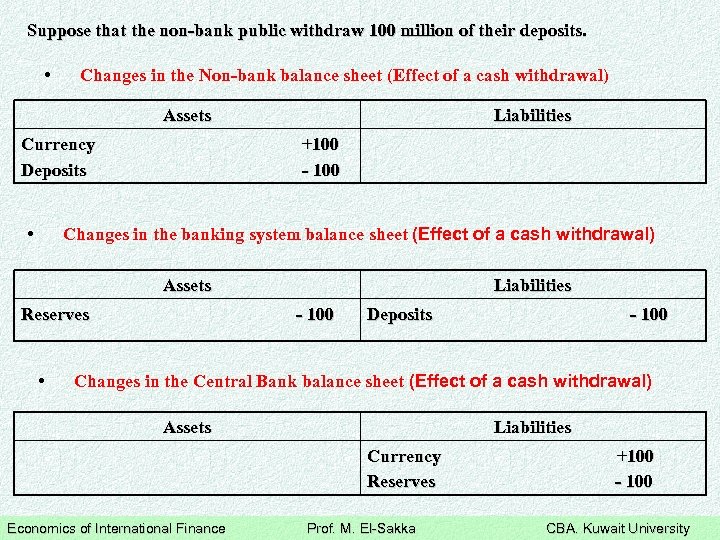
Suppose that the non-bank public withdraw 100 million of their deposits. • Changes in the Non-bank balance sheet (Effect of a cash withdrawal) Assets Currency Deposits • Liabilities +100 - 100 Changes in the banking system balance sheet (Effect of a cash withdrawal) Assets Reserves • Liabilities - 100 Deposits - 100 Changes in the Central Bank balance sheet (Effect of a cash withdrawal) Assets Liabilities Currency Reserves Economics of International Finance Prof. M. El-Sakka +100 - 100 CBA. Kuwait University
Economics of International Finance Prof. M. El-Sakka CBA. Kuwait University
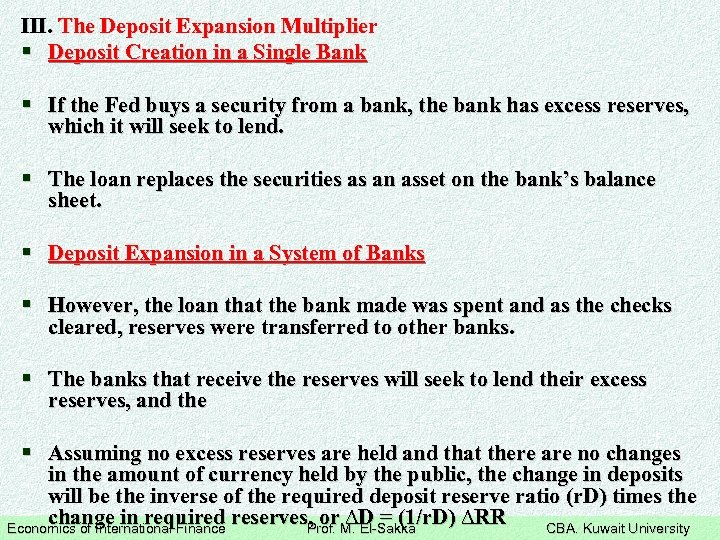
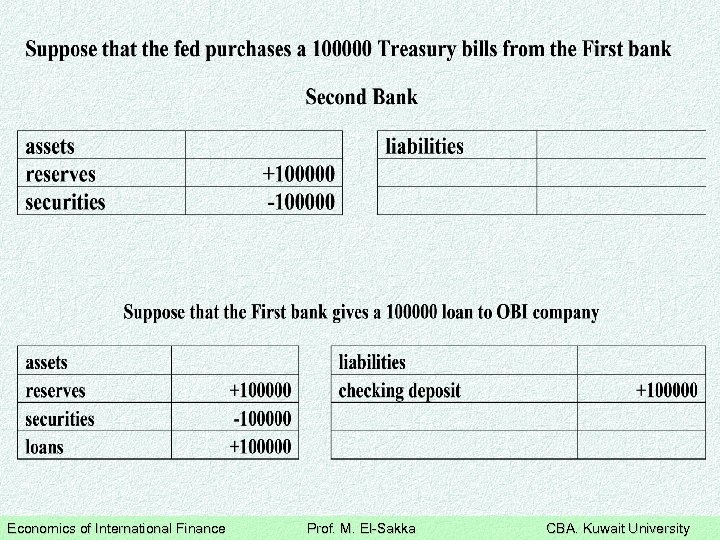
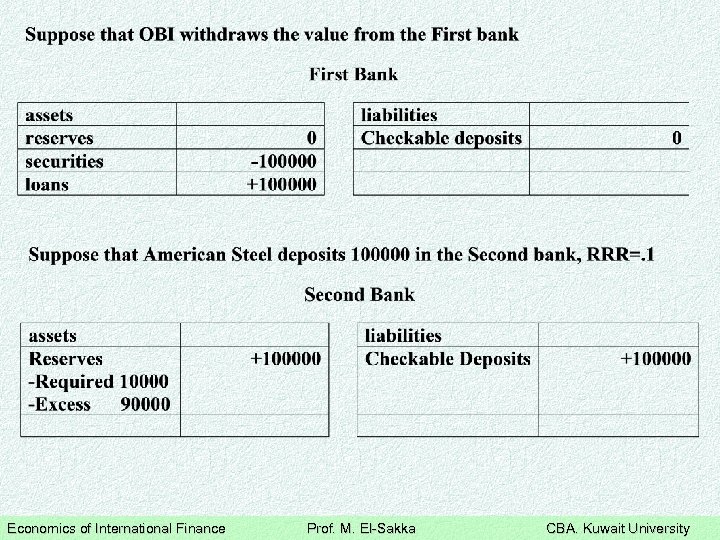
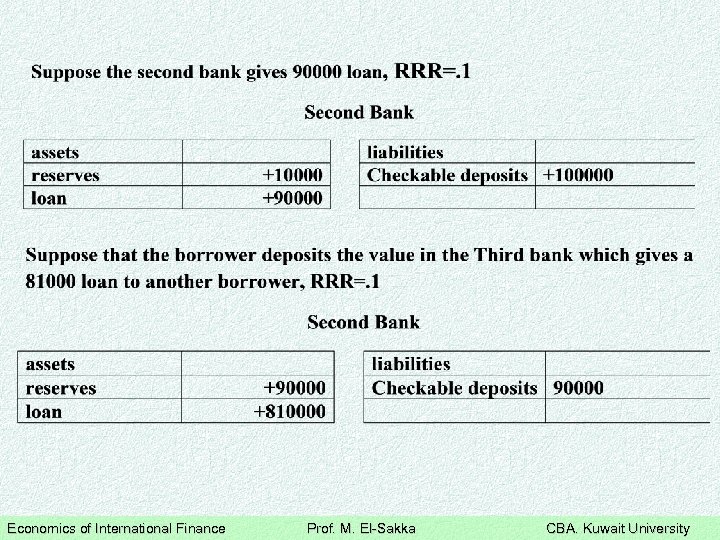
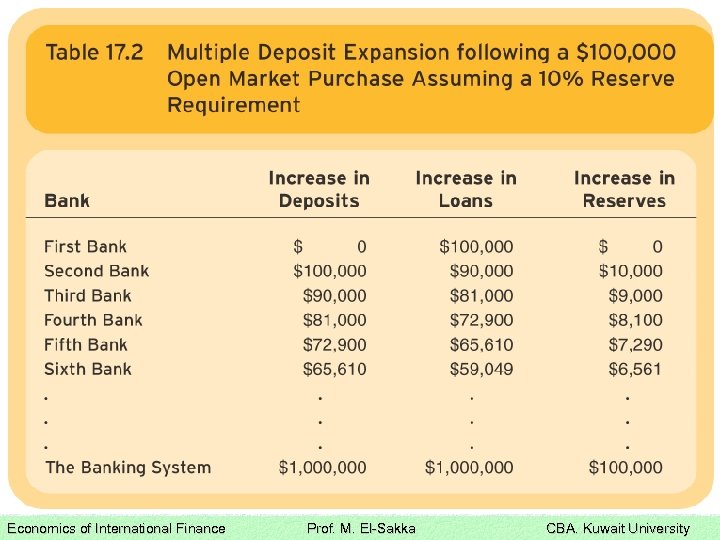
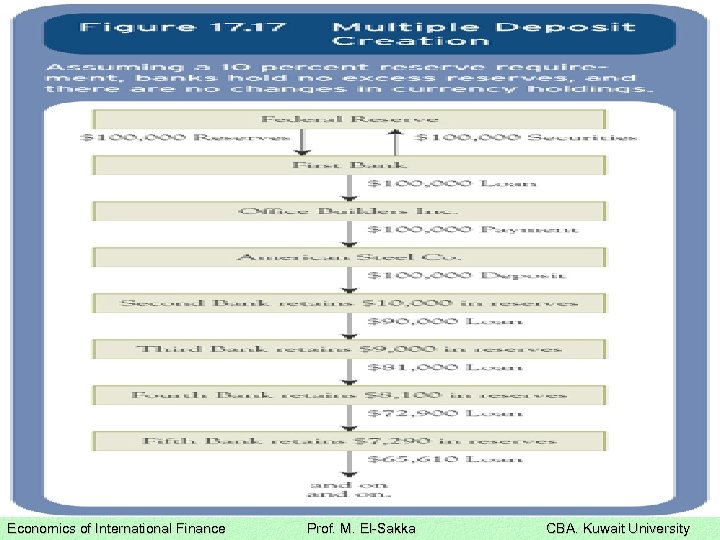
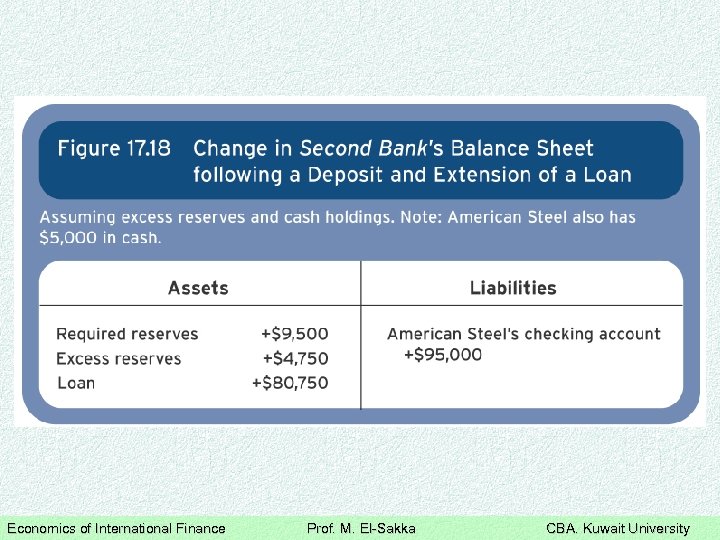
III. The Deposit Expansion Multiplier § Deposit Creation in a Single Bank § If the Fed buys a security from a bank, the bank has excess reserves, which it will seek to lend. § The loan replaces the securities as an asset on the bank’s balance sheet. § Deposit Expansion in a System of Banks § However, the loan that the bank made was spent and as the checks cleared, reserves were transferred to other banks. § The banks that receive the reserves will seek to lend their excess reserves, and the § Assuming no excess reserves are held and that there are no changes in the amount of currency held by the public, the change in deposits will be the inverse of the required deposit reserve ratio (r. D) times the change in required reserves, or M. El-Sakka ∆D = (1/r. D) ∆RR Economics of International Finance Prof. CBA. Kuwait University
Economics of International Finance Prof. M. El-Sakka CBA. Kuwait University
Economics of International Finance Prof. M. El-Sakka CBA. Kuwait University
Economics of International Finance Prof. M. El-Sakka CBA. Kuwait University
Economics of International Finance Prof. M. El-Sakka CBA. Kuwait University
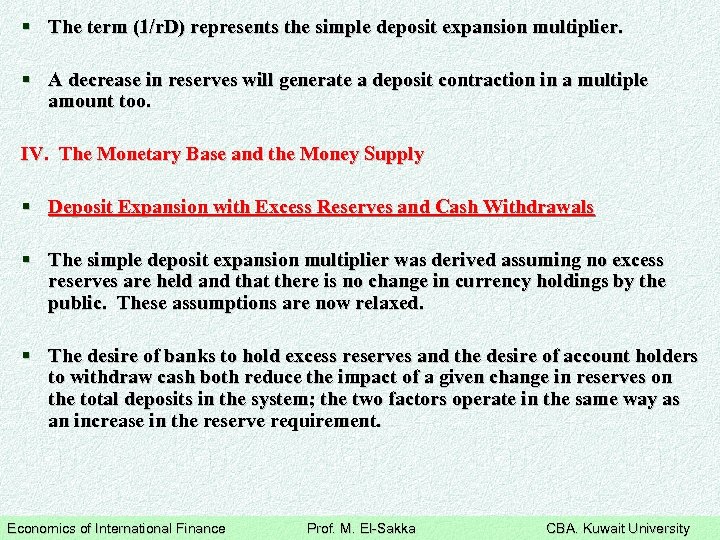
§ The term (1/r. D) represents the simple deposit expansion multiplier. § A decrease in reserves will generate a deposit contraction in a multiple amount too. IV. The Monetary Base and the Money Supply § Deposit Expansion with Excess Reserves and Cash Withdrawals § The simple deposit expansion multiplier was derived assuming no excess reserves are held and that there is no change in currency holdings by the public. These assumptions are now relaxed. § The desire of banks to hold excess reserves and the desire of account holders to withdraw cash both reduce the impact of a given change in reserves on the total deposits in the system; the two factors operate in the same way as an increase in the reserve requirement. Economics of International Finance Prof. M. El-Sakka CBA. Kuwait University
Economics of International Finance Prof. M. El-Sakka CBA. Kuwait University
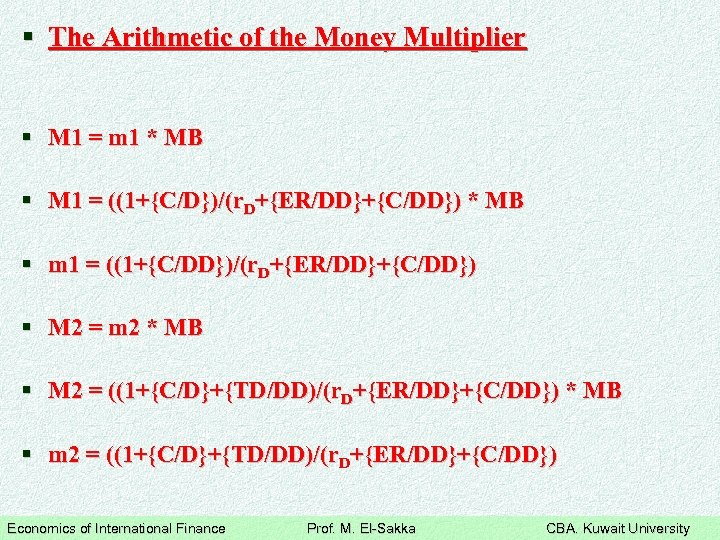
§ The Arithmetic of the Money Multiplier § M 1 = m 1 * MB § M 1 = ((1+{C/D})/(r. D+{ER/DD}+{C/DD}) * MB § m 1 = ((1+{C/DD})/(r. D+{ER/DD}+{C/DD}) § M 2 = m 2 * MB § M 2 = ((1+{C/D}+{TD/DD)/(r. D+{ER/DD}+{C/DD}) * MB § m 2 = ((1+{C/D}+{TD/DD)/(r. D+{ER/DD}+{C/DD}) Economics of International Finance Prof. M. El-Sakka CBA. Kuwait University
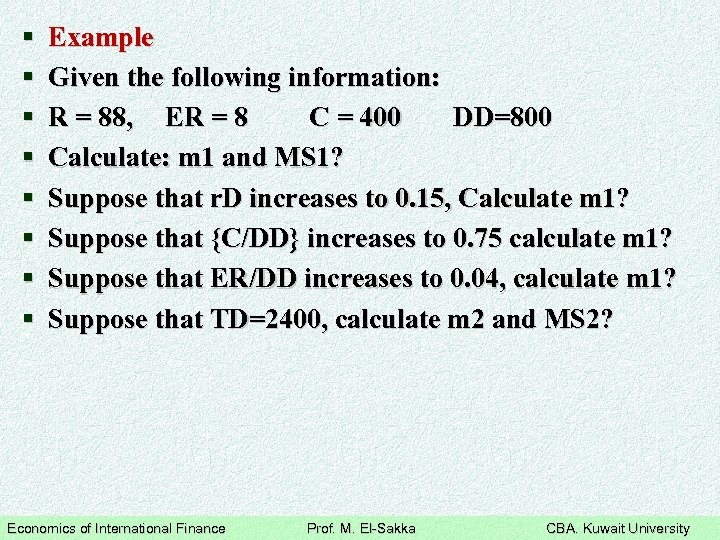
§ § § § Example Given the following information: R = 88, ER = 8 C = 400 DD=800 Calculate: m 1 and MS 1? Suppose that r. D increases to 0. 15, Calculate m 1? Suppose that {C/DD} increases to 0. 75 calculate m 1? Suppose that ER/DD increases to 0. 04, calculate m 1? Suppose that TD=2400, calculate m 2 and MS 2? Economics of International Finance Prof. M. El-Sakka CBA. Kuwait University
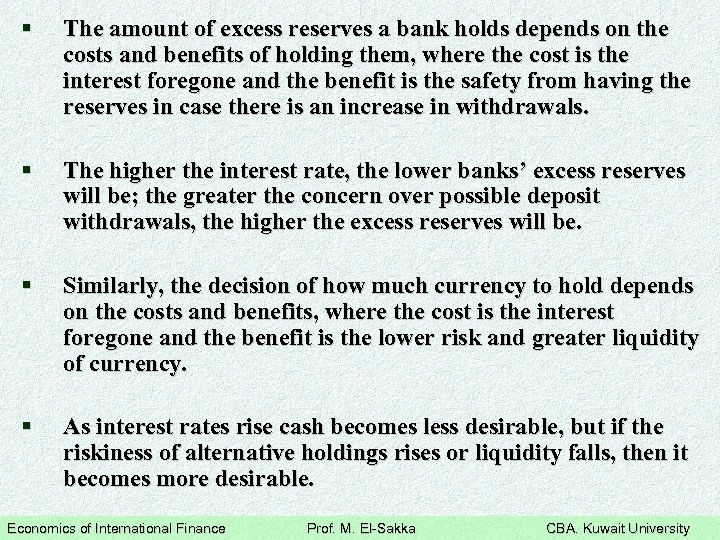
§ The amount of excess reserves a bank holds depends on the costs and benefits of holding them, where the cost is the interest foregone and the benefit is the safety from having the reserves in case there is an increase in withdrawals. § The higher the interest rate, the lower banks’ excess reserves will be; the greater the concern over possible deposit withdrawals, the higher the excess reserves will be. § Similarly, the decision of how much currency to hold depends on the costs and benefits, where the cost is the interest foregone and the benefit is the lower risk and greater liquidity of currency. § As interest rates rise cash becomes less desirable, but if the riskiness of alternative holdings rises or liquidity falls, then it becomes more desirable. Economics of International Finance Prof. M. El-Sakka CBA. Kuwait University
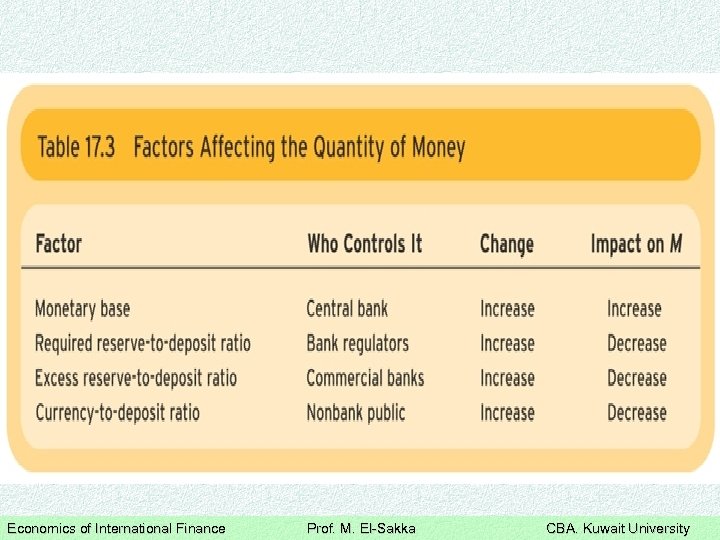
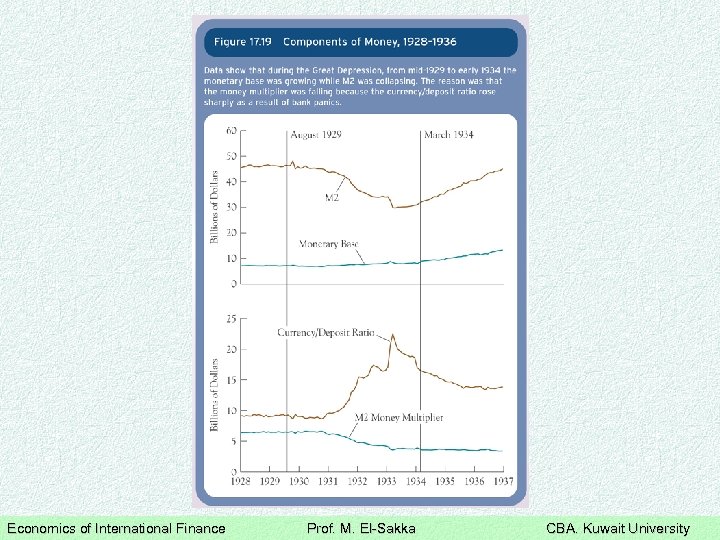
§ Deriving the money multiplier tells us that the quantity of money in the economy depends on the monetary base, the reserve requirement, the desire by banks to hold excess reserve and the desire by the public to hold currency. § The quantity of money changes directly with the base, and for a given amount of the base, an increase in either the reserve requirement or the holdings of excess reserves will decrease the quantity of money. § But currency holdings affect both the numerator and the denominator of the multiplier, so the effect is not immediately obvious. Logic tells us that an increase in currency decreases reserves and so decreases the money supply. Economics of International Finance Prof. M. El-Sakka CBA. Kuwait University
Economics of International Finance Prof. M. El-Sakka CBA. Kuwait University
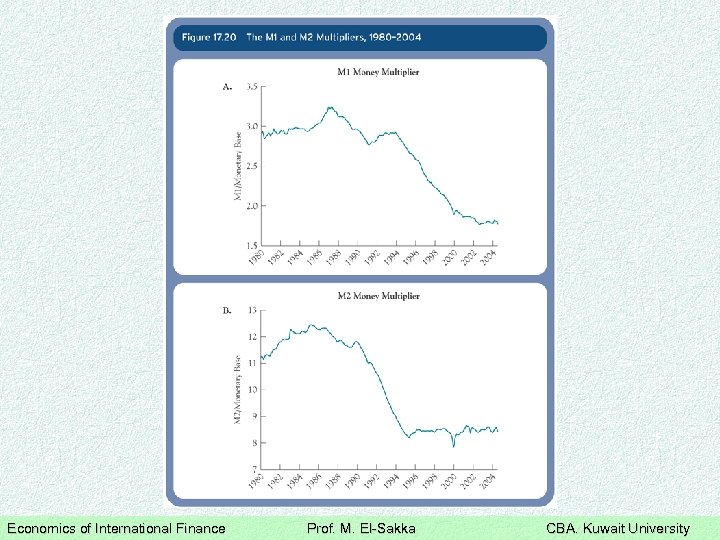
§ The Limits of the Central Bank’s Ability to Control the Quantity of Money § There is no tight link between changes in interest rates and changes in the money multiplier. § In places like the United States, Europe, and Japan, the link between the central bank’s balance sheet and the quantity of money circulating in the economy has become too weak and unpredictable to be exploited for policy purposes. § The Fed, the ECB, and the Bank of Japan have very limited control over the quantity of money in their currency areas. § Instead, modern central banks keep an eye on trends in money growth since that is what ultimately determines inflation. For short-run policy, interest rates have become the tool of choice. Economics of International Finance Prof. M. El-Sakka CBA. Kuwait University
Lessons of Chapter 17 § § § The central bank uses its balance sheet to control the quantity of money and credit in the economy. § The central bank holds assets and liabilities to meet its responsibilities as the government’s bank and the bankers’ bank. § Central bank assets include securities, foreign exchange reserves, and loans. § Central bank liabilities include currency, the government’s account, and reserves. § Reserves equal commercial bank account balances at the central bank plus vault cash. § The monetary base, also called high-powered money, is the sum of currency and reserves, the two primary liabilities of the central bank. The central bank controls the size of its balance sheet. § The central bank can increase the size of its balance sheet, raising reserve liabilities and expanding the monetary base, through: open market purchases of domestic securities; the purchase of foreign exchange reserves (in the form of bonds issued by a foreign government); and the extension of a loan to a commercial bank. § The central bank can decrease the size of its balance sheet, lowering reserve liabilities and reducing the monetary base through the sale of domestic or foreign securities. § The public’s cash withdrawals from banks shift the central bank’s liabilities from reserves to currency and shrink the size of the banking system balance sheet. Economics of International Finance Prof. M. El-Sakka CBA. Kuwait University
§ § § Bank reserves are transformed into checkable deposits through multiple deposit creation. In the simplest case, this process is limited by the reserve requirement. § When a bank’s reserves increase, it makes a loan that becomes a deposit at a second bank. § The second bank then makes another loan, but the amount of the loan is limited by the reserve requirement. § This process continues until deposits have increased by a multiple that is equal to one over the reserve requirement. The money multiplier links the monetary base to the quantity of money in the economy. § The size of the money multiplier depends on: i. the reserve requirement; ii. banks’ desire to hold excess reserves; and iii. the public’s desire to hold currency. § While the central bank controls the level of the monetary base, it cannot control the money multiplier. § Practices such as deposit sweeping have weakened the connection between the central bank’s balance sheet and the quantity of money. Economics of International Finance Prof. M. El-Sakka CBA. Kuwait University
Economics of International Finance Prof. M. El-Sakka CBA. Kuwait University
Economics of International Finance Prof. M. El-Sakka CBA. Kuwait University
Economics of International Finance Prof. M. El-Sakka CBA. Kuwait University
Economics of International Finance Prof. M. El-Sakka CBA. Kuwait University
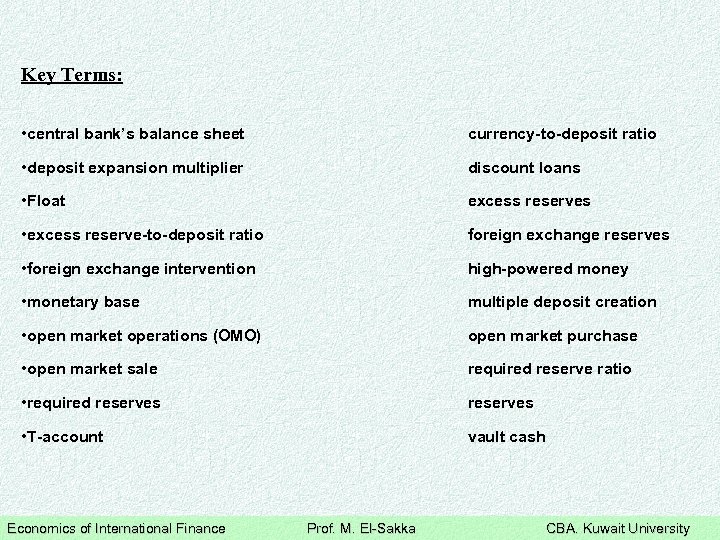
Key Terms: • central bank’s balance sheet currency-to-deposit ratio • deposit expansion multiplier discount loans • Float excess reserves • excess reserve-to-deposit ratio foreign exchange reserves • foreign exchange intervention high-powered money • monetary base multiple deposit creation • open market operations (OMO) open market purchase • open market sale required reserve ratio • required reserves • T-account vault cash Economics of International Finance Prof. M. El-Sakka CBA. Kuwait University
Economics of International Finance Prof. M. El-Sakka CBA. Kuwait University
Скачать презентацию Money Banking and Financial Markets Econ 212
a5a633ed56288c0814e9ad3f8ce9027b.ppt