


Money and Banking Lecture 7
Key Terms Bank: an institution for receiving, keeping, and lending money National bank: a bank chartered by the federal government Gold standard: a monetary system in which paper money and coins had the value of certain amounts of gold Central bank: a bank that can lend to other banks in times of need
Key Terms Money supply: all the money available in the United States economy Liquidity: the ability to be used, or directly converted into, cash Demand deposit: money in a checking account that can be paid out “on demand” or at any time Money market mutual fund: a fund that pools money from small savers to purchase short-term government and corporate securities
Key Terms Fractional reserve banking: a banking system that keeps only a fraction of its funds on hand lends out the remainder Default: failing to pay back a loan Mortgage: a specific type of loan that is used to buy real estate Credit card: a card entitling its owner to buy goods and services based on the owner’s promise to pay for those goods and services

Key Terms Interest: the price paid for the use of borrowed money Principal: the amount of money borrowed Debit card: a card used to withdraw money from a bank account Creditor: a person or institution to whom money is owed
Introduction What banking services do financial institutions provide? Financial institutions: • • • Provide electronic services Issue credit cards Make loans to businesses Provide mortgages to prospective home buyers Manage ATM machines

ancial The Fin System The financial system is the process by which money flows from savers to users.
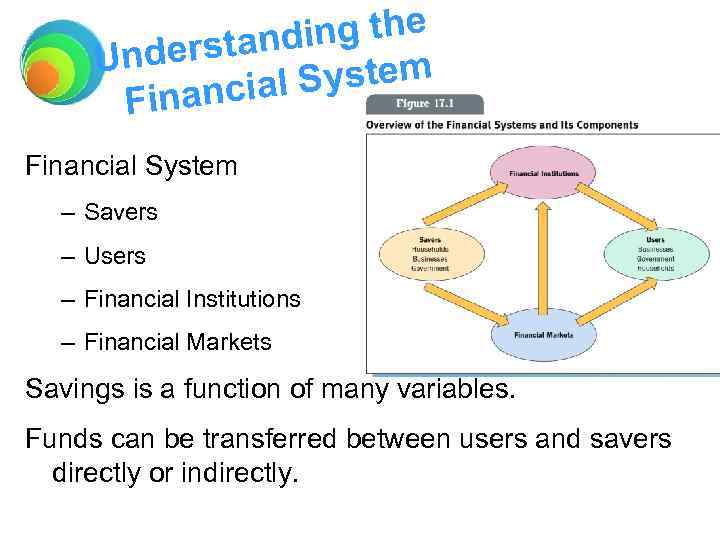
ing the erstand Und l System inancia F Financial System – Savers – Users – Financial Institutions – Financial Markets Savings is a function of many variables. Funds can be transferred between users and savers directly or indirectly.
urities of Sec Types Securities – Financial instruments – Obligations on the part of the issuer • Businesses and Governments – Provide rate of return to purchasers Money Market Instruments Bonds Stock
Bonds Government Bonds – Bonds sold by the Department of the Treasury. Municipal Bonds – Bonds issued by state or local governments • Revenue bonds are used toward a project that will produce revenue, General Obligation Bonds are not.
Stocks Common stock – ownership claims in corporations. – Vote on major company decisions – Cash dividends – Price appreciation Preferred stock – stockholders with preference in the payment of dividends.

onvertible C ecurities S Stockholder has the right to exchange the bond or preferred stock for a fixed number of shares of common stock.

standing Under Markets Stock market (exchange) – market in which common stocks are traded, such as the New York Stock Exchange.
titutions ancial Ins Fin ü Commercial Banks ü Savings Banks and Credit Unions ü Non-depository Institutions
Functions of Financial Institutions Banks and other financial institutions provide a wide range of services to customers. Storing money – They provide a safe place to store money Saving money – They offer people ways to save money through: • Savings accounts • Checking accounts • Money market accounts, which allow people to save and write a limited number of checks • CDs, which offer a guaranteed rate of interest but cannot be removed until after a specified period of time.
Loans Financial institutions lend money to consumers and charge interest on those loans. Loans help consumers: – Buy homes – Pay for college – Start and grow businesses Many banks loan money to other financial institutions and individuals. A banking system that only keeps a fraction of its funds on hand lends out the rest is called fractional reserve banking.

Mortgages and Credit Cards A mortgage is a specific type of loan that is used to buy real estate. Banks issue credit cards, which entitle their owners to buy goods and services based on the owners promise to pay. – Banks usually charge high interest rates on credit cards.
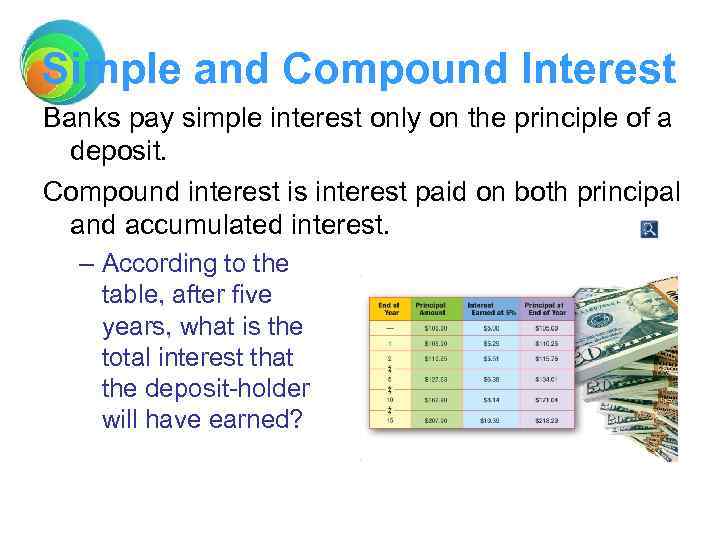
Simple and Compound Interest Banks pay simple interest only on the principle of a deposit. Compound interest is interest paid on both principal and accumulated interest. – According to the table, after five years, what is the total interest that the deposit-holder will have earned?
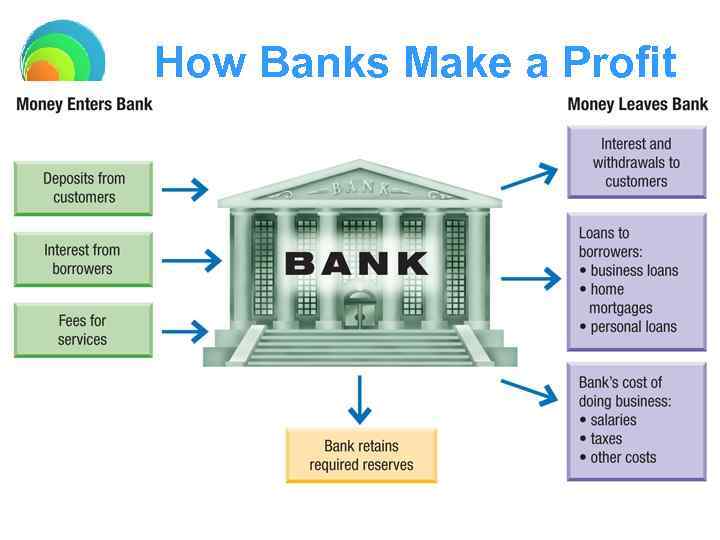
How Banks Make a Profit
In financial economics, a financial institution acts as an agent that provides financial services for its clients. Financial institutions generally fall under financial regulation from a government authority.
Types of Financial Institutions Common types of financial institutions include banks, Insurance Co, Leasing Co, Investment Co, Mutual Funds
Banks A bank is a commercial or state institution that provides financial services, including issuing money in various forms, receiving deposits of money, lending money and processing transactions and the creating of credit.
1. Central Bank A central bank, reserve bank or monetary authority, is an entity responsible for the monetary policy of its country or of a group of member states, such as the European Central Bank (ECB) in the European Union, the Federal Reserve System in the United States of America, State Bank in Pakistan.
1. Central Bank Its primary responsibility is to maintain the stability of the national currency and money supply, but more active duties include controlling subsidized-loan interest rates, and acting as a “lender of last resort” to the banking sector during times of financial crisis
2. Commercial Banks A commercial bank accepts deposits from customers and in turn makes loans, even in excess of the deposits; a process known as fractional-reserve banking. Some banks (called Banks of issue) issue banknotes as legal tender.
3. Investment Banks Investment banks help companies and governments and their agencies to raise money by issuing and selling securities in the primary market. They assist public and private corporations in raising funds in the capital markets (both equity and debt), as well as in providing strategic advisory services for mergers, acquisitions and other types of financial transactions.
4. Saving Banks A savings bank is a financial institution whose primary purpose is accepting savings deposits. It may also perform some other functions.
5. Micro Finance Banks For the purpose of poverty reduction program, such kind of banks are working in the different countries with the contribution of UNO or World Bank. In Pakistan 7 Micro Finance Banks are providing services under the SBP prudential regulation.
6. Islamic Banks Islamic banking refers to a system of banking or banking activity that is consistent with Islamic law (Sharia) principles and guided by Islamic economics. In particular, Islamic law prohibits usury, the collection and payment of interest, also commonly called riba in Islamic discourse.
7. Specialized Banks 1. ZTBL – The Zarai Taraqiati Bank Limited It is also known as Agricultural Development Bank of Pakistan (ADBP). – It is the premier financial institution geared towards the development of the agricultural sector through the provision of financial services and technical know-how.
7. Specialized Banks 2. IDBP Industrial Development Bank of Pakistan is one of Pakistan's oldest development financing institution created with the primary objective of extending term finance for investment in the manufacturing sector and SME Sector of the economy.
7. Specialized Banks 3. SME Bank Promote the business. Positive impact on Financial environment. Financing of projects. Tell revenue generation schemes to entrepreneurs.
8. Non-banking financial company Non-bank financial companies (NBFCs) also known as a non-bank or a non-bank, are financial institutions that provide banking services without meeting the legal definition of a bank, i. e. one that does not hold a banking license.
8. Non-banking financial company Operations are, regardless of this, still exercised under bank regulation. However this depends on the jurisdiction, as in some jurisdictions, such as New Zealand, any company can do the business of banking, and there are no banking licenses issued.
8. Non-banking financial company Non-bank institutions frequently acts as suppliers of loans and credit facilities, supporting investments in property, providing services relating to events within peoples lives such as funding private education, wealth management and retirement planning
8. Non-banking financial company however they are typically not allowed to take deposits from the general public and have to find other means of funding their operations such as issuing debt instruments. In India, most NBFCs raise capital through Chit Funds.

9. Investment company Generally, an "investment company" is a company (corporation, business trust, partnership, or limited liability company) that issues securities and is primarily engaged in the business of investing in securities.

9. Investment company An investment company invests the money it receives from investors on a collective basis, and each investor shares in the profits and losses in proportion to the investor’s interest in the investment company.

11. Leasing Companies A lease or tenancy is the right to use or occupy personal property or real property given by a lessor to another person (usually called the lessee or tenant) for a fixed or indefinite period of time, whereby the lessee obtains exclusive possession of the property in return for paying the lessor a fixed or determinable consideration (payment).

12. Insurances Companies Insurance companies may be classified as 1. Life insurance companies, which sell life insurance, annuities and pensions products. 2. Non-life or general insurance companies, which sell other types of insurance.
Mutual Fund An investment which is comprised of a pool of funds collected from many investors for the purpose of investing in securities such as stocks, bonds, money market securities and similar assets.

Mutual funds are operated by money mangers, who invest the fund's capital and attempt to produce capital gains and income for the fund's investors. A mutual fund's portfolio is structured and maintained to match the investment objectives stated in its prospectus.

10. Brokerage Houses Stock brokers assist people in investing, online only companies are called 'discount brokerages', companies with a branch presence are called 'full service brokerages' or 'private client services.
Financial Institution Functions Financial institutions provide a service as intermediaries of the capital and debt markets. They are responsible for transferring funds from investors to companies, in need of those funds. The presence of financial institutions facilitate the flow of cash through the economy.
Financial Institution Functions To do so, savings accounts are pooled to mitigate the risk brought by individual account holders in order to provide funds for loans. Such is the primary means for depository institutions to develop revenue.

Financial Institution Functions Should the yield curve become inverse, firms in this arena will offer additional feegenerating services including securities underwriting, sales & trading, and prime brokerage.
Misleading financial analysis Financial analysis of an organization is misleading when it is used to misrepresent the organisation, its situation or its prospects.

This type of deceit is sometimes used to obtain money by misdirecting people to invest in a stock market bubble, profiting from the increase in value, then removing funds before the bubble collapses, for instance in a stock market crash.
Electronic Banking With the increased importance of computers in today’s world, electronic banking has seen an upsurge. – ATMs allow customers to deposit money, withdraw cash, and obtain information. – Debit cards can be used at an ATM or in a store to purchase goods. These cards require a PIN for security reasons. – Home banking—More and more people use the Internet to check balances, transfer money, automatically deposit paychecks, and pay bills. – Checkpoint: How does a debit card work?
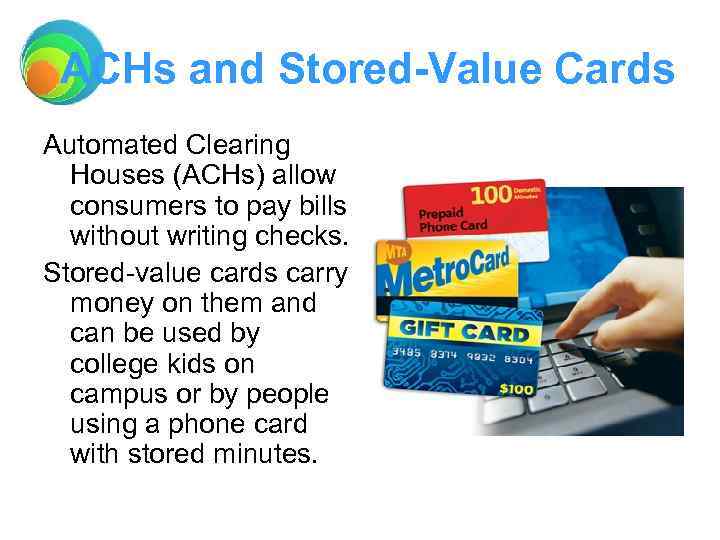
ACHs and Stored-Value Cards Automated Clearing Houses (ACHs) allow consumers to pay bills without writing checks. Stored-value cards carry money on them and can be used by college kids on campus or by people using a phone card with stored minutes.
