


 Скачать презентацию Monetary Policy Challenges Recent Reforms and Planned Reform
67e03fb63963ba9a4f7ec0935a996788.ppt
- Количество слайдов: 18
 Monetary Policy: Challenges, Recent Reforms and Planned Reform Agenda Shahid Hafiz Kardar Governor State Bank of Pakistan Development Forum November 15, 2010 1
 Monetary Policy Framework in Pakistan v Objective(s) of SBP’s monetary policy is to strike a delicate balance on inflation containment and maintaining/supporting economic growth. v Change in the monetary policy stance is communicated through adjustment in the policy rate – the overnight rate at which SBP provides collateralized cash to bank(s). If required, changes in the Cash Reserve Requirement (CRR) and Statutory Liquid Reserve requirement (SLR) are also made. 2
 Inherited Macroeconomics Imbalances v Government inherited large macroeconomic imbalances owing to expansionary monetary and fiscal policies, with them having spillover effects on the current account but without adjustment of the exchange rate because of large capital inflows. FY 05 FY 06 FY 07 FY 08 FY 09 FY 10 Inflation % 9. 0 8. 0 12 21 12 Overall Fiscal Deficit % age of GDP 3. 3 4. 4 7. 6 5. 3 6. 3 Current Account Deficit % of GDP 1. 5 4. 4 5. 1 8. 5 5. 7 19. 1 15. 1 19. 3 15. 3 * 9. 6 * 12. 5 2. 0 4. 5 8. 4 5. 4 2. 6 2. 1 Money Supply (%) Pvt. /FDI/Portfolio (US $ billion) * - Low money growth in FY 08 and FY 09 was due to depletion of reserves. 3
 Recent experiences with monetary management: Inflation v After a sustained reduction, from 20. 8 percent in FY 09 to 11. 7 percent in FY 10, inflation has started to increase again in FY 11, September & October in excess of 15. 4% Yo. Y v Most of this inflation is being contributed by food, fuel and transportation groups after floods. v The resurgence in inflation is attributable to a number of factors. v Reform measures (to dismantle past distortion/suppression of energy and oil prices) whose impact is being felt in the short-term. o Reduction in energy related subsidies. o Automatic pass through of increase in international prices of oil in electricity tariffs. 4
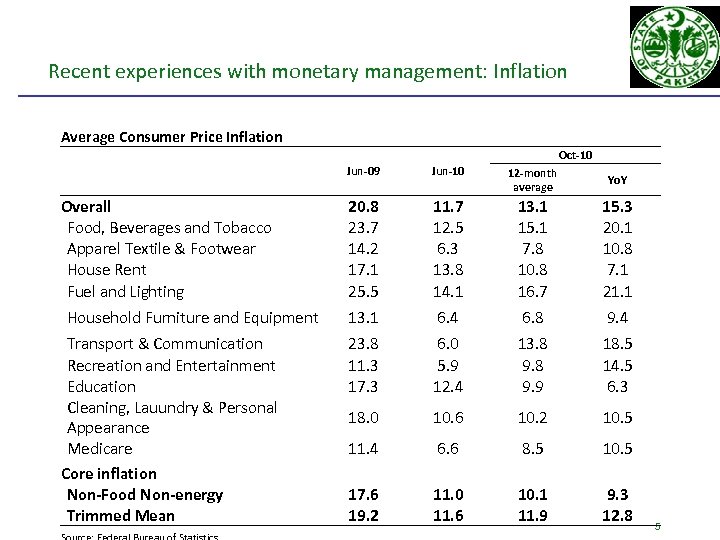 Recent experiences with monetary management: Inflation Average Consumer Price Inflation Oct-10 12 -month average Jun-09 Overall Food, Beverages and Tobacco Apparel Textile & Footwear House Rent Fuel and Lighting Household Furniture and Equipment Transport & Communication Recreation and Entertainment Education Cleaning, Lauundry & Personal Appearance Medicare Core inflation Non-Food Non-energy Trimmed Mean Jun-10 20. 8 23. 7 14. 2 17. 1 25. 5 11. 7 12. 5 6. 3 13. 8 14. 1 13. 1 15. 1 7. 8 10. 8 16. 7 15. 3 20. 1 10. 8 7. 1 21. 1 13. 1 6. 4 6. 8 9. 4 23. 8 11. 3 17. 3 6. 0 5. 9 12. 4 13. 8 9. 9 18. 5 14. 5 6. 3 18. 0 10. 6 10. 2 10. 5 11. 4 6. 6 8. 5 10. 5 17. 6 19. 2 11. 0 11. 6 10. 1 11. 9 9. 3 12. 8 Yo. Y 5
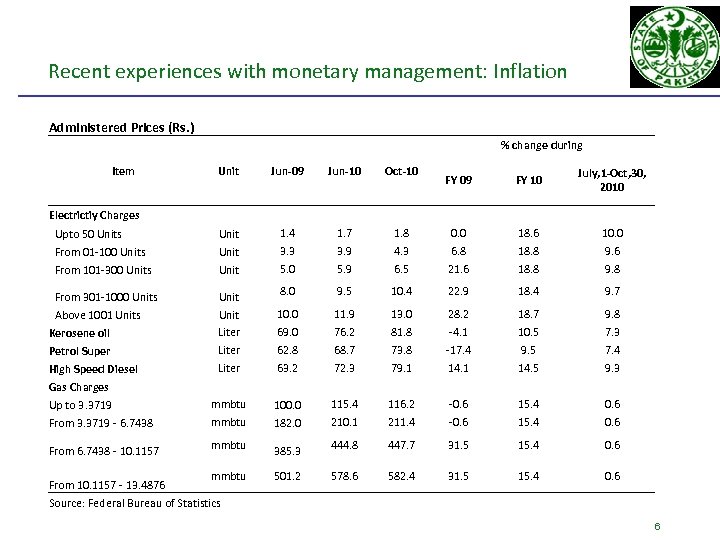 Recent experiences with monetary management: Inflation Administered Prices (Rs. ) % change during Item Unit Jun-09 Jun-10 Oct-10 1. 4 3. 3 5. 0 1. 7 3. 9 5. 9 Electrictiy Charges FY 09 FY 10 July, 1 -Oct, 30, 2010 1. 8 4. 3 6. 5 0. 0 6. 8 21. 6 18. 6 18. 8 10. 0 9. 6 9. 8 Upto 50 Units From 01 -100 Units From 101 -300 Units Unit From 301 -1000 Units Above 1001 Units Kerosene oil Petrol Super High Speed Diesel Gas Charges Up to 3. 3719 From 3. 3719 - 6. 7438 Unit Liter 8. 0 9. 5 10. 4 22. 9 18. 4 9. 7 10. 0 69. 0 62. 8 63. 2 11. 9 76. 2 68. 7 72. 3 13. 0 81. 8 73. 8 79. 1 28. 2 -4. 1 -17. 4 14. 1 18. 7 10. 5 9. 5 14. 5 9. 8 7. 3 7. 4 9. 3 mmbtu 100. 0 182. 0 115. 4 210. 1 116. 2 211. 4 -0. 6 15. 4 0. 6 444. 8 447. 7 31. 5 15. 4 0. 6 578. 6 582. 4 31. 5 15. 4 0. 6 From 6. 7438 - 10. 1157 From 10. 1157 - 13. 4876 mmbtu 385. 3 501. 2 Source: Federal Bureau of Statistics 6
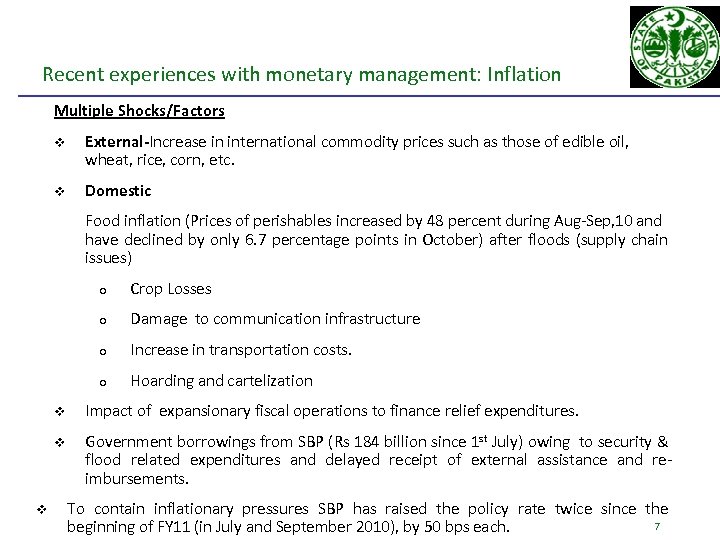 Recent experiences with monetary management: Inflation Multiple Shocks/Factors v External-Increase in international commodity prices such as those of edible oil, wheat, rice, corn, etc. v Domestic Food inflation (Prices of perishables increased by 48 percent during Aug-Sep, 10 and have declined by only 6. 7 percentage points in October) after floods (supply chain issues) o Crop Losses o Damage to communication infrastructure o Increase in transportation costs. o Hoarding and cartelization v v v Impact of expansionary fiscal operations to finance relief expenditures. Government borrowings from SBP (Rs 184 billion since 1 st July) owing to security & flood related expenditures and delayed receipt of external assistance and reimbursements. To contain inflationary pressures SBP has raised the policy rate twice since the 7 beginning of FY 11 (in July and September 2010), by 50 bps each.
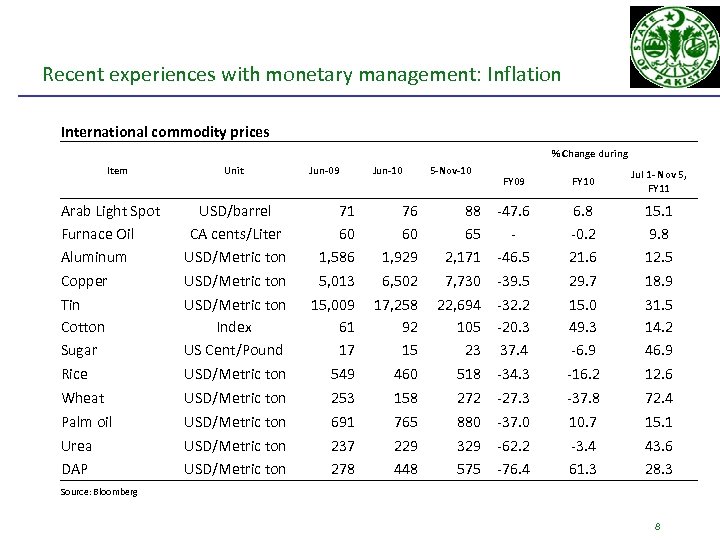 Recent experiences with monetary management: Inflation International commodity prices % Change during Item Arab Light Spot Furnace Oil Aluminum Copper Tin Cotton Sugar Rice Wheat Palm oil Urea DAP Unit USD/barrel CA cents/Liter USD/Metric ton Index US Cent/Pound USD/Metric ton USD/Metric ton Jun-09 Jun-10 71 60 1, 586 5, 013 15, 009 61 17 549 253 691 237 278 76 60 1, 929 6, 502 17, 258 92 15 460 158 765 229 448 5 -Nov-10 88 65 2, 171 7, 730 22, 694 105 23 518 272 880 329 575 FY 09 FY 10 Jul 1 - Nov 5, FY 11 -47. 6 -46. 5 -39. 5 -32. 2 -20. 3 37. 4 -34. 3 -27. 3 -37. 0 -62. 2 -76. 4 6. 8 -0. 2 21. 6 29. 7 15. 0 49. 3 -6. 9 -16. 2 -37. 8 10. 7 -3. 4 61. 3 15. 1 9. 8 12. 5 18. 9 31. 5 14. 2 46. 9 12. 6 72. 4 15. 1 43. 6 28. 3 Source: Bloomberg 8
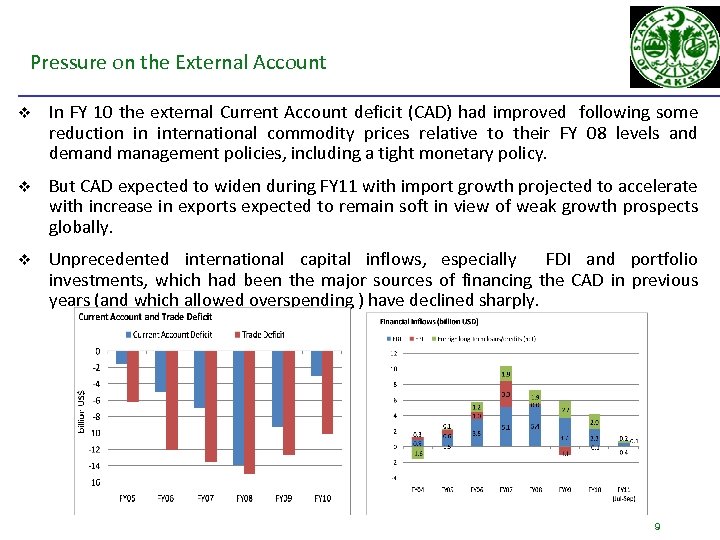 Pressure on the External Account v In FY 10 the external Current Account deficit (CAD) had improved following some reduction in international commodity prices relative to their FY 08 levels and demand management policies, including a tight monetary policy. v But CAD expected to widen during FY 11 with import growth projected to accelerate with increase in exports expected to remain soft in view of weak growth prospects globally. v Unprecedented international capital inflows, especially FDI and portfolio investments, which had been the major sources of financing the CAD in previous years (and which allowed overspending ) have declined sharply. 9
 Recent Policy, Administrative and Procedural reforms in monetary policy v Removal of SBP support for oil payments. v Increased flexibility in exchange rate movement- with minimal SBP interventions. v Separation of liquidity and debt management. - Transfer of decision on amount to be raised in T-bill auctions and the cut-off rate to the Mo. F has removed ambiguities, enhancing the role of SBP’s policy rate as the sole instrument for signaling monetary policy changes. - Advance announcement of a T-bill auction calendar by the Ministry of Finance (Mo. F). This has reduced uncertainty and improved liquidity forecasting and management. v Introduction of corridor framework for overnight money market rate. - Has helped in containing excessive volatility in overnight money market rate, strengthening transmission of monetary policy signals. 10
 Recent Policy and Administrative Monetary Policy v Establishment of a Monetary Policy Committee (MPC). - A 9 member MPC chaired by Governor SBP with two external academic experts. - Minutes of MPC meetings along with votes of members (without names) on monetary policy decisions posted on SBP’s website, increasing transparency of monetary policy formulation process and SBP’s credibility. v Frequency of Monetary Policy reviews and decisions has been increased. - Instead of twice a year SBP now announces its monetary policy decisions six times a year. - This has reduced uncertainty and increased SBP’s ability to influence market expectations and respond to changing economic conditions in a timely manner. 11
 Challenges to effective Monetary Management and Reforms v Government Borrowing Challenges - Apart from causing inflation, unrestricted access of Go. P to borrowing from SBP complicates liquidity management, dilutes the impact of the monetary policy stance, puts pressure on the exchange rate and hurts the private sector by affecting availability and cost of credit. - Total Government borrowings 50% of NDA of banking system (56% if PSEs included) high and at rising rates of interest because of borrowing of Rs 390 billion for trade in commodities like wheat, sugar, rice, fertilizer etc. Reforms Undertaken v Mo. F has piloted an amended SBP Act through the National Assembly. - Limits government borrowing from SBP to only 10% of previous year’s revenues and link it to FRDL. Government also bound to gradually reduce its current stock of borrowing from SBP (Rs 1355 billion or 65% of revenue) in next 5 years. - Enhances autonomy of SBP 12
 Challenges to effective Monetary Management and Reforms v Provincial government borrowings now being restricted to their Ways and Means Limits. v Public sector commodity operations being phased out v Monetary policy transmission mechanism Challenges - Different components of credit affected by interest rate changes with different intensities. Understanding of other channels through which monetary policy influences economic behavior needs improvement. - Despite weaknesses, monetary policy remains effective in controlling inflation (as the graph on next slide shows), reflected 13 also in the decline of core inflation.
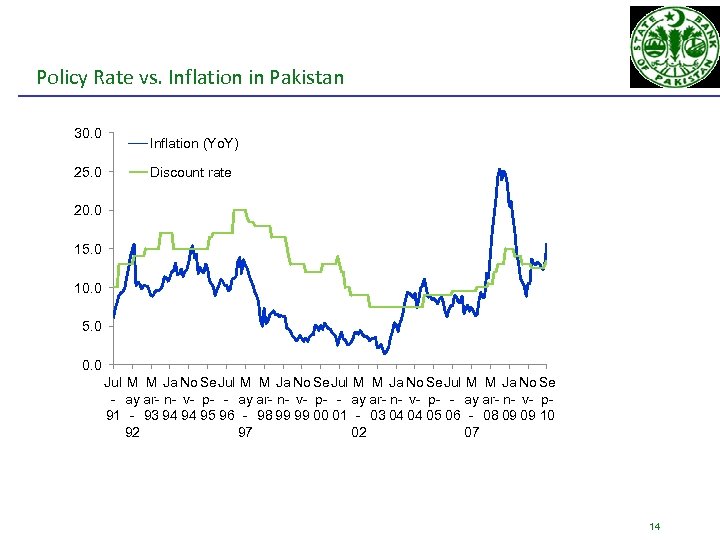 Policy Rate vs. Inflation in Pakistan 30. 0 25. 0 Inflation (Yo. Y) Discount rate 20. 0 15. 0 10. 0 5. 0 0. 0 Jul M M Ja No Se - ay ar- n- v- p- - ay ar- n- v- p 91 - 93 94 94 95 96 - 98 99 99 00 01 - 03 04 04 05 06 - 08 09 09 10 92 97 02 07 14
 Challenges to effective monetary management and Reforms v Large banking spreads and credit concentration Challenges - Large spreads between interest rates on deposits and interest rates on loans (700 basis points) partly due to limited saving avenues and heavy reliance of borrowers (government, private and public sector) on banks to finance their needs. The weighted average return on deposits are low because most of the deposits are in zero return current accounts (26%) and 5% minimum-return saving account s (38%). - Presence of large informal sector also contributing to transmission weaknesses. Planned Reforms o Widening access to government paper. o Creating greater awareness on high-return term deposits. o Development of a market for corporate debt. o 15 Phasing out role of institutional investors in National Saving Schemes.
 Challenges to effective monetary management and Reforms v Documentation of economy through introduction of RGST and mandatory e-filing of tax returns expected to help reduce impact of such weaknesses. v Subsidized credit facilities Challenges - Facilities like Export Finance Scheme (EFS) and Long-term Financing Facility (LTFF), complicate monetary management (their effect similar to printing money) and promote economic inefficiency. - Efforts of banks to mobilize deposits and raise returns constrained by easy availability of re-finance from SBP. - These schemes also dilute the clarity of the main objectives of SBP, which are price and financial stability. Reforms Undertakes - Removal of distortions by narrowing the difference of interest rates on subsidized schemes with the market interest rates and making them more focused to achieve objectives for which created. 16
 Challenges to effective Monetary Management and Planned Areas of Reform v Several in-house studies in progress to limit inflationary impact of refinancing by enhancing focus on development finance and improve functioning of credit markets e. g. a) reforming EFS to consider focus on SME and nontraditional exports b) developing incentive packages for agriculture, Micro finance and SME by experimenting in flood affected areas v Tackling above will also help improve process of financial intermediation , which will gradually narrow banking spreads. 17
 Challenges to effective Monetary Management and Planned Areas of Reform v Coordination between Monetary and Fiscal policies. Challenges - Increased coordination between monetary and fiscal policies required to achieve mutual and desirable macroeconomic goals through sharing of data and information and regular interaction at the technical and policy level to ensure consistency between monetary and fiscal policies. - Data on key macroeconomic variables, such as real GDP, not available with appropriate frequency. Lack of information resulting in second guessing on what is happening, constraining SBP’s ability to accurately gauge aggregate demand pressures. Such uncertainty raises risk premium of private sector. Reforms Better coordination of monetary and fiscal policy now possible because of same mindset and excellent relations between the leaderships at the Mo. F, Planning Commission (PC) and SBP – a weakness until now 18