


 Скачать презентацию Momentum Reconstruction and Triggering in the ATLAS Detector
e7ffad091c59487cc9fc73fa9cbe7403.ppt
- Количество слайдов: 17
 Momentum Reconstruction and Triggering in the ATLAS Detector Fermi. Lab, October 2000 Erez Etzion 1, Gideon Dror 2, David Horn 1, Halina Abramowicz 1 1. Tel-Aviv University, Tel Aviv, Israel. 2. The Academic College of Tel-Aviv-Yaffo, Tel Aviv, Israel. Momentum Reconstruction and Triggering ACAT 2000 Oct. 2000 1
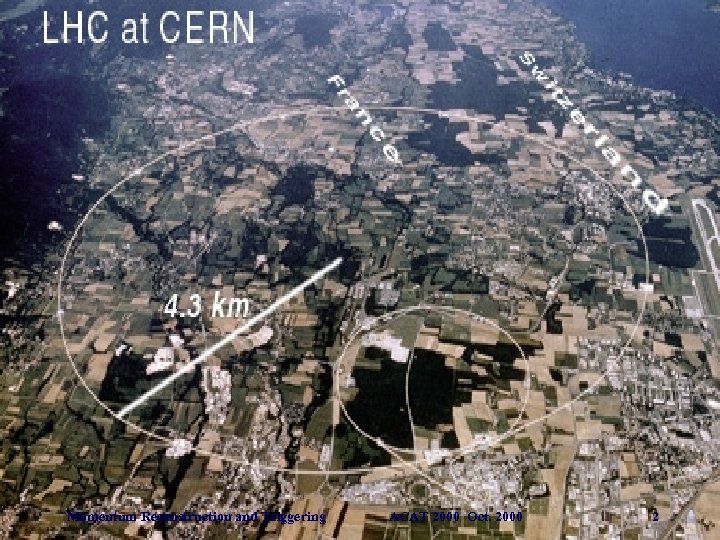 LHC @ CERN Momentum Reconstruction and Triggering ACAT 2000 Oct. 2000 2
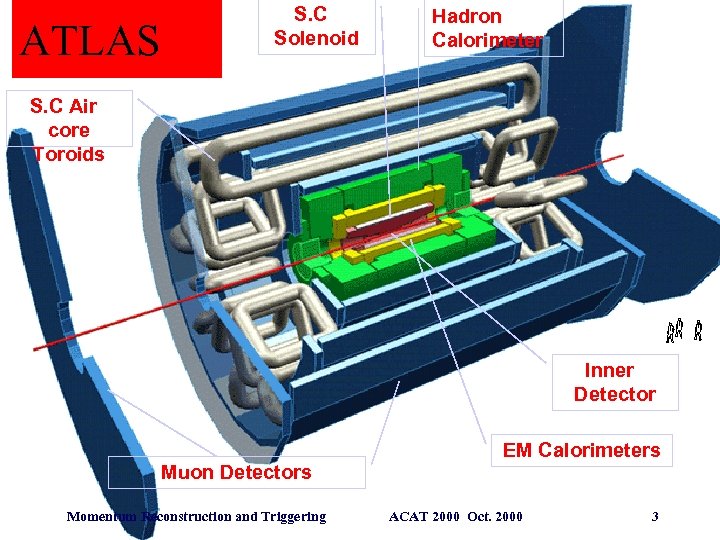 ATLAS S. C Solenoid Hadron Calorimeter S. C Air core Toroids Inner Detector Muon Detectors Momentum Reconstruction and Triggering EM Calorimeters ACAT 2000 Oct. 2000 3
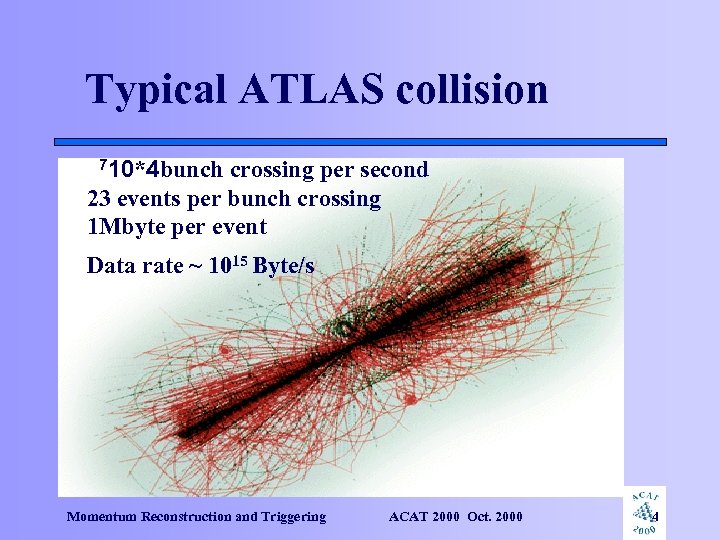 Typical ATLAS collision 710*4 bunch crossing per second 23 events per bunch crossing 1 Mbyte per event Data rate ~ 1015 Byte/s Momentum Reconstruction and Triggering ACAT 2000 Oct. 2000 4
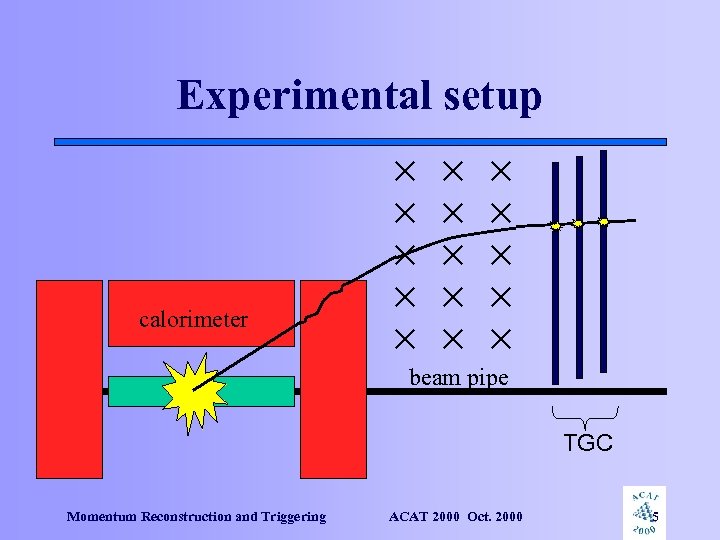 Experimental setup calorimeter beam pipe TGC Momentum Reconstruction and Triggering ACAT 2000 Oct. 2000 5
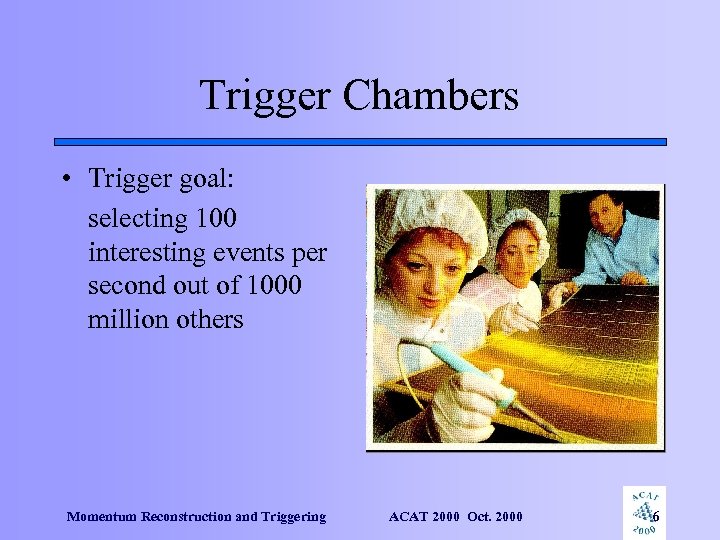 Trigger Chambers • Trigger goal: selecting 100 interesting events per second out of 1000 million others Momentum Reconstruction and Triggering ACAT 2000 Oct. 2000 6
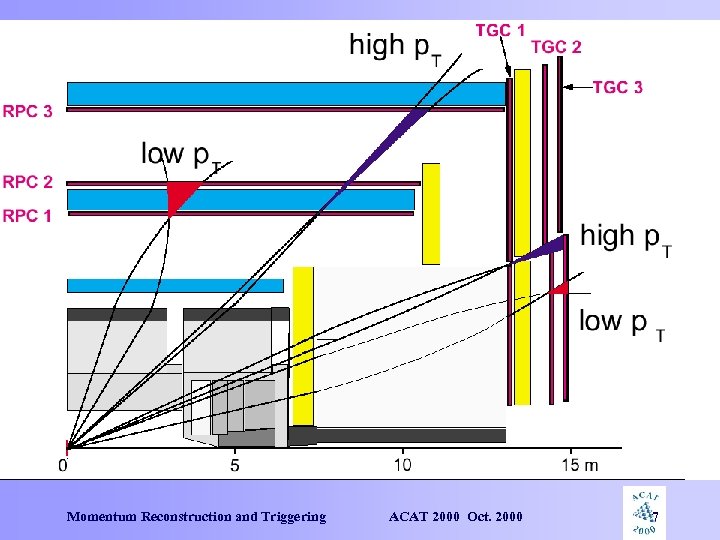 Low. Pt High Pt trigger Momentum Reconstruction and Triggering ACAT 2000 Oct. 2000 7
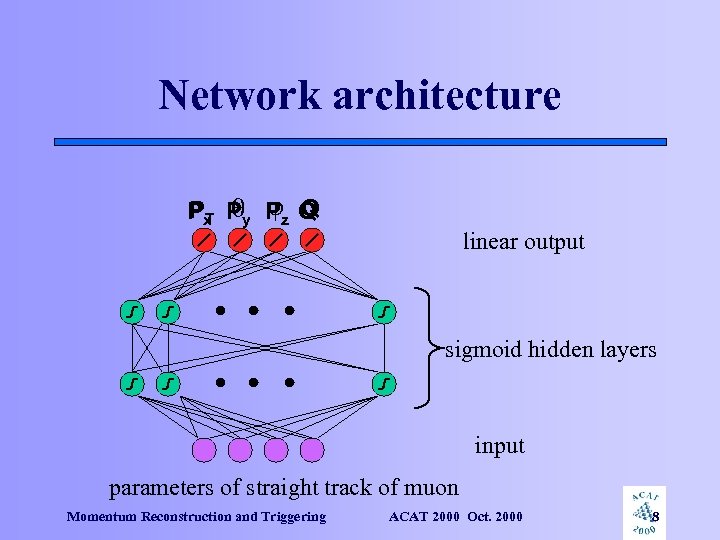 Network architecture Q Px Py Pz Q T linear output sigmoid hidden layers input parameters of straight track of muon Momentum Reconstruction and Triggering ACAT 2000 Oct. 2000 8
 Training • Training is performed using Levenberg. Marquardt method. • Early stopping methods are used (validation set / bayesian regularization). • Architectures varying in the number of neurons in first and second layers. Momentum Reconstruction and Triggering ACAT 2000 Oct. 2000 9
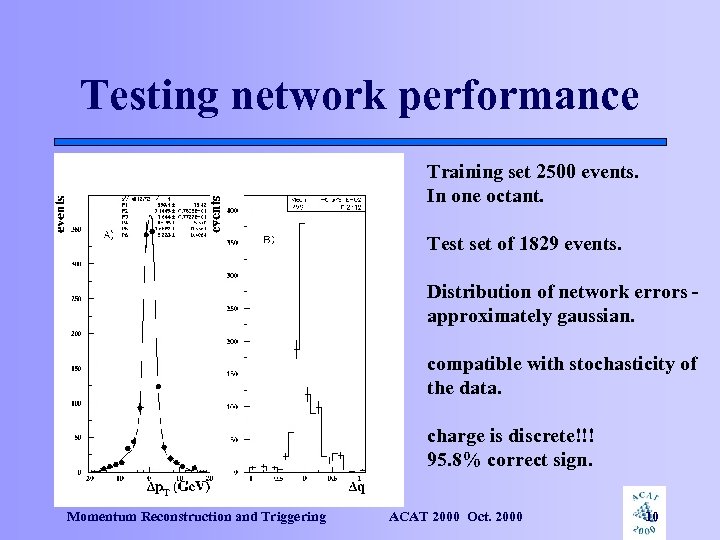 Testing network performance Training set 2500 events. In one octant. Test set of 1829 events. Distribution of network errors approximately gaussian. compatible with stochasticity of the data. charge is discrete!!! 95. 8% correct sign. Momentum Reconstruction and Triggering ACAT 2000 Oct. 2000 10
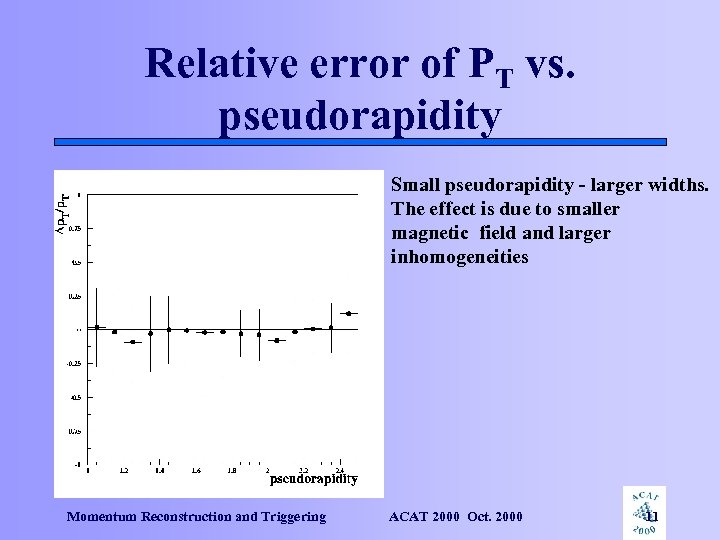 Relative error of PT vs. pseudorapidity Small pseudorapidity - larger widths. The effect is due to smaller magnetic field and larger inhomogeneities Momentum Reconstruction and Triggering ACAT 2000 Oct. 2000 11
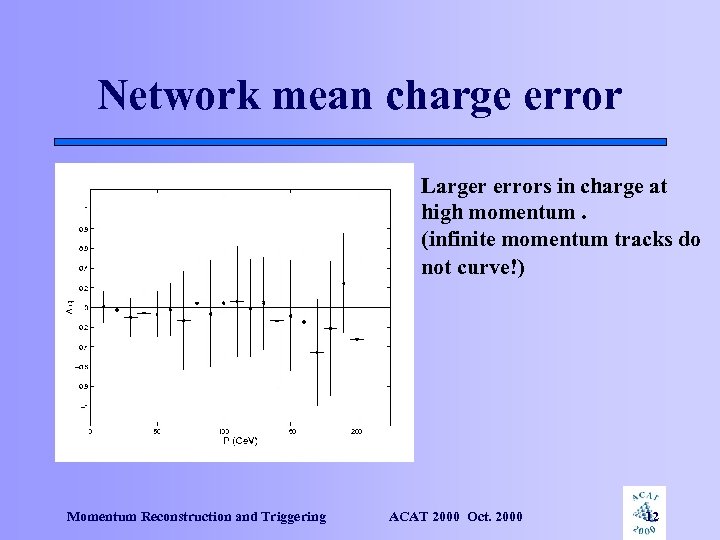 Network mean charge error Larger errors in charge at high momentum. (infinite momentum tracks do not curve!) Momentum Reconstruction and Triggering ACAT 2000 Oct. 2000 12
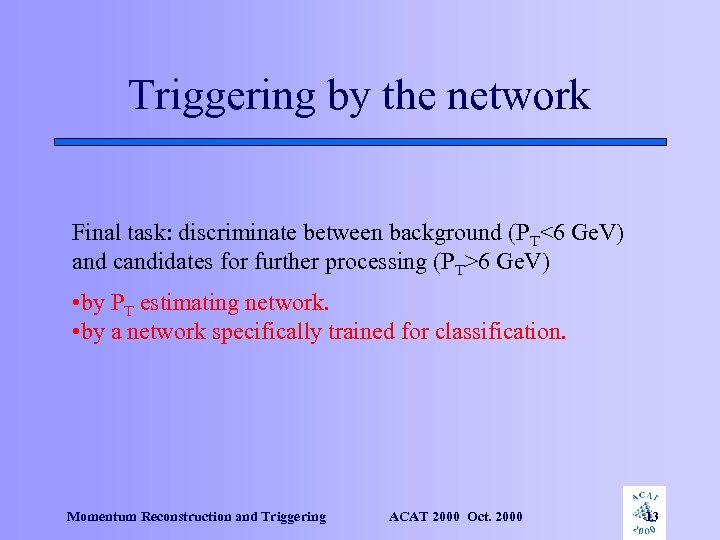 Triggering by the network Final task: discriminate between background (PT<6 Ge. V) and candidates for further processing (PT>6 Ge. V) • by PT estimating network. • by a network specifically trained for classification. Momentum Reconstruction and Triggering ACAT 2000 Oct. 2000 13
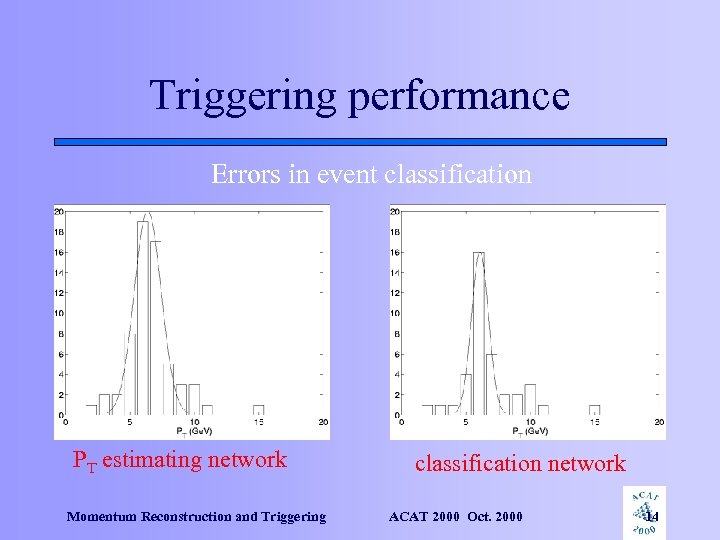 Triggering performance Errors in event classification PT estimating network Momentum Reconstruction and Triggering classification network ACAT 2000 Oct. 2000 14
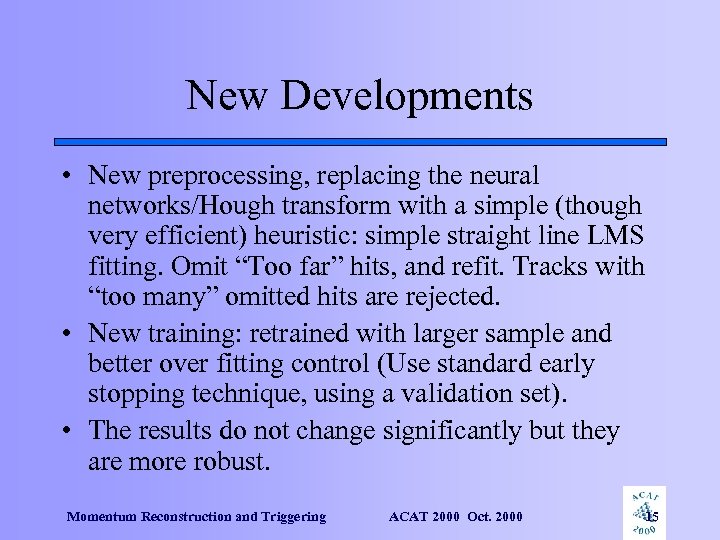 New Developments • New preprocessing, replacing the neural networks/Hough transform with a simple (though very efficient) heuristic: simple straight line LMS fitting. Omit “Too far” hits, and refit. Tracks with “too many” omitted hits are rejected. • New training: retrained with larger sample and better over fitting control (Use standard early stopping technique, using a validation set). • The results do not change significantly but they are more robust. Momentum Reconstruction and Triggering ACAT 2000 Oct. 2000 15
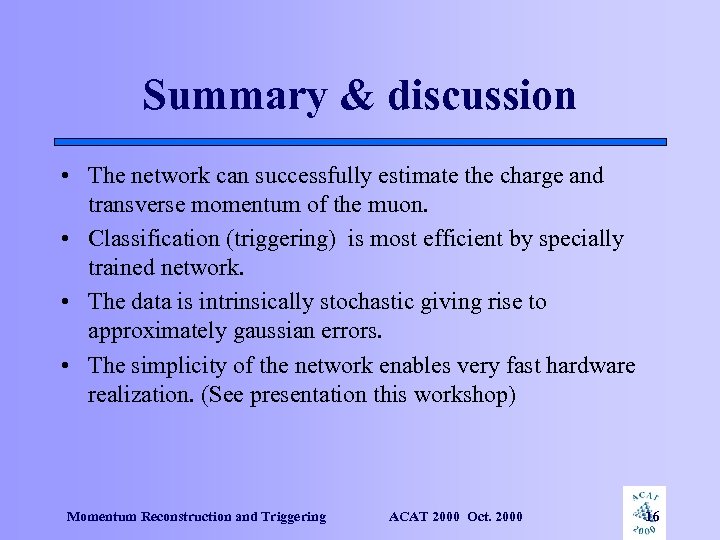 Summary & discussion • The network can successfully estimate the charge and transverse momentum of the muon. • Classification (triggering) is most efficient by specially trained network. • The data is intrinsically stochastic giving rise to approximately gaussian errors. • The simplicity of the network enables very fast hardware realization. (See presentation this workshop) Momentum Reconstruction and Triggering ACAT 2000 Oct. 2000 16
 Future work • Further optimize the architecture. • Calculate the lower bound for network errors based on data stochasticity. • Calculate triggering efficiencies in realistic environments. • Use further data (TGC station, data from 1 st level trigger). • Realize in hardware. Momentum Reconstruction and Triggering ACAT 2000 Oct. 2000 17