


 Скачать презентацию Mohandas Karamchand Gandhi Father of Our Nation-My Life
129dd5b72654802ec3b000c9ecb54eea.ppt
- Количество слайдов: 35
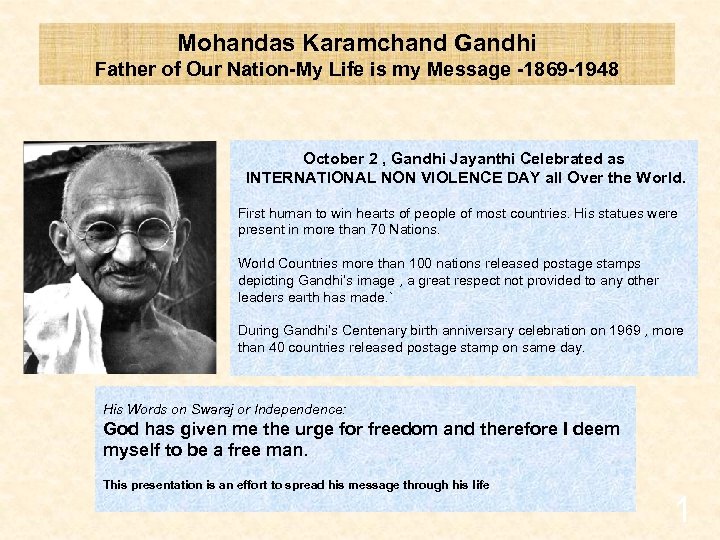 Mohandas Karamchand Gandhi Father of Our Nation-My Life is my Message -1869 -1948 October 2 , Gandhi Jayanthi Celebrated as INTERNATIONAL NON VIOLENCE DAY all Over the World. First human to win hearts of people of most countries. His statues were present in more than 70 Nations. World Countries more than 100 nations released postage stamps depicting Gandhi’s image , a great respect not provided to any other leaders earth has made. ` During Gandhi’s Centenary birth anniversary celebration on 1969 , more than 40 countries released postage stamp on same day. His Words on Swaraj or Independence: God has given me the urge for freedom and therefore I deem myself to be a free man. This presentation is an effort to spread his message through his life 1
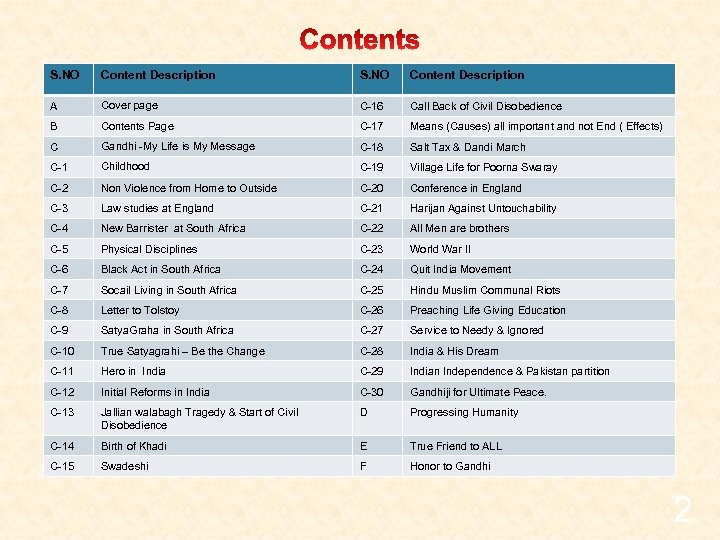 S. NO Content Description A Cover page C-16 Call Back of Civil Disobedience B Contents Page C-17 Means (Causes) all important and not End ( Effects) C Gandhi -My Life is My Message C-18 Salt Tax & Dandi March C-1 Childhood C-19 Village Life for Poorna Swaray C-2 Non Violence from Home to Outside C-20 Conference in England C-3 Law studies at England C-21 Harijan Against Untouchability C-4 New Barrister at South Africa C-22 All Men are brothers C-5 Physical Disciplines C-23 World War II C-6 Black Act in South Africa C-24 Quit India Movement C-7 Socail Living in South Africa C-25 Hindu Muslim Communal Riots C-8 Letter to Tolstoy C-26 Preaching Life Giving Education C-9 Satya. Graha in South Africa C-27 Service to Needy & Ignored C-10 True Satyagrahi – Be the Change C-28 India & His Dream C-11 Hero in India C-29 Indian Independence & Pakistan partition C-12 Initial Reforms in India C-30 Gandhiji for Ultimate Peace. C-13 Jallian walabagh Tragedy & Start of Civil Disobedience D Progressing Humanity C-14 Birth of Khadi E True Friend to ALL C-15 Swadeshi F Honor to Gandhi 2
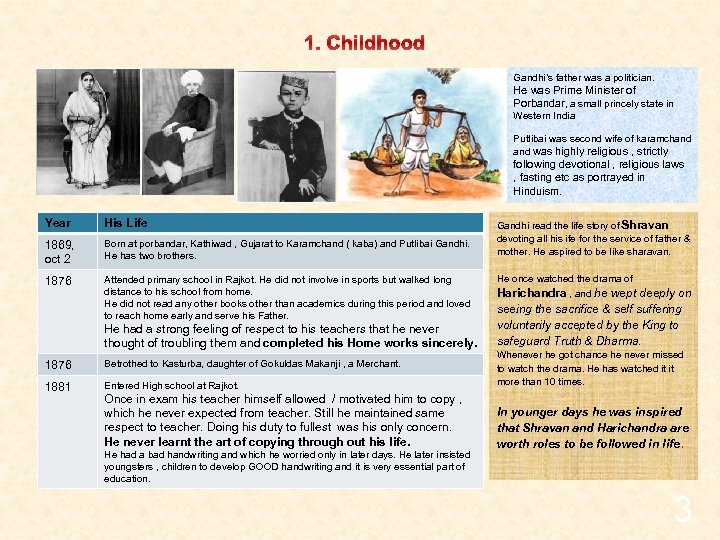 1. Childhood Gandhi’s father was a politician. He was Prime Minister of Porbandar, a small princely state in Western India Putlibai was second wife of karamchand was highly religious , strictly following devotional , religious laws , fasting etc as portrayed in Hinduism. Year His Life 1869, oct 2 Born at porbandar, Kathiwad , Gujarat to Karamchand ( kaba) and Putlibai Gandhi. He has two brothers. 1876 Attended primary school in Rajkot. He did not involve in sports but walked long distance to his school from home. He did not read any other books other than academics during this period and loved to reach home early and serve his Father. He had a strong feeling of respect to his teachers that he never thought of troubling them and completed his Home works sincerely. Gandhi read the life story of Shravan devoting all his ife for the service of father & mother. He aspired to be like sharavan. He once watched the drama of Harichandra , and he wept deeply on seeing the sacrifice & self suffering voluntarily accepted by the King to safeguard Truth & Dharma. 1876 Betrothed to Kasturba, daughter of Gokuldas Makanji , a Merchant. 1881 Entered High school at Rajkot. Whenever he got chance he never missed to watch the drama. He has watched it it more than 10 times. Once in exam his teacher himself allowed / motivated him to copy , which he never expected from teacher. Still he maintained same respect to teacher. Doing his duty to fullest was his only concern. He never learnt the art of copying through out his life. In younger days he was inspired that Shravan and Harichandra are worth roles to be followed in life. He had a bad handwriting and which he worried only in later days. He later insisted youngsters , children to develop GOOD handwriting and it is very essential part of education. 3
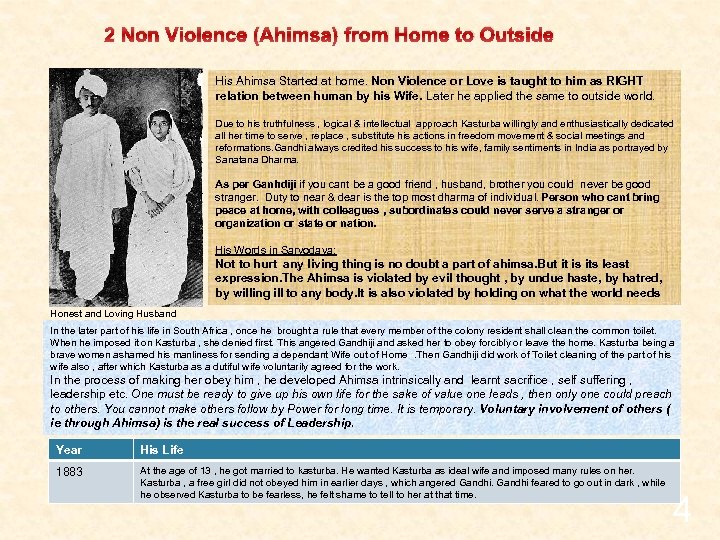 2 Non Violence (Ahimsa) from Home to Outside His Ahimsa Started at home. Non Violence or Love is taught to him as RIGHT relation between human by his Wife. Later he applied the same to outside world. Due to his truthfulness , logical & intellectual approach Kasturba willingly and enthusiastically dedicated all her time to serve , replace , substitute his actions in freedom movement & social meetings and reformations. Gandhi always credited his success to his wife, family sentiments in India as portrayed by Sanatana Dharma. As per Ganhdiji if you cant be a good friend , husband, brother you could never be good stranger. Duty to near & dear is the top most dharma of individual. Person who cant bring peace at home, with colleagues , subordinates could never serve a stranger or organization or state or nation. His Words in Sarvodaya: Not to hurt any living thing is no doubt a part of ahimsa. But it is its least expression. The Ahimsa is violated by evil thought , by undue haste, by hatred, by willing ill to any body. It is also violated by holding on what the world needs Honest and Loving Husband In the later part of his life in South Africa , once he brought a rule that every member of the colony resident shall clean the common toilet. When he imposed it on Kasturba , she denied first. This angered Gandhiji and asked her to obey forcibly or leave the home. Kasturba being a brave women ashamed his manliness for sending a dependant Wife out of Home . Then Gandhiji did work of Toilet cleaning of the part of his wife also , after which Kasturba as a dutiful wife voluntarily agreed for the work. In the process of making her obey him , he developed Ahimsa intrinsically and learnt sacrifice , self suffering , leadership etc. One must be ready to give up his own life for the sake of value one leads , then only one could preach to others. You cannot make others follow by Power for long time. It is temporary. Voluntary involvement of others ( ie through Ahimsa) is the real success of Leadership. Year His Life 1883 At the age of 13 , he got married to kasturba. He wanted Kasturba as ideal wife and imposed many rules on her. Kasturba , a free girl did not obeyed him in earlier days , which angered Gandhi feared to go out in dark , while he observed Kasturba to be fearless, he felt shame to tell to her at that time. 4
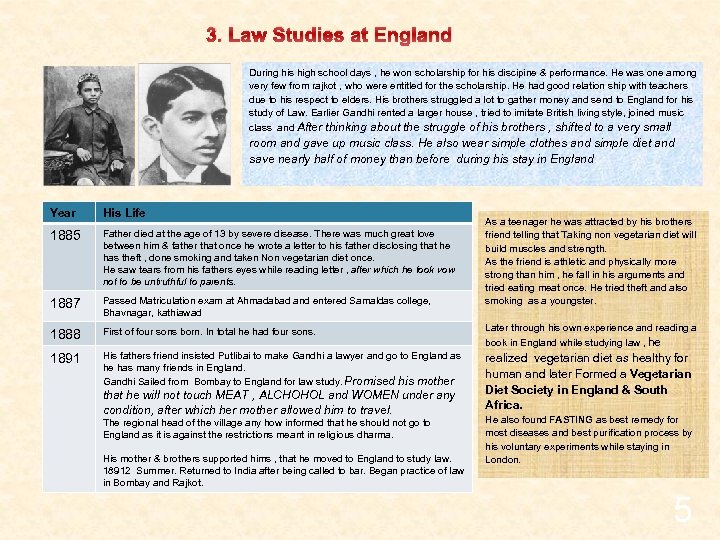 3. Law Studies at England During his high school days , he won scholarship for his discipine & performance. He was one among very few from rajkot , who were entitled for the scholarship. He had good relation ship with teachers due to his respect to elders. His brothers struggled a lot to gather money and send to England for his study of Law. Earlier Gandhi rented a larger house , tried to imitate British living style, joined music class and After thinking about the struggle of his brothers , shifted to a very small room and gave up music class. He also wear simple clothes and simple diet and save nearly half of money than before during his stay in England Year His Life 1885 Father died at the age of 13 by severe disease. There was much great love between him & father that once he wrote a letter to his father disclosing that he has theft , done smoking and taken Non vegetarian diet once. He saw tears from his fathers eyes while reading letter , after which he took vow not to be untruthful to parents. 1887 Passed Matriculation exam at Ahmadabad and entered Samaldas college, Bhavnagar, kathiawad 1888 First of four sons born. In total he had four sons. Later through his own experience and reading a 1891 His fathers friend insisted Putlibai to make Gandhi a lawyer and go to England as he has many friends in England. Gandhi Sailed from Bombay to England for law study. Promised his mother realized vegetarian diet as healthy for human and later Formed a Vegetarian Diet Society in England & South Africa. that he will not touch MEAT , ALCHOHOL and WOMEN under any condition, after which her mother allowed him to travel. The regional head of the village any how informed that he should not go to England as it is against the restrictions meant in religious dharma. His mother & brothers supported hims , that he moved to England to study law. 18912 Summer. Returned to India after being called to bar. Began practice of law in Bombay and Rajkot. As a teenager he was attracted by his brothers friend telling that Taking non vegetarian diet will build muscles and strength. As the friend is athletic and physically more strong than him , he fall in his arguments and tried eating meat once. He tried theft and also smoking as a youngster. book in England while studying law , he He also found FASTING as best remedy for most diseases and best purification process by his voluntary experiments while staying in London. 5
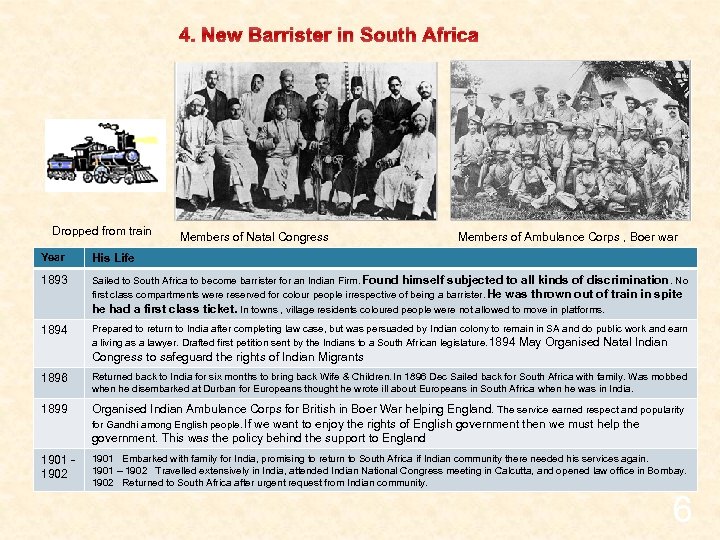 4. New Barrister in South Africa Dropped from train Members of Natal Congress Members of Ambulance Corps , Boer war Year His Life 1893 Sailed to South Africa to become barrister for an Indian Firm. Found himself subjected to all kinds of discrimination. No first class compartments were reserved for colour people irrespective of being a barrister. He was thrown out of train in spite he had a first class ticket. In towns , village residents coloured people were not allowed to move in platforms. 1894 Prepared to return to India after completing law case, but was persuaded by Indian colony to remain in SA and do public work and earn a living as a lawyer. Drafted first petition sent by the Indians to a South African legislature. 894 May Organised Natal Indian 1 Congress to safeguard the rights of Indian Migrants 1896 Returned back to India for six months to bring back Wife & Children. In 1896 Dec Sailed back for South Africa with family. Was mobbed when he disembarked at Durban for Europeans thought he wrote ill about Europeans in South Africa when he was in India. 1899 Organised Indian Ambulance Corps for British in Boer War helping England. The service earned respect and popularity for Gandhi among English people. If we want to enjoy the rights of English government then we must help the government. This was the policy behind the support to England 1901 - 1902 1901 Embarked with family for India, promising to return to South Africa if Indian community there needed his services again. 1901 – 1902 Travelled extensively in India, attended Indian National Congress meeting in Calcutta, and opened law office in Bombay. 1902 Returned to South Africa after urgent request from Indian community. 6
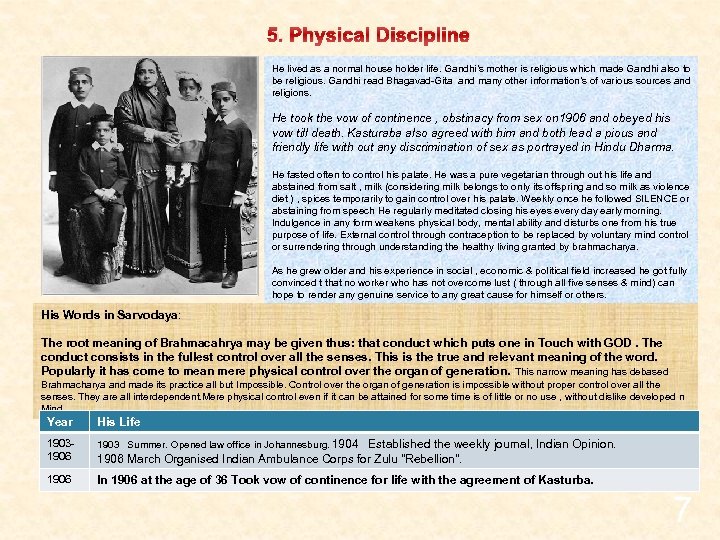 5. Physical Discipline He lived as a normal house holder life. Gandhi’s mother is religious which made Gandhi also to be religious. Gandhi read Bhagavad-Gita and many other information’s of various sources and religions. He took the vow of continence , obstinacy from sex on 1906 and obeyed his vow till death. Kasturaba also agreed with him and both lead a pious and friendly life with out any discrimination of sex as portrayed in Hindu Dharma. He fasted often to control his palate. He was a pure vegetarian through out his life and abstained from salt , milk (considering milk belongs to only its offspring and so milk as violence diet ) , spices temporarily to gain control over his palate. Weekly once he followed SILENCE or abstaining from speech He regularly meditated closing his eyes every day early morning. Indulgence in any form weakens physical body, mental ability and disturbs one from his true purpose of life. External control through contraception to be replaced by voluntary mind control or surrendering through understanding the healthy living granted by brahmacharya. As he grew older and his experience in social , economic & political field increased he got fully convinced t that no worker who has not overcome lust ( through all five senses & mind) can hope to render any genuine service to any great cause for himself or others. His Words in Sarvodaya: The root meaning of Brahmacahrya may be given thus: that conduct which puts one in Touch with GOD. The conduct consists in the fullest control over all the senses. This is the true and relevant meaning of the word. Popularly it has come to mean mere physical control over the organ of generation. This narrow meaning has debased Brahmacharya and made its practice all but Impossible. Control over the organ of generation is impossible without proper control over all the senses. They are all interdependent. Mere physical control even if it can be attained for some time is of little or no use , without dislike developed n Mind. Year His Life 19031906 1903 Summer. Opened law office in Johannesburg. 1904 Established the weekly journal, Indian Opinion. 1906 In 1906 at the age of 36 Took vow of continence for life with the agreement of Kasturba. 1906 March Organised Indian Ambulance Corps for Zulu "Rebellion". 7
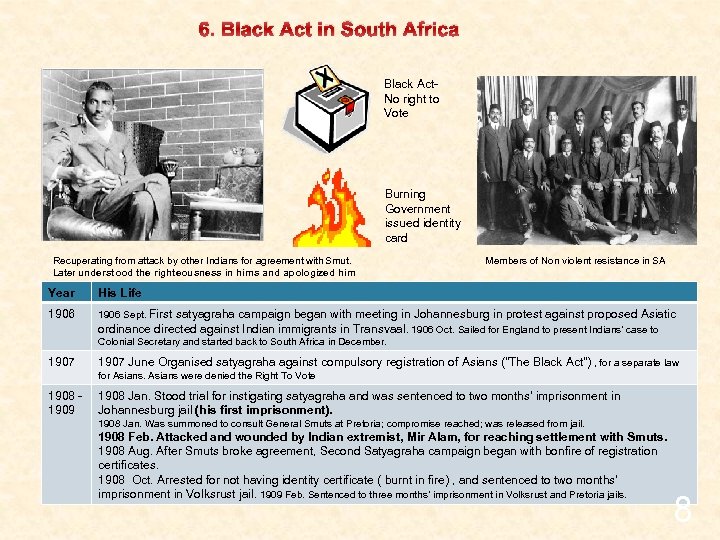 6. Black Act in South Africa Black Act. No right to Vote Burning Government issued identity card Recuperating from attack by other Indians for agreement with Smut. Later understood the righteousness in hims and apologized him Members of Non violent resistance in SA Year His Life 1906 Sept. First satyagraha campaign began with meeting in Johannesburg in protest against proposed Asiatic ordinance directed against Indian immigrants in Transvaal. 1906 Oct. Sailed for England to present Indians’ case to Colonial Secretary and started back to South Africa in December. 1907 June Organised satyagraha against compulsory registration of Asians ("The Black Act") , for a separate law for Asians were denied the Right To Vote 1908 - 1909 1908 Jan. Stood trial for instigating satyagraha and was sentenced to two months' imprisonment in Johannesburg jail (his first imprisonment). 1908 Jan. Was summoned to consult General Smuts at Pretoria; compromise reached; was released from jail. 1908 Feb. Attacked and wounded by Indian extremist, Mir Alam, for reaching settlement with Smuts. 1908 Aug. After Smuts broke agreement, Second Satyagraha campaign began with bonfire of registration certificates. 1908 Oct. Arrested for not having identity certificate ( burnt in fire) , and sentenced to two months' imprisonment in Volksrust jail. 1909 Feb. Sentenced to three months’ imprisonment in Volksrust and Pretoria jails. 8
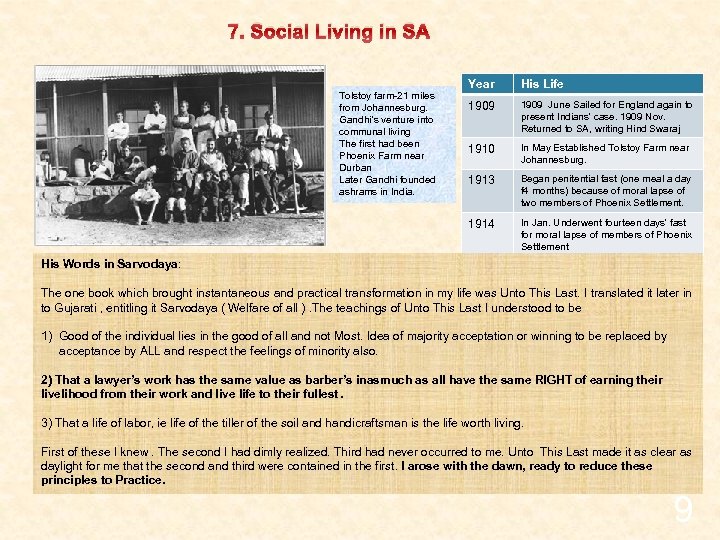 7. Social Living in SA Year His Life 1909 June Sailed for England again to present Indians' case. 1909 Nov. Returned to SA, writing Hind Swaraj 1910 In May Established Tolstoy Farm near Johannesburg. 1913 Began penitential fast (one meal a day f 4 months) because of moral lapse of two members of Phoenix Settlement. 1914 Tolstoy farm-21 miles from Johannesburg. Gandhi’s venture into communal living The first had been Phoenix Farm near Durban Later Gandhi founded ashrams in India. In Jan. Underwent fourteen days' fast for moral lapse of members of Phoenix Settlement His Words in Sarvodaya: The one book which brought instantaneous and practical transformation in my life was Unto This Last. I translated it later in to Gujarati , entitling it Sarvodaya ( Welfare of all ). The teachings of Unto This Last I understood to be 1) Good of the individual lies in the good of all and not Most. Idea of majority acceptation or winning to be replaced by acceptance by ALL and respect the feelings of minority also. 2) That a lawyer’s work has the same value as barber’s inasmuch as all have the same RIGHT of earning their livelihood from their work and live life to their fullest. 3) That a life of labor, ie life of the tiller of the soil and handicraftsman is the life worth living. First of these I knew. The second I had dimly realized. Third had never occurred to me. Unto This Last made it as clear as daylight for me that the second and third were contained in the first. I arose with the dawn, ready to reduce these principles to Practice. 9
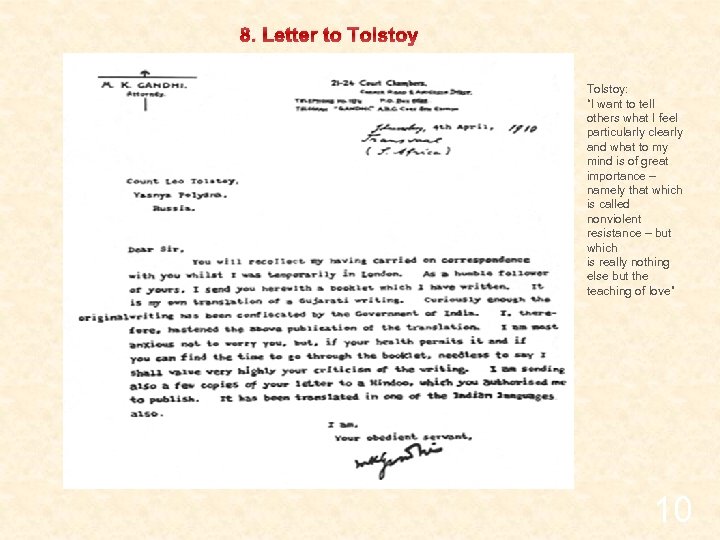 8. Letter to Tolstoy: “I want to tell others what I feel particularly clearly and what to my mind is of great importance – namely that which is called nonviolent resistance – but which is really nothing else but the teaching of love” 10
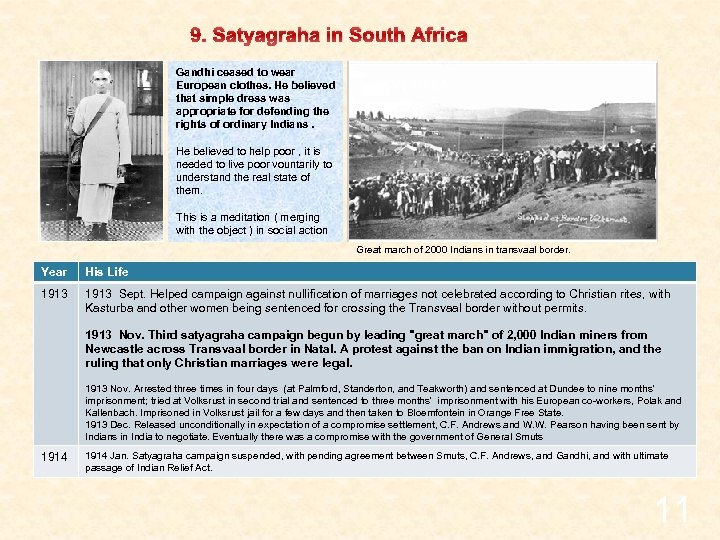 9. Satyagraha in South Africa Gandhi ceased to wear European clothes. He believed that simple dress was appropriate for defending the rights of ordinary Indians. He believed to help poor , it is needed to live poor vountarily to understand the real state of them. This is a meditation ( merging with the object ) in social action Great march of 2000 Indians in transvaal border. Year His Life 1913 Sept. Helped campaign against nullification of marriages not celebrated according to Christian rites, with Kasturba and other women being sentenced for crossing the Transvaal border without permits. 1913 Nov. Third satyagraha campaign begun by leading "great march" of 2, 000 Indian miners from Newcastle across Transvaal border in Natal. A protest against the ban on Indian immigration, and the ruling that only Christian marriages were legal. 1913 Nov. Arrested three times in four days (at Palmford, Standerton, and Teakworth) and sentenced at Dundee to nine months' imprisonment; tried at Volksrust in second trial and sentenced to three months' imprisonment with his European co-workers, Polak and Kallenbach. Imprisoned in Volksrust jail for a few days and then taken to Bloemfontein in Orange Free State. 1913 Dec. Released unconditionally in expectation of a compromise settlement, C. F. Andrews and W. W. Pearson having been sent by Indians in India to negotiate. Eventually there was a compromise with the government of General Smuts 1914 Jan. Satyagraha campaign suspended, with pending agreement between Smuts, C. F. Andrews, and Gandhi, and with ultimate passage of Indian Relief Act. 11
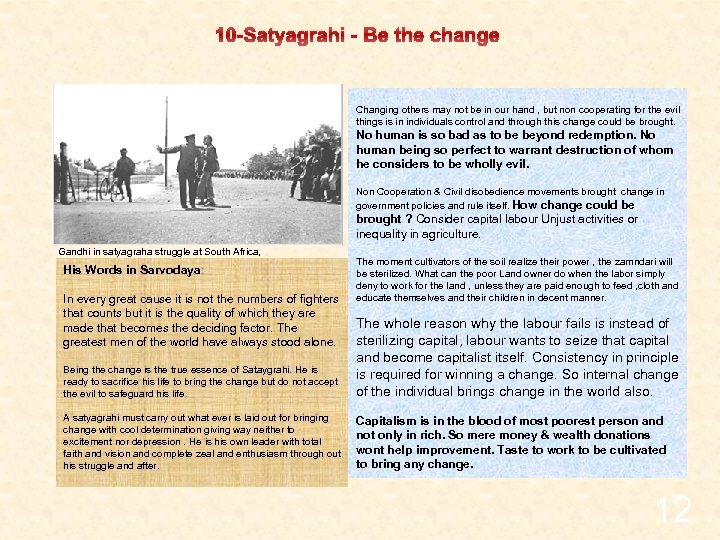 10 -Satyagrahi - Be the change Changing others may not be in our hand , but non cooperating for the evil things is in individuals control and through this change could be brought. No human is so bad as to be beyond redemption. No human being so perfect to warrant destruction of whom he considers to be wholly evil. Non Cooperation & Civil disobedience movements brought change in government policies and rule itself. How change could be brought ? Consider capital labour Unjust activities or inequality in agriculture. Gandhi in satyagraha struggle at South Africa, His Words in Sarvodaya: In every great cause it is not the numbers of fighters that counts but it is the quality of which they are made that becomes the deciding factor. The greatest men of the world have always stood alone. The moment cultivators of the soil realize their power , the zamndari will be sterilized. What can the poor Land owner do when the labor simply deny to work for the land , unless they are paid enough to feed , cloth and educate themselves and their children in decent manner. Being the change is the true essence of Sataygrahi. He is ready to sacrifice his life to bring the change but do not accept the evil to safeguard his life. The whole reason why the labour fails is instead of sterilizing capital, labour wants to seize that capital and become capitalist itself. Consistency in principle is required for winning a change. So internal change of the individual brings change in the world also. A satyagrahi must carry out what ever is laid out for bringing change with cool determination giving way neither to excitement nor depression. He is his own leader with total faith and vision and complete zeal and enthusiasm through out his struggle and after. Capitalism is in the blood of most poorest person and not only in rich. So mere money & wealth donations wont help improvement. Taste to work to be cultivated to bring any change. 12
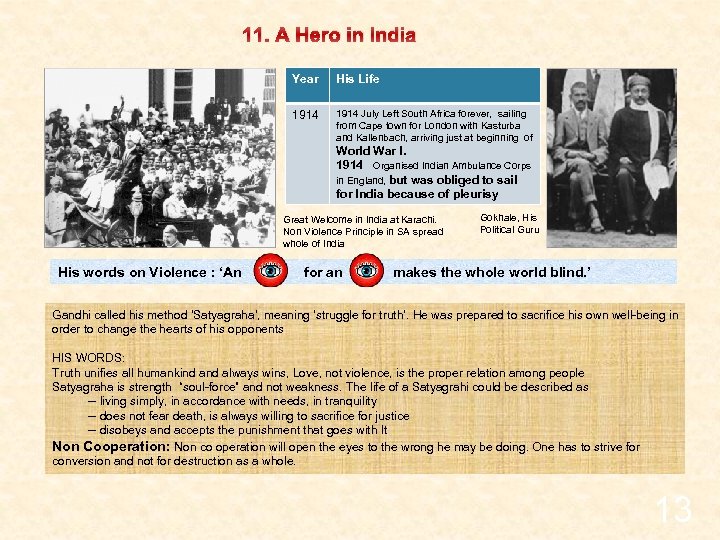 11. A Hero in India Year His Life 1914 July Left South Africa forever, sailing from Cape town for London with Kasturba and Kallenbach, arriving just at beginning of World War I. 1914 Organised Indian Ambulance Corps in England, but was obliged to sail for India because of pleurisy Great Welcome in India at Karachi. Non Violence Principle in SA spread whole of India Gokhale, His Political Guru His words on Violence : ‘An for an makes the whole world blind. ’ Gandhi called his method ‘Satyagraha’, meaning ‘struggle for truth’. He was prepared to sacrifice his own well-being in order to change the hearts of his opponents HIS WORDS: Truth unifies all humankind always wins, Love, not violence, is the proper relation among people Satyagraha is strength “soul-force” and not weakness. The life of a Satyagrahi could be described as -- living simply, in accordance with needs, in tranquility -- does not fear death, is always willing to sacrifice for justice -- disobeys and accepts the punishment that goes with It Non Cooperation: Non co operation will open the eyes to the wrong he may be doing. One has to strive for conversion and not for destruction as a whole. 13
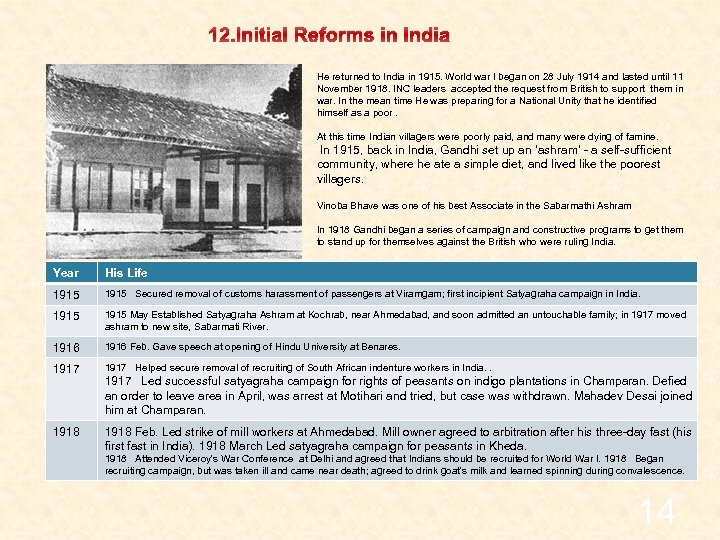 12. Initial Reforms in India He returned to India in 1915. World war I began on 28 July 1914 and lasted until 11 November 1918. INC leaders accepted the request from British to support them in war. In the mean time He was preparing for a National Unity that he identified himself as a poor. At this time Indian villagers were poorly paid, and many were dying of famine. In 1915, back in India, Gandhi set up an ‘ashram’ - a self-sufficient community, where he ate a simple diet, and lived like the poorest villagers. Vinoba Bhave was one of his best Associate in the Sabarmathi Ashram In 1918 Gandhi began a series of campaign and constructive programs to get them to stand up for themselves against the British who were ruling India. Year His Life 1915 Secured removal of customs harassment of passengers at Viramgam; first incipient Satyagraha campaign in India. 1915 May Established Satyagraha Ashram at Kochrab, near Ahmedabad, and soon admitted an untouchable family; in 1917 moved ashram to new site, Sabarmati River. 1916 Feb. Gave speech at opening of Hindu University at Benares. 1917 Helped secure removal of recruiting of South African indenture workers in India. . 1918 Feb. Led strike of mill workers at Ahmedabad. Mill owner agreed to arbitration after his three-day fast (his first fast in India). 1918 March Led satyagraha campaign for peasants in Kheda. 1917 Led successful satyagraha campaign for rights of peasants on indigo plantations in Champaran. Defied an order to leave area in April, was arrest at Motihari and tried, but case was withdrawn. Mahadev Desai joined him at Champaran. 1918 Attended Viceroy's War Conference at Delhi and agreed that Indians should be recruited for World War I. 1918 Began recruiting campaign, but was taken ill and came near death; agreed to drink goat's milk and learned spinning during convalescence. 14
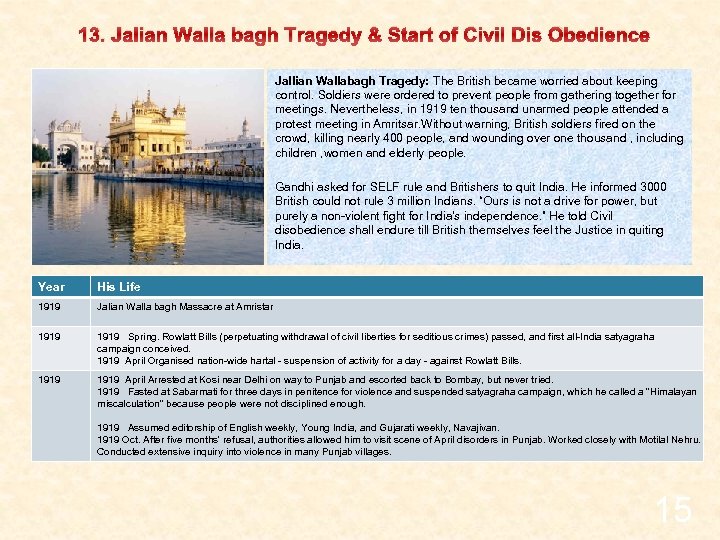 13. Jalian Walla bagh Tragedy & Start of Civil Dis Obedience Jallian Wallabagh Tragedy: The British became worried about keeping control. Soldiers were ordered to prevent people from gathering together for meetings. Nevertheless, in 1919 ten thousand unarmed people attended a protest meeting in Amritsar. Without warning, British soldiers fired on the crowd, killing nearly 400 people, and wounding over one thousand , including children , women and elderly people. Gandhi asked for SELF rule and Britishers to quit India. He informed 3000 British could not rule 3 million Indians. “Ours is not a drive for power, but purely a non-violent fight for India's independence. ” He told Civil disobedience shall endure till British themselves feel the Justice in quiting India. Year His Life 1919 Jalian Walla bagh Massacre at Amristar 1919 Spring. Rowlatt Bills (perpetuating withdrawal of civil liberties for seditious crimes) passed, and first all-India satyagraha campaign conceived. 1919 April Organised nation-wide hartal - suspension of activity for a day - against Rowlatt Bills. 1919 April Arrested at Kosi near Delhi on way to Punjab and escorted back to Bombay, but never tried. 1919 Fasted at Sabarmati for three days in penitence for violence and suspended satyagraha campaign, which he called a “Himalayan miscalculation" because people were not disciplined enough. 1919 Assumed editorship of English weekly, Young India, and Gujarati weekly, Navajivan. 1919 Oct. After five months' refusal, authorities allowed him to visit scene of April disorders in Punjab. Worked closely with Motilal Nehru. Conducted extensive inquiry into violence in many Punjab villages. 15
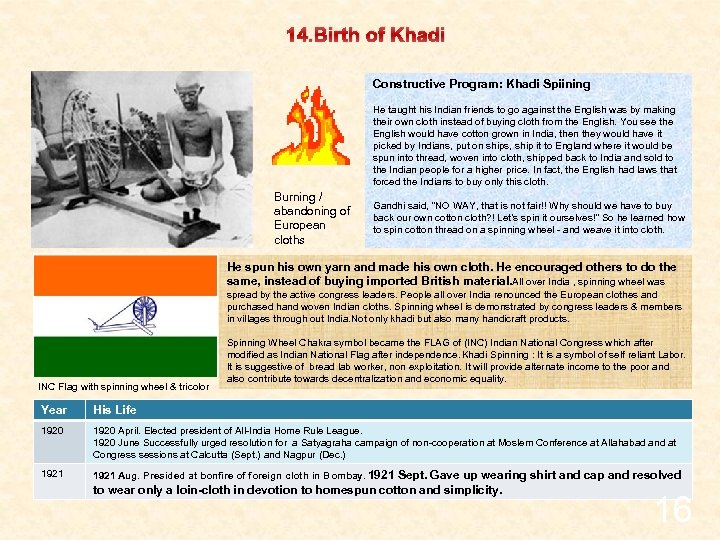 14. Birth of Khadi Constructive Program: Khadi Spiining Burning / abandoning of European cloths He taught his Indian friends to go against the English was by making their own cloth instead of buying cloth from the English. You see the English would have cotton grown in India, then they would have it picked by Indians, put on ships, ship it to England where it would be spun into thread, woven into cloth, shipped back to India and sold to the Indian people for a higher price. In fact, the English had laws that forced the Indians to buy only this cloth. Gandhi said, “NO WAY, that is not fair!! Why should we have to buy back our own cotton cloth? ! Let’s spin it ourselves!” So he learned how to spin cotton thread on a spinning wheel - and weave it into cloth. He spun his own yarn and made his own cloth. He encouraged others to do the same, instead of buying imported British material. All over India , spinning wheel was spread by the active congress leaders. People all over India renounced the European clothes and purchased hand woven Indian cloths. Spinning wheel is demonstrated by congress leaders & members in villages through out India. Not only khadi but also many handicraft products. INC Flag with spinning wheel & tricolor Spinning Wheel Chakra symbol became the FLAG of (INC) Indian National Congress which after modified as Indian National Flag after independence. Khadi Spinning : It is a symbol of self reliant Labor. It is suggestive of bread lab worker, non exploitation. It will provide alternate income to the poor and also contribute towards decentralization and economic equality. Year His Life 1920 April. Elected president of All-India Home Rule League. 1920 June Successfully urged resolution for a Satyagraha campaign of non-cooperation at Moslem Conference at Allahabad and at Congress sessions at Calcutta (Sept. ) and Nagpur (Dec. ) 1921 Aug. Presided at bonfire of foreign cloth in Bombay. 1921 Sept. Gave up wearing shirt and cap and resolved to wear only a loin-cloth in devotion to homespun cotton and simplicity. 16
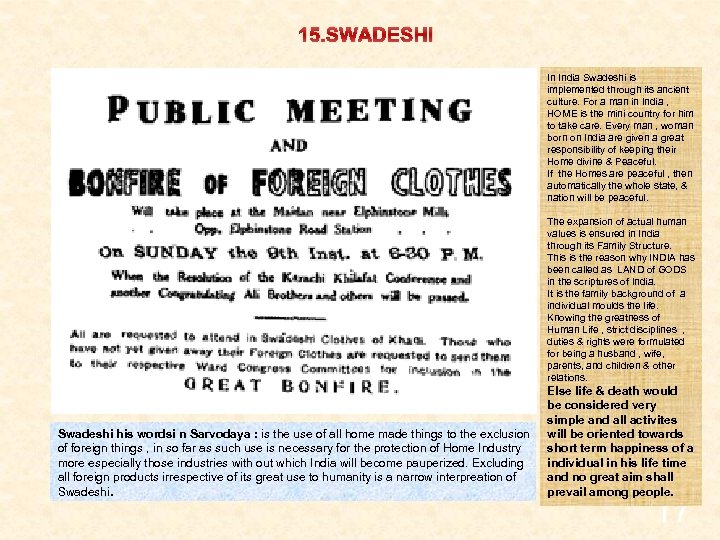 15. SWADESHI In India Swadeshi is implemented through its ancient culture. For a man in India , HOME is the mini country for him to take care. Every man , woman born on India are given a great responsibility of keeping their Home divine & Peaceful. If the Homes are peaceful , then automatically the whole state, & nation will be peaceful. The expansion of actual human values is ensured in India through its Family Structure. This is the reason why INDIA has been called as LAND of GODS in the scriptures of India. It is the family background of a individual moulds the life. Knowing the greatness of Human Life , strict disciplines , duties & rights were formulated for being a husband , wife, parents, and children & other relations. Swadeshi his wordsi n Sarvodaya : is the use of all home made things to the exclusion of foreign things , in so far as such use is necessary for the protection of Home Industry more especially those industries with out which India will become pauperized. Excluding all foreign products irrespective of its great use to humanity is a narrow interpreation of Swadeshi. Else life & death would be considered very simple and all activites will be oriented towards short term happiness of a individual in his life time and no great aim shall prevail among people. 17
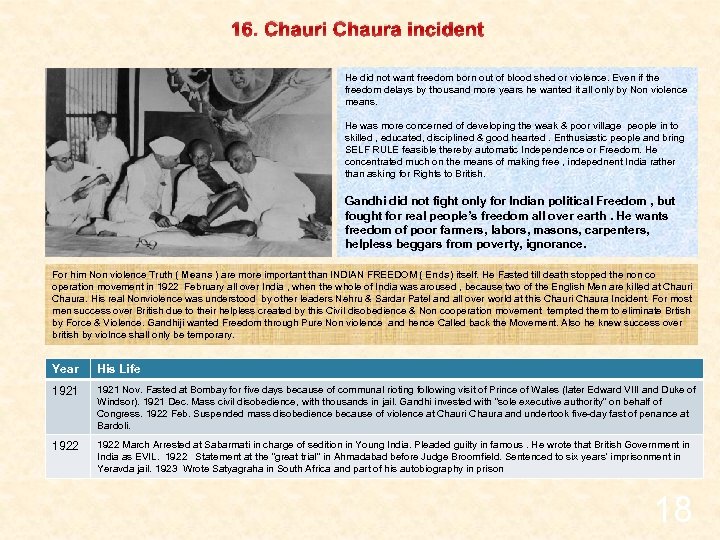 16. Chauri Chaura incident He did not want freedom born out of blood shed or violence. Even if the freedom delays by thousand more years he wanted it all only by Non violence means. He was more concerned of developing the weak & poor village people in to skilled , educated, disciplined & good hearted. Enthusiastic people and bring SELF RULE feasible thereby automatic Independence or Freedom. He concentrated much on the means of making free , indepednent India rather than asking for Rights to British. Gandhi did not fight only for Indian political Freedom , but fought for real people’s freedom all over earth. He wants freedom of poor farmers, labors, masons, carpenters, helpless beggars from poverty, ignorance. For him Non violence Truth ( Means ) are more important than INDIAN FREEDOM ( Ends) itself. He Fasted till death stopped the non co operation movement in 1922 February all over India , when the whole of India was aroused , because two of the English Men are killed at Chauri Chaura. His real Nonviolence was understood by other leaders Nehru & Sardar Patel and all over world at this Chauri Chaura Incident. For most men success over British due to their helpless created by this Civil disobedience & Non cooperation movement tempted them to eliminate Brtish by Force & Violence. Gandhiji wanted Freedom through Pure Non violence and hence Called back the Movement. Also he knew success over british by violnce shall only be temporary. Year His Life 1921 Nov. Fasted at Bombay for five days because of communal rioting following visit of Prince of Wales (later Edward VIII and Duke of Windsor). 1921 Dec. Mass civil disobedience, with thousands in jail. Gandhi invested with "sole executive authority" on behalf of Congress. 1922 Feb. Suspended mass disobedience because of violence at Chauri Chaura and undertook five-day fast of penance at Bardoli. 1922 March Arrested at Sabarmati in charge of sedition in Young India. Pleaded guilty in famous. He wrote that British Government in India as EVIL. 1922 Statement at the "great trial" in Ahmadabad before Judge Broomfield. Sentenced to six years' imprisonment in Yeravda jail. 1923 Wrote Satyagraha in South Africa and part of his autobiography in prison 18
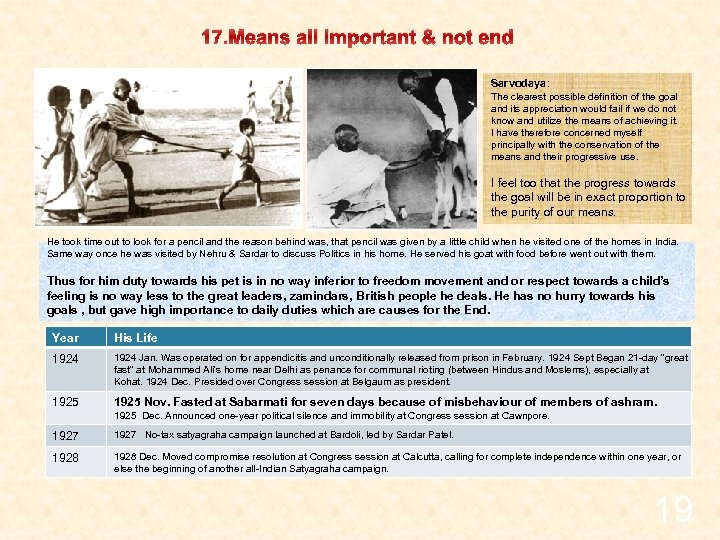 17. Means all Important & not end Sarvodaya: The clearest possible definition of the goal and its appreciation would fail if we do not know and utilize the means of achieving it. I have therefore concerned myself principally with the conservation of the means and their progressive use. I feel too that the progress towards the goal will be in exact proportion to the purity of our means. He took time out to look for a pencil and the reason behind was, that pencil was given by a little child when he visited one of the homes in India. Same way once he was visited by Nehru & Sardar to discuss Politics in his home. He served his goat with food before went out with them. Thus for him duty towards his pet is in no way inferior to freedom movement and or respect towards a child’s feeling is no way less to the great leaders, zamindars, British people he deals. He has no hurry towards his goals , but gave high importance to daily duties which are causes for the End. Year His Life 1924 Jan. Was operated on for appendicitis and unconditionally released from prison in February. 1924 Sept Began 21 -day "great fast" at Mohammed Ali's home near Delhi as penance for communal rioting (between Hindus and Moslems), especially at Kohat. 1924 Dec. Presided over Congress session at Belgaum as president. 1925 Nov. Fasted at Sabarmati for seven days because of misbehaviour of members of ashram. 1925 Dec. Announced one-year political silence and immobility at Congress session at Cawnpore. 1927 No-tax satyagraha campaign launched at Bardoli, led by Sardar Patel. 1928 Dec. Moved compromise resolution at Congress session at Calcutta, calling for complete independence within one year, or else the beginning of another all-Indian Satyagraha campaign. 19
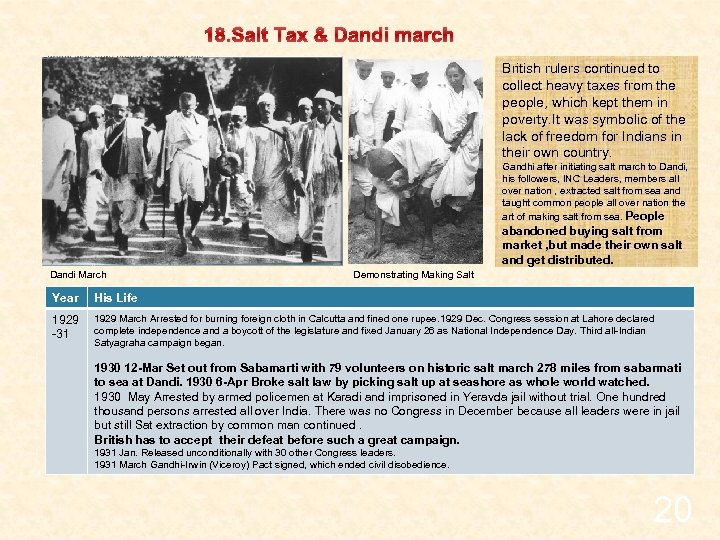 18. Salt Tax & Dandi march British rulers continued to collect heavy taxes from the people, which kept them in poverty. It was symbolic of the lack of freedom for Indians in their own country. Gandhi after initiating salt march to Dandi, his followers, INC Leaders, members all over nation , extracted salt from sea and taught common people all over nation the art of making salt from sea. People abandoned buying salt from market , but made their own salt and get distributed. Dandi March Demonstrating Making Salt Year His Life 1929 -31 1929 March Arrested for burning foreign cloth in Calcutta and fined one rupee. 929 Dec. Congress session at Lahore declared 1 complete independence and a boycott of the legislature and fixed January 26 as National Independence Day. Third all-Indian Satyagraha campaign began. 1930 12 -Mar Set out from Sabamarti with 79 volunteers on historic salt march 278 miles from sabarmati to sea at Dandi. 1930 6 -Apr Broke salt law by picking salt up at seashore as whole world watched. 1930 May Arrested by armed policemen at Karadi and imprisoned in Yeravda jail without trial. One hundred thousand persons arrested all over India. There was no Congress in December because all leaders were in jail but still Sat extraction by common man continued. British has to accept their defeat before such a great campaign. 1931 Jan. Released unconditionally with 30 other Congress leaders. 1931 March Gandhi-Irwin (Viceroy) Pact signed, which ended civil disobedience. 20
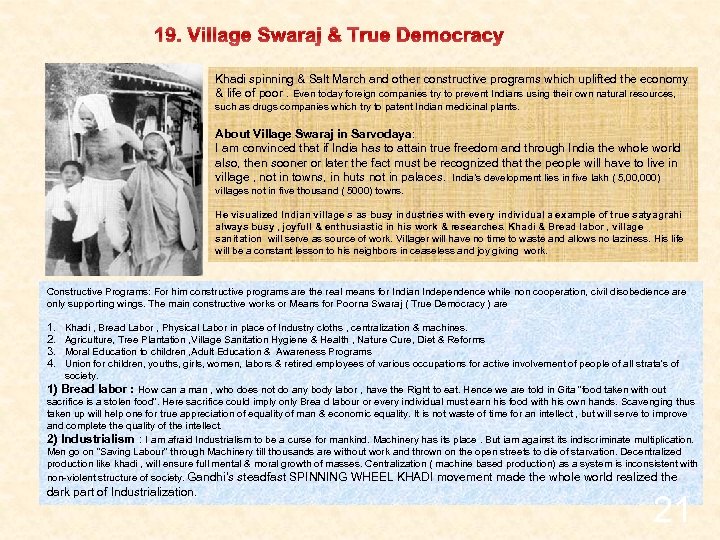 19. Village Swaraj & True Democracy Khadi spinning & Salt March and other constructive programs which uplifted the economy & life of poor. Even today foreign companies try to prevent Indians using their own natural resources, such as drugs companies which try to patent Indian medicinal plants. About Village Swaraj in Sarvodaya: I am convinced that if India has to attain true freedom and through India the whole world also, then sooner or later the fact must be recognized that the people will have to live in village , not in towns, in huts not in palaces. India’s development lies in five lakh ( 5, 000) villages not in five thousand ( 5000) towns. He visualized Indian village s as busy industries with every individual a example of true satyagrahi always busy , joyfull & enthusiastic in his work & researches. Khadi & Bread labor , village sanitation will serve as source of work. Villager will have no time to waste and allows no laziness. His life will be a constant lesson to his neighbors in ceaseless and joy giving work. Constructive Programs: For him constructive programs are the real means for Indian Independence while non cooperation, civil disobedience are only supporting wings. The main constructive works or Means for Poorna Swaraj ( True Democracy ) are 1. 2. 3. 4. Khadi , Bread Labor , Physical Labor in place of Industry cloths , centralization & machines. Agriculture, Tree Plantation , Village Sanitation Hygiene & Health , Nature Cure, Diet & Reforms Moral Education to children , Adult Education & Awareness Programs Union for children, youths, girls, women, labors & retired employees of various occupations for active involvement of people of all strata's of society. 1) Bread labor : How can a man , who does not do any body labor , have the Right to eat. Hence we are told in Gita “food taken with out sacrifice is a stolen food”. Here sacrifice could imply only Brea d labour or every individual must earn his food with his own hands. Scavenging thus taken up will help one for true appreciation of equality of man & economic equality. It is not waste of time for an intellect , but will serve to improve and complete the quality of the intellect. 2) Industrialism : I am afraid Industrialism to be a curse for mankind. Machinery has its place. But iam against its indiscriminate multiplication. Men go on “Saving Labour“ through Machinery till thousands are without work and thrown on the open streets to die of starvation. Decentralized production like khadi , will ensure full mental & moral growth of masses. Centralization ( machine based production) as a system is inconsistent with non-violent structure of society. Gandhi’s steadfast SPINNING WHEEL KHADI movement made the whole world realized the dark part of Industrialization. 21
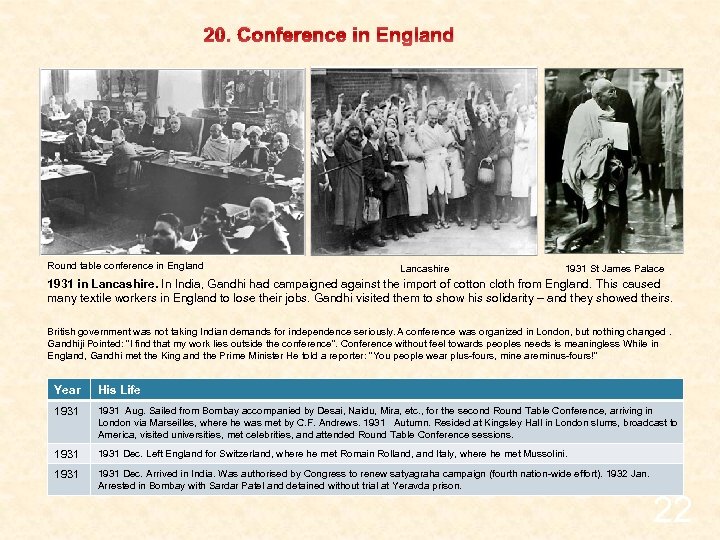 20. Conference in England Round table conference in England Lancashire 1931 St James Palace 1931 in Lancashire. In India, Gandhi had campaigned against the import of cotton cloth from England. This caused many textile workers in England to lose their jobs. Gandhi visited them to show his solidarity – and they showed theirs. British government was not taking Indian demands for independence seriously. A conference was organized in London, but nothing changed. Gandhiji Pointed: “I find that my work lies outside the conference”. Conference without feel towards peoples needs is meaningless. While in England, Gandhi met the King and the Prime Minister He told a reporter: “You people wear plus-fours, mine are inus-fours!” m Year His Life 1931 Aug. Sailed from Bombay accompanied by Desai, Naidu, Mira, etc. , for the second Round Table Conference, arriving in London via Marseilles, where he was met by C. F. Andrews. 1931 Autumn. Resided at Kingsley Hall in London slums, broadcast to America, visited universities, met celebrities, and attended Round Table Conference sessions. 1931 Dec. Left England for Switzerland, where he met Romain Rolland, and Italy, where he met Mussolini. 1931 Dec. Arrived in India. Was authorised by Congress to renew satyagraha campaign (fourth nation-wide effort). 1932 Jan. Arrested in Bombay with Sardar Patel and detained without trial at Yeravda prison. 22
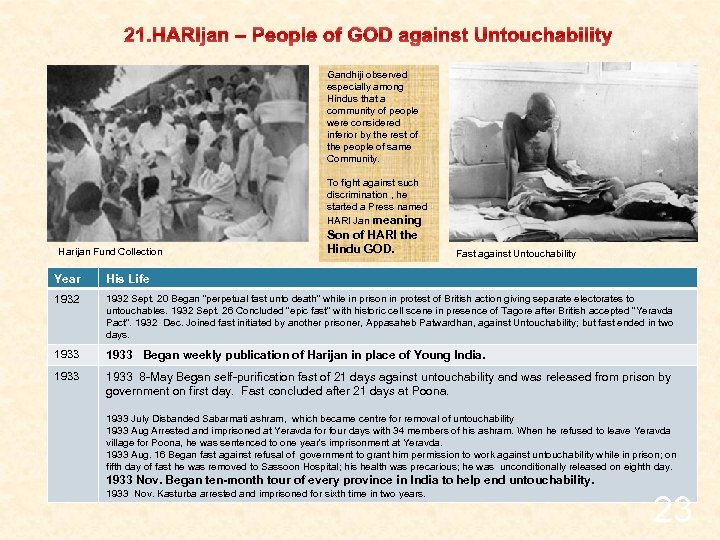 21. HARIjan – People of GOD against Untouchability Gandhiji observed especially among Hindus that a community of people were considered inferior by the rest of the people of same Community. To fight against such discrimination , he started a Press named HARI Jan meaning Harijan Fund Collection Son of HARI the Hindu GOD. Fast against Untouchability Year His Life 1932 Sept. 20 Began "perpetual fast unto death" while in prison in protest of British action giving separate electorates to untouchables. 1932 Sept. 26 Concluded "epic fast” with historic cell scene in presence of Tagore after British accepted "Yeravda Pact". 1932 Dec. Joined fast initiated by another prisoner, Appasaheb Patwardhan, against Untouchability; but fast ended in two days. 1933 Began weekly publication of Harijan in place of Young India. 1933 8 -May Began self-purification fast of 21 days against untouchability and was released from prison by government on first day. Fast concluded after 21 days at Poona. 1933 July Disbanded Sabarmati ashram, which became centre for removal of untouchability 1933 Aug Arrested and imprisoned at Yeravda for four days with 34 members of his ashram. When he refused to leave Yeravda village for Poona, he was sentenced to one year's imprisonment at Yeravda. 1933 Aug. 16 Began fast against refusal of government to grant him permission to work against untouchability while in prison; on fifth day of fast he was removed to Sassoon Hospital; his health was precarious; he was unconditionally released on eighth day. 1933 Nov. Began ten-month tour of every province in India to help end untouchability. 1933 Nov. Kasturba arrested and imprisoned for sixth time in two years. 23
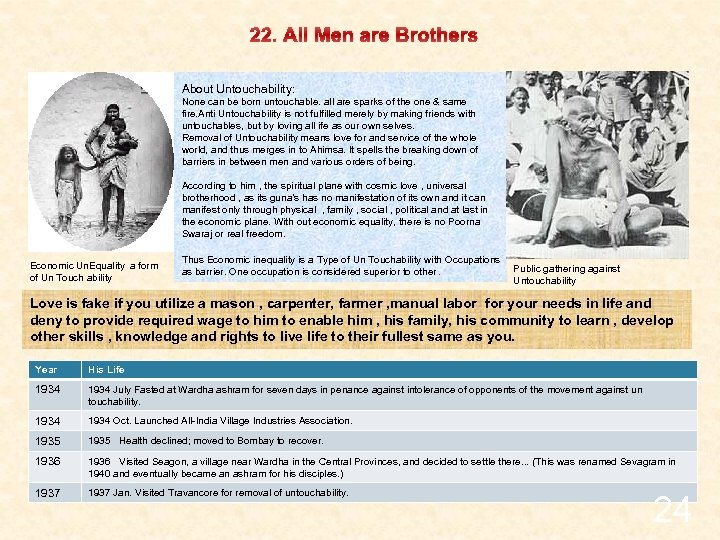 22. All Men are Brothers About Untouchability: None can be born untouchable. all are sparks of the one & same fire. Anti Untouchability is not fulfilled merely by making friends with untouchables, but by loving all ife as our own selves. Removal of Untouchability means love for and service of the whole world, and thus merges in to Ahimsa. It spells the breaking down of barriers in between men and various orders of being. According to him , the spiritual plane with cosmic love , universal brotherhood , as its guna’s has no manifestation of its own and it can manifest only through physical , family , social , political and at last in the economic plane. With out economic equality, there is no Poorna Swaraj or real freedom. Economic Un. Equality a form of Un Touch ability Thus Economic inequality is a Type of Un Touchability with Occupations as barrier. One occupation is considered superior to other. Public gathering against Untouchability Love is fake if you utilize a mason , carpenter, farmer , manual labor for your needs in life and deny to provide required wage to him to enable him , his family, his community to learn , develop other skills , knowledge and rights to live life to their fullest same as you. Year His Life 1934 July Fasted at Wardha ashram for seven days in penance against intolerance of opponents of the movement against un touchability. 1934 Oct. Launched All-India Village Industries Association. 1935 Health declined; moved to Bombay to recover. 1936 Visited Seagon, a village near Wardha in the Central Provinces, and decided to settle there. . . (This was renamed Sevagram in 1940 and eventually became an ashram for his disciples. ) 1937 Jan. Visited Travancore for removal of untouchability. 24
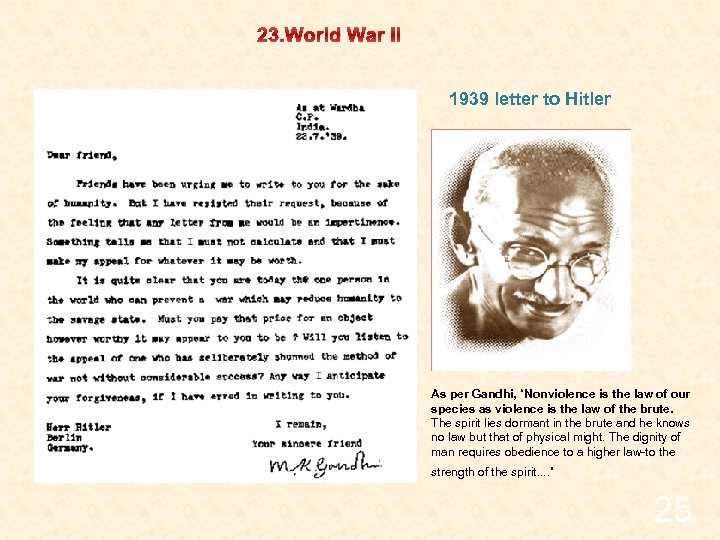 23. World War II 1939 letter to Hitler As per Gandhi, “Nonviolence is the law of our species as violence is the law of the brute. The spirit lies dormant in the brute and he knows no law but that of physical might. The dignity of man requires obedience to a higher law-to the strength of the spirit. . ” 25
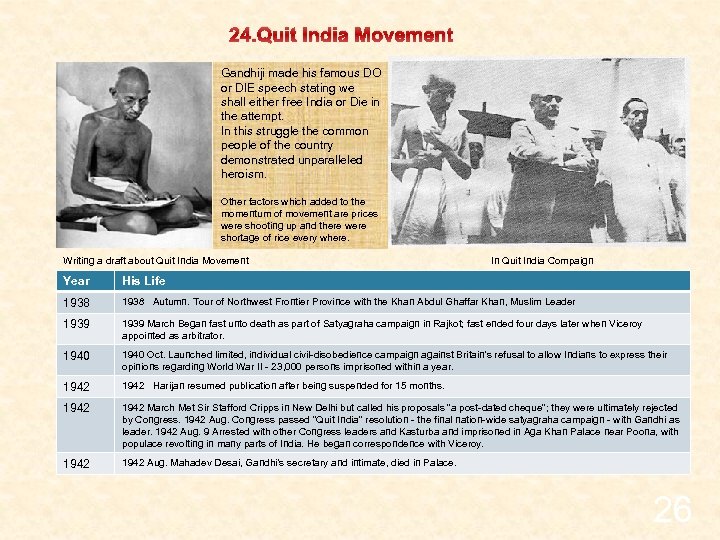 24. Quit India Movement Gandhiji made his famous DO or DIE speech stating we shall either free India or Die in the attempt. In this struggle the common people of the country demonstrated unparalleled heroism. Other factors which added to the momentum of movement are prices were shooting up and there were shortage of rice every where. Writing a draft about Quit India Movement In Quit India Compaign Year His Life 1938 Autumn. Tour of Northwest Frontier Province with the Khan Abdul Ghaffar Khan, Muslim Leader 1939 March Began fast unto death as part of Satyagraha campaign in Rajkot; fast ended four days later when Viceroy appointed as arbitrator. 1940 Oct. Launched limited, individual civil-disobedience campaign against Britain's refusal to allow Indians to express their opinions regarding World War II - 23, 000 persons imprisoned within a year. 1942 Harijan resumed publication after being suspended for 15 months. 1942 March Met Sir Stafford Cripps in New Delhi but called his proposals "a post-dated cheque"; they were ultimately rejected by Congress. 1942 Aug. Congress passed "Quit India" resolution - the final nation-wide satyagraha campaign - with Gandhi as leader. 1942 Aug. 9 Arrested with other Congress leaders and Kasturba and imprisoned in Aga Khan Palace near Poona, with populace revolting in many parts of India. He began correspondence with Viceroy. 1942 Aug. Mahadev Desai, Gandhi's secretary and intimate, died in Palace. 26
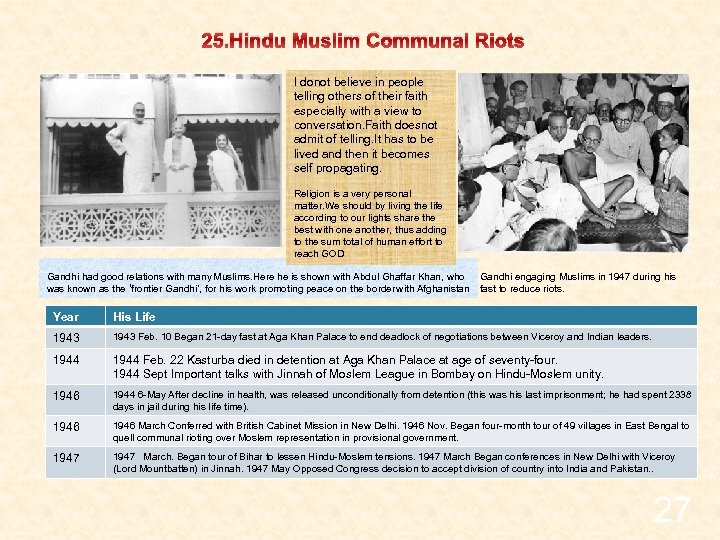 25. Hindu Muslim Communal Riots I donot believe in people telling others of their faith especially with a view to conversation. Faith doesnot admit of telling. It has to be lived and then it becomes self propagating. Religion is a very personal matter. We should by living the life according to our lights share the best with one another, thus adding to the sum total of human effort to reach GOD Gandhi had good relations with many Muslims. Here he is shown with Abdul Ghaffar Khan, who was known as the ‘frontier Gandhi’, for his work promoting peace on the border with Afghanistan Gandhi engaging Muslims in 1947 during his fast to reduce riots. Year His Life 1943 Feb. 10 Began 21 -day fast at Aga Khan Palace to end deadlock of negotiations between Viceroy and Indian leaders. 1944 Feb. 22 Kasturba died in detention at Aga Khan Palace at age of seventy-four. 1944 Sept Important talks with Jinnah of Moslem League in Bombay on Hindu-Moslem unity. 1946 1944 6 -May After decline in health, was released unconditionally from detention (this was his last imprisonment; he had spent 2338 days in jail during his life time). 1946 March Conferred with British Cabinet Mission in New Delhi. 1946 Nov. Began four-month tour of 49 villages in East Bengal to quell communal rioting over Moslem representation in provisional government. 1947 March. Began tour of Bihar to lessen Hindu-Moslem tensions. 1947 March Began conferences in New Delhi with Viceroy (Lord Mountbatten) in Jinnah. 1947 May Opposed Congress decision to accept division of country into India and Pakistan. . 27
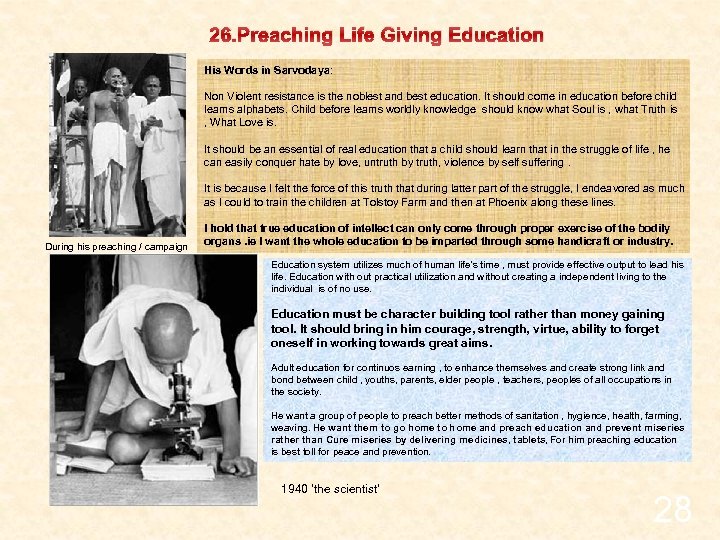 26. Preaching Life Giving Education His Words in Sarvodaya: Non Violent resistance is the noblest and best education. It should come in education before child learns alphabets. Child before learns worldly knowledge should know what Soul is , what Truth is , What Love is. It should be an essential of real education that a child should learn that in the struggle of life , he can easily conquer hate by love, untruth by truth, violence by self suffering. It is because I felt the force of this truth that during latter part of the struggle, I endeavored as much as I could to train the children at Tolstoy Farm and then at Phoenix along these lines. During his preaching / campaign I hold that true education of intellect can only come through proper exercise of the bodily organs. ie I want the whole education to be imparted through some handicraft or industry. Education system utilizes much of human life’s time , must provide effective output to lead his life. Education with out practical utilization and without creating a independent living to the individual is of no use. Education must be character building tool rather than money gaining tool. It should bring in him courage, strength, virtue, ability to forget oneself in working towards great aims. Adult education for continuos earning , to enhance themselves and create strong link and bond between child , youths, parents, elder people , teachers, peoples of all occupations in the society. He want a group of people to preach better methods of sanitation , hygience, health, farming, weaving. He want them to go home to home and preach education and prevent miseries rather than Cure miseries by delivering medicines, tablets, For him preaching education is best toll for peace and prevention. 1940 ‘the scientist’ 28
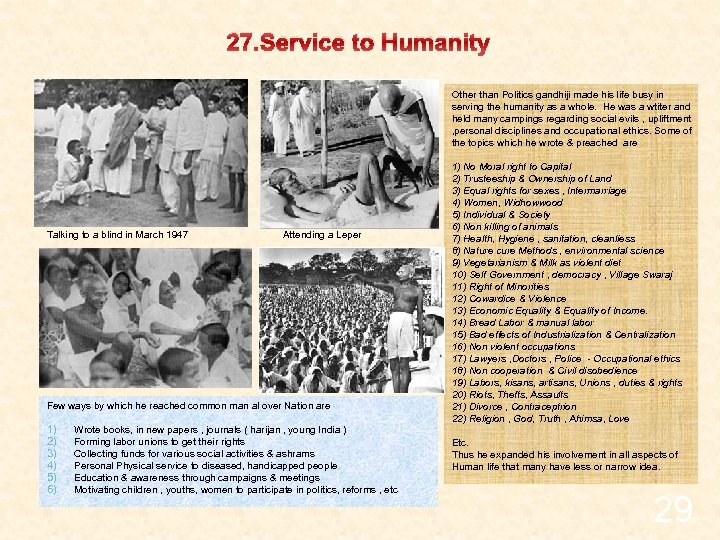 27. Service to Humanity Other than Politics gandhiji made his life busy in serving the humanity as a whole. He was a wtiter and held many campings regarding social evils , upliftment , personal disciplines and occupational ethics. Some of the topics which he wrote & preached are Talking to a blind in March 1947 Attending a Leper Few ways by which he reached common man al over Nation are 1) 2) 3) 4) 5) 6) Wrote books, in new papers , journals ( harijan , young India ) Forming labor unions to get their rights Collecting funds for various social activities & ashrams Personal Physical service to diseased, handicapped people Education & awareness through campaigns & meetings Motivating children , youths, women to participate in politics, reforms , etc 1) No Moral right to Capital 2) Trusteeship & Ownership of Land 3) Equal rights for sexes , Intermarriage 4) Women, Widhowwood 5) Individual & Society 6) Non killing of animals 7) Health, Hygiene , sanitation, cleanliess 8) Nature cure Methods , environmental science 9) Vegetarianism & Milk as violent diet 10) Self Government , democracy , Village Swaraj 11) Right of Minorities 12) Cowardice & Violence 13) Economic Equality & Equality of Income. 14) Bread Labor & manual labor 15) Bad effects of Industrialization & Centralization 16) Non violent occupations 17) Lawyers , Doctors , Police - Occupational ethics 18) Non cooperation & Civil disobedience 19) Labors, kisans, artisans, Unions , duties & rights 20) Riots, Thefts, Assaults 21) Divorce , Contraceptrion 22) Religion , God, Truth , Ahimsa, Love Etc. Thus he expanded his involvement in all aspects of Human life that many have less or narrow idea. 29
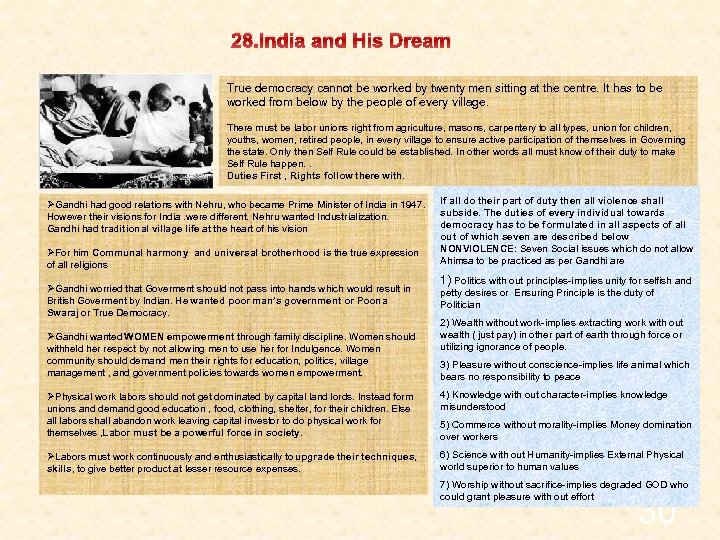 28. India and His Dream True democracy cannot be worked by twenty men sitting at the centre. It has to be worked from below by the people of every village. There must be labor unions right from agriculture, masons, carpentery to all types, union for children, youths, women, retired people, in every village to ensure active participation of themselves in Governing the state. Only then Self Rule could be established. In other words all must know of their duty to make Self Rule happen. . Duties First , Rights follow there with. ØGandhi had good relations with Nehru, who became Prime Minister of India in 1947. However their visions for India. were different. Nehru wanted Industrialization. Gandhi had traditional village life at the heart of his vision ØFor him Communal harmony and universal brotherhood is the true expression of all religions ØGandhi worried that Goverment should not pass into hands which would result in British Goverment by Indian. He wanted poor man’s government or Poona Swaraj or True Democracy. ØGandhi wanted WOMEN empowerment through family discipline. Women should withheld her respect by not allowing men to use her for Indulgence. Women community should demand men their rights for education, politics, village management , and government policies towards women empowerment. If all do their part of duty then all violence shall subside. The duties of every individual towards democracy has to be formulated in all aspects of all out of which seven are described below NONVIOLENCE: Seven Social issues which do not allow Ahimsa to be practiced as per Gandhi are 1) Politics with out principles-implies unity for selfish and petty desires or Ensuring Principle is the duty of Politician 2) Wealth without work-implies extracting work with out wealth ( just pay) in other part of earth through force or utilizing ignorance of people. 3) Pleasure without conscience-implies life animal which bears no responsibility to peace ØPhysical work labors should not get dominated by capital land lords. Instead form unions and demand good education , food, clothing, shelter, for their children. Else all labors shall abandon work leaving capital investor to do physical work for themselves , Labor must be a powerful force in society. 4) Knowledge with out character-implies knowledge misunderstood ØLabors must work continuously and enthusiastically to upgrade their techniques, skills, to give better product at lesser resource expenses. 6) Science with out Humanity-implies External Physical world superior to human values 5) Commerce without morality-implies Money domination over workers 7) Worship without sacrifice-implies degraded GOD who could grant pleasure with out effort 30
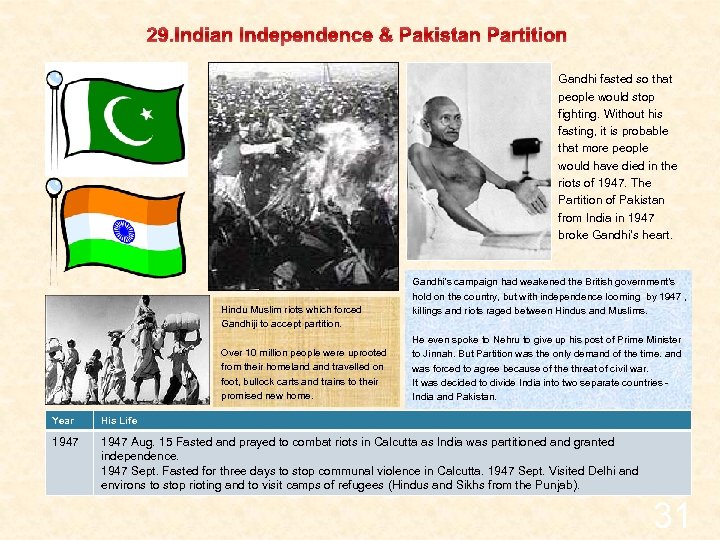 29. Indian Independence & Pakistan Partition Gandhi fasted so that people would stop fighting. Without his fasting, it is probable that more people would have died in the riots of 1947. The Partition of Pakistan from India in 1947 broke Gandhi’s heart. Hindu Muslim riots which forced Gandhiji to accept partition. Over 10 million people were uprooted from their homeland travelled on foot, bullock carts and trains to their promised new home. Gandhi’s campaign had weakened the British government’s hold on the country, but with independence looming by 1947 , killings and riots raged between Hindus and Muslims. He even spoke to Nehru to give up his post of Prime Minister to Jinnah. But Partition was the only demand of the time. and was forced to agree because of the threat of civil war. It was decided to divide India into two separate countries - India and Pakistan. Year His Life 1947 Aug. 15 Fasted and prayed to combat riots in Calcutta as India was partitioned and granted independence. 1947 Sept. Fasted for three days to stop communal violence in Calcutta. 1947 Sept. Visited Delhi and environs to stop rioting and to visit camps of refugees (Hindus and Sikhs from the Punjab). 31
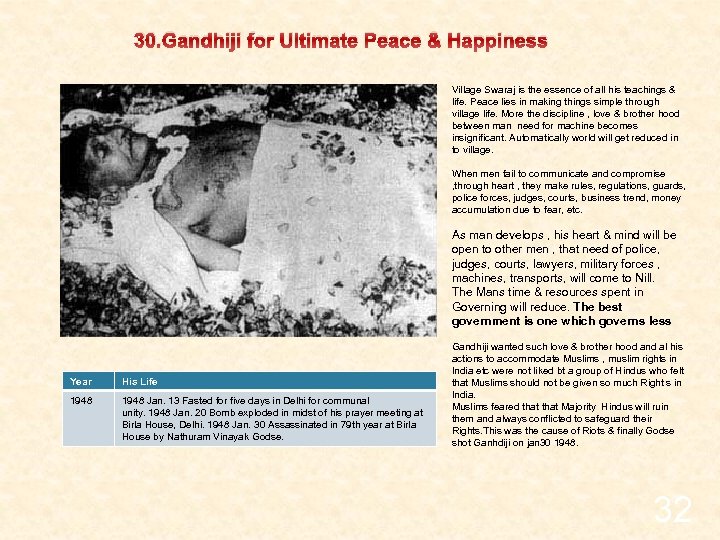 30. Gandhiji for Ultimate Peace & Happiness Village Swaraj is the essence of all his teachings & life. Peace lies in making things simple through village life. More the discipline , love & brother hood between man need for machine becomes insignificant. Automatically world will get reduced in to village. When men fail to communicate and compromise , through heart , they make rules, regulations, guards, police forces, judges, courts, business trend, money accumulation due to fear, etc. As man develops , his heart & mind will be open to other men , that need of police, judges, courts, lawyers, military forces , machines, transports, will come to Nill. The Mans time & resources spent in Governing will reduce. The best government is one which governs less Year His Life 1948 Jan. 13 Fasted for five days in Delhi for communal unity. 1948 Jan. 20 Bomb exploded in midst of his prayer meeting at Birla House, Delhi. 1948 Jan. 30 Assassinated in 79 th year at Birla House by Nathuram Vinayak Godse. Gandhiji wanted such love & brother hood and al his actions to accommodate Muslims , muslim rights in India etc were not liked bt a group of Hindus who felt that Muslims should not be given so much Right s in India. Muslims feared that Majority Hindus will ruin them and always conflicted to safeguard their Rights. This was the cause of Riots & finally Godse shot Ganhdiji on jan 30 1948. 32
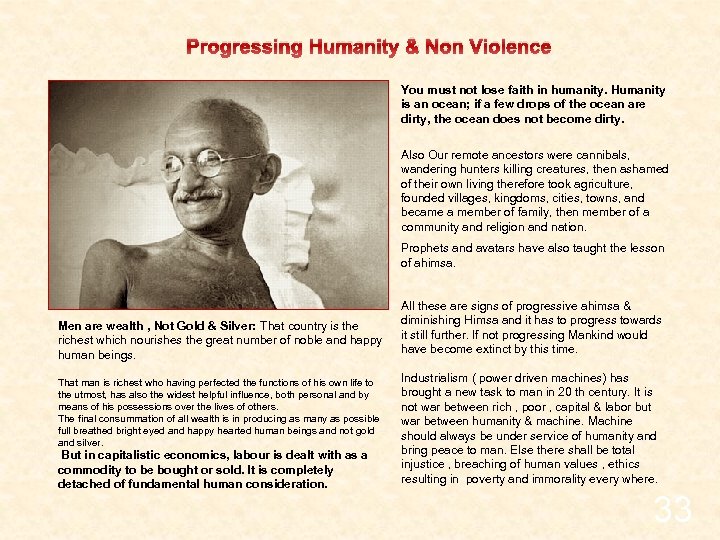 Progressing Humanity & Non Violence You must not lose faith in humanity. Humanity is an ocean; if a few drops of the ocean are dirty, the ocean does not become dirty. Also Our remote ancestors were cannibals, wandering hunters killing creatures, then ashamed of their own living therefore took agriculture, founded villages, kingdoms, cities, towns, and became a member of family, then member of a community and religion and nation. Prophets and avatars have also taught the lesson of ahimsa. Men are wealth , Not Gold & Silver: That country is the richest which nourishes the great number of noble and happy human beings. That man is richest who having perfected the functions of his own life to the utmost, has also the widest helpful influence, both personal and by means of his possessions over the lives of others. The final consummation of all wealth is in producing as many as possible full breathed bright eyed and happy hearted human beings and not gold and silver. But in capitalistic economics, labour is dealt with as a commodity to be bought or sold. It is completely detached of fundamental human consideration. All these are signs of progressive ahimsa & diminishing Himsa and it has to progress towards it still further. If not progressing Mankind would have become extinct by this time. Industrialism ( power driven machines) has brought a new task to man in 20 th century. It is not war between rich , poor , capital & labor but war between humanity & machine. Machine should always be under service of humanity and bring peace to man. Else there shall be total injustice , breaching of human values , ethics resulting in poverty and immorality every where. 33
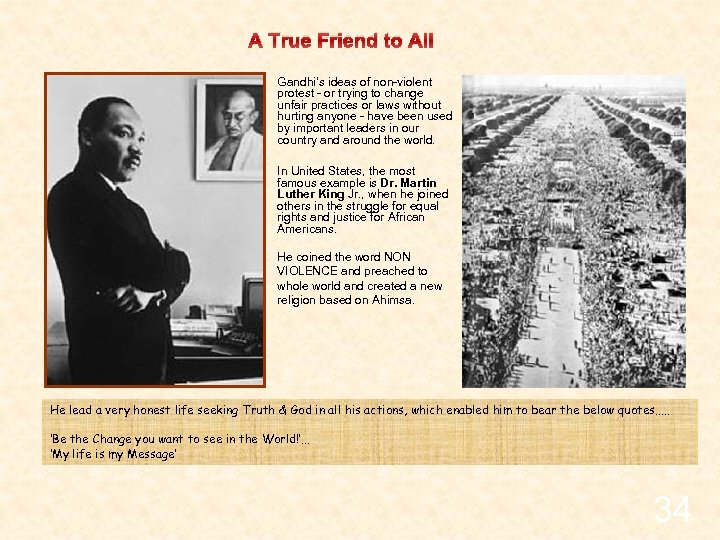 A True Friend to All Gandhi’s ideas of non-violent protest - or trying to change unfair practices or laws without hurting anyone - have been used by important leaders in our country and around the world. In United States, the most famous example is Dr. Martin Luther King Jr. , when he joined others in the struggle for equal rights and justice for African Americans. He coined the word NON VIOLENCE and preached to whole world and created a new religion based on Ahimsa. He lead a very honest life seeking Truth & God in all his actions, which enabled him to bear the below quotes. . . ‘Be the Change you want to see in the World!’. . . ‘My life is my Message’ 34
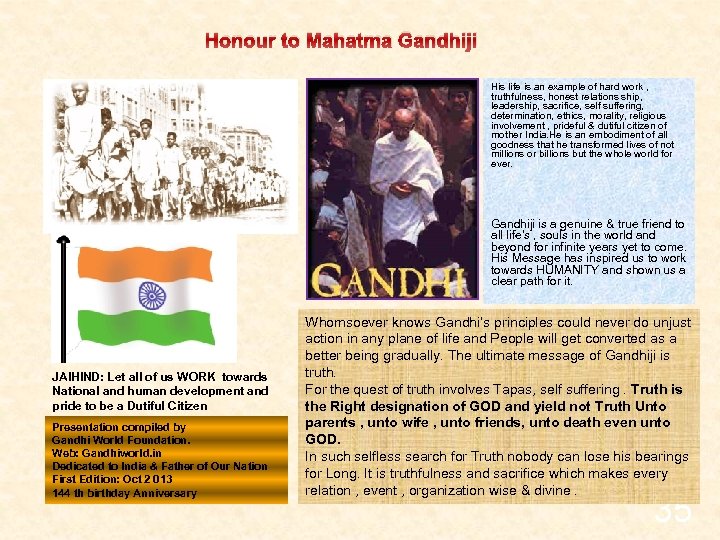 Honour to Mahatma Gandhiji His life is an example of hard work , truthfulness, honest relations ship, leadership, sacrifice, self suffering, determination, ethics, morality, religious involvement , prideful & dutiful citizen of mother India. He is an embodiment of all goodness that he transformed lives of not millions or billions but the whole world for ever. Gandhiji is a genuine & true friend to all life's , souls in the world and beyond for infinite years yet to come. His Message has inspired us to work towards HUMANITY and shown us a clear path for it. JAIHIND: Let all of us WORK towards National and human development and pride to be a Dutiful Citizen Presentation compiled by Gandhi World Foundation. Web: Gandhiworld. in Dedicated to India & Father of Our Nation First Edition: Oct 2 013 144 th birthday Anniversary Whomsoever knows Gandhi’s principles could never do unjust action in any plane of life and People will get converted as a better being gradually. The ultimate message of Gandhiji is truth. For the quest of truth involves Tapas, self suffering. Truth is the Right designation of GOD and yield not Truth Unto parents , unto wife , unto friends, unto death even unto GOD. In such selfless search for Truth nobody can lose his bearings for Long. It is truthfulness and sacrifice which makes every relation , event , organization wise & divine. 35