 Скачать презентацию MODULE A — ADMINISTRATIVE SUBMODULES A 1 Tools
bb9c9539bf95c775ca0d970dd7ceb9db.ppt
- Количество слайдов: 36



MODULE A - ADMINISTRATIVE SUBMODULES A 1. Tools and Resources A 2. Standards and Certification Products and Services A 3. Membership Maintenance A 4. Honors and Awards A 5. Publishing Codes and Standards ASME S&C Training Module A 2 0
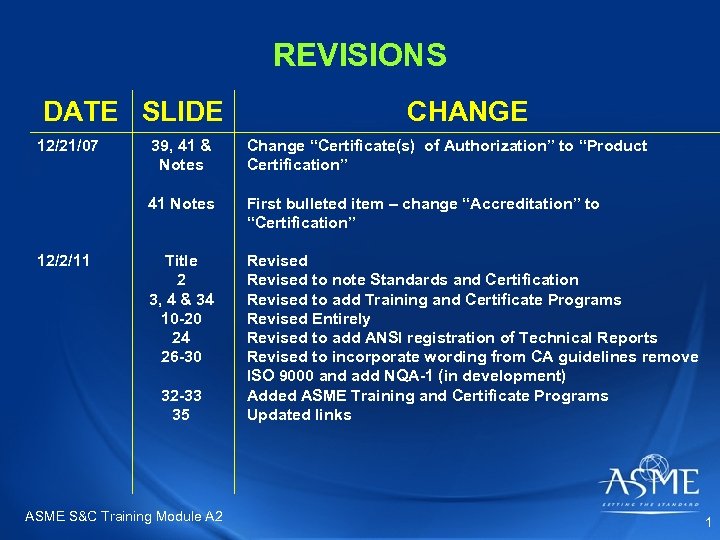
REVISIONS DATE SLIDE 12/21/07 CHANGE Change “Certificate(s) of Authorization” to “Product Certification” 41 Notes 12/2/11 39, 41 & Notes First bulleted item – change “Accreditation” to “Certification” Title 2 3, 4 & 34 10 -20 24 26 -30 Revised to note Standards and Certification Revised to add Training and Certificate Programs Revised Entirely Revised to add ANSI registration of Technical Reports Revised to incorporate wording from CA guidelines remove ISO 9000 and add NQA-1 (in development) Added ASME Training and Certificate Programs Updated links 32 -33 35 ASME S&C Training Module A 2 1
A 2. Standards and Certification Products and Services
OBJECTIVES This submodule will - Define the ASME use of the term “Standard” - Identify the standardized format used on ASME Codes and Standards - Describe how various types of Inquiries are identified and handled. - Describe the difference between a standard, guide and technical report. - Name the 4 types of conformity assessment programs available. - Describe the ASME Training and Certificate Programs ASME S&C Training Module A 2 3
AGENDA I. III. IV. Codes and Standards Guides/Reports Conformity Assessment ASME Training and Certificate Programs ASME S&C Training Module A 2 4
I. CODES AND STANDARDS ASME S&C Training Module A 2 5
STANDARDS • Definitions of the term “Standard” varies depending on the source. • Compare the definition of Standard within: – ISO/IEC Guide 2 – OMB Circular A-119 – ASME S&C Training Module A 2 6
“STANDARD” Definition (ISO / IEC GUIDE 2) Document, established by consensus and approved by a recognized body, that provides, for common and repeated use, rules, guidelines or characteristics for activities or their results, aimed at the achievement of the optimum degree of order in a given context. NOTE – Standards should be based on the consolidated results of science, technology and experience, and aimed at the promotion of optimum community benefits. ASME S&C Training Module A 2 7
“STANDARD” Definition (OMB CIRCULAR A-119*) Common and repeated use of rules, conditions, guidelines or characteristics for products or related processes and production methods, and related management systems practices The definition of terms; classification of components; delineation of procedures; specification of dimensions, materials, performance, designs, or operations; measurement of quality and quantity in describing materials, processes, products, systems, services, or practices; test methods and sampling procedures; or descriptions of fit and measurements of size or strength * OMB A-119 = Federal Participation in the Development and Use of Voluntary Consensus Standards and Conformity Assessment Activities ASME S&C Training Module A 2 8
“STANDARD” (ASME) Definition A set of technical definitions, instructions, rules, guidelines, or characteristics set forth to provide consistent and comparable results, including: • Items manufactured uniformly, providing for interchangeability • Tests and analyses conducted reliably, minimizing the uncertainty of the results • Facilities designed and constructed for safe operation By custom, some standards are called codes. ASME S&C Training Module A 2 9
ASME CODES AND STANDARDS • Developed under the ANSI accredited Procedures for Codes and Standards Development Committees • Standardized Format • Key Content Characteristics – Clear consistent style – Well-defined scope – Realistic – Enforceable ASME S&C Training Module A 2 10
Codes and Standards Standardized Format • Front Matter – Copyright, Contents, Foreword, Roster, Committee Correspondence, Preface, Introduction, Summary of Changes, Organization Page • Chapters • Back Matter – Appendices (Mandatory and Non Mandatory), – Interpretations, Code Cases, Annexes, Informational pages • Addenda Subscription (no longer being issued for standards issued after July 1, 2010) ASME S&C Training Module A 2 11
IMPACT OF CODES AND STANDARDS • Affects all interested parties for the given piece of equipment, work process or technology such as: – Manufacturers – Installers – Enforcing Authorities & Inspection Agencies – Specialists having expert knowledge – Designers – Users or owners of equipment • Market impact has legal implications • Basis for regulatory requirements ASME S&C Training Module A 2 12
INQUIRIES to ASME DEVELOPMENT COMMITTEES • Due to the impact ASME Codes and Standards have on various industries, development committees may be requested to respond to the following types of inquiries: – Interpretations – Code Cases – Informal Inquiries – Requests for Revision – Request for Errata/Editorial Changes ASME S&C Training Module A 2 13
INTERPRETATIONS Interpretations are used to clarify the meaning of some aspect of a code or standard as outlined in C&S Policy 33 1. Interpretation – Formal response to a written inquiry to clarify wording in the code or standard (letter, fax, email) 2. Intent Interpretation – Clarifies and corrects ambiguous or incorrect wording – Must be accompanied by a revision to the standard that supports the interpretation – Interpretation and associated revision must be approved by consensus committee. ASME S&C Training Module A 2 14
INTERPRETATIONS - REQUIREMENTS • Interpretations shall NOT – Revise existing requirements – Establish new requirements – Include explanations describing why the standard is written the way it is, except they may include the rationale that was approved through the consensus process as part of the standards action – Approve, certify, rate or endorse any item, construction, proprietary device or activity ASME S&C Training Module A 2 15
CODE CASES • Purpose – To provide alternatives to existing requirements • Permission to use new materials • Permission to use alternative constructions – To allow early and urgent implementation of a revised requirement • Can be requested by an inquirer or initiated by a committee • The specific steps taken to develop and approve Cases are similar to those used for standards revision and are covered in detail in Module B 11 Interpretations and Code Cases. ASME S&C Training Module A 2 16
INFORMAL RESPONSES • Requirements – May be verbal or in writing – Should clearly state that the response expresses an opinion, not an official interpretation – Must not be sent on ASME interpretation letterhead ASME S&C Training Module A 2 17
REQUESTS FOR REVISION AND ERRATA/EDITORIAL CHANGES • Requests may be initiated by: – Committee member – Staff – General Public • Requests for Revision – Standards committees may have specific format requirements for this type of inquiry. These requirements can be posted in the Introduction or Foreword of the Standard ASME S&C Training Module A 2 18
REQUESTS FOR REVISION AND ERRATA/EDITORIAL CHANGES • Errata – Typographical errors or misspellings, grammatical errors, publication errors (omission by staff, printer errors) – Errata are posted online and are sent to all purchasers of the code or standard – Errata apply retroactively • Editorial Changes – Non-substantive changes that do not change the requirements in any way ASME S&C Training Module A 2 19
ADDENDA • Addenda Services are no longer an option available to ASME Codes and Standards development Committees for standards issued after July 1, 2010: – Pagination problems – Miscellaneous addenda revisions difficult to follow – Addenda issued too frequently imposed manufacturing hardships – Shift to XML publishing format • Revisions are now incorporated into new editions and edition cycles can be shortened ASME S&C Training Module A 2 20
POP QUIZ #3 (Extra Credit) Which of the following is not published? a. Code b. Standard c. Errata d. Interpretation e. Informal response f. Intent interpretation g. Case ASME S&C Training Module A 2 21
II. GUIDES/REPORTS ASME S&C Training Module A 2 22
GUIDES • Characteristics – Provide recognized and generally accepted good engineering practices – Include suggestions, alternatives rather than directives – Are occasionally updated ASME S&C Training Module A 2 23
TECHNICAL REPORTS • Characteristics – Informational or tutorial in nature • Technical research reports • Methods for applying a code/standard – Covered in specific committee training sessions – Can be registered with ANSI ASME S&C Training Module A 2 24
III. CONFORMITY ASSESSMENT ASME S&C Training Module A 2 25
CONFORMITY ASSESSMENT • Types – Accreditation – Product Certification – Personnel Certification – Management Systems Certification ASME S&C Training Module A 2 26
CONFORMITY ASSESSMENT • Accreditation – ASME assesses and verifies an organization’s competence to serve as a conformity assessment body. – ASME-accredited organization may develop and administer a conformity assessment program (e. g. , testing, inspection, or certification) in accordance with program requirements contained in an ASME standard. – Certificate of Accreditation awarded for successful review and organizations are referred to as “ASMEaccredited”. ASME S&C Training Module A 2 27
CONFORMITY ASSESSMENT • Product Certification – ASME certifies that a manufacturer is capable of constructing equipment and fulfilling requirements of an ASME standard. – Supplier is responsible for ensuring that individual products meet the requirements on which the certification is based. – ASME “Certificate of Authorization” is issued where there is an associated certification mark (stamp)that may be placed on the product. ASME S&C Training Module A 2 28
CONFORMITY ASSESSMENT • Personnel Certification – Certifies that an individual meets the qualification criteria specified in an ASME standard. – Evaluation includes an examination or series of examinations. – Individual receives certificate or Certification Card upon successful completion and is referred to as “Certified”. – Certification is not licensing ASME S&C Training Module A 2 29
CONFORMITY ASSESSMENT • Management Systems Certification – Certifies the organization’s quality management system, not its products – ASME audit team reviews system documentation and implementation – ASME “Certificate of Registration” is granted and the company may be referred to as “Registered”. – ASME NQA-1, Quality Assurance Requirements for Nuclear Facility Applications is currently in development ASME C&S Training Module A 2 30
POP QUIZ #4 Which of the following authorizes a manufacturer to stamp equipment indicating it meets an ASME code or standard? a. b. c. d. Accreditation Personnel Certification Product Certification Management Systems Certification ASME S&C Training Module A 2 31
IV. ASME Training and Certificate Programs ASME S&C Training Module A 2 32
ASME Training and Certificate Programs • Certificate Programs – Training-based individual credentialing programs – ASME curriculum is developed and administered by ASME Training and Development – Individuals successfully completing the program receive a Certificate or Qualification Card and are referred to as “Qualified” – Authorized Training Providers (ATPs) may be engaged to administer programs ASME S&C Training Module A 2 33
SUMMARY I. III. IV. Codes and Standards Guides/Reports Conformity Assessment ASME Training and Certificate Programs ASME S&C Training Module A 2 34
REFERENCES – ISO / IEC Guide 2: 1996, Standardization and related activities General vocabulary • http: //webstore. ansi. org/ansidocstore/default. asp • www. iso. ch/iso/en/ISOOnline. frontpage – OMB Circular A-119 • www. whitehouse. gov/omb/circulars/a 119. html • http: //ts. nist. gov/ts/htdocs/210/215/fr-omba 119. htm – ANSI Accredited Procedures • http: //cstools. asme. org/csconnect/Committee. Pages. cfm? Committee= A 01000000&Action=7609 – Codes and Standards Policy 33 (Interpretations) • http: //cstools. asme. org/csconnect/Committee. Pages. cfm? Committee= A 01000000&Action=7609 ASME S&C Training Module A 2 35
Скачать презентацию MODULE A — ADMINISTRATIVE SUBMODULES A 1 Tools
bb9c9539bf95c775ca0d970dd7ceb9db.ppt