


 Скачать презентацию Module 8 Story time 6 Look at
9390c35c0240ce7576fc0fc2f57369d3.ppt
- Количество слайдов: 30
 Module 8 Story time
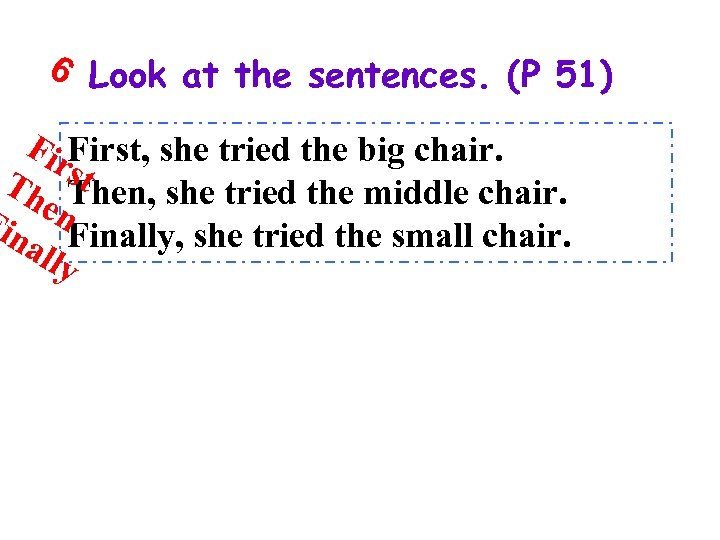 6 Look at the sentences. (P 51) First, she tried the big chair. Th st en. Then, she tried the middle chair. ina Finally, she tried the small chair. lly
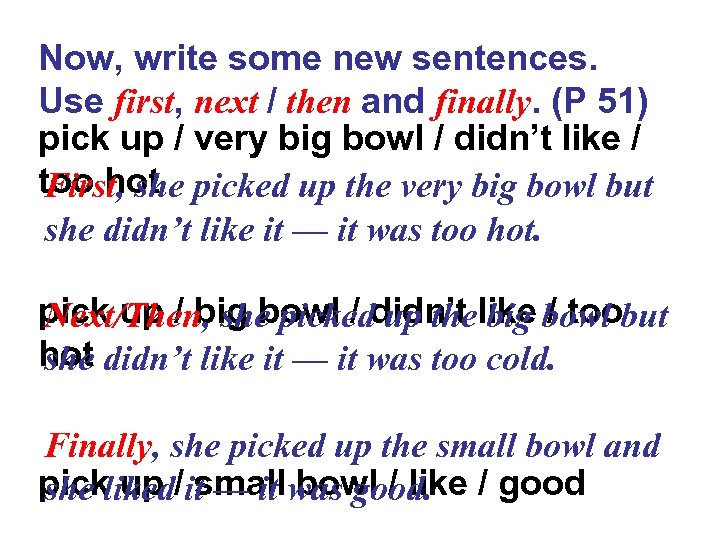 Now, write some new sentences. Use first, next / then and finally. (P 51) pick up / very big bowl / didn’t like / too hot picked up the very big bowl but First, she didn’t like it — it was too hot. pick up / big bowl / didn’t like bowl but Next/Then, she picked up the big / too hot didn’t like it — it was too cold. she Finally, she picked up the small bowl and pick up /it — it was good. / good she liked small bowl / like
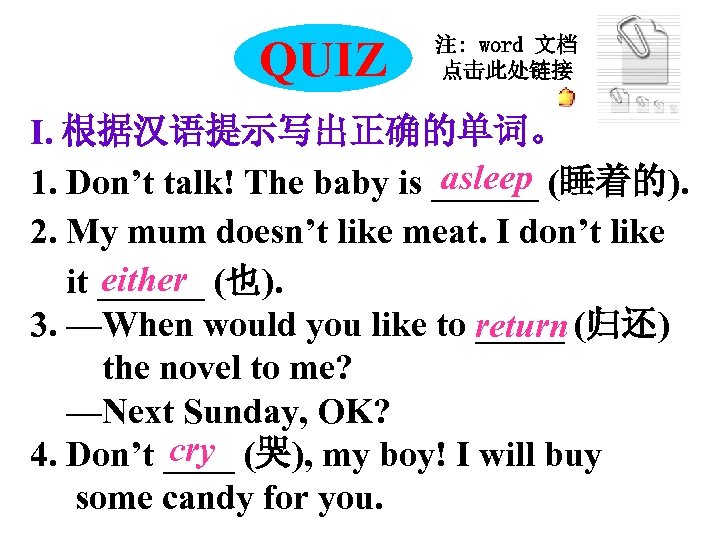 QUIZ 注: word 文档 点击此处链接 Ⅰ. 根据汉语提示写出正确的单词。 asleep 1. Don’t talk! The baby is ______ (睡着的). 2. My mum doesn’t like meat. I don’t like either it ______ (也). 3. —When would you like to _____ (归还) return the novel to me? —Next Sunday, OK? cry 4. Don’t ____ (哭), my boy! I will buy some candy for you.
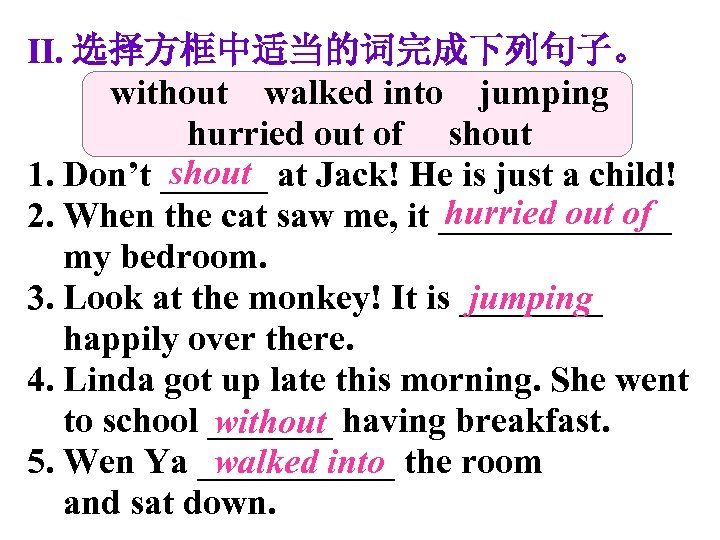 Ⅱ. 选择方框中适当的词完成下列句子。 without walked into jumping hurried out of shout 1. Don’t ______ at Jack! He is just a child! hurried out of 2. When the cat saw me, it _______ my bedroom. jumping 3. Look at the monkey! It is ____ happily over there. 4. Linda got up late this morning. She went to school _______ having breakfast. without walked into 5. Wen Ya ______ the room and sat down.
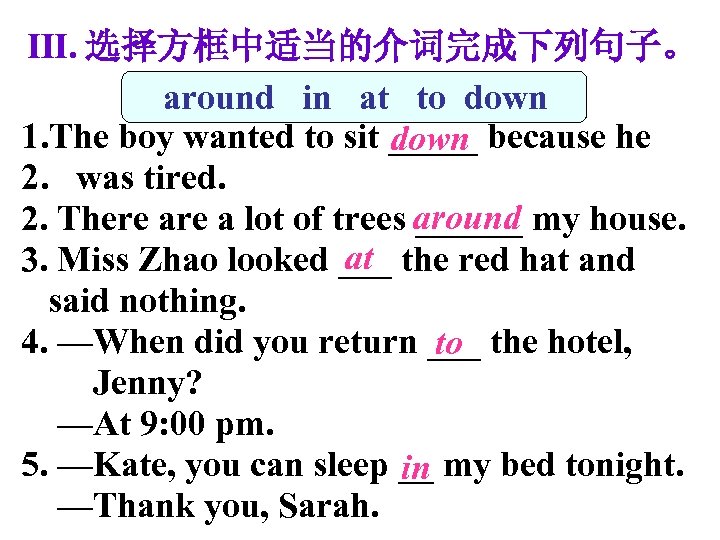 Ⅲ. 选择方框中适当的介词完成下列句子。 around in at to down 1. The boy wanted to sit _____ because he down 2. was tired. 2. There a lot of trees around my house. ______ at 3. Miss Zhao looked ___ the red hat and said nothing. 4. —When did you return ___ the hotel, to Jenny? —At 9: 00 pm. 5. —Kate, you can sleep __ my bed tonight. in —Thank you, Sarah.
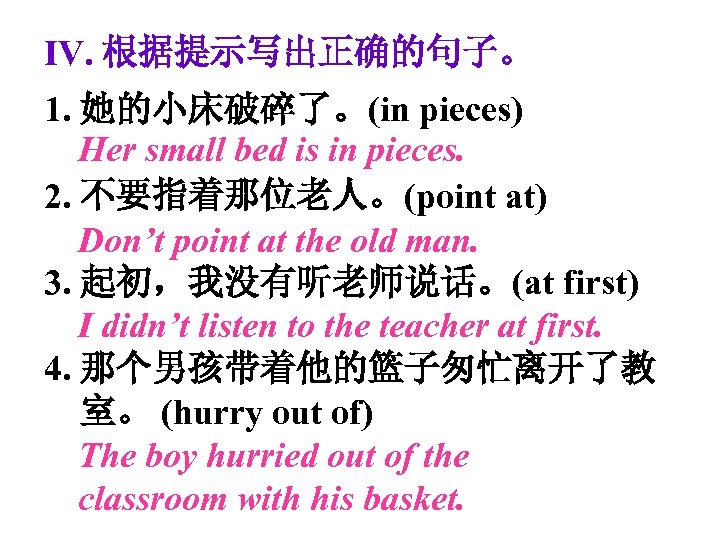 Ⅳ. 根据提示写出正确的句子。 1. 她的小床破碎了。(in pieces) Her small bed is in pieces. 2. 不要指着那位老人。(point at) Don’t point at the old man. 3. 起初,我没有听老师说话。(at first) I didn’t listen to the teacher at first. 4. 那个男孩带着他的篮子匆忙离开了教 室。 (hurry out of) The boy hurried out of the classroom with his basket.
 一般过去时(Ⅱ)
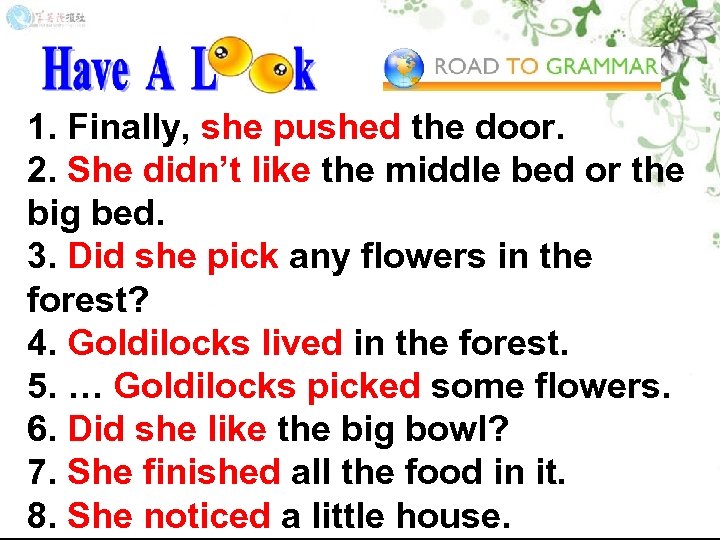 1. Finally, she pushed the door. 2. She didn’t like the middle bed or the big bed. 3. Did she pick any flowers in the forest? 4. Goldilocks lived in the forest. 5. … Goldilocks picked some flowers. 6. Did she like the big bowl? 7. She finished all the food in it. 8. She noticed a little house.
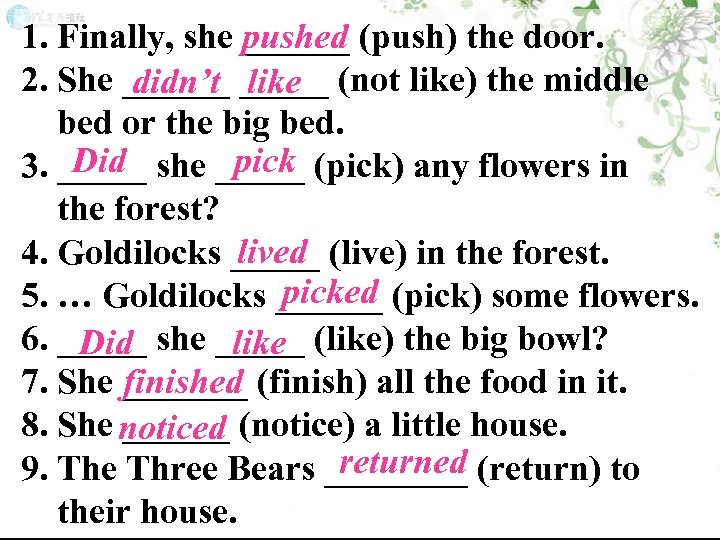 1. Finally, she ______ (push) the door. pushed 2. She ______ (not like) the middle didn’t like bed or the big bed. Did pick 3. _____ she _____ (pick) any flowers in the forest? lived 4. Goldilocks _____ (live) in the forest. picked 5. … Goldilocks ______ (pick) some flowers. 6. _____ she _____ (like) the big bowl? Did like 7. She _______ (finish) all the food in it. finished 8. She noticed (notice) a little house. ______ returned 9. The Three Bears ____ (return) to their house.
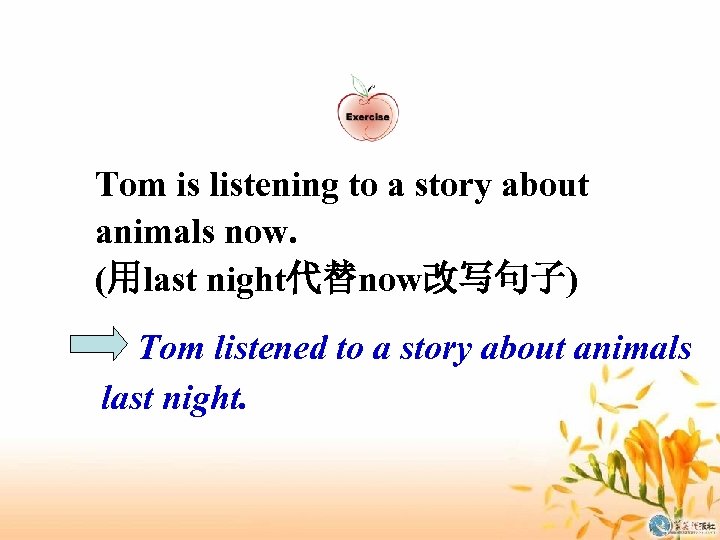 Tom is listening to a story about animals now. (用last night代替now改写句子) Tom listened to a story about animals last night.
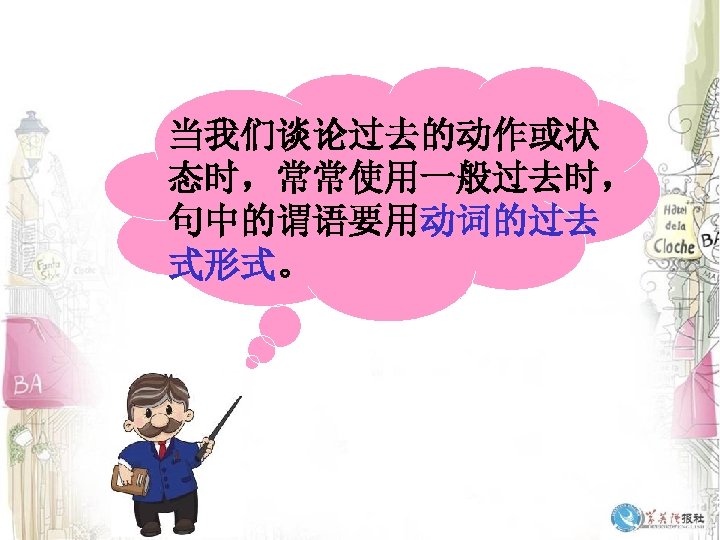 当我们谈论过去的动作或状 态时,常常使用一般过去时, 句中的谓语要用动词的过去 式形式。
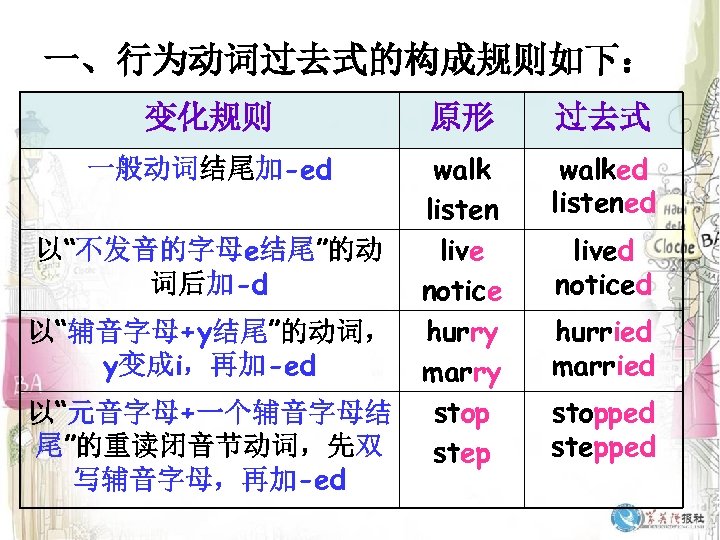 一、行为动词过去式的构成规则如下: 变化规则 原形 过去式 一般动词结尾加-ed walk listen live notice hurry marry stop step walked listened 以“不发音的字母e结尾”的动 词后加-d 以“辅音字母+y结尾”的动词, y变成i,再加-ed 以“元音字母+一个辅音字母结 尾”的重读闭音节动词,先双 写辅音字母,再加-ed lived noticed hurried married stopped stepped
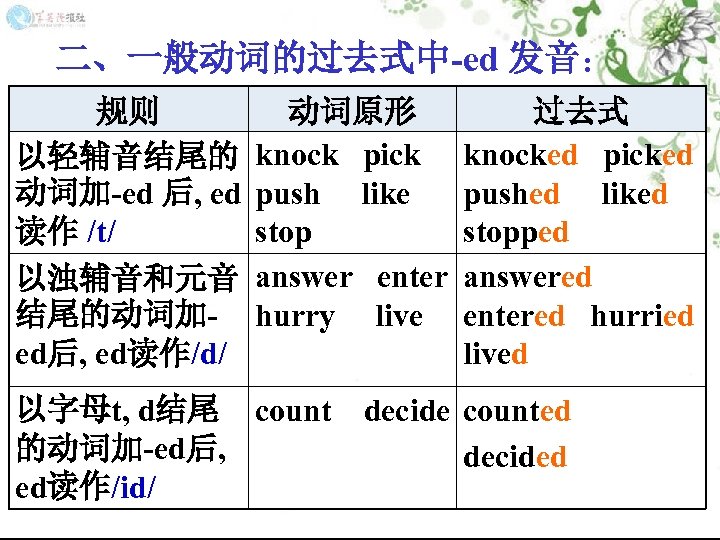 二、一般动词的过去式中-ed 发音: 规则 以轻辅音结尾的 动词加-ed 后, ed 读作 /t/ 以浊辅音和元音 结尾的动词加ed后, ed读作/d/ 动词原形 knock pick push like stop answer enter hurry live 以字母t, d结尾 count 的动词加-ed后, ed读作/id/ 过去式 knocked picked pushed liked stopped answered entered hurried lived decide counted decided
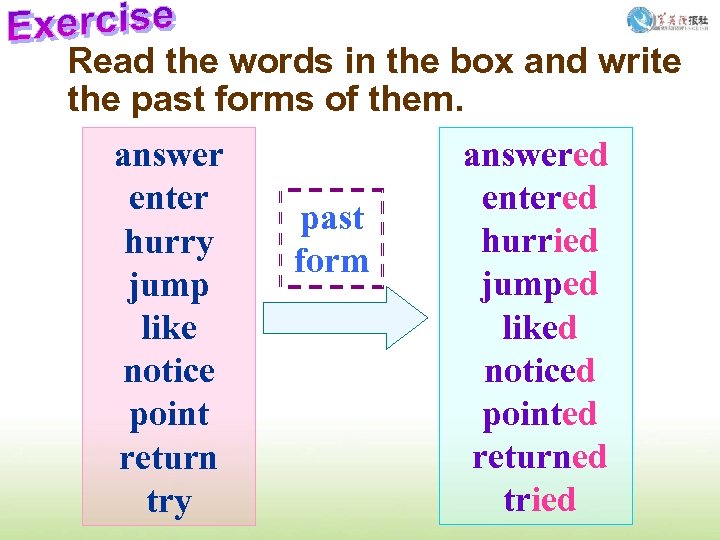 Read the words in the box and write the past forms of them. answer enter hurry jump like notice point return try past form answered entered hurried jumped liked noticed pointed returned tried
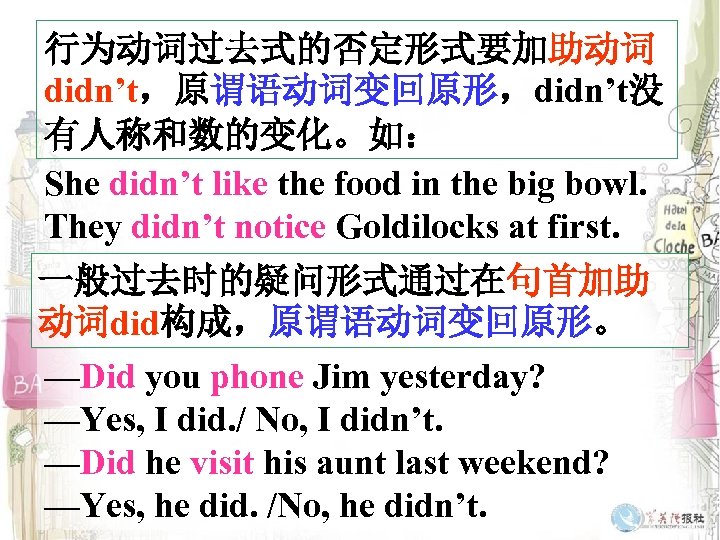 行为动词过去式的否定形式要加助动词 didn’t,原谓语动词变回原形,didn’t没 有人称和数的变化。如: She didn’t like the food in the big bowl. They didn’t notice Goldilocks at first. 一般过去时的疑问形式通过在句首加助 动词did构成,原谓语动词变回原形。 —Did you phone Jim yesterday? —Yes, I did. / No, I didn’t. —Did he visit his aunt last weekend? —Yes, he did. /No, he didn’t.
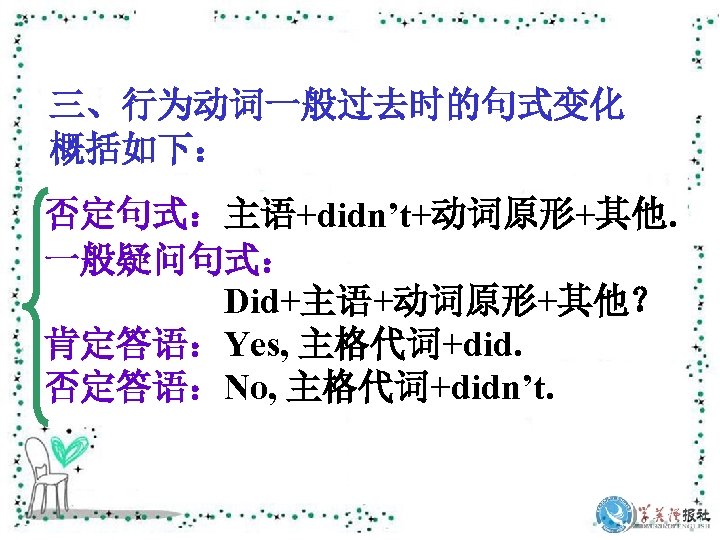 三、行为动词一般过去时的句式变化 概括如下: 否定句式:主语+didn’t+动词原形+其他. 一般疑问句式: Did+主语+动词原形+其他? 肯定答语:Yes, 主格代词+did. 否定答语:No, 主格代词+didn’t.
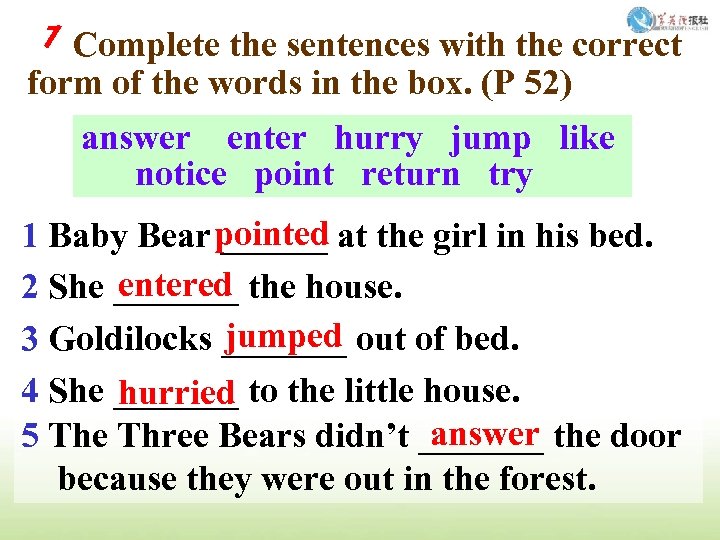 1 Complete the sentences with the correct form of the words in the box. (P 52) answer enter hurry jump like notice point return try 1 Baby Bear pointed at the girl in his bed. ______ entered 2 She _______ the house. jumped 3 Goldilocks _______ out of bed. 4 She _______ to the little house. hurried answer 5 The Three Bears didn’t _______ the door because they were out in the forest.
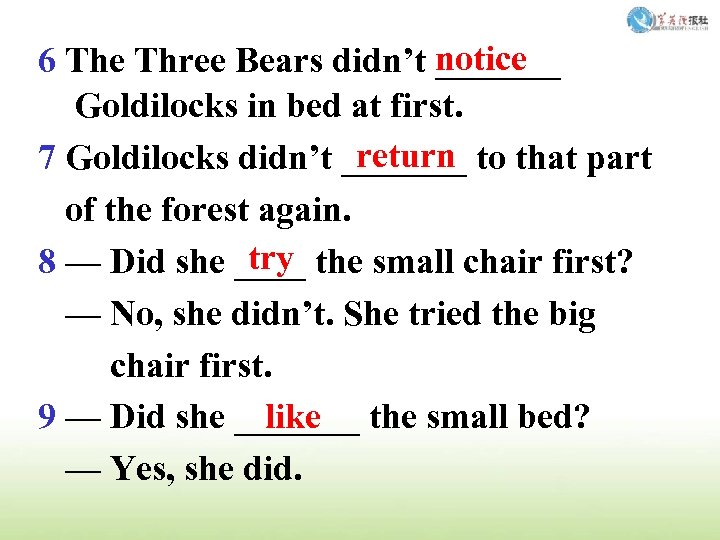 notice 6 The Three Bears didn’t _______ Goldilocks in bed at first. return 7 Goldilocks didn’t _______ to that part of the forest again. try 8 — Did she ____ the small chair first? — No, she didn’t. She tried the big chair first. like 9 — Did she _______ the small bed? — Yes, she did.
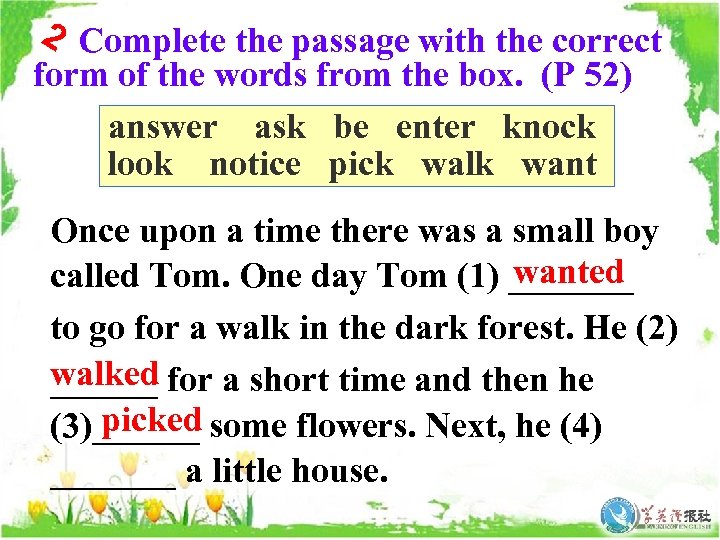 2 Complete the passage with the correct form of the words from the box. (P 52) answer ask be enter knock look notice pick walk want Once upon a time there was a small boy wanted called Tom. One day Tom (1) _______ to go for a walk in the dark forest. He (2) walked ______ for a short time and then he picked (3)______ some flowers. Next, he (4) _______ a little house.
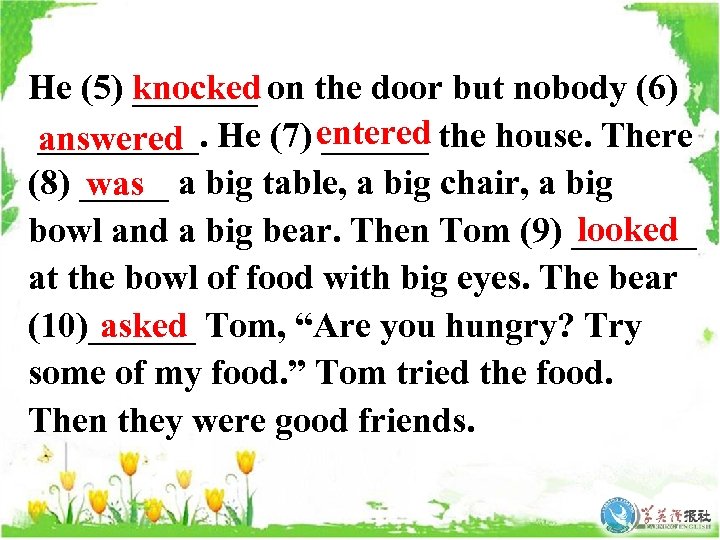 knocked He (5) _______ on the door but nobody (6) _____. He (7) entered the house. There ______ answered (8) _____ a big table, a big chair, a big was looked bowl and a big bear. Then Tom (9) _______ at the bowl of food with big eyes. The bear (10)______ Tom, “Are you hungry? Try asked some of my food. ” Tom tried the food. Then they were good friends.
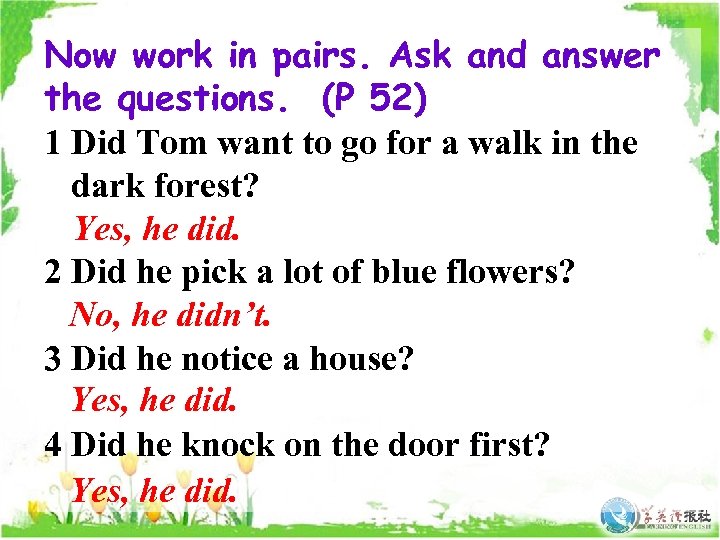 Now work in pairs. Ask and answer the questions. (P 52) 1 Did Tom want to go for a walk in the dark forest? Yes, he did. 2 Did he pick a lot of blue flowers? No, he didn’t. 3 Did he notice a house? Yes, he did. 4 Did he knock on the door first? Yes, he did.
 Telling a story
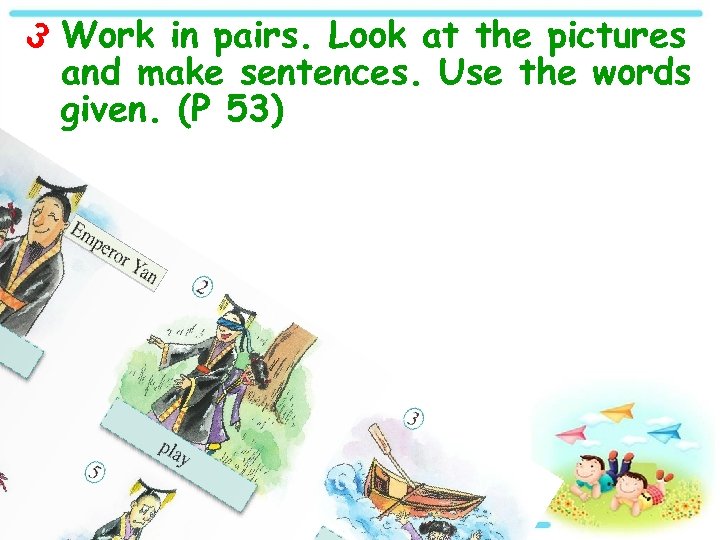 3 Work in pairs. Look at the pictures and make sentences. Use the words given. (P 53)
 4 Put the sentences together to make a story. Remember to use words like and, so, but, because, first, next, and then and finally. (P 53) Once upon a time, there was a little girl called Nüwa. Her father was Emperor Yan and he loved…
 Once upon a time there was a little girl called Nüwa. Her father was Emperor Yan and he loved his daughter. They lived in a palace. They played in the garden and were very happy. One day, Nüwa decided to go to the sea in a boat but the weather was very bad and soon the boat was in pieces.
 Nüwa jumped into the water. She tried to swim but she died. Then Nüwa changed into a bird called Jingwei and returned home to her father. The Emperor cried because Nüwa died. But he watched the bird and he was happy again. Finally, the bird decided to return to the sea and tried to fill up the sea with pebbles.
 QUIZ I. Fill in the blanks. walked 1. I _______ (walk) to school yesterday. entered 2. Lily _______ (enter) the house and saw four girls. 3. I _______ (decide) to see a movie this decided Saturday. 4. David’s grandfather died (die) three ____ years ago. arrived 5. My friend Helen _______ (arrive) in Beijing last month.
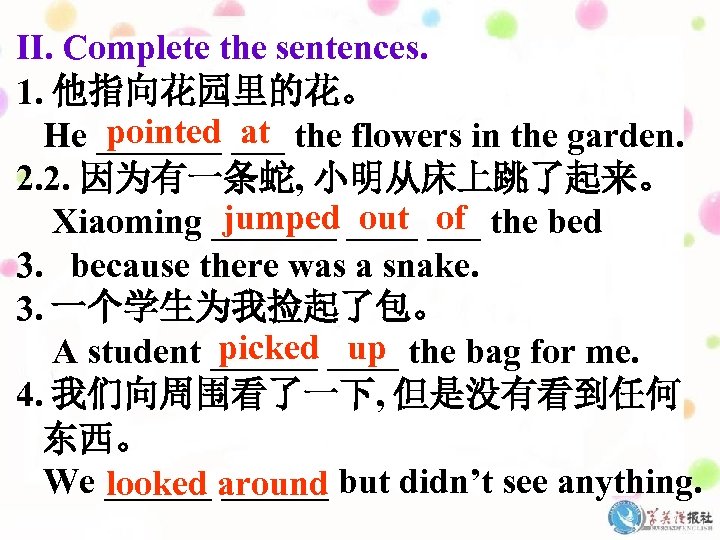 II. Complete the sentences. 1. 他指向花园里的花。 pointed at He _______ the flowers in the garden. 2. 2. 因为有一条蛇, 小明从床上跳了起来。 jumped out of Xiaoming _______ ___ the bed 3. because there was a snake. 3. 一个学生为我捡起了包。 picked up A student ______ the bag for me. 4. 我们向周围看了一下, 但是没有看到任何 东西。 We ______ around but didn’t see anything. looked ______
 1. Review the grammar we’ve learned today. 2. Finish the exercises in Learning English. 3. Preview Betty and Tony’s conversation on page 54.