Скачать презентацию Module 4 OOP in Java Script D Petin
Module 4 OOP - first touch.ppt
- Количество слайдов: 24
 Module 4: OOP in Java. Script D. Petin 06/2014
 Agenda ▪ Custom objects ▪ Constructors ▪ Context and "this" ▪ Operator "new"
 Custom Object
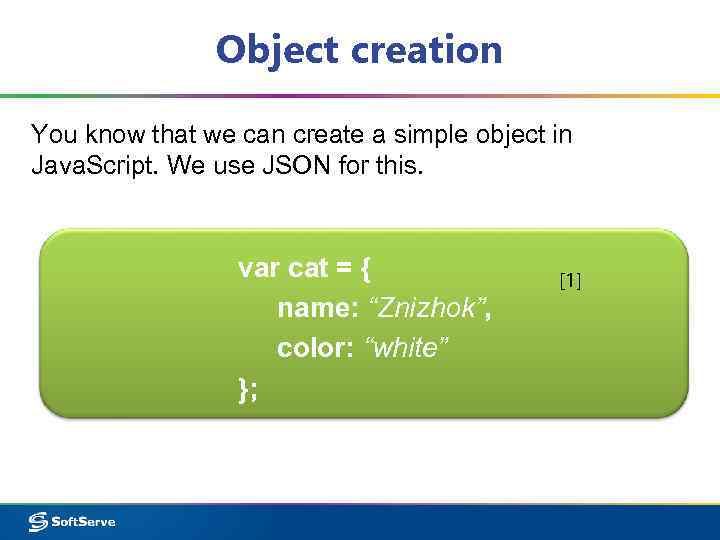 Object creation You know that we can create a simple object in Java. Script. We use JSON for this. var cat = { name: “Znizhok”, color: “white” }; [1]
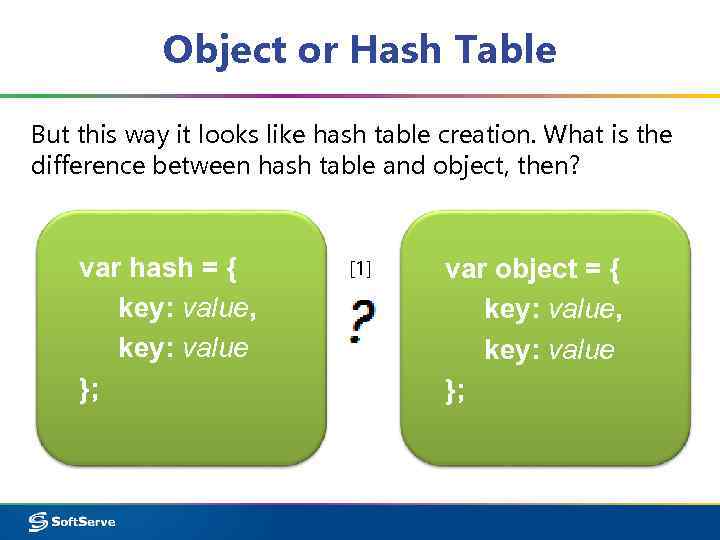 Object or Hash Table But this way it looks like hash table creation. What is the difference between hash table and object, then? var hash = { key: value, key: value }; [1] var object = { key: value, key: value };
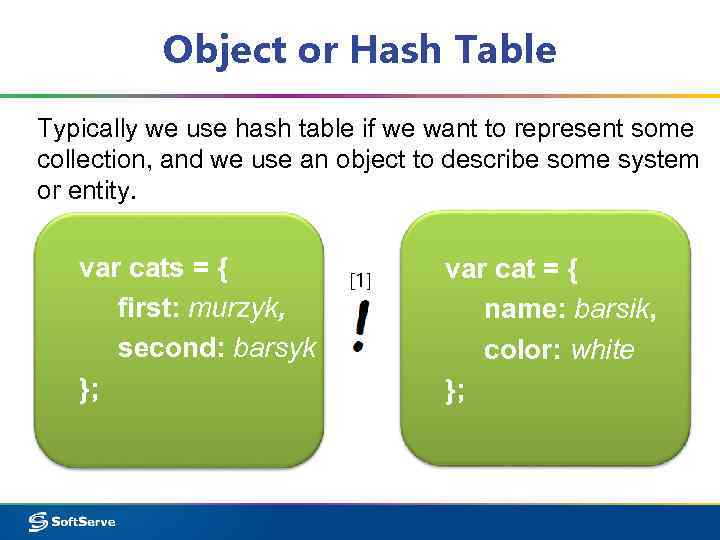 Object or Hash Table Typically we use hash table if we want to represent some collection, and we use an object to describe some system or entity. var cats = { first: murzyk, second: barsyk }; [1] var cat = { name: barsik, color: white };
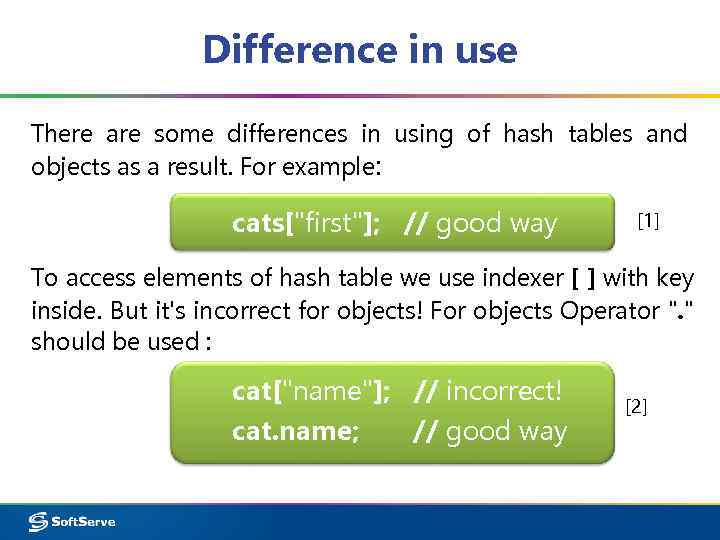 Difference in use There are some differences in using of hash tables and objects as a result. For example: cats["first"]; // good way [1] To access elements of hash table we use indexer [ ] with key inside. But it's incorrect for objects! For objects Operator ". " should be used : cat["name"]; // incorrect! cat. name; // good way [2]
 Constructors
 Constructors Sometimes we need to create more than one single object. It is not a good idea to use the literal way for this. It will be better create a scenario for objects reproducing. Constructor is a function that implements this scenario in Java. Script. Constructor consists of declaration attributes and methods that should be added into each new object with presented structure.
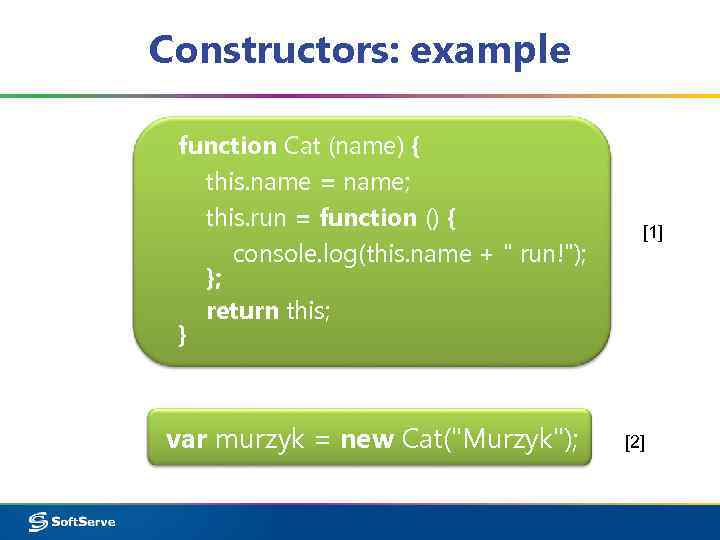 Constructors: example function Cat (name) { this. name = name; this. run = function () { console. log(this. name + " run!"); }; return this; } var murzyk = new Cat("Murzyk"); [1] [2]
 Context and "this"
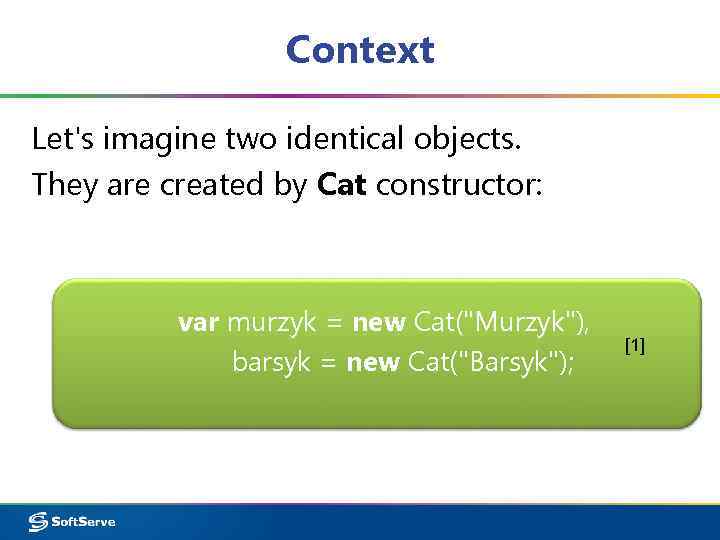 Context Let's imagine two identical objects. They are created by Cat constructor: var murzyk = new Cat("Murzyk"), barsyk = new Cat("Barsyk"); [1]
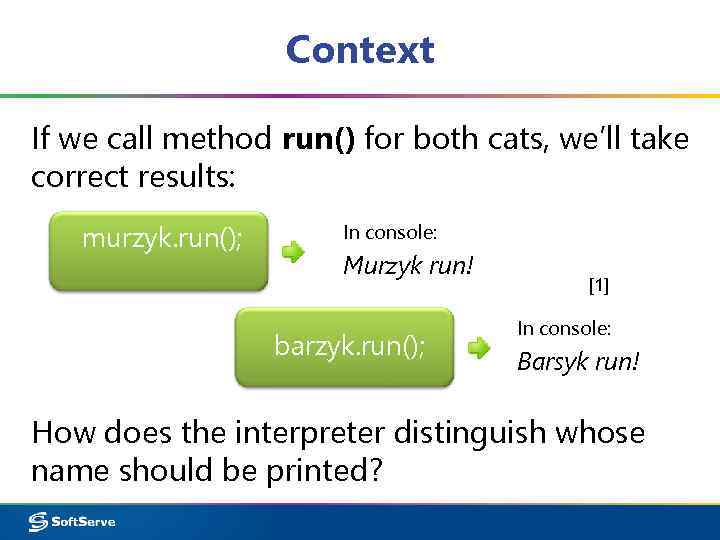 Context If we call method run() for both cats, we’ll take correct results: murzyk. run(); In console: Murzyk run! barzyk. run(); [1] In console: Barsyk run! How does the interpreter distinguish whose name should be printed?
 Context It works because we use the next form of access to attribute name: this. name. this contains inside a reference to object on whose behalf was called method run. Such a reference is called a context. The context determined automatically after the method calling and can't be changed by code.
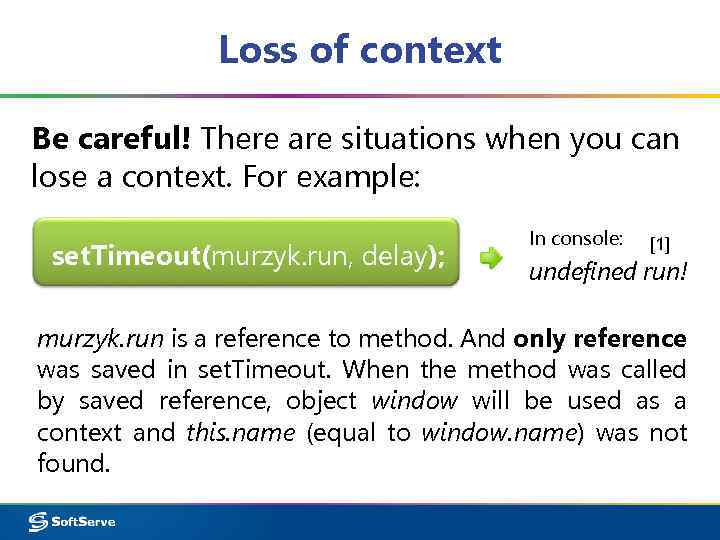 Loss of context Be careful! There are situations when you can lose a context. For example: set. Timeout(murzyk. run, delay); In console: [1] undefined run! murzyk. run is a reference to method. And only reference was saved in set. Timeout. When the method was called by saved reference, object window will be used as a context and this. name (equal to window. name) was not found.
 Operator new
![Pre-example Imagine that some abstract factory produces cars. All cars are absolutely identical: [1]](https://present5.com/presentation/11332478_411914176/image-17.jpg "Pre-example Imagine that some abstract factory produces cars. All cars are absolutely identical: [1]") Pre-example Imagine that some abstract factory produces cars. All cars are absolutely identical: [1]
Pre-example Imagine that some abstract factory produces cars. All cars are absolutely identical: [1]
 Pre-example But there are some emergency services and each of them has an own color scheme for a car: [1]
![New: scenario of work new processing has a similar scenario: [1] creation of default](https://present5.com/presentation/11332478_411914176/image-19.jpg "New: scenario of work new processing has a similar scenario: [1] creation of default") New: scenario of work new processing has a similar scenario: [1] creation of default object calling of constructor with just created [2] object context [3] modification of default object returning and saving the reference to [4] modified object [5]
New: scenario of work new processing has a similar scenario: [1] creation of default object calling of constructor with just created [2] object context [3] modification of default object returning and saving the reference to [4] modified object [5]
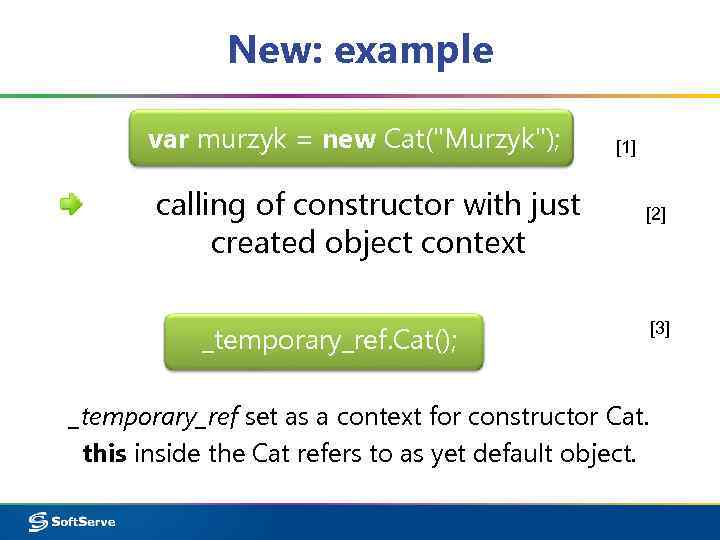 New: example var murzyk = new Cat("Murzyk"); calling of constructor with just created object context [1] [2] _temporary_ref. Cat(); _temporary_ref set as a context for constructor Cat. this inside the Cat refers to as yet default object. [3]
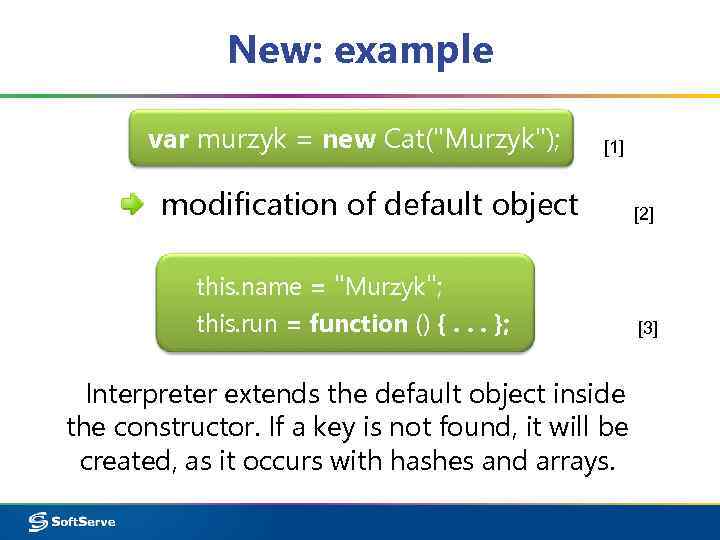 New: example var murzyk = new Cat("Murzyk"); [1] modification of default object this. name = "Murzyk"; this. run = function () {. . . }; Interpreter extends the default object inside the constructor. If a key is not found, it will be created, as it occurs with hashes and arrays. [2] [3]
![New: example var murzyk = new Cat(“Murzyk”); [1] returning and saving the reference to](https://present5.com/presentation/11332478_411914176/image-23.jpg "New: example var murzyk = new Cat(“Murzyk”); [1] returning and saving the reference to") New: example var murzyk = new Cat(“Murzyk”); [1] returning and saving the reference to modified object var murzik = _temporary_ref; At last the reference to modified object returned and saved in a user variable. [2] [3]
New: example var murzyk = new Cat(“Murzyk”); [1] returning and saving the reference to modified object var murzik = _temporary_ref; At last the reference to modified object returned and saved in a user variable. [2] [3]