


 Скачать презентацию MODULE 4 Module 4 Canadian Guidelines for the
20070e91038828584a67e7f9bc20cbdb.ppt
- Количество слайдов: 50
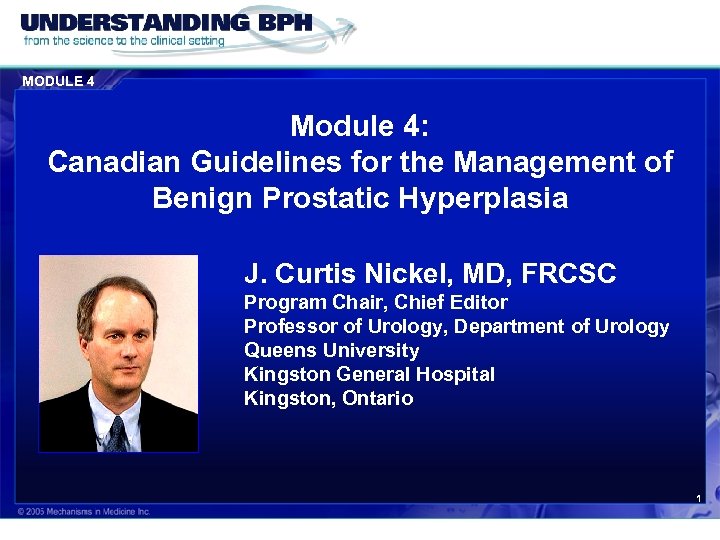 MODULE 4 Module 4: Canadian Guidelines for the Management of Benign Prostatic Hyperplasia J. Curtis Nickel, MD, FRCSC Program Chair, Chief Editor Professor of Urology, Department of Urology Queens University Kingston General Hospital Kingston, Ontario 1
 MODULE 4 4. 1 Learning Objectives y After reviewing this module, the learner will be better able to: 1. Describe the process and rationale behind the development of Canadian guidelines for BPH 2. Identify which BPH diagnostic evaluations are appropriate for Canadian men who present with LUTS 3. Describe the principles that underlie the treatment of BPH = Benign Prostatic Hyperplasia LUTS = Lower Urinary Tract Symptoms 2
 MODULE 4 y After reviewing this module, the learner will be better able to: 4. Identify which medical and surgical treatment options for BPH is appropriate for Canadian men who present with LUTS 5. Choose clinical practice tools for use in the diagnosis and treatment of Canadian men with BPH 6. Adopt best practice standards for the management of BPH within the Canadian medical environment BPH = Benign Prostatic Hyperplasia LUTS = Lower Urinary Tract Symptoms 3
 MODULE 4 4. 2 Introduction y Significant changes have occurred over the last decade in diagnostic and therapeutic approaches to BPH y BPH is a common, progressive condition experienced by aging men y The CUA and CPHC have recognized the importance of developing independent Canadian guidelines to assist the Canadian urologist and physician in the management of men with BPH = Benign Prostatic Hyperplasia CUA = Canadian Urological Association CPHC = Canadian Prostate Health Council 4
 MODULE 4 y Canadian society has profound and subtle differences from other societies with regards to: § Social priorities § Economics § Healthcare management § Manpower issues § Medicolegal considerations § Clinical practice trends y These differences warrant the development of BPH guidelines customized for the Canadian medical environment BPH = Benign Prostatic Hyperplasia 5
 MODULE 4 y These joint guidelines refer to the typical patient over 50 years of age who presents with BPO and associated LUTS y Men with non-BPO-associated LUTS will require a more extensive diagnostic workup and different treatment considerations y The 2005 Canadian Guidelines for the Management of Benign Prostatic Hyperplasia are the first clinical practice guidelines on BPH specifically developed for the Canadian physician y As the management of BPH continues to evolve, these guidelines will be critically reviewed and updated BPO = Benign Prostatic Obstruction; LUTS = Lower Urinary Tract Symptoms; BPH = Benign Prostatic Hyperplasia 6
 MODULE 4 4. 3 Methodology y The Canadian BPH guidelines were developed as a collaborative effort between the CUA Guidelines Committee and the Canadian Prostate Health Council (CPHC). These guidelines are an evidence-based consensus of the joint committee members. BPH = Benign Prostatic Hyperplasia CUA = Canadian Urological Association 7
 MODULE 4 y The joint committee reviewed: § BPH guidelines from the AUA 1, 2, the EUA 3, 4, the WHO International Consultation on BPH 5, and similar committees from Germany, Sweden, and Australia § A systematic literature search (updated to May 2004), data abstraction, and analyses that were prepared for the AUA and EAU BPH guidelines committees § A Canadian report 6 that reviewed Canadian urological opinion of the 2003 AUA BPH guidelines BPH = Benign Prostatic Hyperplasia; AUA = American Urology Association EUA = European Urology Association; WHO = World Health Organization 1. Mc. Connell JD et al. Agency for Health Care Policy and Research, Public Health Service, No. 94 -0582, 1994. 2. AUA Guidelines on management of BPH (2003). J Urol. 2003; 170: 530 -547. 3. de la Rosette JJM et al. Euro Urol. 2001; 40: 256 -263. 4. Madersbacher S et al. Euro Urol. 2004; 46(5): 547 -554. 5. Chatelain C et al. In: Proceedings of the 5 th International Consultation on BPH. United Kingdom: Health Publications Ltd. 2001: 519 -534. 6. Nickel JC & Saad J. Can J Urol. 2004; 11: 2186 -2193. 8
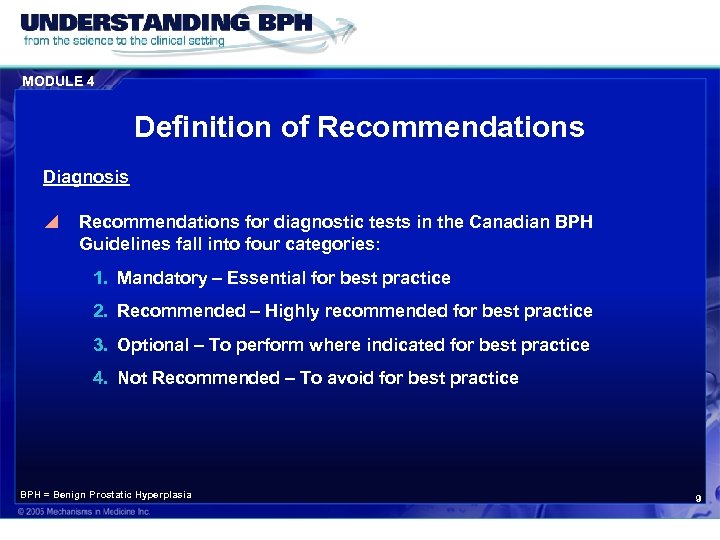 MODULE 4 Definition of Recommendations Diagnosis y Recommendations for diagnostic tests in the Canadian BPH Guidelines fall into four categories: 1. Mandatory – Essential for best practice 2. Recommended – Highly recommended for best practice 3. Optional – To perform where indicated for best practice 4. Not Recommended – To avoid for best practice BPH = Benign Prostatic Hyperplasia 9
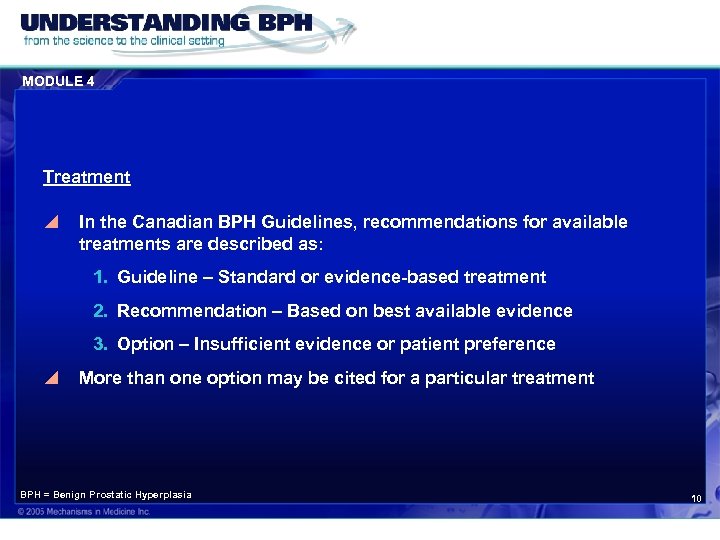 MODULE 4 Treatment y In the Canadian BPH Guidelines, recommendations for available treatments are described as: 1. Guideline – Standard or evidence-based treatment 2. Recommendation – Based on best available evidence 3. Option – Insufficient evidence or patient preference y More than one option may be cited for a particular treatment BPH = Benign Prostatic Hyperplasia 10
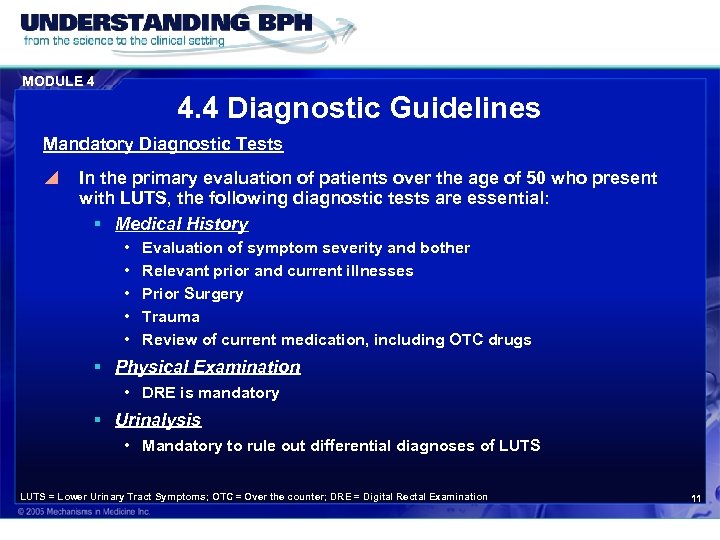 MODULE 4 4. 4 Diagnostic Guidelines Mandatory Diagnostic Tests y In the primary evaluation of patients over the age of 50 who present with LUTS, the following diagnostic tests are essential: § Medical History • • • Evaluation of symptom severity and bother Relevant prior and current illnesses Prior Surgery Trauma Review of current medication, including OTC drugs § Physical Examination • DRE is mandatory § Urinalysis • Mandatory to rule out differential diagnoses of LUTS = Lower Urinary Tract Symptoms; OTC = Over the counter; DRE = Digital Rectal Examination 11
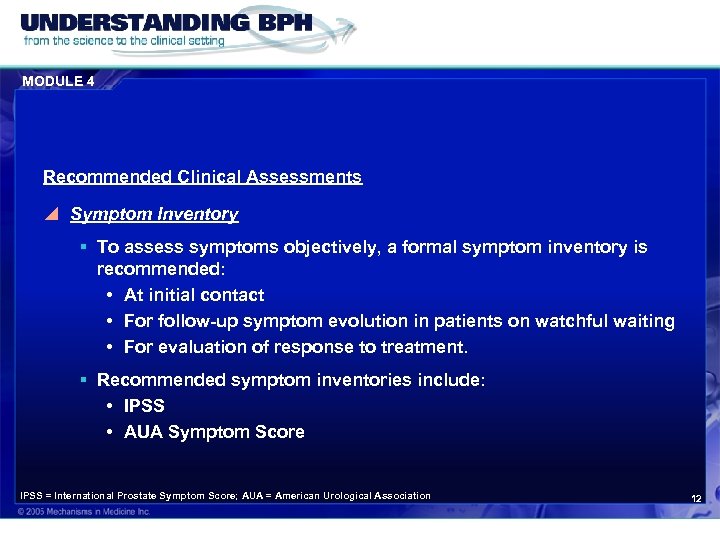 MODULE 4 Recommended Clinical Assessments y Symptom Inventory § To assess symptoms objectively, a formal symptom inventory is recommended: • At initial contact • For follow-up symptom evolution in patients on watchful waiting • For evaluation of response to treatment. § Recommended symptom inventories include: • IPSS • AUA Symptom Score IPSS = International Prostate Symptom Score; AUA = American Urological Association 12
 MODULE 4 Recommended Clinical Assessments y Prostate Specific Antigen § PSA testing should be offered to selected patients, specifically: • Patients with ≥ 10 years life expectancy • Patients for whom the presence of prostate cancer may change management • Patients for whom PSA measurement may change the management of voiding symptoms (estimate for prostate volume) PSA = Prostate-Specific Antigen 13
 MODULE 4 Optional Diagnostic Tests y The Canadian BPH guidelines state that it is reasonable to proceed with one or more of the following diagnostic tests, where the physician feels the test(s) is (are) indicated: § Serum Creatinine § Uroflow § Voiding Diary § Post-Void Residual § Sexual function questionnaire BPH = Benign Prostatic Hyperplasia 14
 MODULE 4 Not Recommended y The Canadian BPH guidelines do not recommend the following tests in the routine evaluation of a typical patient with BPH-associated LUTS: § Cystoscopy § Cytology § Urodynamics § Radiological evaluation of upper urinary tract § Prostate ultrasound § Prostate biopsy BPH = Benign Prostatic Hyperplasia; LUTS = Lower Urinary Tract Symptoms 15
 MODULE 4 4. 5 Treatment Guidelines Principles of Treatment y According to the Canadian BPH guidelines, the treatment choices should be governed by: § Severity of symptoms § Extent of Bother § Patient preference BPH = Benign Prostatic Hyperplasia 16
 MODULE 4 Principles of Treatment y Treatment decisions depend on patients being sufficiently informed about treatment options and the consequences of such treatments y Even with severe symptoms, a patient may choose a less effective but less risky therapy. This may often conflict with professional urological opinion y Where possible, expect in the case of an absolute indication for surgery, the choice of treatment should be based on the joint decision of both the patient and physician 17
 MODULE 4 Principles of Treatment y Guideline § Physicians should explain information on the benefits and harms of treatment option for BPH to all patients who are bothered enough to consider therapy § Patients should be invited to participate as much as possible in the treatment choice y Recommendation § Patients with mild symptoms (e. g. IPSS ≤ 8) should be counseled about a combination of lifestyle modification and watchful waiting § Patients with mild symptoms and severe bother should undergo further assessment BPH = Benign Prostatic Hyperplasia; IPSS = International Prostate Symptom Score 18
 MODULE 4 Principles of Treatment y Option § Treatment options for patients with bothersome, moderate (e. g. , IPSS 8– 18) and severe (e. g. , IPSS 19– 35) symptoms of BPH include: • Watchful waiting and lifestyle modification • Medical therapy • Minimally invasive therapy • Surgical therapies IPSS = International Prostate Symptom Score; BPH = Benign Prostatic Hyperplasia 19
 MODULE 4 Treatment Options y Watchful Waiting includes: § Lifestyle modification y Medical Therapy includes: § α-blockers § 5α-reductase inhibitors § Combination therapy § Phytotherapy 20
 MODULE 4 Treatment Options y Surgical § Invasive Surgical Options: • Transurethral Resection of the Prostate (TURP) • Transurethral Incision of the Prostate (TUIP) • Open prostatectomy • Laser prostatectomy 21
 MODULE 4 Treatment Options y Surgical § Minimally invasive surgical therapies: • Transurethral Microwave Therapy (TUMT) • Transurethral Needle Ablation (TUNA) • Stents • Not Currently Recommended – Balloon dilation – Absolute ethanol injection – High intensity focused ultrasound – Interstitial laser coagulation – Water-induced thermal therapy – Plasma kinetic tissue management system 22
 MODULE 4 Lifestyle Modifications With Watchful Waiting y Recommendations § Patients on watchful waiting should be monitored periodically by their physician y Option § Physicians can use the following information* to advise patients on their individual risk of symptom progression, AUR, or BPHrelated surgery: • • Baseline Age Severity of LUTS Prostate Volume Serum PSA *These risk factors identify those at risk for progression of BPH (e. g. increasing value = increasing risk of progressive symptom deterioration, need for eventual surgery or the risk for AUR) 23
 MODULE 4 Lifestyle Modifications With Watchful Waiting y Option § For patients without bothersome symptoms, physicians may suggest a variety of lifestyle modifications, including: • Fluid restriction • Avoiding irritative food and drink (e. g. spicy foods, caffeine, alcohol) • Avoiding or monitoring the effects of certain drugs (e. g. diuretics, decongestants, antihistamines, antidepressants) • Bladder retraining (i. e. organized, or timed-voiding) • Pelvic floor exercises • Avoiding or treating constipation 24
 MODULE 4 Medical Treatment: α-Adrenergic Receptor Blockers y Option § Four α-adrenergic receptor blockers are considered appropriate treatment options for patients with BPH-associated LUTS: • Alfuzosin • Doxazosin • Tamsulosin • Terazosin BPH = Benign Prostatic Hyperplasia; LUTS = Lower Urinary Tract Symptoms 25
 MODULE 4 Medical Treatment: α-Adrenergic Receptor Blockers y Recommendation § Although α-adrenergic receptor blockers have different adverseevent profiles, the joint committee believes that all four agents have equivalent clinical efficacy. The choice of drug depends on the: • Patient’s comorbidities • Side-effect profile • Tolerance of agent y Guideline § Prazosin is not recommended for the medical treatment of BPH in Canada 26
 MODULE 4 Medical Treatment: 5α-Reductase Inhibitors y Option § In men whose LUTS is associated with demonstrable prostatic enlargement, * the following 5α-reductase inhibitors are considered appropriate, effective treatments: • Finasteride • Dutasteride y Guideline § The 5α-reductase inhibitors are not appropriate therapy for men with LUTS and no clinical evidence of prostatic enlargement *In patients without prostate cancer, the PSA value may provide a useful estimate of prostate size. LUTS = Lower Urinary Tract Symptoms 27
 MODULE 4 Medical Treatment: Combination Therapy y Option § Combination therapy with an α-adrenergic receptor blockers and 5α-reductase inhibitor is appropriate and effective for men with LUTS and demonstrable prostatic enlargement* y Option § After 6 to 12 months, patients who have been successfully treated with combination therapy may opt to discontinue the α -adrenergic receptor blocker. If symptoms recur, the prescription of this medication can be renewed *In patients without prostate cancer, the PSA value may provide a useful estimate of prostate size. LUTS = Lower Urinary Tract Symptoms 28
 MODULE 4 Medical Treatment: Phytotherapy y Option § Further evidence is required before phytotherapy or other supplements can be recommended as standard therapy for BPHassociated LUTS. However, the following substances appear to be safe for use in this group of patients: • Saw palmetto berry extract • Pygeum africanum § Physicians may counsel interested patients with BPH-associated LUTS that these plant extracts have shown some efficacy in small, but unconvincing studies. y Guideline § Phytotherapy and other dietary supplements cannot be recommended as standard therapy for BPH at this time LUTS = Lower Urinary Tract Symptoms; BPH = Benign Prostatic Hyperplasia 29
 MODULE 4 Surgery: Transurethral Resection of the Prostate (TURP) y Option § TURP should be considered as the gold standard for patients with bothersome moderate or severe LUTS: • Who request active treatment • Who fail medical therapy • Who do not want medical therapy § Patients should be informed of the potential short- and long-term complications of TURP LUTS = Lower Urinary Tract Symptoms 30
 MODULE 4 Surgery: Transurethral Resection of the Prostate (TURP) y Guideline § Absolute indications for TURP include: • Failure of medical therapy • Intractable urinary retention • Renal insufficiency (caused by BPO) § Relative indications of TURP include: • Recurrent cystitis • Bladder calculi • Persistent prostatic bleeding BPO=Benign Prostatic Obstruction 31
 MODULE 4 Surgery: Transurethral Incision of the Prostate (TUIP) y Option § Appropriate for men with prostate glands of <30 grams § Similar results as TURP, but with a lower incidence of retrograde ejaculation. TURP = Transurethral Resection of the Prostate 32
 MODULE 4 Surgery: Transurethral Electrovaporization of the Prostate (TUVP) y Option § TUVP is an alternative to TURP and TUIP § The short-term results of TUVP are comparable to TURP, particularly in men with small prostates § Patients experience a higher incidence of irritative symptoms, dysuria, and urinary retention § Few long-term studies are available TURP = Transurethral Resection of the Prostate; TUIP = Transurethral Incision of the Prosatate 33
 MODULE 4 Surgery: Laser Prostatectomy y Option § Performed with a variety of lasers (YAG; KTP; Holmium: YAG) and delivery systems (end-firing; side-firing; interstitial) § Used mainly for prostatic tissue coagulation or vaporization/ablation § Each laser has particular characteristics and potential advantages § Holmium Laser Enucleation (HOLEP) has been used effectively on larger glands. This procedure has a reduced duration of hospitalization, bleeding, and catheterization 34
 MODULE 4 Minimally Invasive Surgical Therapies (MIST): Transurethral Microwave Therapy (TUMT) y Option § Reasonable choice for patients with: • moderate symptoms • small to moderately sized prostate glands • desire to avoid more invasive therapy § Potentially less effective results 35
 MODULE 4 Minimally Invasive Surgical Therapies (MIST): Transurethral Needle Ablation (TUNA) y Option § Reasonable option for relief of symptoms in younger men for whom sexual function is an important quality-of-life issue § Procedure has less risk of retrograde ejaculation § Limited data available on long-term outcomes 36
 MODULE 4 Minimally Invasive Surgical Therapies (MIST): Stents y Guideline § Stents are not recommended as standard therapy for BPHassociated LUTS y Option § Either temporary or permanent, may be considered in men with severe urinary obstruction, secondary to BPH, who are medically unfit for surgery or MIST BPH = Benign Prostatic Hyperplasia; LUTS = Lower Urinary Tract Symptoms 37
 MODULE 4 Other Minimally Invasive Surgical Therapies (MIST): y The following obsolete or evolving MIST are not recommended as standard therapy at this time: § Balloon dilatation § Absolute ethanol injection § High-intensity focused ultrasound § Water-induced thermotherapy § Plasma kinetic tissue management systems 38
 MODULE 4 Special Situations: Symptomatic Prostatic Enlargement Without Bother y Option § Patients with this condition may be offered a 5α-reductase inhibitor to prevent progression of BPH § Physician and patient should discuss the disadvantages of treatment and the need for long-term, daily therapy in relation to the individual’s risk of progression BPH = Benign Prostatic Hyperplasia 39
 MODULE 4 Special Situations: Acute Urinary Retention (AUR) y Option § Men with AUR may be offered a catheter-free trial at 2 -7 days after catheterization § The use of an α-adrenergic receptor blocker before and after catheter removal is considered as reasonable § If voiding trials fail, the patient should be considered for more invasive therapy 40
 MODULE 4 Special Situations: BPH-related Bleeding y Guideline § Before BPH is confirmed as the source of BPH-related bleeding, all other potential causes of bleeding must be excluded y Option § In men with BPH-related hematuria, a trial of 5α-reductase inhibitors is appropriate § If bleeding persists, surgery is recommended BPH = Benign Prostatic Hyperplasia 41
 MODULE 4 Special Situations: BPH with Chronic Prostatitis Symptoms y Option § In the absence of infection, the use of the following medical therapies may be considered in patients with BPH and prostatitislike symptoms: • α-adrenergic receptor blockers • 5α-reductase inhibitors • Combination therapy (α-adrenergic receptor blocker and 5α-reductase inhibitors) • Anti-inflammatory agents BPH = Benign Prostatic Hyperplasia 42
 MODULE 4 Special Situations: BPH Patients with Concerns About Prostate Cancer y Option § Physicians may counsel BPH patients who are concerned about prostate cancer on the evidence-based benefits of using a 5α-reductase inhibitor to reduce the risk of prostate cancer § As part of this discussion, physicians should advise patients about the low potential risk of developing high-grade prostate cancer while taking these agents BPH = Benign Prostatic Hyperplasia 43
 MODULE 4 4. 6 Clinical Tools y This section contains several tools for use in daily clinical practice, including: § IPSS – International Prostate Symptom Score and diseasespecific Qo. L questionnaire (equivalent to the AUA Symptom Score) § BPH Impact Index § AUA simplified outcome tables § Canadian BPH Guideline tables and algorithms y These clinical tools act as practical aids for the diagnosis and treatment of BPH. They may be used to assess symptoms or guide treatment strategies y Clinical Tools are available in the download section Qo. L= Quality of Life; AUA = American Urological Association; BPH = Benign Prostatic Hyperplasia 44
 MODULE 4 4. 7 Quiz 1. Which of the following evaluations is considered mandatory in the primary evaluation of a man ≥ 50 years of age who presents with LUTS? a) Residual PVR b) PSA measurement c) DRE (Correct) d) Serum creatinine LUTS = Lower Urinary Tract Symptoms; PVR = Post-Void Residual Volume PSA = Prostate-Specific Antigen; DRE = Digital Rectal Examination 45
 MODULE 4 2. In a patient with a small prostate, which of the following treatment plans is recommended for patients with mild symptoms (IPSS ≤ 7)? a) Watchful waiting (Correct) b) α-blockers c) 5α-reductase inhibitors d) Combination therapy IPSS = International Prostate Symptom Score 46
 MODULE 4 3. Which of the following treatments can alter the underlying pathology of BPH and shrink the prostate? a) TUNA b) 5α-reductase inhibitors (Correct) c) α-blockers d) Phytotherapy BPH = Benign Prostatic Hyperplasia; TUNA = Transurethral Needle Ablation 47
 MODULE 4 4. When counseling a patient who wants to pursue phytotherapy, which of the following supplements are appropriate to recommend? a) Black cohosh b) Palmetto berry extract (Correct) c) Vitamin K d) Pyreum americanus 48
 MODULE 4 5. Which of the following treatment plans is an appropriate and effective treatment for men with LUTS and demonstrable prostatic enlargement? a) watchful waiting b) α-blockers c) 5α-reductase inhibitors d) combination therapy e) all of the above (Correct) LUTS = Lower Urinary Tract Symptoms 49
 MODULE 4 6. Which of the following symptoms is an absolute indication for surgery? a) Prostate size ≥ 30 g b) Recurrent cystitis c) Intractable urinary retention (Correct) d) PSA ≥ 10 ng/m. L PSA = Prostate Specific Antigen 50