 Скачать презентацию Module 3 Risky Business Relating risk to hazard
mod3_pptx (1).pptx
- Количество слайдов: 36



Module 3: Risky Business Relating risk to hazard SMS BASICS FOR PUBLIC SERVICE AVIATION
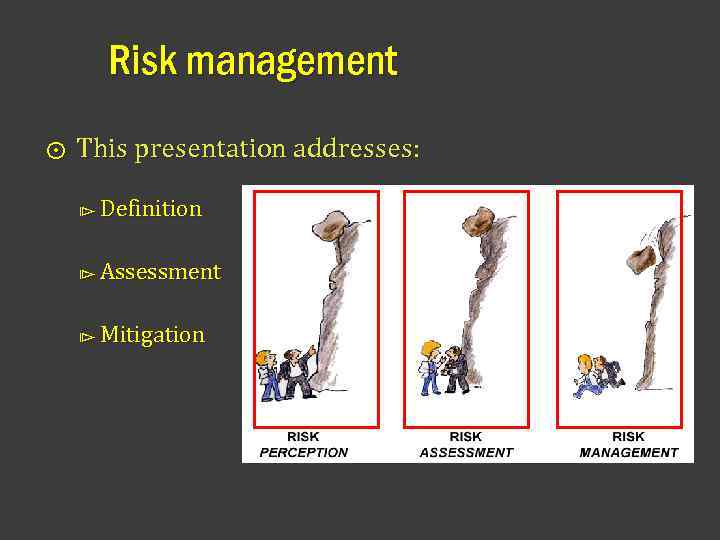
Risk management ⨀ This presentation addresses: ⧐ Definition ⧐ Assessment ⧐ Mitigation
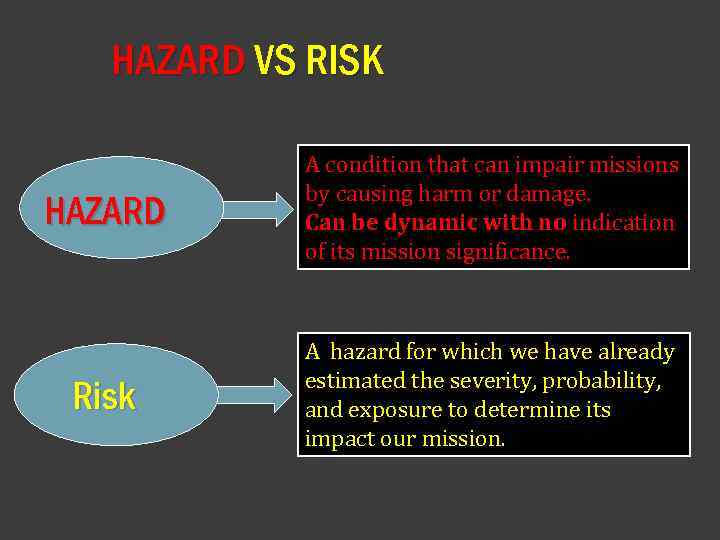
HAZARD VS RISK HAZARD A condition that can impair missions by causing harm or damage. Can be dynamic with no indication of its mission significance. Risk A hazard for which we have already estimated the severity, probability, and exposure to determine its impact our mission.
Risk Management Theory: ⨀ Risk is an expression that represents both the likelihood of an event occurring and the expected damages if it does occur. ⨀ Exposure is frequently the biggest single factor in risk calculations. ⧐ Example: How often do you plan on checking for power by sticking your finger in the light socket? ⧐ Exposure in terms of flight in bad weather, etc.
Risk Management Theory: ⨀ 1. 2. 3. Aviation Risk management is based on a few simple ideas: Always a degree of risk. We cannot eliminate all risk. The level at which risk management decisions are made. You must elevate risk management decisions. ⧐ Decisions on whether or not to accept a risk should be based on the magnitude of the risk and the benefits of accepting it.
Basic Risk Assessment Knowledge Base ⨀ ORGANIZATION: Must maintain a “safety balanced ” aviation unit. Ensure programs sustain proactive safety. ⨀ LINE MANAGEMENT: Must have knowledge of the human factors, and risks, and maintain leadership of crews. ⨀ CREWS: Must maintain their own flight skills sets and have an understanding of human factors. Proper judgment and awareness for “Aeronautical Decision Making” (ADM).
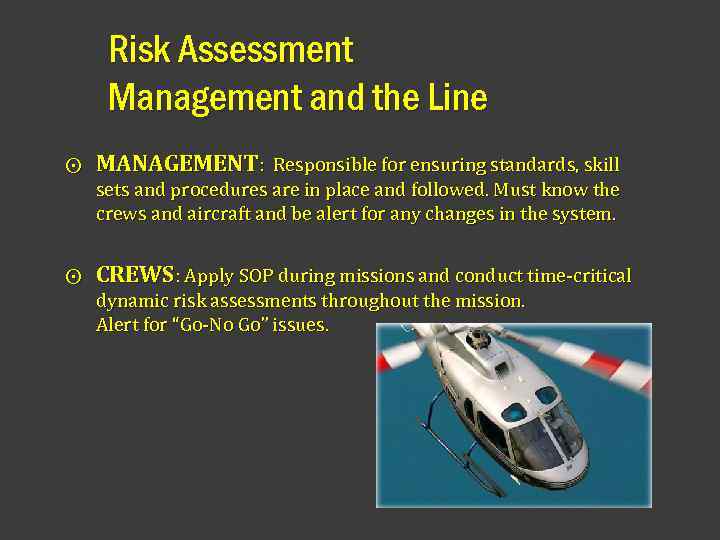
Risk Assessment Management and the Line ⨀ MANAGEMENT: Responsible for ensuring standards, skill sets and procedures are in place and followed. Must know the crews and aircraft and be alert for any changes in the system. ⨀ CREWS: Apply SOP during missions and conduct time-critical dynamic risk assessments throughout the mission. Alert for “Go-No Go” issues.
Risk Assessment is Dynamic ⨀ All missions or tasks have risks ⨀ Calculated Risk Assessment: determines benefits AND risks “ Is it worth doing this considering the risk potential? ” ⨀ When in doubt : Err on the side of safety ⨀ Know the limitations of: ⧐ Crews ⧐ Mission ⧐ Human Factors ⧐ Hardware Limitations (Systems, Aircraft, etc. )
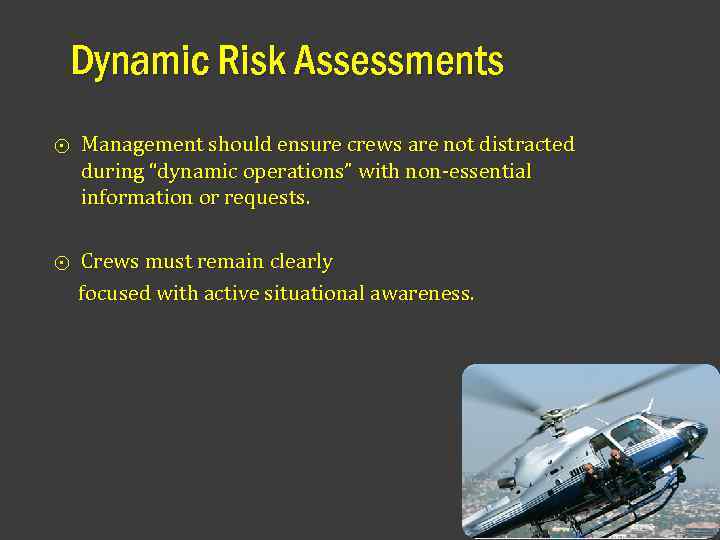
Dynamic Risk Assessments ⨀ Management should ensure crews are not distracted during “dynamic operations” with non-essential information or requests. ⨀ Crews must remain clearly focused with active situational awareness.
Risk Value Judgments Line Management Considerations At some stage organizational values , pressures and subjective judgments may enter the decision making process. ⨀ Consider: ⧐ The importance of the estimated risk. ⧐ What crews are best suited for the mission. ⧐ Query the crew (and senior crews. ) ⧐ Associated social, environmental, economic issues. ⧐ Potential cost of acting vs. not acting. ⧐ Future implications. ⧐ Effects on the missions to support the troops. ⧐ What risk will you be accountable for? ⧐ What risk will those take that you represent? ⨀
Line Management Challenges Risk Assessment Quickness to comply with command requests. ⨀ Unexpected “missions” from Department Command. ⨀ ⧐ SAR flights. ⧐ Security, urgent tactical Missions. ⧐ Special “now” operations. Failure to advise High Command of need to examine ops risk… “ Let me get back to you. ” ⨀ Failure to query line crews who must take the mission. ⨀ Line Management must be the initial filter of risk assessment for the crews. ⨀
Four Principles of Risk Management ⨀ 1. ACCEPT NO UNNECESSARY RISK ⧐ All ‘acceptable’ risks must provide an opportunity for greater benefit. ⧐ All necessary risk must be accepted. ⨀ 2. MAKE RISK DECISIONS AT THE APPROPRIATE LEVEL ⧐ Establish clear accountability. ⧐ Risks assumed at the resource level to reduce risk. PO LIC E
Four Principles of Risk Management ⨀ 3. ACCEPT RISK WHEN BENEFITS OUTWEIGH COSTS ⧐ Benefits must out-weight costs. ⧐ Benefit v. Cost can be very subjective! ⨀ 4. INTEGRATE OPERATIONAL RISK MANAGEMENT AT ALL LEVELS OF OPERATION ⧐ Manage risk during planning stages. ⧐ Early risk management enables ORM principals. PO LIC E
Factors in Risk Management STEPS IN RISK MANAGEMENT: 1. Identify risks 2. Evaluate probability and severity of each risk. 3. Find ways to control or reduce each risk. 4. Decide to accept or reject each risk.
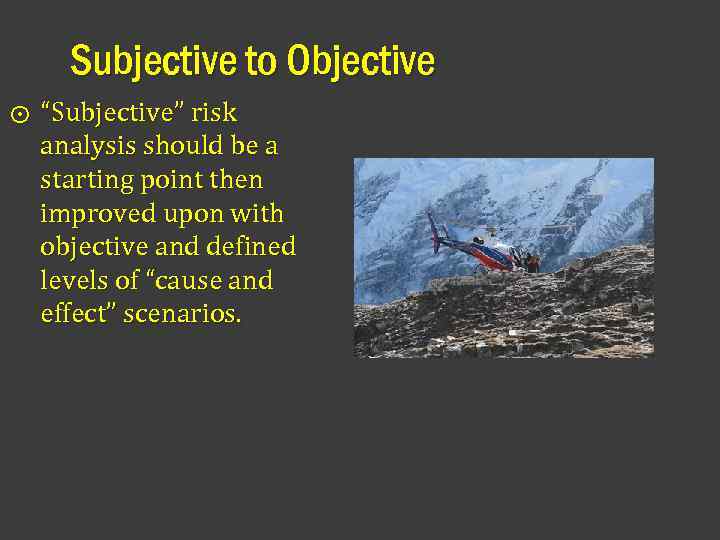
Subjective to Objective ⨀ “Subjective” risk analysis should be a starting point then improved upon with objective and defined levels of “cause and effect” scenarios.
Basics of Aviation Risk Management REVIEW: ⨀Key Points in Aviation Risk Management: ⧐ In every activity, there is some degree of risk. ⧐ We cannot eliminate all risk. ⧐ Elevate all decisions about risk to the level of management. • Decisions to accept or reject a risk should be based on the frequency of the risk and the benefits of accepting it.
Specific Responsibilities ⨀ Ultimately, after a proper risk/hazard assessment the line manager decides how to reduce or avoid each risk, based on two factors: 1. The magnitude of each risk 2. The benefits of accepting each risk. ⨀ A management decision must be made whether to accept each risk, or cancel a flight due to risk overload. ⨀ Based on policy and SOP of risk/hazard the PIC or Crew then conducts an operational risk analysis and has the final authority on go-no or to abort an ongoing operation. Note: Intimation to accept a mission is a risk and hazard in itself.
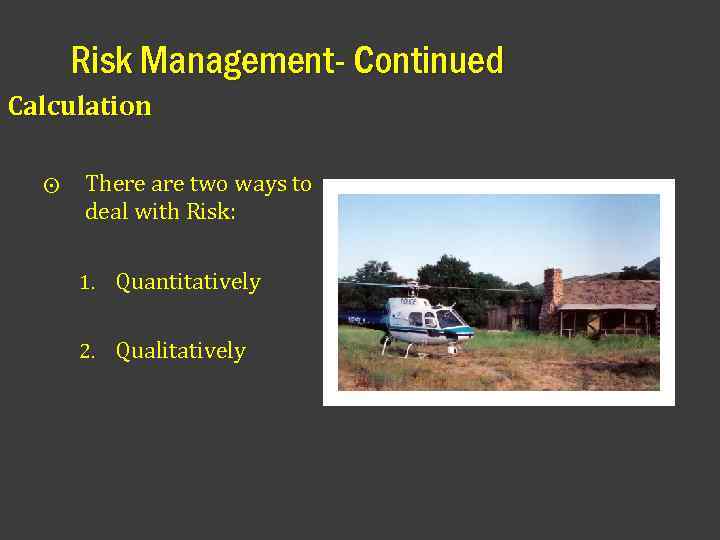
Risk Management- Continued Calculation ⨀ There are two ways to deal with Risk: 1. Quantitatively 2. Qualitatively
Risk Management- Continued Calculation ⨀ Quantitative Risk Management: ⧐ Predicts frequency of occurrence and anticipated losses are calculated for a twelve month period and displayed as an annual loss estimate (ALE). ⧐ Puts risk in terms management can understand; money. ⧐ Time consuming process and is never precisely accurate.
Risk Management- Continued Calculation ⨀ Qualitative Risk Management: ⧐ ⧐ Easier to use and depends on adjectives to describe various levels of probability and severity. This method has been around for a long time. Could be difficult to sell to management. Can be a bit subjective.
Assessing The Risks SEVERITY MATRIX: ⨀ CATASTROPHIC – Complete mission failure, death, or loss of system. ⨀ CRITICAL – Major mission degradation, severe injury, occupational illness or major system damage. ⨀ MODERATE – Minor mission degradation or injury, minor occupational illness, or minor system damage. ⨀ NEGLIGIBLE – Very minimal mission degradation, injury, occupational illness, or minor system damage.
Assessing The Risks PROBABILITY MATRIX: ⨀ FREQUENT – Individual/Item. Occurs often in career/equipment service life. Everyone is exposed. Situation is experienced continually. ⨀ LIKELY – Individual/Item. Occurs several times in career/equipment life. All members exposed. Occurs regularly. ⨀ OCCASIONALLY – Individual/Item. Occurs sometime in career/equipment service life. All members exposed. Occurs sporadically, in inventory/service life. ⨀ SELDOM – Individual/Item. Can occur during career/equipment life. All members exposed. Remote chance of occurrence; may occur during the inventory service life. ⨀ UNLIKELY – Individual/Item. Can assume this will not occur in career/equipment service life. All members still exposed. Possible, but improbable; occurs very rarely.
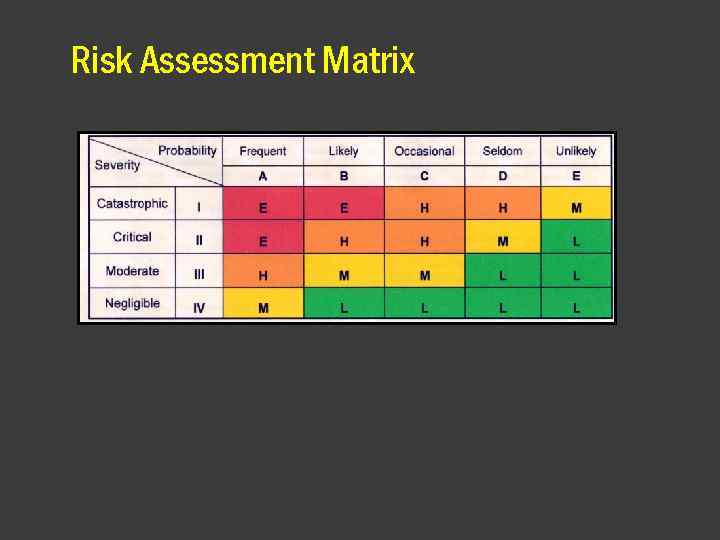
Risk Assessment Matrix
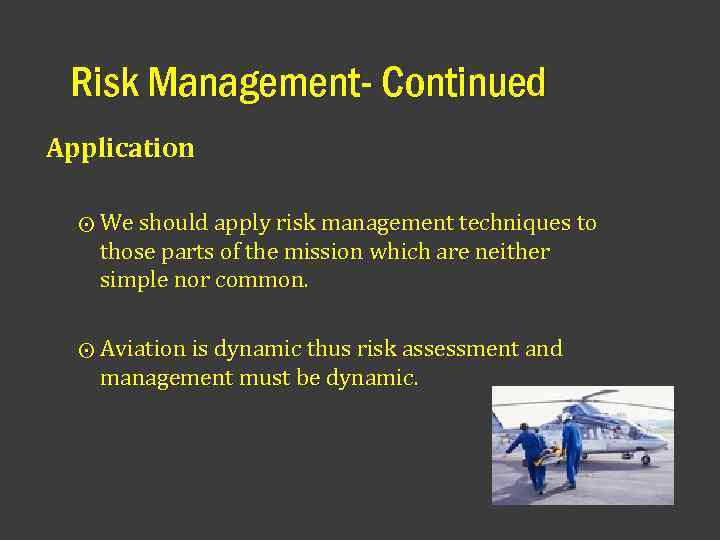
Risk Management- Continued Application ⨀ We should apply risk management techniques to those parts of the mission which are neither simple nor common. ⨀ Aviation is dynamic thus risk assessment and management must be dynamic.
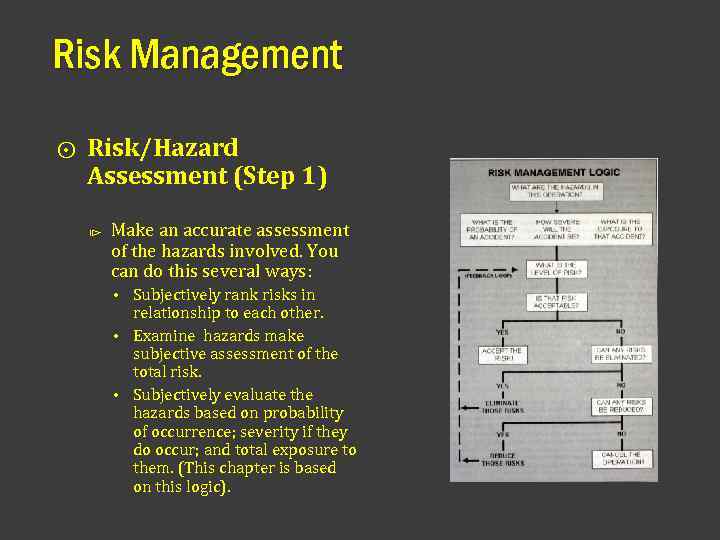
Risk Management ⨀ Risk/Hazard Assessment (Step 1) ⧐ Make an accurate assessment of the hazards involved. You can do this several ways: • Subjectively rank risks in relationship to each other. • Examine hazards make subjective assessment of the total risk. • Subjectively evaluate the hazards based on probability of occurrence; severity if they do occur; and total exposure to them. (This chapter is based on this logic).
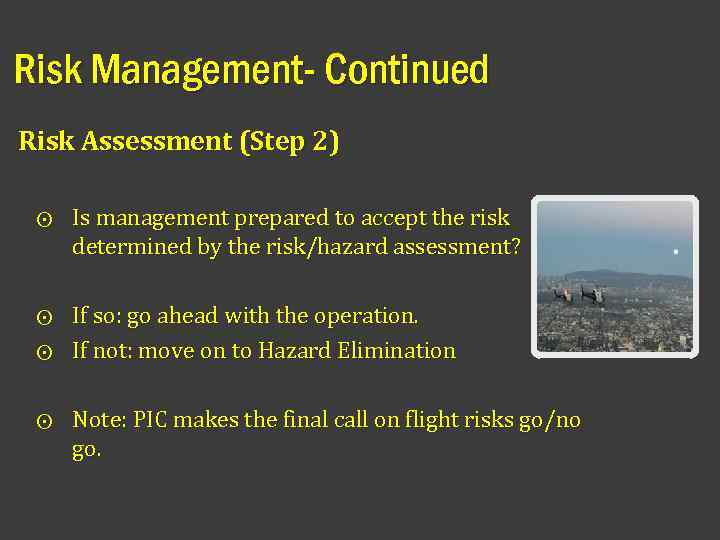
Risk Management- Continued Risk Assessment (Step 2) ⨀ Is management prepared to accept the risk determined by the risk/hazard assessment? If so: go ahead with the operation. ⨀ If not: move on to Hazard Elimination ⨀ ⨀ Note: PIC makes the final call on flight risks go/no go.
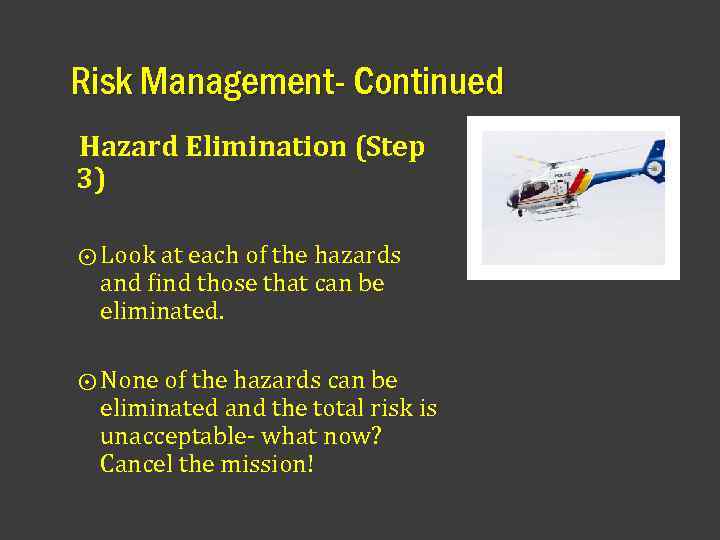
Risk Management- Continued Hazard Elimination (Step 3) ⨀ Look at each of the hazards and find those that can be eliminated. ⨀ None of the hazards can be eliminated and the total risk is unacceptable- what now? Cancel the mission!
Risk Management- Continued Hazard Reduction (Step 4) ⨀ Look for hazards that can be reduced. ⧐ Reduce the exposure to a particular hazard ⧐ Reduce the probability that it will occur ⧐ Or reduce its severity if it does occur ⨀ What if you have gone through hazard elimination and found that the total risk is still unacceptable? ⧐ Cancel the mission!
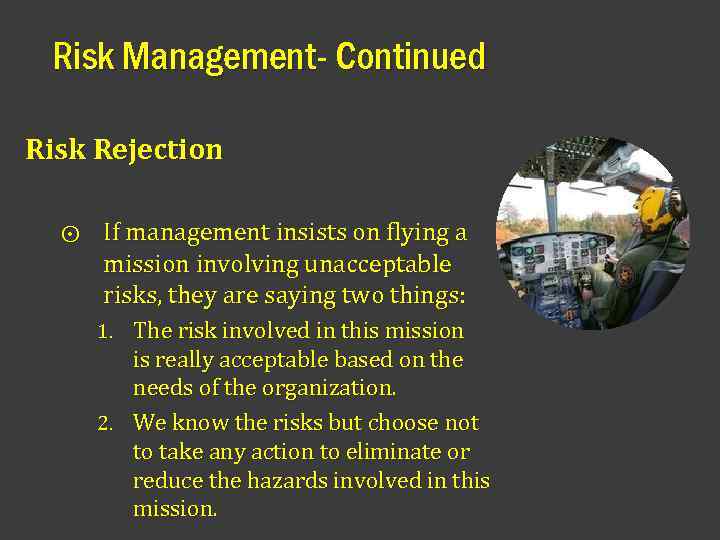
Risk Management- Continued Risk Rejection ⨀ If management insists on flying a mission involving unacceptable risks, they are saying two things: 1. The risk involved in this mission is really acceptable based on the needs of the organization. 2. We know the risks but choose not to take any action to eliminate or reduce the hazards involved in this mission
Risk Management- Continued Risk Acceptance ⨀ If we decide that the risk is acceptable: ⧐ Make sure that the actions we took did reduce the level of risk. - Example: Requiring an additional inspection of completed maintenance work sounds good, but doesn‘t work if there is no qualified inspector available
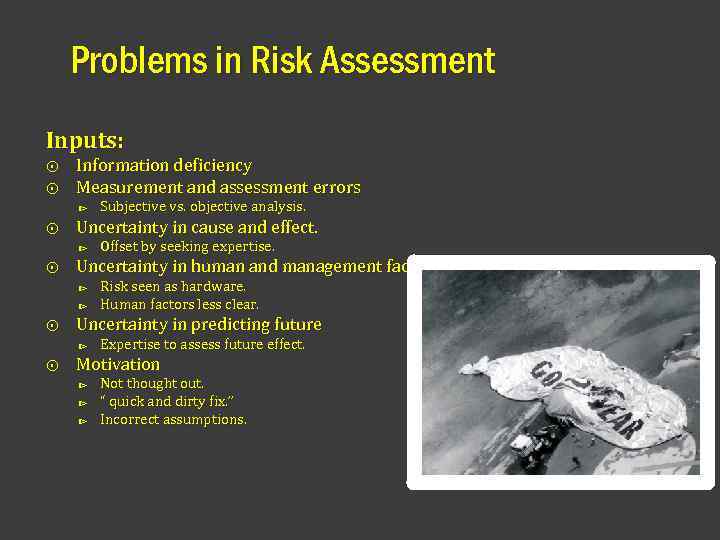
Problems in Risk Assessment Inputs: ⨀ ⨀ Information deficiency Measurement and assessment errors ⧐ ⨀ Uncertainty in cause and effect. ⧐ ⨀ Risk seen as hardware. Human factors less clear. Uncertainty in predicting future ⧐ ⨀ Offset by seeking expertise. Uncertainty in human and management factors ⧐ ⧐ ⨀ Subjective vs. objective analysis. Expertise to assess future effect. Motivation ⧐ ⧐ ⧐ Not thought out. “ quick and dirty fix. ” Incorrect assumptions.
“Cause for Flaws ‘ Risk Safety Management ⨀ The parent organization “expects” performance from its aviation assets. ⨀ Possible clash of philosophy between the definition of “risk” as seen from the aviation vs. the rest of the organization. ⨀ Managers/supervisors may not have been provided with formal aviation risk management training. ⨀ Ingrained cultural beliefs or resistance to change. “This is how we always do it. ” or “It’s our job to take risks
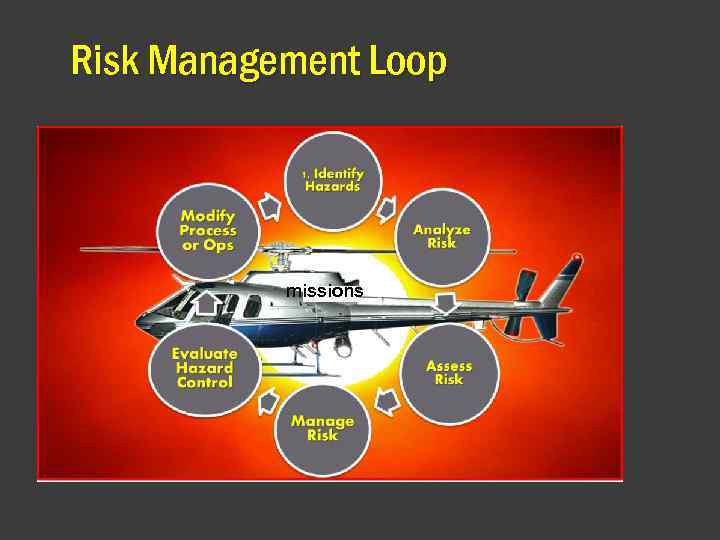
Risk Management Loop missions
Management Challenges Risk Assessment ⨀ Management must be the initial filter of risk assessment for the mission or operations. Crews must have the tools, training, resources, procedures and support to conduct a given mission. These things assist the PIC in making the final call on go/ no go. ⨀ Breaking the Error Chain…A series of events that, but for one of those events, the mishap would not have occurred. This requires knowing what precipitates errors.
Wrap Up and Key Points… ⨀ Risk management decisions can be no better than the original assessment of the hazards. ⨀ A benefit of risk management is that it forces management/organization to step up and make informed, intelligent decisions. It also provides a better picture of the results of that action or inaction. ⨀ Unit risk management decisions do not negate the authority of the PIC or crew to make the final decision on the mission. ⨀ Actually, good unit risk management will better assist crews in making good risk/hazard decisions during the flight.
End
Скачать презентацию Module 3 Risky Business Relating risk to hazard
mod3_pptx (1).pptx