


 Скачать презентацию MODULE 3 ACQUIRING 1 Civilian Human Resources
508a22f81055fe9b17a405b3ce5989ed.ppt
- Количество слайдов: 42
 MODULE 3 ACQUIRING 1
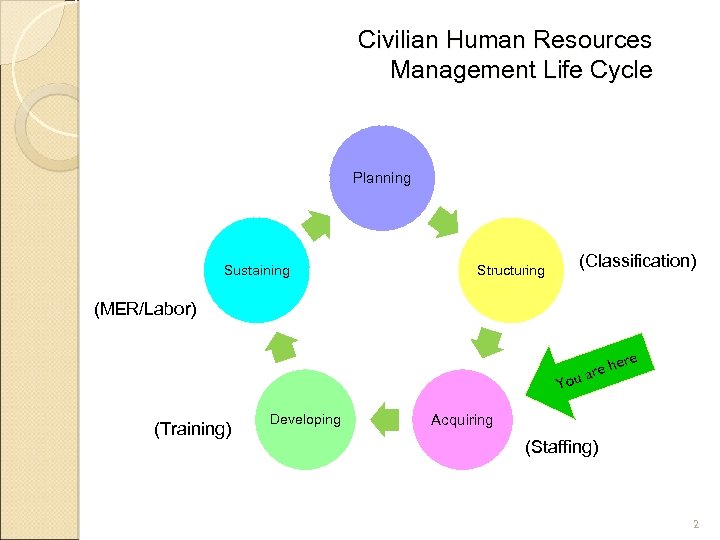 Civilian Human Resources Management Life Cycle Planning Sustaining Structuring (Classification) (MER/Labor) You (Training) Developing re he are Acquiring (Staffing) 2
 Learning Objectives After completion of this module, participants will be able to: 1. Identify supervisors and CPAC roles in the recruitment process 2. Describe the key concepts in job analysis 3. Describe supervisory options on how to fill vacancies 4. Describe when veterans preference applies in the hiring process 5. Identify at least 3 types of recruitment incentives 6. Explain general Reduction in Force (RIF) rules 3
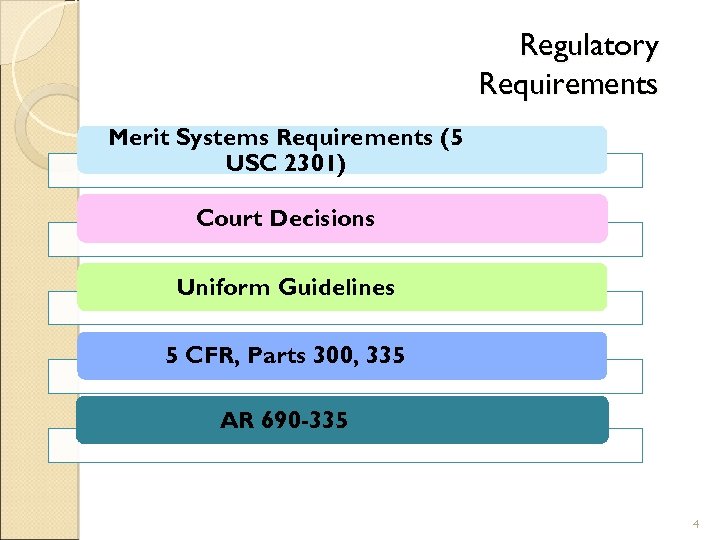 Regulatory Requirements Merit Systems Requirements (5 USC 2301) Court Decisions Uniform Guidelines 5 CFR, Parts 300, 335 AR 690 -335 4
 Key Principles Ø Merit Systems Principles Ø Prohibited Personnel Practices Ø Veterans’ Preference Ø Use of mandatory placement programs ü Priority Placement Program (PPP), Reemployment Priority List (RPL), Interagency Career Transition Assistance Program (ICTAP) Ø Current competitive and excepted service appointing authorities and entitlements Ø Current hiring flexibilities Ø OPM qualification standards Ø Public notice requirements – using CPOL or USAJOBS 5
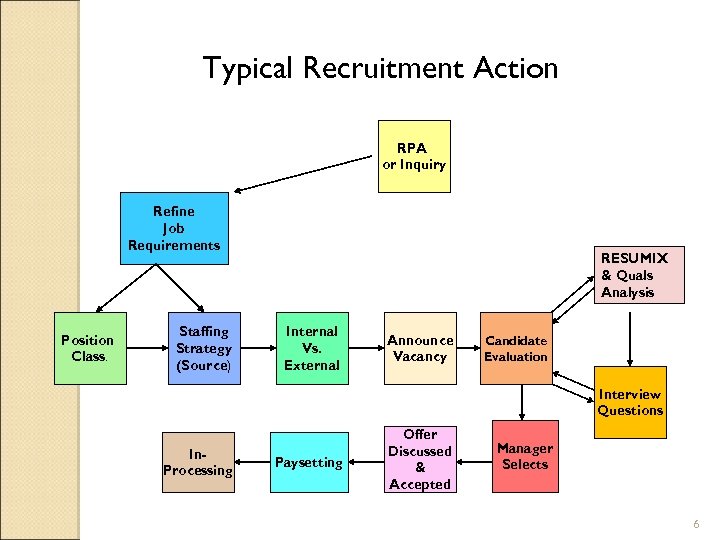 Typical Recruitment Action RPA or Inquiry Refine Job Requirements Position Class. Staffing Strategy (Source) RESUMIX & Quals Analysis Internal Vs. External Announce Vacancy Candidate Evaluation Interview Questions In. Processing Paysetting Offer Discussed & Accepted Manager Selects 6
 The Electronic RPA q Request for Personnel Action (RPA) is an electronic HR work order form that: ü Is created in Defense Civilian Personnel Data System (DCPDS) ü Tracked via the Army’s Civilian Personnel On-Line (CPOL) Portal Manager Tab ü Requires a “manager’s” user account to create and track RPA q To learn about Portal, go to the CHRA link below for an on-line tutorial called “Portal for Supervisors and Managers” http: //www. chra. army. mil/tmd/cpoc_dl. htm 7
 Planning is an Essential First Step Ø What are the roles in filling positions? Ø Ø Which rules / regulations apply? How do I fill my vacancy? ü Is this a temporary or permanent position? Ø Ø Which skills am I looking for in a candidate? Where can I find well-qualified candidates? ü External or internal ü Are there non-competitive placements available? ü Can I do a name request? Ø Should I consider recruitment incentives? Ø Ø Where can I go for advice? How long will it take? 8
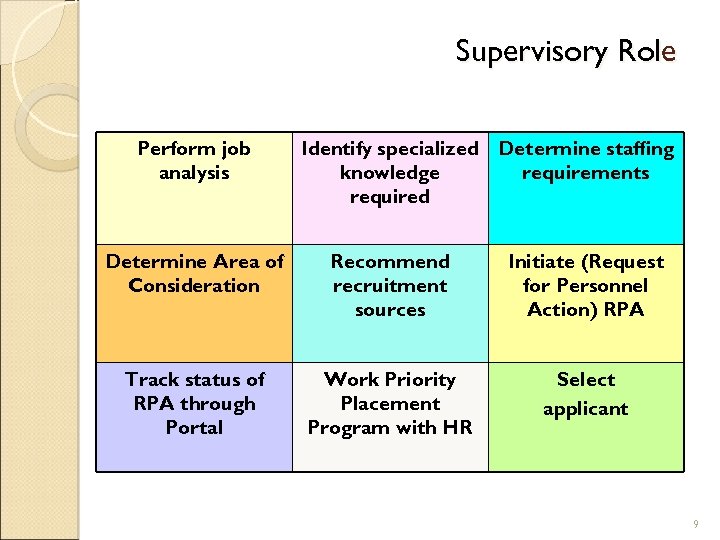 Supervisory Role Perform job analysis Identify specialized Determine staffing knowledge requirements required Determine Area of Consideration Recommend recruitment sources Initiate (Request for Personnel Action) RPA Track status of RPA through Portal Work Priority Placement Program with HR Select applicant 9
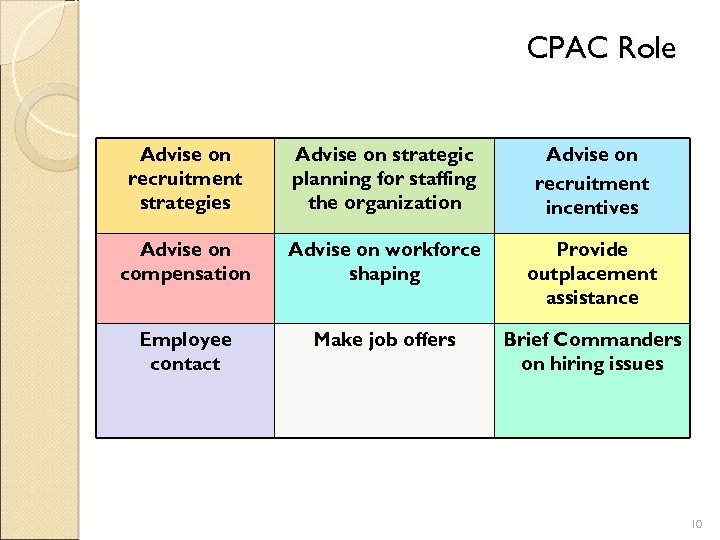 CPAC Role Advise on recruitment strategies Advise on strategic planning for staffing the organization Advise on recruitment incentives Advise on compensation Advise on workforce shaping Provide outplacement assistance Employee contact Make job offers Brief Commanders on hiring issues 10
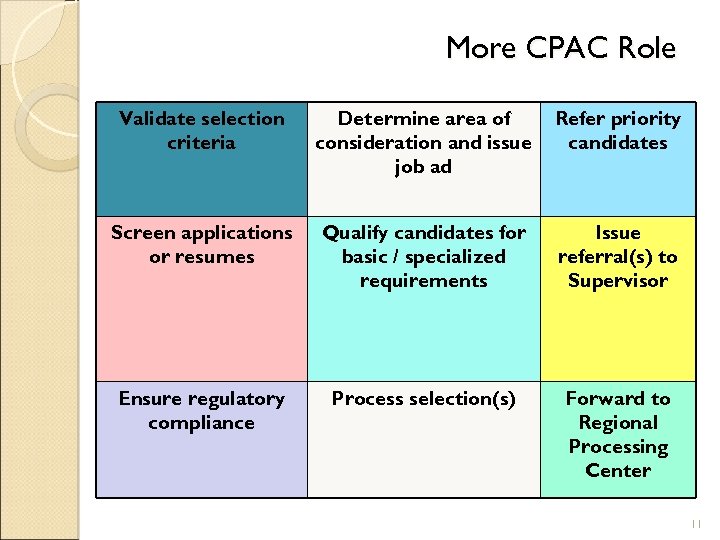 More CPAC Role Validate selection criteria Determine area of consideration and issue job ad Refer priority candidates Screen applications or resumes Qualify candidates for basic / specialized requirements Issue referral(s) to Supervisor Ensure regulatory compliance Process selection(s) Forward to Regional Processing Center 11
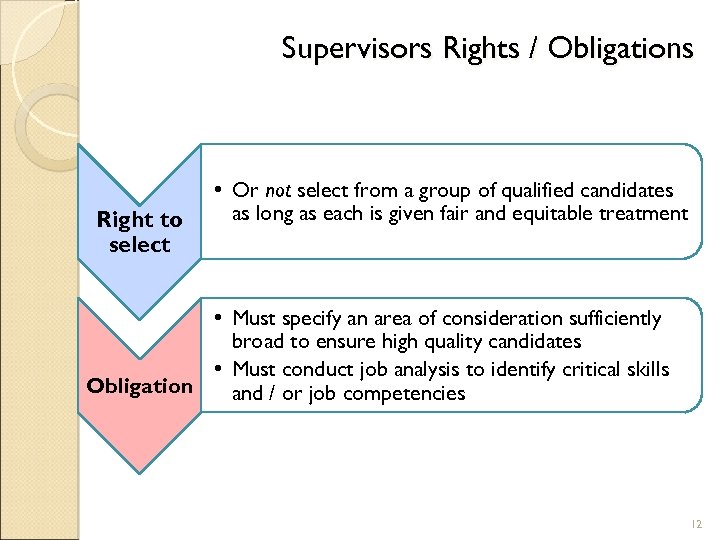 Supervisors Rights / Obligations Right to select • Or not select from a group of qualified candidates as long as each is given fair and equitable treatment • Must specify an area of consideration sufficiently broad to ensure high quality candidates • Must conduct job analysis to identify critical skills Obligation and / or job competencies 12
 Job Analysis Who provides job information? q q q Supervisor Subject matter expert Incumbent What is involved? Gathering information about a position during the Strategic Recruitment Discussion q Identifying major job related requirements q Linking job requirements to ü Knowledge, skills, abilities (KSAs) ü Education and/or training requirements q Determining what "reasonable accommodations" could be made for an individual q 13
 Job Analysis Where are the information sources? q q Current, official position description OPM qualification standards OPM classification standards Job objectives When should job analysis be done? q q Before recruitment begins When reasonable accommodations are required 14
 Job Analysis Why is it necessary? q To identify: ü experience, education, training, and other qualifying factors, possessed by candidates ü those candidates who are potentially the best qualified to perform the duties of the position How is it done? q Review of classification standards q Supervisor/SME interviews q Expert panels q Structured questionnaires q Check lists q Open-ended questionnaires q Observation q Incumbent work logs q Task inventories 15
 Exercise 3 -1 1. 2. 3. 4. Review your assigned PD to conduct a job analysis Highlight key tasks or statements that serve to identify the knowledge, skills, and abilities required for the position. Be creative and add requirements that are unstated or implied. These would be used to update the PD prior to submitting the RPA and for use in the vacancy announcement and/or evaluation process. You have 15 min to work through the PD. 16
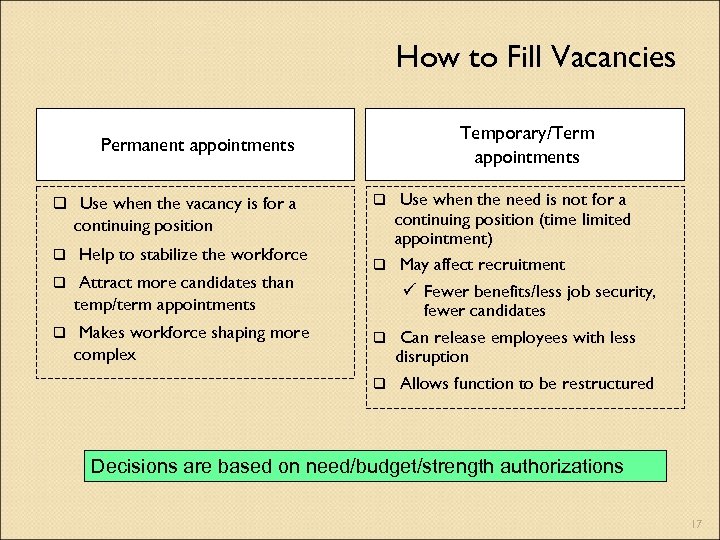 How to Fill Vacancies Temporary/Term appointments Permanent appointments q Use when the vacancy is for a continuing position q Help to stabilize the workforce q Attract more candidates than temp/term appointments q Makes workforce shaping more complex Use when the need is not for a continuing position (time limited appointment) q May affect recruitment ü Fewer benefits/less job security, fewer candidates q Can release employees with less disruption q Allows function to be restructured q Decisions are based on need/budget/strength authorizations 17
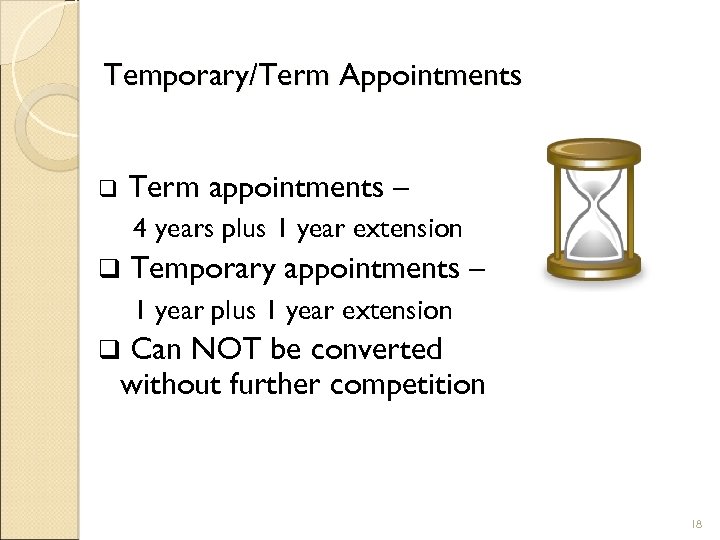 Temporary/Term Appointments Term appointments – q 4 years plus 1 year extension q Temporary appointments – 1 year plus 1 year extension Can NOT be converted without further competition q 18
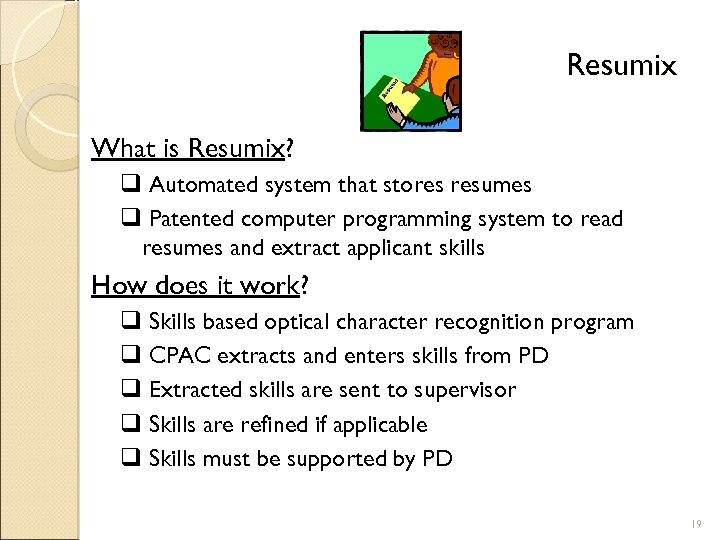 Resumix What is Resumix? q Automated system that stores resumes q Patented computer programming system to read resumes and extract applicant skills How does it work? q Skills based optical character recognition program q CPAC extracts and enters skills from PD q Extracted skills are sent to supervisor q Skills are refined if applicable q Skills must be supported by PD 19
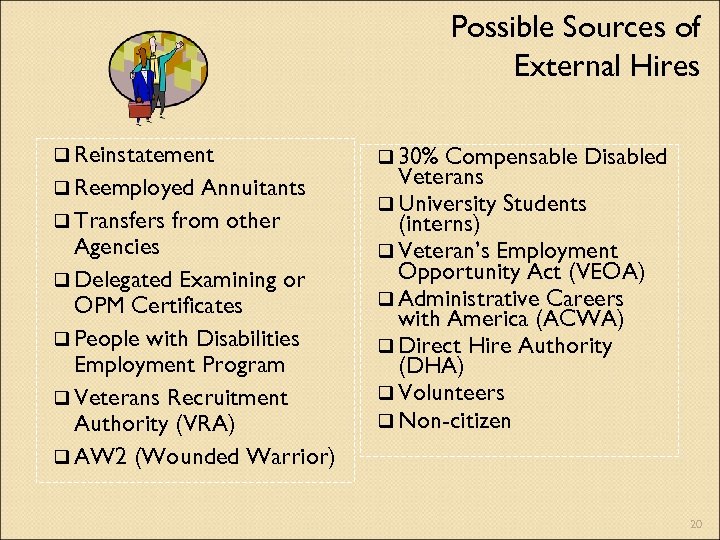 Possible Sources of External Hires q Reinstatement q Reemployed Annuitants q Transfers from other Agencies q Delegated Examining or OPM Certificates q People with Disabilities Employment Program q Veterans Recruitment Authority (VRA) q AW 2 (Wounded Warrior) q 30% Compensable Disabled Veterans q University Students (interns) q Veteran’s Employment Opportunity Act (VEOA) q Administrative Careers with America (ACWA) q Direct Hire Authority (DHA) q Volunteers q Non-citizen 20
 Competitive Examining Used to recruit applicants from outside civil service for competitive appointments to competitive service positions. • • • Typically used for first Federal appointment Has public notice requirements Open to all U. S. citizens OPM recommends 5 day open period Veterans’ preference rules and the “rule of three” apply 21
 Veterans’ Preference What is veterans’ preference? q Special consideration in hiring veterans primarily for vacancies filled from outside Federal service q Based upon periods of military service or service connected disability When does it apply? q New appointments from OPM / DEU lists ü Permanent ü Terms ü Temporary q Some VRA appointments q Most excepted service appointments When doesn’t it apply? Merit promotion, VEOA, Reinstatement, Transfer, Employment of Family Members, DHA 22
 Exceptions to Competition Examples of exceptions to competition: q Promotions where competition occurred for a higher grade (e. g. , interns) q Promotion resulting from re-classification to a higher grade to assignment of additional duties and responsibilities q Temporary promotion to a position in a higher grade for less than 180 days for NSPS or 120 days or less for OPM 23
 Recruitment Incentives – – – First duty station travel expenses Travel expenses for interviews Recruitment bonuses Advanced in-hire rates Student loan repayment 24
 What can you do to reduce fill -time? q Pre-plan üIdentify the key events occurring during selection process üEnsure PDs are adequate and accurate before submitting an RPA q Communicate üDevelop up-front recruitment strategy with HR üRespond to HR queries promptly üMake yourself available to your HR Specialist q Conduct üSound job analysis üInterviews and reference checks 25
 Reducing Fill Time q Act üProcess referral lists as quickly as possible q Bargaining Unit Agreement üAnalyze for impact on time-to-fill q Examine üInternal review process to identify impediments to quick fill-time 26
 Interviewing STEP 1 - Prepare for the Interview ◦ Customize questions to fit the job requirements ◦ Do your homework--review resumes and other documents ◦ Put the candidate at ease! ◦ Make a connection ◦ Build rapport ◦ Demonstrate that your organization cares about its people 27
 Interviewing STEP 2 – Tell the candidate: How the interview will be conducted What will be covered Names of the interviewers Requirements of the position ◦ Organization structure ◦ Mission requirements ◦ Significant factors (e. g. , travel, shift work, physical demands, overtime) ◦ Exciting projects ◦ Promotional opportunities 28
 Interviewing STEP 3 – During the interview: – Verify information on resume – Discuss accomplishments, education, past job experiences – Try to assess learning potential, personal characteristics – Ask appropriate questions 29
 Types of Questions Ask Open-ended questions ◦ Gives you more than a yes or no; addresses the 5 “Ws”-who, what, where, when, and why or how. “Tell me about” questions ◦ allows candidate to describe challenges or situations previously encountered Closed questions ◦ Use only to verify key facts or points The “non-question” question ◦ Less threatening for some candidates 30
 Ending the Interview ◦ Provide an opportunity for questions ◦ Explain the next step, e. g. , reference checks ◦ Set a reasonable timeframe for results ◦ Thank the candidate for his/her time 31
 Common Problems Lack of preparation Interview bias Inappropriate questions Using prohibited interview questions Interviewer too dominating Questions are inconsistent across candidates Using questions that make binding contractual statements Poor selection criteria for questions 32
 Prohibited Questions Federal law states that hiring must be based on bona fide occupational qualifications Interviewers and selecting officials CANNOT discriminate due to: ◦ age, sex, marital status, ethnic origin, religious preference, sexual preference, disabilities 33
 Prohibited Questions CPAC Responsibilities--CPAC will address these points if necessary--interviewers will NOT ask about: ◦ Citizenship ◦ Nepotism ◦ Police records 34
 Prohibited Questions to be avoided include: ◦ ◦ Are you married? What is your religious affiliation? What are your arrangements for child care? What are your union activities? Are you a member of the union? ◦ Do you have a good credit rating? ◦ Do you plan to live in this area long? 35
 Exercise 3 -2 For your assigned PD, develop at least 5 potential (valid) interview questions. 2. Refer to the handouts on interviewing tips and sample interview questions. 1. 36
 Reduction In Force (RIF) Process q When RIF occurs ü An employee is released from his/her competitive level or group by Separation Furlough for more than 30 days Demotion / Change to Lower Grade/Band q Why RIF is used ü Lack of work ü Shortage of funds ü Insufficient personnel authorizations ü Reorganization ü Exercise re-employment/restoration rights ü Reclassification (in some instances) ü Result of Competitive Sourcing Decision 37
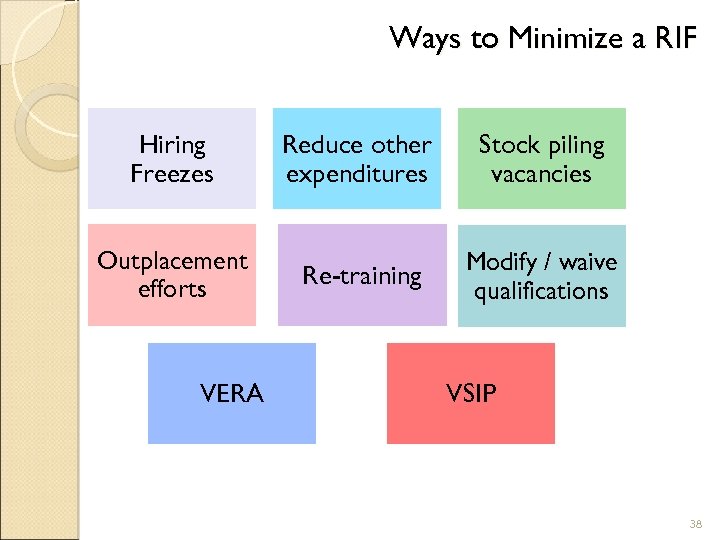 Ways to Minimize a RIF Hiring Freezes Reduce other expenditures Stock piling vacancies Outplacement efforts Re-training Modify / waive qualifications VERA VSIP 38
 Retention Factors q Tenure ü Group I - career ü Group II - career conditional ü Group III - term and similar non-status appointments q Veterans’ Preference ü Subgroup AD - veterans with a compensable serviceconnected disability of 30% or more ü Subgroup A - veterans not included in subgroup AD ü Subgroup B - non-veterans q RIF creditable service date q Performance rating 39
 Grievances and Appeals Ø Employees downgraded or separated as a result of RIF ü May appeal to Merit Systems Protection Board (MSPB) ü Appeals must be filed within 30 days after effective date of RIF Ø Bargaining unit members must use negotiated grievance procedure unless RIF actions are specifically excluded from contract 40
 CPAC RIF Functions HR Specialist assures qualifications are met for placements ü Meet OPM qualifications standards ü Meet physical requirements for position ü Background clearly demonstrates ability to perform successfully all critical elements ü Ability to take over duties without “undue interruption” ü Managers may approve waiver of qualifications in assignments to vacant positions q RIF processing is automated (Auto. RIF) ü CPAC ensures accuracy of DCPDS database prior to beginning RIF process ü Auto. RIF produces annotated retention registers, letters and reports ü CPAC explains process – must understand rules and options q 41
 Review q Supervisor’s role in recruitment, selection, and placement q Job analysis q Competitive examining q Internal placement q Interviewing q General RIF rules 42