


 Скачать презентацию Module 3 a Chapter 10 Strategic Performance Management
Module_3a.ppt
- Количество слайдов: 26
 Module 3 a Chapter 10 Strategic Performance Management ‘The ultimate limitation on human aspirations lies neither in intelligence nor in technology, but in our ability to work together effectively in our organisations’ (Buchanan & Huczynski 1997, p. 2). 
 Need something to lift your spirits today? Think about this… If you woke up this morning with more health than illness… you are more blessed than the million who will not survive this week. If you have never experienced the danger of battle, the loneliness of imprisonment, the agony of torture, or the pangs of starvation… you are ahead of 500 million people in the world. If you have food in the refrigerator, clothes on your back, a roof overhead and a place to sleep… you are richer than 75% of the world. If you have money in the bank, in your wallet and spare change in a dish someplace… you are among the top 8% of the world’s wealthy. If your parents are still alive and still married… you are very rare, even in the United States, Canada or Australia Aren’t we blessed!! Make the most of your day.
 What is the purpose of performance management? http: //www. youtube. com/watch? v=4 Zlf. R e. H 8 zn. M&feature=fvwrel
 Lecture objectives Define and discuss performance and performance management; Describe the dimensions of performance management Discuss performance appraisal as part of the performance management process Discuss conventional and contemporary methods of performance Explain the aspects of performance appraisal that should be considered before appraisals are conducted
 The annual ‘fiasco’ of the performance review Employees’ negative attitude towards performance reviews: difficulty in being ‘open and honest’, especially with managers Performance: To accomplish, execute or carry out an ordered task or assignment Two-dimensions of performance ØTask performance v. contextual performance Motivated employees have much higher task performance and contextual performance than less motivated employees
 Performance management Performance management: A collective range of activities conducted by an organisation aimed at enhancing performance • ↑ individual performance = ↑ organisational performance Performance management can be conducted at the team or individual level (or both) • Group performance = the process of individuals interacting as a group and the outcomes of such a process. • Types of things on which group performance depends include shared purpose, group norms, hidden and espoused goals, member roles, communication, available resources and group cohesion
 Characteristics of performance management 1. 2. 3. 4. 5. ü A process of continuous input and output management A multifaceted and multilevel agreement of input and output Vertical integration = The integration of individual, group, functional and organisational objectives Horizontal integration = The integration of HRM functions A holistic management process It is also important to maintain open lines of communication
 The performance management process Despite the importance of PM, most companies fail to identify the link between performance management and organisational strategy Aguilar (2003) identified some critical dimensions of performance management: • Strategic planning • Performance criteria and measures • Taking action • Organisational culture ü The balanced scorecard can be used as a performance management tool
 Performance appraisal Performance appraisal: A formal and mutually agreed upon system of planning and reviewing employee performance ØPut simply, it is the reviewing, evaluating and planning of individual or group performance Appraisals are part of the PM process: 1. How well are employees doing their job? 2. Communicate this to employees 3. Establish a plan to build on strengths and fill performance gaps 4. Implement this plan 5. Training and development
 Performance appraisal v performance managemen Performance appraisal is both distinct from performance management and a part of it • Performance appraisal is focused on the planning and reviewing of individual performance and is a subset of performance management • Performance management is concerned with organisational performance improvement through various HRM functions and procedures including performance appraisal.
 Considerations in the performance appraisal process HR managers should adopt the contemporary view of performance appraisal and view it as a dynamic development process 1. Define the performance criteria 2. Facilitate discussion regarding the performance review 3. Identify training and development needs 4. Reward good performance Refer to Figure 10. 4 to understand how performance appraisals can lead to improved organisational performance
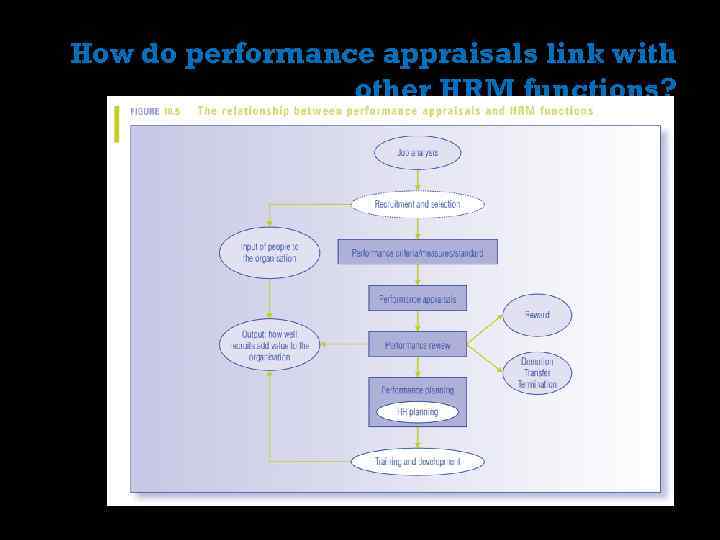 How do performance appraisals link with other HRM functions?
 Performance appraisal ‘tips for success’ Ø Although formal performance appraisals are held only annually, half yearly or quarterly, ongoing performance conversations should be occuring so that there are ‘no surprises’ in the appraisal meeting. Before the meeting • Preparation is imperative (i. e. data from the HRIS) • SMART method of goal setting (specific purpose) Ø During the meeting • Elicit input from the employee • Strategically communicate and provide feedback Ø After the meeting • Feedback/outcomes must be put into practice
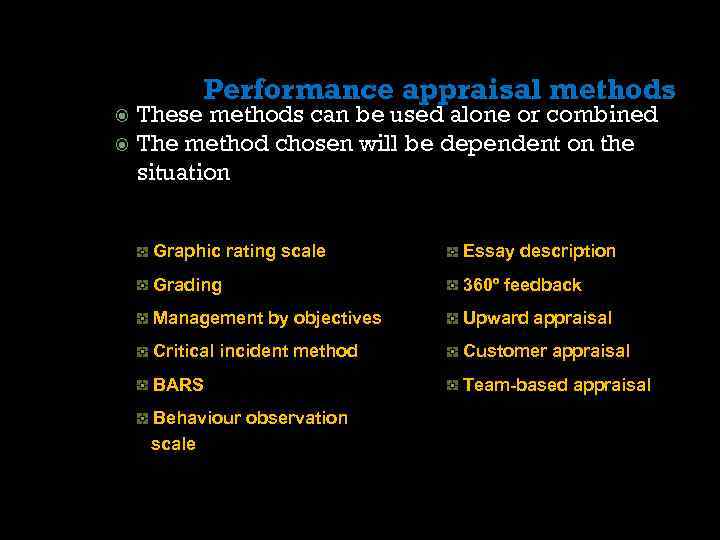 Performance appraisal methods These methods can be used alone or combined The method chosen will be dependent on the situation Graphic rating scale Essay description Grading 360º feedback Management by objectives Upward appraisal Critical incident method Customer appraisal BARS Team-based appraisal Behaviour observation scale
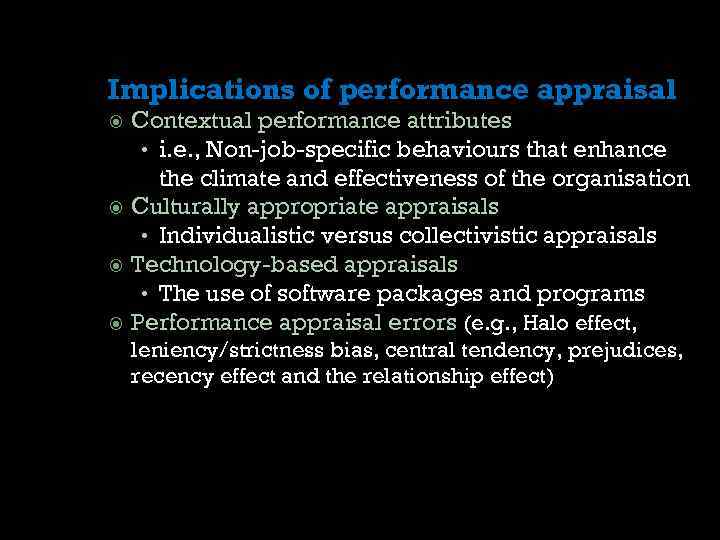 Implications of performance appraisal Contextual performance attributes • i. e. , Non-job-specific behaviours that enhance the climate and effectiveness of the organisation Culturally appropriate appraisals • Individualistic versus collectivistic appraisals Technology-based appraisals • The use of software packages and programs Performance appraisal errors (e. g. , Halo effect, leniency/strictness bias, central tendency, prejudices, recency effect and the relationship effect)
 Disciplining employees Disciplinary procedures should not be part of the performance management process • Purpose of performance management is to review employee performance for continuous improvement • Purpose of disciplinary procedures is to make it clear to an employee when they have engaged in unacceptable behaviours
 Employee Assistance Programs (EAP) come in when employees experience difficulties in their lives that carry over and create problems in the workplace. EAP is a worksite-based-program to assist: • Organisations in addressing productivity issues • Employee clients in identifying and resolving personal concerns e. g. , health, marital, family, financial, alcohol abuse
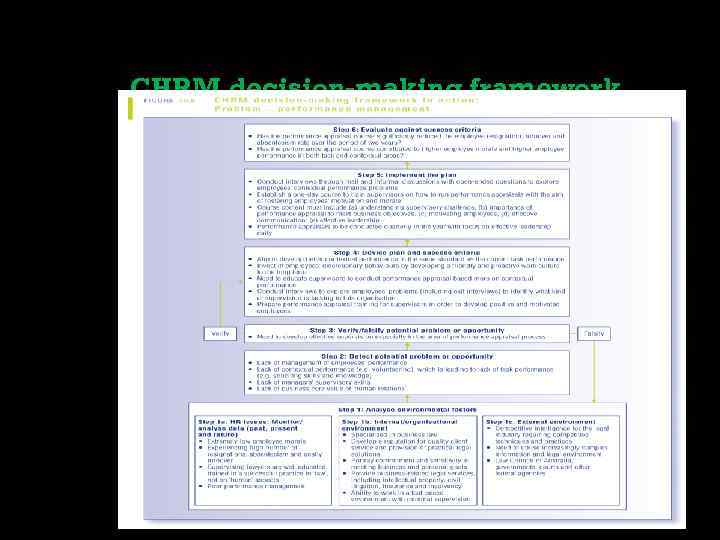 CHRM decision-making framework
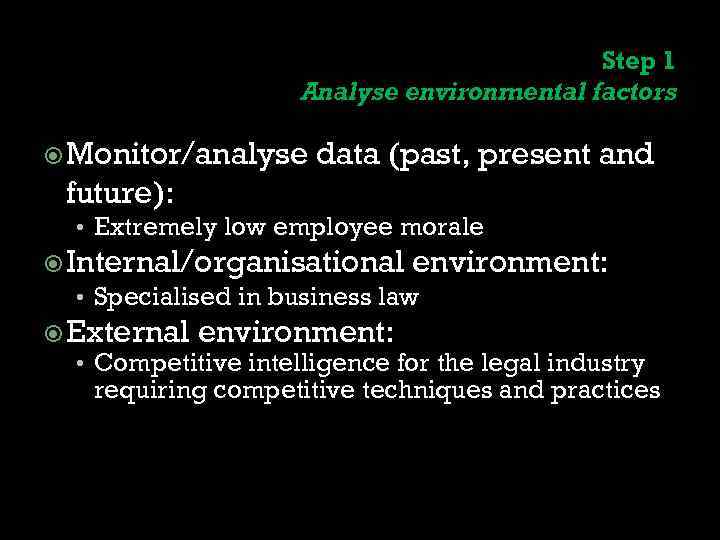 Step 1 Analyse environmental factors Monitor/analyse data (past, present and future): • Extremely low employee morale Internal/organisational environment: • Specialised in business law External environment: • Competitive intelligence for the legal industry requiring competitive techniques and practices
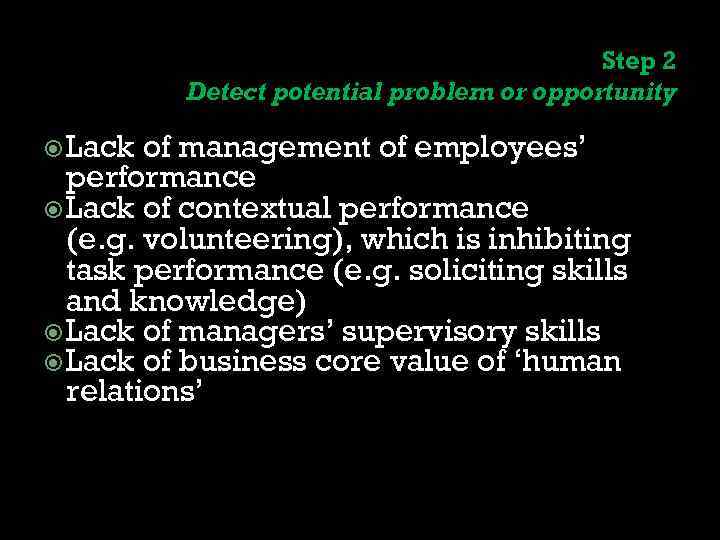 Step 2 Detect potential problem or opportunity Lack of management of employees’ performance Lack of contextual performance (e. g. volunteering), which is inhibiting task performance (e. g. soliciting skills and knowledge) Lack of managers’ supervisory skills Lack of business core value of ‘human relations’
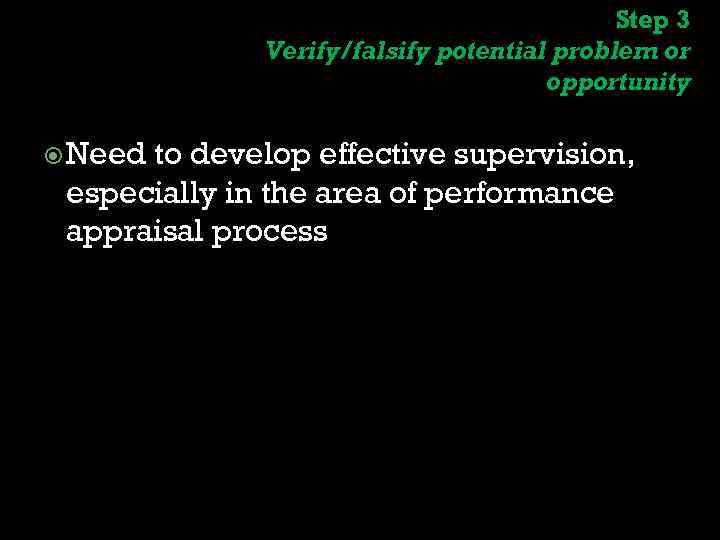 Step 3 Verify/falsify potential problem or opportunity Need to develop effective supervision, especially in the area of performance appraisal process
 Step 4 Devise plan and success criteria Aim to develop better contextual performance Invest in employees’ discretionary behaviours by developing a friendly and proactive work culture in the long term Need to educate supervisors to emphasise contextual performance in performance appraisal Conduct interviews to explore employees’ problems (including exit interviews) to identify what kind of supervision is lacking in the organisation Prepare performance appraisal training for supervisors in order to develop positive and motivated employees
 Step 5 Implement the plan Conduct interviews through mail and informal discussions with open-ended questions to explore employees’ contextual performance problems Establish a one-day course to train supervisors on how to run performance appraisals with the aim of fostering employees’ motivation and morale
 Step 5 Implement the plan (cont. ) Course content must include a) understanding supervisory challenge, b) importance of performance appraisal to meet business objectives, c) motivating employees, d) effective communication, e) positive leadership Performance appraisals to be conducted quarterly in the year with focus on positive leadership daily
 Step 6 Evaluate against success criteria Has the performance appraisal course significantly reduced employee turnover and absenteeism rates over the period of 2 years? Has the performance appraisal course contributed to higher employee morale? Has the performance appraisal course resulted in higher employee performance in both task and contextual areas?
 Conclusion Although often viewed as ‘a fiasco’, performance management is important if organisational goals are to be achieved Performance management is concerned with inputs and outputs • At the individual, group and organisational level Performance appraisals form part of the performance management process There are various methods for conducting appraisals • Take care to adopt the most appropriate one Performance management is a continuous process