


 Скачать презентацию Module 19 Welfare of Animals used in Education
e99ac923e76279d1eddc9d3a72bd6d9c.ppt
- Количество слайдов: 40
 Module 19 Welfare of Animals used in Education, Research and Testing This lecture was first developed for World Animal Protection by Dr David Main (University of Bristol) in 2003. It was revised by World Animal Protection scientific advisors in 2012 using updates provided by Dr Caroline Hewson. Free online resources To get free updates and additional materials, please go to www. animalmosaic. org/education/tertiary-education/ Module 19: Welfare of Animals used in Education, Research and Testing Concepts in Animal Welfare © World Animal Protection 2014. Unless stated otherwise, image credits are World Animal Protection.
 This module will teach you Why using animals for education, research and testing is so well established Lock-in theory Ethics review The main welfare concerns for animals in education, research and testing How to improve their welfare Module 19: Welfare of Animals used in Education, Research and Testing Concepts in Animal Welfare © World Animal Protection 2014. Unless stated otherwise, image credits are World Animal Protection.
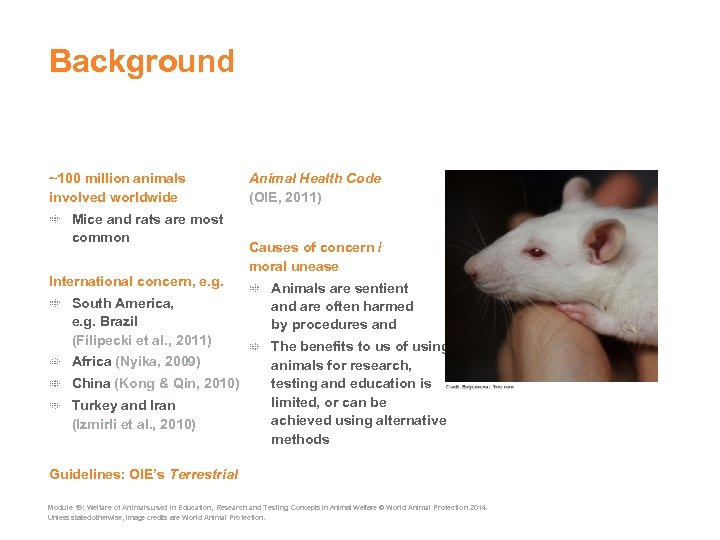 Background ~100 million animals involved worldwide Mice and rats are most common International concern, e. g. South America, e. g. Brazil (Filipecki et al. , 2011) Africa (Nyika, 2009) China (Kong & Qin, 2010) Turkey and Iran (Izmirli et al. , 2010) Animal Health Code (OIE, 2011) Causes of concern / moral unease Animals are sentient and are often harmed by procedures and The benefits to us of using animals for research, testing and education is limited, or can be achieved using alternative methods Guidelines: OIE’s Terrestrial Module 19: Welfare of Animals used in Education, Research and Testing Concepts in Animal Welfare © World Animal Protection 2014. Unless stated otherwise, image credits are World Animal Protection.
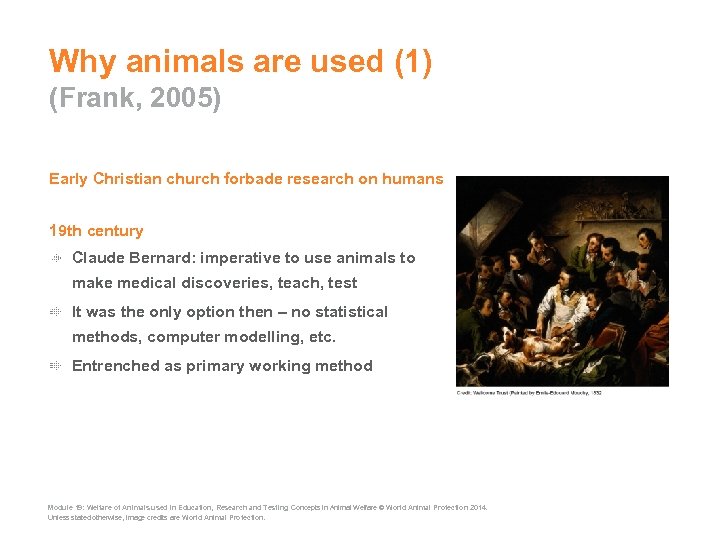 Why animals are used (1) (Frank, 2005) Early Christian church forbade research on humans 19 th century Claude Bernard: imperative to use animals to make medical discoveries, teach, test It was the only option then – no statistical methods, computer modelling, etc. Entrenched as primary working method Module 19: Welfare of Animals used in Education, Research and Testing Concepts in Animal Welfare © World Animal Protection 2014. Unless stated otherwise, image credits are World Animal Protection.
 Why animals are used (2) (Frank, 2005) ‘Lock-in’ Economic theory: path of increasing ‘Lock-in’ returns inflexible behaviours and inertia because Huge infrastructure, e. g. strongly held assumptions even Journals, research labs, private though a different path might be more testing companies, cosmetics beneficial in the long term companies, pharmaceutical Laboratory animal research: big initial production, staff, regulatory bodies, investment, but inexpensive academic departments, funding production increasing returns agencies, etc. ‘lock in’ likely Cost of changing buildings, etc. Module 19: Welfare of Animals used in Education, Research and Testing Concepts in Animal Welfare © World Animal Protection 2014. Unless stated otherwise, image credits are World Animal Protection.
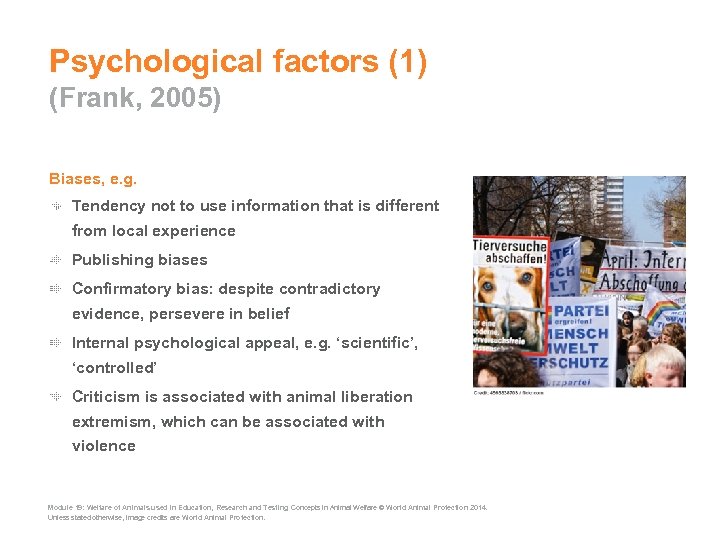 Psychological factors (1) (Frank, 2005) Biases, e. g. Tendency not to use information that is different from local experience Publishing biases Confirmatory bias: despite contradictory evidence, persevere in belief Internal psychological appeal, e. g. ‘scientific’, ‘controlled’ Criticism is associated with animal liberation extremism, which can be associated with violence Module 19: Welfare of Animals used in Education, Research and Testing Concepts in Animal Welfare © World Animal Protection 2014. Unless stated otherwise, image credits are World Animal Protection.
 Psychological factors (2) (Frank, 2005) Cognitive dissonance, e. g. ‘Sacrificed’ not ‘killed’ Animals listed by number, not name Human animal bond (Herzog, 2002) Personnel may favour some animals Affects results (e. g. Sherwin, 2004) Module 19: Welfare of Animals used in Education, Research and Testing Concepts in Animal Welfare © World Animal Protection 2014. Unless stated otherwise, image credits are World Animal Protection.
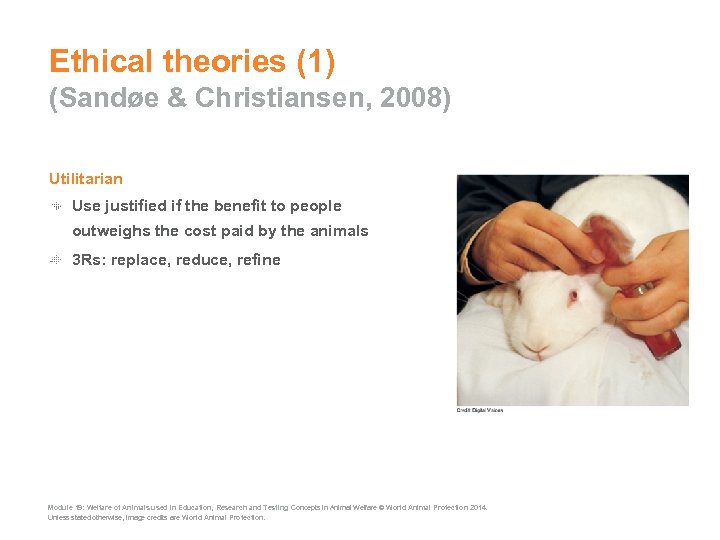 Ethical theories (1) (Sandøe & Christiansen, 2008) Utilitarian Use justified if the benefit to people outweighs the cost paid by the animals 3 Rs: replace, reduce, refine Module 19: Welfare of Animals used in Education, Research and Testing Concepts in Animal Welfare © World Animal Protection 2014. Unless stated otherwise, image credits are World Animal Protection.
 The 3 Rs (Russell & Burch, 1959; Fenwick et al. , 2009) Russell and Burch: The principles of humane experimental technique 3 Rs: replace, reduce and refine as alternatives to using animals 3 Rs in OIE Terrestrial Animal Health Code, Chapter 7. 8 (OIE, 2011) Relative Replacement: use cells, tissues, organs Absolute replacement: use inanimate systems (e. g. computer modelling) Reduction: use fewer animals Refinement: minimise pain etc. and enhance welfare, e. g. Use species with less capacity for suffering or distress Consider welfare throughout the animal’s life husbandry, transport and death, as well as during the procedures Module 19: Welfare of Animals used in Education, Research and Testing Concepts in Animal Welfare © World Animal Protection 2014. Unless stated otherwise, image credits are World Animal Protection.
 Criticisms of utilitarianism (Sandøe & Christiansen, 2008) Problems with utilitarian approach, e. g. Uncritical acceptance of animal usage (Haynes, 2010) Many new products are unnecessary for human or animal health, only for commercial gain Non-vital human ailments (e. g. baldness) Animal data do not predict human data, e. g. polio vaccine Module 19: Welfare of Animals used in Education, Research and Testing Concepts in Animal Welfare © World Animal Protection 2014. Unless stated otherwise, image credits are World Animal Protection.
 Case study: polio vaccination (Frank, 2005; WHO, 2012) Viral disease that paralyses children; can be fatal Effective vaccine after cultured virus in human intestinal tissue However, the clinical / observational Vaccine research used ~1 million monkeys, mostly Rhesus macaques from India studies from humans were considered inferior to lab-based animal work Nasal route of infection in monkeys but oral in people Researchers ignored presence of virus in human gut – confirmatory bias? Module 19: Welfare of Animals used in Education, Research and Testing Concepts in Animal Welfare © World Animal Protection 2014. Unless stated otherwise, image credits are World Animal Protection.
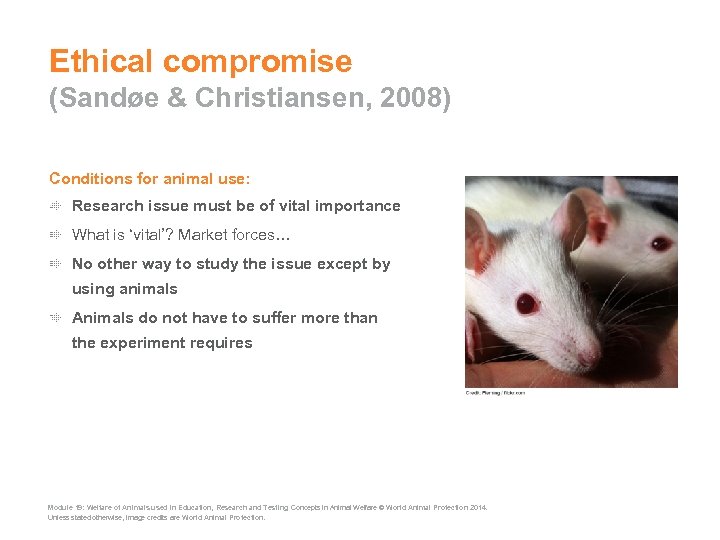 Ethical compromise (Sandøe & Christiansen, 2008) Conditions for animal use: Research issue must be of vital importance What is ‘vital’? Market forces… No other way to study the issue except by using animals Animals do not have to suffer more than the experiment requires Module 19: Welfare of Animals used in Education, Research and Testing Concepts in Animal Welfare © World Animal Protection 2014. Unless stated otherwise, image credits are World Animal Protection.
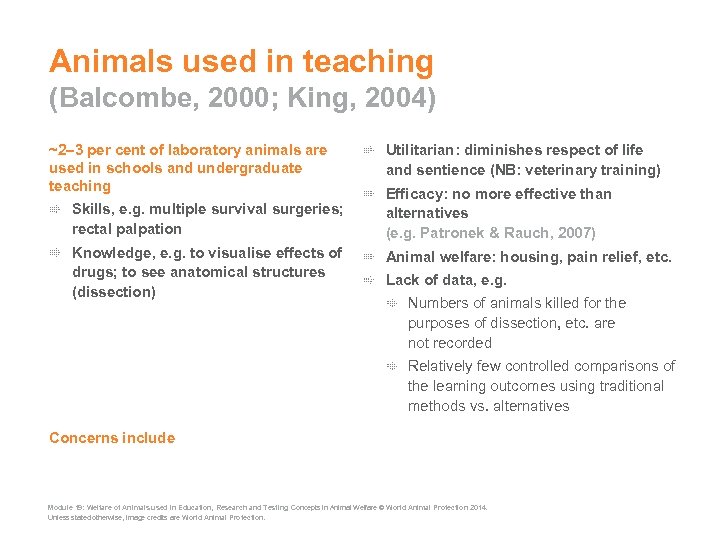 Animals used in teaching (Balcombe, 2000; King, 2004) ~2 3 per cent of laboratory animals are used in schools and undergraduate teaching Skills, e. g. multiple survival surgeries; rectal palpation Knowledge, e. g. to visualise effects of drugs; to see anatomical structures (dissection) Utilitarian: diminishes respect of life and sentience (NB: veterinary training) Efficacy: no more effective than alternatives (e. g. Patronek & Rauch, 2007) Animal welfare: housing, pain relief, etc. Lack of data, e. g. Numbers of animals killed for the purposes of dissection, etc. are not recorded Relatively few controlled comparisons of the learning outcomes using traditional methods vs. alternatives Concerns include Module 19: Welfare of Animals used in Education, Research and Testing Concepts in Animal Welfare © World Animal Protection 2014. Unless stated otherwise, image credits are World Animal Protection.
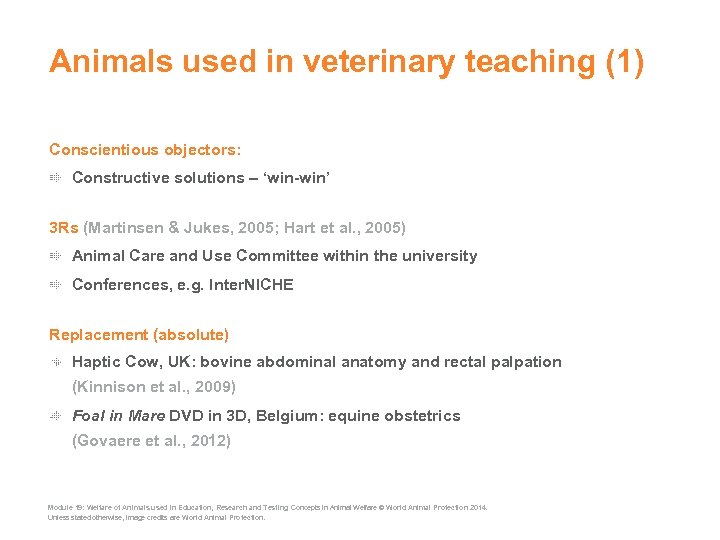 Animals used in veterinary teaching (1) Conscientious objectors: Constructive solutions ‘win-win’ 3 Rs (Martinsen & Jukes, 2005; Hart et al. , 2005) Animal Care and Use Committee within the university Conferences, e. g. Inter. NICHE Replacement (absolute) Haptic Cow, UK: bovine abdominal anatomy and rectal palpation (Kinnison et al. , 2009) Foal in Mare DVD in 3 D, Belgium: equine obstetrics (Govaere et al. , 2012) Module 19: Welfare of Animals used in Education, Research and Testing Concepts in Animal Welfare © World Animal Protection 2014. Unless stated otherwise, image credits are World Animal Protection.
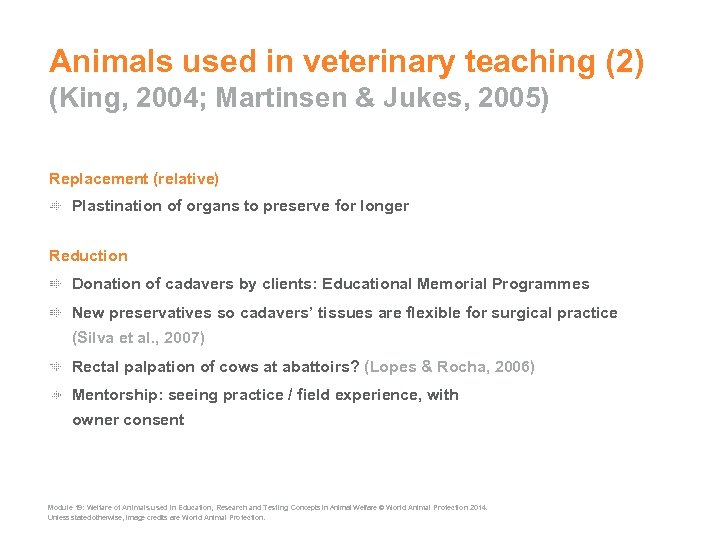 Animals used in veterinary teaching (2) (King, 2004; Martinsen & Jukes, 2005) Replacement (relative) Plastination of organs to preserve for longer Reduction Donation of cadavers by clients: Educational Memorial Programmes New preservatives so cadavers’ tissues are flexible for surgical practice (Silva et al. , 2007) Rectal palpation of cows at abattoirs? (Lopes & Rocha, 2006) Mentorship: seeing practice / field experience, with owner consent Module 19: Welfare of Animals used in Education, Research and Testing Concepts in Animal Welfare © World Animal Protection 2014. Unless stated otherwise, image credits are World Animal Protection.
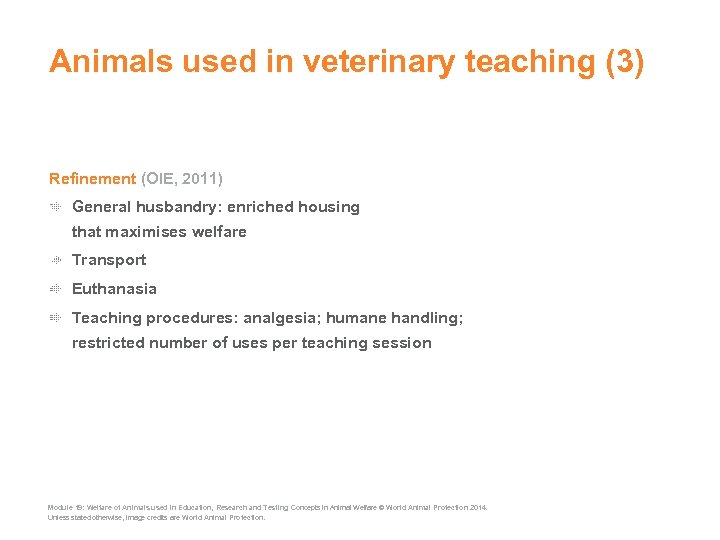 Animals used in veterinary teaching (3) Refinement (OIE, 2011) General husbandry: enriched housing that maximises welfare Transport Euthanasia Teaching procedures: analgesia; humane handling; restricted number of uses per teaching session Module 19: Welfare of Animals used in Education, Research and Testing Concepts in Animal Welfare © World Animal Protection 2014. Unless stated otherwise, image credits are World Animal Protection.
 Animals used in research (Richmond, 2010) Exploratory models Practical application not yet known Utilitarian ethic therefore problematic (Sandøe & Christiansen, 2008) Explanatory models Discover mechanisms, e. g. disease; drug action Genetically modified animals, e. g. cancer gene Predictive models Make decisions: efficacy, potency, safety Module 19: Welfare of Animals used in Education, Research and Testing Concepts in Animal Welfare © World Animal Protection 2014. Unless stated otherwise, image credits are World Animal Protection.
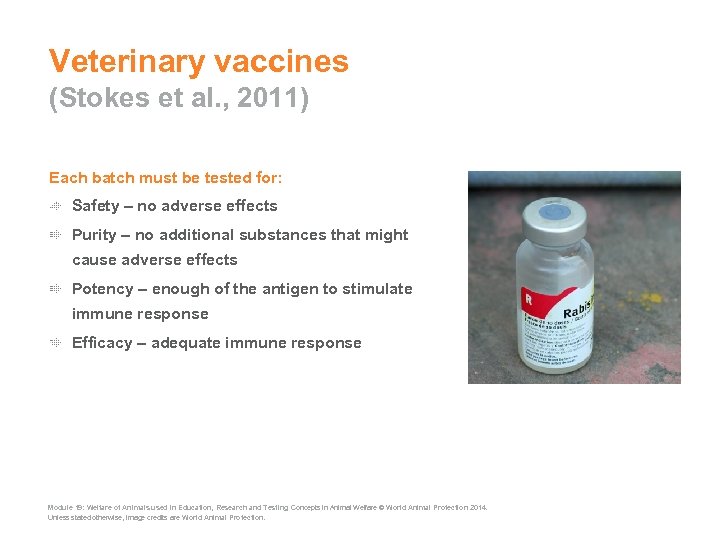 Veterinary vaccines (Stokes et al. , 2011) Each batch must be tested for: Safety – no adverse effects Purity – no additional substances that might cause adverse effects Potency – enough of the antigen to stimulate immune response Efficacy – adequate immune response Module 19: Welfare of Animals used in Education, Research and Testing Concepts in Animal Welfare © World Animal Protection 2014. Unless stated otherwise, image credits are World Animal Protection.
 The 3 Rs and veterinary vaccines (Stokes et al. , 2011) Potency testing Refinement of potency testing Serial dilutions of vaccine given to groups Research to identify clinical signs that of animals + one unvaccinated control predict death Challenged with pathogen Training personnel to recognise this – if vaccinated animals become In vitro alternatives not all regulatory sick and die, potency at that authorities have accepted them dilution is inadequate Welfare concern: inhumane end-point Reduction of potency testing Minimum numbers per group Humane end-point (OIE, 2011) Combination testing Point when experimental animals suffering is terminated by, e. g. analgesia, euthanasia, removing from the study Similar concerns with fish vaccines (Midtlyng et al. , 2011) Module 19: Welfare of Animals used in Education, Research and Testing Concepts in Animal Welfare © World Animal Protection 2014. Unless stated otherwise, image credits are World Animal Protection.
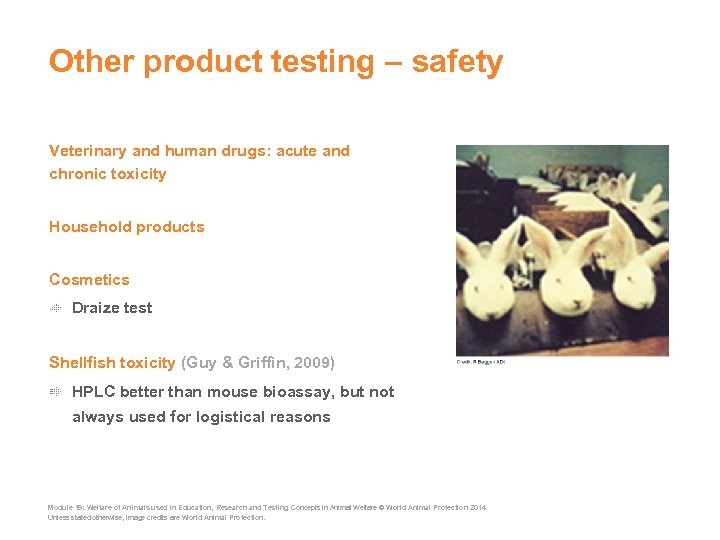 Other product testing safety Veterinary and human drugs: acute and chronic toxicity Household products Cosmetics Draize test Shellfish toxicity (Guy & Griffin, 2009) HPLC better than mouse bioassay, but not always used for logistical reasons Module 19: Welfare of Animals used in Education, Research and Testing Concepts in Animal Welfare © World Animal Protection 2014. Unless stated otherwise, image credits are World Animal Protection.
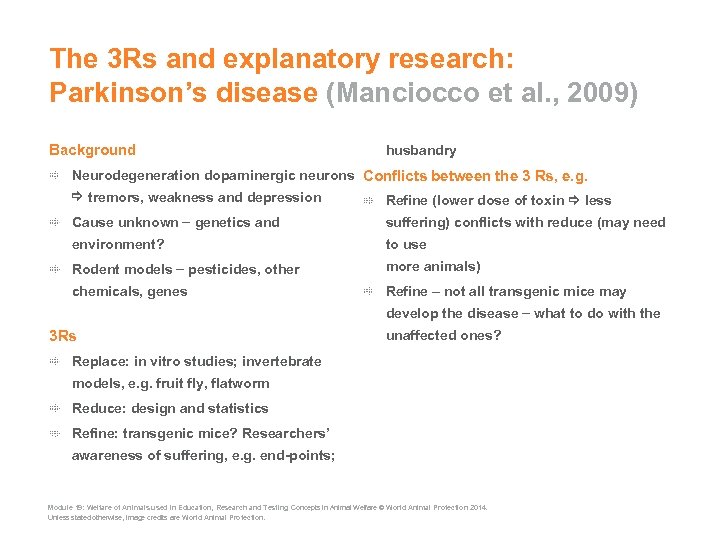 The 3 Rs and explanatory research: Parkinson’s disease (Manciocco et al. , 2009) Background husbandry Neurodegeneration dopaminergic neurons Conflicts between the 3 Rs, e. g. tremors, weakness and depression Refine (lower dose of toxin less Cause unknown genetics and suffering) conflicts with reduce (may need environment? to use Rodent models pesticides, other more animals) chemicals, genes Refine not all transgenic mice may develop the disease what to do with the 3 Rs unaffected ones? Replace: in vitro studies; invertebrate models, e. g. fruit fly, flatworm Reduce: design and statistics Refine: transgenic mice? Researchers’ awareness of suffering, e. g. end-points; Module 19: Welfare of Animals used in Education, Research and Testing Concepts in Animal Welfare © World Animal Protection 2014. Unless stated otherwise, image credits are World Animal Protection.
 Genetically modified animals Manipulating genes Within species or Between species – transgenic animals, e. g. human gene in mice Problems include (Christiansen & Sandøe, 2000; Kues & Niemann, 2011) Suffering from the induced condition of interest, e. g. Parkinson’s in transgenic mice Unexpected effects, e. g. eccelerated growth rate in transgenic farm animals; tumours ‘Wastage’ Module 19: Welfare of Animals used in Education, Research and Testing Concepts in Animal Welfare © World Animal Protection 2014. Unless stated otherwise, image credits are World Animal Protection.
 Uses of genetically modified animals (Kues & Niemann, 2011) ‘Bio reactors’: production of therapeutic proteins in milk Livestock / agriculture, e. g. routines in fish farming Transgenic animals as models of human diseases Xenotransplantation: production of compatible organs for transplantation into humans Pigs disease free Caesarean delivery, reared in sterile environments Module 19: Welfare of Animals used in Education, Research and Testing Concepts in Animal Welfare © World Animal Protection 2014. Unless stated otherwise, image credits are World Animal Protection.
 Greater use of the 3 Rs Discussion of them in scientific papers? Other reductions: Few researchers do Clinical research on client-owned Huntingdon’s disease papers animals (Olsson et al. , 2008): 3/51 mentioned More observational ‘real world’ data, to adapting the housing; 6/14 mentioned reduce reliance on lab animals euthanasia of moribund animals Translational research, e. g. osteoarthritis in dogs (Vainio, 2012) Make it an absolute requirement, e. g. Animal Care and Use Committees Funding bodies Journal guidelines, e. g. Animal Behaviour (Anon, 2012) Module 19: Welfare of Animals used in Education, Research and Testing Concepts in Animal Welfare © World Animal Protection 2014. Unless stated otherwise, image credits are World Animal Protection.
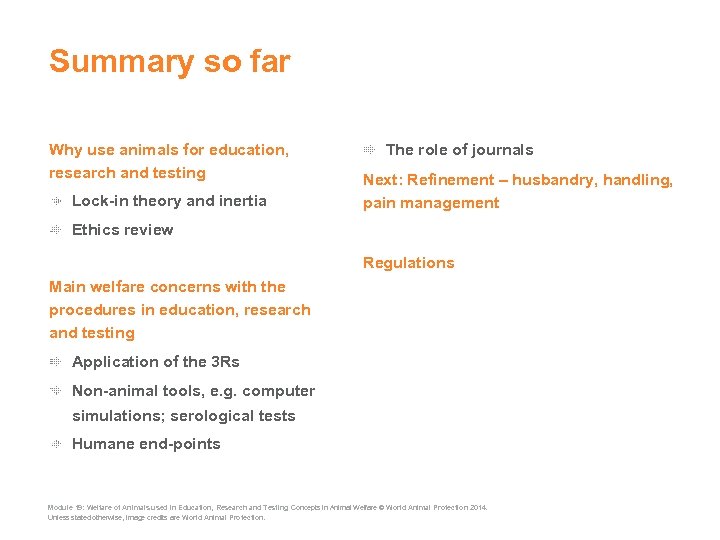 Summary so far Why use animals for education, research and testing Lock-in theory and inertia The role of journals Next: Refinement husbandry, handling, pain management Ethics review Regulations Main welfare concerns with the procedures in education, research and testing Application of the 3 Rs Non-animal tools, e. g. computer simulations; serological tests Humane end-points Module 19: Welfare of Animals used in Education, Research and Testing Concepts in Animal Welfare © World Animal Protection 2014. Unless stated otherwise, image credits are World Animal Protection.
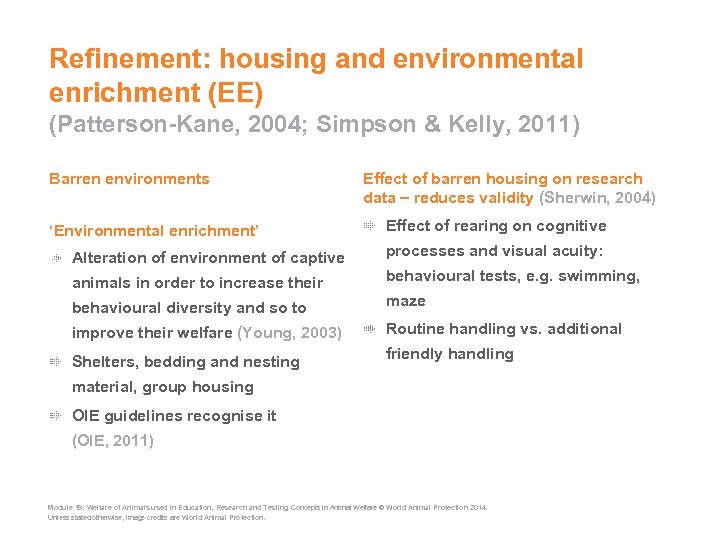 Refinement: housing and environmental enrichment (EE) (Patterson-Kane, 2004; Simpson & Kelly, 2011) Barren environments ‘Environmental enrichment’ Alteration of environment of captive animals in order to increase their Effect of barren housing on research data reduces validity (Sherwin, 2004) Effect of rearing on cognitive processes and visual acuity: behavioural tests, e. g. swimming, behavioural diversity and so to maze improve their welfare (Young, 2003) Routine handling vs. additional Shelters, bedding and nesting friendly handling material, group housing OIE guidelines recognise it (OIE, 2011) Module 19: Welfare of Animals used in Education, Research and Testing Concepts in Animal Welfare © World Animal Protection 2014. Unless stated otherwise, image credits are World Animal Protection.
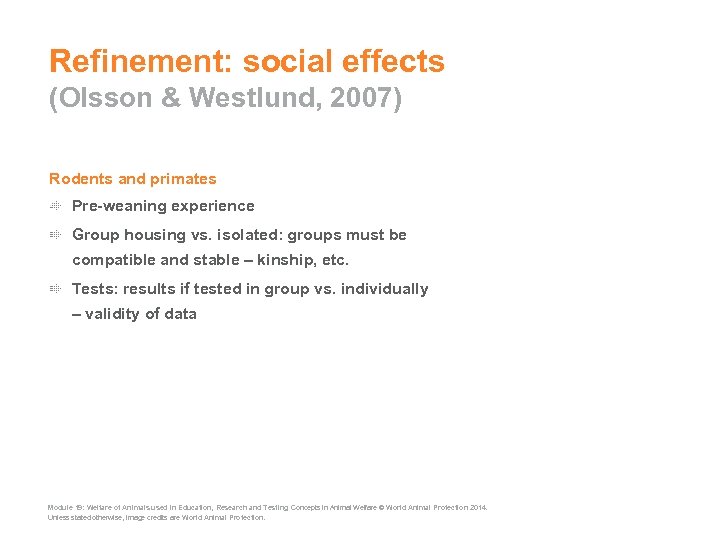 Refinement: social effects (Olsson & Westlund, 2007) Rodents and primates Pre-weaning experience Group housing vs. isolated: groups must be compatible and stable kinship, etc. Tests: results if tested in group vs. individually – validity of data Module 19: Welfare of Animals used in Education, Research and Testing Concepts in Animal Welfare © World Animal Protection 2014. Unless stated otherwise, image credits are World Animal Protection.
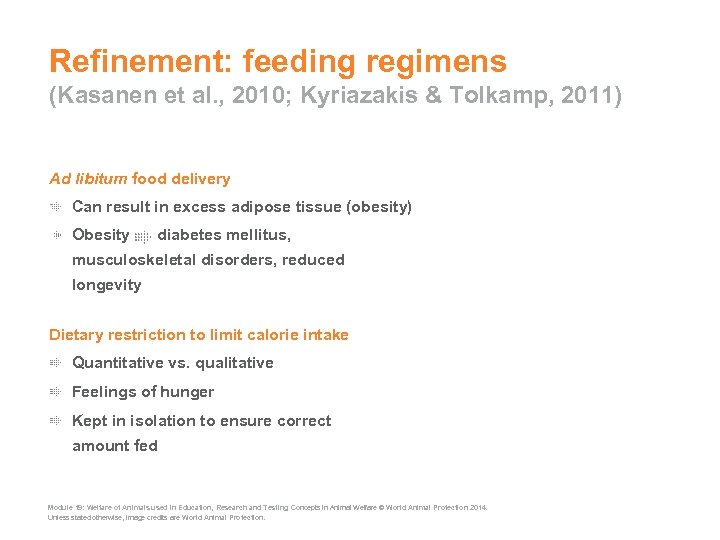 Refinement: feeding regimens (Kasanen et al. , 2010; Kyriazakis & Tolkamp, 2011) Ad libitum food delivery Can result in excess adipose tissue (obesity) Obesity diabetes mellitus, musculoskeletal disorders, reduced longevity Dietary restriction to limit calorie intake Quantitative vs. qualitative Feelings of hunger Kept in isolation to ensure correct amount fed Module 19: Welfare of Animals used in Education, Research and Testing Concepts in Animal Welfare © World Animal Protection 2014. Unless stated otherwise, image credits are World Animal Protection.
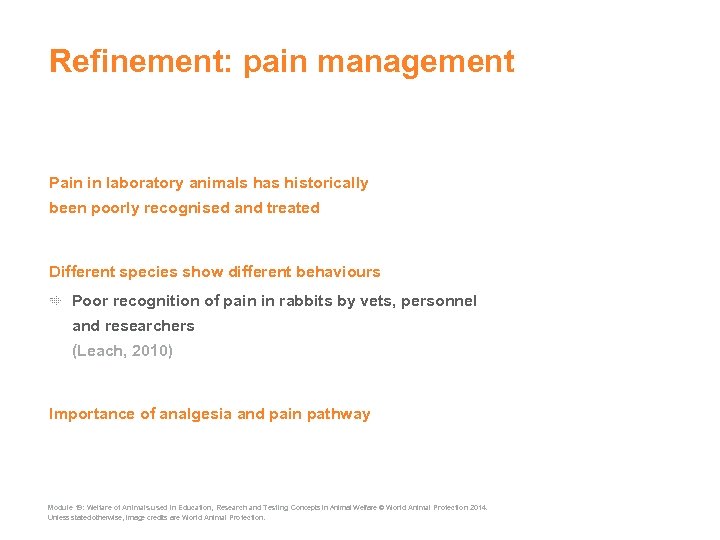 Refinement: pain management Pain in laboratory animals has historically been poorly recognised and treated Different species show different behaviours Poor recognition of pain in rabbits by vets, personnel and researchers (Leach, 2010) Importance of analgesia and pain pathway Module 19: Welfare of Animals used in Education, Research and Testing Concepts in Animal Welfare © World Animal Protection 2014. Unless stated otherwise, image credits are World Animal Protection.
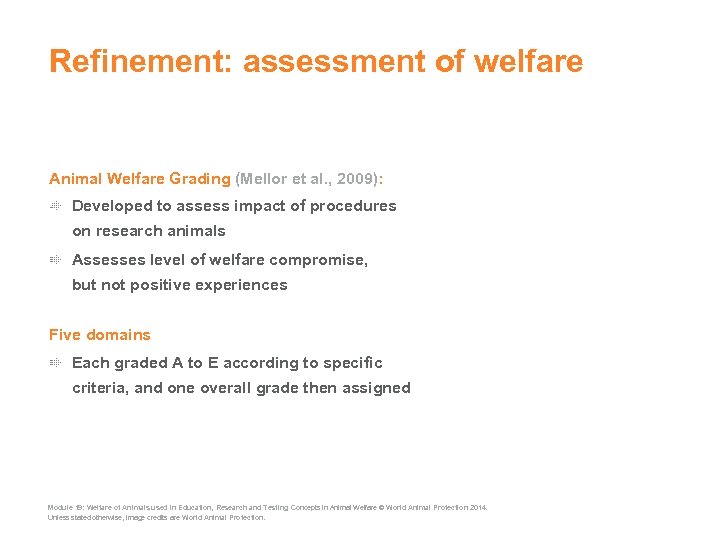 Refinement: assessment of welfare Animal Welfare Grading (Mellor et al. , 2009): Developed to assess impact of procedures on research animals Assesses level of welfare compromise, but not positive experiences Five domains Each graded A to E according to specific criteria, and one overall grade then assigned Module 19: Welfare of Animals used in Education, Research and Testing Concepts in Animal Welfare © World Animal Protection 2014. Unless stated otherwise, image credits are World Animal Protection.
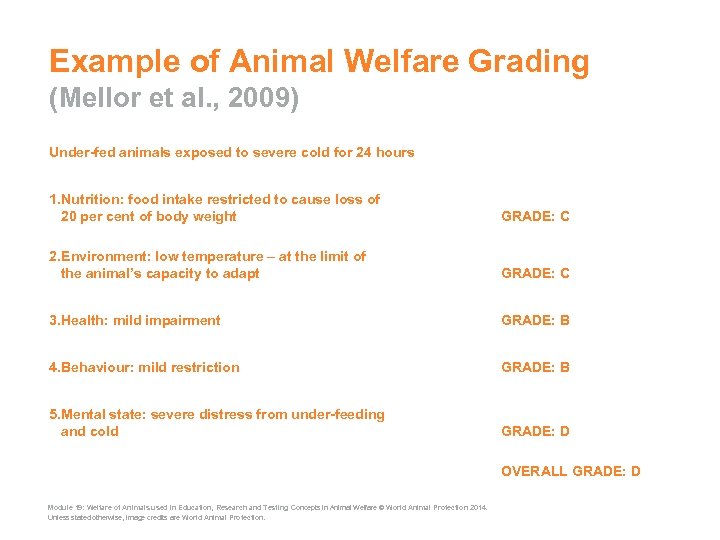 Example of Animal Welfare Grading (Mellor et al. , 2009) Under-fed animals exposed to severe cold for 24 hours 1. Nutrition: food intake restricted to cause loss of 20 per cent of body weight GRADE: C 2. Environment: low temperature at the limit of the animal’s capacity to adapt GRADE: C 3. Health: mild impairment GRADE: B 4. Behaviour: mild restriction GRADE: B 5. Mental state: severe distress from under-feeding and cold GRADE: D OVERALL GRADE: D Module 19: Welfare of Animals used in Education, Research and Testing Concepts in Animal Welfare © World Animal Protection 2014. Unless stated otherwise, image credits are World Animal Protection.
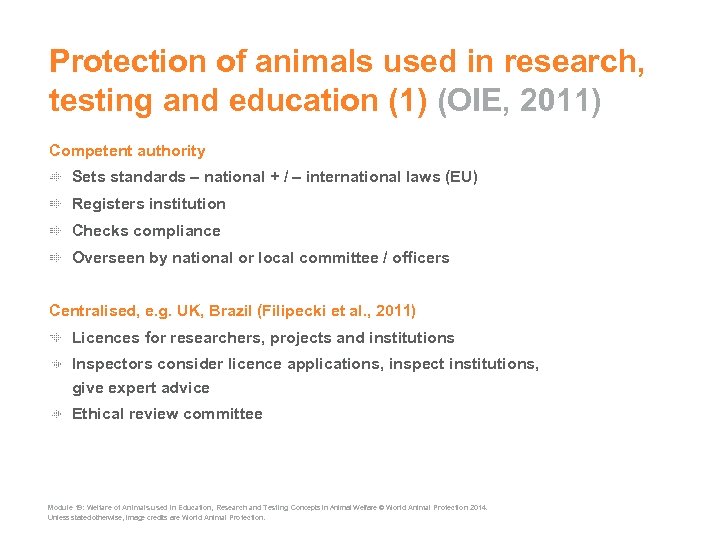 Protection of animals used in research, testing and education (1) (OIE, 2011) Competent authority Sets standards national + / international laws (EU) Registers institution Checks compliance Overseen by national or local committee / officers Centralised, e. g. UK, Brazil (Filipecki et al. , 2011) Licences for researchers, projects and institutions Inspectors consider licence applications, inspect institutions, give expert advice Ethical review committee Module 19: Welfare of Animals used in Education, Research and Testing Concepts in Animal Welfare © World Animal Protection 2014. Unless stated otherwise, image credits are World Animal Protection.
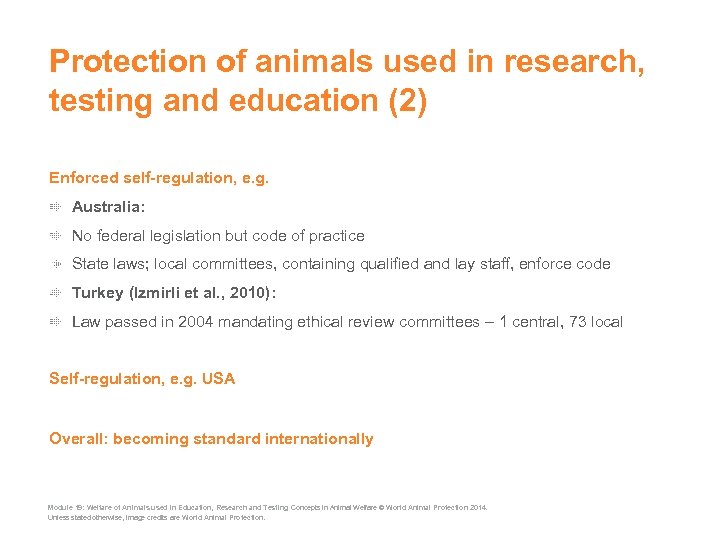 Protection of animals used in research, testing and education (2) Enforced self-regulation, e. g. Australia: No federal legislation but code of practice State laws; local committees, containing qualified and lay staff, enforce code Turkey (Izmirli et al. , 2010): Law passed in 2004 mandating ethical review committees – 1 central, 73 local Self-regulation, e. g. USA Overall: becoming standard internationally Module 19: Welfare of Animals used in Education, Research and Testing Concepts in Animal Welfare © World Animal Protection 2014. Unless stated otherwise, image credits are World Animal Protection.
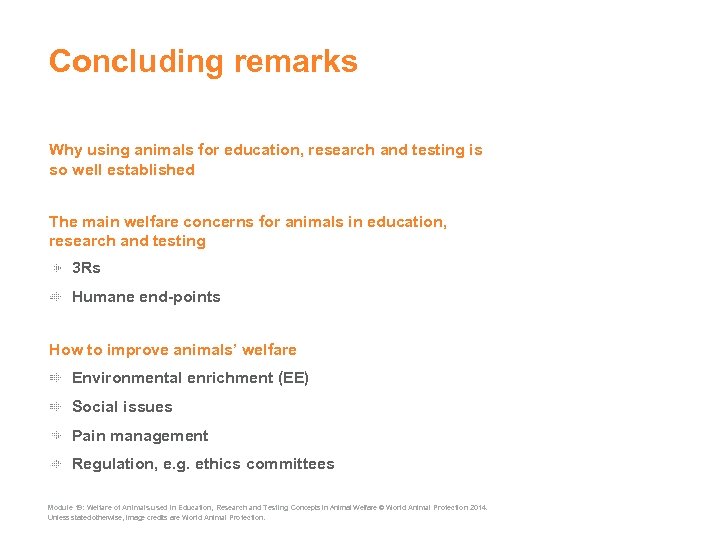 Concluding remarks Why using animals for education, research and testing is so well established The main welfare concerns for animals in education, research and testing 3 Rs Humane end-points How to improve animals’ welfare Environmental enrichment (EE) Social issues Pain management Regulation, e. g. ethics committees Module 19: Welfare of Animals used in Education, Research and Testing Concepts in Animal Welfare © World Animal Protection 2014. Unless stated otherwise, image credits are World Animal Protection.
 Feedback: Please let us know what you think How have you used this module? What did you like about it? What did you not like? Do you have any tips to share? Please take part in our 10 minute survey here: https: //www. surveymonkey. com/s/BKP 3 D 6 H Your feedback will help other teachers like you Module 19: Welfare of Animals used in Education, Research and Testing Concepts in Animal Welfare © World Animal Protection 2014. Unless stated otherwise, image credits are World Animal Protection.
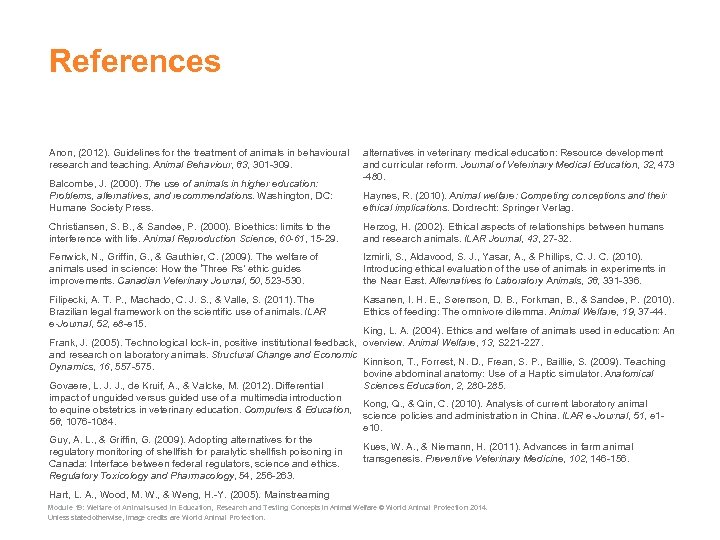 References Anon, (2012). Guidelines for the treatment of animals in behavioural research and teaching. Animal Behaviour, 83, 301 -309. Balcombe, J. (2000). The use of animals in higher education: Problems, alternatives, and recommendations. Washington, DC: Humane Society Press. alternatives in veterinary medical education: Resource development and curricular reform. Journal of Veterinary Medical Education, 32, 473 -480. Haynes, R. (2010). Animal welfare: Competing conceptions and their ethical implications. Dordrecht: Springer Verlag. Christiansen, S. B. , & Sandøe, P. (2000). Bioethics: limits to the interference with life. Animal Reproduction Science, 60 -61, 15 -29. Herzog, H. (2002). Ethical aspects of relationships between humans and research animals. ILAR Journal, 43, 27 -32. Fenwick, N. , Griffin, G. , & Gauthier, C. (2009). The welfare of animals used in science: How the ‘Three Rs’ ethic guides improvements. Canadian Veterinary Journal, 50, 523 -530. Izmirli, S. , Aldavood, S. J. , Yasar, A. , & Phillips, C. J. C. (2010). Introducing ethical evaluation of the use of animals in experiments in the Near East. Alternatives to Laboratory Animals, 38, 331 -336. Filipecki, A. T. P. , Machado, C. J. S. , & Valle, S. (2011). The Brazilian legal framework on the scientific use of animals. ILAR e-Journal, 52, e 8 -e 15. Kasanen, I. H. E. , Sørenson, D. B. , Forkman, B. , & Sandøe, P. (2010). Ethics of feeding: The omnivore dilemma. Animal Welfare, 19, 37 -44. King, L. A. (2004). Ethics and welfare of animals used in education: An Frank, J. (2005). Technological lock-in, positive institutional feedback, overview. Animal Welfare, 13, S 221 -227. and research on laboratory animals. Structural Change and Economic Kinnison, T. , Forrest, N. D. , Frean, S. P. , Baillie, S. (2009). Teaching Dynamics, 16, 557 -575. bovine abdominal anatomy: Use of a Haptic simulator. Anatomical Sciences Education, 2, 280 -285. Govaere, L. J. J. , de Kruif, A. , & Valcke, M. (2012). Differential impact of unguided versus guided use of a multimedia introduction Kong, Q. , & Qin, C. (2010). Analysis of current laboratory animal to equine obstetrics in veterinary education. Computers & Education, science policies and administration in China. ILAR e-Journal, 51, e 158, 1076 -1084. e 10. Guy, A. L. , & Griffin, G. (2009). Adopting alternatives for the Kues, W. A. , & Niemann, H. (2011). Advances in farm animal regulatory monitoring of shellfish for paralytic shellfish poisoning in transgenesis. Preventive Veterinary Medicine, 102, 146 -156. Canada: Interface between federal regulators, science and ethics. Regulatory Toxicology and Pharmacology, 54, 256 -263. Hart, L. A. , Wood, M. W. , & Weng, H. -Y. (2005). Mainstreaming Module 19: Welfare of Animals used in Education, Research and Testing Concepts in Animal Welfare © World Animal Protection 2014. Unless stated otherwise, image credits are World Animal Protection.
 References Kyriazakis, I. , & Tolkamp, B. (2011). Hunger and thirst. In M. C. Appleby, J. A. Mench, I. A. S. Olsson, & B. O. Hughes (Eds. ), Animal welfare (pp. 44 -63). Wallingford, UK: CABI. Midtlyng, P. J. , Hendriksen, C. , Balks, E. , Bruckner, L. , Elsken, L. , Evensen, Ø. , Fyrand, K. , Guy, A. , Halder, M. , Hawkins, P. , Kisen, G. , Berit Romstad A. , Salonius, K, Smith, P. , Sneddon, L. U. (2011). Three Rs approaches in the production and quality control of fish vaccines. Biologicals, 39, 117 -128. Leach, M. (2010). Looking in the wrong place … implications for assessing pain and distress in animals. In P. Hawkins, C. Burn, J. Hurst, O. Burman, P. Van Loo, M. Leach, M. Maconochie, N. Dennison, Nyika, A. (2009). Animal research ethics in Africa: An overview. Acta M. Jennings, R. Hubrecht (Eds. ), Report of the 2010 RSPCA/UFAW Tropica, 112 S, S 48 -S 52. Rodent Welfare Group meeting – the effects of husbandry on welfare and promoting good practice. Animal Technology and Welfare, 2011, Office International des Epizooties (OIE) (2011). Chapter 7. 8: Use of animals in research and education. Office International des Epizooties 108 -109. Terrestrial Animal Health Code. Paris: OIE. Lopes, G. , & Rocha, A. (2006). Teaching bovine rectal palpation Olsson, I. A. S. , & Westlund, K. (2007). More than numbers matter: The with live cows in the slaughterhouse: is it worthwhile? Reproduction of Domestic Animals, 41, 510 -513. effect of social factors on behaviour and welfare of laboratory rodents and non-human primates. Applied Animal Behaviour Science, 103, 229 Manciocco, A. , Chiarotti, F. , Vitale, A. , Calamandrei, G. , Laviola, G. , -254. Alleva, E. (2009). The application of Russell and Burch 3 R principle in rodent models of neurodegenerative disease: The case of Parkinson’s disease. Neuroscience and Biobehavioral Reviews, 33, 18 -32. Olsson, I. A. S. , Hansen, A. K. , & Sandøe, P. (2008). Animal welfare and the refinement of neuroscience research methods – a case study of Huntington’s disease models. Laboratory Animals, 42, 277 -283. Martinsen, S. , & Jukes, N. (2005). Towards a humane veterinary education. Journal of Veterinary Medical Education, 32, 454 -460. Patronek, G. J. , & Rauch, A. (2007). Systematic review of comparative studies examining alternatives to the harmful use of animals in Mellor, D. J. , Patterson-Kane, E. , & Stafford, K. (2009). The sciences ofbiomedical education. Journal of the American Veterinary Medical animal welfare (pp. 72 -94). UFAW Animal Welfare Series. Oxford: Association, 230, 37 -43. Wiley-Blackwell. Module 19: Welfare of Animals used in Education, Research and Testing Concepts in Animal Welfare © World Animal Protection 2014. Unless stated otherwise, image credits are World Animal Protection.
 References Patterson-Kane, E. G. (2004). Enrichment of laboratory caging for rats: A review. Animal Welfare, 13, S 209 -214. Richmond, J. (2010). The three Rs. In R. Hubrecht & J. Kirkwood (Eds. ), The UFAW handbook on the care and management of laboratory and other research animals (8 th ed, pp. 5 -22). Oxford: Wiley-Blackwell. Russell, W. M. S. , & Burch, R. L. (1959) (reprinted 1992). The principles of humane experimental technique. Wheathampstead, UK : Universities Federation for Animal Welfare. Sandøe, P. , & Christiansen, S. B. (2008). Ethics of animal use. Chichester, UK: Wiley Sherwin, C. (2004). The influences of standard laboratory cages on rodents and the validity of research data. Animal Welfare, 13, S 9 -15. Stokes, W. S. , Brown, K. , Kulpa-Eddy, J. , Srinivas, G. , Halder, M. , Draayer, H. , Galvin, J. , Claassen, I. , Gifford, G. , Woodland, R. , Doelling, V. , Jones, B. (2011). Improving animal welfare and reducing animal use for veterinary vaccine potency testing: State of the science and future directions. Procedia in Vaccinology, 5, 84 -105. Vainio, O. (2012). Translational animal models using veterinary patients – An example of canine osteoarthritis (OA). Scandinavian Journal of Pain, 3, 84 -89. World Health Organization (WHO) (2012). Health topics: Poliomyelitis. Geneva: World Health Organization. Retrieved July 15, 2012, from www. who. int/topics/poliomyelitis/en/ Young, R. J. (2003). Environmental enrichment for captive animals. Oxford: Blackwell. Silva, R. N. G. , Matera, J. M. , & Ribeiro, A. A. C. M. (2007). New alternative methods to teach surgical techniques for veterinary medicine students despite the absence of living animals. Is that an academic paradox? Anatomy Histology Embryology, 36, 220 -224. Simpson, J. , & Kelly, J. P. (2011). The impact of environmental enrichment in laboratory rats: Behavioural and neurochemical aspects. Behavioural Brain Research, 222, 246 -264. Module 19: Welfare of Animals used in Education, Research and Testing Concepts in Animal Welfare © World Animal Protection 2014. Unless stated otherwise, image credits are World Animal Protection.
 Websites about alternatives to animals in laboratories or education www. interniche. org www. eurca. org http: //oslovet. veths. no/NORINA www. Humane. Learning. info www. pcrm. org www. navs. org/site/Page. Server? pagename=index Module 19: Welfare of Animals used in Education, Research and Testing Concepts in Animal Welfare © World Animal Protection 2014. Unless stated otherwise, image credits are World Animal Protection.
 Websites about the 3 Rs www. nc 3 rs. org. uk www. frame. org. uk http: //caat. jhsph. edu http: //ecvam. jrc. it/index. htm http: //iccvam. niehs. nih. gov www. ardf-online. org Module 19: Welfare of Animals used in Education, Research and Testing Concepts in Animal Welfare © World Animal Protection 2014. Unless stated otherwise, image credits are World Animal Protection.