 Скачать презентацию Module 19 Security n The Security Problem n
69283f50b9815ca9fc99f2ee85d9276f.ppt
- Количество слайдов: 17



Module 19: Security n The Security Problem n Authentication n Program Threats n System Threats n Securing Systems n Intrusion Detection n Encryption n Windows NT Operating System Concepts 19. 1 Silberschatz, Galvin and Gagne 2002
The Security Problem n Security must consider external environment of the system, and protect it from: F unauthorized access. F malicious modification or destruction F accidental introduction of inconsistency. n Easier to protect against accidental than malicious misuse. Operating System Concepts 19. 2 Silberschatz, Galvin and Gagne 2002
Authentication n User identity most often established through passwords, can be considered a special case of either keys or capabilities. n Passwords must be kept secret. F Frequent change of passwords. F Use of “non-guessable” passwords. F Log all invalid access attempts. n Passwords may also either be encrypted or allowed to be used only once. Operating System Concepts 19. 3 Silberschatz, Galvin and Gagne 2002
Program Threats n Trojan Horse F Code segment that misuses its environment. F Exploits mechanisms for allowing programs written by users to be executed by other users. n Trap Door F Specific user identifier or password that circumvents normal security procedures. F Could be included in a compiler. n Stack and Buffer Overflow F Exploits a bug in a program (overflow either the stack or memory buffers. ) Operating System Concepts 19. 4 Silberschatz, Galvin and Gagne 2002
System Threats n Worms – use spawn mechanism; standalone program n Internet worm F Exploited UNIX networking features (remote access) and bugs in finger and sendmail programs. F Grappling hook program uploaded main worm program. n Viruses – fragment of code embedded in a legitimate program. F Mainly effect microcomputer systems. F Downloading viral programs from public bulletin boards or exchanging floppy disks containing an infection. F Safe computing. n Denial of Service F Overload the targeted computer preventing it from doing any sueful work. Operating System Concepts 19. 5 Silberschatz, Galvin and Gagne 2002
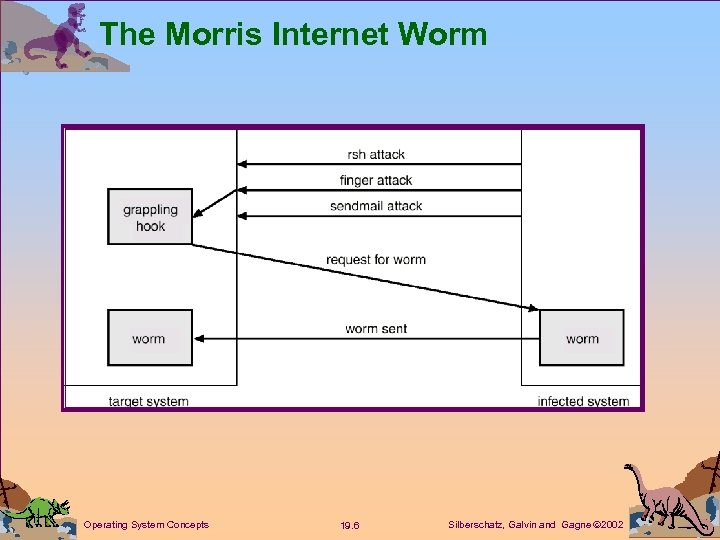
The Morris Internet Worm Operating System Concepts 19. 6 Silberschatz, Galvin and Gagne 2002
Threat Monitoring n Check for suspicious patterns of activity – i. e. , several incorrect password attempts may signal password guessing. n Audit log – records the time, user, and type of all accesses to an object; useful for recovery from a violation and developing better security measures. n Scan the system periodically for security holes; done when the computer is relatively unused. Operating System Concepts 19. 7 Silberschatz, Galvin and Gagne 2002
Threat Monitoring (Cont. ) n Check for: F Short or easy-to-guess passwords F Unauthorized set-uid programs F Unauthorized programs in system directories F Unexpected long-running processes F Improper directory protections F Improper protections on system data files F Dangerous entries in the program search path (Trojan horse) F Changes to system programs: monitor checksum values Operating System Concepts 19. 8 Silberschatz, Galvin and Gagne 2002
Fire. Wall n A firewall is placed between trusted and untrusted hosts. n The firewall limits network access between these two security domains. Operating System Concepts 19. 9 Silberschatz, Galvin and Gagne 2002
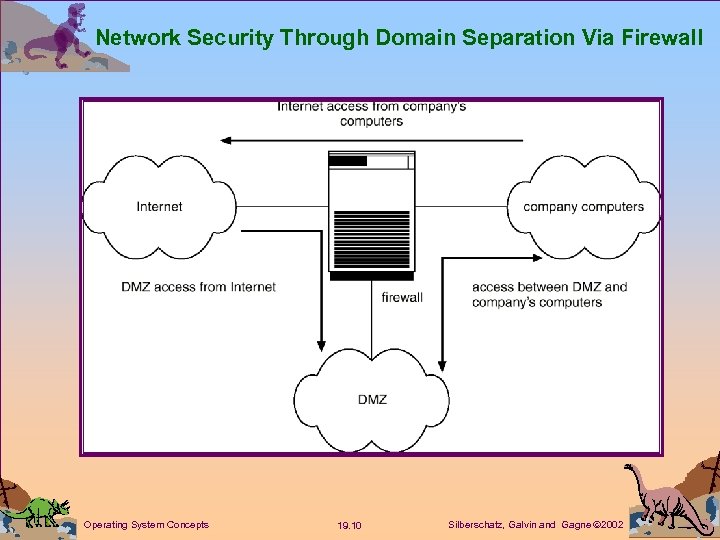
Network Security Through Domain Separation Via Firewall Operating System Concepts 19. 10 Silberschatz, Galvin and Gagne 2002
Intrusion Detection n Detect attempts to intrude into computer systems. n Detection methods: F Auditing and logging. F Tripwire (UNIX software that checks if certain files and directories have been altered – I. e. password files) n System call monitoring Operating System Concepts 19. 11 Silberschatz, Galvin and Gagne 2002
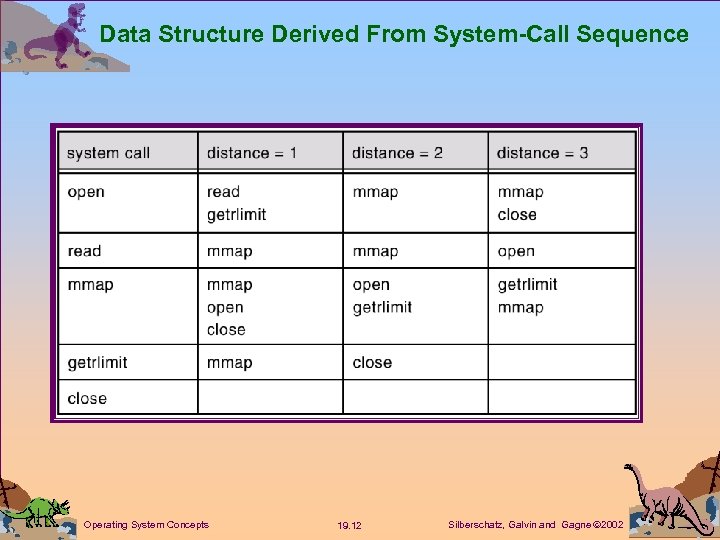
Data Structure Derived From System-Call Sequence Operating System Concepts 19. 12 Silberschatz, Galvin and Gagne 2002
Encryption n Encrypt clear text into cipher text. n Properties of good encryption technique: F Relatively simple for authorized users to incrypt and decrypt data. F Encryption scheme depends not on the secrecy of the algorithm but on a parameter of the algorithm called the encryption key. F Extremely difficult for an intruder to determine the encryption key. n Data Encryption Standard substitutes characters and rearranges their order on the basis of an encryption key provided to authorized users via a secure mechanism. Scheme only as secure as the mechanism. Operating System Concepts 19. 13 Silberschatz, Galvin and Gagne 2002
Encryption (Cont. ) n Public-key encryption based on each user having two keys: F public key – published key used to encrypt data. F private key – key known only to individual user used to decrypt data. n Must be an encryption scheme that can be made public without making it easy to figure out the decryption scheme. F Efficient algorithm for testing whether or not a number is prime. F No efficient algorithm is know for finding the prime factors of a number. Operating System Concepts 19. 14 Silberschatz, Galvin and Gagne 2002
Encryption Example - SSL n SSL – Secure Socket Layer n Cryptographic protocol that limits two computers to only exchange messages with each other. n Used between web servers and browsers for secure communication (credit card numbers) n The server is verified with a certificate. n Communication between each computers uses symmetric key cryptography. Operating System Concepts 19. 15 Silberschatz, Galvin and Gagne 2002
Computer Security Classifications n U. S. Department of Defense outlines four divisions of n n computer security: A, B, C, and D. D – Minimal security. C – Provides discretionary protection through auditing. Divided into C 1 and C 2. C 1 identifies cooperating users with the same level of protection. C 2 allows user-level access control. B – All the properties of C, however each object may have unique sensitivity labels. Divided into B 1, B 2, and B 3. A – Uses formal design and verification techniques to ensure security. Operating System Concepts 19. 16 Silberschatz, Galvin and Gagne 2002
Windows NT Example n Configurable security allows policies ranging from D to C 2. n Security is based on user accounts where each user has a security ID. n Uses a subject model to ensure access security. A subject tracks and manages permissions for each program that a user runs. n Each object in Windows NT has a security attribute defined by a security descriptor. For example, a file has a security descriptor that indicates the access permissions for all users. Operating System Concepts 19. 17 Silberschatz, Galvin and Gagne 2002
Скачать презентацию Module 19 Security n The Security Problem n
69283f50b9815ca9fc99f2ee85d9276f.ppt