


 Скачать презентацию MODULE 13 ELECTRONIC COMMERCE Learning Units 13 1
8dfb33f4cd5a5dd9b833b858455aea3e.ppt
- Количество слайдов: 93
 MODULE 13 ELECTRONIC COMMERCE Learning Units 13. 1 What is E-Commerce? 13. 2 Electronic Data Interchange 13. 3 Security of E-Commerce 13. 4 Payment in E-Commerce Systems Analysis And Design © V. Rajaraman
 Learning Goals § The basics of Electronic Commerce abbreviated as e-commerce § The advantages and disadvantages of e-commerce § Architecture of e-commerce systems § Electronic Data Interchange in e-commerce § The need for security in e-commerce transactions and how to ensure it § How Electronic payment schemes work in e-commerce. Systems Analysis And Design © V. Rajaraman 1 of 92
 Motivation § With the emergence of internet and the world wide web new methods of carrying out business transactions using the world wide web began to be explored. § Electronic Commerce emerged as a very important application of the world wide web. § Today it is difficult to find an isolated computer. Computers in an organization are interconnected to form intranets and intranets of the cooperating organizations are interconnected to form extranet. Systems Analysis And Design © V. Rajaraman 2 of 92
 Motivation (Contd) § It is cheaper and faster to carry out business transactions within an organization and among organizations electronically using the network connection. § Thus it is important to understand how business transactions are carried out electronically reliably and securely § When designing information systems it is essential to understand the emerging web based transactions § A number of organizations are exploring how to carry out all dayto-day operations electronically using the intranet in a so-called paperless system § It is thus important for a student to understand how to design such systems Systems Analysis And Design © V. Rajaraman 3 of 92
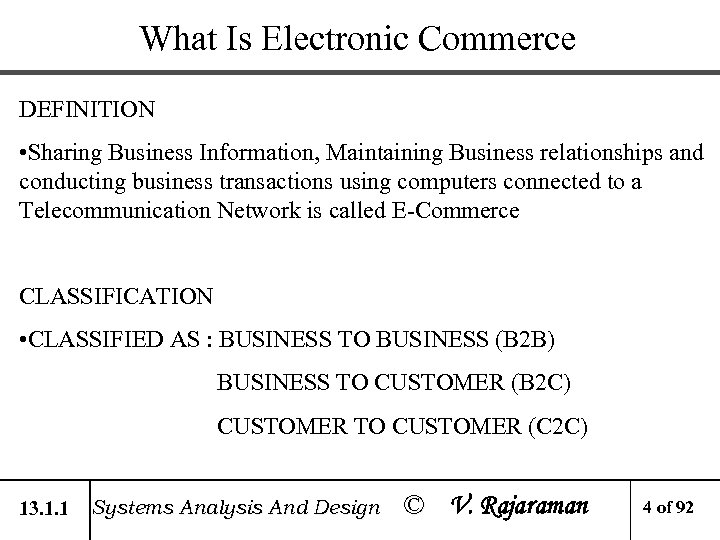 What Is Electronic Commerce DEFINITION • Sharing Business Information, Maintaining Business relationships and conducting business transactions using computers connected to a Telecommunication Network is called E-Commerce CLASSIFICATION • CLASSIFIED AS : BUSINESS TO BUSINESS (B 2 B) BUSINESS TO CUSTOMER (B 2 C) CUSTOMER TO CUSTOMER (C 2 C) 13. 1. 1 Systems Analysis And Design © V. Rajaraman 4 of 92
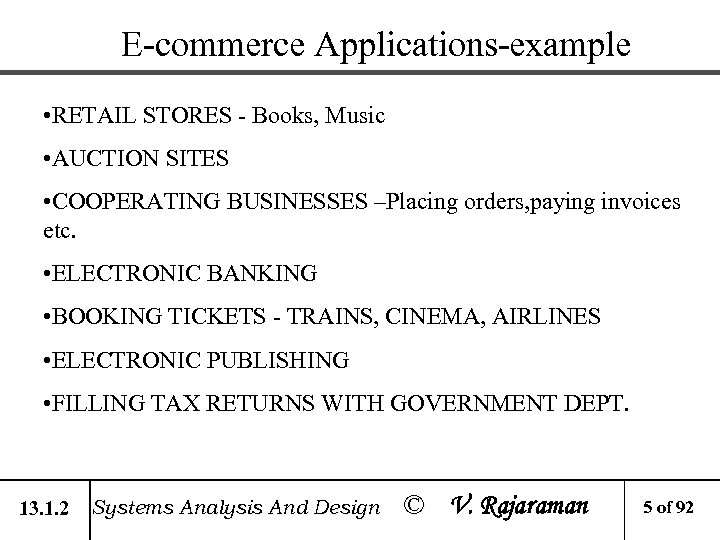 E-commerce Applications-example • RETAIL STORES - Books, Music • AUCTION SITES • COOPERATING BUSINESSES –Placing orders, paying invoices etc. • ELECTRONIC BANKING • BOOKING TICKETS - TRAINS, CINEMA, AIRLINES • ELECTRONIC PUBLISHING • FILLING TAX RETURNS WITH GOVERNMENT DEPT. 13. 1. 2 Systems Analysis And Design © V. Rajaraman 5 of 92
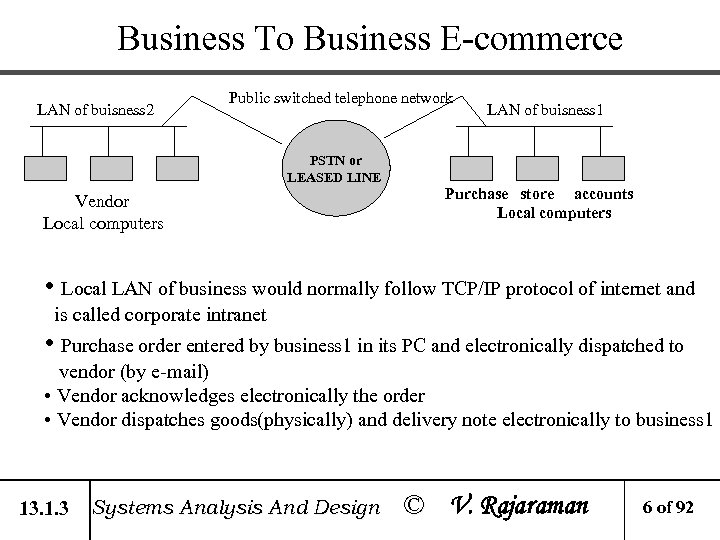 Business To Business E-commerce LAN of buisness 2 Public switched telephone network LAN of buisness 1 PSTN or LEASED LINE Vendor Local computers Purchase store accounts Local computers • Local LAN of business would normally follow TCP/IP protocol of internet and is called corporate intranet • Purchase order entered by business 1 in its PC and electronically dispatched to vendor (by e-mail) • Vendor acknowledges electronically the order • Vendor dispatches goods(physically) and delivery note electronically to business 1 13. 1. 3 Systems Analysis And Design © V. Rajaraman 6 of 92
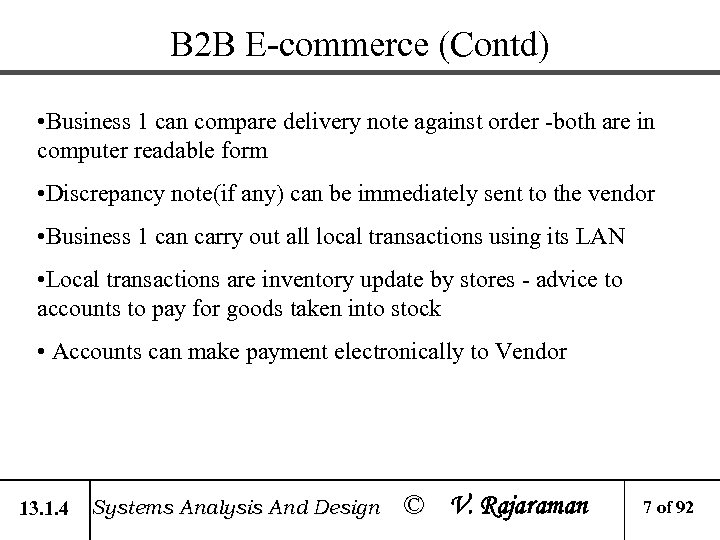 B 2 B E-commerce (Contd) • Business 1 can compare delivery note against order -both are in computer readable form • Discrepancy note(if any) can be immediately sent to the vendor • Business 1 can carry out all local transactions using its LAN • Local transactions are inventory update by stores - advice to accounts to pay for goods taken into stock • Accounts can make payment electronically to Vendor 13. 1. 4 Systems Analysis And Design © V. Rajaraman 7 of 92
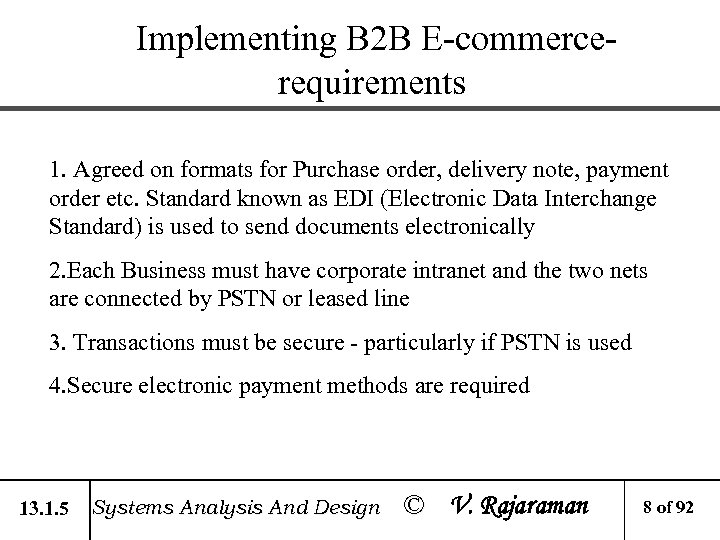 Implementing B 2 B E-commercerequirements 1. Agreed on formats for Purchase order, delivery note, payment order etc. Standard known as EDI (Electronic Data Interchange Standard) is used to send documents electronically 2. Each Business must have corporate intranet and the two nets are connected by PSTN or leased line 3. Transactions must be secure - particularly if PSTN is used 4. Secure electronic payment methods are required 13. 1. 5 Systems Analysis And Design © V. Rajaraman 8 of 92
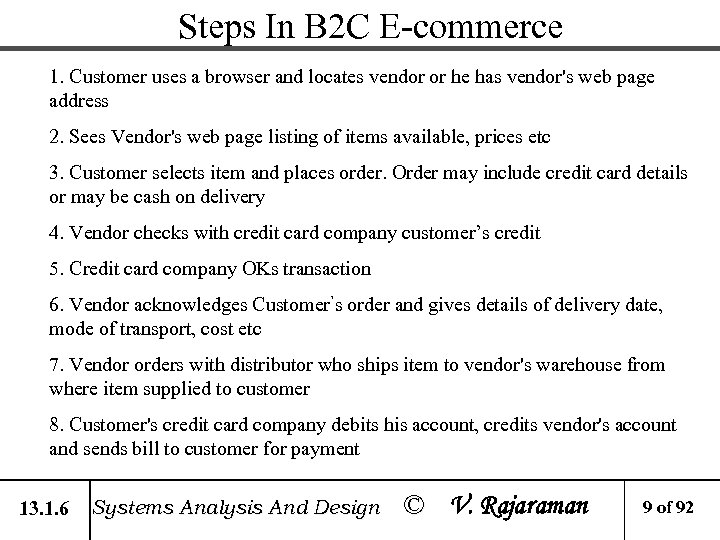 Steps In B 2 C E-commerce 1. Customer uses a browser and locates vendor or he has vendor's web page address 2. Sees Vendor's web page listing of items available, prices etc 3. Customer selects item and places order. Order may include credit card details or may be cash on delivery 4. Vendor checks with credit card company customer’s credit 5. Credit card company OKs transaction 6. Vendor acknowledges Customer’s order and gives details of delivery date, mode of transport, cost etc 7. Vendor orders with distributor who ships item to vendor's warehouse from where item supplied to customer 8. Customer's credit card company debits his account, credits vendor's account and sends bill to customer for payment 13. 1. 6 Systems Analysis And Design © V. Rajaraman 9 of 92
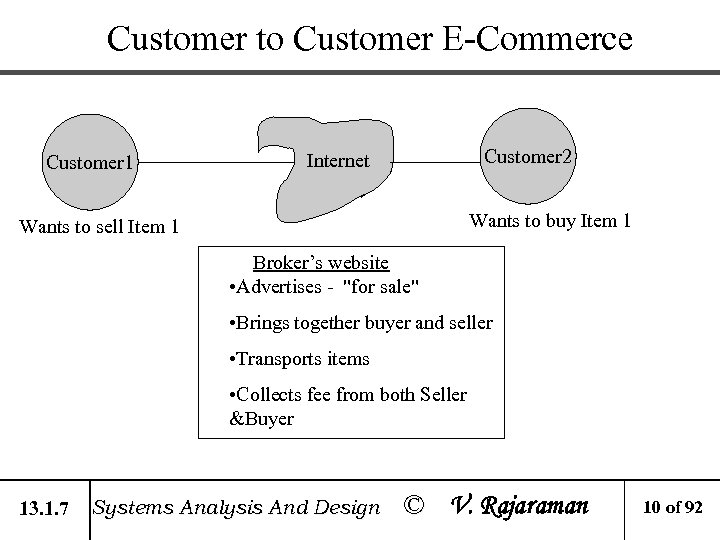 Customer to Customer E-Commerce Customer 1 Customer 2 Internet Wants to buy Item 1 Wants to sell Item 1 Broker’s website • Advertises - "for sale" • Brings together buyer and seller • Transports items • Collects fee from both Seller &Buyer 13. 1. 7 Systems Analysis And Design © V. Rajaraman 10 of 92
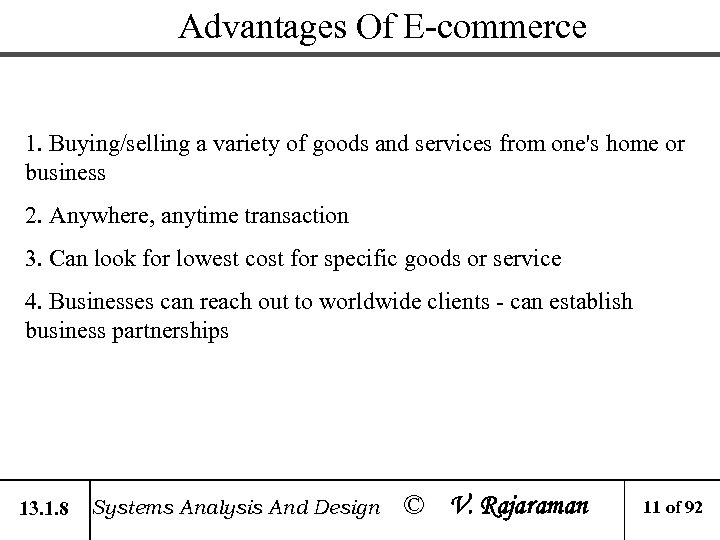 Advantages Of E-commerce 1. Buying/selling a variety of goods and services from one's home or business 2. Anywhere, anytime transaction 3. Can look for lowest cost for specific goods or service 4. Businesses can reach out to worldwide clients - can establish business partnerships 13. 1. 8 Systems Analysis And Design © V. Rajaraman 11 of 92
 Advantages Of E-commerce 5. Order processing cost reduced 6. Electronic funds transfer faster 7. Supply chain management is simpler, faster, and cheaper using e-commerce - Can order from several vendors and monitor supplies. - Production schedule and inventory of an organization can be inspected by cooperating supplier who can in-turn schedule their work. 13. 1. 9 Systems Analysis And Design © V. Rajaraman 12 of 92
 Disadvantages Of E-commerce 1. Electronic data interchange using EDI is expensive for small businesses 2. Security of internet is not very good - viruses, hacker attacks can paralise e-commerce 3. Privacy of e-transactions is not guaranteed 4. E-commerce de-personalises shopping. People go shopping to meet others - window shop and bargain 13. 1. 10 Systems Analysis And Design © V. Rajaraman 13 of 92
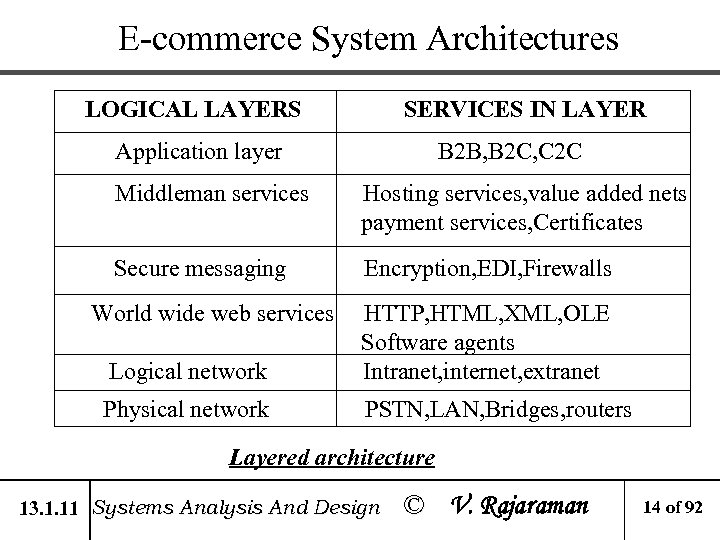 E-commerce System Architectures LOGICAL LAYERS SERVICES IN LAYER Application layer B 2 B, B 2 C, C 2 C Middleman services Hosting services, value added nets payment services, Certificates Secure messaging Encryption, EDI, Firewalls World wide web services Logical network HTTP, HTML, XML, OLE Software agents Intranet, internet, extranet Physical network PSTN, LAN, Bridges, routers Layered architecture 13. 1. 11 Systems Analysis And Design © V. Rajaraman 14 of 92
 Electronic Data Interchange • Computer readable forms for business documents such as invoices, purchase orders, delivery notes needed in B 2 B ecommerce so that e-documents can be exchanged. • Essential to eliminate manual data entry which is error prone • Essential to agree on common formats for commonly used forms. • Electronic data interchange (EDI) standard gives specifications for commonly used standard business forms • Currently two standards are available for EDI forms • It is possible to adapt these standards for documents which use XML for specification. 13. 2. 1 Systems Analysis And Design © V. Rajaraman 15 of 92
 EDI Standards • ANSI X. 12 standard proposed by American National Standards Institute • EDIFACT (Electronic Data Interchange For Administration Commerce and Trade) standardized by United Nations Economic Commission for Europe for international trade • EDIFACT used in India for government transactions customs, central excise etc. 13. 2. 2 Systems Analysis And Design © V. Rajaraman 16 of 92
 EDI Transactions in B 2 B E-commerce • Cooperating businesses agree on EDI standard • Programs needed to translate data received in EDI format to a form needed by the application program • Method of sending/receiving data between businesses to be agreed on - is it PSTN, Extranet or VAN (value added network) service ? • Important to ensure reliable, guaranteed and secure receipt of electronic documents by intended receiver 13. 2. 3 Systems Analysis And Design © V. Rajaraman 17 of 92
 EDI Using Value Added Network Service • VAN provides post box for all subscribers • Guarantees delivery • Open 24 hours, 7 days a week • Provides security, acknowledgement, audit trails for transactions, non repudiation by users • Some VAN’S provide conversion of EDI forms to application format • Disadvantage high cost. Used by large businesses - may not be cost-effective for smaller businesses 13. 2. 4 Systems Analysis And Design © V. Rajaraman 18 of 92
 EDI Using Internet • Cheaper method for use by small business is to use XML for EDI and e-mail, instead of VAN • Establish EDI form standard - XML appropriate – Document Type Definition(DTD) publicised using organization’s web pagecooperating business can use a DTD to interpret XML documents. • Use MIME (multipurpose internet mail extension) to attach EDI forms to e-mail messages 13. 2. 5 Systems Analysis And Design © V. Rajaraman 19 of 92
 EDI Using Internet • Can use Simple Mail Transfer Protocol(SMTP) of internet • If secure transmission needed use S/MIME (Security enhanced MIME) which uses encryption and digital signature –(We will describe encryption and digital signature later in this module) • If very long document or many documents are to be sent together File Transfer Protocol (FTP) may be more appropriate. 13. 2. 6 Systems Analysis And Design © V. Rajaraman 20 of 92
 EDI Standard • Defines several hundred transaction sets corresponding to each type of business document such as invoice, purchase order etc. • Defines data segments - corresponding to groups of data elements such as purchase order line • Defines data elements - which are individual fields such as price, quantity etc 13. 2. 7 Systems Analysis And Design © V. Rajaraman 21 of 92
 Security In E-commerce • Transactions between organizations take place in many e-commerce applications using the Internet • Internet is widely accessible and insecure as eavesdropping is possible • Need to protect company confidential information from snoopers • We need to protect a company's network from unauthorised entry both hardware and software techniques used • When an organization receives a message it has to be sure from whom it came and whether the message is authentic and not changed by an unauthorised person • We thus need a digital signature which can be used in a court of law 13. 3. 1 Systems Analysis And Design © V. Rajaraman 22 of 92
 Network Security Using Firewall • Firewall is a security device deployed at the boundary of an organization' s network to protect it from unauthorised external access • It links an organization's intranet to the internet and restricts the type of traffic that it will pass, thus providing security • Simple firewalls may be implemented in some routers, called packet filtering firewalls, they pass only some packets based on simple specified criteria such as -Type of access (such as email, ftp, telnet as determined by TCP port number) -Direction of traffic -Source or destination IP address -Time of day 13. 3. 2 Systems Analysis And Design © V. Rajaraman 23 of 92
 Proxy Application Gateway • Primarily for allowing members of an organization on corporate intranet to access internet facility ensuring organizational discipline and security • Proxy application program running on a firewall machine is the one which acts on behalf of all members of an organization wanting to use the internet • This program monitors all requests - allows access to only designated addresses outside, limits use of certain browsers and disallows use of some protocols with known security holes • Proxy application program may also be allowed to run on some user's machine who have authorization for internet use 13. 3. 3 Systems Analysis And Design © V. Rajaraman 24 of 92
 Hardened Firewalls With Proxy Application Gateway • Any one from inside or outside an organization give their user id, password, service required to the firewall machine which acts as one's proxy (ie. does ones work on his behalf) • Proxy firewall is now server to the requestor's desktop PC and also a client to some other requested service acting on requestor's behalf • Firewall needs proxy agent for each service requested such as FTP, HTTP, TELNET etc 13. 3. 4 Systems Analysis And Design © V. Rajaraman 25 of 92
 Hardened Firewalls With Proxy Application Gateway • Now proxy firewall is the initiator of all sessions and thus knows every activity - thus ensuring security • Firewall with a proxy function replaces the source address of transaction requestor with its own IP address -this ensures that others on internet see only firewall's IP address - all other IP addresses of organization are hidden 13. 3. 5 Systems Analysis And Design © V. Rajaraman 26 of 92
 Data Encryption With Secret Keys • Data sent via a public network may be accessed and used by unauthorized persons • Thus necessary to scramble it so that even if one accesses it, it cannot be understood • Similarly data stored in data bases accessible via internet should be scrambled • Method of scrambling known as encryption • Method of unscrambling known as decryption 13. 3. 6 Systems Analysis And Design © V. Rajaraman 27 of 92
 Plain Text And Ciphertext • Plain text is data in its natural form • Encryption is taking data in any form(Text, Audio, Video etc. ) and transforming it to another form which cannot be understood • Transformed data is known as cryptogram or cipher text 13. 3. 7 Systems Analysis And Design © V. Rajaraman 28 of 92
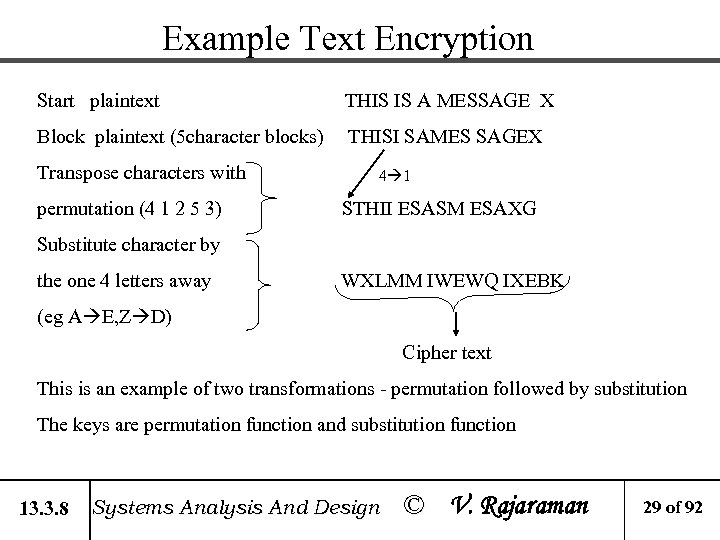 Example Text Encryption Start plaintext THIS IS A MESSAGE X Block plaintext (5 character blocks) THISI SAMES SAGEX Transpose characters with permutation (4 1 2 5 3) 4 1 STHII ESASM ESAXG Substitute character by the one 4 letters away WXLMM IWEWQ IXEBK (eg A E, Z D) Cipher text This is an example of two transformations - permutation followed by substitution The keys are permutation function and substitution function 13. 3. 8 Systems Analysis And Design © V. Rajaraman 29 of 92
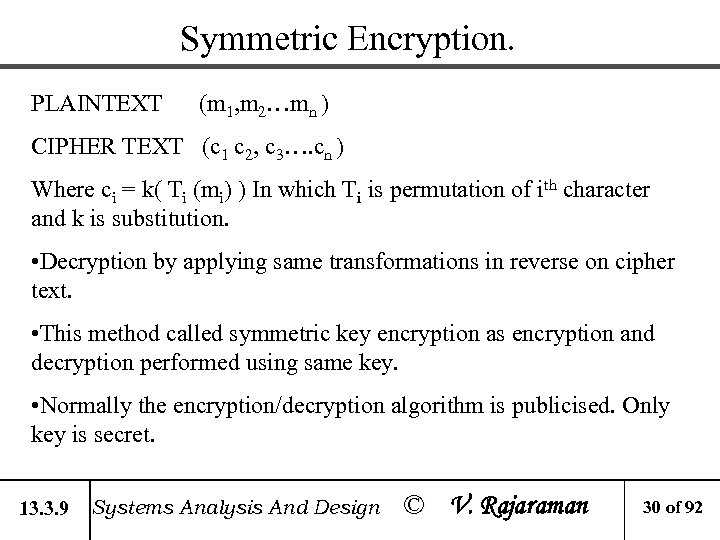 Symmetric Encryption. PLAINTEXT (m 1, m 2…mn ) CIPHER TEXT (c 1 c 2, c 3…. cn ) Where ci = k( Ti (mi) ) In which Ti is permutation of ith character and k is substitution. • Decryption by applying same transformations in reverse on cipher text. • This method called symmetric key encryption as encryption and decryption performed using same key. • Normally the encryption/decryption algorithm is publicised. Only key is secret. 13. 3. 9 Systems Analysis And Design © V. Rajaraman 30 of 92
 Symmetric Encryption • Problem is to ensure secrecy of key when it is sent to partner. • If the key is to be sent to many partners need for separate key for each partner. Directory of who was sent which key is to be kept and used for each transaction. Directory should be secure. • If large number of partners are there key distribution very difficult. • Advantage of symmetric key is easy and fast to transform plain text to cipher text. 13. 3. 10 Systems Analysis And Design © V. Rajaraman 31 of 92
 Digital Encryption Standard DES - Proposed by IBM in 1975 Standardised by US Govt in 1977 Reasonably secure It is a combination of permutation and substitution on blocks of 64 bits. A message is broken up into 64 bit blocks and each block is separately encrypted. 13. 3. 11 Systems Analysis And Design © V. Rajaraman 32 of 92
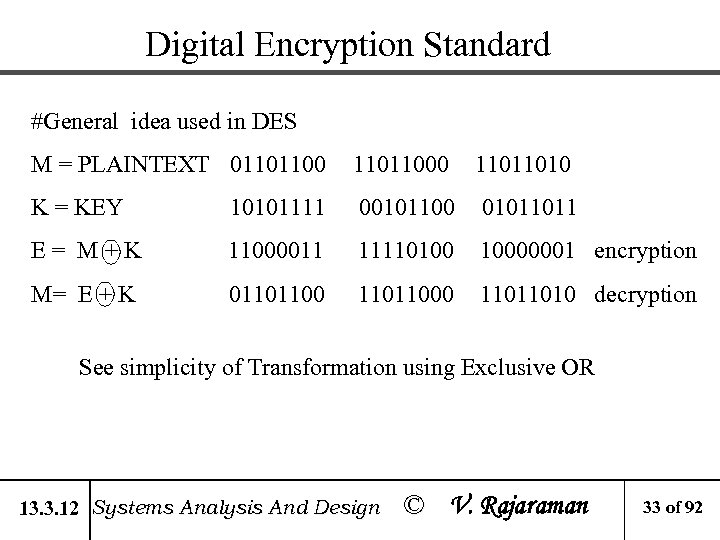 Digital Encryption Standard #General idea used in DES M = PLAINTEXT 01101100 11011010 K = KEY 10101111 00101100 01011011 E= M+K 11000011 11110100 10000001 encryption M= E + K 01101100 11011010 decryption See simplicity of Transformation using Exclusive OR 13. 3. 12 Systems Analysis And Design © V. Rajaraman 33 of 92
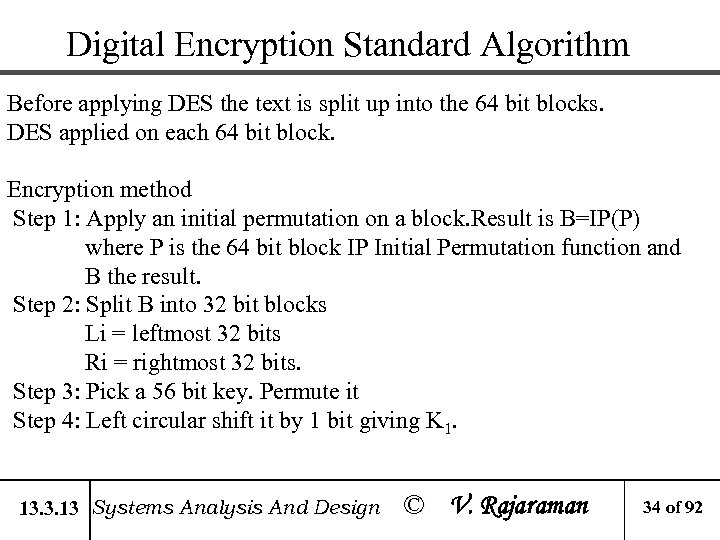 Digital Encryption Standard Algorithm Before applying DES the text is split up into the 64 bit blocks. DES applied on each 64 bit block. Encryption method Step 1: Apply an initial permutation on a block. Result is B=IP(P) where P is the 64 bit block IP Initial Permutation function and B the result. Step 2: Split B into 32 bit blocks Li = leftmost 32 bits Ri = rightmost 32 bits. Step 3: Pick a 56 bit key. Permute it Step 4: Left circular shift it by 1 bit giving K 1. 13. 3. 13 Systems Analysis And Design © V. Rajaraman 34 of 92
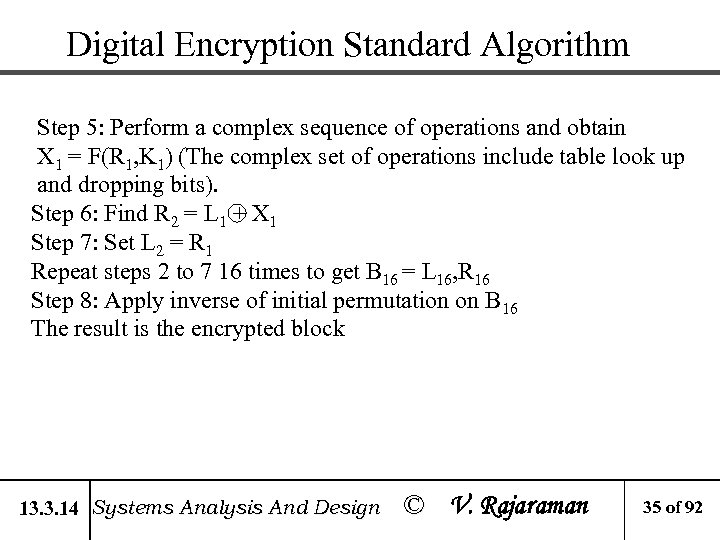 Digital Encryption Standard Algorithm Step 5: Perform a complex sequence of operations and obtain X 1 = F(R 1, K 1) (The complex set of operations include table look up and dropping bits). Step 6: Find R 2 = L 1 + X 1 Step 7: Set L 2 = R 1 Repeat steps 2 to 7 16 times to get B 16 = L 16, R 16 Step 8: Apply inverse of initial permutation on B 16 The result is the encrypted block 13. 3. 14 Systems Analysis And Design © V. Rajaraman 35 of 92
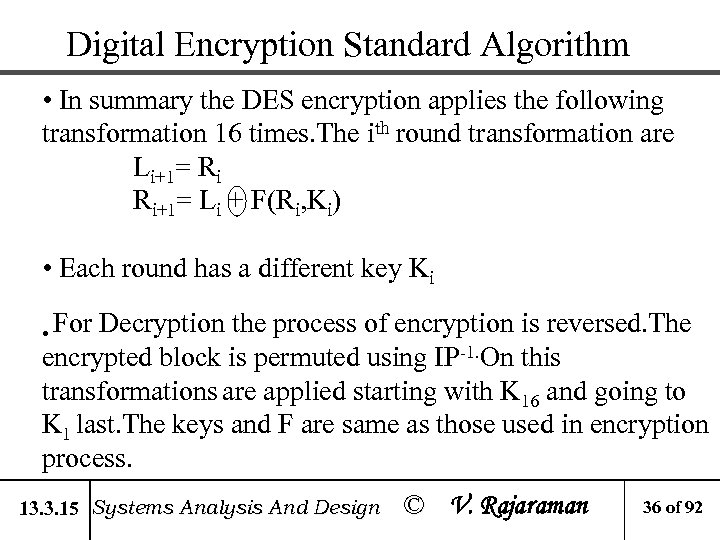 Digital Encryption Standard Algorithm • In summary the DES encryption applies the following transformation 16 times. The ith round transformation are Li+1= Ri Ri+1= Li + F(Ri, Ki) • Each round has a different key Ki • For Decryption the process of encryption is reversed. The encrypted block is permuted using IP-1. On this transformations are applied starting with K 16 and going to K 1 last. The keys and F are same as those used in encryption process. 13. 3. 15 Systems Analysis And Design © V. Rajaraman 36 of 92
 Digital Encryption Standard Algorithm • The encryption process uses simple binary operations. They can thus be realised in hardware as an integrated circuit chip. • DES chips are inexpensive. Key externally fed. • The complex encryption algorithm is explained using two block diagrams in the next two transparencies. 13. 3. 16 Systems Analysis And Design © V. Rajaraman 37 of 92
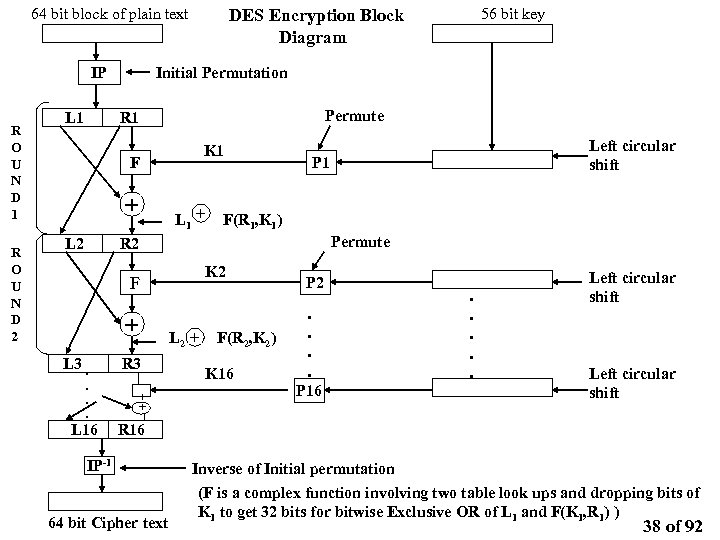 64 bit block of plain text IP R O U N D 1 R O U N D 2 L 1 Initial Permutation Permute R 1 K 1 F + L 2 L 1 + F(R 1, K 1) Permute K 2 F +. . . L 16 L 2 + R 3 + Left circular shift P 1 R 2 L 3. 56 bit key DES Encryption Block Diagram F(R 2, K 2) K 16 P 2. . P 16 . . . Left circular shift R 16 IP-1 64 bit Cipher text Inverse of Initial permutation (F is a complex function involving two table look ups and dropping bits of K 1 to get 32 bits for bitwise Exclusive OR of L 1 and F(K 1, R 1) ) 38 of 92
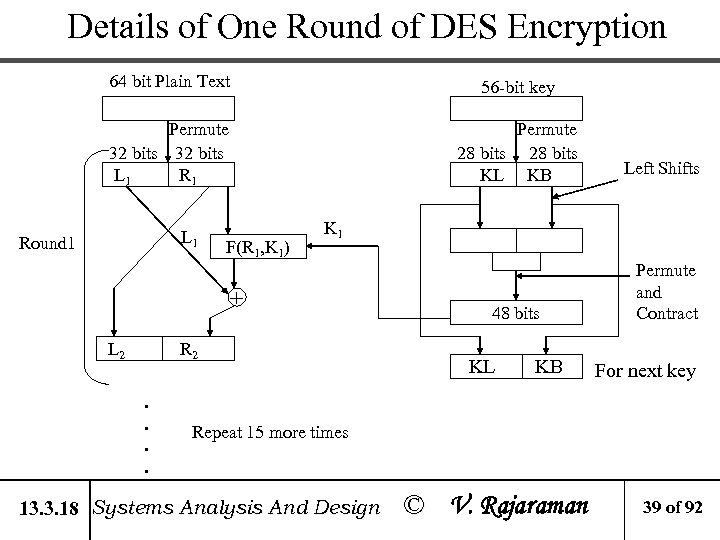 Details of One Round of DES Encryption 64 bit Plain Text 56 -bit key Permute 32 bits L 1 R 1 Permute 28 bits KL KB Left Shifts 48 bits Permute and Contract L 1 Round 1 F(R 1, K 1) K 1 + L 2 R 2. . KL KB For next key Repeat 15 more times 13. 3. 18 Systems Analysis And Design © V. Rajaraman 39 of 92
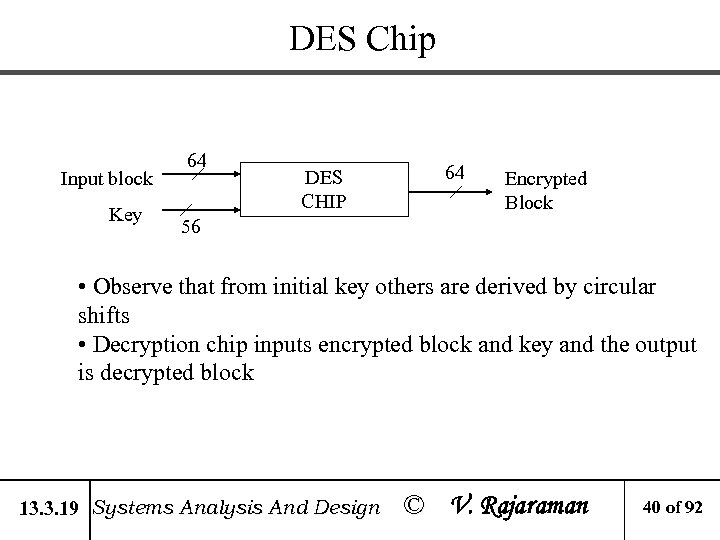 DES Chip Input block Key 64 DES CHIP 64 Encrypted Block 56 • Observe that from initial key others are derived by circular shifts • Decryption chip inputs encrypted block and key and the output is decrypted block 13. 3. 19 Systems Analysis And Design © V. Rajaraman 40 of 92
 DES - Discussion • Cryptanalysis is technique for breaking a code, given samples of encrypted messages. • If plain text also known it is somewhat easier. • DES code can be broken if key is found. • The easiest method of breaking a code is by brute force of trying out all possible keys to decrypt message. 13. 3. 20 Systems Analysis And Design © V. Rajaraman 41 of 92
 DES - Discussion • With increase in speed of computers it has now been shown that DES key can be found in less than 12 hrs with a fast computer (1 Million decryption per microsecond) • Thus DES is practically useless now (original DES was invented in mid 70 s) • New more secure symmetric encryption algorithm is needed • An extension of DES called triple DES is shown to be more secure. 13. 3. 21 Systems Analysis And Design © V. Rajaraman 42 of 92
 Triple DES • Triple DES uses three different keys and three executions of DES algorithm. • The algorithm is Cipher text = Ek 3 [Dk 2 [Ek 1 [Plain Text]]] where Ek[X] = DES Encryption of X using key K and Dk[X] = DES Decryption of X using key K • Remember that in DES Decryption of encrypted plain text with a different key is almost same as another encryption. • This is true as encryption and decryption use the same algorithm 13. 3. 22 Systems Analysis And Design © V. Rajaraman 43 of 92
 Triple DES • To decrypt cipher text we reverse the operations. Plain text = Dk 1[Ek 2 [Dk 3[Cipher Text]]] BLOCK DIAGRAMS OF TRIPLE DES Encryption K 1 Plain text (64 bit block) E K 2 D K 3 E Cipher text (64 bit block) Decryption K 3 Cipher text E K 2 D 13. 3. 23 Systems Analysis And Design K 1 E © V. Rajaraman Plain text 44 of 92
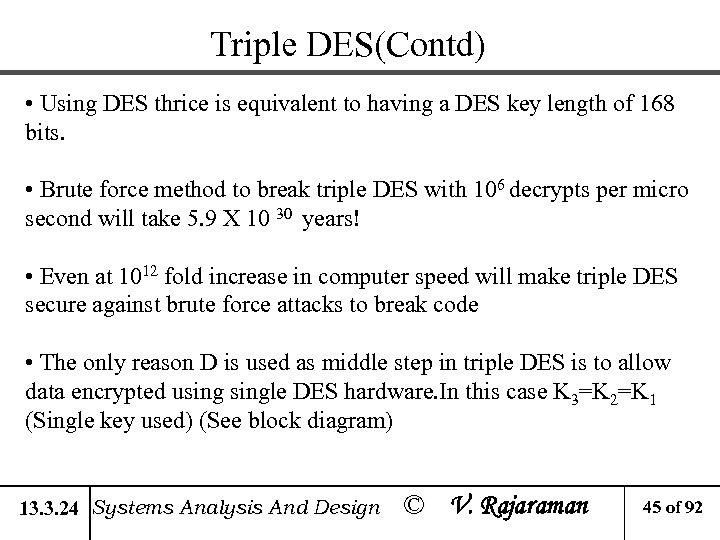 Triple DES(Contd) • Using DES thrice is equivalent to having a DES key length of 168 bits. • Brute force method to break triple DES with 106 decrypts per micro second will take 5. 9 X 10 30 years! • Even at 1012 fold increase in computer speed will make triple DES secure against brute force attacks to break code • The only reason D is used as middle step in triple DES is to allow data encrypted usingle DES hardware. In this case K 3=K 2=K 1 (Single key used) (See block diagram) 13. 3. 24 Systems Analysis And Design © V. Rajaraman 45 of 92
 Triple DES(Contd) • Triple DES will be quite popular for a foreseeable future as it is very secure, can be realised by simple hardware. • Triple DES has two disadvantages 1. It is slow to implement in software 2. It uses 64 bit blocks. • Thus new standards were explored. 13. 3. 25 Systems Analysis And Design © V. Rajaraman 46 of 92
 Requirements of Symmetric Key Cryptography Algorithm(NIST) –Advanced Encryption System(AES) • National Institute for Standards Technology put out a call for proposals for new crypto system with following requirements. • Must provide a high level of security (i. e. difficult to decrypt in finite time) • Must be completely specified and easily understood. • Security must reside in key – Not in algorithm 13. 3. 26 Systems Analysis And Design © V. Rajaraman 47 of 92
 Requirements of Symmetric Key Cryptography Algorithm(NIST) –Advanced Encryption System(AES) • Must be available for all users • Adaptable for use in diverse applications e. g. credit cards • Implementable economically in electronic devices • Must be efficient to use as both software and hardware • Must allow one to validate it. 13. 3. 27 Systems Analysis And Design © V. Rajaraman 48 of 92
 Requirements of Symmetric Key Cryptography Algorithm(NIST) –Advanced Encryption System(AES) • Must be exportable • No trap door • Must use 128 blocks and key lengths of 128, 192 or 256 bits depending on the level of security desired. • In October 2000 it announced the selection of an algorithm – called Rijin dael(Pronounce RAIN DOLL) as new Advance Encryption Standard (AES) • Details may be found in www. nist. gov/aes 13. 3. 28 Systems Analysis And Design © V. Rajaraman 49 of 92
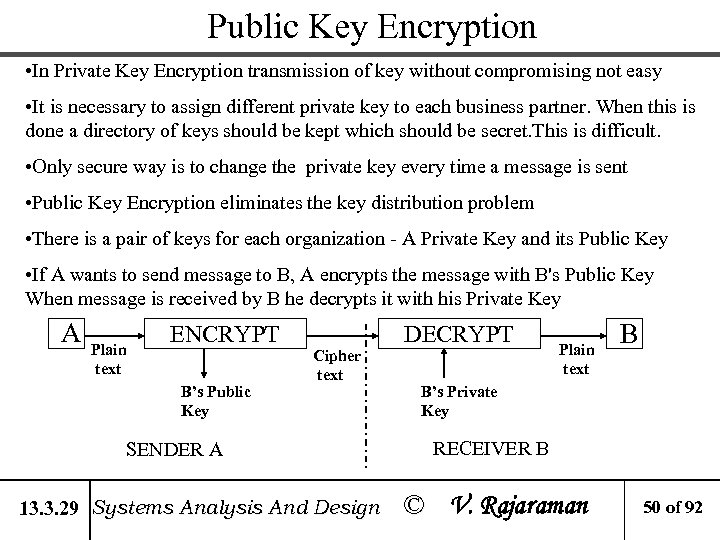 Public Key Encryption • In Private Key Encryption transmission of key without compromising not easy • It is necessary to assign different private key to each business partner. When this is done a directory of keys should be kept which should be secret. This is difficult. • Only secure way is to change the private key every time a message is sent • Public Key Encryption eliminates the key distribution problem • There is a pair of keys for each organization - A Private Key and its Public Key • If A wants to send message to B, A encrypts the message with B's Public Key When message is received by B he decrypts it with his Private Key A Plain text ENCRYPT B’s Public Key Cipher text SENDER A 13. 3. 29 Systems Analysis And Design DECRYPT Plain text B B’s Private Key RECEIVER B © V. Rajaraman 50 of 92
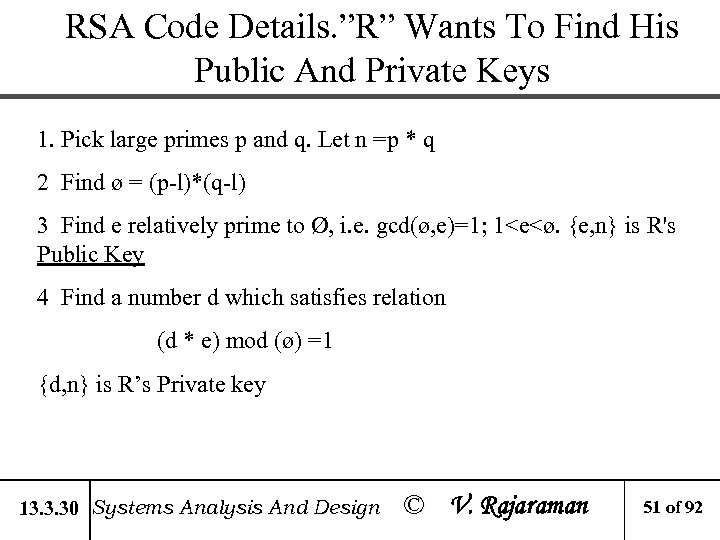 RSA Code Details. ”R” Wants To Find His Public And Private Keys 1. Pick large primes p and q. Let n =p * q 2 Find ø = (p-l)*(q-l) 3 Find e relatively prime to Ø, i. e. gcd(ø, e)=1; 1
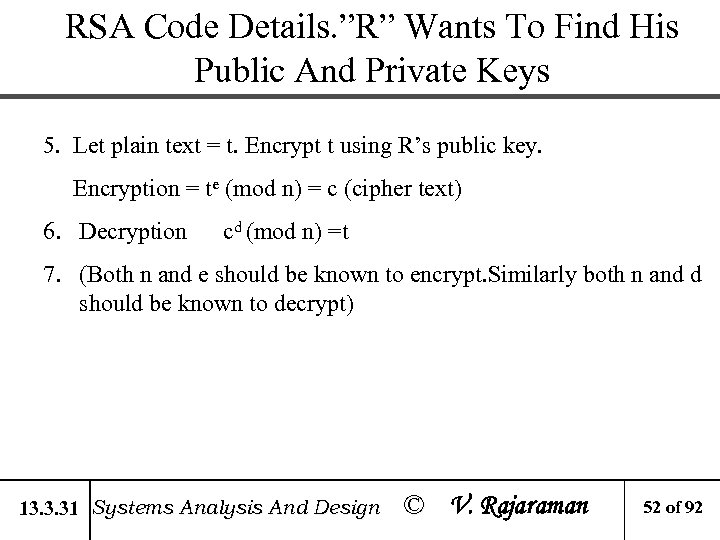 RSA Code Details. ”R” Wants To Find His Public And Private Keys 5. Let plain text = t. Encrypt t using R’s public key. Encryption = te (mod n) = c (cipher text) 6. Decryption cd (mod n) =t 7. (Both n and e should be known to encrypt. Similarly both n and d should be known to decrypt) 13. 3. 31 Systems Analysis And Design © V. Rajaraman 52 of 92
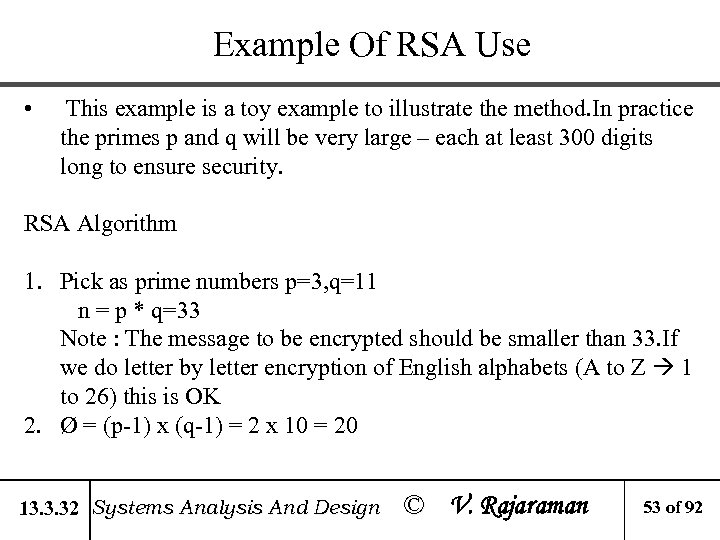 Example Of RSA Use • This example is a toy example to illustrate the method. In practice the primes p and q will be very large – each at least 300 digits long to ensure security. RSA Algorithm 1. Pick as prime numbers p=3, q=11 n = p * q=33 Note : The message to be encrypted should be smaller than 33. If we do letter by letter encryption of English alphabets (A to Z 1 to 26) this is OK 2. Ø = (p-1) x (q-1) = 2 x 10 = 20 13. 3. 32 Systems Analysis And Design © V. Rajaraman 53 of 92
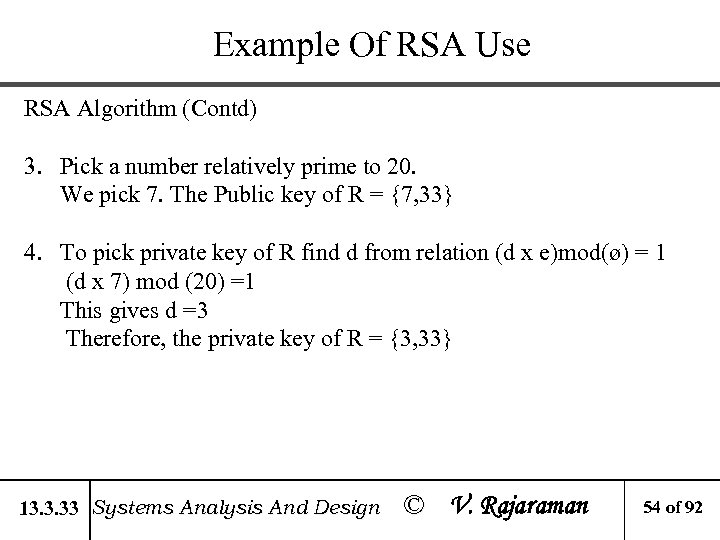 Example Of RSA Use RSA Algorithm (Contd) 3. Pick a number relatively prime to 20. We pick 7. The Public key of R = {7, 33} 4. To pick private key of R find d from relation (d x e)mod(ø) = 1 (d x 7) mod (20) =1 This gives d =3 Therefore, the private key of R = {3, 33} 13. 3. 33 Systems Analysis And Design © V. Rajaraman 54 of 92
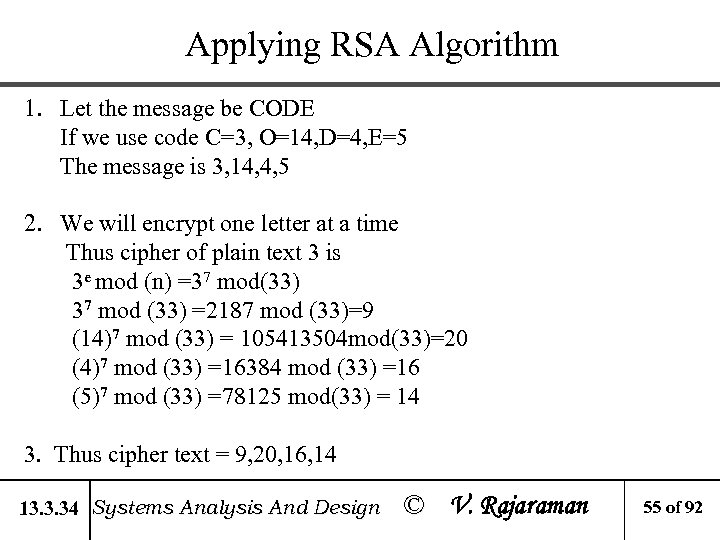 Applying RSA Algorithm 1. Let the message be CODE If we use code C=3, O=14, D=4, E=5 The message is 3, 14, 4, 5 2. We will encrypt one letter at a time Thus cipher of plain text 3 is 3 e mod (n) =37 mod(33) 37 mod (33) =2187 mod (33)=9 (14)7 mod (33) = 105413504 mod(33)=20 (4)7 mod (33) =16384 mod (33) =16 (5)7 mod (33) =78125 mod(33) = 14 3. Thus cipher text = 9, 20, 16, 14 13. 3. 34 Systems Analysis And Design © V. Rajaraman 55 of 92
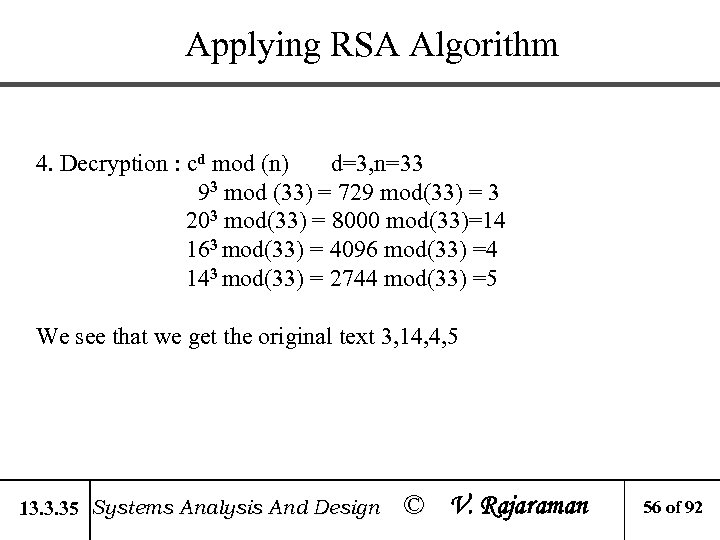 Applying RSA Algorithm 4. Decryption : cd mod (n) d=3, n=33 93 mod (33) = 729 mod(33) = 3 203 mod(33) = 8000 mod(33)=14 163 mod(33) = 4096 mod(33) =4 143 mod(33) = 2744 mod(33) =5 We see that we get the original text 3, 14, 4, 5 13. 3. 35 Systems Analysis And Design © V. Rajaraman 56 of 92
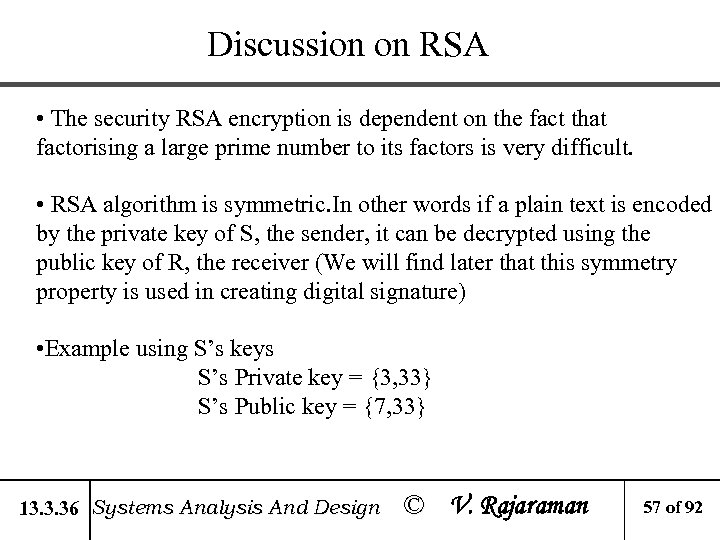 Discussion on RSA • The security RSA encryption is dependent on the fact that factorising a large prime number to its factors is very difficult. • RSA algorithm is symmetric. In other words if a plain text is encoded by the private key of S, the sender, it can be decrypted using the public key of R, the receiver (We will find later that this symmetry property is used in creating digital signature) • Example using S’s keys S’s Private key = {3, 33} S’s Public key = {7, 33} 13. 3. 36 Systems Analysis And Design © V. Rajaraman 57 of 92
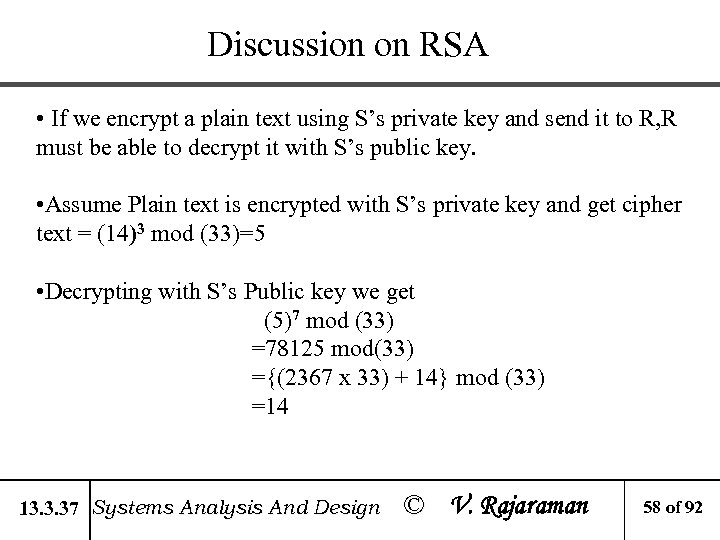 Discussion on RSA • If we encrypt a plain text using S’s private key and send it to R, R must be able to decrypt it with S’s public key. • Assume Plain text is encrypted with S’s private key and get cipher text = (14)3 mod (33)=5 • Decrypting with S’s Public key we get (5)7 mod (33) =78125 mod(33) ={(2367 x 33) + 14} mod (33) =14 13. 3. 37 Systems Analysis And Design © V. Rajaraman 58 of 92
 DISCUSSION – RSA Vs DES • RSA Public key has two keys – a private secret key and a public open key. • RSA implemented as a program (software) It is computationally complex to encode plain text and decode cipher text using RSA • DES Same key for encryption and decryption It is a single key system - Also called symmetric key system 13. 3. 38 Systems Analysis And Design © V. Rajaraman 59 of 92
 DISCUSSION – RSA Vs DES • DES computationally simple-implemented in hardware thus very fast • Each communication between two businesses can use a different key –provided key is securely exchanged • If key can be sent separately encrypted using RSA, then a recipient can use this to decrypt DES encrypted message. • We look next at combining DES and RSA. 13. 3. 39 Systems Analysis And Design © V. Rajaraman 60 of 92
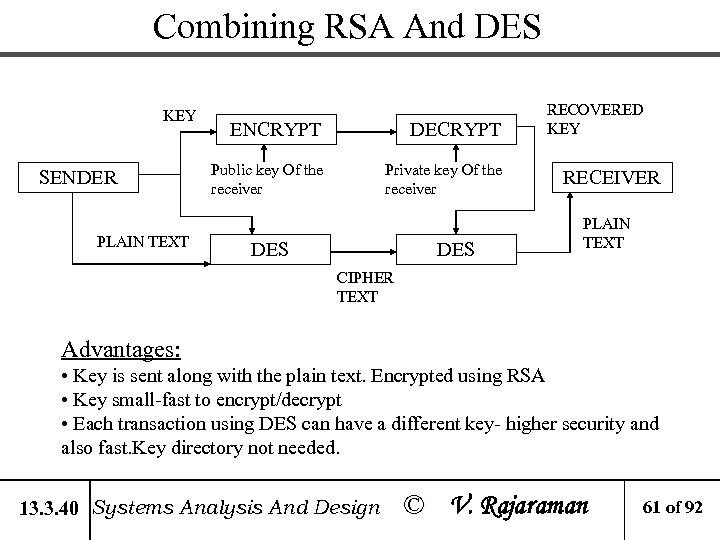 Combining RSA And DES KEY SENDER PLAIN TEXT ENCRYPT DECRYPT Public key Of the receiver Private key Of the receiver DES RECOVERED KEY RECEIVER PLAIN TEXT CIPHER TEXT Advantages: • Key is sent along with the plain text. Encrypted using RSA • Key small-fast to encrypt/decrypt • Each transaction using DES can have a different key- higher security and also fast. Key directory not needed. 13. 3. 40 Systems Analysis And Design © V. Rajaraman 61 of 92
 Digital Signature REQUIREMENTS • Needed to ensure that a message received from say "A" is indeed from him • Signature should be tied to the message sent by "A" SENDING STEP • Sender sends key using RSA system • Sender sends plain text "M" using DES • Receiver decrypts cipher text using DES and the key received from sender call it "MR" 13. 3. 41 Systems Analysis And Design © V. Rajaraman 62 of 92
 Digital Signature • Sender hashes plain text "M' using a hashing function - let the hashed text be "H" • Hashed text "H" encrypted by sender using his Private key • DS is his signature as H encrypted with his private key • DS decrypted by receiver using sender's Public key and obtains "H" 13. 3. 42 Systems Analysis And Design © V. Rajaraman 63 of 92
 Digital Signature (Contd) Authentication step • Receiver hashes “MR" using hash function and gets“HR" • Receiver compares “H" with “HR" • If they match then it is a signed authenticated plain text • TM is signed as sender has encrypted the hashed text using his private key which he only knows. If H=(MR)(HASHED) = HR where MR is the received message then MR must have been sent by sender. He cannot repudiate. 13. 3. 43 Systems Analysis And Design © V. Rajaraman 64 of 92
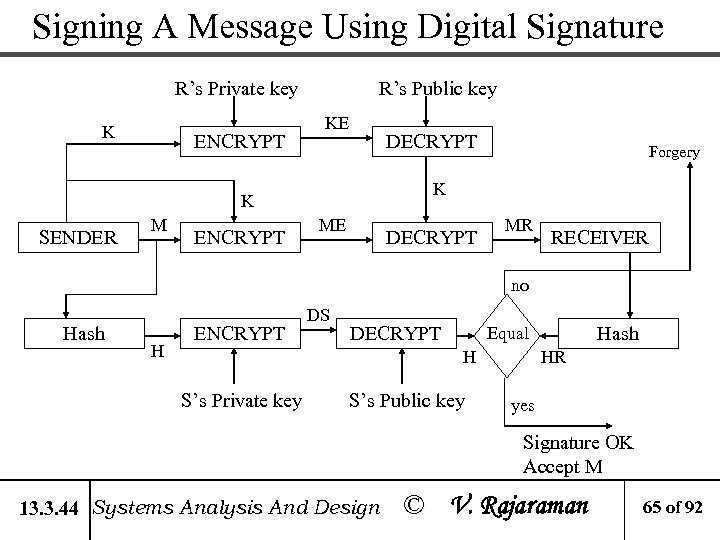 Signing A Message Using Digital Signature R’s Private key K ENCRYPT R’s Public key KE DECRYPT K K SENDER M ENCRYPT Forgery ME DECRYPT MR RECEIVER no Hash H ENCRYPT DS DECRYPT H S’s Private key Hash Equal S’s Public key HR yes Signature OK Accept M 13. 3. 44 Systems Analysis And Design © V. Rajaraman 65 of 92
 Certificate Authority For Digital Signature • As the hashed message in Digital Signature system is decrypted using senders public key, this key must be certified as belonging to sender by an independent authority • Certification needed to ensure authenticity of public keys of organizations as public key is used to verify signature • Certification authority keeps data base of public keys of organizations participating in e-commerce after verifying their credentials. • Potential business partners can authenticate public keys by sending request to certifying authority who certifies after receiving a fee for his services 13. 3. 45 Systems Analysis And Design © V. Rajaraman 66 of 92
 Electronic Payment Systems • In any commercial transaction payment is an integral part for goods supplied. • Four types of payments may be made in e-commerce they are • Credit card payments • Electronic cheque payments • Micro or small payments for internet based services such as music download. • Electronic-cash payments Each of these requires a different system of payment. We will examine first credit card payments. 13. 4. 1 Systems Analysis And Design © V. Rajaraman 67 of 92
 Review Of Manual Credit Card Payment Four parties are invoked in credit card payments. They are: • Customer having a credit card • Merchant accepting credit cards (such as VISA, MASTER CARD etc) • Bank which issues credit cards to customers and collects payments from customers 13. 4. 2 Systems Analysis And Design © V. Rajaraman 68 of 92
 Review Of Manual Credit Card Payment • Acquirer which is financial institution that establishes an account with a merchant, validates credit card information sent electronically by merchant and authorises sale based on customer’s credit status. • Acquirer accepts credit cards of several card companies and guarantees payment to merchants. • Acquirer gets reimbursed by bank issuing credit card. 13. 4. 3 Systems Analysis And Design © V. Rajaraman 69 of 92
 Sequence Of Transactions In Manual Credit Card Payment Step 1: Customer presents credit card after purchase. Merchant swipes it on his special phone and enters amount Step 2: Data from merchant’s terminal goes to acquirer via a private telephone line Step 3: Acquirer checks with the issuing bank validity of card and credit-available 13. 4. 4 Systems Analysis And Design © V. Rajaraman 70 of 92
 Sequence Of Transactions In Manual Credit Card Payment Step 4: Acquirer authorizes sale if all OK and sends approval slip which is printed at merchant’s terminal. Step 5: Merchant takes customer’s signature on the slip-verifies it with the signature on card and delivers the goods. Step 6: The acquirer pays the money to merchant and collects it from the appropriate issuing bank. The bank sends monthly statement to customer and collects outstanding amount. 13. 4. 5 Systems Analysis And Design © V. Rajaraman 71 of 92
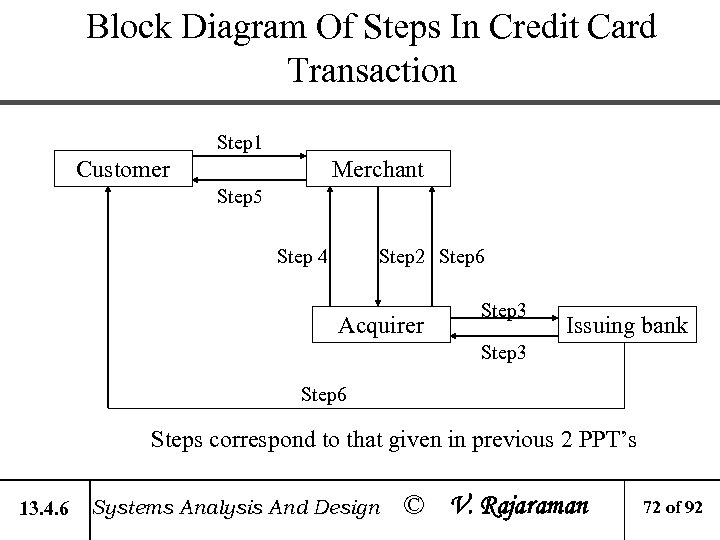 Block Diagram Of Steps In Credit Card Transaction Step 1 Customer Merchant Step 5 Step 4 Step 2 Step 6 Acquirer Step 3 Issuing bank Step 3 Step 6 Steps correspond to that given in previous 2 PPT’s 13. 4. 6 Systems Analysis And Design © V. Rajaraman 72 of 92
 Credit Card In E-commerce Main Problems 1. Main Problem is: if a merchant had only a web presence, a Customer needs to be reassured that the merchant is genuine. 2. Customers Signature cannot be physically verified. Customer needs electronic signature. 3. Secrecy of credit card number has to be ensured. 4. Dispute settlement mechanism must be worked out. 13. 4. 7 Systems Analysis And Design © V. Rajaraman 73 of 92
 Secure Electronic Transaction Protocol • • Standardised credit card payments in e-commerce by major card companies such as Visa, Master. Card etc. To use SET protocol it is assumed that 1. Each party involved in e-commerce transaction has a public and private key. A public key encryption is used. 2. All parties have their public keys certified. 3. A standard hashing algorithm is used to create message digest for signature verification. 13. 4. 8 Systems Analysis And Design © V. Rajaraman 74 of 92
 Secure Electronic Transaction Protocol Main Features • Customers credit card number is not revealed to a merchant. It is revealed only to the acquirer who authorises payment. • Purchase invoice details are not revealed to the acquirer. Only the credit card number and total amount are revealed to him • Purchase invoice + credit card number is digitally signed by the customer. In case of a dispute an arbitrator can use this to settle the dispute. (Computer protocol runs to 262 pages and may be found in www. ibm. com/redbook/SG 244978) 13. 4. 9 Systems Analysis And Design © V. Rajaraman 75 of 92
 Secure Electronic Transaction Protocol DUAL SIGNATURE SCHEME • Dual signature scheme is an innovation in SET protocol Steps followed in the protocol are: 1. Customer purchase information has 3 parts (i) Purchase Order (PO) (ii) Credit Card Number(CCN) (iii) Amount to be paid 2. Merchant should know (PO + Amount)=POA 3. Acquirer should know (CCN+Amount)=CCA 13. 4. 10 Systems Analysis And Design © V. Rajaraman 76 of 92
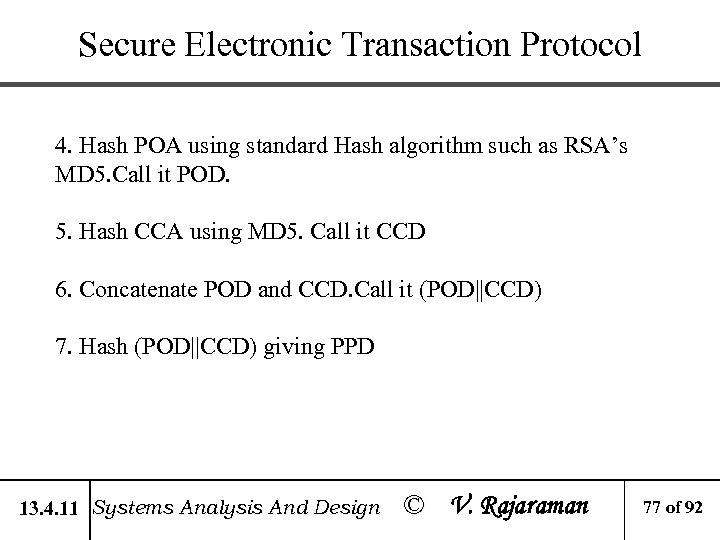 Secure Electronic Transaction Protocol 4. Hash POA using standard Hash algorithm such as RSA’s MD 5. Call it POD. 5. Hash CCA using MD 5. Call it CCD 6. Concatenate POD and CCD. Call it (POD||CCD) 7. Hash (POD||CCD) giving PPD 13. 4. 11 Systems Analysis And Design © V. Rajaraman 77 of 92
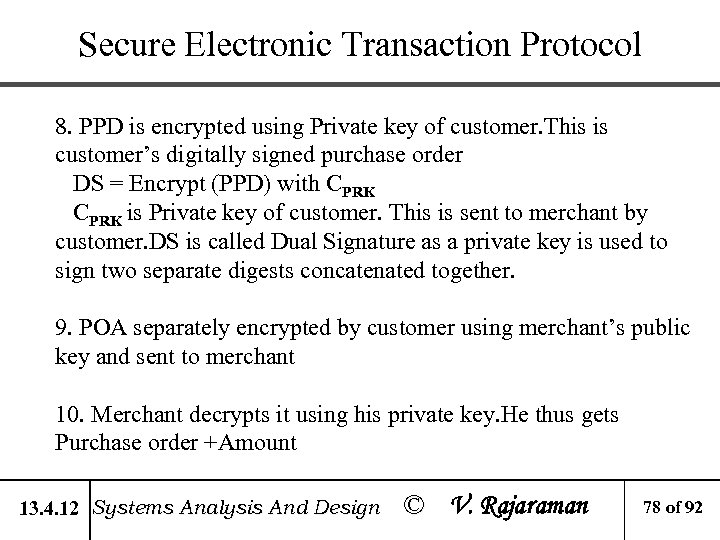 Secure Electronic Transaction Protocol 8. PPD is encrypted using Private key of customer. This is customer’s digitally signed purchase order DS = Encrypt (PPD) with CPRK is Private key of customer. This is sent to merchant by customer. DS is called Dual Signature as a private key is used to sign two separate digests concatenated together. 9. POA separately encrypted by customer using merchant’s public key and sent to merchant 10. Merchant decrypts it using his private key. He thus gets Purchase order +Amount 13. 4. 12 Systems Analysis And Design © V. Rajaraman 78 of 92
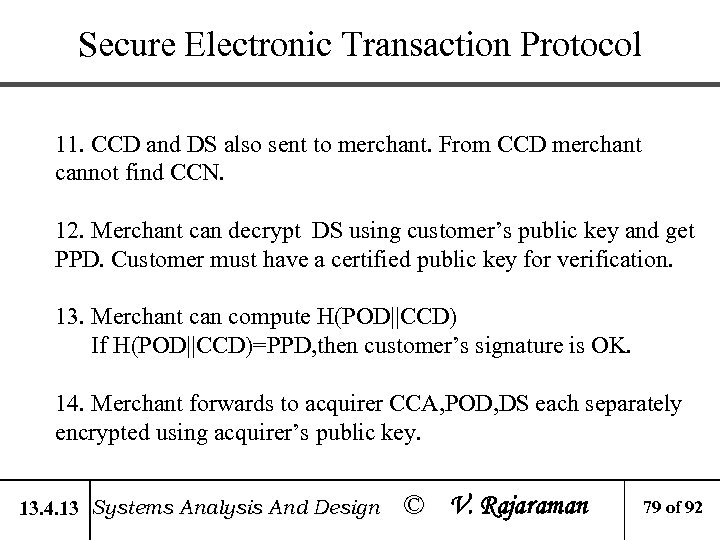 Secure Electronic Transaction Protocol 11. CCD and DS also sent to merchant. From CCD merchant cannot find CCN. 12. Merchant can decrypt DS using customer’s public key and get PPD. Customer must have a certified public key for verification. 13. Merchant can compute H(POD||CCD) If H(POD||CCD)=PPD, then customer’s signature is OK. 14. Merchant forwards to acquirer CCA, POD, DS each separately encrypted using acquirer’s public key. 13. 4. 13 Systems Analysis And Design © V. Rajaraman 79 of 92
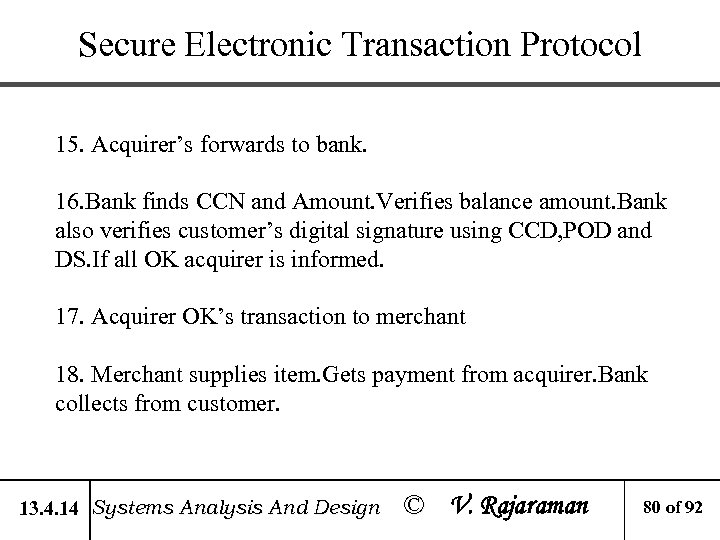 Secure Electronic Transaction Protocol 15. Acquirer’s forwards to bank. 16. Bank finds CCN and Amount. Verifies balance amount. Bank also verifies customer’s digital signature using CCD, POD and DS. If all OK acquirer is informed. 17. Acquirer OK’s transaction to merchant 18. Merchant supplies item. Gets payment from acquirer. Bank collects from customer. 13. 4. 14 Systems Analysis And Design © V. Rajaraman 80 of 92
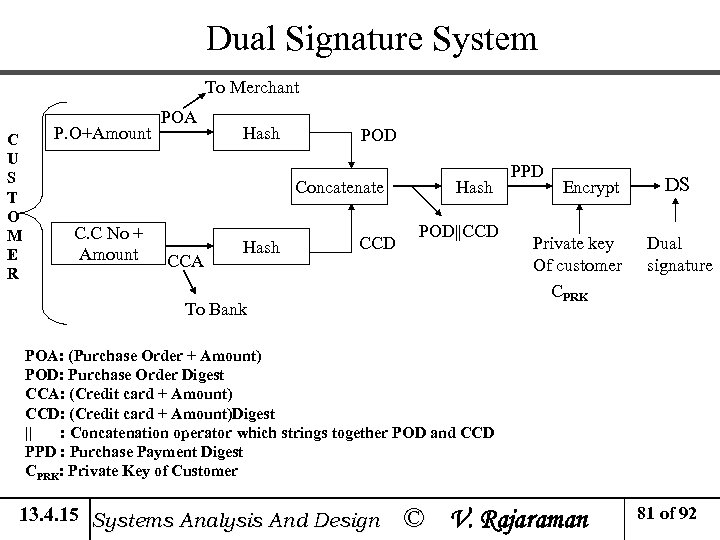 Dual Signature System To Merchant C U S T O M E R P. O+Amount POA Hash POD Concatenate C. C No + Amount CCA Hash CCD Hash POD||CCD To Bank PPD Encrypt Private key Of customer CPRK DS Dual signature POA: (Purchase Order + Amount) POD: Purchase Order Digest CCA: (Credit card + Amount) CCD: (Credit card + Amount)Digest || : Concatenation operator which strings together POD and CCD PPD : Purchase Payment Digest CPRK: Private Key of Customer 13. 4. 15 Systems Analysis And Design © V. Rajaraman 81 of 92
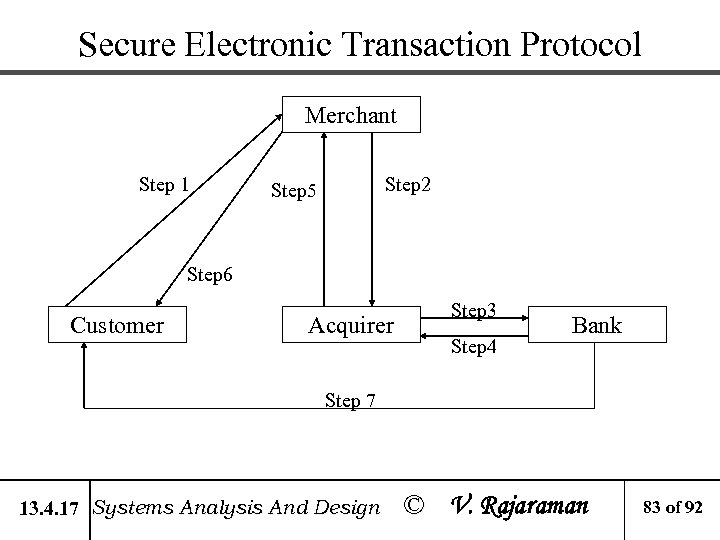
![Secure Electronic Transaction Protocol - Step 1 : [(POA)EM + (CCA)EB + CCD +DS]](https://present5.com/presentation/8dfb33f4cd5a5dd9b833b858455aea3e/image-83.jpg "Secure Electronic Transaction Protocol - Step 1 : [(POA)EM + (CCA)EB + CCD +DS]") Secure Electronic Transaction Protocol - Step 1 : [(POA)EM + (CCA)EB + CCD +DS] to Merchant - Step 2 : Merchant sends [(CCA)EB + DS + POD] to Acquirer - Step 3 : Acquirer sends (CCA)EB + DS +POD to Bank. - Bank finds (CC No. + amount) sees if OK Computes H(CCD||POD) Decrypts DS with customer’s public key If (DS)CPK = H(CCD || POD) Signature verified - Step 4 : OK to acquirer if credit and signature OK - Step 5 : Ok to Merchant finds H(H(POA) || CCD)=PPD Decrypts DS with public key of customer. If match signature verified. - Step 6 : Sends delivery details - Step 7 : Bill to customer 13. 4. 16 Systems Analysis And Design © V. Rajaraman 82 of 92
Secure Electronic Transaction Protocol - Step 1 : [(POA)EM + (CCA)EB + CCD +DS] to Merchant - Step 2 : Merchant sends [(CCA)EB + DS + POD] to Acquirer - Step 3 : Acquirer sends (CCA)EB + DS +POD to Bank. - Bank finds (CC No. + amount) sees if OK Computes H(CCD||POD) Decrypts DS with customer’s public key If (DS)CPK = H(CCD || POD) Signature verified - Step 4 : OK to acquirer if credit and signature OK - Step 5 : Ok to Merchant finds H(H(POA) || CCD)=PPD Decrypts DS with public key of customer. If match signature verified. - Step 6 : Sends delivery details - Step 7 : Bill to customer 13. 4. 16 Systems Analysis And Design © V. Rajaraman 82 of 92
 Secure Electronic Transaction Protocol Merchant Step 1 Step 2 Step 5 Step 6 Customer Acquirer Step 3 Step 4 Bank Step 7 13. 4. 17 Systems Analysis And Design © V. Rajaraman 83 of 92
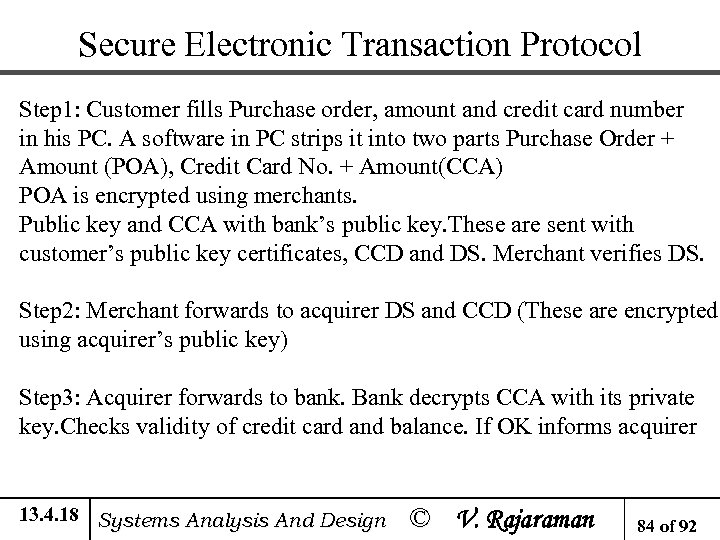 Secure Electronic Transaction Protocol Step 1: Customer fills Purchase order, amount and credit card number in his PC. A software in PC strips it into two parts Purchase Order + Amount (POA), Credit Card No. + Amount(CCA) POA is encrypted using merchants. Public key and CCA with bank’s public key. These are sent with customer’s public key certificates, CCD and DS. Merchant verifies DS. Step 2: Merchant forwards to acquirer DS and CCD (These are encrypted using acquirer’s public key) Step 3: Acquirer forwards to bank. Bank decrypts CCA with its private key. Checks validity of credit card and balance. If OK informs acquirer 13. 4. 18 Systems Analysis And Design © V. Rajaraman 84 of 92
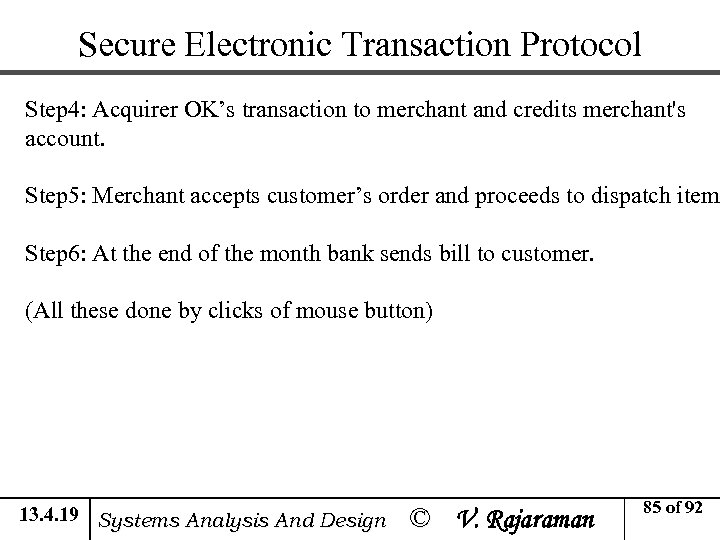 Secure Electronic Transaction Protocol Step 4: Acquirer OK’s transaction to merchant and credits merchant's account. Step 5: Merchant accepts customer’s order and proceeds to dispatch items Step 6: At the end of the month bank sends bill to customer. (All these done by clicks of mouse button) 13. 4. 19 Systems Analysis And Design © V. Rajaraman 85 of 92
 Electronic Cheque Payment • Most cheque based transactions will be between businesses -thus special hardware attached to PC’s for signing payments • Signature encrypted by hardware • All public keys of business partners authenticated by certifying agencies Steps in transaction 1 Purchaser sends purchase order and payment advice signed with his private key to vendor. He also sends his public key certificate encrypted with vendor's public key to vendor 2 Vendor decrypts with his private key, checks certificate and cheque, attaches deposit slip, encrypts with bank's public key and sends it to bank. he also sends his public key certificate 3 Bank checks signatures, credits and clears cheque 4 Credit advice goes to vendor, & consolidated debit advice sent to purchaser periodically 13. 4. 20 Systems Analysis And Design © V. Rajaraman 86 of 92
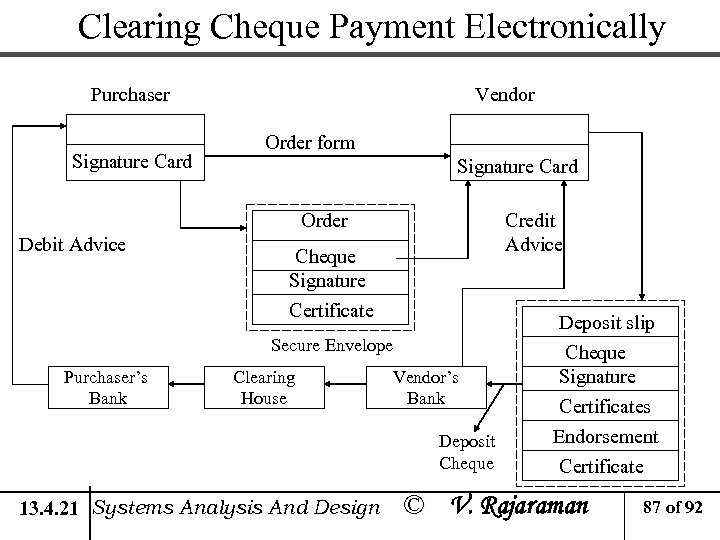 Clearing Cheque Payment Electronically Purchaser Signature Card Vendor Order form Signature Card Order Debit Advice Credit Advice Cheque Signature Certificate Secure Envelope Purchaser’s Bank Clearing House Vendor’s Bank Deposit Cheque 13. 4. 21 Systems Analysis And Design Deposit slip Cheque Signature Certificates Endorsement Certificate © V. Rajaraman 87 of 92
 Payments Of Small Amounts On Internet NETBILL'S PROPRIETARY SYSTEM • Customer charged only when information delivered • Vendor guaranteed payment when information delivered • Netbill is the intermediary MAJOR STEPS • When customer accepts quote for information, vendor sends encrypted information without key to customer • Payment order sent to vendor with checksum of information obtained. It is signed by customer • Vendor sends to NET BILL copy of purchase order and the key for decryption • NET BILL checks credit of customer. If ok it sends key to customer. Credits vendor account and debits customer account. Key sent to customer to decrypt information • Customer decrypts information 13. 4. 22 Systems Analysis And Design © V. Rajaraman 88 of 92
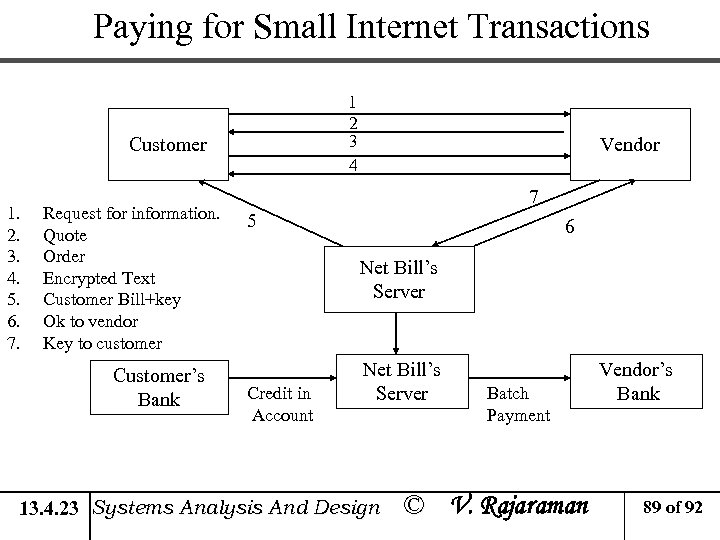 Paying for Small Internet Transactions 1 2 3 4 Customer 1. 2. 3. 4. 5. 6. 7. Request for information. Quote Order Encrypted Text Customer Bill+key Ok to vendor Key to customer Customer’s Bank Vendor 7 5 6 Net Bill’s Server Credit in Account Net Bill’s Server 13. 4. 23 Systems Analysis And Design Batch Payment © V. Rajaraman Vendor’s Bank 89 of 92
 Electronic Cash • Cash for small payments • Cash preserves anonymity • Cash should not be traceable We will discuss only traceable cash payments STEPS 1. Customer withdraws coins in various denominations signed by bank STRUCTURE------> serial no, denomination, signature of bank Bank stores issued coins copy 2. Customer pays vendor using signed coins 3. Bank checks whether it is current or spent 4. If current it authorises dispatch of goods and credits vendor account with electronic coins 13. 4. 24 Systems Analysis And Design © V. Rajaraman 90 of 92
 Electronic Cash(contd) • Cheaper than credit card transaction • DES normally used for these transaction as it is cheap and amounts involved is small 13. 4. 25 Systems Analysis And Design © V. Rajaraman 91 of 92
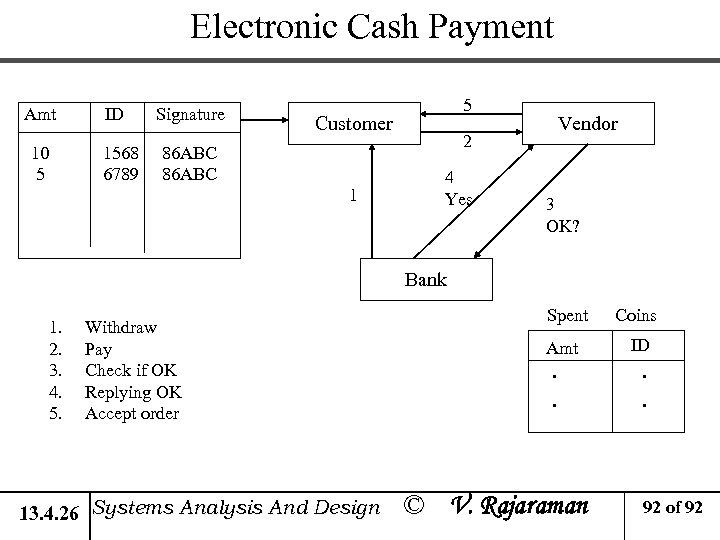 Electronic Cash Payment Amt 10 5 ID 1568 6789 Signature 5 Customer 86 ABC 1 Vendor 2 4 Yes 3 OK? Bank 1. 2. 3. 4. 5. Withdraw Pay Check if OK Replying OK Accept order 13. 4. 26 Systems Analysis And Design Spent Amt . . © V. Rajaraman Coins ID . . 92 of 92