


 Скачать презентацию MODULE 11 Healthcare Waste Minimization Module Overview
5470a9ae3fc3ebc095f9c31f2c36722a.ppt
- Количество слайдов: 50
 MODULE 11: Healthcare Waste Minimization
 Module Overview • Describe the waste management hierarchy • Describe practices that encourage waste minimization • Describe environmentally preferable purchasing and green procurement methods • Describe safe reuse, recycling, and recovery • Introduce environmental management systems
 Learning Objectives • Understand the reasoning behind the waste management hierarchy • Understand waste minimization and methods and approaches for waste minimization • Understand practices for reducing waste accumulation and toxic quantities along the supply chain (EPP, green procurement) • Understand differences between reuse and recycling • Understand key parts of an environmental management system
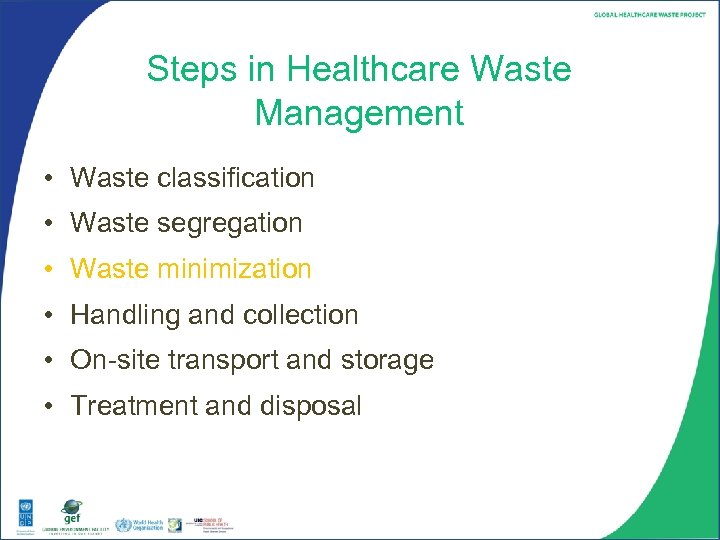 Steps in Healthcare Waste Management • Waste classification • Waste segregation • Waste minimization • Handling and collection • On-site transport and storage • Treatment and disposal
 The Waste Management Hierarchy • A ranking of waste management methods in terms of their ‘desirability’ • The hierarchy is based largely on the concept of the 3 R’s – reduce, reuse, recycle. • The most preferable approach is that which produces as little waste as possible, thus minimizing the amount entering the waste stream.
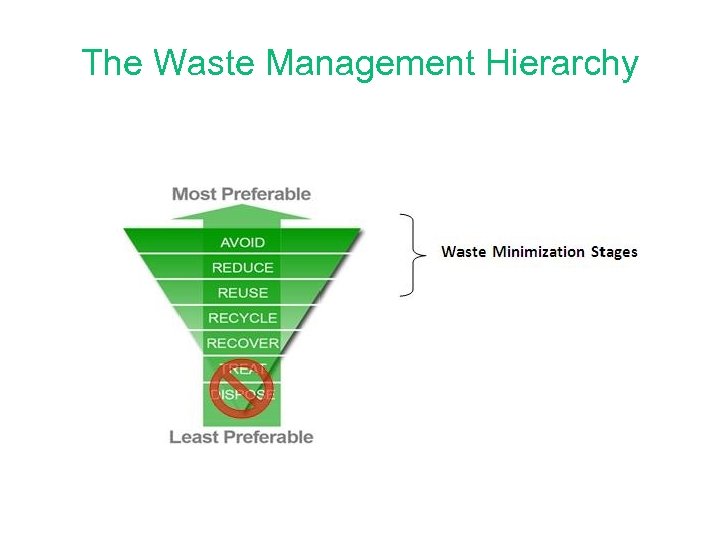 The Waste Management Hierarchy
 What is Waste Minimization? • Preventing or reducing generation of waste through an emphasis on source reduction and recycling – source reduction is preferred, where possible – for lasting waste minimization, focus on working with the medical staff to make changes towards less wasteful clinical practices
 Benefits of Waste Minimization • Reduces cost of waste disposal • Reduces environmental impact • Enhances public health • Enhances worker safety • Improves public image
 Waste Minimization Opportunity Assessment • Systematic procedure for identifying ways to reduce or eliminate waste • Four phases: – Planning and organization – Assessment phase – Feasibility analysis phase – Implementation
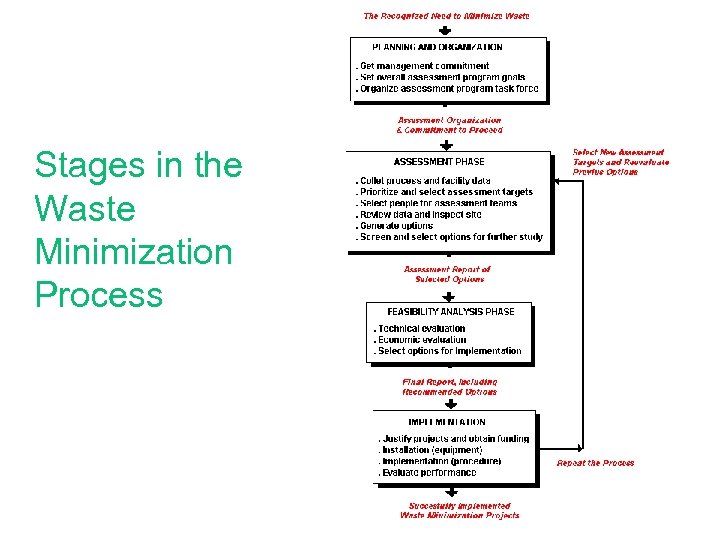 Stages in the Waste Minimization Process
 Planning and Organization • Getting management support is very important. • Successful waste minimization programs are often initiated and sustained by one or more environmental champions. • Planning entails the setting of overall goals. • A task force is needed to start the assessment phase.
 Assessment Phase • Collect process and facility data – Identify types, quantities and generation rates of different waste streams – Prepare waste flow maps or diagrams • Prioritize and select assessment targets – Prioritize wastes with the greatest minimization potential – Also consider overall quantities, characteristics (toxicity, persistence in the environment, bioaccumulative properties), worker safety, and costs
 Assessment Phase • Select people for assessment teams • Review data and inspect site – Follow the target activities from point of generation to where the waste leaves the facility • Generate options – Consider waste minimization techniques – Get ideas from many resources • Screen and select options for further study
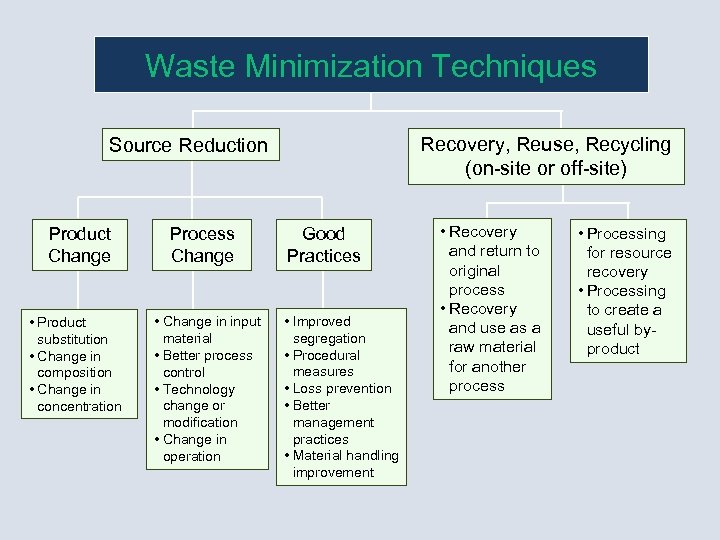 Waste Minimization Techniques Recovery, Reuse, Recycling (on-site or off-site) Source Reduction Product Change • Product substitution • Change in composition • Change in concentration Process Change • Change in input material • Better process control • Technology change or modification • Change in operation Good Practices • Improved segregation • Procedural measures • Loss prevention • Better management practices • Material handling improvement • Recovery and return to original process • Recovery and use as a raw material for another process • Processing for resource recovery • Processing to create a useful byproduct
 Specific Examples of Waste Minimization in Health Facilities • Source Reduction – Environmentally preferable purchasing – Inventory control in pharmacy and stockroom – Employing reusable and recycled products • Recovery and Reuse – Solvent recovery in the hospital laboratory – Silver recovery in the x-ray department • Recycling – Recycling office paper, newspapers, aluminum cans, glass bottles, construction debris, printer toners, etc. • Composting – Composting of kitchen waste and yard waste
 Environmentally Preferable Purchasing (EPP) • Purchasing products or services whose environmental impacts have been assessed and found to be less damaging to the environment and human health when compared to competing products/services • Also called “green purchasing” • Includes everything from recycled paper at the simplest level to medical equipment at higher levels • Employs a ‘life-cycle’ approach to reduce overall environmental impact
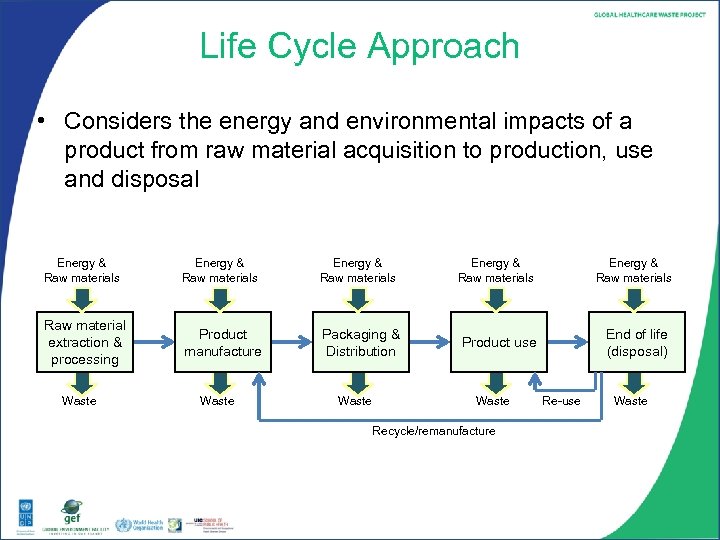 Life Cycle Approach • Considers the energy and environmental impacts of a product from raw material acquisition to production, use and disposal Energy & Raw materials Raw material extraction & processing Product manufacture Packaging & Distribution Waste Energy & Raw materials Product use End of life (disposal) Waste Recycle/remanufacture Re-use Waste
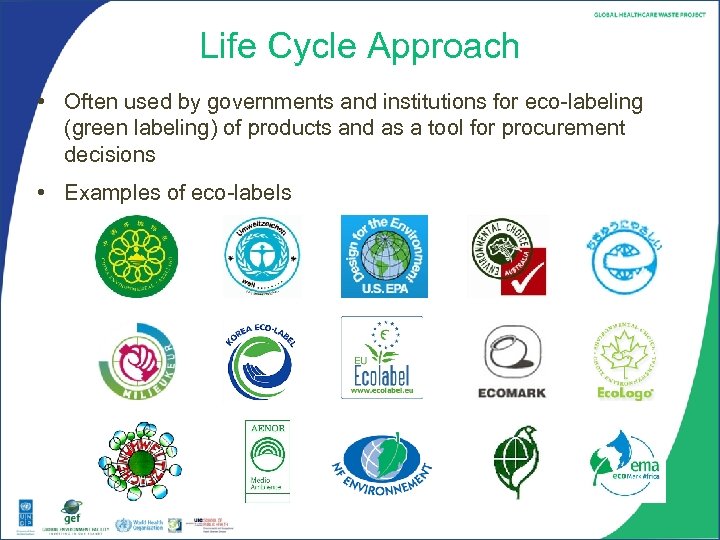 Life Cycle Approach • Often used by governments and institutions for eco-labeling (green labeling) of products and as a tool for procurement decisions • Examples of eco-labels
 Packaging and Green Purchasing • A significant portion of waste is packaging. • Select products that have minimal packaging where possible. • Require vendors or shippers to take back shipping pallets with their next delivery for later reuse. • Work with the purchasing department or group purchasing organization to include reduced packaging in procurement specifications. • Work with vendors and manufacturers to re-design their packaging to the minimum required to protect the product during shipment. • Work with vendors and manufacturers to use recycled or recyclable materials for their packaging and packing.
 Inventory Control • The management of supply, storage and distribution of items to maintain a balance between adequate supply and oversupply • Goal: to minimize the total cost of inventory • Good inventory control is an effective tool for minimizing waste.
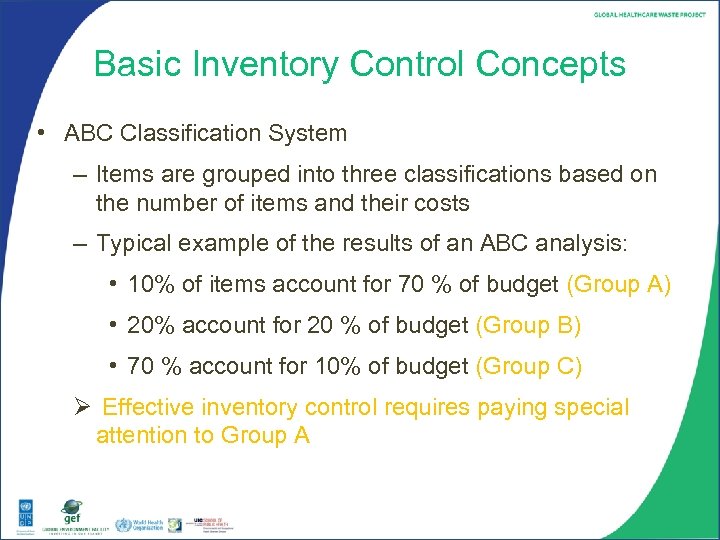 Basic Inventory Control Concepts • ABC Classification System – Items are grouped into three classifications based on the number of items and their costs – Typical example of the results of an ABC analysis: • 10% of items account for 70 % of budget (Group A) • 20% account for 20 % of budget (Group B) • 70 % account for 10% of budget (Group C) Ø Effective inventory control requires paying special attention to Group A
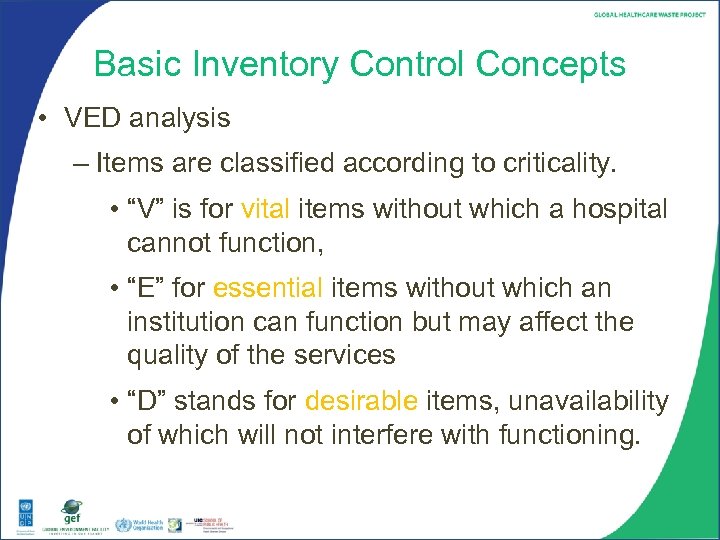 Basic Inventory Control Concepts • VED analysis – Items are classified according to criticality. • “V” is for vital items without which a hospital cannot function, • “E” for essential items without which an institution can function but may affect the quality of the services • “D” stands for desirable items, unavailability of which will not interfere with functioning.
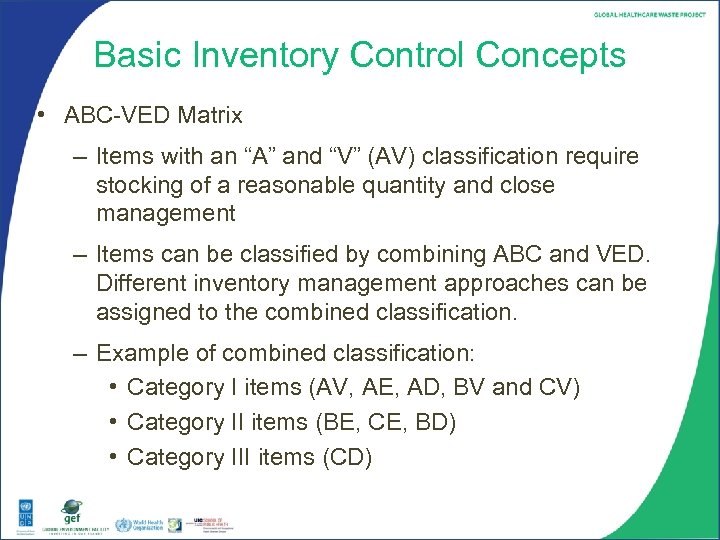 Basic Inventory Control Concepts • ABC-VED Matrix – Items with an “A” and “V” (AV) classification require stocking of a reasonable quantity and close management – Items can be classified by combining ABC and VED. Different inventory management approaches can be assigned to the combined classification. – Example of combined classification: • Category I items (AV, AE, AD, BV and CV) • Category II items (BE, CE, BD) • Category III items (CD)
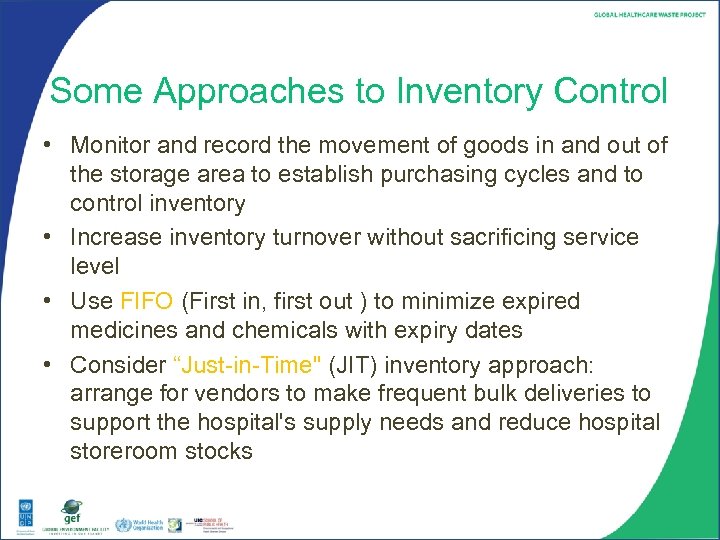 Some Approaches to Inventory Control • Monitor and record the movement of goods in and out of the storage area to establish purchasing cycles and to control inventory • Increase inventory turnover without sacrificing service level • Use FIFO (First in, first out ) to minimize expired medicines and chemicals with expiry dates • Consider “Just-in-Time" (JIT) inventory approach: arrange for vendors to make frequent bulk deliveries to support the hospital's supply needs and reduce hospital storeroom stocks
 Other Source Reduction Practices • Physical cleaning (e. g. , using steam) rather than chemical cleaning avoids the need for harsh chemicals. • Using all the contents in a container prevents product wastage. • Centralized purchasing of hazardous chemicals facilitates monitoring – from receipt to disposal. • Purchasing products with long expiration dates reduces waste from expired items.
 Plastics and Green Purchasing • Healthcare facilities could investigate options for purchasing plastics that can be easily recycled, or goods supplied with less packaging material. • The most easily recyclable plastics are: – polyethylene – polypropylene – polyethylene terephthalate • Polyvinyl chloride (PVC) is the most difficult to recycle due to the many additives used in its different forms – PVC use should be avoided because of the potential toxicity of its additives and the formation of dioxins and furans from burning of PVC plastics.
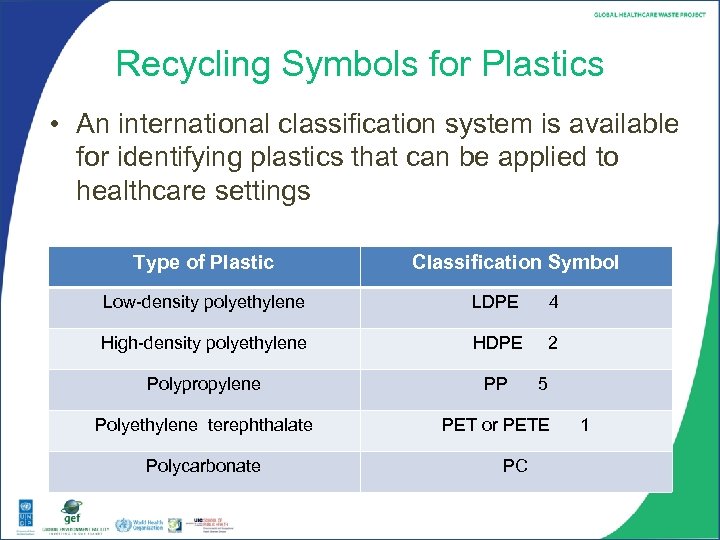 Recycling Symbols for Plastics • An international classification system is available for identifying plastics that can be applied to healthcare settings Type of Plastic Classification Symbol Low-density polyethylene LDPE 4 High-density polyethylene HDPE 2 Polypropylene PP 5 Polyethylene terephthalate PET or PETE 1 Polycarbonate PC
 Safe Reuse of Materials • In general, using non-disposable items for health services will help to minimize waste quantities – Reusable items should be emphasized over singleuse items, so long as cleaning (or sterilization in the case of critical items) will prevent the risk of infection • Single-use items should never be reused because they cannot be properly sterilized and pose a risk of cross-infection – Reusing disposable syringes and hypodermic needles pose great risk of spreading disease
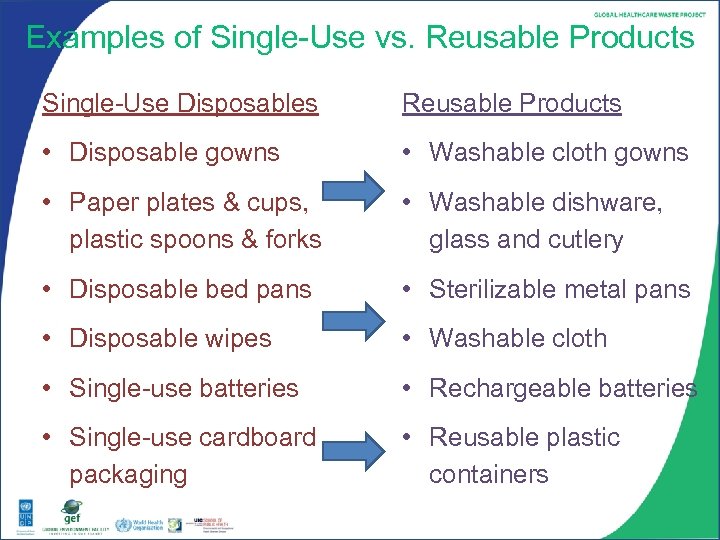 Examples of Single-Use vs. Reusable Products Single-Use Disposables Reusable Products • Disposable gowns • Washable cloth gowns • Paper plates & cups, plastic spoons & forks • Washable dishware, glass and cutlery • Disposable bed pans • Sterilizable metal pans • Disposable wipes • Washable cloth • Single-use batteries • Rechargeable batteries • Single-use cardboard packaging • Reusable plastic containers
 Solvent Recovery and Reuse • Waste solvents from biomedical labs can be recovered using fractional distillation units. • Purity of recovered solvents can approach 99. 9%. • “Bottom still” residues may contain dyes, paraffin, tissues, etc. and should be disposed as hazardous waste. • Examples of waste solvents that can be recycled: – Formaldehyde, formalin (aqueous solution of formaldehyde), ethanol, methanol, isopropyl alcohol, xylene, xylene substitutes, chloroform, toluene, methylene chloride, propylene glycol
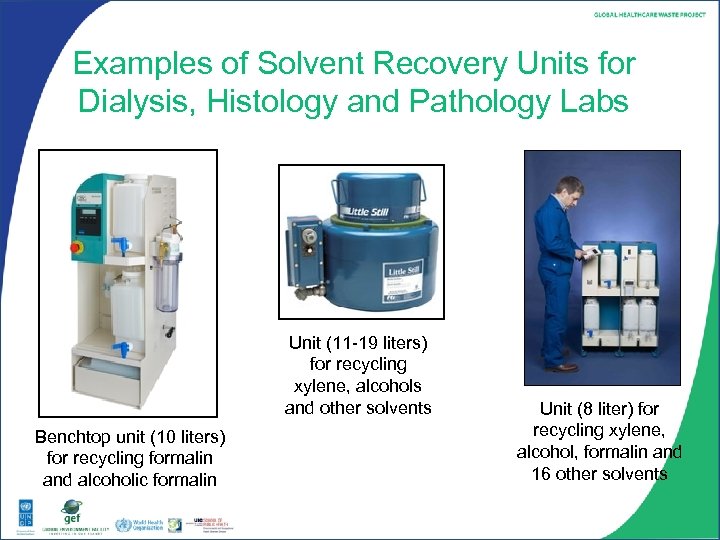 Examples of Solvent Recovery Units for Dialysis, Histology and Pathology Labs Unit (11 -19 liters) for recycling xylene, alcohols and other solvents Benchtop unit (10 liters) for recycling formalin and alcoholic formalin Unit (8 liter) for recycling xylene, alcohol, formalin and 16 other solvents
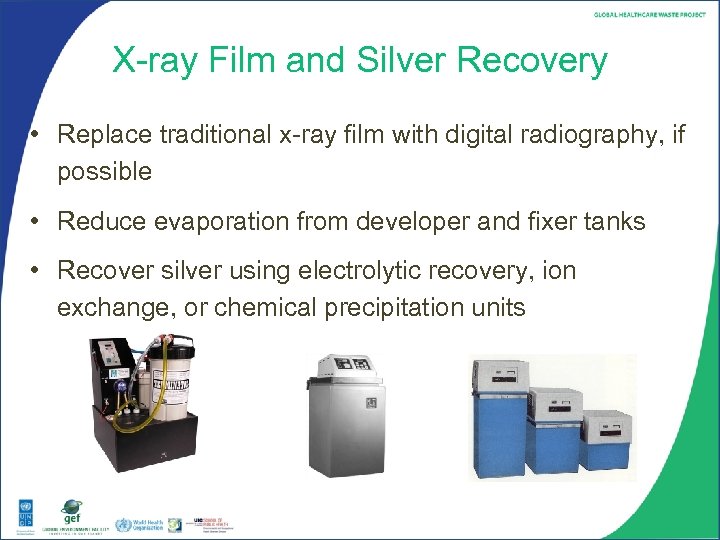 X-ray Film and Silver Recovery • Replace traditional x-ray film with digital radiography, if possible • Reduce evaporation from developer and fixer tanks • Recover silver using electrolytic recovery, ion exchange, or chemical precipitation units Silver recovery electrolytic units
 Recovery and Recycling • From an environmental perspective, recycling is less desirable than reuse because of the energy and transport needs that are required. • Recovery is defined in one of two ways: – Recovery of materials that are then recycled by converting into new products, or composting of organic waste matter to produce compost or soil conditioners for agricultural uses. – Use as fuel thereby converting waste into energy in the form of heat or electricity.
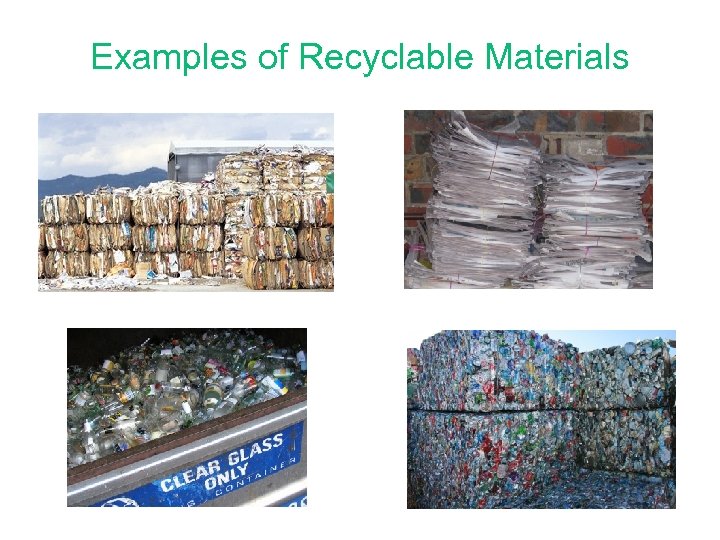 Examples of Recyclable Materials Cardboard Glass Paper Aluminum
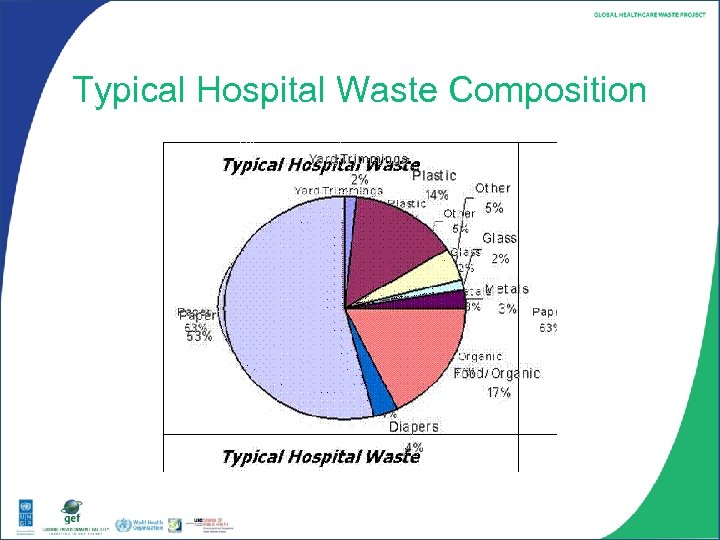 Typical Hospital Waste Composition
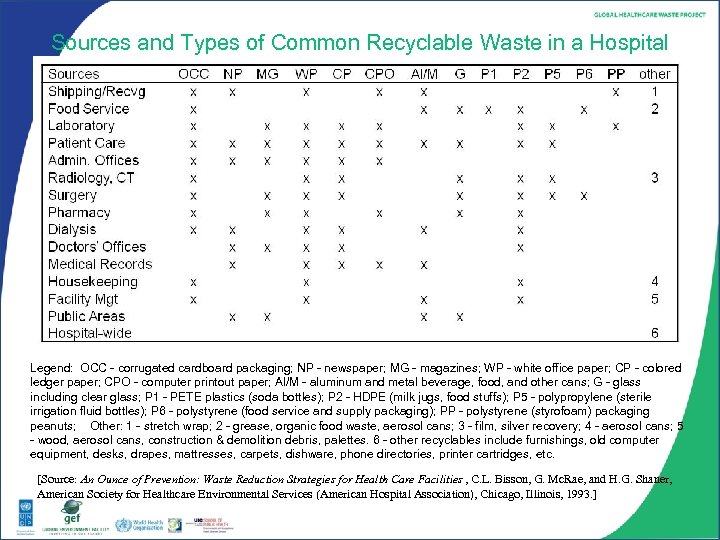 Sources and Types of Common Recyclable Waste in a Hospital Legend: OCC - corrugated cardboard packaging; NP - newspaper; MG - magazines; WP - white office paper; CP - colored ledger paper; CPO - computer printout paper; Al/M - aluminum and metal beverage, food, and other cans; G - glass including clear glass; P 1 - PETE plastics (soda bottles); P 2 - HDPE (milk jugs, food stuffs); P 5 - polypropylene (sterile irrigation fluid bottles); P 6 - polystyrene (food service and supply packaging); PP - polystyrene (styrofoam) packaging peanuts; Other: 1 - stretch wrap; 2 - grease, organic food waste, aerosol cans; 3 - film, silver recovery; 4 - aerosol cans; 5 - wood, aerosol cans, construction & demolition debris, palettes. 6 - other recyclables include furnishings, old computer equipment, desks, drapes, mattresses, carpets, dishware, phone directories, printer cartridges, etc. [Source: An Ounce of Prevention: Waste Reduction Strategies for Health Care Facilities , C. L. Bisson, G. Mc. Rae, and H. G. Shaner, American Society for Healthcare Environmental Services (American Hospital Association), Chicago, Illinois, 1993. ]
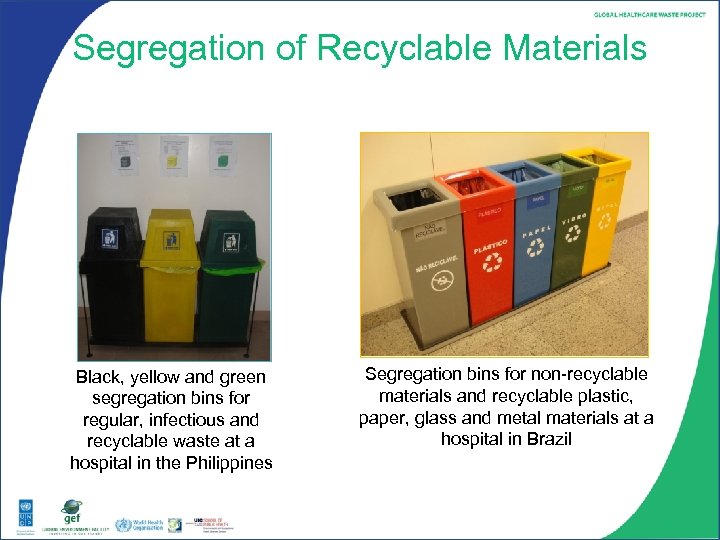 Segregation of Recyclable Materials Black, yellow and green segregation bins for regular, infectious and recyclable waste at a hospital in the Philippines Segregation bins for non-recyclable materials and recyclable plastic, paper, glass and metal materials at a hospital in Brazil
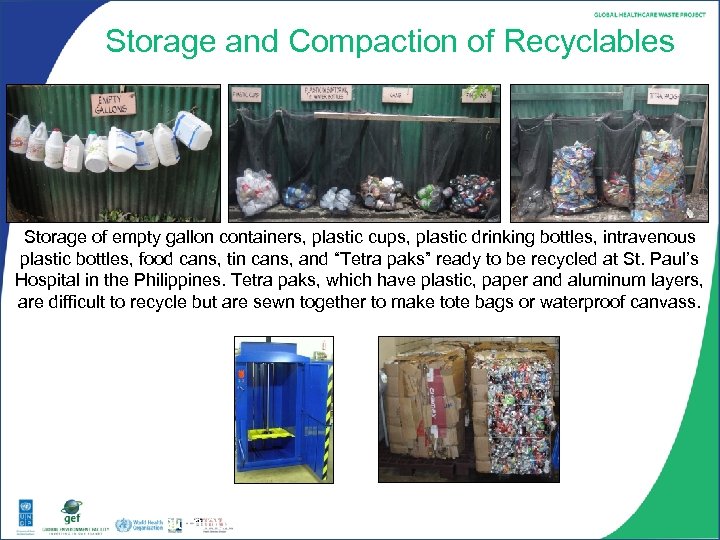 Storage and Compaction of Recyclables Storage of empty gallon containers, plastic cups, plastic drinking bottles, intravenous plastic bottles, food cans, tin cans, and “Tetra paks” ready to be recycled at St. Paul’s Hospital in the Philippines. Tetra paks, which have plastic, paper and aluminum layers, are difficult to recycle but are sewn together to make tote bags or waterproof canvass. Example of a compactor-baler and compacted cardboard and aluminum cans for recycling at a hospital in Brazil
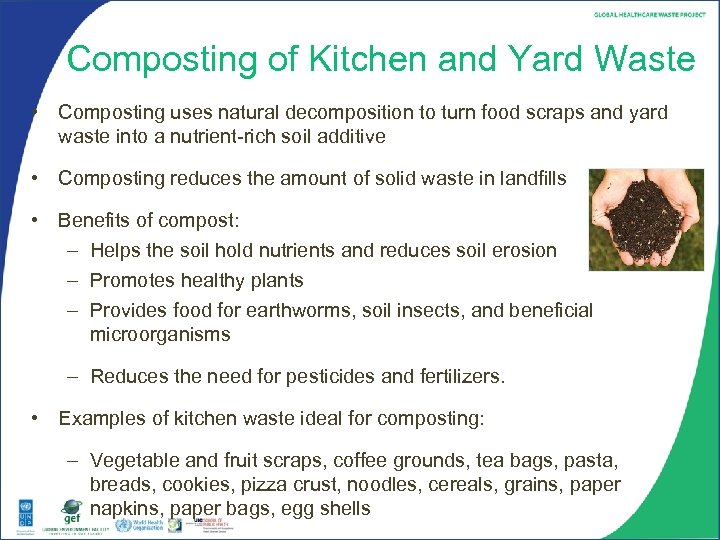 Composting of Kitchen and Yard Waste • Composting uses natural decomposition to turn food scraps and yard waste into a nutrient-rich soil additive • Composting reduces the amount of solid waste in landfills • Benefits of compost: – Helps the soil hold nutrients and reduces soil erosion – Promotes healthy plants – Provides food for earthworms, soil insects, and beneficial microorganisms – Reduces the need for pesticides and fertilizers. • Examples of kitchen waste ideal for composting: – Vegetable and fruit scraps, coffee grounds, tea bags, pasta, breads, cookies, pizza crust, noodles, cereals, grains, paper napkins, paper bags, egg shells
 Key Factors in Composting • • • The carbon/nitrogen ratio: use about 4: 1 ratio by volume – Carbon: dry leaves, straw, sawdust, twigs, shredded newspapers – Nitrogen: vegetable & fruit scraps, manure, green plants, newly cut grass The presence of microorganisms: – A few shovels full of rich garden soil or previously made compost supply the necessary microorganisms. The moisture level: – Water should be added to the pile to keep it moist like a wellsqueezed sponge. The oxygen level: – Composting is an aerobic process. The compost pile should be turned regularly to add oxygen and promote decay of its contents. The particle size: – Breaking up large materials into smaller sizes generates compost faster.
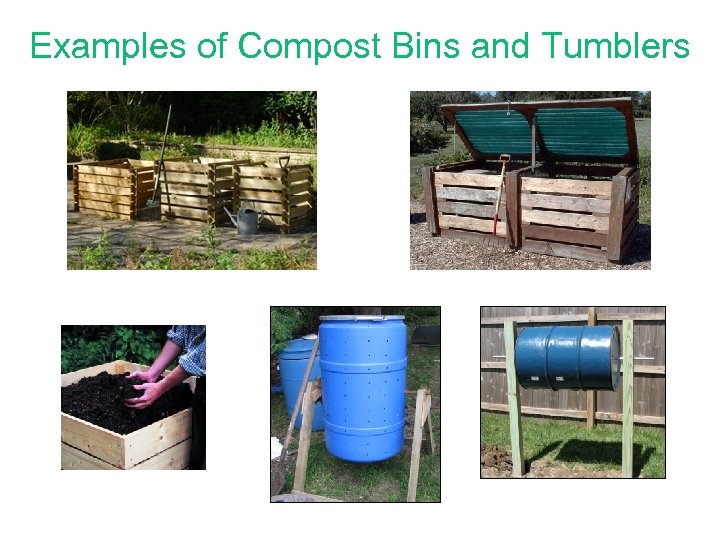 Examples of Compost Bins and Tumblers
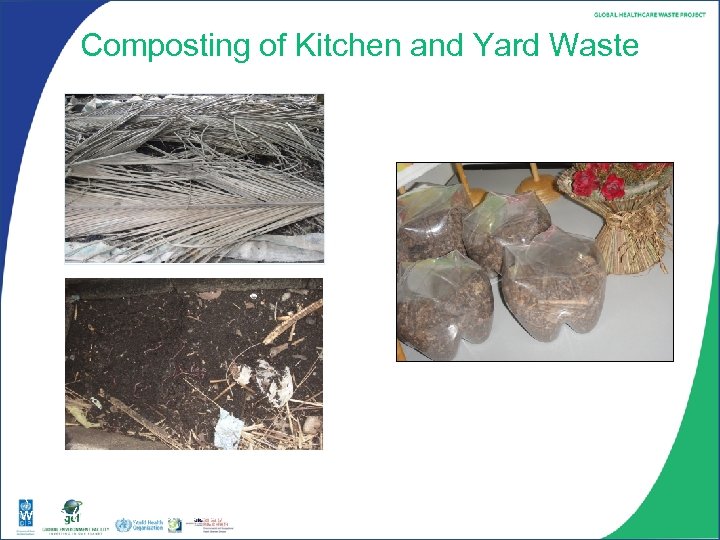 Composting of Kitchen and Yard Waste Sale of compost made from their kitchen waste by a hospital in Brazil Coconut leaves covering a vermi-culture plot (top) and close-up of vermi-culture of kitchen waste (bottom) at a hospital in the Philippines
 Biodigestion of Healthcare Waste • Biodigestion – A process of waste decomposition in an anaerobic (oxygen-free) system • Biodigesters – Convert waste (kitchen waste, food waste, leaves, etc. ) into methane which can be used for cooking. • The sludge from a biodigester is rich organic manure.
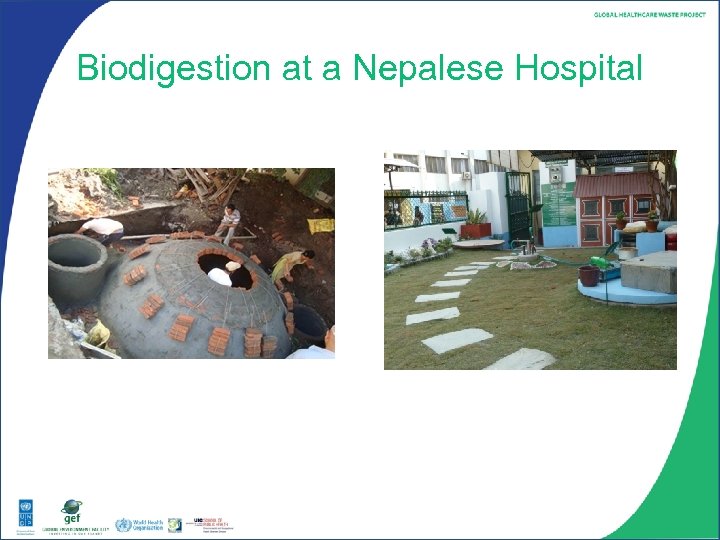 Biodigestion at a Nepalese Hospital Before and after photos of a biodigester at a hospital in Nepal. The biodigester decomposes about 75 kg of kitchen and food waste per day and is estimated to produce about $1000 of cooking gas per year. Photo: HECAF
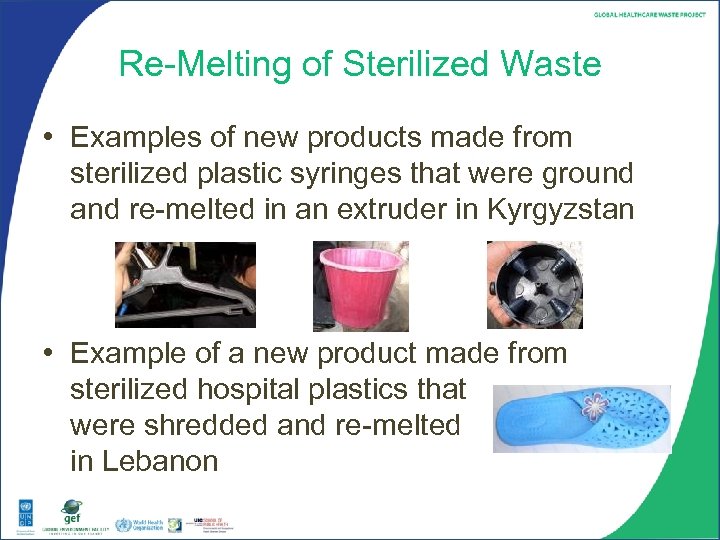 Re-Melting of Sterilized Waste • Examples of new products made from sterilized plastic syringes that were ground and re-melted in an extruder in Kyrgyzstan • Example of a new product made from sterilized hospital plastics that were shredded and re-melted in Lebanon
 Environmental Management System (EMS) • Formal approach in countries with strict environmental laws to manage an organization’s impact on the environment • Benefits for healthcare facilities from implementation of an EMS include: – – Cost reductions through energy consumption Reduced quantities of waste Increased recycling Fewer negative environmental impacts from waste handling and treatment – Improved public image
 Environmental Management System (EMS) • An EMS should be an integral component of an organization’s approach to managing healthcare waste • Key elements of an EMS include: – Process or mechanism for screening project plans and activities for environmental risks – Development and use of clearly defined environmental management plans – Monitoring and reporting activities to verify that relevant environmental management activities are being taken and generating the intended results – Evaluation of overall environmental performance of projects and activities
 Examples of Waste Minimization Around the Globe (Blue Book Ch. 6) Reuse of medical devices in Canada: • 41% of Canadian hospitals reuse non-disposable medical devices like endoscopes for economic reason Recycling infectious waste in Nepal: • NGO ‘Healthcare Foundation’ recycles blood contaminated plastic after autoclaving • 40% of handling costs are covered by recycling EMS for Cardiff and Vale NHS Trust • Environmental Management System (EMS) introduced into their environmental policy • Clinical waste reduced by 4. 1%, energy consumption by 3. 6%, and water usage by 9. 6%
 Minimal Approach to Waste Minimization • Establish a system to generate ideas from staff, which may later be implemented in practice • Educate staff to use medical equipment carefully in order to avoid creating unnecessary waste • Healthcare managers should periodically review their purchases and alternative options for generating the least amount of waste
 Discussion • What is the purpose of the waste management hierarchy? • Think of specific ways to apply waste minimization techniques in your facility. • How can EPP and green procurement be implemented in your facility? • Compare reuse vs. recycling and recovery • What are the potential benefits of an EMS?