


 Скачать презентацию Module 11 First European Settlements in Canada HIST
04cca960eb445051871de27cb8efb972.ppt
- Количество слайдов: 32
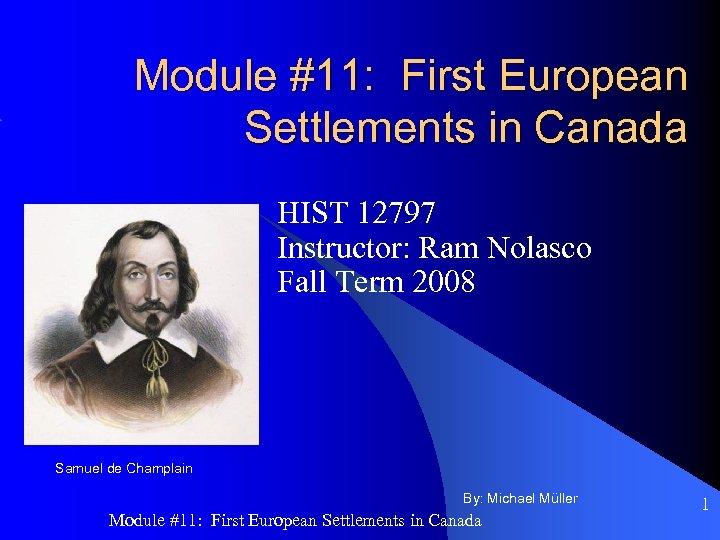 Module #11: First European Settlements in Canada HIST 12797 Instructor: Ram Nolasco Fall Term 2008 Samuel de Champlain By: Michael Müller Module #11: First European Settlements in Canada 1
 Learner Outcomes l Who were the first European Settlers to develop permanent colonies in Canada. l Be aware of the challenges faced by these early settlers. l Know the built forms first constructed by Europeans in Canada. Module #11: First European Settlements in Canada 2
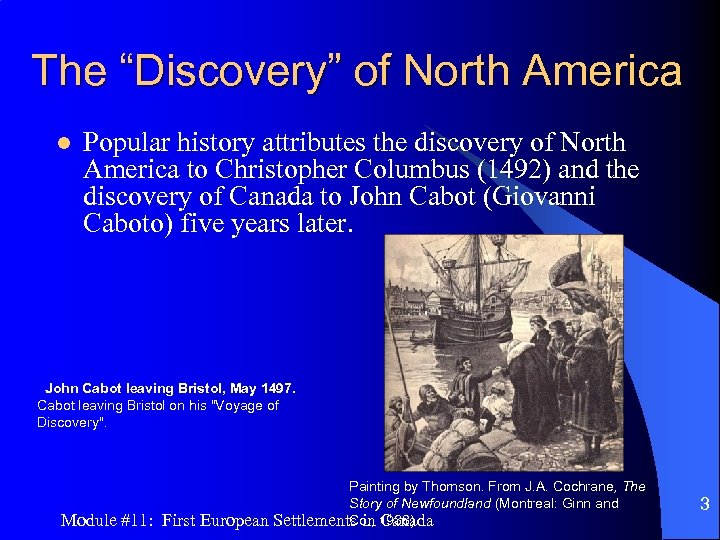 The “Discovery” of North America l Popular history attributes the discovery of North America to Christopher Columbus (1492) and the discovery of Canada to John Cabot (Giovanni Caboto) five years later. John Cabot leaving Bristol, May 1497. Cabot leaving Bristol on his "Voyage of Discovery". Module #11: First European Painting by Thomson. From J. A. Cochrane, The Story of Newfoundland (Montreal: Ginn and Co. , 1938) Settlements in Canada 3
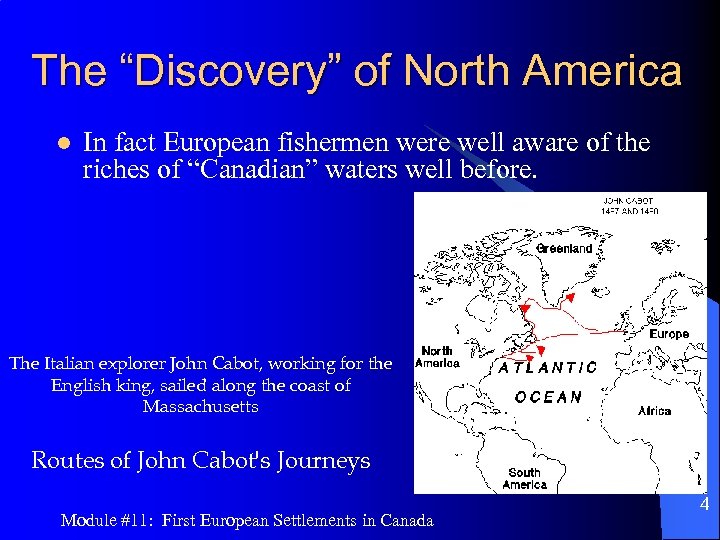 The “Discovery” of North America l In fact European fishermen were well aware of the riches of “Canadian” waters well before. The Italian explorer John Cabot, working for the English king, sailed along the coast of Massachusetts Routes of John Cabot's Journeys Module #11: First European Settlements in Canada 4
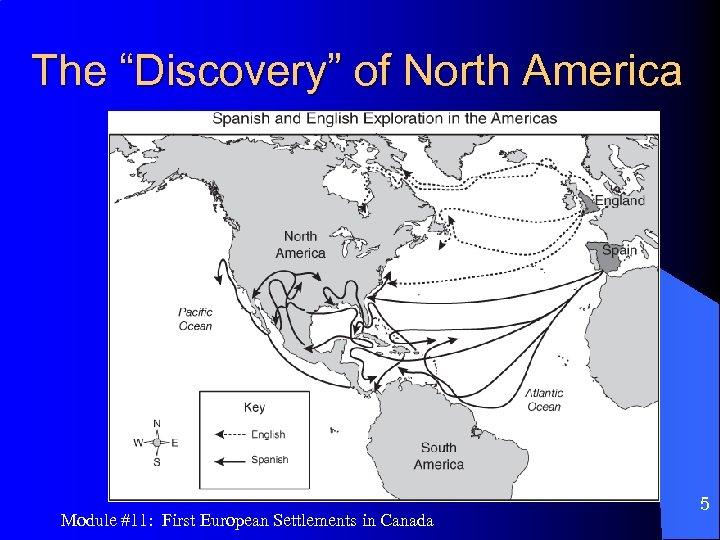 The “Discovery” of North America Module #11: First European Settlements in Canada 5
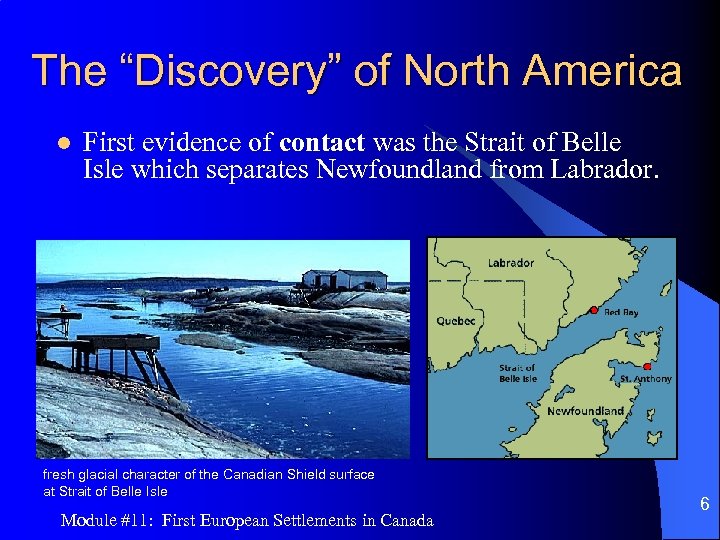 The “Discovery” of North America l First evidence of contact was the Strait of Belle Isle which separates Newfoundland from Labrador. fresh glacial character of the Canadian Shield surface at Strait of Belle Isle Module #11: First European Settlements in Canada 6
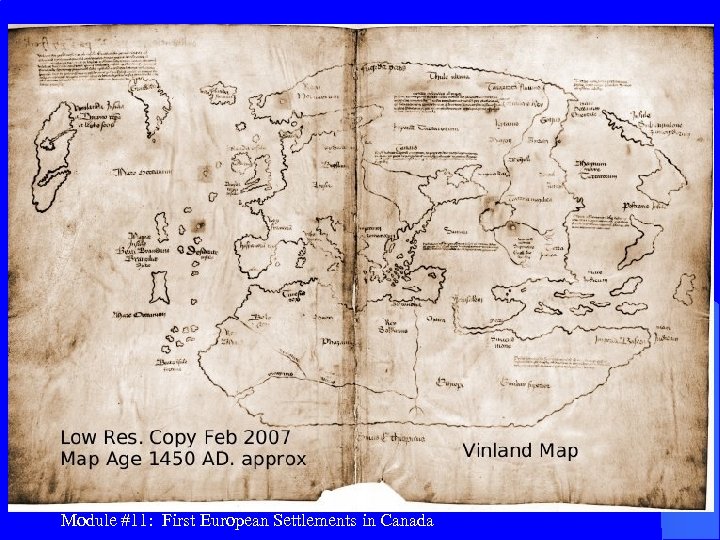
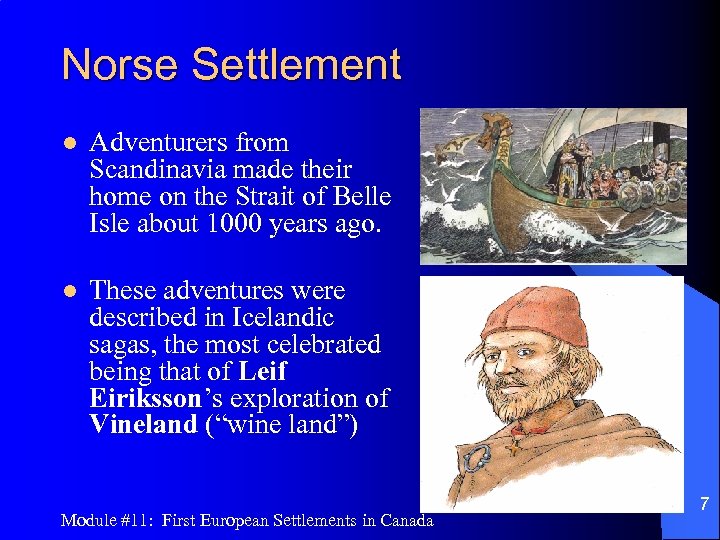 Norse Settlement l Adventurers from Scandinavia made their home on the Strait of Belle Isle about 1000 years ago. l These adventures were described in Icelandic sagas, the most celebrated being that of Leif Eiriksson’s exploration of Vineland (“wine land”) Module #11: First European Settlements in Canada 7
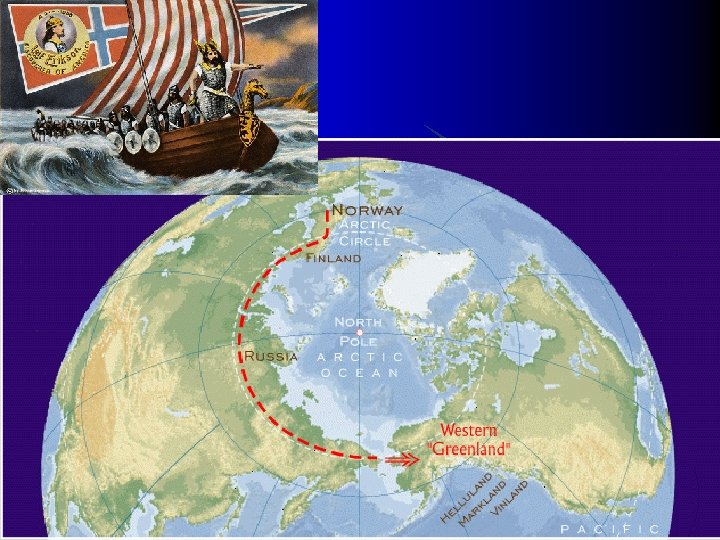 Module #11: First European Settlements in Canada 8
 Module #11: First European Settlements in Canada 9
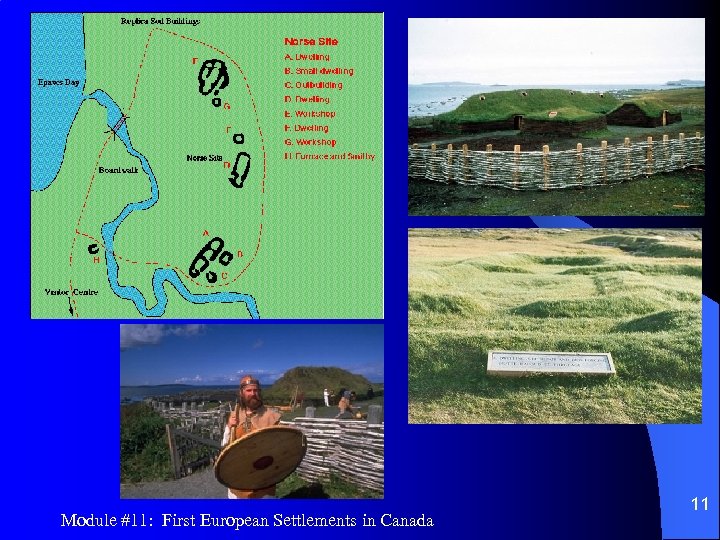
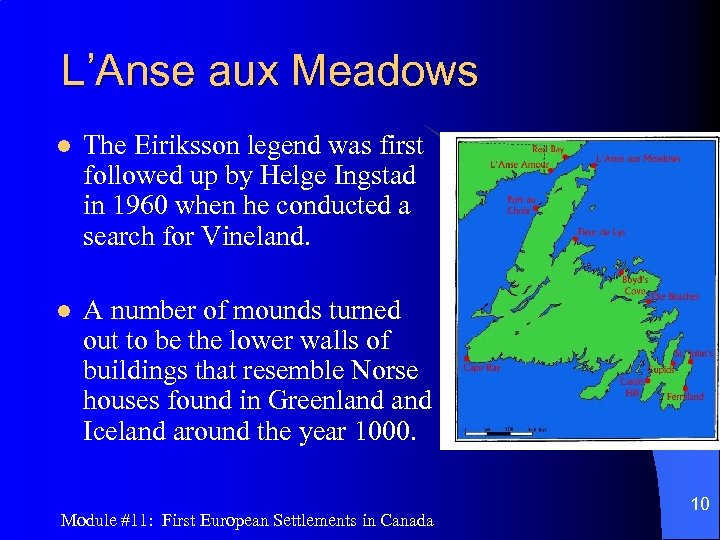 L’Anse aux Meadows l The Eiriksson legend was first followed up by Helge Ingstad in 1960 when he conducted a search for Vineland. l A number of mounds turned out to be the lower walls of buildings that resemble Norse houses found in Greenland Iceland around the year 1000. Module #11: First European Settlements in Canada 10
 Module #11: First European Settlements in Canada 11
 But is it “Vineland”? l While it is undisputed that l’Anse aux Meadows is a Norse site, there is a debate as to whether it is the Vineland of Leif Eiriksson’s sagas. l The descriptions of grapes and frost-free winters do not quite jive. l An alternative suggestion is that this site is an attempt at colonization made in c. 1004 by Icelander Thorfinn Karlsefni. Module #11: First European Settlements in Canada 12
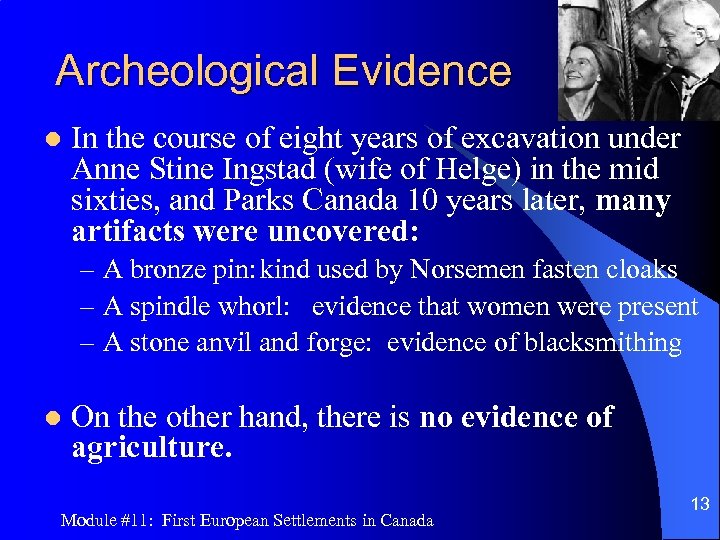 Archeological Evidence l In the course of eight years of excavation under Anne Stine Ingstad (wife of Helge) in the mid sixties, and Parks Canada 10 years later, many artifacts were uncovered: – A bronze pin: kind used by Norsemen fasten cloaks – A spindle whorl: evidence that women were present – A stone anvil and forge: evidence of blacksmithing l On the other hand, there is no evidence of agriculture. Module #11: First European Settlements in Canada 13
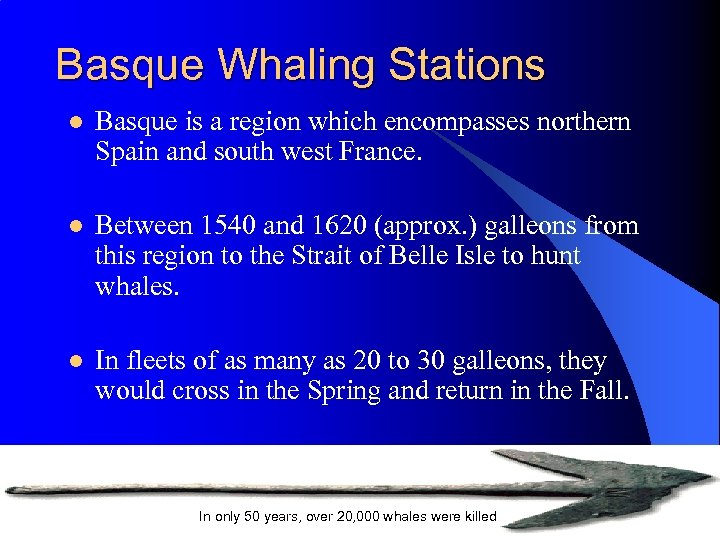 Basque Whaling Stations l Basque is a region which encompasses northern Spain and south west France. l Between 1540 and 1620 (approx. ) galleons from this region to the Strait of Belle Isle to hunt whales. l In fleets of as many as 20 to 30 galleons, they would cross in the Spring and return in the Fall. Module #11: First In only 50 years, over 20, 000 whales were killed European Settlements in Canada 14
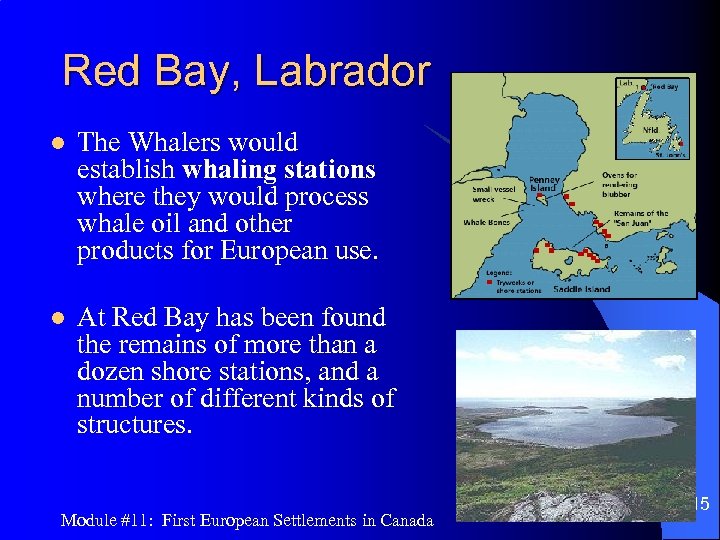 Red Bay, Labrador l The Whalers would establish whaling stations where they would process whale oil and other products for European use. l At Red Bay has been found the remains of more than a dozen shore stations, and a number of different kinds of structures. Module #11: First European Settlements in Canada 15
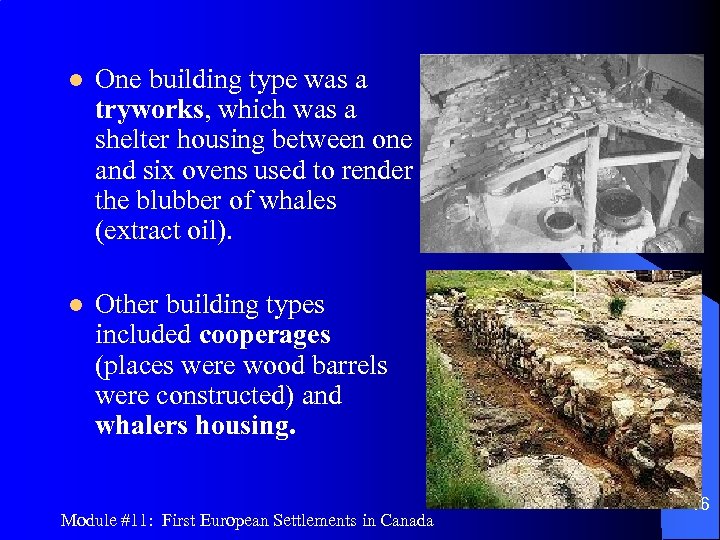 l One building type was a tryworks, which was a shelter housing between one and six ovens used to render the blubber of whales (extract oil). l Other building types included cooperages (places were wood barrels were constructed) and whalers housing. Module #11: First European Settlements in Canada 16
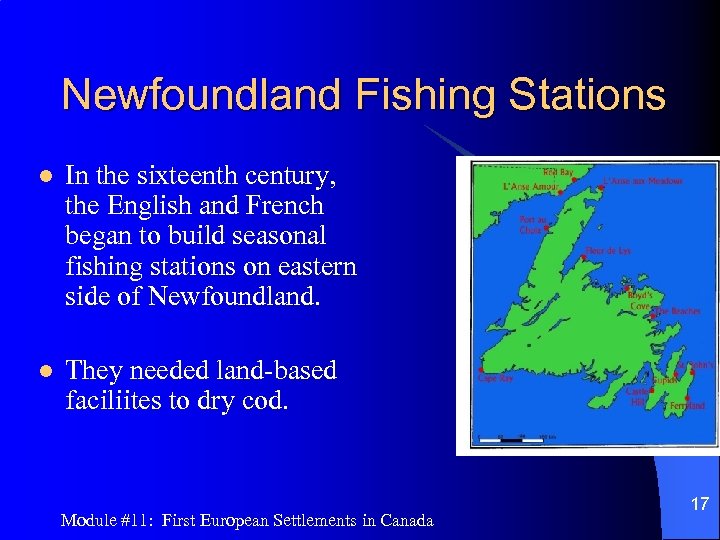 Newfoundland Fishing Stations l In the sixteenth century, the English and French began to build seasonal fishing stations on eastern side of Newfoundland. l They needed land-based faciliites to dry cod. Module #11: First European Settlements in Canada 17
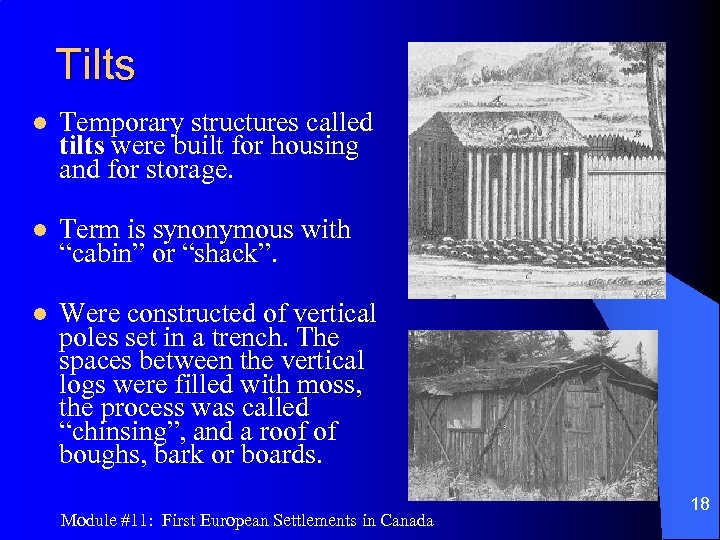 Tilts l Temporary structures called tilts were built for housing and for storage. l Term is synonymous with “cabin” or “shack”. l Were constructed of vertical poles set in a trench. The spaces between the vertical logs were filled with moss, the process was called “chinsing”, and a roof of boughs, bark or boards. Module #11: First European Settlements in Canada 18
 Early French Colonization l King Henry of France wanted to establish French settlements in Canada to confirm his domain over this new land. l To do so he gave Pierre du Gua de Monts a patent (ie. Sole rights to trade in the region) in 1603. l The following year de Monts traveled with 2 ships carrying 120 -150 men to an island just off of Nova Scotia, calling it Ile Sainte Croix. (Today this island is known as Dochet Island, Maine. ) Module #11: First European Settlements in Canada 19
 The “habitation” of Ile Ste. Croix l The island was chosen largely because it could be defended and offered a good base for trade. l The settlement included accommodation of various kinds and of varied construction within a palisade. Even in this tentative beginning architecture was used to express social value. l De Monts’ house had a French “chateau” roof and was built of sawn lumber which must have been shipped from France. Module #11: First European Settlements in Canada 20
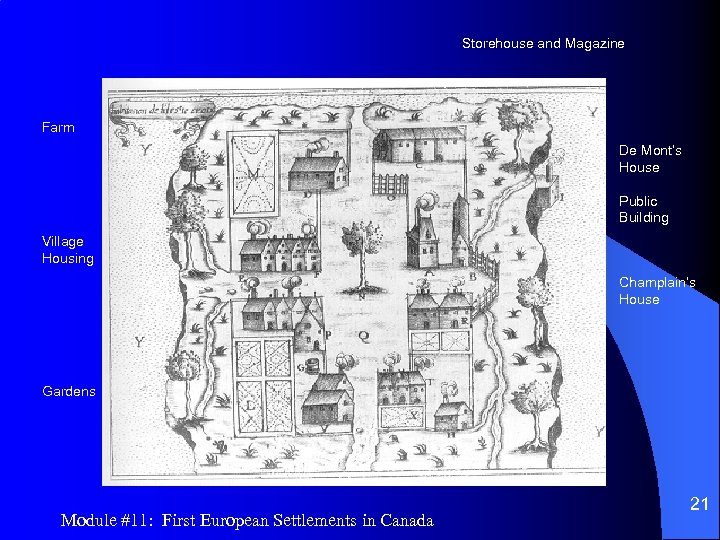 Storehouse and Magazine Farm De Mont’s House Public Building Village Housing Champlain’s House Gardens Module #11: First European Settlements in Canada 21
 A winter of hardship… l The winter of 1604 -5 was long and hard. With the island “scalped” by their construction projects, there was no shelter from wind or snow. l Ice flows cut the community off from the mainland from fresh water, fuel and game. l Of 79 men, 35 died and 20 became seriously sick. Module #11: First European Settlements in Canada 22
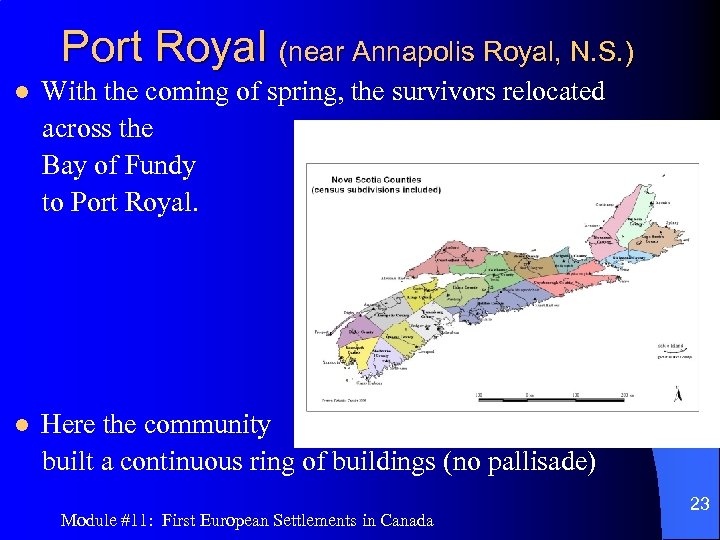 Port Royal (near Annapolis Royal, N. S. ) l With the coming of spring, the survivors relocated across the Bay of Fundy to Port Royal. l Here the community built a continuous ring of buildings (no pallisade) Module #11: First European Settlements in Canada 23
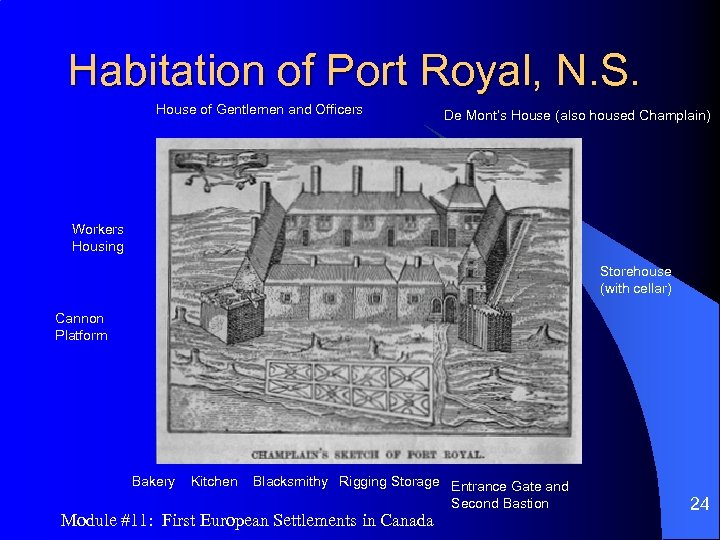 Habitation of Port Royal, N. S. House of Gentlemen and Officers De Mont’s House (also housed Champlain) Workers Housing Storehouse (with cellar) Cannon Platform Bakery Kitchen Blacksmithy Rigging Storage Entrance Gate and Second Bastion Module #11: First European Settlements in Canada 24
 Revoking of the Patent l De Mont’s fur-trading monopoly was revoked in 1607 and the habitation was temporarily abandoned. l The community was resettled in 1610 under the leadership of Jean de Biencourt de Poutrincourt one of the original settlers. l Port Royal was destroyed in 1613 by an English privateer Samuel Argall and the area was for a brief while the home of Scottish colony. Module #11: First European Settlements in Canada 25
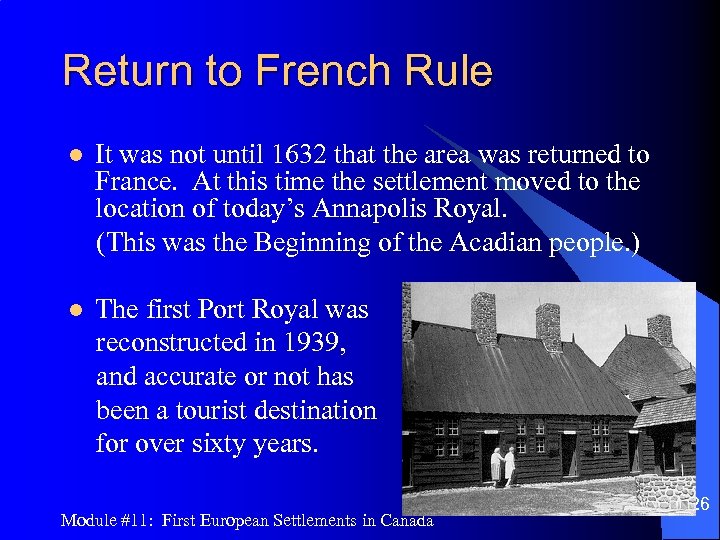 Return to French Rule l It was not until 1632 that the area was returned to France. At this time the settlement moved to the location of today’s Annapolis Royal. (This was the Beginning of the Acadian people. ) l The first Port Royal was reconstructed in 1939, and accurate or not has been a tourist destination for over sixty years. Module #11: First European Settlements in Canada 26
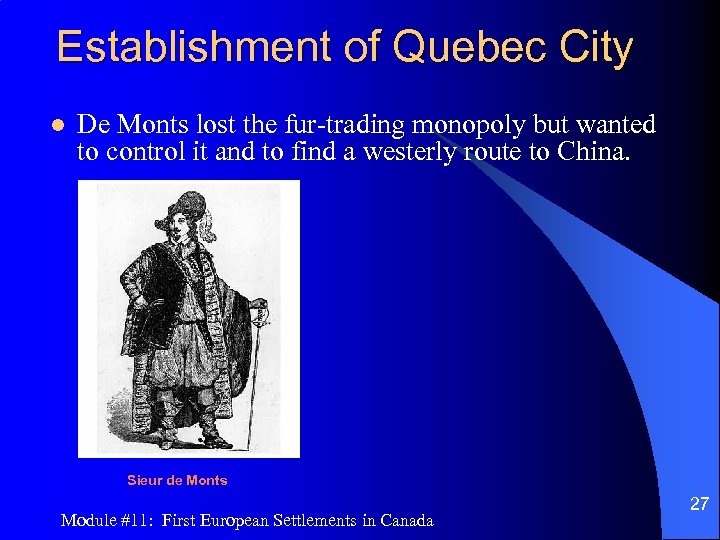 Establishment of Quebec City l De Monts lost the fur-trading monopoly but wanted to control it and to find a westerly route to China. Sieur de Monts Module #11: First European Settlements in Canada 27
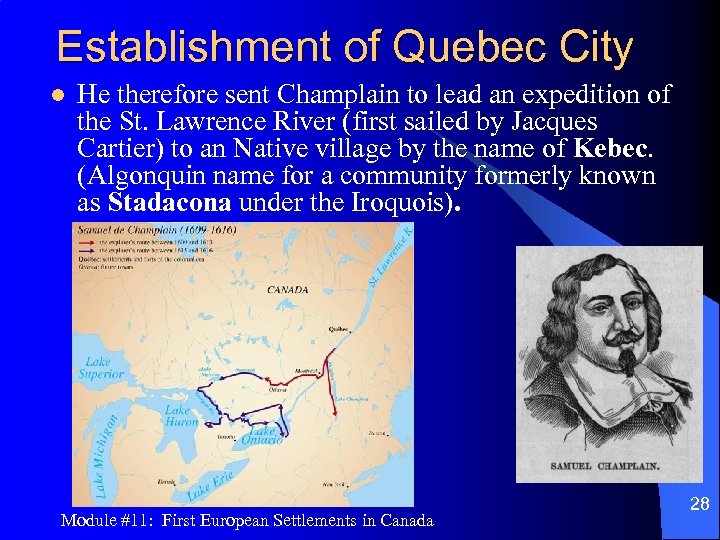 Establishment of Quebec City l He therefore sent Champlain to lead an expedition of the St. Lawrence River (first sailed by Jacques Cartier) to an Native village by the name of Kebec. (Algonquin name for a community formerly known as Stadacona under the Iroquois). Module #11: First European Settlements in Canada 28
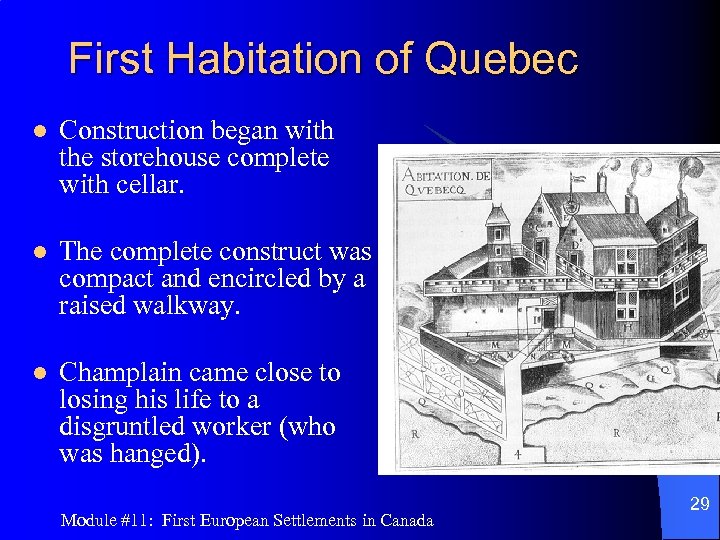 First Habitation of Quebec l Construction began with the storehouse complete with cellar. l The complete construct was compact and encircled by a raised walkway. l Champlain came close to losing his life to a disgruntled worker (who was hanged). Module #11: First European Settlements in Canada 29
 Second Habitation of Quebec l Champlain was rewarded for his work by being appointed the Governor of New France in 1620. l As the colony became more improved he decided to place a new fort at the top of the escarpment. l This subsequently became know as the “magasin de Roi” (the King’s storehouse) and is known from plans of 1630… Module #11: First European Settlements in Canada 30
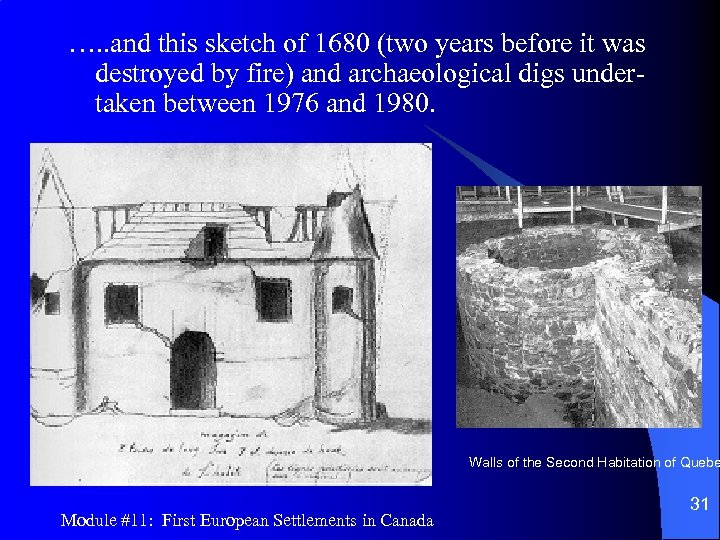 …. . and this sketch of 1680 (two years before it was destroyed by fire) and archaeological digs undertaken between 1976 and 1980. Walls of the Second Habitation of Quebe Module #11: First European Settlements in Canada 31
 Sources of photo images: A Concise History of Architecture, Harold Kalman, Oxford University Press …and sites listed below. For further research: http: //www. labradorstraits. nt. ca/redbay. html http: //www. heritage. hf. ca/exploration/basque. html http: //web. globalserve. net/~gcrose/acadianh. html http: //blupete. com/Hist/Bios. NS/1600 -00/ Champlai Module #11: First European Settlements in Canada 32