 Скачать презентацию Module 10 11 Stream Surveys February 2004 Part
56cc3d13bbbb66be72ba6b54dfc98f85.ppt
- Количество слайдов: 65



Module 10/11 Stream Surveys – February 2004 Part 1 – Water Quality Assessment
Objectives Students will be able to: · describe techniques used to determine dissolved oxygen. · list factors that influence high turbidity and suspended solids in streams. · explain methods used to determine total suspended solids. · evaluate the relationship between total suspended solids and turbidity. · identify methods used to determine water clarity in streams. · assess habitat degradation by determining the degree of sediment embeddedness in a stream. · analyze the impact of dissolved salts, p. H and temperature on streams. · describe accepted sampling methods used in stream surveys. Developed by: Updated: U 5 -m 21 a-s 2
Stream assessments · Water quality · Habitat · Hydrologic · Biological · Watershed Developed by: Updated: U 5 -m 21 a-s 3
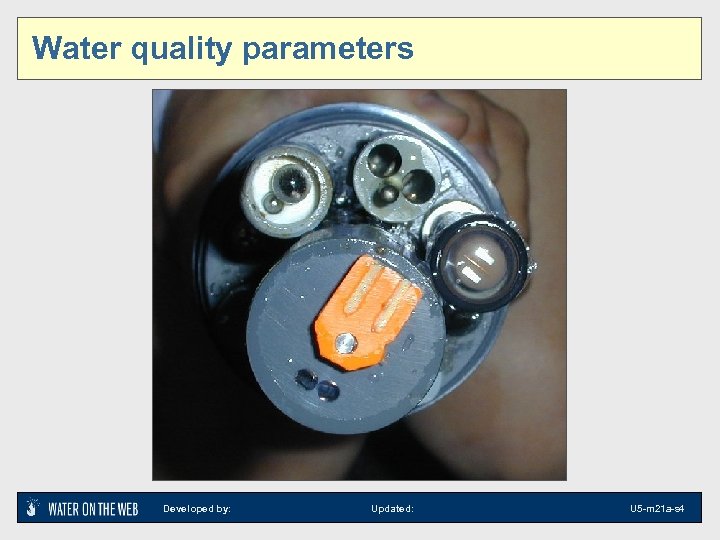
Water quality parameters Developed by: Updated: U 5 -m 21 a-s 4
Water Quality Parameters · Dissolved oxygen · Suspended sediments (TSS) and turbidity · Specific conductivity (EC) · alkalinity · p. H · Temperature · Major ions · All of these parameters are presented in greater detail in Module 9 – Lake surveys Developed by: Updated: U 5 -m 21 a-s 5
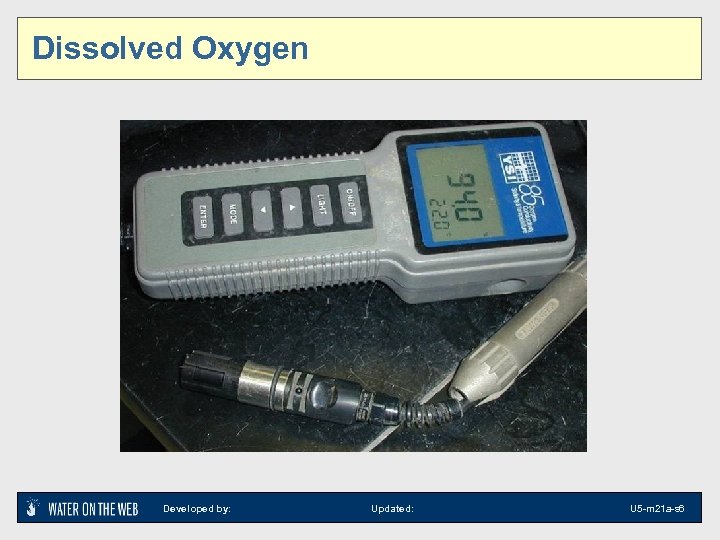
Dissolved Oxygen Developed by: Updated: U 5 -m 21 a-s 6
DO – importance and reporting · Oxygen is produced during photosynthesis and consumed during respiration and decomposition. · Generally < 3 mg/L is stressful to aquatic life. · Units of measurement are: · Concentration: mg/L = ppm; concentrations range 0. 0 to 20 mg/L · % saturation – used to determine if water is fully saturated with oxygen at a particular temperature Developed by: Updated: U 5 -m 21 a-s 7
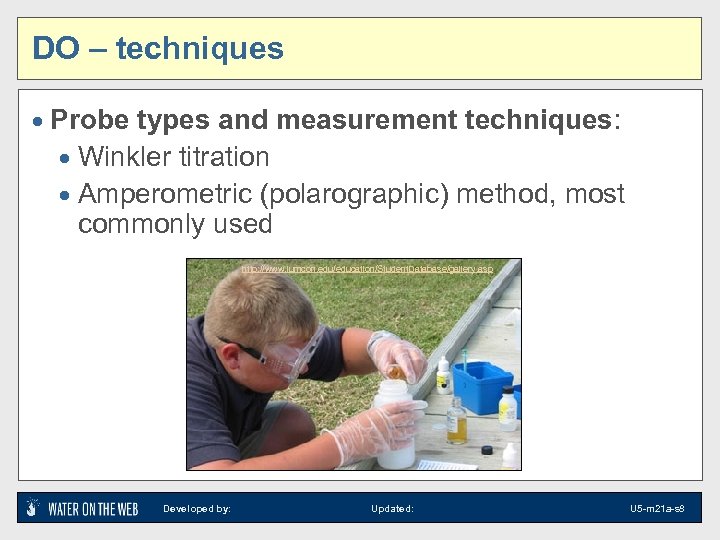
DO – techniques · Probe types and measurement techniques: · Winkler titration · Amperometric (polarographic) method, most commonly used http: //www. lumcon. edu/education/Student. Database/gallery. asp Developed by: Updated: U 5 -m 21 a-s 8
DO – probes · Most common sensor is the temperature compensated polarographic membrane-type (amperometric) · Temperature sensitive (but virtually all are compensated). · The probes actually consume O 2 as they work so measurements require moving water using either a built-in stirrer (typical in multiparameter sondes and BOD probes) or “hand jiggling” during the measurement. · in situ sensors are prone to fouling by algal/bacterial slimes and by silt in streams. Developed by: Updated: U 5 -m 21 a-s 9
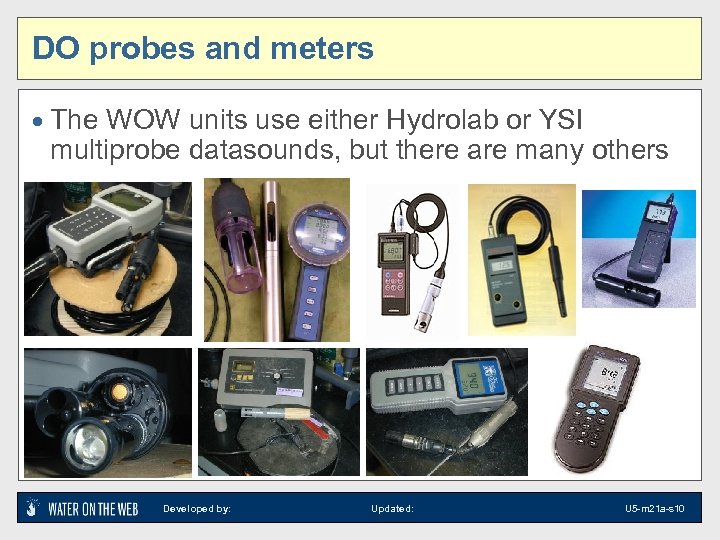
DO probes and meters · The WOW units use either Hydrolab or YSI multiprobe datasounds, but there are many others Developed by: Updated: U 5 -m 21 a-s 10
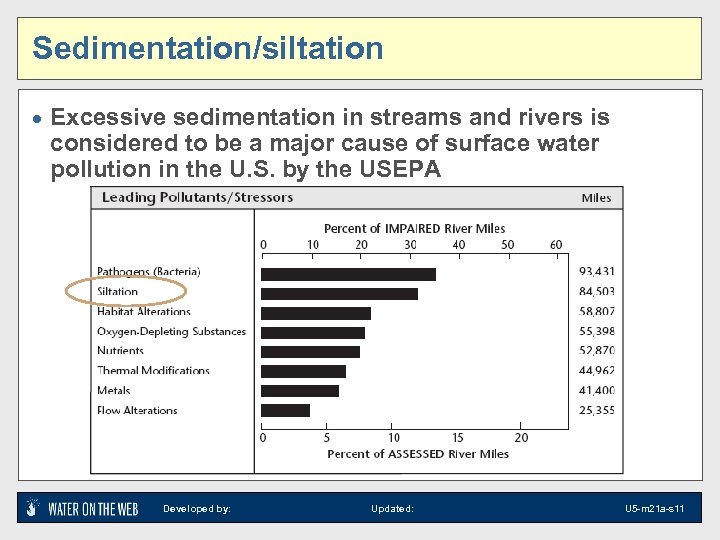
Sedimentation/siltation · Excessive sedimentation in streams and rivers is considered to be a major cause of surface water pollution in the U. S. by the USEPA Developed by: Updated: U 5 -m 21 a-s 11
Measures of sedimentation · Suspended sediments · Turbidity · Embededdness Developed by: Updated: U 5 -m 21 a-s 12
High turbidity and suspended solids · Caused by many factors including: · soil erosion · domestic and industrial wastewater discharge · urban runoff · flooding · algal growth due to nutrient enrichment · dredging operations · channelization · removal of riparian vegetation and other stream bank disturbances Developed by: Updated: U 5 -m 21 a-s 13
Total suspended solids and turbidity · Both are indicators of the amount of solids suspended in the water · Mineral (e. g. , soil particles) · Organic (e. g. , algae, detritus) · TSS measures the actual weight of material per volume of water (mg/L) · Turbidity measures the amount of light scattered · Therefore, TSS allows the determination of an actual concentration or quantity of material while turbidity does not Developed by: Updated: U 5 -m 21 a-s 14
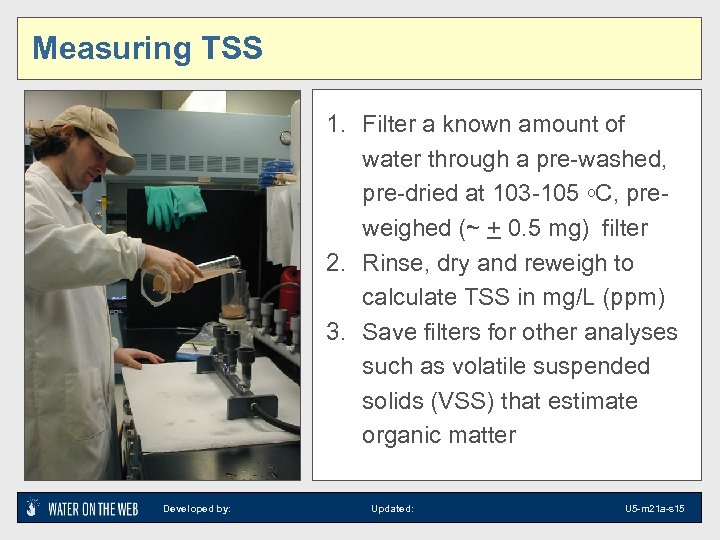
Measuring TSS 1. Filter a known amount of water through a pre-washed, pre-dried at 103 -105 o. C, preweighed (~ + 0. 5 mg) filter 2. Rinse, dry and reweigh to calculate TSS in mg/L (ppm) 3. Save filters for other analyses such as volatile suspended solids (VSS) that estimate organic matter Developed by: Updated: U 5 -m 21 a-s 15
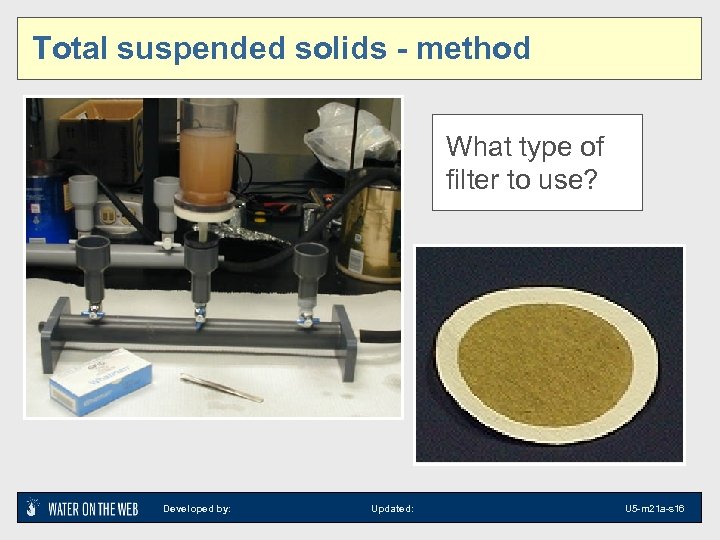
Total suspended solids - method What type of filter to use? Developed by: Updated: U 5 -m 21 a-s 16
![Total suspended solids Calculate TSS by using the equation below TSS (mg/L) = ([A-B]*1000)/C](https://present5.com/presentation/56cc3d13bbbb66be72ba6b54dfc98f85/image-17.jpg "Total suspended solids Calculate TSS by using the equation below TSS (mg/L) = ([A-B]*1000)/C")
Total suspended solids Calculate TSS by using the equation below TSS (mg/L) = ([A-B]*1000)/C where A = final dried weight of the filter (in milligrams = mg) B = Initial weight of the filter (in milligrams = mg) C = Volume of water filtered (in Liters) Developed by: Updated: U 5 -m 21 a-s 17
TSS · Range of results and what the results mean · Example: Suspended solids concentrations at Slate Creek WA average 150. 8 mg/l with a range of 50 to 327 mg/l. It is generally desired to maintain total suspended solid concentrations below 100 mg/l. Developed by: Updated: U 5 -m 21 a-s 18
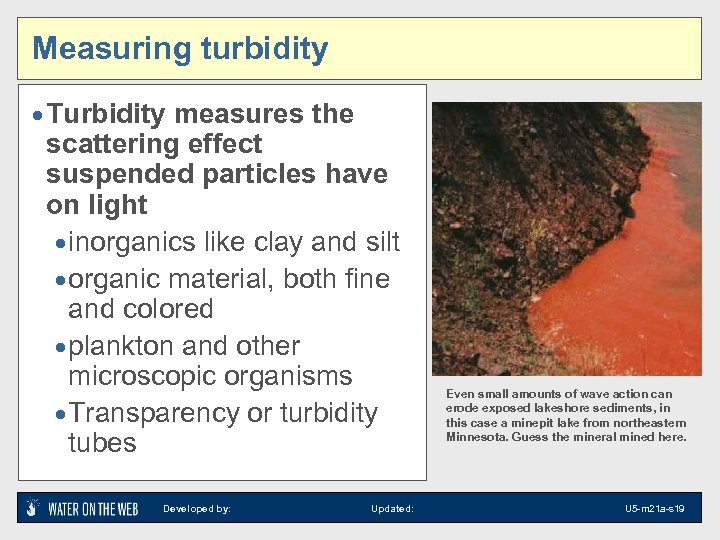
Measuring turbidity · Turbidity measures the scattering effect suspended particles have on light · inorganics like clay and silt · organic material, both fine and colored · plankton and other microscopic organisms · Transparency or turbidity tubes Developed by: Updated: Even small amounts of wave action can erode exposed lakeshore sediments, in this case a minepit lake from northeastern Minnesota. Guess the mineral mined here. U 5 -m 21 a-s 19
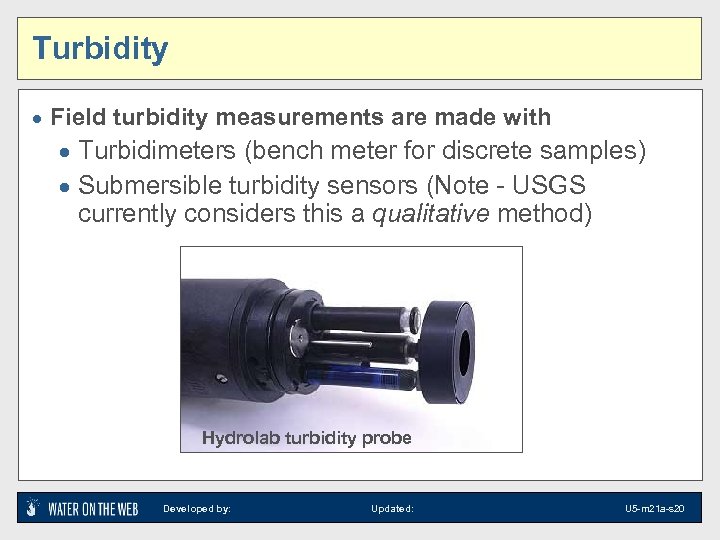
Turbidity · Field turbidity measurements are made with · Turbidimeters (bench meter for discrete samples) · Submersible turbidity sensors (Note - USGS currently considers this a qualitative method) Hydrolab turbidity probe Developed by: Updated: U 5 -m 21 a-s 20
Turbidity - Nephelometric optics · Nephelometric turbidity estimated by the scattering effect suspended particles have on light · Detector is at 90 o from the light source Developed by: Updated: U 5 -m 21 a-s 21
Turbidity – units and reporting • Nephelometric Turbidity Units (NTU) standards are formazin or other certified material • JTU’s are from an “older” technology in which a candle flame was viewed through a tube of water 1 NTU = 1 JTU (Jackson Turbidity Unit) Developed by: Updated: U 5 -m 21 a-s 22
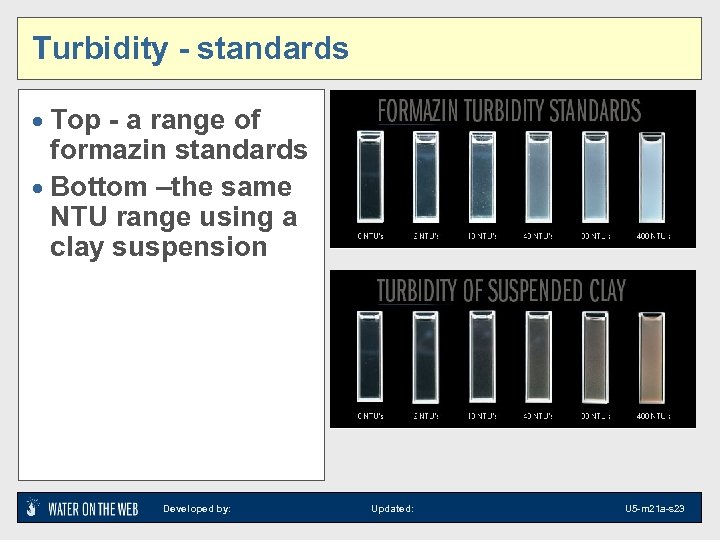
Turbidity - standards · Top - a range of formazin standards · Bottom –the same NTU range using a clay suspension Developed by: Updated: U 5 -m 21 a-s 23
Turbidity · Range of results and what the results mean · Ex: Salmon Creek Watershed (OR/WA border) TMDL for turbidity is: "Turbidity shall not exceed 5 NTU over background turbidity when the background turbidity is 50 NTU or less. Or more than a 10% increase in turbidity when the background turbidity is > 50 NTU”. Developed by: Updated: U 5 -m 21 a-s 24
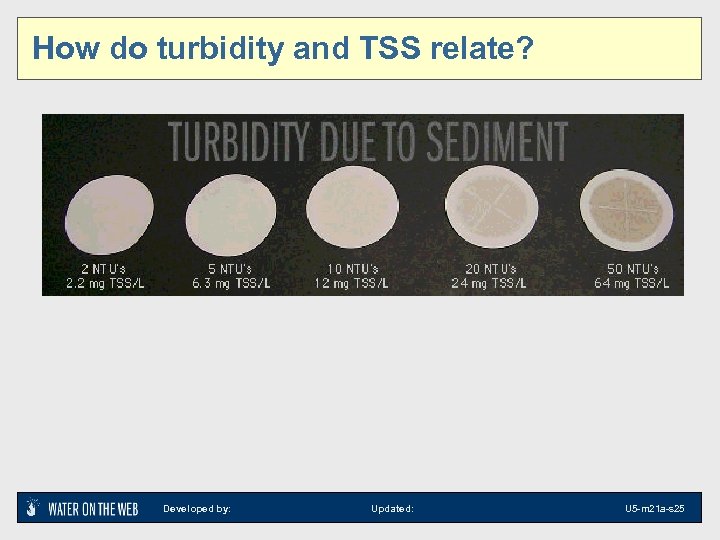
How do turbidity and TSS relate? Developed by: Updated: U 5 -m 21 a-s 25
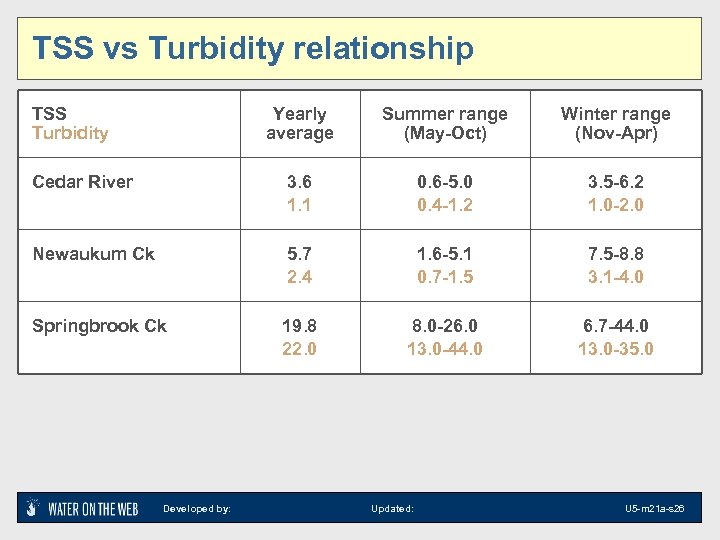
TSS vs Turbidity relationship TSS Turbidity Yearly average Summer range (May-Oct) Winter range (Nov-Apr) Cedar River 3. 6 1. 1 0. 6 -5. 0 0. 4 -1. 2 3. 5 -6. 2 1. 0 -2. 0 Newaukum Ck 5. 7 2. 4 1. 6 -5. 1 0. 7 -1. 5 7. 5 -8. 8 3. 1 -4. 0 Springbrook Ck 19. 8 22. 0 8. 0 -26. 0 13. 0 -44. 0 6. 7 -44. 0 13. 0 -35. 0 Developed by: Updated: U 5 -m 21 a-s 26
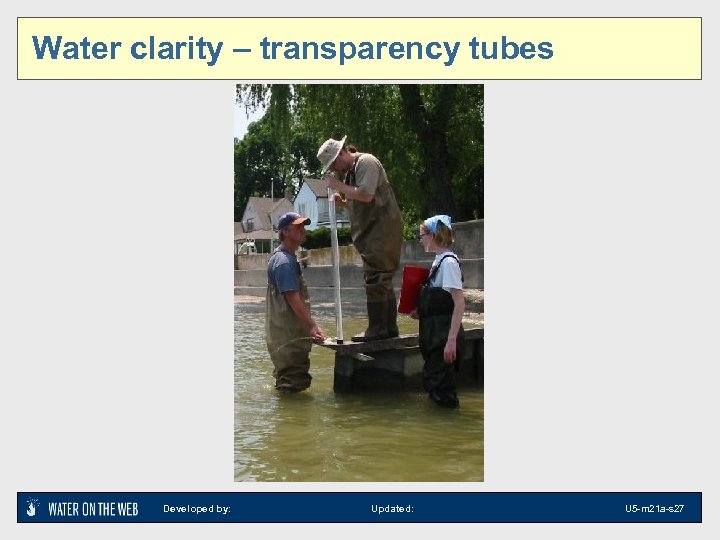
Water clarity – transparency tubes Developed by: Updated: U 5 -m 21 a-s 27
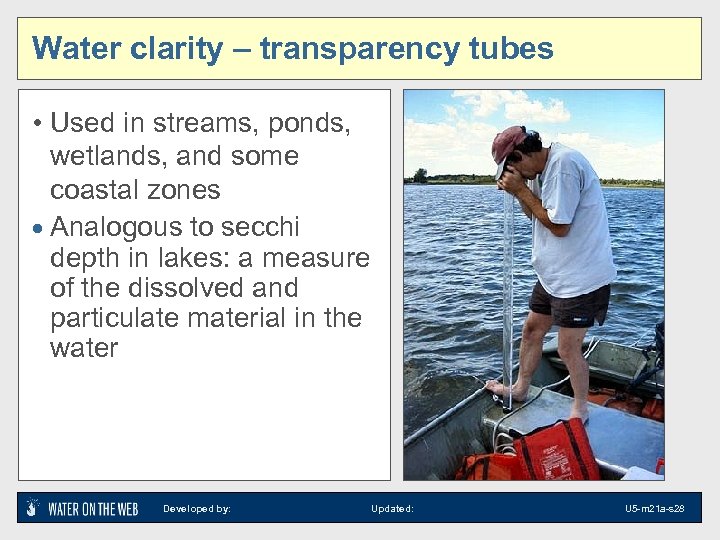
Water clarity – transparency tubes • Used in streams, ponds, wetlands, and some coastal zones · Analogous to secchi depth in lakes: a measure of the dissolved and particulate material in the water Developed by: Updated: U 5 -m 21 a-s 28
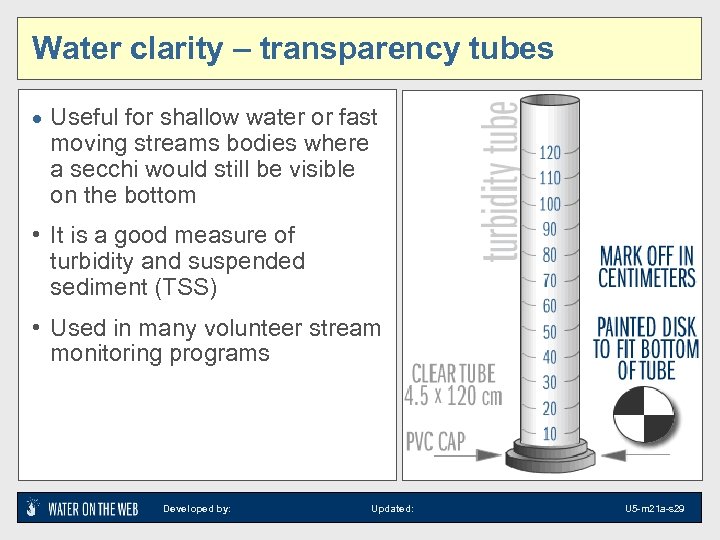
Water clarity – transparency tubes · Useful for shallow water or fast moving streams bodies where a secchi would still be visible on the bottom • It is a good measure of turbidity and suspended sediment (TSS) • Used in many volunteer stream monitoring programs Developed by: Updated: U 5 -m 21 a-s 29
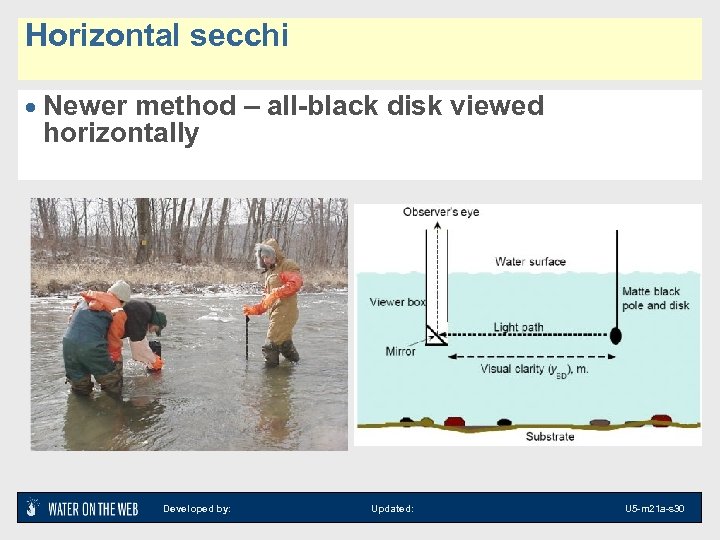
Horizontal secchi · Newer method – all-black disk viewed horizontally Developed by: Updated: U 5 -m 21 a-s 30
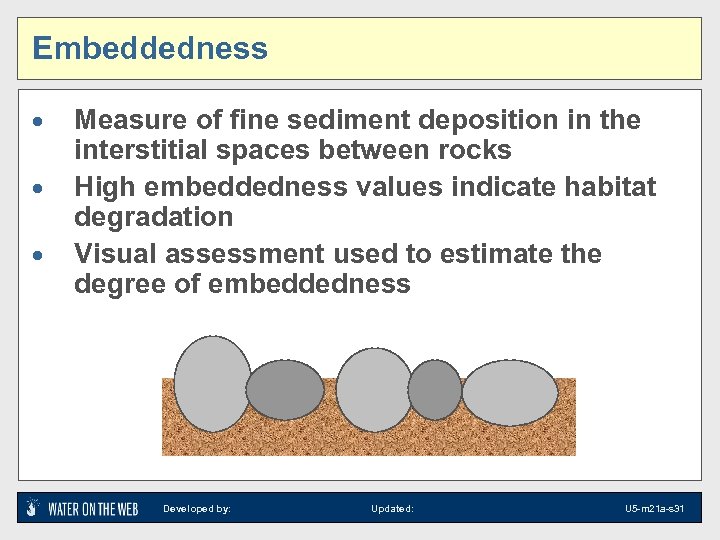
Embeddedness · · · Measure of fine sediment deposition in the interstitial spaces between rocks High embeddedness values indicate habitat degradation Visual assessment used to estimate the degree of embeddedness Developed by: Updated: U 5 -m 21 a-s 31
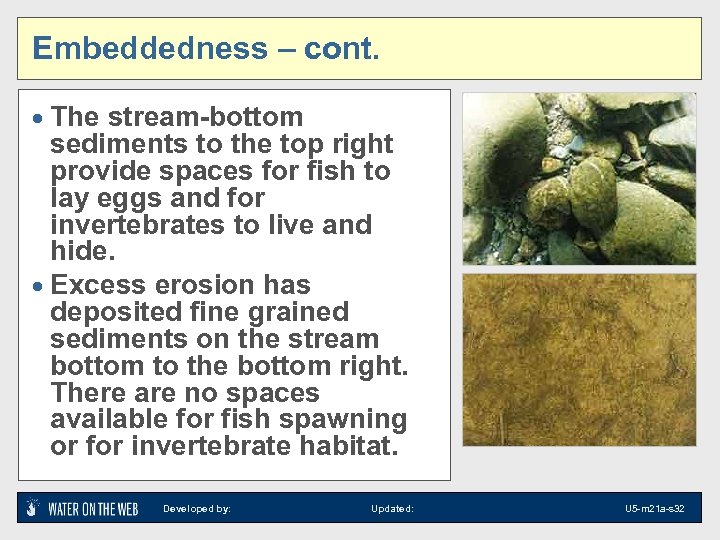
Embeddedness – cont. · The stream-bottom sediments to the top right provide spaces for fish to lay eggs and for invertebrates to live and hide. · Excess erosion has deposited fine grained sediments on the stream bottom to the bottom right. There are no spaces available for fish spawning or for invertebrate habitat. Developed by: Updated: U 5 -m 21 a-s 32
Embededdness – visual assessment · Embeddedness: General guidelines · · · 0% = no fine sediments even at base of top layer of gravel/cobble 25% = rocks are half surrounded by sediment 50% = rocks are completely surrounded by sediment but their tops are clean 75% = rocks are completely surrounded by sediment and half covered 100% = rocks are completely covered by sediment Developed by: Updated: U 5 -m 21 a-s 33
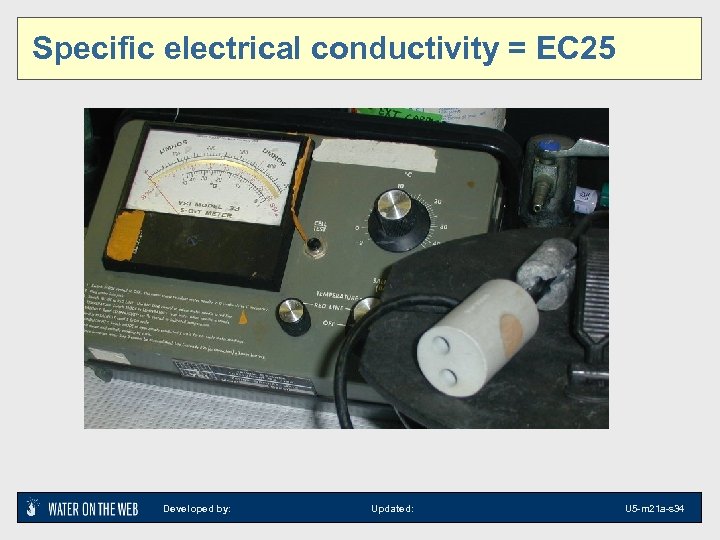
Specific electrical conductivity = EC 25 Developed by: Updated: U 5 -m 21 a-s 34
EC 25 - importance · Cheap, easy way to characterize the total dissolved salt concentration of a water sample · For tracing water masses and defining mixing zones · Groundwater plumes · Stream flowing into another stream or into a lake or reservoir Developed by: Updated: U 5 -m 21 a-s 35
EC 25 – units and reporting Principle of measurement • A small voltage is applied between 2 parallel metal rod shaped electrodes, usually 1 cm apart • Measured current flow is proportional to the dissolved ion content of the water • If the sensor is temperature compensated to 25 o. C, EC is called “specific” EC (EC 25) Developed by: Updated: U 5 -m 21 a-s 36
EC 25 - units · What in the world are micro. Siemens per centimeter (µS/cm)? • Units for EC and EC 25 are m. S/cm or μS/cm @25 o. C. The WOW site reports it as EC @25 o. C (in μS/cm). • Usually report to 2 or 3 significant figures (to + ~ 15 μS/cm) · More details can be found in Module 9 Developed by: Updated: U 5 -m 21 a-s 37
EC 25 · EC 25 values in streams reflect primarily a combination of watershed sources of salts and the hydrology of the system · wastewater from sewage treatment plants and industrial discharge · wastewater from on-site wastewater treatment and dispersal systems (septic systems and drainfields) · urban runoff · agricultural runoff · acid mine drainage · atmospheric inputs Developed by: Updated: U 5 -m 21 a-s 38
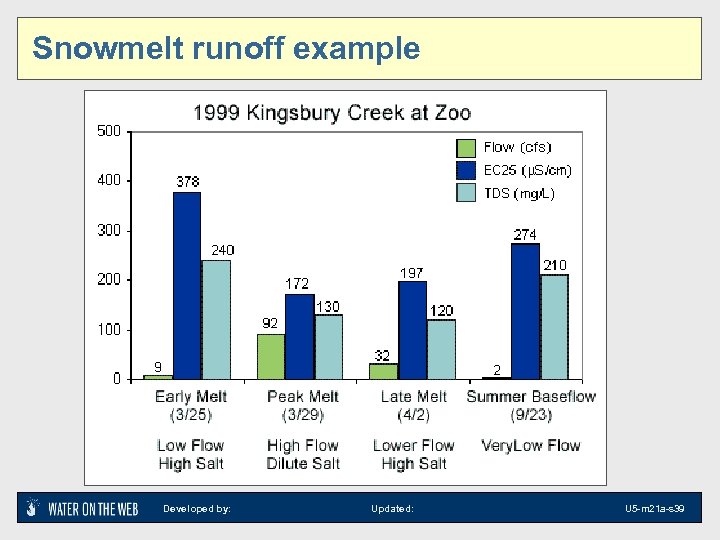
Snowmelt runoff example Developed by: Updated: U 5 -m 21 a-s 39
p. H Image courtesy of USGS at http: //www. usgs. gov/ Developed by: Updated: U 5 -m 21 a-s 40
p. H – importance in aquatic systems · The p. H of a sample of water is a measure of the concentration of hydrogen ions. · p. H determines the solubility and biological availability of chemical constituents such as nutrients (phosphorus, nitrogen, and carbon) and heavy metals (lead, copper, cadmium, etc. ). Developed by: Updated: U 5 -m 21 a-s 41
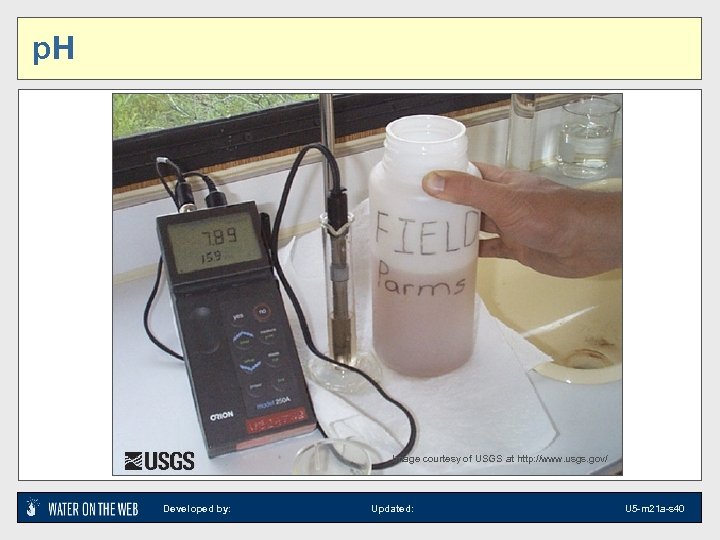
p. H - reporting · p. H can be measured electrometrically or colorimetrically (p. H paper) BUT ONLY the former technique is approved by the EPA and USGS for natural waters. · The electrometric method uses a hydrogen ion electrode. · p. H meters require extensive care in handling and operation. · Report to the nearest 0. 1 standard p. H unit Developed by: Updated: U 5 -m 21 a-s 42
p. H – probes · Field probe types: · Combination probes (e. g. YSI) · Less expensive; more rugged design · Less precise · Shorter life because reference solution cannot be replenished · Separate reading and reference electrodes (e. g. , Hydrolab) · Costs more · More precise; faster response time · Allows user maintenance; Teflon junction and electrolyte can be replaced Developed by: Updated: U 5 -m 21 a-s 43
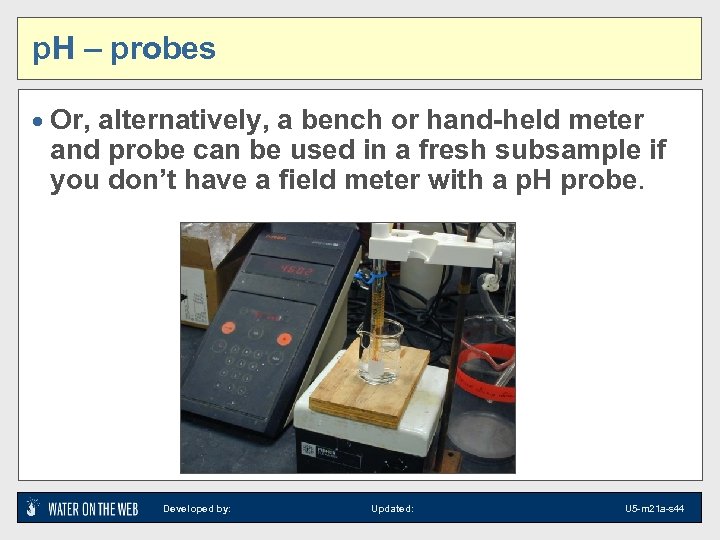
p. H – probes · Or, alternatively, a bench or hand-held meter and probe can be used in a fresh subsample if you don’t have a field meter with a p. H probe. Developed by: Updated: U 5 -m 21 a-s 44
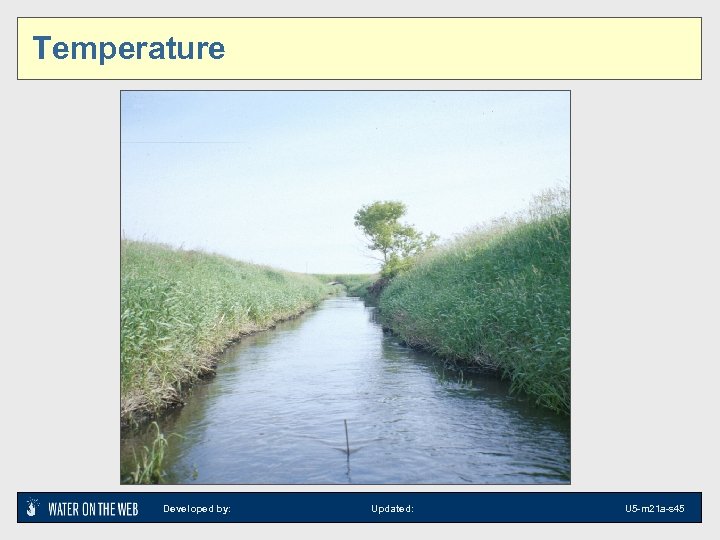
Temperature Developed by: Updated: U 5 -m 21 a-s 45
Temperature importance · Temperature affects: · the oxygen content of the water (oxygen levels become lower as temperature increases) · the rate of photosynthesis by aquatic plants · the metabolic rates of aquatic organisms · the sensitivity of organisms to toxic wastes, parasites, and diseases Developed by: Updated: U 5 -m 21 a-s 46
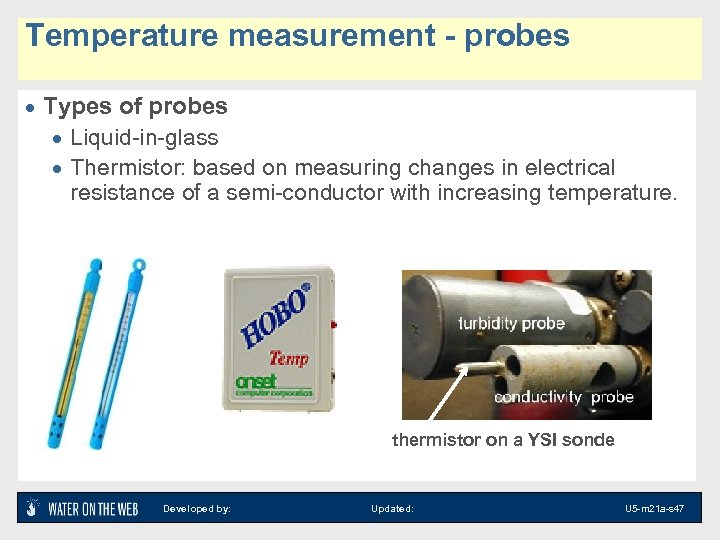
Temperature measurement - probes · Types of probes · Liquid-in-glass · Thermistor: based on measuring changes in electrical resistance of a semi-conductor with increasing temperature. thermistor on a YSI sonde Developed by: Updated: U 5 -m 21 a-s 47
Temperature changes · Causes of temperature change include: · weather · removal of shading streambank vegetation, · impoundments (a body of water confined by a barrier, such as a dam) · discharge of cooling water · urban storm water · groundwater inflows to the stream Developed by: Updated: U 5 -m 21 a-s 48
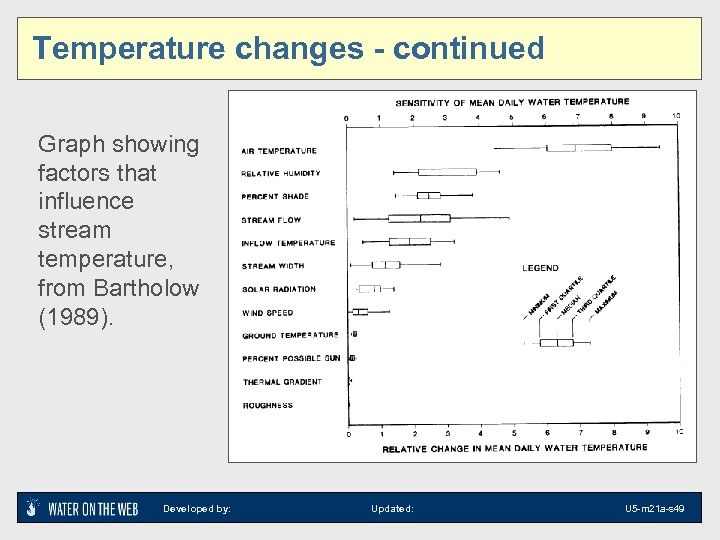
Temperature changes - continued Graph showing factors that influence stream temperature, from Bartholow (1989). Developed by: Updated: U 5 -m 21 a-s 49
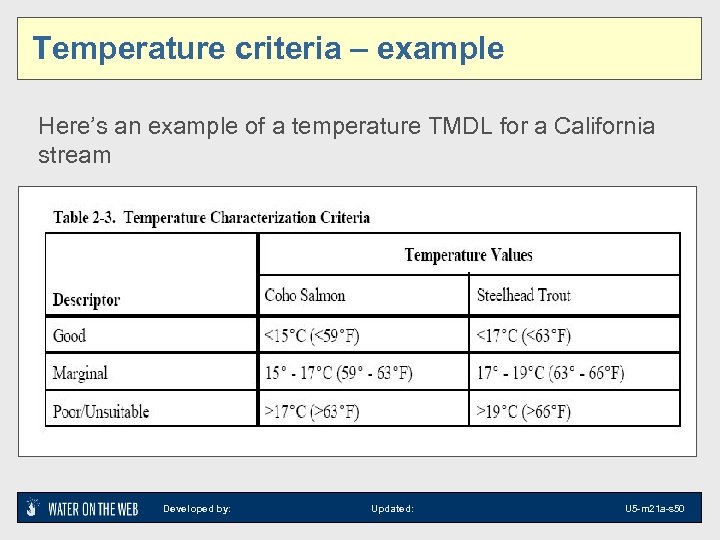
Temperature criteria – example Here’s an example of a temperature TMDL for a California stream Developed by: Updated: U 5 -m 21 a-s 50
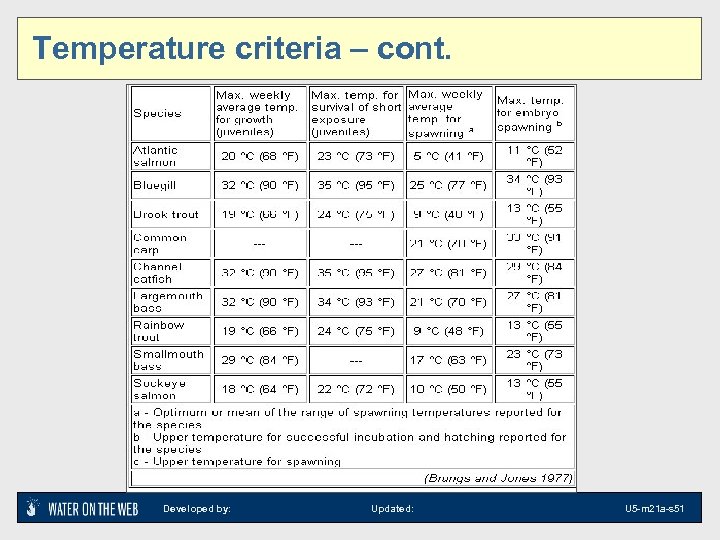
Temperature criteria – cont. Developed by: Updated: U 5 -m 21 a-s 51
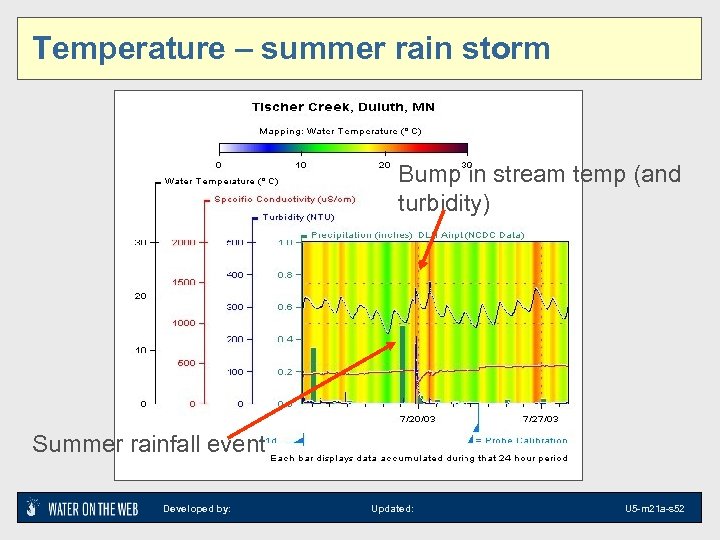
Temperature – summer rain storm Bump in stream temp (and turbidity) Summer rainfall event Developed by: Updated: U 5 -m 21 a-s 52
Other Water Quality Parameters · · · Nutrients – nitrogen and phosphorus Fecal coliforms Biochemical oxygen demand (BOD) Metals Toxic contaminants · Details on analyzing these parameters are in Module 9 – Lake Surveys Developed by: Updated: U 5 -m 21 a-s 53
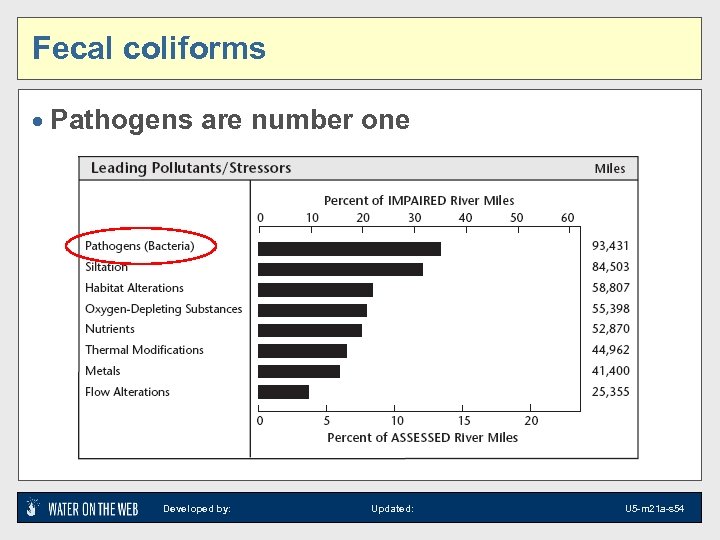
Fecal coliforms · Pathogens are number one Developed by: Updated: U 5 -m 21 a-s 54
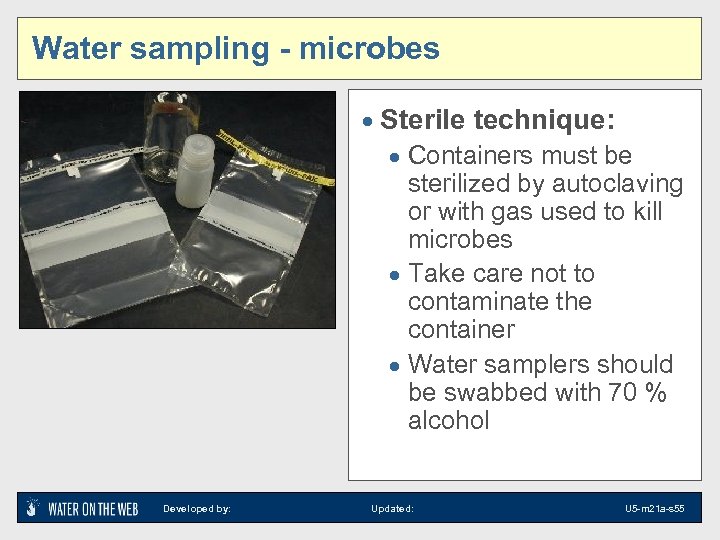
Water sampling - microbes · Sterile technique: · Containers must be sterilized by autoclaving or with gas used to kill microbes · Take care not to contaminate the container · Water samplers should be swabbed with 70 % alcohol Developed by: Updated: U 5 -m 21 a-s 55
Bacteria – E. coli and fecal coliforms · Fecal bacteria are used as indicators of possible sewage contamination · These bacteria indicate the possible presence of disease-causing bacteria, viruses, and protozoans that also live in human and animal digestive systems · E. coli is currently replacing the fecal coliform assay in most beach monitoring programs See Module 9 for a detailed discussion of measuring pathogens Developed by: Updated: U 5 -m 21 a-s 56
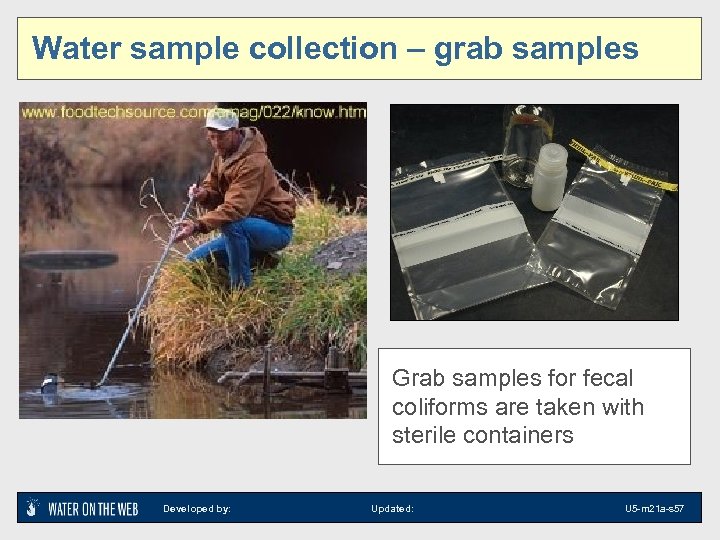
Water sample collection – grab samples Grab samples for fecal coliforms are taken with sterile containers Developed by: Updated: U 5 -m 21 a-s 57
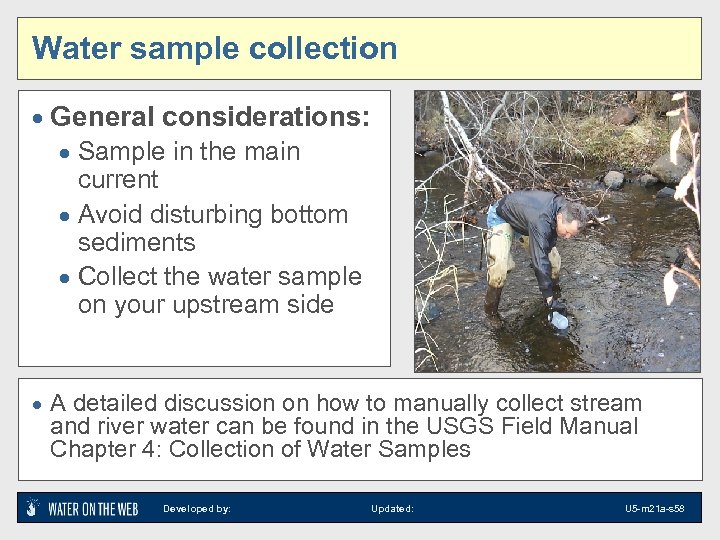
Water sample collection · General considerations: · Sample in the main current · Avoid disturbing bottom sediments · Collect the water sample on your upstream side · A detailed discussion on how to manually collect stream and river water can be found in the USGS Field Manual Chapter 4: Collection of Water Samples Developed by: Updated: U 5 -m 21 a-s 58
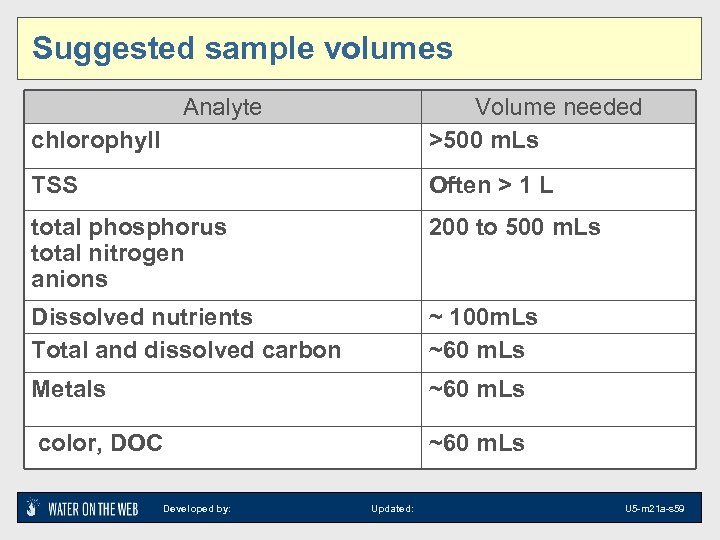
Suggested sample volumes Analyte chlorophyll Volume needed >500 m. Ls TSS Often > 1 L total phosphorus total nitrogen anions 200 to 500 m. Ls Dissolved nutrients Total and dissolved carbon ~ 100 m. Ls ~60 m. Ls Metals ~60 m. Ls color, DOC ~60 m. Ls Developed by: Updated: U 5 -m 21 a-s 59
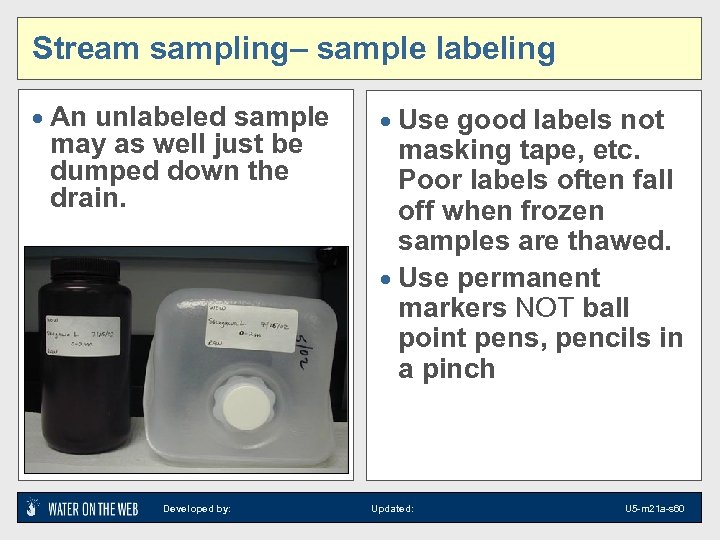
Stream sampling– sample labeling · An unlabeled sample may as well just be dumped down the drain. Developed by: · Use good labels not masking tape, etc. Poor labels often fall off when frozen samples are thawed. · Use permanent markers NOT ball point pens, pencils in a pinch Updated: U 5 -m 21 a-s 60
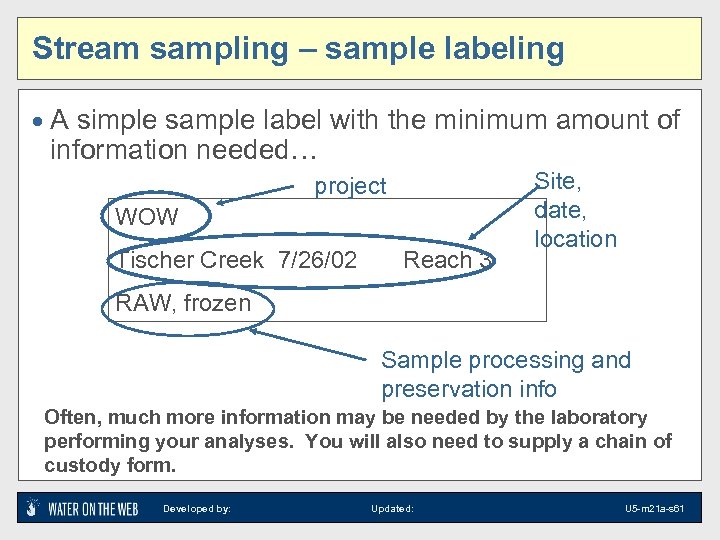
Stream sampling – sample labeling Lake sampling – sample labeling · A simple sample label with the minimum amount of information needed… project WOW Tischer Creek 7/26/02 Reach 3 Site, date, location RAW, frozen Sample processing and preservation info Often, much more information may be needed by the laboratory performing your analyses. You will also need to supply a chain of custody form. Developed by: Updated: U 5 -m 21 a-s 61
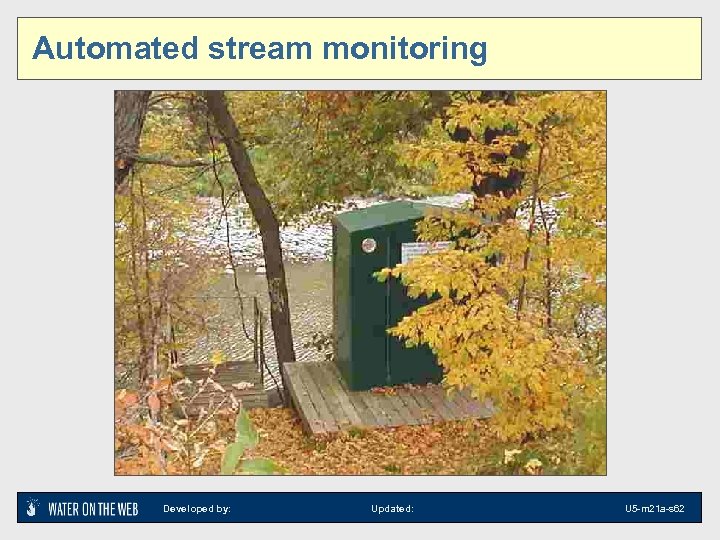
Automated stream monitoring Developed by: Updated: U 5 -m 21 a-s 62
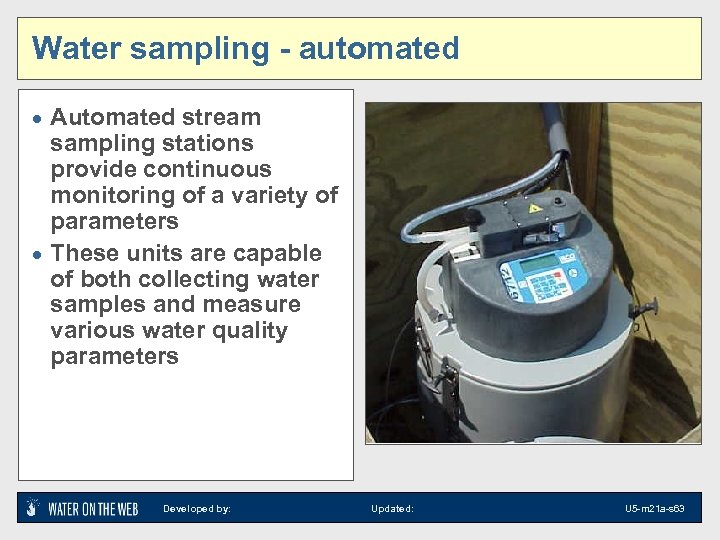
Water sampling - automated · Automated stream sampling stations provide continuous monitoring of a variety of parameters · These units are capable of both collecting water samples and measure various water quality parameters Developed by: Updated: U 5 -m 21 a-s 63
Automated stream samplers · Flow weighted composites · Flow weighted discrete · Sampling triggered by predetermined set point such as: · Flow · Precipitation · Any other parameter measured by in-stream sensors Developed by: Updated: U 5 -m 21 a-s 64
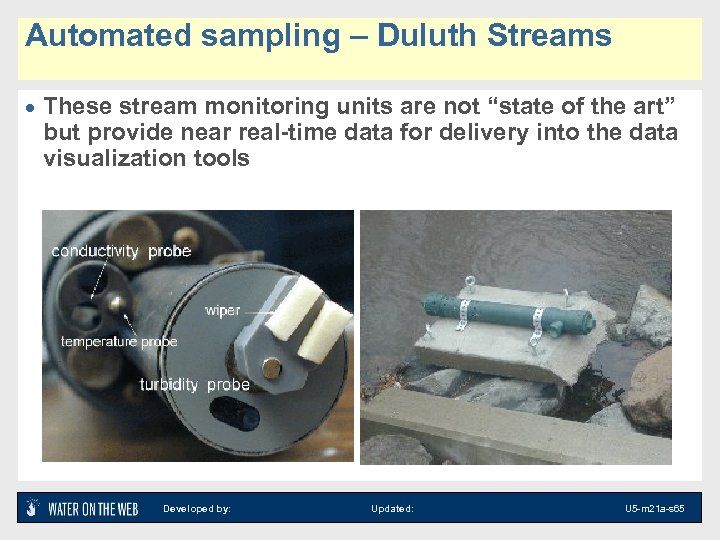
Automated sampling – Duluth Streams · These stream monitoring units are not “state of the art” but provide near real-time data for delivery into the data visualization tools Developed by: Updated: U 5 -m 21 a-s 65
Скачать презентацию Module 10 11 Stream Surveys February 2004 Part
56cc3d13bbbb66be72ba6b54dfc98f85.ppt