


 Скачать презентацию Module 1 Unit 2 Epidemiology of HIV
955e924f104db1b435124894c7d5c20f.ppt
- Количество слайдов: 18
 Module 1 Unit 2: Epidemiology of HIV
 Objectives At the end of this session, the participant should be able to: 1. 2. 3. 4. 5. 6. Describe the history of HIV Explain the global, regional and national/local distribution of HIV Discuss the distribution of HIV by age and sex Discuss changes in morbidity and mortality due to HIV/AIDS define different modes of HIV transmission Discus factors that facilitate HIV transmission-biological and social
 Historical background n 1981 - doctors in US recognized a previously unseen syndrome (PCP) in homosexual males n n Later recognized that they were all immune suppressed 1983/4 - scientist described the cause of the syndrome as a retrovirus n n n Lymphadenopathy Associated Virus (LAV) AIDs Associated Retrovirus (ARV) Human T-lymphotrophic Virus Ш (HTLV-Ш) n In Kenya the 1 st case described in 1984 n 1986 - HIV accepted as international designation for the retrovirus in a WHO consultative meeting
 Epidemic Update: Global Picture n n n Fourth biggest killer in the world Estimated 40 million living with HIV by end of 2003 About one-third of PLHA are between 15 -24 years n Most people are unaware they are infected n Young women are more vulnerable
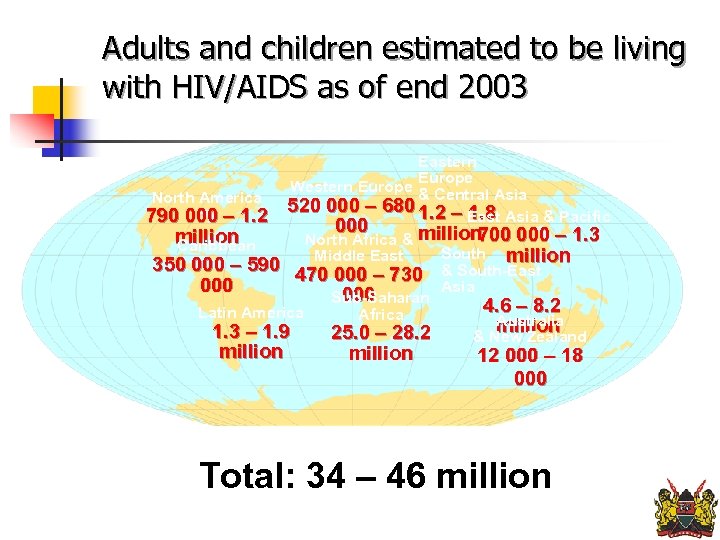 Adults and children estimated to be living with HIV/AIDS as of end 2003 Eastern Europe Western Europe & Central Asia North America 520 000 – 680 1. 2 – East Asia & Pacific 1. 8 790 000 – 1. 2 000 700 000 – 1. 3 million North Africa & million Caribbean South million Middle 350 000 – 590 470 000 East – 730 & South-East 000 Asia 000 Sub-Saharan 4. 6 – 8. 2 Latin America Africa Australia million 1. 3 – 1. 9 25. 0 – 28. 2 & New Zealand million 12 000 – 18 000 Total: 34 – 46 million
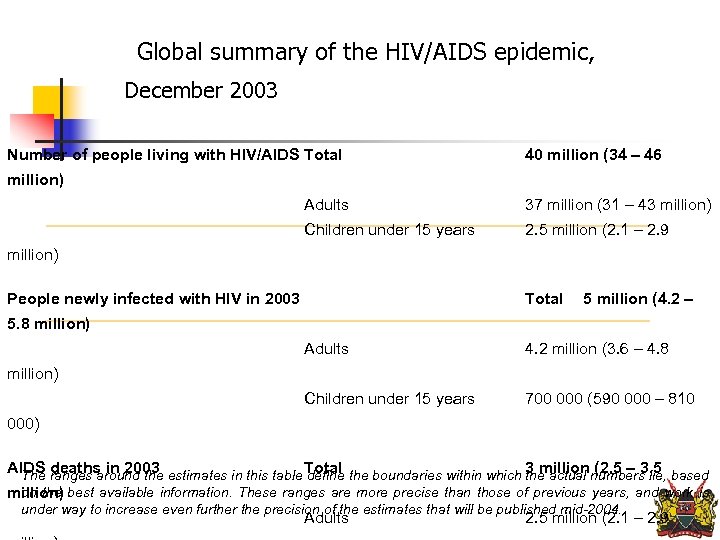 Global summary of the HIV/AIDS epidemic, December 2003 Number of people living with HIV/AIDS Total 40 million (34 – 46 million) Adults 37 million (31 – 43 million) Children under 15 years 2. 5 million (2. 1 – 2. 9 million) People newly infected with HIV in 2003 Total 5 million (4. 2 – 5. 8 million) Adults 4. 2 million (3. 6 – 4. 8 Children under 15 years 700 000 (590 000 – 810 million) 000) AIDS ranges around the estimates in this table Total the boundaries within which 3 millionnumbers lie, based deaths in 2003 (2. 5 – 3. 5 The define the actual on the million) best available information. These ranges are more precise than those of previous years, and work is under way to increase even further the precision of the estimates that will be published mid-2004. Adults 2. 5 million (2. 1 – 2. 9
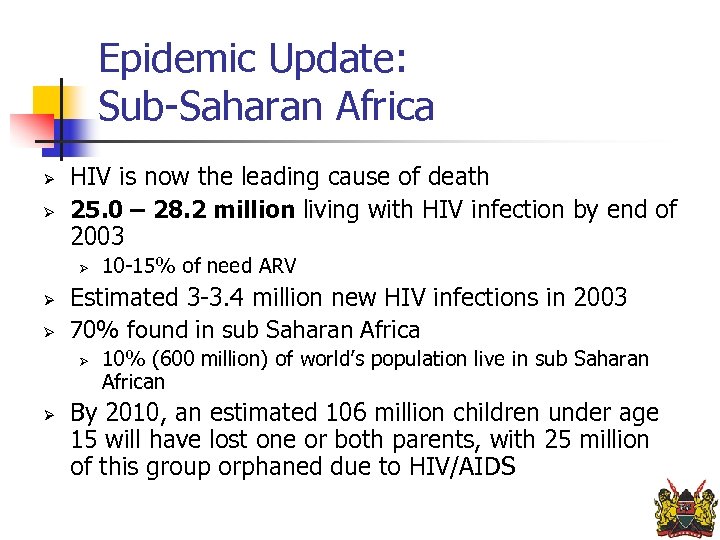 Epidemic Update: Sub-Saharan Africa Ø Ø HIV is now the leading cause of death 25. 0 – 28. 2 million living with HIV infection by end of 2003 Ø Ø Ø Estimated 3 -3. 4 million new HIV infections in 2003 70% found in sub Saharan Africa Ø Ø 10 -15% of need ARV 10% (600 million) of world’s population live in sub Saharan African By 2010, an estimated 106 million children under age 15 will have lost one or both parents, with 25 million of this group orphaned due to HIV/AIDS
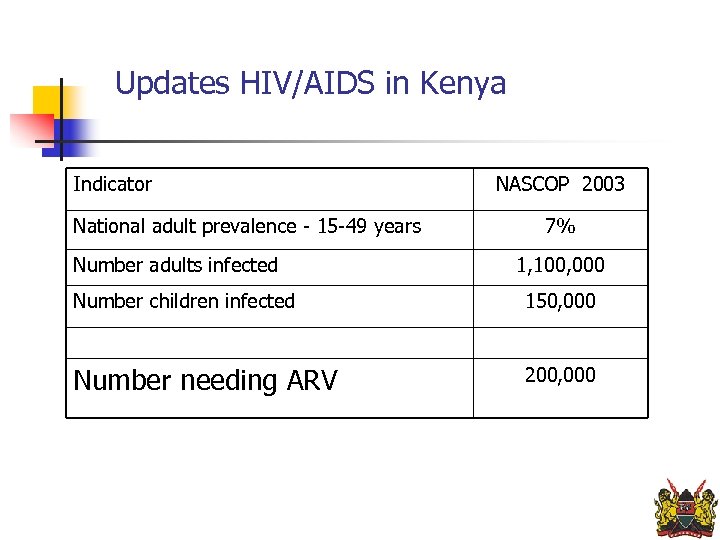 Updates HIV/AIDS in Kenya Indicator National adult prevalence - 15 -49 years Number adults infected NASCOP 2003 7% 1, 100, 000 Number children infected 150, 000 Number needing ARV 200, 000
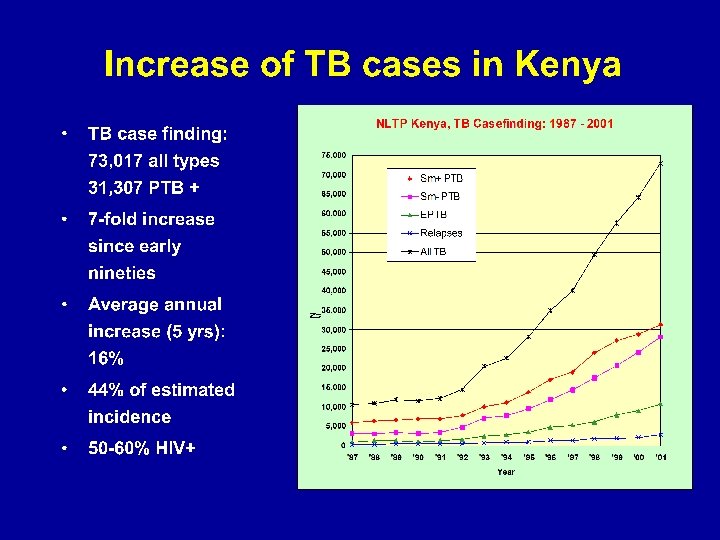
 Impact on Morbidity and mortality of other infections n People with HIV/AIDS are susceptible to other infections n n n Due to lowered immunity High HIV prevalence increases the pool of people with suppressed immunity Any other infectious condition within such population (e. g. TB) therefore finds a highly susceptible group of people.
 HIV Transmission n Modes of Transmission n Biological Factors Affecting Transmission n Socio-economic Factors Facilitating Transmission
 Modes of Transmission n Sexual contact n n Parenteral n n n Blood transfusion of infected blood or blood products Exposure to infected blood or body fluids- IDU through needle-sharing or needle stick accidents Donated organs Perinatal n n Male-to-female, female-to-male, and female-to-female Transplacental, during labour/delivery and breastfeeding Worldwide, sexual transmission is the predominant mode HIV cannot be transmitted by casual contact, surface contact, or from insect bites
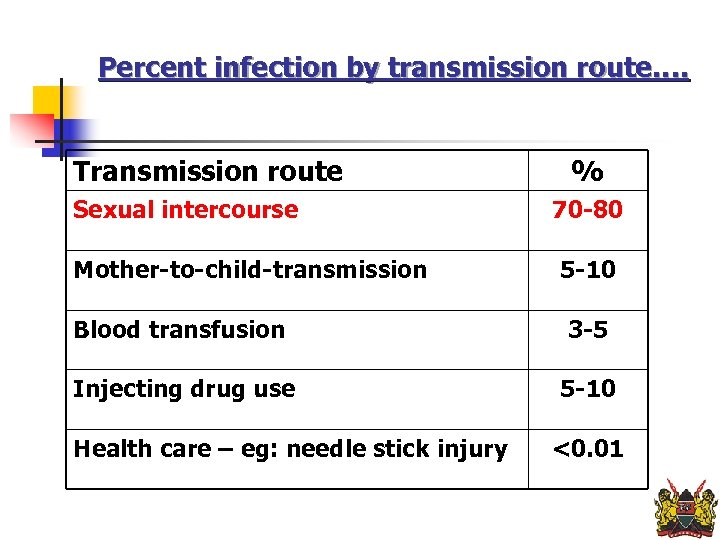 Percent infection by transmission route…. Transmission route Sexual intercourse Mother-to-child-transmission % 70 -80 5 -10 Blood transfusion 3 -5 Injecting drug use 5 -10 Health care – eg: needle stick injury <0. 01
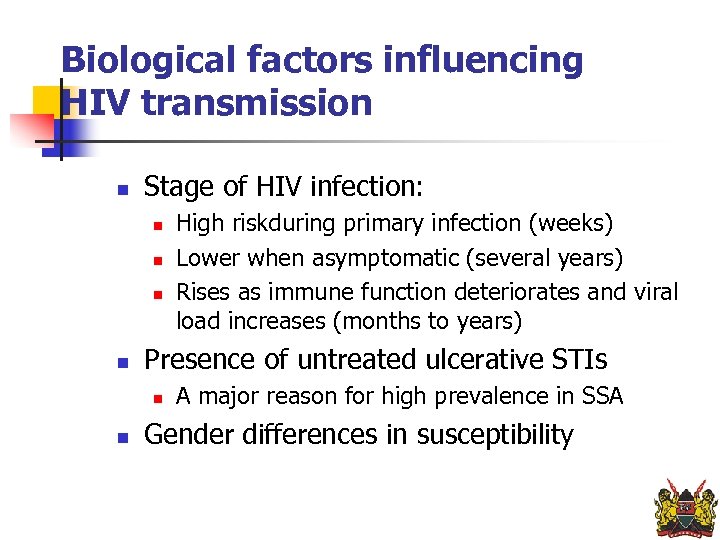 Biological factors influencing HIV transmission n Stage of HIV infection: n n Presence of untreated ulcerative STIs n n High riskduring primary infection (weeks) Lower when asymptomatic (several years) Rises as immune function deteriorates and viral load increases (months to years) A major reason for high prevalence in SSA Gender differences in susceptibility
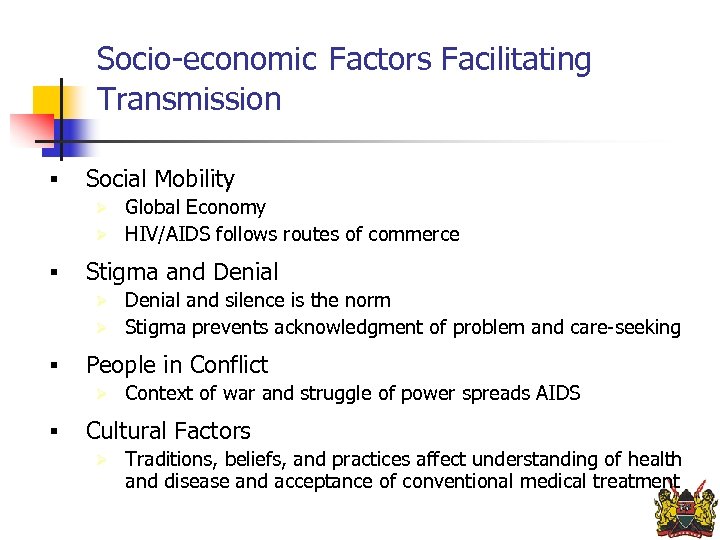 Socio-economic Factors Facilitating Transmission § Social Mobility Global Economy Ø HIV/AIDS follows routes of commerce Ø § Stigma and Denial and silence is the norm Ø Stigma prevents acknowledgment of problem and care-seeking Ø § People in Conflict Ø § Context of war and struggle of power spreads AIDS Cultural Factors Ø Traditions, beliefs, and practices affect understanding of health and disease and acceptance of conventional medical treatment
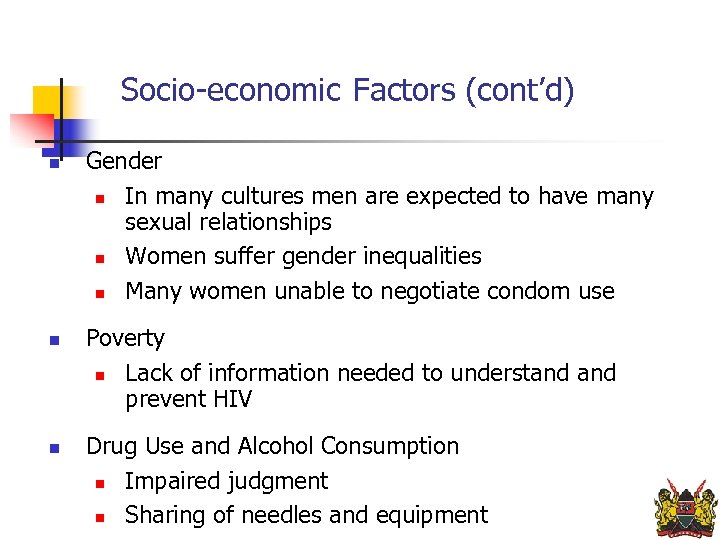 Socio-economic Factors (cont’d) n n n Gender n In many cultures men are expected to have many sexual relationships n Women suffer gender inequalities n Many women unable to negotiate condom use Poverty n Lack of information needed to understand prevent HIV Drug Use and Alcohol Consumption n Impaired judgment n Sharing of needles and equipment
 Factors not associated with risk of transmission n n n insect bites Saliva sneezing or coughing skin contact (e. g. hugging) shared use of facilities (e. g. toilets)
 Summary n n HIV has spread worldwide after its discovery It is a major cause of morbidity and mortality in many countries Many factors contribute to HIV transmission in a society Knowledge of these factors can be used to design control strategies.