Скачать презентацию MODULE 1 SENSITIVITY AND AWARENESS OF CULTURAL AND
1d483d15e7809172c4d1ebc7cf6bf7b6.ppt
- Количество слайдов: 32
 MODULE 1: SENSITIVITY AND AWARENESS OF CULTURAL AND OTHER FORMS OF DIVERSITY Unit 1. Diversity Prepared by: Ainhoa Ruiz and Amets Suess, Andalusian School of Public Health Adapted by Kathrine Vitus, University of Copenhagen,
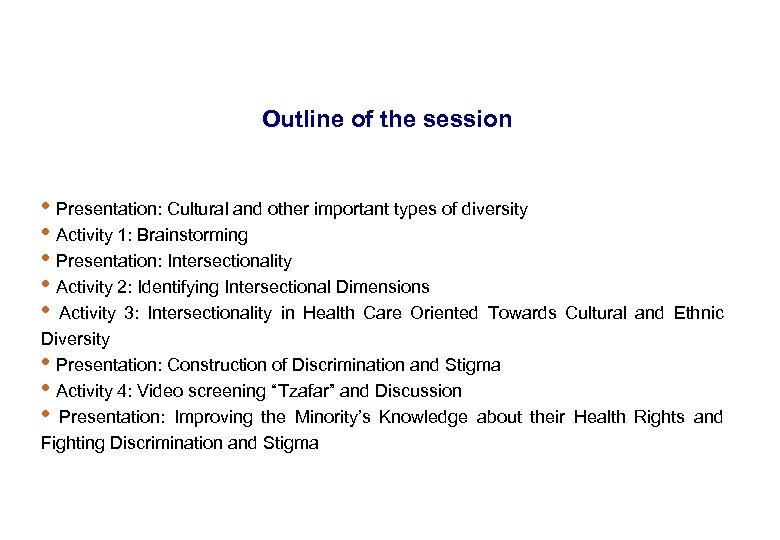 Outline of the session • Presentation: Cultural and other important types of diversity • Activity 1: Brainstorming • Presentation: Intersectionality • Activity 2: Identifying Intersectional Dimensions • Activity 3: Intersectionality in Health Care Oriented Towards Cultural and Ethnic Diversity • Presentation: Construction of Discrimination and Stigma • Activity 4: Video screening “Tzafar” and Discussion • Presentation: Improving the Minority’s Knowledge about their Health Rights and Fighting Discrimination and Stigma
 Cultural and other important types of diversity Ainhoa Ruiz Azarola, Andalusian School of Public Health, 2015
 Activity 1: Brainstorming Traditional definition: Culture can be defined as the values, beliefs, norms and practices of certain groups, acquired and shared, and that act as a model to guide thinking, decisions and actions[1]. k thin do you What ? e is cultur [1] Leininger, M. (Ed. ). (1985). Qualitative research methods in nursing. New York: Grune & Stratton.
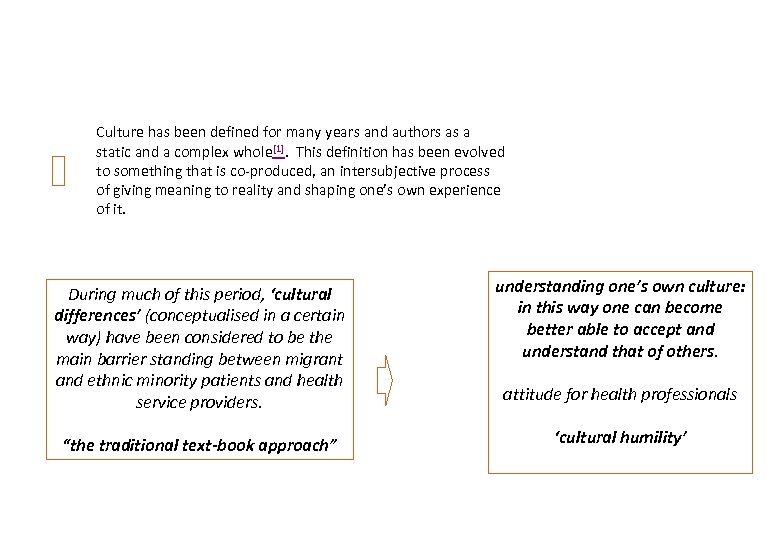 Culture has been defined for many years and authors as a static and a complex whole[1]. This definition has been evolved to something that is co-produced, an intersubjective process of giving meaning to reality and shaping one’s own experience of it. During much of this period, ‘cultural differences’ (conceptualised in a certain way) have been considered to be the main barrier standing between migrant and ethnic minority patients and health service providers. understanding one’s own culture: in this way one can become better able to accept and understand that of others. “the traditional text-book approach” ‘cultural humility’ attitude for health professionals
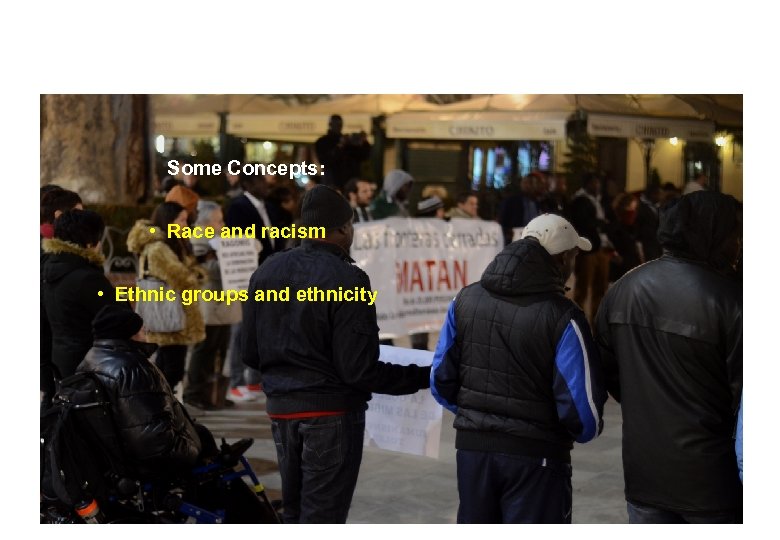 Some Concepts: • Race and racism • Ethnic groups and ethnicity
 The concept of ethnicity • The UNESCO Declaration (1978) • The UN International Convention on the Elimination of all Forms of Racial Discrimination (1969) • Lisbon Treaty (2007)
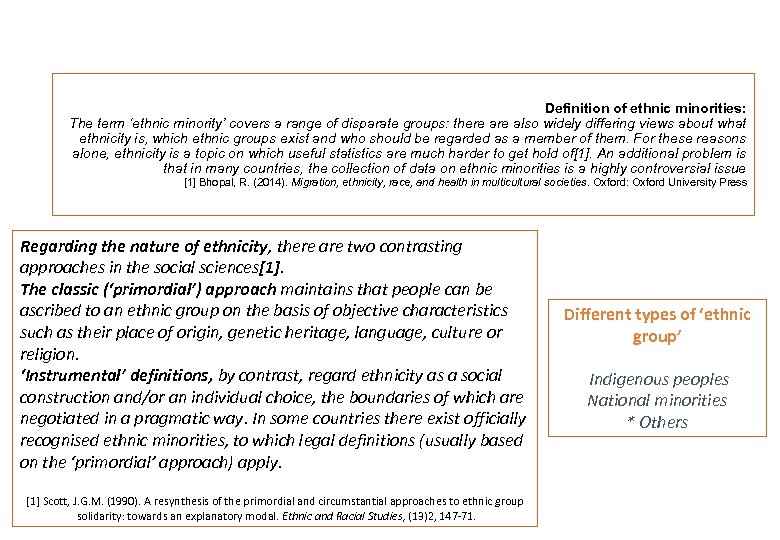 Definition of ethnic minorities: The term ‘ethnic minority’ covers a range of disparate groups: there also widely differing views about what ethnicity is, which ethnic groups exist and who should be regarded as a member of them. For these reasons alone, ethnicity is a topic on which useful statistics are much harder to get hold of[1]. An additional problem is that in many countries, the collection of data on ethnic minorities is a highly controversial issue [1] Bhopal, R. (2014). Migration, ethnicity, race, and health in multicultural societies. Oxford: Oxford University Press Regarding the nature of ethnicity, there are two contrasting approaches in the social sciences[1]. The classic (‘primordial’) approach maintains that people can be ascribed to an ethnic group on the basis of objective characteristics such as their place of origin, genetic heritage, language, culture or religion. ‘Instrumental’ definitions, by contrast, regard ethnicity as a social construction and/or an individual choice, the boundaries of which are negotiated in a pragmatic way. In some countries there exist officially recognised ethnic minorities, to which legal definitions (usually based on the ‘primordial’ approach) apply. [1] Scott, J. G. M. (1990). A resynthesis of the primordial and circumstantial approaches to ethnic group solidarity: towards an explanatory modal. Ethnic and Racial Studies, (13)2, 147 -71. Different types of ‘ethnic group’ Indigenous peoples National minorities * Others
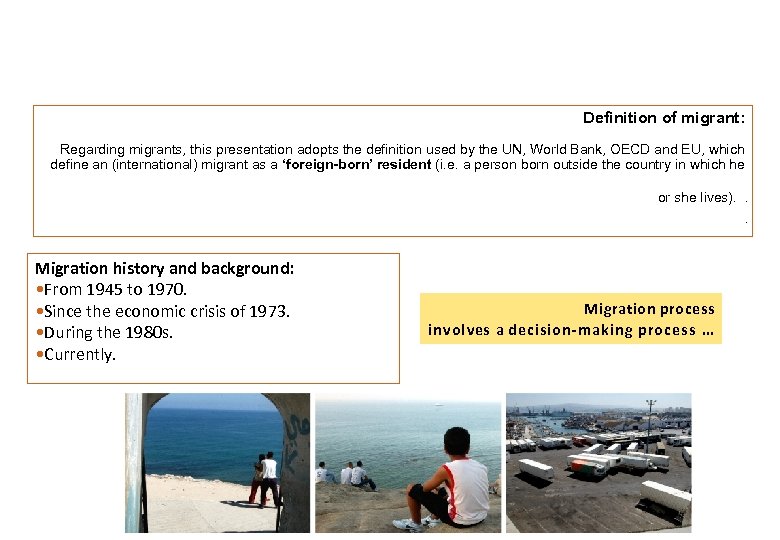 Definition of migrant: Regarding migrants, this presentation adopts the definition used by the UN, World Bank, OECD and EU, which define an (international) migrant as a ‘foreign-born’ resident (i. e. a person born outside the country in which he or she lives). . . Migration history and background: • From 1945 to 1970. • Since the economic crisis of 1973. • During the 1980 s. • Currently. Migration process involves a decision-making process …
 Intersectionality Amets Suess, Andalusian School of Public Health, 2015
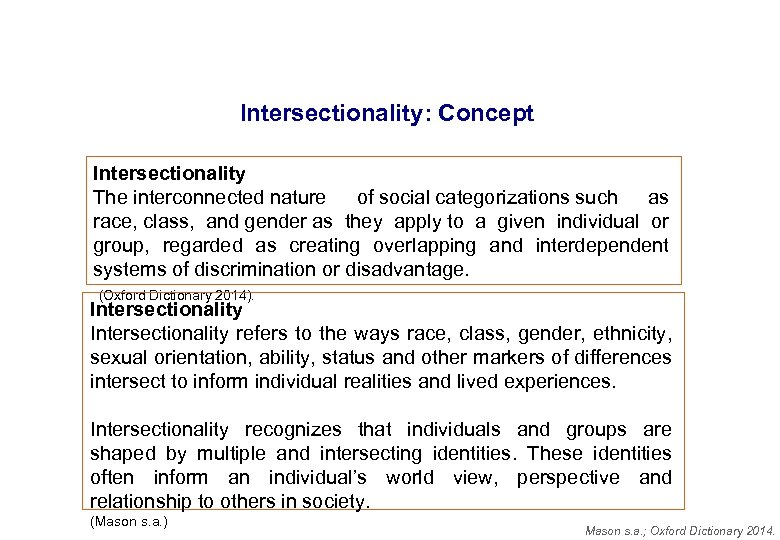 Intersectionality: Concept Intersectionality The interconnected nature of social categorizations such as race, class, and gender as they apply to a given individual or group, regarded as creating overlapping and interdependent systems of discrimination or disadvantage. (Oxford Dictionary 2014). Intersectionality refers to the ways race, class, gender, ethnicity, sexual orientation, ability, status and other markers of differences intersect to inform individual realities and lived experiences. Intersectionality recognizes that individuals and groups are shaped by multiple and intersecting identities. These identities often inform an individual’s world view, perspective and relationship to others in society. (Mason s. a. ) Mason s. a. ; Oxford Dictionary 2014.
 Intersectionality: Concept • First mention of the concept attributed to Kimberle Crenshaw in 1989, in relation to the multiple and interconnected forms of structural discrimination observed in black women in the US. • Development of a broad field of intersectionality theories and applications of the concept, including the field of public health research and practice. Bowleg 2012; Crenshaw 1989; Mason s. a. ; Mc. Call 2005; Nash 2008; Walby, Armstrong, Strid
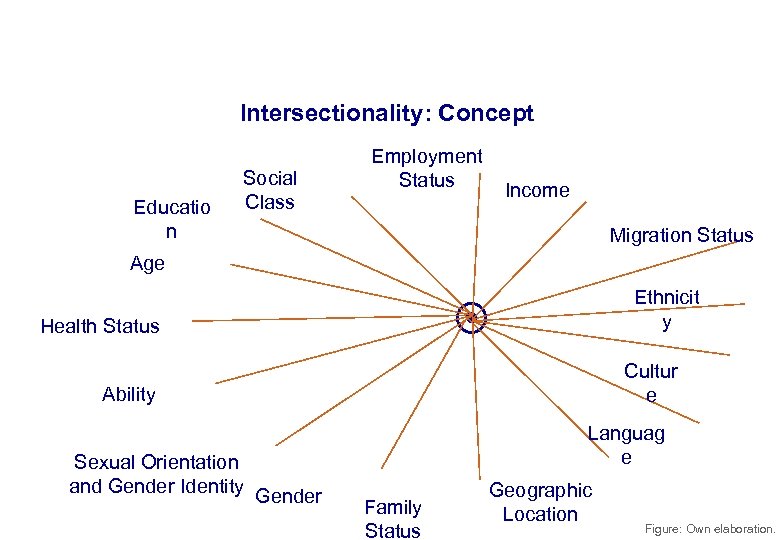 Intersectionality: Concept Educatio n Social Class Employment Status Income Migration Status Age Ethnicit y Health Status Cultur e Ability Sexual Orientation and Gender Identity Gender Languag e Family Status Geographic Location Figure: Own elaboration.
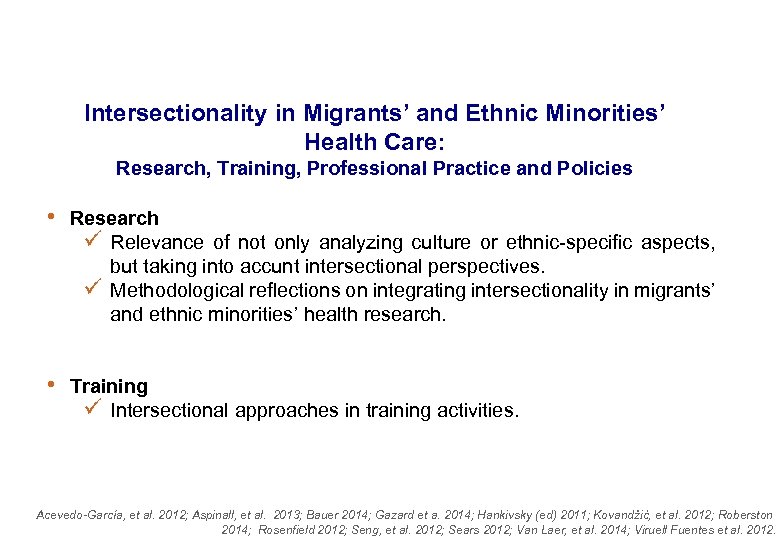 Intersectionality in Migrants’ and Ethnic Minorities’ Health Care: Research, Training, Professional Practice and Policies • Research ü Relevance of not only analyzing culture or ethnic-specific aspects, ü but taking into accunt intersectional perspectives. Methodological reflections on integrating intersectionality in migrants’ and ethnic minorities’ health research. • Training ü Intersectional approaches in training activities. Acevedo-García, et al. 2012; Aspinall, et al. 2013; Bauer 2014; Gazard et a. 2014; Hankivsky (ed) 2011; Kovandžić, et al. 2012; Roberston 2014; Rosenfield 2012; Seng, et al. 2012; Sears 2012; Van Laer, et al. 2014; Viruell Fuentes et al. 2012.
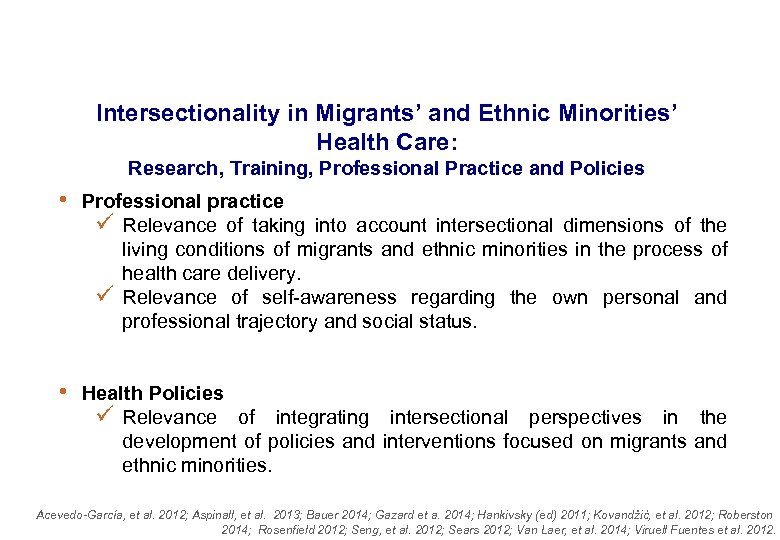 Intersectionality in Migrants’ and Ethnic Minorities’ Health Care: Research, Training, Professional Practice and Policies • Professional practice ü Relevance of taking into account intersectional dimensions of the ü living conditions of migrants and ethnic minorities in the process of health care delivery. Relevance of self-awareness regarding the own personal and professional trajectory and social status. • Health Policies ü Relevance of integrating intersectional perspectives in the development of policies and interventions focused on migrants and ethnic minorities. Acevedo-García, et al. 2012; Aspinall, et al. 2013; Bauer 2014; Gazard et a. 2014; Hankivsky (ed) 2011; Kovandžić, et al. 2012; Roberston 2014; Rosenfield 2012; Seng, et al. 2012; Sears 2012; Van Laer, et al. 2014; Viruell Fuentes et al. 2012.
 Activity 2: Identifying Intersectional Dimensions • Presentation of methodology • Individual task • Discussion in small groups the
 Activity 3: Intersectionality in Health Care Oriented Towards Cultural and Ethnic Diversity • Presentation of the methodology • Identification of barriers for introducing intersectional dimensions in health care oriented towards cultural and ethnic diversity (in plenary) • Identification of strategies for introducing intersectional dimensions in health care oriented towards cultural and ethnic diversity (in small groups) • Prioritization of the most feasible strategies (in plenary). • Discussion (in plenary).
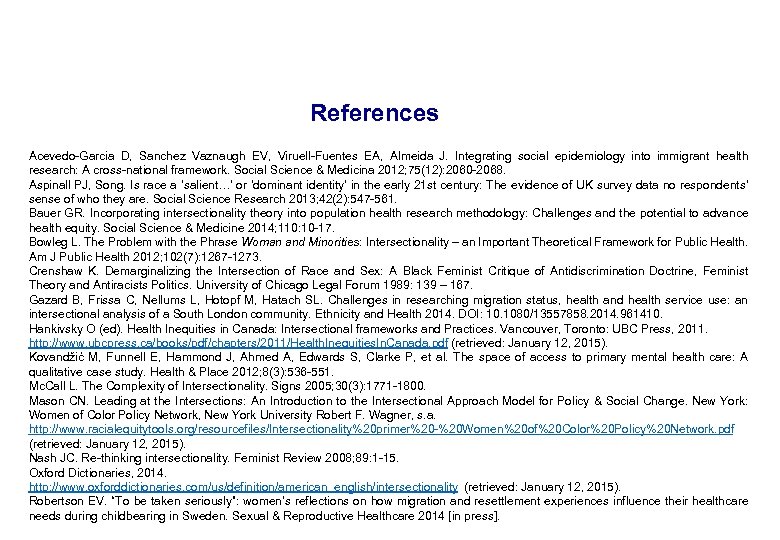 References Acevedo-Garcia D, Sanchez Vaznaugh EV, Viruell-Fuentes EA, Almeida J. Integrating social epidemiology into immigrant health research: A cross-national framework. Social Science & Medicina 2012; 75(12): 2060 -2068. Aspinall PJ, Song. Is race a ‘salient…’ or ‘dominant identity’ in the early 21 st century: The evidence of UK survey data no respondents’ sense of who they are. Social Science Research 2013; 42(2): 547 -561. Bauer GR. Incorporating intersectionality theory into population health research methodology: Challenges and the potential to advance health equity. Social Science & Medicine 2014; 110: 10 -17. Bowleg L. The Problem with the Phrase Woman and Minorities: Intersectionality – an Important Theoretical Framework for Public Health. Am J Public Health 2012; 102(7): 1267 -1273. Crenshaw K. Demarginalizing the Intersection of Race and Sex: A Black Feminist Critique of Antidiscrimination Doctrine, Feminist Theory and Antiracists Politics. University of Chicago Legal Forum 1989: 139 – 167. Gazard B, Frissa C, Nellums L, Hotopf M, Hatach SL. Challenges in researching migration status, health and health service use: an intersectional analysis of a South London community. Ethnicity and Health 2014. DOI: 10. 1080/13557858. 2014. 961410. Hankivsky O (ed). Health Inequities in Canada: Intersectional frameworks and Practices. Vancouver, Toronto: UBC Press, 2011. http: //www. ubcpress. ca/books/pdf/chapters/2011/Health. Inequities. In. Canada. pdf (retrieved: January 12, 2015). Kovandžić M, Funnell E, Hammond J, Ahmed A, Edwards S, Clarke P, et al. The space of access to primary mental health care: A qualitative case study. Health & Place 2012; 8(3): 536 -551. Mc. Call L. The Complexity of Intersectionality. Signs 2005; 30(3): 1771 -1800. Mason CN. Leading at the Intersections: An Introduction to the Intersectional Approach Model for Policy & Social Change. New York: Women of Color Policy Network, New York University Robert F. Wagner, s. a. http: //www. racialequitytools. org/resourcefiles/Intersectionality%20 primer%20 -%20 Women%20 of%20 Color%20 Policy%20 Network. pdf (retrieved: January 12, 2015). Nash JC. Re-thinking intersectionality. Feminist Review 2008; 89: 1 -15. Oxford Dictionaries, 2014. http: //www. oxforddictionaries. com/us/definition/american_english/intersectionality (retrieved: January 12, 2015). Robertson EV. “To be taken seriously”: women’s reflections on how migration and resettlement experiences influence their healthcare needs during childbearing in Sweden. Sexual & Reproductive Healthcare 2014 [in press].
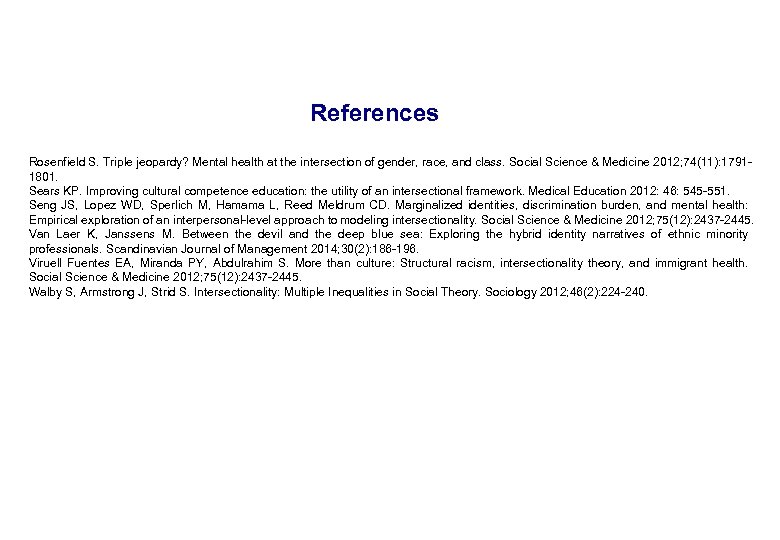 References Rosenfield S. Triple jeopardy? Mental health at the intersection of gender, race, and class. Social Science & Medicine 2012; 74(11): 17911801. Sears KP. Improving cultural competence education: the utility of an intersectional framework. Medical Education 2012: 46: 545 -551. Seng JS, Lopez WD, Sperlich M, Hamama L, Reed Meldrum CD. Marginalized identities, discrimination burden, and mental health: Empirical exploration of an interpersonal-level approach to modeling intersectionality. Social Science & Medicine 2012; 75(12): 2437 -2445. Van Laer K, Janssens M. Between the devil and the deep blue sea: Exploring the hybrid identity narratives of ethnic minority professionals. Scandinavian Journal of Management 2014; 30(2): 186 -196. Viruell Fuentes EA, Miranda PY, Abdulrahim S. More than culture: Structural racism, intersectionality theory, and immigrant health. Social Science & Medicine 2012; 75(12): 2437 -2445. Walby S, Armstrong J, Strid S. Intersectionality: Multiple Inequalities in Social Theory. Sociology 2012; 46(2): 224 -240.
 Construction of discrimination and stigma Ainhoa Ruiz Azarola, Andalusian School of Public Health, 2015
 Activity 4: Video Screening “Tzafar” Stereotypes and generalisations üDo you think this situation could happen in your own country / regional context? üWhat strategies could be developed to avoid discrimination? üDo you think that stereotypes and generalizations are present? In what way?
 Prejudices are a consequence of stereotypes Prejudices are a specific part of racism that are fed from ignorance, lack of contact, and lack of knowledge about the people or groups who are the victims. Prejudices can also generate stress. The most common distortions are: ü Tunnel vision or mental filter, or the tendency to only remember a certain aspect of reality, excluding the rest. ü Absolutism and dichotomy of thinking, or the tendency to perceive reality as a dichotomy (“black or white”) going from one extreme to the opposite without considering middle positions. ü Fatalism, or the perception of a lack of control about living events. ü Confusion of thoughts and emotions with reality, or believing that we think about reality is the reality itself and what we feel to be the truth, is the truth. ü Exaggerated interpretation of the behaviour of others with intention, this being negatively directed towards the self. Experiencing violent situations helps to interpret the behaviour of others in the worse possible way. ü Tagging, or converting one´s their own behaviour or that of others to a personality feature and then judging it negatively. ü Useless anticipatory thoughts. Foreseeing that some negative events or situations will happen without thinking about how to prevent them.
 The following steps can be taken to overcome the problems mentioned above: ü Describing as objectively as possible the situation that generated the tension or discomfort. ü Identifying and naming all the emotions and feelings that we associate with the described situation. ü Trying to reconstruct the internal conversation, in writing and phrase by phrase, both before and after the stressful situation, ü Identifying the different types of distortions that occur in the internal conversation that provokes stress, and those thereafter: tunnel vision, absolutism, fatalism, confusion of emotions with reality. ü Correcting distorted thoughts by replacing them with others.
 Improving the minority’s knowledge about their health rights and fighting discrimination and stigma Ainhoa Ruiz Azarola, Andalusian School of Public Health, 2015
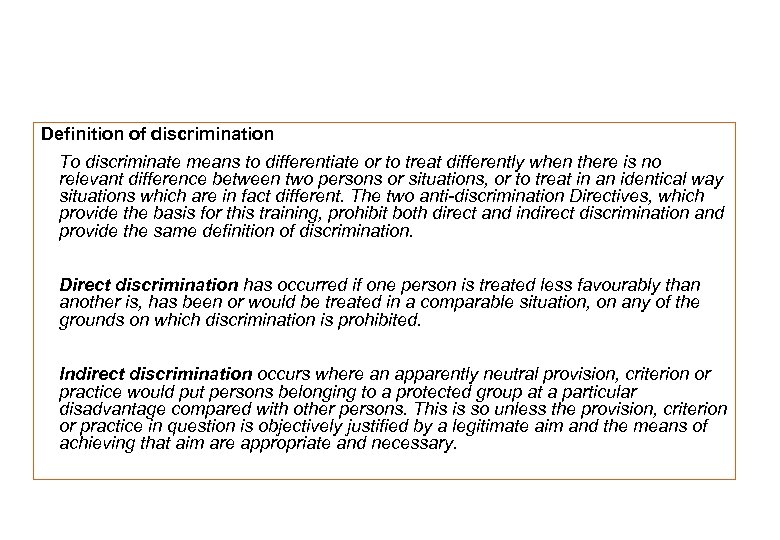 Definition of discrimination To discriminate means to differentiate or to treat differently when there is no relevant difference between two persons or situations, or to treat in an identical way situations which are in fact different. The two anti-discrimination Directives, which provide the basis for this training, prohibit both direct and indirect discrimination and provide the same definition of discrimination. Direct discrimination has occurred if one person is treated less favourably than another is, has been or would be treated in a comparable situation, on any of the grounds on which discrimination is prohibited. Indirect discrimination occurs where an apparently neutral provision, criterion or practice would put persons belonging to a protected group at a particular disadvantage compared with other persons. This is so unless the provision, criterion or practice in question is objectively justified by a legitimate aim and the means of achieving that aim are appropriate and necessary.
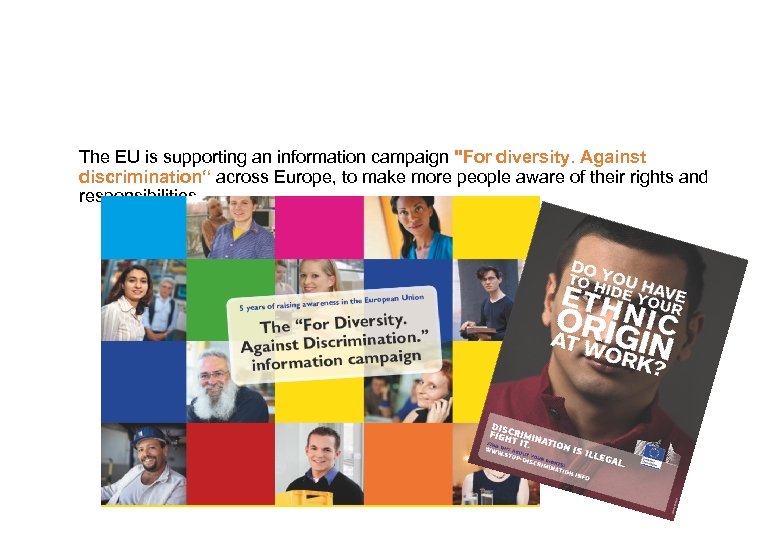 The EU is supporting an information campaign "For diversity. Against discrimination“ across Europe, to make more people aware of their rights and responsibilities.
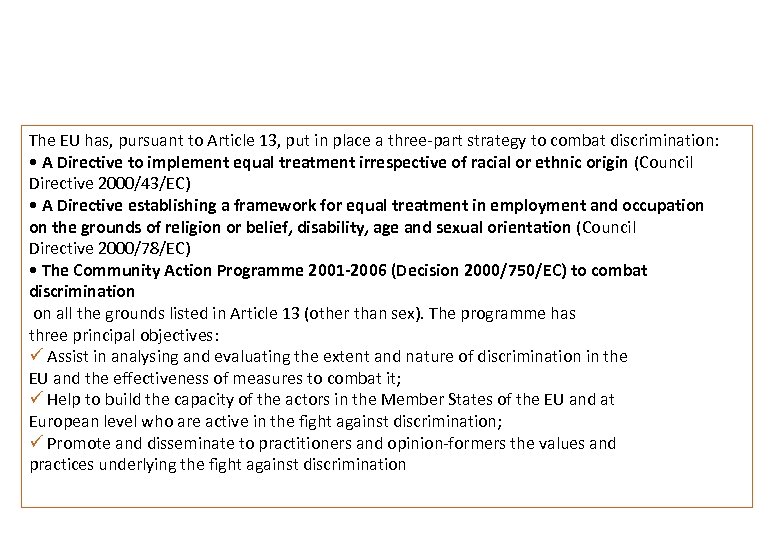 The EU has, pursuant to Article 13, put in place a three-part strategy to combat discrimination: • A Directive to implement equal treatment irrespective of racial or ethnic origin (Council Directive 2000/43/EC) • A Directive establishing a framework for equal treatment in employment and occupation on the grounds of religion or belief, disability, age and sexual orientation (Council Directive 2000/78/EC) • The Community Action Programme 2001 -2006 (Decision 2000/750/EC) to combat discrimination on all the grounds listed in Article 13 (other than sex). The programme has three principal objectives: ü Assist in analysing and evaluating the extent and nature of discrimination in the EU and the effectiveness of measures to combat it; ü Help to build the capacity of the actors in the Member States of the EU and at European level who are active in the fight against discrimination; ü Promote and disseminate to practitioners and opinion-formers the values and practices underlying the fight against discrimination
 Self or institutional awareness-raising has been used as a strategy for fighting against of equality issues
 ü Purpose of awareness-raising ü Target groups ü How can it be done
 Thank you and questions … Pictures: Andalusian Childhood Observatory (OIA, Observatorio de la Infancia de Andalucía), 2014; Josefa Marín Vega 2014; Red. Isir 2014; Morguefile 2014.
 References Sears KP. Improving cultural competence education: the utility of an intersectional framework. Medical Education 2012: 46: 545551. European Commision. Justice. The “For Diversity. Against Discrimination. ” information campaign. http: //ec. europa. eu/justice/discrimination/awareness/information/index_en. htm European Commission. Directorate-General for Employment, Social Affairs and Equal Opportunities Combating Discrimination A Training Manual, 2005. file: ///C: /Documents%20 and%20 Settings/aruiza. VEASP/Mis%20 documentos/Downloads/train_en%20(1). pdf Björngren Cuadra, C. ; Cattacin, S. : Migration and health: difference sensitivity from an organisational perspective. Malmö University. 2007. www. bit. mah. se/MUEP IENE. Intercultural education of nurses and other medical staff in European Commission. Life Long Learning Programme. Education and Culture DG. http: //ieneproject. eu/ UNESCO, United Nations Educational, Scientific and Cultural Organization. Intercultural Competences. Conceptual and Operational Framework. Paris: UNESCO, 2013. http: //unesdoc. unesco. org/images/002197/219768 e. pdf European Commission. Report from the Commission to the European Parliament and the Council. Brussels. 2014. http: //europa. eu/publications/official-documents/index_en. htm