 Скачать презентацию Module 1 Civilization and culture Basic concepts What
Module 1.pptx
- Количество слайдов: 9




Module 1 Civilization and culture Basic concepts What is the difference between culture and civilization? These terms are often used interchangeably but they represent two different levels of phenomena. According to the Cambridge English Dictionary culture is ”the way of life, especially the general customs and beliefs, of a particular group of people at a particular time” and civilization is usually described as a complex social structure characterized by urban development and stratified society, and based on a culture that had acquired a writing system. It was said that civilization is a mechanism and organization that enables people to control all aspects of life. (Mac. Iver and Page, 1962)
Module 1 Civilization and culture Two meanings of ”civilization” The term ”civilization” has two meanings. 1. Civilization is a form of human organization. 2. Civilization is a certain society of high coherency that had been developed in a certain region. As a form of human organization, civilization combines: economy, cities, writing, and states. As a coherent society, civilization includes: legends and myths, religion, law, ethics, aesthetics, and political organization.
Module 1 Civilization and culture Human needs and actions Humans have inhabited the Earth for a long time and before the invention of writing, they gradually mastered the various abilities of mind and body that together enabled their survival as a species. Human actions were dictated by three types of needs: physical (food, water); intellectual (religious belief, scientific curiosity); artistic (literary and visual forms of expression). The activity was also fueled by the need to dominate over others.
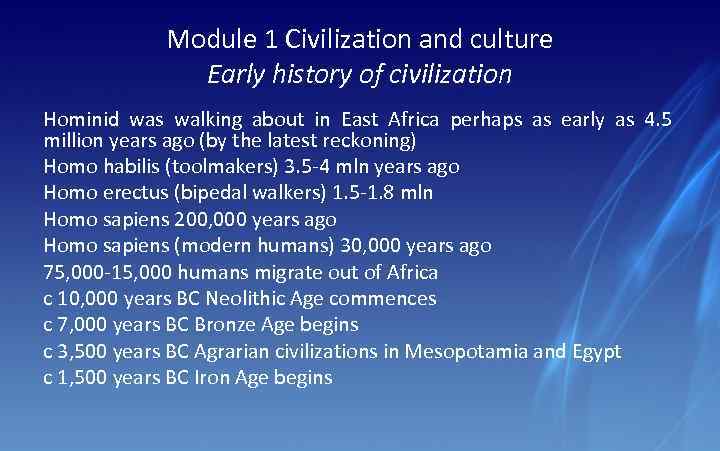
Module 1 Civilization and culture Early history of civilization Hominid was walking about in East Africa perhaps as early as 4. 5 million years ago (by the latest reckoning) Homo habilis (toolmakers) 3. 5 -4 mln years ago Homo erectus (bipedal walkers) 1. 5 -1. 8 mln Homo sapiens 200, 000 years ago Homo sapiens (modern humans) 30, 000 years ago 75, 000 -15, 000 humans migrate out of Africa c 10, 000 years BC Neolithic Age commences c 7, 000 years BC Bronze Age begins c 3, 500 years BC Agrarian civilizations in Mesopotamia and Egypt c 1, 500 years BC Iron Age begins
Module 1 Civilization and culture Paleolithic The Paleolithic era lasted from about 70, 000 years ago to about 10, 000 years (Old Stone Age) and during that time hominids started to make tools from stone. They were hunters and gatherers. They lived in groups within an extended family that had given protection. There were various conflicts over grounds, water, and widespread theft but gradually peaceful absorption prevailed over warfare. In the Paleolithic era, at least 17 varieties of hominid evolved during this time. All of these species of hominid came to an evolutionary ’dead end’ except homo sapiens. The famous Neanderthal man is a good example of these failed species. During this time humans made clothing for survival in cold seasons, kindled fire when it was needed, remembered the past and developed speech patterns (80, 000 -100, 000 years ago).
Module 1 Civilization and culture The Neolithic Revolution In the Neolithic Age (or New Stone Age), nomadic hunter-gatherers adopted agriculture and established settlements. This revolutionary change lasted 200 -400 years (five to ten generations). Plant and animal husbandry became the primary way of providing food. The population expanded and the concept of privately owned property was developed. Codes of law and organized authority emerged, as well as the concept of good and bad. Matriarchy (female social and political domination) was common and mother goddesses found in various cultures prove this. Catal Huyuk in today’s Turkey is an example of a Neolithic community that existed 7, 200 -6, 300 years BC.
Module 1 Civilization and culture How did it begin? There are two theories that refer to the question where the first food-producing societies existed. 1. The diffusion theory says that the first food-producing societies emerged in one place and that was the socalled the Levantine Corridor (today’s Middle East) and from there it spread to other regions. 2. The parallelism theory stresses that by 7, 000 years BC agriculture had developed independently in at least seven separate areas: the Near East, Central America, South America, northern China, southern China and Southeast Asia, northeast Africa and West Africa.
Module 1 Civilization and culture Where did it begin? Agrarian societies developed civilizations based on irrigation. They emerged in the plains bordering on major rivers or in the valleys the rivers created, in particular in: - Mesopotamia in the Tigris and Euphrates valley; - along the Nile (4, 000 miles long); - in the Niger River valley; - in the valley of the Indus River; - along the he Yellow River in northern China; - in the Andes in Peru.
Module 1 Civilization and culture • That’s the end of Module 1. • Please read through Module 2.
Скачать презентацию Module 1 Civilization and culture Basic concepts What
Module 1.pptx