Скачать презентацию MODUL 2 VIDEN OM MIGRANTER ETNISKE MINORITETER OG
627b63d65e50d1e45dc82bb93665944c.ppt
- Количество слайдов: 27
 MODUL 2: VIDEN OM MIGRANTER, ETNISKE MINORITETER OG DERES SUNDHED Del 1: Migranter og etniske minoriteters sundhedsproblemer og sundhedsdeterminanter Præsenteret af Marie Nørredam Oplysningerne i dette dokument er hentet fra Mock-Muñoz de Luna C, Ingleby D, Graval E, Krasnik A. Synthesis Report. MEM-TP, Training packages for health professionals to improve access and quality of health services for migrants and ethnic minorities, including the Roma. Granada, Copenhagen: Andalusian School of Public Health, University of Copenhagen, 2015.
 Program • Præsentation: Den sociale kontekst omkring migranter og etniske minoriteter • Aktivitet: Gruppediskussion om forekomsten af diagnostiseret psykisk sygdom blandt migranter og etniske minoriteter • Præsentation: Sociale determinatorer for sundhed • Aktivitet: Video “Making the Connections: Our City, Our Society, Our Health” • Præsentation: Behov og hyppige sundhedsproblemer blandt migranter og etniske minoriteter
 Den sociale kontekst omkring migranter og etniske minoriter • Migranter i EU 27: 10. 1% af den totale population i 2013, heraf er 30% fra andre EU-lande • Asyl krav: stigende siden 2010 og når i 2013 til højeste niveau i Europa i 10 år. Oprindelseslandene er hovedsagelig: Syrien, Rusland, Afghanistan, Irak og Serbien/Kosovo. • Det er svært at estimere antallet af illegale migranter: ca. 1% of EUs befolkning (5 til 8 millioner). • Kvinder udgør ca. halvdelen af migranterne i Europa. I nogle lande er der overtal af kvindelige migranter i forhold til mandlige migranter.
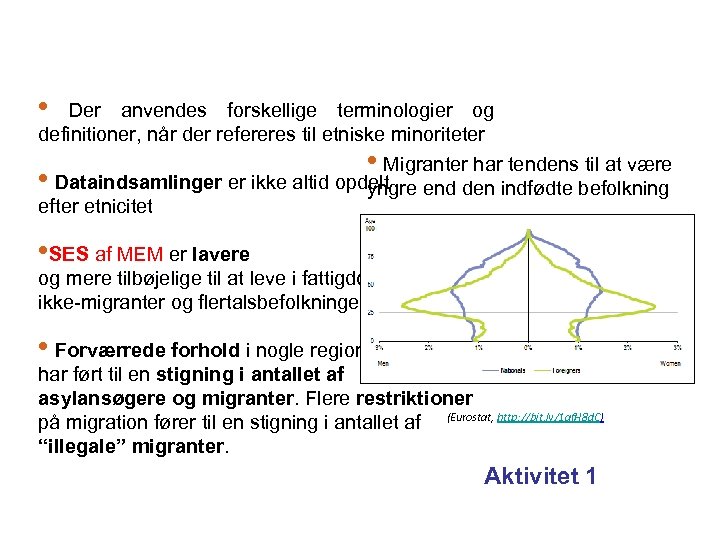 • Der anvendes forskellige terminologier og definitioner, når der refereres til etniske minoriteter • Migranter har tendens til at være • Dataindsamlinger er ikke altid opdelt end den indfødte befolkning yngre efter etnicitet • SES af MEM er lavere og mere tilbøjelige til at leve i fattigdom end ikke-migranter og flertalsbefolkningen • Forværrede forhold i nogle regioner har ført til en stigning i antallet af asylansøgere og migranter. Flere restriktioner på migration fører til en stigning i antallet af (Eurostat, http: //bit. ly/1 qf. H 8 d. C) “illegale” migranter. Aktivitet 1
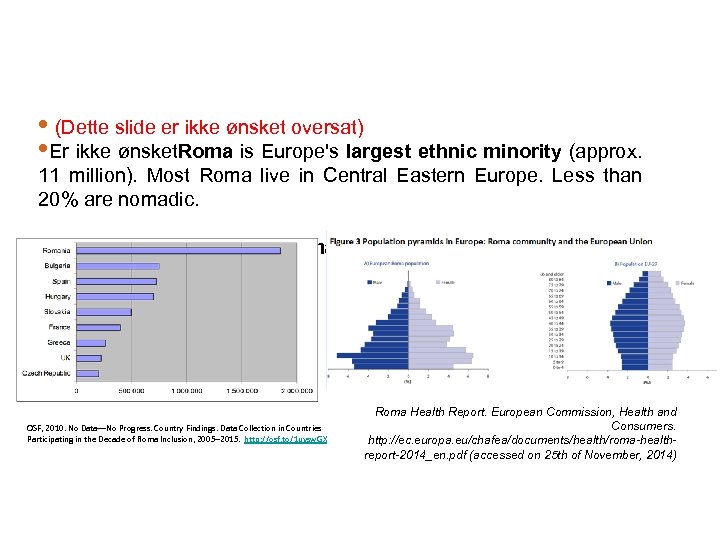 • (Dette slide er ikke ønsket oversat) • Er ikke ønsket. Roma is Europe's largest ethnic minority (approx. 11 million). Most Roma live in Central Eastern Europe. Less than 20% are nomadic. • Most migrant European Roma come from Eastern EU countries. OSF, 2010. No Data—No Progress. Country Findings. Data Collection in Countries Participating in the Decade of Roma Inclusion, 2005– 2015. http: //osf. to/1 uysw. GX Roma Health Report. European Commission, Health and Consumers. http: //ec. europa. eu/chafea/documents/health/roma-healthreport-2014_en. pdf (accessed on 25 th of November, 2014)
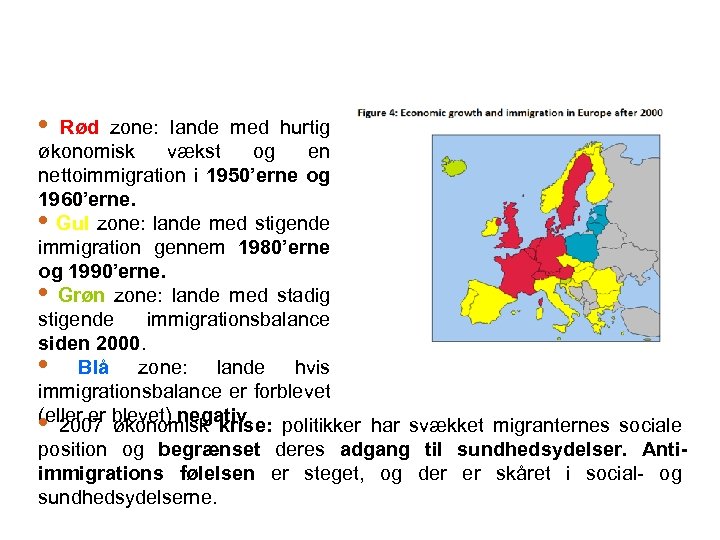 • Rød zone: lande med hurtig økonomisk vækst og en nettoimmigration i 1950’erne og 1960’erne. • Gul zone: lande med stigende immigration gennem 1980’erne og 1990’erne. • Grøn zone: lande med stadig stigende immigrationsbalance siden 2000. • Blå zone: lande hvis immigrationsbalance er forblevet (eller er blevet) negativ • 2007 økonomisk krise: politikker har svækket migranternes sociale position og begrænset deres adgang til sundhedsydelser. Antiimmigrations følelsen er steget, og der er skåret i social- og sundhedsydelserne.
 Sociale determinatorer for sundhed blandt migranter og ethniske minoritier Aktivitet 2 Making The Connections: Our City, Our Society, Our Health • Kombinationen af mange faktorer påvirker migranternes sundhed og de små samfund. Determinatorerne for sundhed inkluderer: Ødet sociale og økonomiske miljø, Ødet fysiske miljø, og Øpersonens individuelle karakteristika og adfærd • Helbredsproblemernes oprindelse kan måske skyldes forhold i hjemlandet, rejsen eller i værtslandet. • Life-course’ kigger på den meget komplekse interaktion mellem alle faktorer • “Healthy migrant effect” • Sparsomme data er tilgængelige på sundhedstilstanden blandt
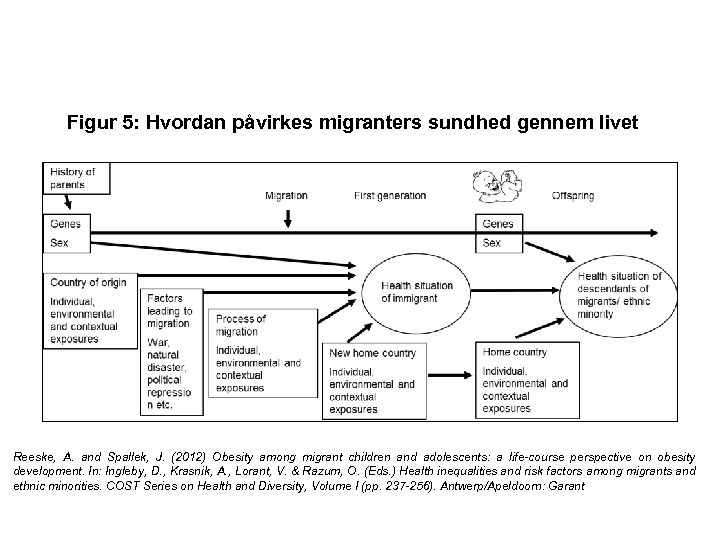 Figur 5: Hvordan påvirkes migranters sundhed gennem livet Reeske, A. and Spallek, J. (2012) Obesity among migrant children and adolescents: a life-course perspective on obesity development. In: Ingleby, D. , Krasnik, A. , Lorant, V. & Razum, O. (Eds. ) Health inequalities and risk factors among migrants and ethnic minorities. COST Series on Health and Diversity, Volume I (pp. 237 -256). Antwerp/Apeldoorn: Garant
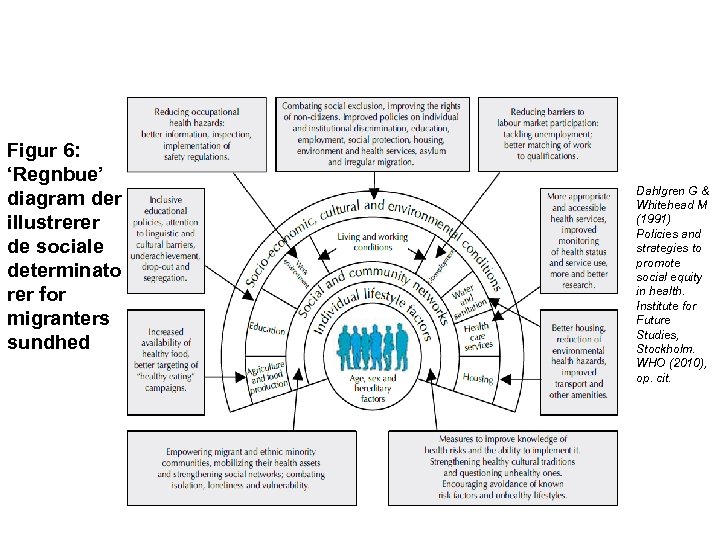 Figur 6: ‘Regnbue’ diagram der illustrerer de sociale determinato rer for migranters sundhed Dahlgren G & Whitehead M (1991) Policies and strategies to promote social equity in health. Institute for Future Studies, Stockholm. WHO (2010), op. cit.
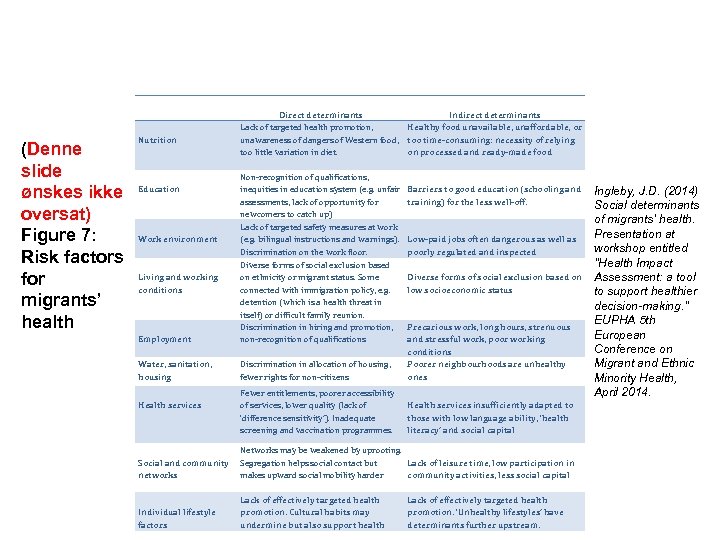 (Denne slide ønskes ikke oversat) Figure 7: Risk factors for migrants’ health Nutrition Direct determinants Indirect determinants Lack of targeted health promotion, Healthy food unavailable, unaffordable, or unawareness of dangers of Western food, too time-consuming: necessity of relying too little variation in diet. on processed and ready-made food Employment Non-recognition of qualifications, inequities in education system (e. g. unfair assessments, lack of opportunity for newcomers to catch up) Lack of targeted safety measures at work (e. g. bilingual instructions and warnings). Discrimination on the work floor. Diverse forms of social exclusion based on ethnicity or migrant status. Some connected with immigration policy, e. g. detention (which is a health threat in itself) or difficult family reunion. Discrimination in hiring and promotion, non-recognition of qualifications Water, sanitation, housing Discrimination in allocation of housing, fewer rights for non-citizens Precarious work, long hours, strenuous and stressful work, poor working conditions Poorer neighbourhoods are unhealthy ones Fewer entitlements, poorer accessibility of services, lower quality (lack of ‘difference sensitivity’). Inadequate screening and vaccination programmes. Health services insufficiently adapted to those with low language ability, ‘health literacy’ and social capital Education Work environment Living and working conditions Health services Barriers to good education (schooling and training) for the less well-off. Low-paid jobs often dangerous as well as poorly regulated and inspected Diverse forms of social exclusion based on low socioeconomic status Social and community networks Networks may be weakened by uprooting. Segregation helps social contact but Lack of leisure time, low participation in makes upward social mobility harder community activities, less social capital Individual lifestyle factors Lack of effectively targeted health promotion. Cultural habits may undermine but also support health Lack of effectively targeted health promotion. ‘Unhealthy lifestyles’ have determinants further upstream. Ingleby, J. D. (2014) Social determinants of migrants' health. Presentation at workshop entitled "Health Impact Assessment: a tool to support healthier decision-making. " EUPHA 5 th European Conference on Migrant and Ethnic Minority Health, April 2014.
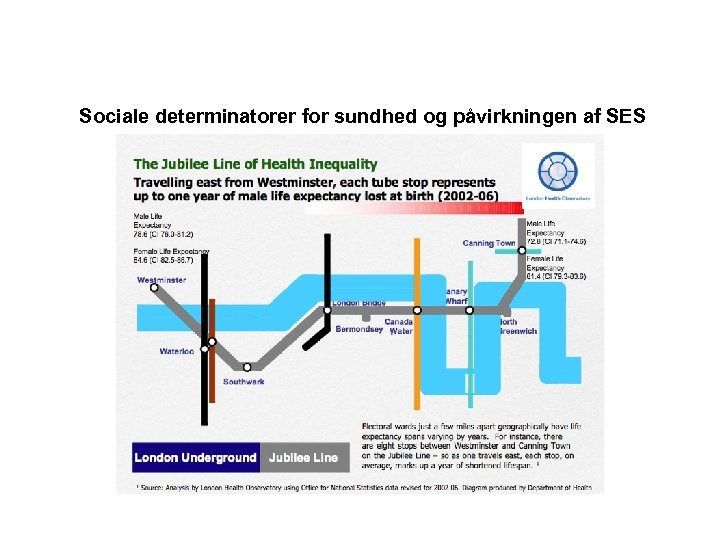 Sociale determinatorer for sundhed og påvirkningen af SES
 WHO Europe: • “adgang til beskæftigelse er et vigtigt aspekt i den sociale og økonomiske inklusion. Fattigdomsniveauet er højere blandt de arbejdsløse og andre ikke-erhvervsaktive medlemmer af samfundet (…) • Arbejdsløshedstallene varierer fra land til land, men der er indikation for at lønindkomsten er lavere blandt migrantgrupper, særligt blandt illegale migranter (. . . ) • Arbejdsaktive mennesker, hvis indkomst er mindre end 60% af den nationale median er i større risiko for fattigdomsassocierede følgevirkninger (…) • Nogle migrantgrupper har særlig risiko for fattigdom (…) migranter i en illegal situation, asylansøgere, enlige migrantfamiler, særlig blandt enlige kvinder, dem der er traumatiseret eller tortureret under immigrationsprocessen, og Poverty and social exclusion in the WHO European Region: health systems respond. Copenhagen, WHO Regional Office for som er ofre for menneskehandel” Europe, 2010.
 • Sundhedsrisici korrelerer med migrantbaggrund og sociale forhold blandt etniske minoriteter: üfattigdom relateret til social eksklusion; ümangel på passende bolig/indkvartering; üdårlig kost; üLavt indkomstniveau associeret til lav uddannelse eller til beskæftigelse, der ikke står mål med uddannelsesniveau • Nogle af disse faktorer deler gruppen med andre grupper, der berøres af fattigdom + faktorer specifikt forbundet med migrationsprocessen og betingelser omkring etniske minoriteter, så som barrierer i adgangen til sundhedsydelser og diskrimination og racisme
 Behov og hyppige typer af helbredsproblemer blandt migranter • Få generaliseringer (afhængig af sundhedsproblem, oprindelsesland og værtsland, køn og alder, årsag til migration, juridisk status og SES. • “Healthy migrant effect” påvirket af faktorer før og under migrationsprocessen. • Negative virkninger af migrationen når man sammenligner sundhedstilstanden mellem migranter og værtslandenes befolkninger • Dødelighedsrater er underestimerede (tendens til at vende tilbage til deres hjemland i en høj alder). Dødsårsager er oversimplificerede
 Ikke-smitsomme sygdomme • Hjertekar sygdomme üDødelighedsrisikoen varierer i forhold til migranternes oprindelsesland üKomplekst samspil mellem faktorer, der kan ligge til grund for den højere risiko for CVD blandt visse migranter og minoritets grupper • Diabetes üAlder-standardiseret forekomt af diabetes er højere blandt migrantgrupper uafhængig af migranternes oprindelsesland • Kræft üRisikoen for kræft synes at være lavere blandt migrant grupper üScreeningsprogrammer spiller en vigtig rolle i påvisningen og den tidlige behandling üDer er få data
 Smitsomme sygdomme • Implementeringen af screeningsprogrammer varierer og praksis er forskellig fra land til land • HIV üVisse migrantgrupper har en højere risiko for HIV-smitte. Dette kan være forbundet med udbredelsen af HIV i oprindelseslandene, men infektionerne kan også hænge sammen med værtslandet • Tuberkulose üTB notifikationsrate er højere blandt udenlandsk fødte end hos de indfødte i Europe • Andre infektionssygdomme üHøjere risiko for hepatitis B, malaria og Chagas. üEUs fokus på vaccination har svært ved at nå grupperne
 Mental sundhed • Depression og angst ü Social disadvantage and lavere SES er forbundet ü Oplevet diskrimination eller racisme kan øge forekomsten af almindelige psykiske lidelser • Skizofreni og beslægtede psykotiske lidelser ü Samlende prævalens er lav (omkring 1%), men højere niveau er fundet blandt nogle migrantgrupper • Post-traumatisk stress disorder (PTSD) og psykiske problemer blandt flygtninge ü Psykiske problemer blandt flygtninge er ikke udelukkende et spørgsmål om post-traumatisk stress reaktioner. Bevæggrunden skyldes måske ikke forhold i oprindelseslandet, men i de oplevelser, som migranten har været igennem under rejsen og asylansøgningsprocessen
 Mødre og børns sundhed • Højere risiko for mødredødelighed, lav fødselsvægt, for tidlig fødsel, perinatal dødelighed samt sygelighed og medfødte misdannelser • De obstetriske komplikationer forbundet med FGM giver udfordringer for de sundhedsprofessionelle Arbejdsmiljø, sundhed og sikkerhed • • MEM er udsat for øget sundhedsrisiko ved at arbejde i “ 3 D jobs” Højere forekomst af overtidsarbejde og dermed risici for ulykker og dårligt helbred blandt migrantarbejdere Urapporterede og ubehandlede arbejdsrelaterede sygdomme Sprogrelaterede barrierer for kommunikation og uddannelse i arbejdsmiljø, sundhed og sikkerhed
 (Dette slide ønskes ikke oversat) Needs and frequent types of health problems of ethnic mino • Roma in Europe suffer significant health inequalities when compared to the majority non-Roma population. • Roma are estimated to live approx. 10 years less than non-Roma • Social and environmental determinants: lower income, poor living conditions, discrimination and racism, and barriers to accessing health services. • Research on other national ethnic minorities is limited. Sami population (Norway, Finland Sweden) reported to be in worse health specially Sami women. They experience discrimination and language barriers when accessing to health services
 • (Dette slide ønskes ikke oversat) Non-communicable diseases ü Higher prevalence of cardiovascular disease, diabetes and obesity üRoma women experience higher prevalence of some of these health problems than Roma men üInfluence of lifestyle related factors (smoking, limited physical activity and inadequate diet) • Communicable diseases and Mental health üNegative impact of low SES, discrimination, racism, poverty, and marginalisation; higher rates of certain communicable diseases
 Tak for jeres opmærksomhed. Spørgsmål… Pictures: Andalusian Childhood Observatory (OIA, Observatorio de la Infancia de Andalucía) 2014; Josefa Marín Vega 2014; Red. Isir 2014; Morguefile 2014.
 Referencer Ingleby D. Ethnicity, Migration and the ‘Social Determinants of Health’ Agenda. Psychosocial Intervention 2012; 21(3): 331 -341. Marmot M, Allan J, Bell R, Bloomer E, Goldblatt P, on behalf of the Consortium for the European Review of Social Determinants of Health and the Health Divide. WHO European review of social determinants of health and the health divide. Lancet 2012; 380(15): 1011 -1029. ECDC (2014) Assessing the burden of key infectious diseases affecting migrant populations in the EU/EEA. European Centre for Disease Prevention and Control. Roma Health Report. European Commission, Health and Consumers. http: //ec. europa. eu/chafea/documents/health/roma-health-report-2014_en. pdf (accessed 25 th November, 2014). Newland, K. (2009). Circular Migration and Human Development, Human development research paper 2209/42, UNDP Vertovec, S. (2010). Towards post-multiculturalism? Changing communities, conditions and contexts of diversity. International Social Science Journal, 61: 83– 95. IOM (2008) World migration 2008, Managing labour mobility in the evolving global economy. Geneva, IOM. UNHCR (2014), Asylum Trends 2013. Levels and Trends in Industrialized Countries. New York: United Nations High Commissioner for Refugees. Gushulak B, Pace P, Weekers J (2010). Migration and health of migrants. In: Poverty and social exclusion in the WHO European Region: health systems respond. Copenhagen, WHO Regional Office for Europe. http: //picum. org/en/our-work/who-are-undocumented-migrants/ Düvell F (2009). Irregular migration in northern Europe: overview and comparison. Oxford, University of Oxford Centre on Migration, Policy and Society Flanders, O. A. (2011). Immigration to EU Member States down by 6% and emigration up by 13% in 2008. Eurostat, available at http: //bit. ly/1 t. Rs. WGm Kouta, C. , Kaite, C. (2012). Health issues among female migrant domestic workers. In: Ingleby, D. , et al (eds). Health inequalities and risk factors among migrants and ethnic minorities, Vol. 1. COST Series on Health and Diversity. Antwerp: Garant Publishers. Yamamoto, D. H. (2013). Health Care Costs – From Birth to Death. Schaumburg, Illinois: Society of Actuaries. Sjölander, P. (2009). What is known about the health and living conditions of the indigenous people of northern Scandinavia, the Sami? Global health Action 4. Agudelo-Suárez, A. A. , Ronda-Pérez, E. & Benavides, F. G. (2011). Occupational health. In: Rechel et al. , op cit. , 155168. Voko, Z. et al. (2009) Does socioeconomic status fully mediate the effect of ethnicity on the health of Roma people in
 Referencer Eurofound (2013). Impacts of the crisis on access to healthcare services in the EU, Dublin. Gushulak B, Pace P, Weekers J (2010). Migration and health of migrants. In: Poverty and social exclusion in the WHO European Region: health systems respond. Copenhagen, WHO Regional Office for Europe. Gimeno-Feliu LA, Calderon-Larranaga A, Diaz E, Poblador-Plou B, Macipe-Costa R, Prados-Torres A. The healthy migrant effect in primary care. Gac Sanit. 2014. Reeske, A. and Spallek, J. (2012) Obesity among migrant children and adolescents: a life-course perspective on obesity development. In: Ingleby, D. , Krasnik, A. , Lorant, V. & Razum, O. (Eds. ) Health inequalities and risk factors among migrants and ethnic minorities. COST Series on Health and Diversity, Volume I (pp. 237 -256). Antwerp/Apeldoorn: Garant Jack, R. H. , Davies, E. A. & 1 Møller, H. (2011) Lung cancer incidence and survival in different ethnic groups in South East England. British Journal of Cancer 105, 1049– 1053. Singh, S. P. and Burns, T. (2006) Race and mental health: there is more to race than racism. British Medical Journal, 333(7569): 648– 651. CSDH (2008). Closing the gap in a generation: health equity through action on the social determinants of health. Final report of the Commission on the Social Determinants of Health. Geneva, World Health Organization Dahlgren G & Whitehead M (1991) Policies and strategies to promote social equity in health. Institute for Future Studies, Stockholm. Ingleby, J. D. (2014) Social determinants of migrants' health. Presentation at workshop entitled "Health Impact Assessment: a tool to support healthier decision-making. " EUPHA 5 th European Conference on Migrant and Ethnic Minority Health, April 2014 Sainsbury, D. (2012) Welfare States and Immigrant Rights: The Politics of Inclusion and Exclusion. Oxford: Oxford University Press. Centre for Maternal and Child Enquiries (2011). Saving Mothers’ Lives: Reviewing deaths to make motherhood safer: 2006– 2008. BJOG, 118(s 1): 1– 203. Migrant and Ethnic Health Observatory (MEHO). Website: http: //www. meho. eu. com/ (temporarily unavailable) Vandenheede, H. et al. (2012). Migrant mortality from diabetes mellitus across Europe: the importance of socioeconomic change. European Journal of Epidemiology 27, 109– 117. Devillé W et al. (2006). Perceived health and consultation of GPs among ethnic minorities compared to the general population in the Netherlands. In: Westert GP, Jabaaij L, François G, eds. Morbidity, performance and quality in primary care. Oxford, Radcliffe Publishing Ltd: 85– 96. Kunst, A. , Stronks, K. and Agyemang, C. (2011) Non-communicable diseases. In: Rechel et al. (2011), op. cit. , 101120; Carballo. M. (2009 a). Non-communicable diseases. In: Fernandes, A. , Pereira Miguel, J. , eds. (2009). Health and
 Referencer Bhopal RS, Rafnsson SB, Agyemang C, et al. (2011). Mortality from circulatory diseases by specific country of birth across six European countries: test of concept. Eur J Public Health 22: 353 -9. Rafnsson, S. B. , Bhopal, R. S. , Agyemang, C. , Fagot-Campagna, A. , Harding, S. , Hammar, N. , Kunst, A. E. et al. (2013). Sizable variations in circulatory disease mortality by region and country of birth in six European countries. Eur J Public Health, 23 (4) 594 - 605. Vandenheede, H. et al. (2012). Migrant mortality from diabetes mellitus across Europe: the importance of socioeconomic change. European Journal of Epidemiology 27, 109– 117. Nørredam, M. , Nielsen, S. and Krasnik, A. (2010). Migrants’ utilization of somatic healthcare services in Europe – a systematic review. European Journal of Public Health, 20(5): 555– 63. Berens, E-M, Spallek, J. and Razum, O, (2012). Breast cancer screening among immigrant women: do we need specific approaches in risk communication? In Ingleby, D. , Krasnik, A. , Lorant, V. & Razum, O. (Eds. ) Health inequalities and risk factors among migrants and ethnic minorities. COST Series on Health and Diversity, Volume I (pp. 304 -318). Antwerp/Apeldoorn: Garant. Bateman-House, A. , Fairchild, A. (2008). Medical Examination of Immigrants at Ellis Island. Virtual Mentor 10(4), 235241. Kärki T, Napoli C, Riccardo F, Fabiani M, Dente MG, Carballo M, Noori T, Declich S. Screening for Infectious Diseases among Newly Arrived Migrants in EU/EEA Countries-Varying Practices but Consensus on the Utility of Screening. Int J Environ Res Public Health. 2014 Oct 21; 11(10): 11004 -14. available at http: //www. ncbi. nlm. nih. gov/pmc/articles/PMC 4211019/ (retrieved Janueary 23, 2015) Kärki T, Napoli C, Riccardo F, Fabiani M, Dente MG, Carballo M, Noori T, Declich S. Screening for Infectious Diseases among Newly Arrived Migrants in EU/EEA Countries-Varying Practices but Consensus on the Utility of Screening. Int J Environ Res Public Health. 2014 Oct 21; 11(10): 11004 -14. http: //www. ncbi. nlm. nih. gov/pmc/articles/PMC 4211019/ F. Riccardo, M. G. Dente, M. Kojouharova, M. Fabiani, V. Alfonsi, A. Kurchatova, N. Vladimirova, S. Declich. Migrant’s access to immunization in Mediterranean Countries. Health Policy 2012; 105: 17– 24. Wörmann, T. , Krämer, A. (2011). Communicable diseases. In: Rechel, B. et al (eds. ). Migration and health in the European Union. European observatory on health systems and policies. Open University Press. Bhugra, D. , Gupta, S. (eds. ) (2006). Migration and Mental Health. London and New York: Cambridge University Press Horwitz, A. V. , Wakefield, J. C. (2006). The epidemic in mental illness: clinical fact or survey artifact? Contexts, 5(1): 1923. Karlsen, S. et al. (2005). Racism, psychosis and common mental disorder among ethnic minority groups in England. Psychological Medicine, 35: 12: 1795– 1803
 Referencer Fazel, M. , Wheeler, J. , Danesh, J. (2005). Prevalence of serious mental disorder in 7000 refugees resettled in western countries: a systematic review. The Lancet, 365: 9467: 1309– 1314. Lindert, J. et al. (2009). Depression and anxiety in labor migrants and refugees – a systematic review and metaanalysis. Social Science & Medicine, 69: 2: 246– 257. Ingleby, D. (ed. ) (2005) Forced migration and mental health: rethinking the care of refugees and displaced persons. New York: Springer. Pedersen, G. S. , Grøntved, A. , Mortensen, L. H. , Andersen, A. -M. N. , Rich-Edwards, J, (2013). Maternal Mortality Among Migrants in Western Europe: A Meta-Analysis. Matern Child Health J 1– 11. Bollini, P. , Pampallona, S. , Wanner, P. , Kupelnick, B. , (2009). Pregnancy outcome of migrant women and integration policy: A systematic review of the international literature. Social Science & Medicine 68, 452– 4 Reeske, A. , Razum, O. (2011). Maternal and child health – from conception to first birthday. In Rechel et al. (2011), op. cit. , 139 -144 Villadsen, S. F. , et al (2010). Cross-country variation in stillbirth and neonatal mortality in offspring of Turkish migrants in northern European Journal of Public Health, 20(5): 530– 535. Mc. Cauley, L. A. (2005) Immigrant workers in the United States: recent trends, vulnerable populations, and challenges for occupational health. Journal of the American Association of Occupational Health Nurses, 53(7), 313– 19. Skodova, Z. et al (2010) Psychosocial factors of coronary heart disease and quality of life among Roma coronary patients: a study matched by socioeconomic position. International Journal of Public Health; 55(5): 373 -80 Monteiro, A. P. et al (2013) Promotion of mental health in Roma people: social representations of mental health and wellbeing in a Roma community. European Psychiatry: Abstracts of the 21 th European Congress of Psychiatry. Smith, D. , Ruston, A. (2013) 'If you feel that nobody wants you'll withdraw into your own’: Gypsies/Travellers, networks and healthcare utilisation. Sociology of Health and Illness, Vol. 35; 8: 1196 -1210. Casals, M. et al (2011) Incidence of infectious diseases and survival among Roma population: a longitudinal cohort study. The European Journal of Public Health, 1 -6. Kallayova, D. , Bosak, L. (2012). Improvements of health services for Roma communities in Slovakia. In: Ingleby, D. et al (eds. ) Inequalities in Health Care for Migrants and Ethnic Minorities. COST Series on Health and Diversity. Antwerpen: Garant Publishers. Rechel, B. et al (2009). Access to health care for Roma children in Central and Eastern Europe: findings from a qualitative study in Bulgaria. International Journal for Equity in Health, 8: 24.
 Referencer Hansen, K. , Melhus, M. , Lund, E. (2010). Ethnicity, self-reported health, discrimination and socioeconomic status: a study of Sami and non-Sami Norwegian populations. International Journal of Circumpolar Health, North America, 69. Zeljko, H. M. et al (2013) Age trends in prevalence of cardiovascular risk factors in Roma minority population of Croatia. Economics and Human Biology 11: 326 -336. Qureshi A, Collazos F, Sobradiel N, Eiroa-Orosa FJ, Febrel M, Revollo-Escudero HW, et al. Epidemiology of psychiatric morbidity among migrants compared to native born population in Spain: a controlled study. Gen Hosp Psychiatry. 2013; 35(1): 93 -9. Razum O. Commentary: of salmon and time travellers--musing on the mystery of migrant mortality. Int J Epidemiol. 2006; 35(4): 919 -21. Razum O, Zeeb H, Akgun HS, Yilmaz S. Low overall mortality of Turkish residents in Germany persists and extends into a second generation: merely a healthy migrant effect? Trop Med Int Health. 1998; 3(4): 297 -303. Norredam M, Olsbjerg M, Petersen JH, Juel K, Krasnik A. Inequalities in mortality among refugees and immigrants compared to native Danes--a historical prospective cohort study. BMC Public Health. 2012; 12: 757. Boulogne R, Jougla E, Breem Y, Kunst AE, Rey G. Mortality differences between the foreign-born and locally-born population in France (2004 -2007). Soc Sci Med. 2012; 74(8): 1213 -23. Salway, S. , et al (2011). Contributions and challenges of cross-national comparative research in migration, ethnicity and health: insights from a study of maternity experiences and outcomes. BMC Public Health, 11: 514. The lancet Commission Culture and Health (2014) Lancet 2014; 384: 1607– 39 available at http: //dx. doi. org/10. 1016/S 0140 -6736(14)61603 -2 (retrieved December 19, 2015) Kallayova, D. , Bosak, L. (2012) Improvement of health services for Roma communities in Slovakia. In: Ingleby, D. et al (eds. ) Inequalities in Health Care for Migrants and Ethnic Minorities. COST Series on Health and Diversity. Antwerpen: Garant Publishers. OSF, 2010. No Data—No Progress. Country Findings. Data Collection in Countries Participating in the Decade of Roma Inclusion, 2005– 2015. Dinca, I. (2011) Vaccine preventable diseases and the Roma. European Centre for Disease Prevention and Control. Muscat, MD (2011). Who Gets Measles in Europe? . The Journal of Infectious Diseases 2011; 204: S 353–S 36 Orlikova H, Rogalska J, Kazanowska-Zielinska E, Jankowski T, Slodzinski J, Kess B, Stefanoff P. Spotlight on measles 2010: A measles outbreak in a Roma population in Pulawy, eastern Poland, June to August 2009. Euro Surveill. 2010; 15(17): pii=19550. Hellenic Center for Disease Control and Prevention (2014) Mellou K, et al. (2015) Considerations on the Current Universal Vaccination Policy against Hepatitis A in Greece after Recent Out-breaks. PLo. S ONE 10(1): e 0116939. doi: 10. 1371/journal. pone. 0116939.