 Скачать презентацию Modernity and Heritage Babbitt Sinclair Lewis
a99865fa2eb353be9fd048591766fec5.ppt
- Количество слайдов: 17



Modernity and Heritage
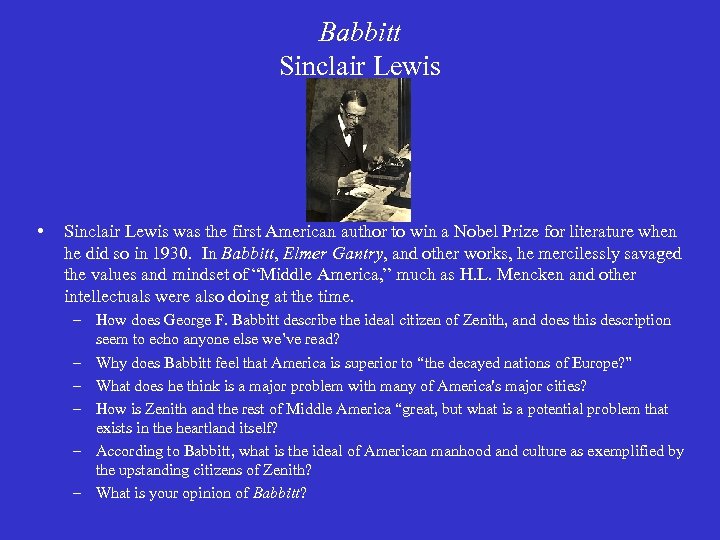
Babbitt Sinclair Lewis • Sinclair Lewis was the first American author to win a Nobel Prize for literature when he did so in 1930. In Babbitt, Elmer Gantry, and other works, he mercilessly savaged the values and mindset of “Middle America, ” much as H. L. Mencken and other intellectuals were also doing at the time. – How does George F. Babbitt describe the ideal citizen of Zenith, and does this description seem to echo anyone else we’ve read? – Why does Babbitt feel that America is superior to “the decayed nations of Europe? ” – What does he think is a major problem with many of America's major cities? – How is Zenith and the rest of Middle America “great, but what is a potential problem that exists in the heartland itself? – According to Babbitt, what is the ideal of American manhood and culture as exemplified by the upstanding citizens of Zenith? – What is your opinion of Babbitt?
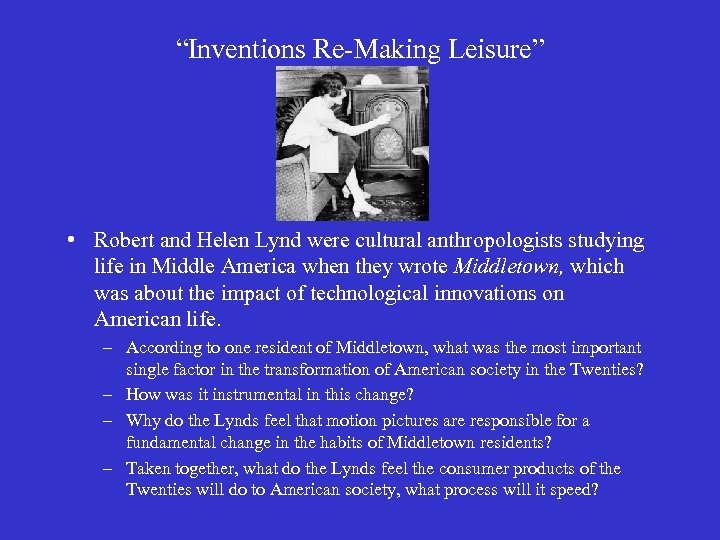
“Inventions Re-Making Leisure” • Robert and Helen Lynd were cultural anthropologists studying life in Middle America when they wrote Middletown, which was about the impact of technological innovations on American life. – According to one resident of Middletown, what was the most important single factor in the transformation of American society in the Twenties? – How was it instrumental in this change? – Why do the Lynds feel that motion pictures are responsible for a fundamental change in the habits of Middletown residents? – Taken together, what do the Lynds feel the consumer products of the Twenties will do to American society, what process will it speed?
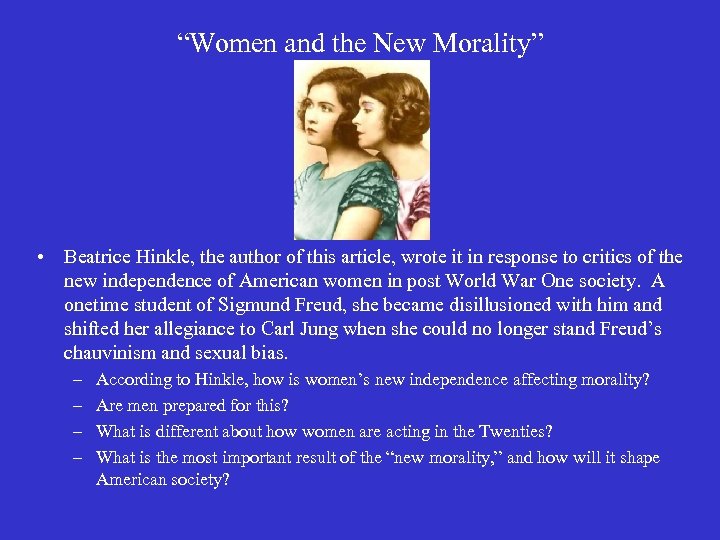
“Women and the New Morality” • Beatrice Hinkle, the author of this article, wrote it in response to critics of the new independence of American women in post World War One society. A onetime student of Sigmund Freud, she became disillusioned with him and shifted her allegiance to Carl Jung when she could no longer stand Freud’s chauvinism and sexual bias. – – According to Hinkle, how is women’s new independence affecting morality? Are men prepared for this? What is different about how women are acting in the Twenties? What is the most important result of the “new morality, ” and how will it shape American society?
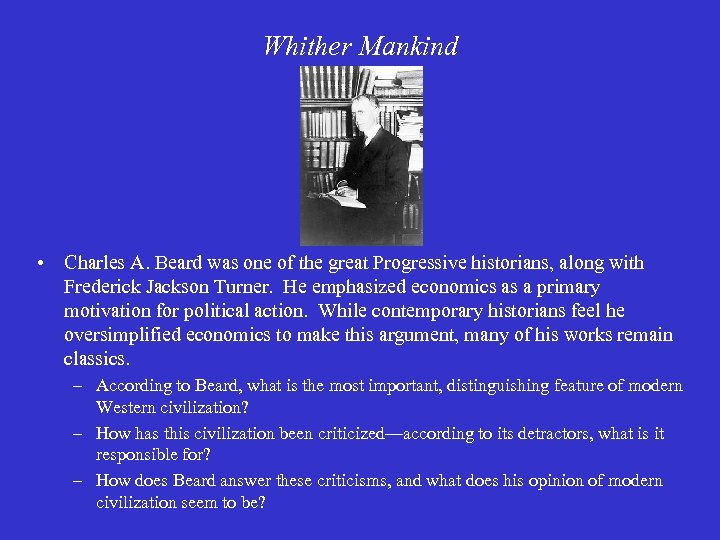
Whither Mankind • Charles A. Beard was one of the great Progressive historians, along with Frederick Jackson Turner. He emphasized economics as a primary motivation for political action. While contemporary historians feel he oversimplified economics to make this argument, many of his works remain classics. – According to Beard, what is the most important, distinguishing feature of modern Western civilization? – How has this civilization been criticized—according to its detractors, what is it responsible for? – How does Beard answer these criticisms, and what does his opinion of modern civilization seem to be?
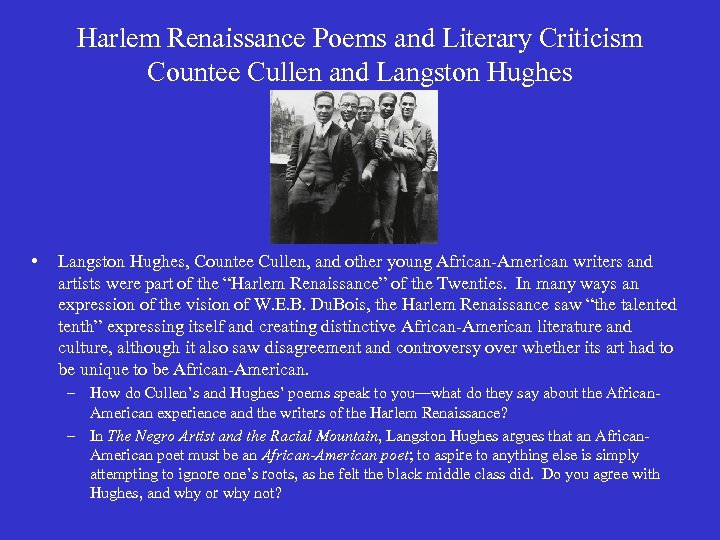
Harlem Renaissance Poems and Literary Criticism Countee Cullen and Langston Hughes • Langston Hughes, Countee Cullen, and other young African-American writers and artists were part of the “Harlem Renaissance” of the Twenties. In many ways an expression of the vision of W. E. B. Du. Bois, the Harlem Renaissance saw “the talented tenth” expressing itself and creating distinctive African-American literature and culture, although it also saw disagreement and controversy over whether its art had to be unique to be African-American. – How do Cullen’s and Hughes’ poems speak to you—what do they say about the African. American experience and the writers of the Harlem Renaissance? – In The Negro Artist and the Racial Mountain, Langston Hughes argues that an African. American poet must be an African-American poet; to aspire to anything else is simply attempting to ignore one’s roots, as he felt the black middle class did. Do you agree with Hughes, and why or why not?
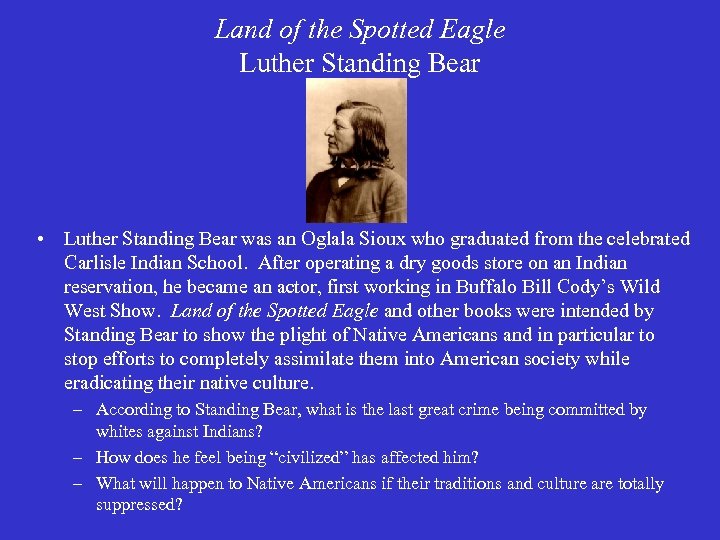
Land of the Spotted Eagle Luther Standing Bear • Luther Standing Bear was an Oglala Sioux who graduated from the celebrated Carlisle Indian School. After operating a dry goods store on an Indian reservation, he became an actor, first working in Buffalo Bill Cody’s Wild West Show. Land of the Spotted Eagle and other books were intended by Standing Bear to show the plight of Native Americans and in particular to stop efforts to completely assimilate them into American society while eradicating their native culture. – According to Standing Bear, what is the last great crime being committed by whites against Indians? – How does he feel being “civilized” has affected him? – What will happen to Native Americans if their traditions and culture are totally suppressed?
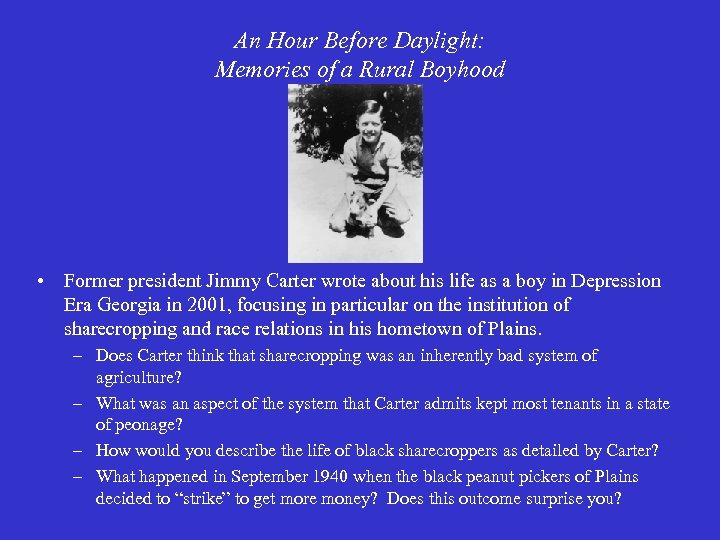
An Hour Before Daylight: Memories of a Rural Boyhood • Former president Jimmy Carter wrote about his life as a boy in Depression Era Georgia in 2001, focusing in particular on the institution of sharecropping and race relations in his hometown of Plains. – Does Carter think that sharecropping was an inherently bad system of agriculture? – What was an aspect of the system that Carter admits kept most tenants in a state of peonage? – How would you describe the life of black sharecroppers as detailed by Carter? – What happened in September 1940 when the black peanut pickers of Plains decided to “strike” to get more money? Does this outcome surprise you?
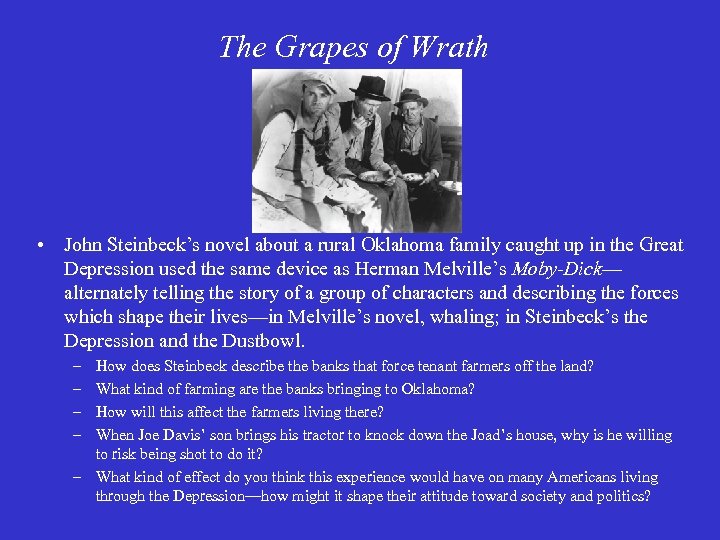
The Grapes of Wrath • John Steinbeck’s novel about a rural Oklahoma family caught up in the Great Depression used the same device as Herman Melville’s Moby-Dick— alternately telling the story of a group of characters and describing the forces which shape their lives—in Melville’s novel, whaling; in Steinbeck’s the Depression and the Dustbowl. – – How does Steinbeck describe the banks that force tenant farmers off the land? What kind of farming are the banks bringing to Oklahoma? How will this affect the farmers living there? When Joe Davis’ son brings his tractor to knock down the Joad’s house, why is he willing to risk being shot to do it? – What kind of effect do you think this experience would have on many Americans living through the Depression—how might it shape their attitude toward society and politics?
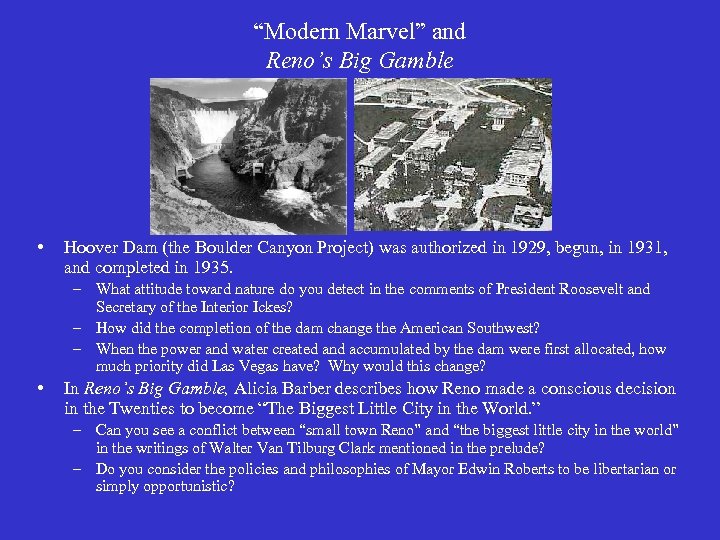
“Modern Marvel” and Reno’s Big Gamble • Hoover Dam (the Boulder Canyon Project) was authorized in 1929, begun, in 1931, and completed in 1935. – What attitude toward nature do you detect in the comments of President Roosevelt and Secretary of the Interior Ickes? – How did the completion of the dam change the American Southwest? – When the power and water created and accumulated by the dam were first allocated, how much priority did Las Vegas have? Why would this change? • In Reno’s Big Gamble, Alicia Barber describes how Reno made a conscious decision in the Twenties to become “The Biggest Little City in the World. ” – Can you see a conflict between “small town Reno” and “the biggest little city in the world” in the writings of Walter Van Tilburg Clark mentioned in the prelude? – Do you consider the policies and philosophies of Mayor Edwin Roberts to be libertarian or simply opportunistic?
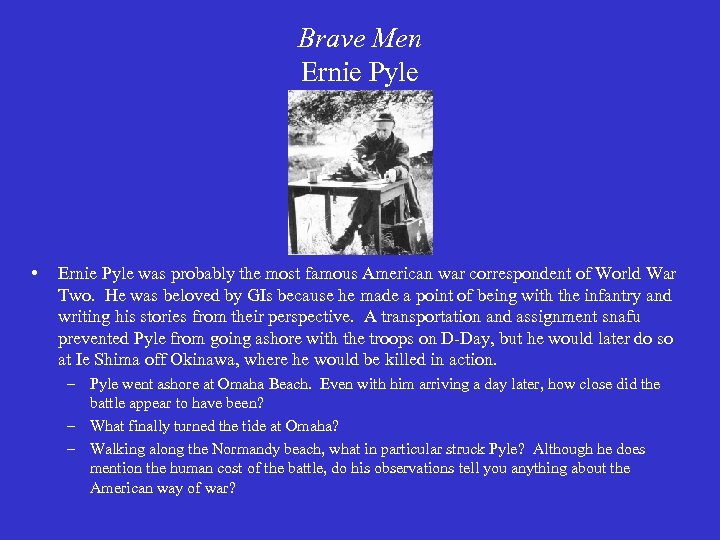
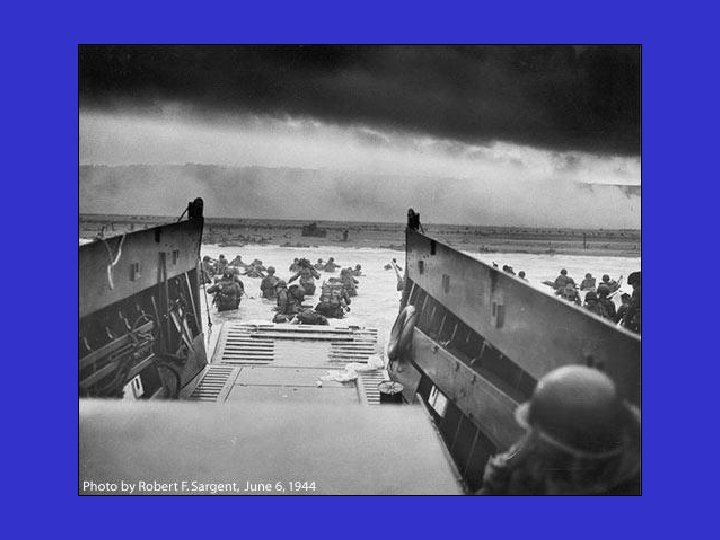
Brave Men Ernie Pyle • Ernie Pyle was probably the most famous American war correspondent of World War Two. He was beloved by GIs because he made a point of being with the infantry and writing his stories from their perspective. A transportation and assignment snafu prevented Pyle from going ashore with the troops on D-Day, but he would later do so at Ie Shima off Okinawa, where he would be killed in action. – Pyle went ashore at Omaha Beach. Even with him arriving a day later, how close did the battle appear to have been? – What finally turned the tide at Omaha? – Walking along the Normandy beach, what in particular struck Pyle? Although he does mention the human cost of the battle, do his observations tell you anything about the American way of war?
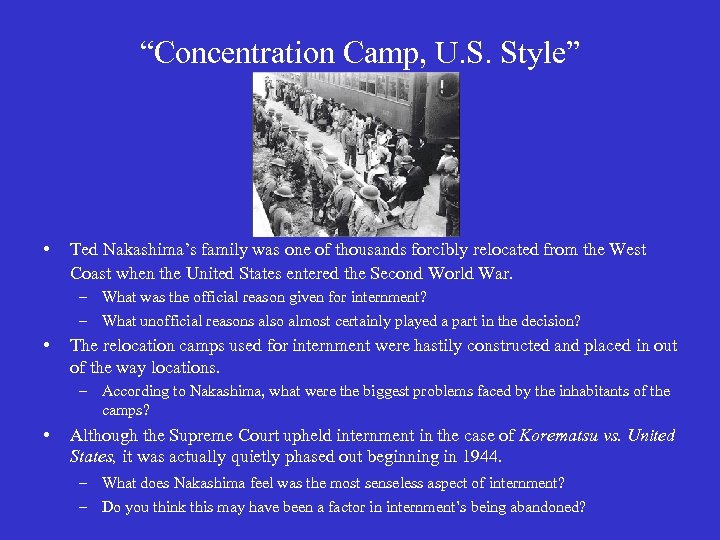
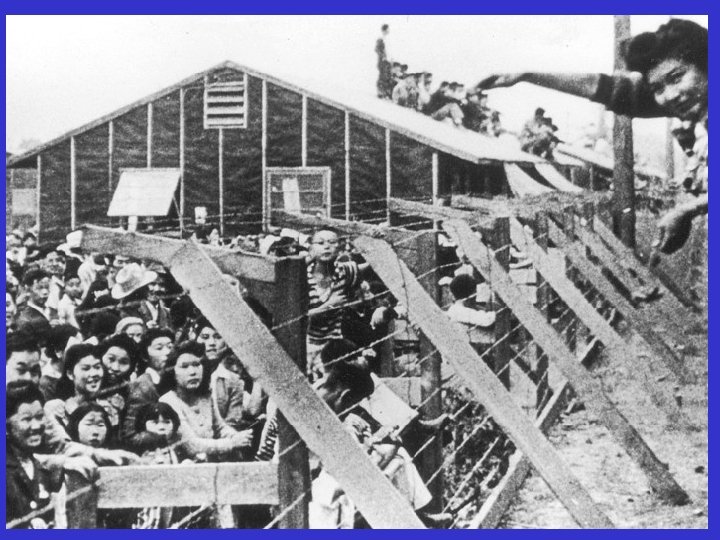
“Concentration Camp, U. S. Style” • Ted Nakashima’s family was one of thousands forcibly relocated from the West Coast when the United States entered the Second World War. – What was the official reason given for internment? – What unofficial reasons also almost certainly played a part in the decision? • The relocation camps used for internment were hastily constructed and placed in out of the way locations. – According to Nakashima, what were the biggest problems faced by the inhabitants of the camps? • Although the Supreme Court upheld internment in the case of Korematsu vs. United States, it was actually quietly phased out beginning in 1944. – What does Nakashima feel was the most senseless aspect of internment? – Do you think this may have been a factor in internment’s being abandoned?
• Supreme Court Justice Hugo Black’s opinion for the majority in Korematsu vs. United States: – “Korematsu was not excluded from the Military Area because of hostility to him or his race. He was excluded because we are at war with the Japanese Empire, because the properly constituted military authorities feared an invasion of our West Coast and felt constrained to take proper security measures, because they decided that the military urgency of the situation demanded that all citizens of Japanese ancestry be segregated from the West Coast temporarily, and, finally, because Congress, reposing its confidence in this time of war in our military leaders — as inevitably it must — determined that they should have the power to do just this. ” • Justice Frank Murphy’s dissent from the majority decision in Korematsu vs. United States: – “I dissent, therefore, from this legalization of racism. Racial discrimination in any form and in any degree has no justifiable part whatever in our democratic way of life. It is unattractive in any setting, but it is utterly revolting among a free people who have embraced the principles set forth in the Constitution of the United States. All residents of this nation are kin in some way by blood or culture to a foreign land. Yet they are primarily and necessarily a part of the new and distinct civilization of the United States. They must, accordingly, be treated at all times as heirs of the American experiment, and as entitled to all the rights and freedoms guaranteed by the Constitution. ”
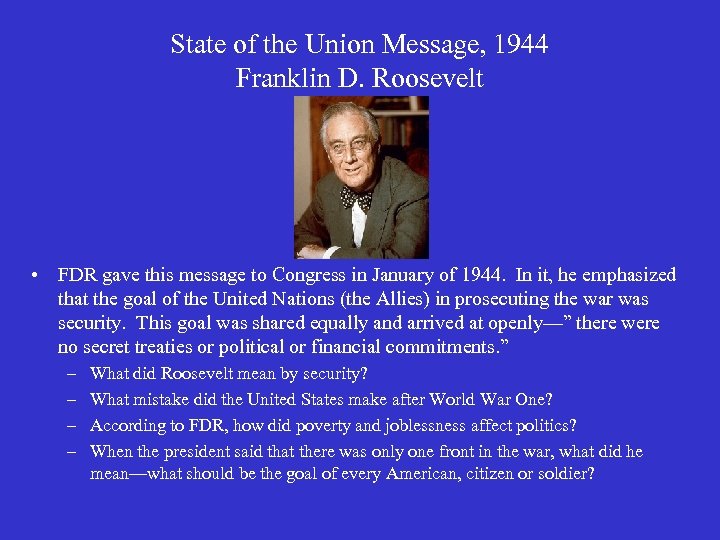
State of the Union Message, 1944 Franklin D. Roosevelt • FDR gave this message to Congress in January of 1944. In it, he emphasized that the goal of the United Nations (the Allies) in prosecuting the war was security. This goal was shared equally and arrived at openly—” there were no secret treaties or political or financial commitments. ” – – What did Roosevelt mean by security? What mistake did the United States make after World War One? According to FDR, how did poverty and joblessness affect politics? When the president said that there was only one front in the war, what did he mean—what should be the goal of every American, citizen or soldier?
Next Class • Topic: Conformity, Protest, Identity Politics I • Read: 500 Yrs 309 -347, S & S 101 -113
Скачать презентацию Modernity and Heritage Babbitt Sinclair Lewis
a99865fa2eb353be9fd048591766fec5.ppt